The twentieth century as a whole, and particularly the three decades after World War II, witnessed steady growth in government size and responsibility. States developed extensive social safety nets, actively managed aggregate demand, and regulated a widening swath of economic and social life. This trajectory of expansion was linked to powerful forces of economic development and demographic change, and anchored in a broad political consensus.1
The 1980s and 1990s saw a sea change in the rate of public-sector growth. British Prime Minister Margaret Thatcher and U.S. President Ronald Reagan led the way with privatization, outsourcing, and load shedding of public responsibilities. But the shift in direction was not limited to radicals on the right. Country reports to the Public Management Committee (PUMA) of the Organization for Economic Cooperation and Development (OECD)—itself an outspoken advocate of downsizing—point to widespread efforts to reduce the public sector. In 1995, for example, Denmark commercialized its railways and gave business autonomy to its postal service; Finland diminished the size of its Forestry Administration; France suppressed 7,400 public-sector jobs; Greece froze new government appointments; Norway promoted competition between public agencies and private firms; Spain decentralized core government functions; and Sweden reduced public-sector employment by 62,000.2
OECD 1995. The Public Management Committee was renamed the Public Governance Committee in 2004.
During the same period, discourse on the appropriate size, role, and functioning of government underwent an even sharper transformation. On the left, O'Connor and Offe depicted state growth as driven by contradictory demands for accumulation and legitimation that were ultimately unsustainable.3
But radical critiques were soon drowned out by conservative ones. Neoliberals advocated limiting government and importing market mechanisms into the public arena. Proponents of the “New Public Management” argued for lean public agencies that would be responsive to citizen customers. A consensus on shrinking government seemed to have replaced a consensus on growing it.Figure 1 gives public-sector employment as a percentage of the working-age population from 1965 to 1994 across OECD member states.4
Data collected by Thomas Cusack from OECD and other sources; see Cusack, Notemans, and Rein 1989. Analyses reported below employ a parallel data series covering the period 1980–97. Figure 1 displays Cusack's data series to provide a sense of the broader trajectory.
A similar pattern appears in the corporate world, where a reform movement centered around downsizing is even more palpable. Baumol, Blinder, and Wolff 2003 show that downsizing in major corporations is on average counterbalanced by upsizing, with many of the largest workforce reductions followed by subsequent growth.

Public-sector employment in OECD member nations, 1964–94
But Figure 1 also shows the slackening pace of public-sector growth. Annual increases of about 4.5 percent in the 1960s and 1970s were reduced to increases of a little more than 1 percent in the 1980s, and less than 1 percent in the 1990s. Growth steadily decelerates with no identifiable inflection point. In 1994, net change in the size of the public sector across OECD countries turned negative for the first time.
Considerable heterogeneity in national experiences underlies the aggregate trend. Great Britain's reduction of more than 30 percent of its public-sector workforce was the most dramatic, while New Zealand and Sweden also conducted large-scale downsizing. By contrast, a number of governments increased sharply in size. The fastest growers were developing states with small public sectors in 1980; public employment per capita more than doubled in Greece, and rose some 75 percent in Portugal. But growth was not restricted to cases of late development; the relative size of government also expanded in countries such as Norway and Austria that possessed large public sectors at the beginning of the period.
We work with this heterogeneity to model change in the size of the public sector between 1980 and 1997 across twenty-six OECD countries.6
Members of the OECD provide a good comparison set because they stand in structurally similar positions to public-sector change, and because comparative data is widely available. We do not assume that government employment change outside the OECD mirrors that within the OECD, particularly given the different cast of international and domestic forces operating in poor and middle-income countries. We return in the discussion section to speculate on the forms that policy diffusion might take outside the OECD.
Government expenditures also follow a trajectory of decelerating growth during the 1980s and 1990s and provide a second index of the size of the public sector. But expenditures are more heavily influenced by business cycle dynamics (such as automatic increases in unemployment insurance during economic slowdowns) than are measures of public-sector employment. Reductions in public employment speak directly to discussions of the relative efficiency of the public and private sectors, and the overall advantages of lean organizations, which are central to the argument we advance here.
The analytic focus in this article is on international diffusion. We ask whether there is evidence of contagious change in the size of the public sector, such that expansion and retrenchment in government employment in one country affects others. We then investigate the pattern of linkages to better specify causal mechanisms. Internal factors such as fiscal crisis, economic growth, and ruling party politics are included in all models to develop a stronger empirical test.
We approach diffusion processes from the perspective of sociological institutionalism, with a focus on the way contagion is shaped by dominant understandings of appropriate and effective behavior.8
Sociological institutionalism has mainly entered the study of international relations through the “world polity” perspective developed by Meyer and colleagues, which views the historical evolution of the state as informed by a cultural project of social rationalization and expansion of the rights and competence of the individual. See Thomas et al. 1987; and Meyer et al. 1997.
Diffusion Research Strategies and Case Study Evidence
“Process tracing” and “pattern finding” strategies can be distinguished in the study of diffusion. Process tracing research follows the spread of a policy or practice from one location to another. This approach permits inspection of the role played by external models, and inquiry into why and how a concrete instance of learning or mimicry occurs. By contrast, pattern finding research tests a priori hypotheses about diffusion channels. Rather than demonstrate that actors in country A were aware of and influenced by country B, this strategy asks whether structures of covariance and temporal ordering are generally consistent with a theoretically specified model of influence.
This article works within the pattern finding approach. Before considering what patterns to test for, however, we note two cases of civil service reform that permit explicit process tracing. Halligan's discussion of Australian policymaking and the Republic of Korea's benchmarking program provide insight into the rationales and organizational structures that support international diffusion.
Halligan argues that international policy networks provide channels for the spread of public management policies between the United States, the United Kingdom, and Australia.9
Halligan 1996.
The policies traced by Halligan all involve “managerialist” efforts to reform public administration. Most relevant for present purposes are initiatives to improve government efficiency and eliminate waste. The approach devised in 1979 by Thatcher—ninety-day investigations aimed at time, money, and staff savings, conducted by an independent Efficiency Unit—was adopted virtually wholesale by Australia in 1986. Diffusion here is more than a correlation: “the methodology [of the scrutinies] follows the basic approach of the United Kingdom Efficiency Unit established by Sir Derek Raynor…. The Unit acknowledges the assistance given by Sir Robin Ibbs, now head of the United Kingdom Unit.”10
Department of the Prime Minister and Cabinet, Annual Report 1986–87 (Canberra: Australian Government Publishing Service), 35 (cited in Halligan 1996, 300).
A Korean effort to benchmark international “best practice” in public administration provides a second opportunity to trace policy diffusion. Between 1994 and 1997, the Republic of Korea's Task Force for Reengineering Governmental Functions collected information about policies in the United Kingdom, Canada, the United States, Australia, New Zealand, Japan, and Germany. The program advocated a variety of downsizing and restructuring initiatives that contributed to sweeping organizational change. Between 1998 and 2002, public-sector employment in Korea was reduced by 20 percent and 209 projects of public entities were contracted out to the private sector.11
Republic of Korea. Ministry of Planning and Budget 2003, 53, 122. Note that the above calculation excludes nonadministrative personnel such as teachers, police officers, and security staff in the central and local governments. For discussions of Korean government reforms and the role of new public management principles, see Kim and Moon 2002; and Ha 2004.
This benchmarking program sheds valuable light on the interpretive frames that surround public-sector change. Korean policy analysts did not seek to determine the ideal size of government relative to population, nor did they study success stories involving public-sector expansion. Instead, they began with downsizing as an objective. In fact, the task force investigated eight reform areas, the first of which was “reduction of government employees”!12
Republic of Korea. Ministry of Government Administration 1997, 61–236. The eight reform areas identified by the task force were “reduction of government employees,” “restructuring government operations,” “human resource management reforms,” “budget and finance reforms,” “performance management,” “service quality and introduction of the market principle,” “information technology in government,” and “regulatory reform.”
This interpretive frame helped identify the countries and policies that benchmarkers focused on. The Korean task force paid close attention to downsizing “pioneers” such as England and New Zealand. Within these countries, benchmarkers focused on generalizable reform strategies that could be adapted to the Korean context:
Korea should take lessons from … the strong leadership for enforcing government reforms like that of Roger Douglas, New Zealand's Minister of Finance…. the argument for reducing the role of government through functional reengineering between public and private organizations as in Great Britain … cutting back to basics as a criterion for the role of government as in the USA … consensus process for reform as in Canada … the simplification of administrative procedures in Germany.13
Ibid. Translations from the Korean conducted by the first author.
The status of downsizing as a desirable reform also shaped the inferences that benchmarkers drew from apparent success and failure. For example, the coincidence of government downsizing and economic growth in Canada was treated as a straightforward instance of cause and effect. New Zealand's experience of rapid downsizing followed by continuing economic difficulty, by contrast, prompted cautions about the complexity of causal inference in the macroeconomic sphere.14
“It is not easy to observe the causal effects of downsizing or government reform in New Zealand. The central government has reduced employment more than 60 percent, from 85,278 employees in 1985 to 32,639 employees in 1996. In 1993–94, the government finally attained budgetary surplus that seems the result of government reforms. New Zealand's economy worsened right after government reforms in 1988–89, however, and then switched direction towards growth since 1992. It is difficult to clarify the effect of government reforms on the economy.” Ibid., 383–384, 404.
Policy diffusion, we should note, does not imply a world without agency. In both of the cases described above, key actors—most notably Australia's Prime Minister Bob Hawke and Korea's President Young-Sam Kim—allied themselves with foreign exemplars to achieve their policy goals.15
In Korea, for example, President Young-Sam Kim was engaged in an effort to promote market reforms and counter bureaucrats who opposed his agenda; see Baum 2002. Moon and Ingraham 1998 develop a model of administrative reform in East Asia that incorporates both internal and external factors.
These episodes provide insight into the way public policies spread internationally. Diffusion took somewhat different forms in the two cases: Australia explicitly borrowed a British organizational vehicle for promoting efficiency, while Korea drew on a wide range of national initiatives to support and reinforce a broad restructuring campaign. Substantively, however, the parallels are strong. In both cases, concrete policies “moved” because policymakers actively attended to and learned from their counterparts in other countries. Policy borrowing did not occur haphazardly but was instead informed by a common interpretive frame that linked one country's experience to another's agenda. Of the many national policies that could have served as international exemplars, both Australia and Korea focused on reform initiatives aimed at downsizing.
While providing evidence that policy diffusion is a concrete reality and not merely an academic conceit, process tracing studies have important limitations. They tell one little about the underlying network structure of influence. For example, Australia might have attended to the United Kingdom because of its colonial heritage, close economic and political ties, economic competition, or a host of other linkages; we cannot discriminate between these alternatives by knowing more about the Raynor scrutinies. Nor does process tracing provide a measure of the relative scale of international versus domestic forces; mimicry might be an omnipresent but minor ingredient in organizational decisionmaking. We thus consider how to represent diffusion processes in formal terms, and assess their significance in a quantitative analysis of government employment.
Diffusion Mechanisms Issue
Diffusion mechanisms are conceptualized here within the framework proposed in this Symposium Issue by Simmons, Dobbin, and Garrett, focusing on the roles of emulation, competition, and vicarious learning.16
This classification overlaps substantially with the others proposed in the diffusion literature. In sociology, the most influential classification scheme, from DiMaggio and Powell 1983, contrasts coercive, mimetic, and normative sources of isomorphism. Strang and Soule 1998 point to a variety of relational linkages (strong versus weak tie arguments, spatial proximity and cultural proximity) as well as the role of agents of diffusion such as the media and professional communities.
Emulation centrally involves the social construction of appropriate behavior, where actors model their behavior on the examples provided by others. One key set of connections are peer-based reference groups. Much sociological work shows that communication between peers leads them to “take the view of the other” and converge in their perceptions.17
Rogers 1995.
The sociological literature on innovation diffusion also points to asymmetric emulation of community leaders. Within the OECD, the United States stands out as the dominant political and economic power. Its potential influence can also be seen in Halligan's account of administrative initiatives. It is notable, for example, that Australian policymakers learned about and duplicated U.S. President Jimmy Carter's Senior Service, rather than the other way around.18
Asymmetric influence always raises the possibility of “coercive” rather than “emulative” diffusion, and some readers may interpret the empirical impact of the United States in this light. A review of OECD public-sector reform does not suggest political pressures emanating from the United States (for a welcome change).
A second mechanism is rivalry between competitors. This idea is elaborated by Burt, who points to the implicit mimicry that often arises among actors who can potentially replace or supplant each other.19
Burt 1987.
A third mechanism is vicarious learning. Policymakers may treat the behaviors of other countries as experiments whose outcomes provide useful information. If changes in the size of the public sector elsewhere are followed by economic benefits, for example, states may imitate the actions that appear to produce success. By the same logic, policies that are accompanied by undesirable outcomes should be avoided.
Simmons, Dobbin, and Garrett also elaborate a fourth mechanism, coercion, where policies are explicitly or implicitly imposed by powerful actors. This is likely to be a central mechanism in shaping the public sectors of middle- and low-income countries, particularly via loan conditionality and aid dependence. Within the OECD community studied in this article, however, coercion seems likely to play a limited role.
What Diffuses?
While all policies have some probability of spreading, some are more contagious than others. What gives real force to observation of what others do, and leads one practice to spread rapidly while another does not? A purely relational analysis does not respond to this question: it helps us understand why Sweden would have a larger impact on Norway than on Portugal, but does not explain what kinds of practices are likely to flow from Stockholm to Oslo.
Work in organizational sociology argues that legitimate practices diffuse more readily than illegitimate ones. Prior adopters are likely to broadcast information about behaviors that are normatively approved, while illegitimate practices tend to be hidden. Potential adopters are also more likely to actively seek out information about legitimate practices, and to be swayed by relatively weak positive signals.
Davis and Greve's analysis of the diffusion of two corporate innovations designed to ward off hostile takeovers provides a case in point.20
Davis and Greve 1997.
Strang and Meyer develop a parallel argument about the cognitive supports of diffusion. They suggest that practices spread more rapidly and less relationally when they are theorized in terms of general models of behavior and cause-effect schemes.21
Strang and Meyer 1993. Theorization also implies that policy experts and professionals play a key role as “change agents,” as we see in the Korean benchmarking program described above.
In the 1980s and 1990s, discourse on the public sector legitimated and theorized downsizing. The neoliberal turn in public policy celebrated market mechanisms and challenged the efficacy of government action. For example, public choice theory delegitimated public servants as self-interested agents. The Chicago School argued that even natural monopolies were disciplined by the threat of competitive entry, providing a rationale for privatizing state enterprises and outsourcing government functions.23
Niskanen 1971.
Emerging theories of organization also supported downsizing. Public bureaucracies had been built around a Weberian ideal of a detailed division of labor, formally specified rules, and an ethos of professional service. The 1980s and 1990s saw a turn toward opposing ideals, first in the corporate sector, and then in public administration. Theorists spoke of “network organizations” and “virtual organizations,” arguing for the advantages of flexibility and rapid response over standardization and reproducibility.24
Piore and Sabel 1984.
Osborne and Gaebler 1993.
The dominance of these discourses is palpable in Korea's benchmarking of public-sector downsizing as a reform (a term defined in the Oxford English Dictionary as “the amendment of some faulty state of things, esp. of a corrupt or oppressive political institution or practice”). Even where champions such as Korea's Kim were absent, policy debate in the 1980s and 1990s was framed in economistic and managerial terms. In describing Denmark's selective adoption of neoliberalism, for example, Kjaer and Pedersen note that “in order to be a participant in the structural policy debate, actors now had to legitimize themselves by reference to being familiar and comfortable, if not masterful, with particular and somewhat exclusive bodies of scientific knowledge.”26
Kjaer and Pedersen 2001, 239.
Given the asymmetry between prevailing interpretations of upsizing and downsizing, we argue that the latter should spread more contagiously. While in epidemiology the disease rather than the remedy is infectious, in public policy the reverse is true. Ideas about market efficiency and organizational empowerment indicated what sorts of policies should be attended to and learned from. Efforts to reduce staff, to decentralize government agencies and draw them into competition with the private sector, and to privatize became virtues to be emulated. By the same token, cases of public-sector expansion became vices to be shunned.
Internal Factors
While our main concern is to develop and test diffusion arguments, we briefly review major lines of argument about internal sources of public-sector downsizing. Incorporation of these factors makes for a stronger test of a diffusion hypothesis and sharpens our ability to detect the role of international influences.
Fiscal stress is one important internal source of government downsizing. Budget deficits may pressure politicians to freeze or shrink state spending and government employment. Or politicians (such as Reagan in 1980, and U.S. President George W. Bush twenty years later) who wish to cut public programs may foster deficits to provide political cover. Fiscal stress also helps explain why Sweden and other countries with large public sectors may move to decrease government employment.
A related argument points to the impact of poor economic performance. Governments presiding over slow growth rates and worsening balances of trade may downsize to improve economic competitiveness, while those doing well may maintain a pattern of economic expansion. This is especially true if the public sector is viewed not as providing the infrastructure needed for economic growth, but as a luxury and drag on private enterprise.
Party politics and the strength of key interest groups provide a third internal source of government downsizing. Thatcher put privatization, deregulation, and managerialism on the map, and the affinity between small governments and the conservative agenda is clear. Rightist governments should be more likely to downsize than leftist governments. As defenders of employment protections and the welfare state, trade unions stand out as a likely source of organized opposition to downsizing, especially as public-sector unions are the fastest-growing segment of the union movement, and in some countries the only growing segment.
Beyond explicit economic and political differences, efforts to shrink the state can be identified with their cultural underpinnings. Castles speaks ironically of “the awfulness of the English” in describing shifts in public management from the 1960s to the 1980s.27
Castles 1989.
Data and Variables
Dependent Variable
We study annual change in public-sector employment from 1980 to 1997 among twenty-six OECD member countries: Austria, Australia, Belgium, Canada, Denmark, Finland, France, Germany, Greece, Iceland, Ireland, Italy, Japan, Korea, Luxembourg, Mexico, New Zealand, the Netherlands, Norway, Portugal, Spain, Sweden, Switzerland, Turkey, the United Kingdom, and the United States.
The dependent variable is the annual rate of change in government employment:

The scope of public-sector employment is “general government” as defined in the UN's Systems of National Accounts. This includes employees of federal, state, and local governments; it does not include military forces and employees of public enterprises. Data on government employment was taken from country reports to the International Monetary Fund (IMF). Data points not available from the IMF were drawn from Public Sector Pay and Employment data assembled by the OECD.
Diffusion Effects
Our general approach to estimating diffusion effects is to model outcomes in each country as a function of prior outcomes elsewhere. For example, change in government employment at t in the United Kingdom is related to prior changes in government employment in the United States, France, Sweden, and the twenty-two remaining OECD countries.
Hypotheses about the structure of diffusion are represented by weighting influence in an appropriate way. Consider a matrix Wij,t that gives the influence of each country j on every country i. The aggregate diffusion effect on a focal country i is then a weighted sum of outcomes across countries

.
The simplest structure that diffusion might take is homogeneous mixing, which produces a pattern of global diffusion where all countries influence each other equally (here, Wij,t equals 1 in all off-diagonal cells). While this is a possible empirical pattern, the results of homogeneous mixing are easily confused with those of external shocks and common environmental stimuli that show stability over time. We thus regard global diffusion as a baseline from which to investigate more structured patterns of influence.
To represent peer-based emulation, we employ economic exchange and spatial proximity as weights that index the degree to which two countries are likely to interact extensively, to be aware of each other's public policies, and to serve as prominent referents for each other. (Concrete exemplars of this sort of relationship include Norway and Sweden, Belgium and the Netherlands, and Belgium and France.) trade partnership is measured as the ratio of imports from the influencing country to all imports received by the influenced country (annual trade data is drawn from the IMF's Direction of Trade tables). Spatial proximity is indexed in two ways: common border, a binary variable that equals 1 if countries are geographically adjacent, and capital city proximity, an inverse function of great circle distance.28
An alternative way to measure peer-based emulation makes use of shared cultural characteristics such as language, religion, and colonial heritage. This approach is difficult to implement in a study of OECD member states, due to much variation in national tongues and religions and a paucity of colonial ties. We opt for ease of comparability and operational transparency by focusing on trade and geographic proximity as two measures that are empirically associated with many forms of cultural similarity.
To study “follow the leader” emulation, we examine the degree to which OECD countries are influenced by prior downsizing or upsizing in the United States. Rather than treat all countries as equally susceptible, however, we weight the relationship by the strength of their economic links to the dominant world power. trade with usa equals the fraction of each country's imports and exports that come from and go to the United States.
To model mimicry between rivals, we develop a measure of competition that weights dyads by the extent to which they trade with the same countries. For example, Korea and Australia would score high on this measure if they both traded a great deal with the United States, Germany, and Japan, even if they did not trade much with each other. This sort of index is often used in sociological research as a measure of structural equivalence that captures competitively driven diffusion.29
Burt 1987 motivates and illustrates this analytic strategy.
Finally, vicarious learning argues that countries respond not only to “who does what” but to “what happens when they do it.” Learning is modeled by multiplying lagged employment change in each country by an economic outcome of interest, and cumulating this term across influencers. Since knowledge of and learning from external outcomes occurs over time, we work with three-year moving averages. The overall process is thus one of backwards-looking adaptation, where positive coefficients indicate that countries move toward policies that were followed by success in the recent past.
Three economic outcomes serve as “evidentiary weights.” learning from economic growth weights lagged employment change by the rate of gross domestic product (GDP) growth. learning from budgetary health uses the state's budgetary position (for example, positive values give surpluses, negative values deficits). Finally, learning from trade balances uses the country's import-export differential as a third signal of strong economic performance.30
Our goal here is not to identify an optimal learning strategy but to construct indicators that reflect the sorts of information that decision makers are likely to treat as salient. Short-run trends are readily available and easily interpreted, while sophisticated data analysis plays a minor role in most policymaking. A fuller analysis might consider the particular salience of well-rehearsed success stories and paradigm-challenging anomalies; see Kuhn 1970; Hall 1993; and Strang and Macy 2001.
The above measures imply a symmetrical analysis of downsizing and upsizing. For example, the signal sent by an upsizing neighbor is assumed to have the same impact as the signal sent by a downsizing neighbor. Similarly, the effects of economic success after upsizing and after downsizing are assumed to have the same magnitude—only the direction differs.
To examine whether upsizing and downsizing are differentially contagious, we distinguish these cases. For network diffusion, we measure linkages to upsizers and downsizers separately. For example, if four of the six OECD members with which France shares a common border decreased government employment in 1995 and two increased the size of their public sectors, aggregate employment change in the four is used to construct a score of proximity to downsizing, while change in the other two is summed to measure proximity to upsizing.
To study asymmetries in vicarious learning, we separate evidence that supports downsizing from evidence that supports upsizing. evidence for downsizing is restricted to those cases where either employment reductions are accompanied by strong performance (rapid economic growth, strong trade balances, or fiscal health) or where upsizing is accompanied by poor performance.31
In any given year, strong (weak) performers are those whose economic growth is above (below) the mean for OECD member states for that year, or where the value of exports is greater (less) than imports, or where government revenues are greater (less) than expenditures.
Internal Factors
Indicators of national economic performance include the rate of growth in GDP, the trade balance (exports minus imports, standardized by total trade), and the unemployment rate. In addition, a measure of the state's fiscal position is calculated as the central government's balance of revenues and expenditures (surpluses have positive values, deficits negative values). All fiscal measures are taken annually from the International Finance Statistics of the IMF.
Indicators of the size of the public sector include the ratio of government expenditure to GDP and the ratio of national population to government employment (an inverse measure), both drawn from IMF statistics.
An index of left party power codes the composition of governing parties on a 1 to 5 scale (1= right party dominance, 5 = left party dominance).32
See Woldendorp, Keman, and Budge 1998, for construction of this index.
We count the number of governmental reforms announced by each country each year, based on the OECD's Issues and Developments in Public Management. (Reform initiatives in recent years are also collected in the OECD Web site.) These initiatives include not only measures focused on public-sector employment but also initiatives involving deregulation, privatization, information technology, and human resources management.
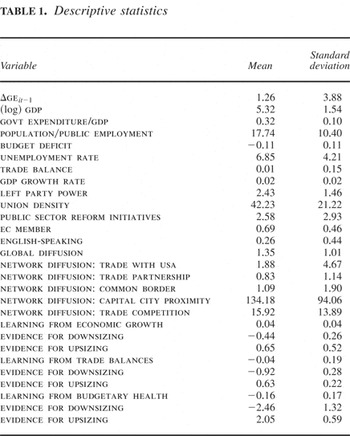
Table 1 provides descriptive statistics for all variables.
Descriptive statistics

Estimation
We estimate models of the form

Two main threats to inference arise. The first is spatial correlation, the statistical problem raised by diffusion. Most diffusion processes (including the majority postulated here) involve reciprocated interdependence, where case i affects case j and case j affects case i. Because each outcome enters as a regressor in the model for the other, a correlation is constructed between explanatory variables and the error term for each country. As is well known, the result is a form of simultaneity bias which generally leads regression coefficients to be overestimated and standard errors underestimated.
Our strategy is to avoid simultaneity bias by relating each country's current upsizing or downsizing to prior upsizing or downsizing in other countries. Case i's outcome at t−1 thus affects j at t, while the outcome for j at t−1 affects i at t. By lagging diffusion influences, we sever the direct connection between regressors and model error. A lag structure also makes substantive sense given the outcome studied here: changes in the size of the public sector can only be accomplished over time and are constrained by the bureaucratic structure of the process.33
Lagged diffusion effects would not make sense where feedback occurs instantaneously or in shorter intervals than those separating panel observations. For example, financial markets react so quickly that interdependence in exchange rates would be appropriately treated as simultaneous.
The second threat to inference is serial correlation, where unmodeled case-specific factors lead the error term to be correlated with the lagged dependent variable. This is the characteristic problem of time-series analysis, and the subject of a large econometric literature. The main statistical remedy is to employ instrumental variables constructed from prior lags of exogenous variables. We adopt this strategy, estimating models within a general method of moments (GMM) framework. GMM estimators have been shown to outperform standard two-stage least squares estimators and to be robust in the absence of knowledge of the structure of heteroskedasticity and serial correlation.34
See Hansen 1982; and Arellano and Bond 1991. Many familiar techniques, such as ordinary least squares (OLS), are methods of moments estimators and thus special cases of GMM. The attraction of GMM is that it identifies parameters based on multiple model assumptions to minimize asymptotic variance. See Greene 1993, for an overview.
Results
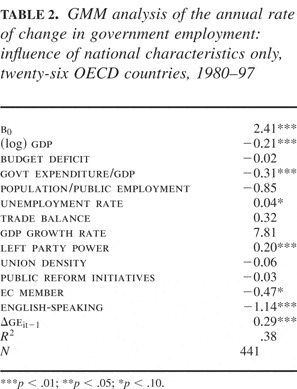
All tables present GMM regression analyses of change in government employment between 1980 and 1997. Table 2 includes only national characteristics, while subsequent analyses add diffusion influences. Because the former have stable effects across all models, we present them once and review them first.
GMM analysis of the annual rate of change in government employment: influence of national characteristics only, twenty-six OECD countries, 1980–97

Most economic and political factors influence public-sector employment in the anticipated direction. The most substantial relationships involve economic development (wealthier countries are more likely to reduce the size of their public sectors), government size (countries with larger governments tend to downsize more), and political leanings (leftist party rule promotes public-sector growth, rightist rule leads toward contraction).
Table 2 also shows the proclivity for public-sector downsizing among English-speaking countries, net of economic and political conditions. We interpret this effect as a product of the centrality of neoliberal and managerial visions in Great Britain, the United States, Canada, Australia, and New Zealand. One indicator of the strength of these affinities is the weak impact of party politics within the English-speaking members of the OECD. Conservatives led the movement toward reducing and restructuring government in three of the five countries, while Labor parties oversaw downsizing in Australia and New Zealand.
Members of the European Community also tend to decrease public employment more than other OECD states do. Supplementary analyses exploring differences by decade (not shown) indicate that this effect appears in the 1990s but not the 1980s. Downsizing within the Community may thus index the Maastricht Treaty's Article 104c(1) provision that member states “shall avoid excessive government deficits.” Downsizing among members of the EC may also reflect responses to the more general problem of structural competitiveness in the context of European integration.
A noneffect of particular interest is the negative but statistically insignificant impact of reform initiatives. This result is compatible with the notion that formal public-sector reforms (not unlike private-sector ones) often lack real consequences. Some governments may have announced vigorous programs for change that accomplished little. We should not leap to the conclusion that reforms are necessarily mere show, however; many initiatives focused not on the size of the public sector but on its functioning.
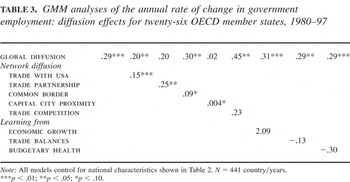
Table 3 reports models that include diffusion influences in addition to internal factors (we do not continue to report coefficients for the latter, which change little from those shown in Table 2). The strong positive effect of global diffusion indicates that change in government employment within the OECD as a whole is followed by movement in the same direction in each focal country. One interpretation is that all OECD members influence each other. But external shocks or broad environmental changes might lead countries to act in similar ways over time, producing a relationship that is hard to distinguish empirically from homogeneous mixing.
GMM analyses of the annual rate of change in government employment: diffusion effects for twenty-six OECD member states, 1980–97

Socially structured patterns of influence can be interpreted more positively. Table 3 indicates that diffusion generally follows the lines of economic interaction and geographic proximity. Net of aggregate trends, the rate of change in government employment in a focal country during a given year was significantly influenced by prior employment change among trade partners. Similarly, spatial measures (common border and great circle distances between capitals) indicate that geographically proximate countries tend to move in the same direction.35
Lee 2001 further examines the lag structure of diffusion influences, which are strongest in the immediately preceding year and fall off smoothly over a three-year period.
Table 3 also links public-sector shifts in the United States to subsequent shifts in other OECD countries. U.S. government employment grew slowly in the early 1980s, rapidly in the late 1980s, and moved toward downsizing through the 1990s. Other countries tended to follow suit, with the greatest movement occurring in member nations whose economies were most closely linked to the United States. (Additional analyses found a similar but weaker effect of unweighted imitation of the United States.)
By contrast, there is little evidence that diffusion is structured by trade competition. While countries that trade extensively with each other tend to move in tandem, countries that trade with the same third parties (and so compete for markets) do not. This is striking, particularly because the two measures of trade patterns are positively correlated; countries that trade with each other also tend to possess similar global trade profiles.
We also find little support for a simple form of vicarious learning, where countries adopt whatever policies appear to work for others. There is much variation over the 1980–97 period in the empirical relationship between public employment change and key macroeconomic outcomes like economic growth, trade balances, and fiscal health. In some years, downsizers grew faster than upsizers, while in others they grew more slowly. But these signals are not systematically related to subsequent shifts in the size of the public sector.
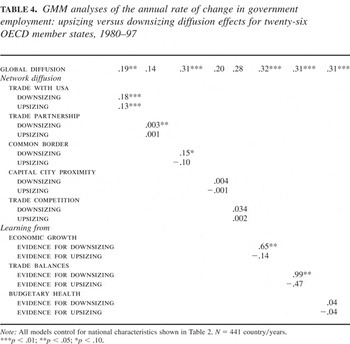
Table 4 examines asymmetries in the diffusion of public-sector upsizing and downsizing. As described above, we do so by distinguishing the impact of proximate countries that downsize from those that upsize, and separating evidence that downsizing is economically beneficial from evidence that it is harmful. All models continue to control for the full set of national characteristics reported in Table 2.
GMM analyses of the annual rate of change in government employment: upsizing versus downsizing diffusion effects for twenty-six OECD member states, 1980–97

Downsizing appears to be contagious, while upsizing does not. Reductions in government employment by a trade partner or neighbor lead to reductions in the size of the public sector. But increases in government employment by the same partners or neighbors have negligible effects. We also find larger effects of downsizing than upsizing when proximity is measured between capitals and as a function of trade competition, though none of these effects are statistically significant at conventional levels.
Even more striking asymmetries appear in vicarious learning. Table 4 indicates that countries act as though they are influenced by evidence that downsizing works: they are more likely to diminish public employment when recent downsizers experienced rapid growth and improving trade balances, and when recent upsizers faced slow growth and worsening trade.36
All measures are constructed so a positive coefficient indicates movement in the direction of the signal. A positive impact of evidence for downsizing indicates a reduction in public employment (since the interaction of positive economic outcomes and decreases in employment produce negative values, as does that of negative outcomes and employment increases). A positive effect of evidence for upsizing indicates a rise in public employment (since the two terms are either both positive or both negative).
These asymmetries emerge even though the overall economic record of upsizers and downsizers was in fact roughly equivalent. The correlation between change in public employment and GDP growth is .04; for trade balance, it is −.16; and for budgetary surpluses, it is −.05. Downsizers thus experienced slightly slower rates of economic growth than upsizers, somewhat better trade balances, and slightly healthier fiscal positions.
Deductions from these negligible and statistically insignificant relationships, we think, say more about the interpreter than the evidence. For example, proponents of vigorous government action might conclude from the first correlation that an enlarged public sphere provides a social and material infrastructure that promotes economic success. Neoliberals could counter that states often shrink in response to sluggish growth, and that a negligible correlation should be interpreted as evidence that downsizing helped prevent a bad situation from getting worse.37
Similarly, in a discussion of the collapse of Southern Cone economies that had enacted liberalization experiments in the 1980s, Kahler notes that “evaluations have typically varied according to initial sympathies”; see Kahler 1990, 45.
The one network relationship that generates mimicry in both directions is imitation of the world's dominant power. When the United States upsizes, countries that trade a great deal with it are more likely to upsize. When the United States downsizes, they are more likely to downsize. This suggests that a dominant actor's behavior may be self-legitimating in a way that those of neighbors or trading partners are not.
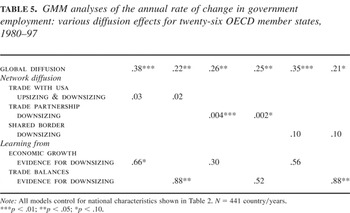
Table 5 combines the major diffusion mechanisms identified above: peer-based emulation of downsizers, evidence that downsizing works, and trade with the United States. We see strong effects of trade-based proximity to downsizers net of vicarious evidence that downsizing works, and strong effects of evidence for downsizing's economic benefits net of the influence of the United States and of border adjacency. Border adjacency and trade with the United States have weaker effects in these combined models, though all estimated effects are larger than their standard errors. On the whole, diffusion effects appear remarkably robust.
GMM analyses of the annual rate of change in government employment: various diffusion effects for twenty-six OECD member states, 1980–97

Discussion and Conclusions
Contemporary governments are immensely complex organizations. Net shifts toward their expansion or contraction are the result of multiple pressures and decisions made at different levels. Yet it is clear that the overall trajectory of these decisions shifted within OECD member states in the 1980s and 1990s, as a long process of public-sector expansion slowed and, in some countries, reversed direction.
Regression analyses indicate that change in the size of the public sector is linked not only to domestic economic and political conditions but also to international policy diffusion. Influence is particularly strong between neighbors and countries that trade extensively with each other, which is suggestive of an underlying process of emulation linked to information flow and cultural similarity. We see correspondingly little sign of competitively driven influence between trade rivals. An asymmetric pattern of contagion also emerges where the trading partners of the United States tend to follow its lead.
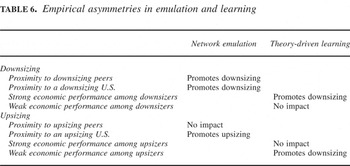
This article's key findings, however, concern not the network structure of international diffusion but the sorts of policies that flow. As Table 6 summarizes, downsizing appears to be contagious while upsizing does not. We find that proximity to downsizers promotes downsizing, but that proximity to upsizers does not promote upsizing. We also find that evidence of the economic benefits of downsizing stimulates more downsizing, while evidence of the economic benefits of upsizing has no observable impact. Only the influence of the United States suggests an interpretively unmediated diffusion pattern, though this effect is weak once we control for vicarious learning.
Empirical asymmetries in emulation and learning

The differential contagiousness of upsizing and downsizing makes sense given their diametrically opposed statuses within policy discourse. The dominant neoliberalism of the 1980s and 1990s argued that the public sector was wasteful and inefficient, and that markets could replace planning in many more contexts than had previously been recognized. Students of organizations contended that smaller was better, and advocated administrative reforms that would foster an entrepreneurial ethos within public servants. Examples of downsizing were broadcast as success stories to be mimicked, while examples of public-sector growth were treated as parochial.
A Korean official of considerable experience provided us with an inside view of the routine way that interpretive frames enter into policy discussions. This official noted that when speaking about his country's experience at international meetings such as OECD/PUMA, he sensed in himself “some kind of desire to exaggerate the contents and numbers of reforms.” The same impulse to “overstate the examples or ideas of reforms in the member countries” resurfaced when he relayed OECD experiences to government leaders at home.
The pattern of differential contagiousness shown here speaks to core theoretical issues in the study of diffusion. It reinforces Davis and Greve's finding that socially legitimated innovations are highly contagious. This article's results go beyond prior research by showing that vicarious learning is theory-driven. Empirical outcomes that confirm expectations reinforce behavior, while outcomes that contradict expectations are discounted. In short, when theories and evidence come into conflict, theories win.
While we are unaware of prior demonstrations of theory-driven learning in national policy, social psychologists have identified similar processes in individual inference. In one classic study, for example, Lord, Ross, and Lepper exposed subjects to different reports concerning the deterrent effects of capital punishment.38
Subjects found research whose conclusions supported their original views to be more convincing than research that came to opposing conclusions, and were more influenced by the former than the latter. Indeed, when subjects were supplied not only with research results but also exposure to discussion of procedures and possible critiques, they interpreted both confirming and disconfirming evidence as strengthening their initial positions.Theory-driven learning poses a challenge to naïve models of rational choice. As Simmons, Dobbin and Garrett point out, most discussions of vicarious learning assume that information is used to update beliefs and increase their accuracy. But if only evidence that confirms beliefs is believed, learning is neither rational nor adaptive! While a short-term lag in response to mixed signals might seem reasonable, our results over two decades suggest that theories have great staying power.
As a process of interest in its own right, theory-driven learning provides an opportunity to combine insights from different theoretical and disciplinary perspectives. Cognitive research on attention, pattern recognition, and inference seems fundamental. Work on communication and social influence can detail how individual biases are propagated and reinforced within different kinds of groups. Political and cultural analyses can probe why particular theories tend to be dominant.
In considering how to put the many pieces of the puzzle together, Kuhn's analysis of normal science and paradigm change provides a powerful set of insights.39
Kuhn 1970.
Hall 1993.
Implications
Three empirical implications of the diffusion pattern identified here stand out. First, downsizing's contagiousness should produce greater reductions in government employment than would occur otherwise. Since downsizing elsewhere has a reinforcing effect while upsizing does not, downsizing pressures should expand over time. Because the benefits of downsizing are treated as consequential while parallel evidence for upsizing is ignored, the international community should increasingly shift toward downsizing.
Second, contagion generates a tendency toward homogeneity. If countries move in the direction of each other's actions, under most conditions (including the models estimated here) they will tend to converge. If countries learn vicariously from the same lessons, they will move in relative lockstep.
Third, the interpretively mediated form of policy diffusion that appears to characterize administrative reform suggests growing convergence in the qualitative strategies used to achieve downsizing. We would anticipate not a process of blind imitation, but a professionally driven dynamic in which policy experts select and codify “best practice.”41
Movement in this direction can be seen in the work of Korea's task force, which criticized simplistic approaches to cutting government employment: “the downsizing programs of each country tend to be arbitrarily enforced without some scientific analysis of the process and decision in advance. Just setting a short-term or long-term ceiling for cutbacks, ignoring the costs of downsizing, or neglecting the downsizing process, is an easy option,” 70–71.
We should emphasize that contagion does not imply uniformity. Since the size of government is not driven solely by diffusion but is anchored in internal conditions as well, the contagiousness of downsizing will neither drive public employment to its natural limit nor lead to the elimination of national differences. Systems of interdependence can in fact generate heterogeneity rather than isomorphism, both cross-sectionally and over time, though to achieve this outcome we would need to complicate the feedback structure considered here.42
Comparisons and Extensions
One of the attractive features of diffusion models is that they travel well. The spread of the same policy in different domains, or of different policies in the same domain, often reveals substantial regularities.43
Walker 1969 provides a classic analysis of regularities in policy diffusion across the American states; within the international arena, see Thomas et al. 1987 and other work by Meyer and colleagues on education, welfare, and human rights policy.
One natural comparison is between public- and private-sector downsizing. During the period studied here, many firms engaged in planned, radical workforce reductions (though a simple pattern of net employment decline is no more true for corporations than for governments). For example, IBM downsized by about 36 percent, or 150,000 employees, between 1991 and 1994. Despite the fervor of its advocates, much research also shows that downsizing bears a heavy cost: it negatively affects the psychological health and motivation of survivors, disrupts intrafirm networks that get things done, and often diminishes organizational performance.44
See De Meuse and Vanderheiden 1994.
Studies of corporate downsizing suggest factors that parallel those documented here for the public sector.45
Budros 1997.
[W]hen few downsizings had occurred in the early 1980s, these acts were regarded as “puzzling” and it took “guts” to commit them. In the mid 1980s, staff trims were “in fashion” and so CEOs were “far less reluctant” to do some trimming. Indeed, downsizers began to hear the words: “Everyone else is doing this; how come you aren't?”46
Ibid., 233, citing Hartford Courant, 6 August 1983 and Business Week 4 August 1983:43.
By the mid 1990s, observers noted that downsizing continued apace in organizations that showed a healthy profit.
As in the public sector, the corporate downsizing movement appeared within a supportive cultural context. Theories of organizational effectiveness extolled the virtues of lean organizations while an older line of analysis stressing the benefits of “organizational slack” was forgotten. Ideologies of employee self-reliance supplanted notions of organizational commitment.47
McKinley, Mone, and Barker 1998.
Diffusion analysis also seems appropriate in public-sector contexts beyond the one examined here. This article has studied downsizing among OECD members, the world's richest and most powerful states. We suspect that analysis of downsizing outside the OECD also involves a combination of internal and external influences, but that different mechanisms are involved.
In particular, the World Bank and the IMF are key advocates and enforcers of neoliberal arrangements in poorer and economically indebted countries. Conditionality agreements that restrict government debt have direct implications for public expenditure and government employment. The scope of these requirements grew over the 1980–99 period studied here, with structural reforms related both to market institutions and to governance increasing in prominence. Since the most stringent conditions are generally applied to the poorest countries and those least able to obtain credit elsewhere, coercion seems likely to play as large a role outside the OECD as emulation does within the OECD.48
See Mosley, Harrigan, and Toye 1991 on the bargaining game between the IMF and recipient countries. As the IMF's conditions for loans grew more stringent, wealthy countries that could receive financing elsewhere largely opted out. Babb and Buira 2004 provide a close analysis of shifts in IMF conditionality that we draw on here.
Finally, it would be useful to compare determinants of the size of the public sector in different historical periods. The 1950s and 1960s gave rise to a rich analysis of public-sector growth as resulting from socioeconomic change, social democratic politics, and supportive political institutions. Is an integrated model of the two eras plausible, or do institutional expansion and retrenchment operate in fundamentally disparate ways? While some mechanisms surely differ,49
Pierson 1994.