Significant outcomes
-
∙ The development of physiological responses is the result of a complex interaction between genetic factors, environmental factors and prenatal hormonal exposure.
-
∙ Social behaviours are moderated by autonomic nervous system activations. Therefore, by shaping the physiological responses, different prenatal environments facilitate distinct paths for social development.
Limitations
-
∙ The movies we used as stimuli were meant to be ecological, however this means that they were complex and less controllable stimuli.
Introduction
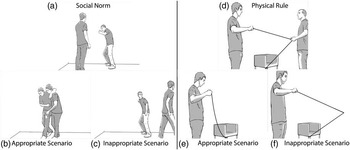
Hormones are chemical substances used for inter-cellular communication within the body. These chemical substances are secreted outside the cells and, usually, spread within the circulatory system and are thus transported all over the body. Because of this transportation system, hormones can affect responses of cells that are very far away from the starting cell and hormonal effects are slow and can last for an extended period of time since it takes several minutes for the hormones to be reabsorbed or disassembled. Due to these characteristics, the presence of several hormones affects both our physical and behavioural development. Steroid hormones such as testosterone and its derivates, such as oestrogens, are one of the hormonal classes that most directly affect physical development and social behaviours. In previous research, distinct testosterone levels in adults have been linked to aggressiveness and empathetic abilities, which are defined as people’s abilities to understand and properly respond to other’s emotions and thoughts (Reference Auyeung, Lombardo and Baron-Cohen1): the higher the levels of testosterone, the higher the aggressiveness and the lower the empathetic abilities (Reference Hermans, Putman and van Honk2,Reference Batrinos3). Exposure to hormones starts in utero, therefore the prenatal environment significantly affects the initial development of the brain. Since brain development influences individual’s overall development, exposure to testosterone in utero can have long-term effects, and influences even adult behaviour. Is it possible to measure pre-natal exposure to testosterone after birth? Exposure to distinct levels of testosterone in utero differentially affects finger growth. The ratio between the lengths of the index and the ring fingers (digit ratio) is an index of the prenatal levels of testosterone exposure: lower ratios are due to higher testosterone exposure, while higher ratios are linked to lower testosterone exposure (Reference Zheng and Chon4). Measuring the digit ratio, researchers have found that various levels of testosterone exposure in the pre-natal period affect adult social abilities by influencing adults’ predispositions to aggressiveness and empathy. Higher levels of testosterone exposure in utero likely lead to higher aggressiveness and lower empathy, while lower levels of testosterone exposure in utero lead to lower aggressiveness, higher empathy and higher social cooperation (Reference Chapman, Baron-Cohen and Auyeung5–Reference Van Honk, Schutter, Bos, Kruijt, Lentjes and Baron-Cohen10). Moreover, in 6–9-year-old children with high levels of testosterone exposure in utero a higher systemising has been found. Systemising is defined as the ability to analyse and explore a rule-governed system (Reference Auyeung, Lombardo and Baron-Cohen1,Reference Auyeung, Baron-Cohen, Chapman, Knickmeyer, Taylor and Hackett11). Thus, higher levels of testosterone are related to a greater attentional drift towards rule-based physical systems and a decreased interest in the analysis of social dynamics. One mechanism through which testosterone exposure in utero may affect adults’ social abilities could be an initial differential influence on physiological responses in the autonomic nervous system (ANS). In this study we aim to investigate how adults’ ANS responses to the observation of dyadic interactions, focussed either on physical or social topics, are influenced by the level of testosterone exposure in utero. We assessed participants’ ANS reactions by measuring indexes of both the parasympathetic (heart rate) and the sympathetic branch (heart rate and skin temperature), while participants watched movies depicting interactions between two actors. The interactions were either focussed on a social norm (to test social abilities) or on a physical norm (to test systemising abilities). A social norm, for example, necessitates that if we find a person leaning sick against a wall and asking for help, we are expected to aid him/her, and not to walk away (see Figs 1a–c). A physical norm, instead, necessitates that if two people are pulling an elastic rope making it take an angle form and then they stop pulling it, the elastic rope cannot maintain the angle shape by itself (see Figs 1d–f). The distinct focus of the two kinds of movies allowed us to investigate the effect of expected attentional drift due to diverse systemising levels. In participants with high testosterone exposure in the pre-natal period we expected to find patterns of physiological reactions which highlight higher distress or alert in response to interactions focussed on social norms, compared with physical norms. On the contrary, for people with lower levels of testosterone exposure, we expected to find patterns of physiological reactions which highlight higher distress or alert in response to interactions focussed on physical norms, compared with social norms. Alertness responses are marked by a decrease in heart rate due to the orienting response (Reference Bradley12), while distress responses are reflected by an increase in heart rate or by changes in facial temperature (Reference Berntson, Bigger and Eckberg13,Reference Appelhans and Luecken14), either by a slight decrease or a strong increase (Reference Salazar-López, Domínguez and Juárez-Ramon15): specifically, negative stimuli which enhance little arousal such as sad faces elicit a slight decrease in facial temperature, whereas negative stimuli which enhance high arousal such as naked corpses elicit a strong increase.
Example of social-norm and physical-norm scenarios. (a–c) Example of social event: Calling for help. (a) One person leans against the wall holding his stomach as if feeling sick. A second person arrives and the first person asks him for help. (b) Appropriate continuation of a social event: the second person helps the sick person. (c) Inappropriate continuation of a social event: the second person pauses to stare at the sick person, and leaves the scene without helping. (d–f) Example of physical event: Playing with a rubber band. (d) Two people play with a rubber band that has one end tied to a chair. The other end is held by one person, while the second person pulls on the middle of the rubber band away from the first person. Later, the second person lets go of the band and leaves. (e) Appropriate continuation of a physical event: after the second person lets go of the band, it bounces back into place. (f) Inappropriate continuation of a physical event: after the second person lets go of the band, it remains taut and pulled back even though no one is holding on to it.

Aims of the study
This study aims to investigate how in utero testosterone exposure long-term influences adults’ physiological responses to the observation of dyadic interactions, focus either on physical or social topics. Specifically, here we hypothesise that distinct levels of testosterone exposure in utero influences adults’ social responses by differently affecting the initial ANS regulation.
Material and methods
Participants
Twenty-five neurotypical adults (12 males), who were undergraduates at the University of Trento (Italy) were recruited as participants. Participants’ mean age was 22.6 years (SD=3.8), all were Caucasians; they did not present any medical or developmental conditions. Participants were given university credits. Informed consent was obtained from all participants. The study was conducted in accordance with the Helsinki Declaration.
Stimuli
We used dynamic movies representing realistic situations as stimuli in our experiment. We created movies showing realistic dyadic interactions between two male adults. At the beginning of each movie there was one actor, while towards the end of the movie, a second actor entered the scene and the two actors began to interact. In each movie the interaction is focussed either on a social behaviour, which follows a social norm that is played out within the social exchange, or focussed on an object, around which the interaction takes place and which follows a physical law. Each norm, social or physical, was represented in two versions: (i) in the appropriate scenario, the social behaviour or the physical object follow social or physical norms as they are supposed to, while (ii) in the inappropriate scenario the social behaviour or the physical object do not follow social or physical norms as expected. More details are presented in the supplementary materials. For each of the four conditions, six video-clips were created for a total of 24 video-clips.
Procedure
The experiment was carried out in a Psychology Department laboratory, at the University of Trento. Each participant viewed one of three randomised sequences of the 24 movies. After each movie, participants were asked to give two behavioural judgements on five-point Likert items. The first judgement asked participants to rate the predictability of the stimuli, whereas the second judgement asked participants to rate stimuli comprehensibility. Participants’ heart rate and peripheral temperature were measured throughout the entire presentation of the 24 movies. Overall, the experimental session lasted 40 min.
Measures
Digit ratio (2D : 4D)
The ratio between the length of the index finger (2D) and the ring finger (4D) has been used in research as an index of testosterone exposure in utero. The relationship between the digit ratio and the testosterone exposure is inverse: the higher the ratio, the lower the exposure to testosterone (Reference Zheng and Chon4).
Heart rate
As index of both parasympathetic and sympathetic nervous system activation, we assessed participants’ heart rate using a pulse oximeter placed on participants’ left index finger (Reference Berntson, Bigger and Eckberg13,Reference Appelhans and Luecken14).
Temperature
As an index of sympathetic activation we assessed participants’ peripheral surface body temperature at two points on the face (left and right cheeks), by placing two thermistors on participants’ skin (Applent at4524 multi-channel temperature meter). Measurements of facial temperature have been used in previous research as a somatic marker for internal emotional valence state (Reference Salazar-López, Domínguez and Juárez-Ramon15,Reference Rimm-Kaufman and Kagan16).
Behavioural judgements
Participants were asked to rate on five-point Likert items, how much each movie was predictable (How predictable was the scene?) and comprehensible (How comprehensible was the scene?).
Analysis
To measure participants’ reactions to dyadic interactions, we considered the physiological responses in the 5 s before (BEFORE) and 5 s after (AFTER) the onset of interactions. For each participant and each physiological response (heart rate, temperature on cheeks) we calculated the mean BEFORE and the mean AFTER in each condition (social (vs.) physical, appropriate (vs.) inappropriate). Then, for each subject in each condition, a single value for the difference BEFORE-AFTER was calculated. A positive value of the difference BEFORE-AFTER reflects a decrease of the considered physiological variable in response to the onset of interactions, while a negative value reflects an increase of the considered physiological variable. For each physiological measure and for the two behavioural judgements, a general linear model (GLM) was performed with the difference BEFORE-AFTER or the judgement as dependent variable, the scenario condition (social (vs.) physical) and the appropriateness (appropriate (vs.) inappropriate) as within-subjects factors and the digit ratio as a continuous covariate. Bonferroni correction was used to analyse post hoc effects of significant factors, the regression coefficients were used to analyse the effect of the covariate on the dependent variable, and the partial eta squared (η 2 p) was used to evaluate the magnitude of significant effects.
Results
Heart rate
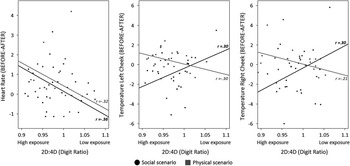
Results are shown in Fig 2a. The GLM showed a significant main effect of the digit ratio on heart rate responses, F(1,23)=5.3, p<0.05, η 2 p =0.18. No other significant main effects or interactions were observed. The parameter analyses of the digit ratio effect revealed that, independent of the scenario and the appropriateness, the higher the testosterone exposure was the higher the heart rate decrease, b=−11.9, 95%CI [−22.7, −1.1].
Physiological arousal: greater in participants with high testosterone exposure in utero. (a–c). Correlations between physiological measures and prenatal testosterone exposure (2D : 4D digit ratio). Black circles=social-norm scenarios; grey squares=physical-norm scenarios. Lines represent the linear models for social-norm scenarios (black) and physical-norm scenarios (grey). In the figure the r-value represents Pearson’s r. (a) Influence of prenatal testosterone exposure on heart rate responses to dyadic interactions. Heart rate responses are calculated as the difference between the mean heart rate before and after the onset of the dyadic interactions (BEFORE-AFTER). (b–c). Effect of the interaction between testosterone exposure and scenarios’ condition (social-norm (vs.) physical-norm focussed dyadic interactions) on participants’ facial temperature left (b) and right (c) cheeks.

Temperature
Results are shown in Figs 2b and c. For face temperature, the GLM showed a significant main effect of the scenario, F(1,23)=6.7, p<0.05, η 2 p =0.23 and F(1,23)=5.8, p<0.05, η 2 p =0.20 for left and right cheeks respectively, and a significant scenario×digit ratio interaction, F(1,23)=6.3, p<0.05, η 2 p =0.22 and F(1,23)=5.5, p<0.05, η 2 p =0.19 for left and right cheeks respectively. The comparison of the mean values computed as a function of the scenario showed that, independent of the appropriateness and the digit ratio, participants had an increase in face temperature in response to social-norm scenarios (M=−0.8), and a decrease in face temperature in response to physical-norm scenarios (M=0.3). With regards to the scenario×digit ratio interaction effect, the parameter analysis showed that, independent of the appropriateness, in response to the onset of the social-norm scenarios, participants with higher testosterone exposure showed an increase in face temperature, b=18.6, 95%CI [−6.6, 43.7] and b=22.5, 95%CI [−9.2, 54.2], respectively, for the left and right cheeks. In response to the onset of the physical-norm scenarios, participants with higher testosterone exposure showed a decrease in the face temperature, b=−10.6, 95%CI [−25.3, 4.1] and b=−11.3, 95%CI [−34.2, 11.6], respectively, for the left and right cheeks.
Behavioural judgements
For the behavioural judgements, no significant main effect or interactions were found on both predictability and comprehensibility scores.
Discussion
In our study we aimed to test how in utero testosterone exposure influences adults’ physiological responses to interactions involving physical norms or social norms.
We found a significant effect of distinct digit ratio values in relation to heart rate changes, where higher levels of testosterone exposure correspond to a significant decrease in heart rate response right after the onset of dyadic interactions, and lower levels of testosterone exposure in utero correspond to a significant increase in heart rate values right after viewing social interaction between the two actors, regardless of the experimental condition. The increased heart rate found in individuals with lower testosterone exposure highlights a stressful response (Reference Berntson, Bigger and Eckberg13,Reference Appelhans and Luecken14), while the heart rate decrease found in people with higher testosterone exposure in response to any type of dyadic interaction is most likely interpretable as an orienting response (Reference Bradley12). The orienting response is part of individuals’ defensive system: the onset of possible threatening stimuli induces a sudden cardiac deceleration which allows the individual to calm down for the time needed in order to understand what is going on and to determine the best plan of action. Also, this interpretation is supported by results from cheek temperature. Indeed, data showed that the relation between the facial temperature arousal and the testosterone exposure was moderated by the scenario. Independently of the appropriateness, in response to the onset of the social-norm scenarios, participants with higher testosterone exposure showed an increase of facial temperature, whereas in response to the onset of the physical-norm scenarios, participants with higher testosterone exposure showed a decrease of the face temperature on both cheeks. The reverse pattern was observed in lower testosterone exposure participants.
Taking into account the previous results from Salazar et al. (Reference Salazar-López, Domínguez and Juárez-Ramon15) and from research on prenatal testosterone exposure, we hypothesise that face temperature responses in high testosterone exposure individuals reflect a negative emotional valence to dyadic interactions, and that this emotional valence is more negative for social norm scenarios (temperature increase) compared with physical norm scenarios (temperature decrease), whereas the opposite pattern is found in people with lower testosterone exposure. These results demonstrate that differential social abilities and systemising tendencies found in people with different levels of testosterone exposure in utero is reflected by two opposite patterns of physiological activations. Specifically, the greater systemising in higher testosterone exposure individuals is highlighted by the higher negative emotional valence assigned to social-norm focussed interactions compared with physical-norm focussed interactions, while the greater empathy in lower testosterone exposure individuals is highlighted by a higher negative emotional valence assigned to physical-norm focussed interactions compared with social-norm focussed interactions. The increase in heart rate together with the decrease in cheek temperature found in people with lower testosterone exposure that occur when viewing social-norm scenarios, which reflect a low arousal of the stimuli, is most likely due to the neutral facial expressions maintained by actors during the movies. A previous study by Willis et al. (Reference Fox17) demonstrated that higher levels of anxiety traits lead to judgements of faces as less trustworthy. Moreover, the perceived valence of an emotional facial expression is affected by the context (Reference Willis, Dodd and Palermo18), thus, in an unusual experimental situation, expressionless and neutral faces displayed during interactions could easily enhance a negative emotion in people viewing them (Reference Willis, Windsor, Lawson and Ridley19).
Taken together, these results show a greater and more negative emotional reaction to dyadic interactions in people with higher as opposed to lower testosterone exposure in utero. The current study found an influence of prenatal hormonal exposure on ANS activations in response to dyadic interactions. Prenatal influence on the initial shaping of the ANS pathways could be one basic mechanism through which in utero environment, such as hormonal exposure, affects the development of individuals’ social abilities. A better understanding of this mechanism could help shed light on how social abilities are developed and how in psychopathologies such as Autism Spectrum Disorders, social abilities are disrupted. Having a clearer understanding could help in developing better therapy techniques and in reaching higher levels of therapeutic success.
Acknowledgements
All participants in this study are gratefully acknowledged. The authors also thank Manuel Muratore (University of Trento), Ashley Tong (Nanyang Technological University) and Giacomo Esposito Vivino for their assistance.
Authors’ contributions: Anna Truzzi participated in designing the idea, in the data analysis, in the interpretation of results and in drafting the manuscript. She read and approved the final version of the manuscript to be published. Vincenzo Paolo Senese participated in the analysis of the data and revising the manuscript. He read and approved the final version of the manuscript to be published. Peipei Setoh participated in drafting the manuscript. She read and approved the final version of the manuscript to be published. Cristian Ripoli participated in the interpretation of results. He read and approved the final version of the manuscript to be published. Gianluca Esposito participated in designing the idea, in the data analysis, in the interpretation of results and in drafting the manuscript. He read and approved the final version of the manuscript to be published.
Financial Support
This research received no specific grant from any funding agency, commercial or not-for-profit sectors.
Conflicts of Interest
None.
Ethical Standards
The authors assert that all procedures contributing to this work comply with the ethical standards of the relevant national and institutional committees on human experimentation and with the Helsinki Declaration of 1975, as revised in 2008.
Supplementary Material
To view supplementary material for this article, please visit http://dx.doi.org/10.1017/neu.2016.15