INTRODUCTION
Migration is a biological strategy allowing individuals to exploit temporarily abundant resources and avoid the harsh physical conditions that are prevalent at other times (Robinson et al., Reference Robinson, Crick, Learmonth, Maclean, Thomas, Bairlein, Forchhammer, Francis, Gill, Godley, Harwood, Hays, Huntley, Hutson, Pierce, Rehfisch, Sims, Santos, Sparks, Stroud and Visser2009). Global warming affects the magnitude and frequency of extreme events. Although its main consequence is the decoupling of climatic variables and mistimed migration, many authors have discussed the effect of climatic oscillation on migratory species (Robinson et al., Reference Robinson, Crick, Learmonth, Maclean, Thomas, Bairlein, Forchhammer, Francis, Gill, Godley, Harwood, Hays, Huntley, Hutson, Pierce, Rehfisch, Sims, Santos, Sparks, Stroud and Visser2009, and references therein). However the impact of these effects is hard to predict because the magnitude of these changes strongly differs between regions (IPCC, 2007; Robinson et al., Reference Robinson, Crick, Learmonth, Maclean, Thomas, Bairlein, Forchhammer, Francis, Gill, Godley, Harwood, Hays, Huntley, Hutson, Pierce, Rehfisch, Sims, Santos, Sparks, Stroud and Visser2009). Thus, some authors have modelled the response of migratory species to large-scale climate phenomena, such as the North Atlantic Oscillation (NAO); such models include weather conditions over large areas, rather than local weather conditions (Forchhammer et al., Reference Forchhammer, Post and Stenseth2002; Robinson et al., Reference Robinson, Crick, Learmonth, Maclean, Thomas, Bairlein, Forchhammer, Francis, Gill, Godley, Harwood, Hays, Huntley, Hutson, Pierce, Rehfisch, Sims, Santos, Sparks, Stroud and Visser2009).
The NAO is associated with differences between the low pressure centre, which is typically located near Iceland, and the high pressure centre, which is typically located over the Azores (Hurrell, Reference Hurrell1995; Visbeck et al., Reference Visbeck, Hurrell, Polvani and Cullen2001; Hurrell & Deser, Reference Hurrell and Deser2009). The NAO is responsible for most of the climatic variability in the North Atlantic region and modifies the direction and intensity of the westerly winds and the location of anticyclones, which could affect the marine ecosystems and fisheries in the Mediterranean Sea (Vicente-Serrano & Trigo, Reference Vicente-Serrano and Trigo2011). For example, the NAO could affect the intensity of migratory pattern of loggerheads and the timing of their arrival in the Mediterranean Sea from the Atlantic Ocean (Báez et al., Reference Báez, Bellido, Ferri-Yáñez, Castillo, Martín, Mons, Romero and Real2011a).
An important issue in fisheries biology is the relationship between species within ecosystems (Pauly et al., Reference Pauly, Christensen, Guénette, Pitcher, Rashid Sumaila, Walters Carl, Watson and Zeller2002) and the response of species to climatic oscillation (Chávez et al., Reference Chávez, Ryan, Lluch-Cota and Ñiquen2003). A popular example is the fluctuation of sardine and anchovy landings in the Pacific Ocean. These landings show synchronous variations over multidecadal periods, such that low sardine abundance is marked by dramatic increases in anchovy populations and vice versa. This regime shift is associated with large-scale changes in ocean temperatures in response to the El Niño/La Niña events (Chávez et al., Reference Chávez, Ryan, Lluch-Cota and Ñiquen2003). Thus, sardine prevalence is favoured by warm temperatures, whereas anchovy prevalence is favoured by cool temperatures. Although this regime shift affects top predators such as seabirds (Chávez et al., Reference Chávez, Ryan, Lluch-Cota and Ñiquen2003), few studies have demonstrated its effect on other top predator species (Worm et al., Reference Worm, Sandow, Oschlies, Lotze Heike and Myers2005). However, many studies have found a strong association between climate oscillation and its effect on top marine predators, such as their local abundance (e.g. Suárez Sánchez et al., Reference Suárez Sánchez, Ritter Ortiz, Gay García and Torres Jácome2004; Báez et al., Reference Báez, Ortiz De Urbina, Real and Macías2011b) and their physical condition (e.g. Golet et al., Reference Golet, Cooper, Campbell and Lutcavage2007; Báez et al., Reference Báez, Macías, De Castro, Gómez-Gesteira, Gimeno and Real2013b).
Mortality among Elasmobranchii due to fisheries has been recognized as one of the main factors driving the decline in their populations, although this decline is also partly due to their low fecundity, slow population growth and late sexual maturation. Thus, understanding how climate affects the local abundance of sharks (and therefore incidental catches of sharks) could be important for shark conservation policies (Myers & Worm, Reference Myers and Worm2005; Worm et al., Reference Worm, Davis, Kettermer, Ward-Paige, Chapman, Heithaus, Kessel and Gruber2013).
The tope shark Galeorhinus galeus (Carcharhiniformes, Triakidae) is a medium-sized common demersal shark that is widespread in temperate waters and on the continental shelf. It is found at near-shore depths down to 550 m (Froese & Pauly, Reference Froese and Pauly2011) and is considered to be highly migratory (Lucifora et al., Reference Lucifora, Menni and Escalante2004; IUCN Species Survival Commission's Shark Specialist Group, 2007). Tope sharks are listed as ‘vulnerable’ in the IUCN red list (available from: http://www.redlist.org) due to declining populations.
A species mixture of the genus Raja (Rajiformes, Rajidae) is landed in Andalusian ports under the denomination ‘sting rays’. This mixture includes R. asterias, R. clavata, R. miraletus, R. montagui and R. undulate, although the first three species are landed more frequently (http://www.ictioterm.es/; Guisande-González et al., Reference Guisande-González, Pascual, Baro, Granado, Acuña, Manjarrés and Pelayo2011). In general, they are demersal marine animals living near the bottom of the shore and down to a maximum depth of 300 m.
The two Elasmobranchii taxa, tope shark and Raja spp., are commonly by-caught together in the Alboran Sea by different demersal fisheries, such as trawlers, artisanal nets and bottom longlines (Guisande-González et al., Reference Guisande-González, Pascual, Baro, Granado, Acuña, Manjarrés and Pelayo2011).
The aim of this study was to investigate the effect of the NAO, the main climatic oscillation in the North Atlantic area, on the regime shift pattern of these species.
MATERIALS AND METHODS
Study area
The Alboran Sea runs from the Strait of Gibraltar to an adopted line running from Cabo de Gata (Almeria, Spain) to the Cape of Oran (Algeria). The study region includes 14 landing harbours in Andalusia (southern Spain): Tarifa, Algeciras, La Linea, Estepona, Marbella, Fuengirola, Málaga, Caleta de Vélez, Motril, Adra, Roquetas de Mar, Almería, Carboneras and Garrucha. Strictly speaking, the latter two harbours are not within the area of the Alboran Sea (Figure 1).
Study area. The Alboran Sea within the Mediterranean Sea.

From the point of view of oceanography, the Mediterranean is considered a peculiar sea, because important oceanic events occur there on a small scale (Parrilla & Kinder, Reference Parrilla and Kinder1987). In this setting, the Alboran Sea forms the frontier with the Atlantic Ocean and is the area in which the less saline surface Atlantic water entering the Mediterranean converges with the more saline deeper Mediterranean water leaving the Mediterranean. As a result, the surface water of the Alboran Sea is less saline than Mediterranean water and mixes with the more saline Mediterranean water as it moves eastwards. Thus, the Alboran Sea is an important area in which many fish species spawn near the coast and is more productive than the adjacent Mediterranean (Camiñas et al., Reference Camiñas, Baro and Abad2004).
Fisheries and climatic oscillation data
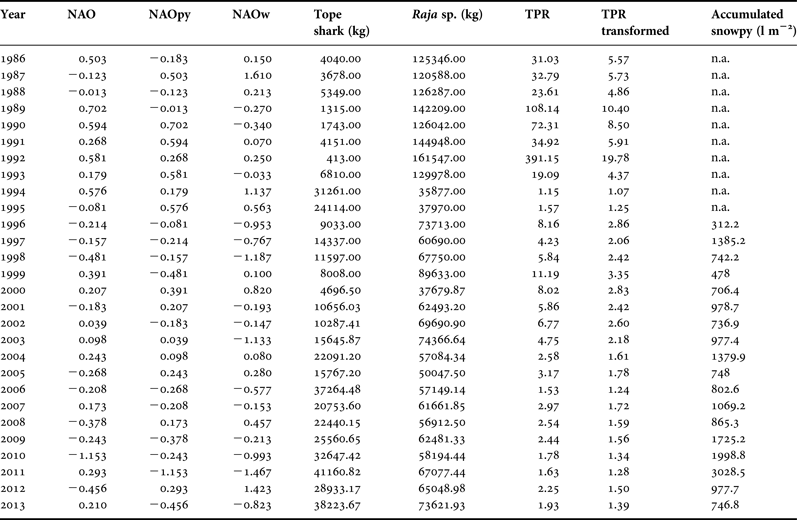
This study used registered tope shark and sting ray landing data for Mediterranean Andalusian harbours obtained from the annual fisheries statistics published by the Junta de Andalucía (Andalusia Regional Government) for the period 1986–2003 (see Table 1), available from: http://www.juntadeandalucia.es/agriculturaypesca/portal/servicios/estadisticas/estadisticas/pesqueras/index.html.
Study variables by year: North Atlantic Oscillation (NAO), North Atlantic Oscillation in the previous year (NAOpy), North Atlantic Oscillation in the previous winter (NAOw), tope shark landings, Raja spp. landings, Ratio of Raja spp. landings to tope shark landings (top predators ratio, TPR), the square root of TPR (TPR transformed), Accumulated snow in previous year in l m−2 (Accumulated snowpy), n.a. not available.

Monthly values of the NAO index were taken from the website of the National Oceanic and Atmospheric Administration: http://www.cpc.noaa.gov/products/precip/CWlink/pna/nao_index.html.
The atmospheric oscillations display strong inter-annual and intra-annual variability (Hurrell, Reference Hurrell1995). However, several studies have shown that changes in NAO trends have a delayed effect on aquatic ecosystems due to ecosystem inertia (Báez et al., Reference Báez, Gimeno, Gómez-Gesteira, Ferri-Yáñez and Real2013a). Thus, this study used data on the NAO, the NAO in the previous year (NAOpy), and the NAO in the previous winter (NAOw) from 1986 to 2013 (Table 1).
As seen from above, the Alboran basin is funnel-shaped, surrounded by a rugged coastline. It is bordered by the highest peaks in the Iberian Peninsula, which accumulate snow (the mountains Mulhacen and Veleta exceed 3000 m). Thus, the NAO is correlated with the accumulated snow from the coastline surrounding the Alboran basin, which is an important freshwater reservoir (Báez et al., Reference Báez, Gimeno, Gómez-Gesteira, Ferri-Yáñez and Real2013a). According to these authors, snowmelt could modify the sea surface temperature in the Alboran Sea due to its effect on the mixed layer, and the increase in freshwater runoff from snowmelt could increase the amount of nutrients entering sea. To investigate these hypotheses, correlations were performed between the total snow in the North Alboran watershed per year (Accumulated snow) and the total tope shark landings in the subsequent year and the NAO. Snow gauge values for 1996 to 2013 (see Table 1) were taken from the Red Hidrosur website (available from: http://redhidrosurmedioambiente.es/webgis2/portada_1.html; accessed 15 May 2014).
Data analysis
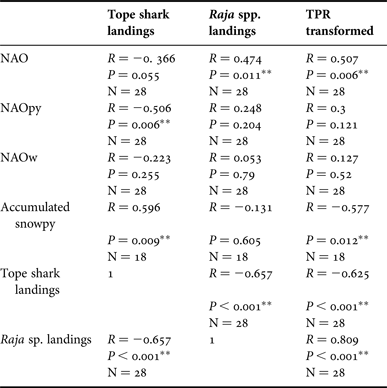
The normality of the distribution of the variables was tested using the Kolmogorov–Smirnov test for one sample (Sokal & Rohlf, Reference Sokal and Rohlf1995). Next, the ratio between Raja spp. landings and tope shark landings was determined (top predators ratio, TPR hereafter). The TPR had a non-normal distribution and was therefore transformed using the square root transformation (see Sokal & Rohlf, Reference Sokal and Rohlf1995) (Table 1). Pearson's r was used to measure correlations between Raja spp. landings, tope sharks landings, and TPR transformed, and between these landings and the NAO, NAOpy, NAOw and Accumulated snow in the previous year (Accumulated snowpy).
The relationship between tope shark landings and Raja spp. landings and the NAO, NAOpy and NAOw was determined by multiple linear regression and curve regression, whereas the relationship between Tope shark landings and Raja spp. landings and Accumulated snowpy was determined using linear regression and curve regression. Based on the highest F-value, we selected the best fit among several significant regressions with different degrees of freedom.
Common time trends and cyclicity in the time series for Raja spp. landings, tope shark landings, and TPR were determined by Spectral Analysis using PAST software (available from: http://folk.uio.no/ohammer/past/) (Hammer et al., Reference Hammer, Harper and Ryan2001; Hammer & Harper, Reference Hammer and Harper2006).
In a second step, from the significant variables hypotheses that could explain the observed regime shifts between these two taxa in the Alboran Sea were tested using Structural Equation Modelling (SEM) (Mitchell, Reference Mitchell1992). The consistency of the abovementioned hypotheses was tested according to a priori models, which were designed as diagrams describing a system of possible relationships between response and predictor variables. All analyses were performed using the IBM SPSS AMOS v. 7.0 software package.
RESULTS
No significant periodicity trends were found for the variables Raja spp. landings, tope shark landings and TPR transformed in the Alboran Sea.
Tope shark landings and Raja spp. landings were significantly correlated with the NAOpy and NAO, respectively (Table 2). There was a significant negative correlation between Raja spp. landings and tope shark landings (Table 2). Tope shark landing was positively correlated with Accumulated snowpy. TPR transformed was positively correlated with the NAO and negatively with Accumulated snow in previous years.
Results of the Pearson correlations. Key: North Atlantic Oscillation (NAO), North Atlantic Oscillation in the previous year (NAOpy), North Atlantic Oscillation in the previous winter (NAOw), Accumulated snow in previous year in l m−2 (Accumulated Snowpy). Significant correlations are indicated by two asterisks.

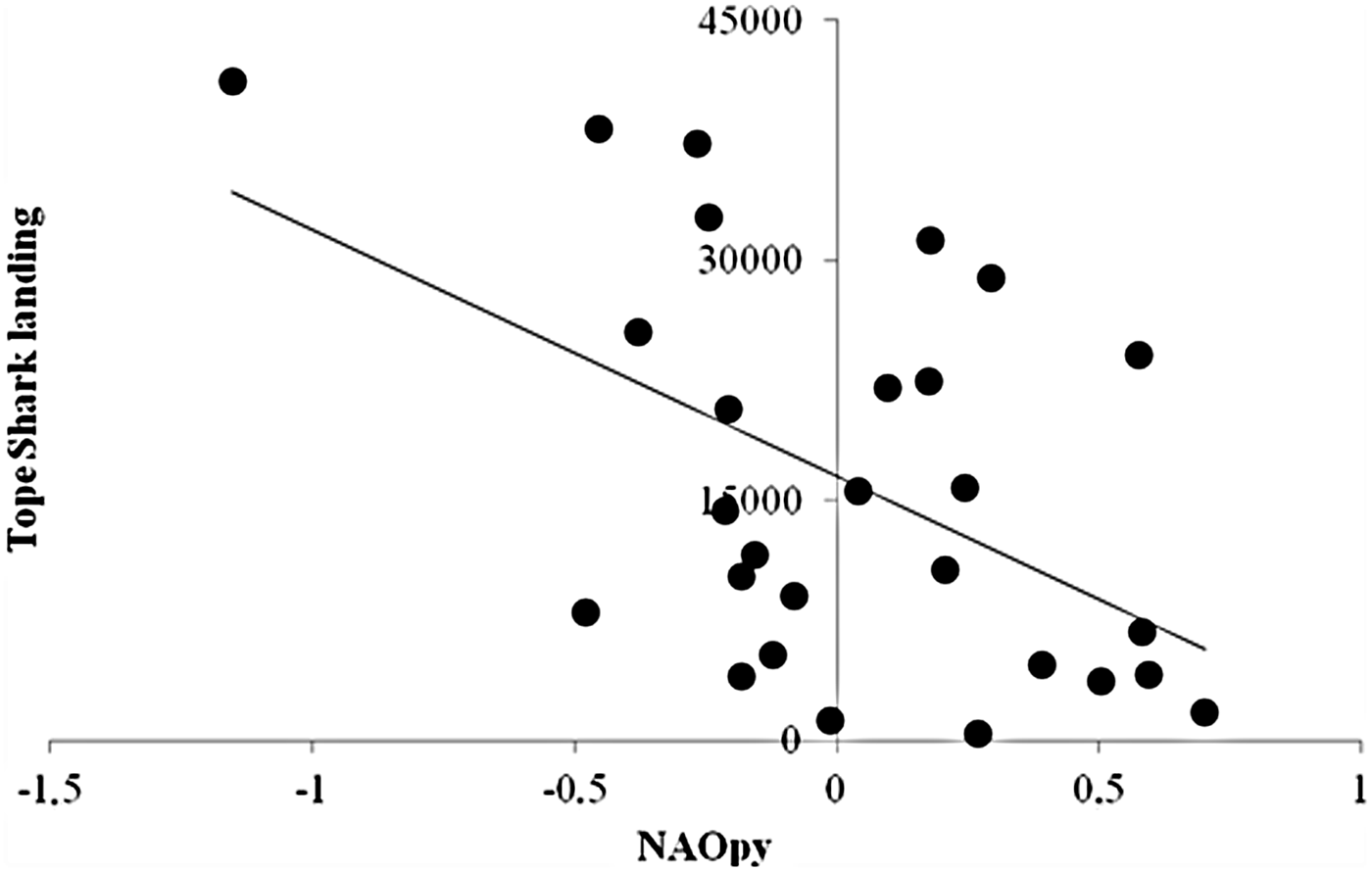
There was a significant negative association between tope shark landings and NAOpy as the independent variable, according to the function (Figure 2):
 $$\eqalign{& \hbox{Tope shark landings} = {16530.39} - {15369.29} \cr & \quad \times {\rm NAOpy}(R^{2} = 0.256;\;F = 8.944;\;P = 0.006;\;\hbox{d.f.} = 27).}$$
Significant negative associations between tope shark landings and the North Atlantic Oscillation in the previous year (NAOpy).

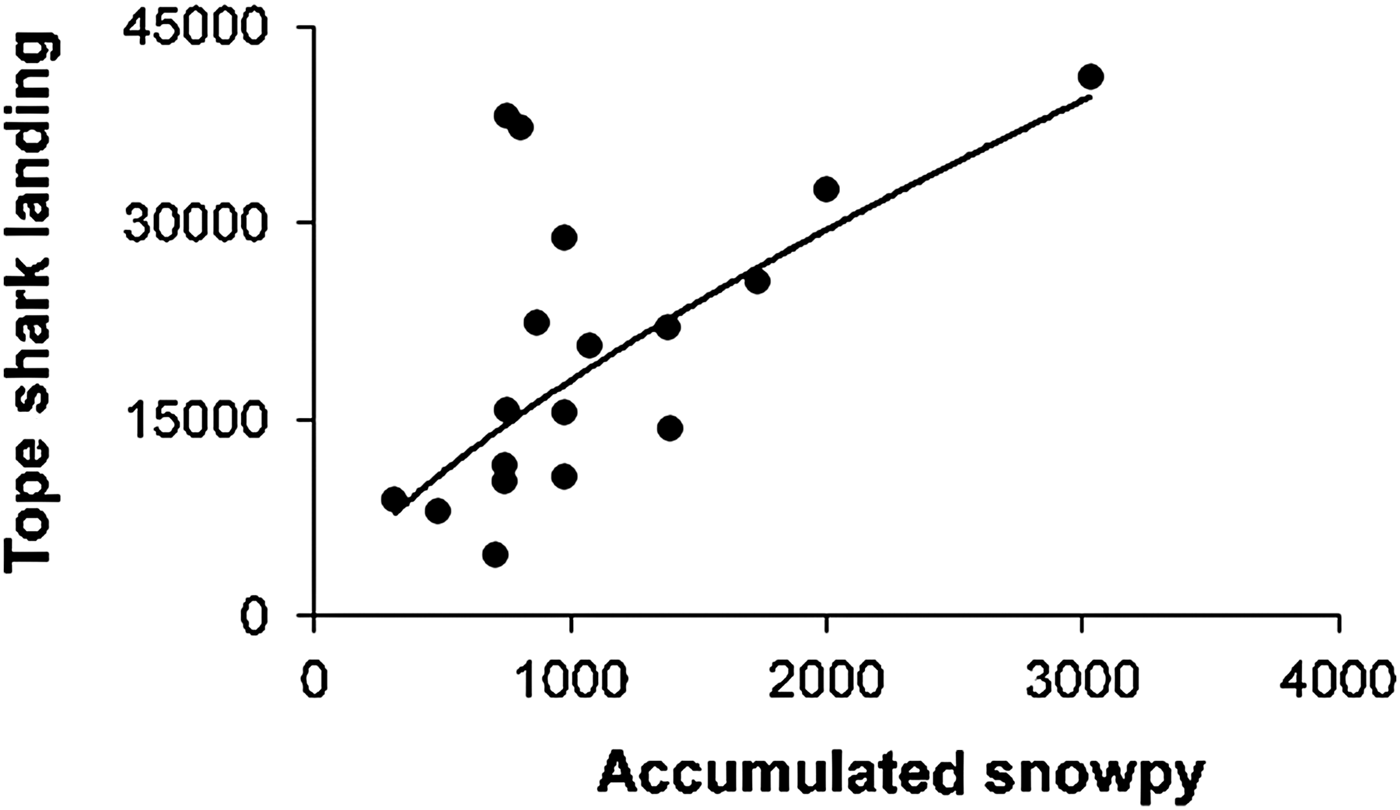
There was also a significant positive association between tope shark landings and Accumulated snowpy as the independent variable (Figure 3) according to the function:
 $$\eqalign{& \hbox{Tope shark landings} = 131.29 \times \hbox{Accumulated snowpy}^{0.712} \cr &\quad (R^{2} = 0.37;\;F = 9.31;\;P = 0.008;\;\hbox{d.f}. = 16).}$$
Significant positive associations between tope shark landings and Accumulated snow in the previous year (Accumulated snowpy) in mountains north of the Alboran basin.

The best-fitting model in the case of Raja spp. landings was a linear multiple regression with NAOpy and Accumulated snowpy as the independent variables, according to the function:
 $$\eqalign{& Raja\;\hbox{spp. landings} = 72398.14 - 26549.56 \cr & \times {\rm NAOpy} \ {- \ 11.24 }\times {\rm Accumulated \;snowpy} \cr & (R^{2} = 0.512;\;F = 7.873;\;P = 0.005;\;\hbox{d.f.} = 17).} $$
A significant negative linear relationship was found between NAOpy and Accumulated snowpy:
 $$\eqalign{& \hbox{Accumulated snowpy} = 955.36 - 1036.16 \cr & \times {\rm NAOpy} \;(R^{2} = 0.35;\;F = 8.62;\;P = 0.01;\;\hbox{d.f.} = 17).} $$
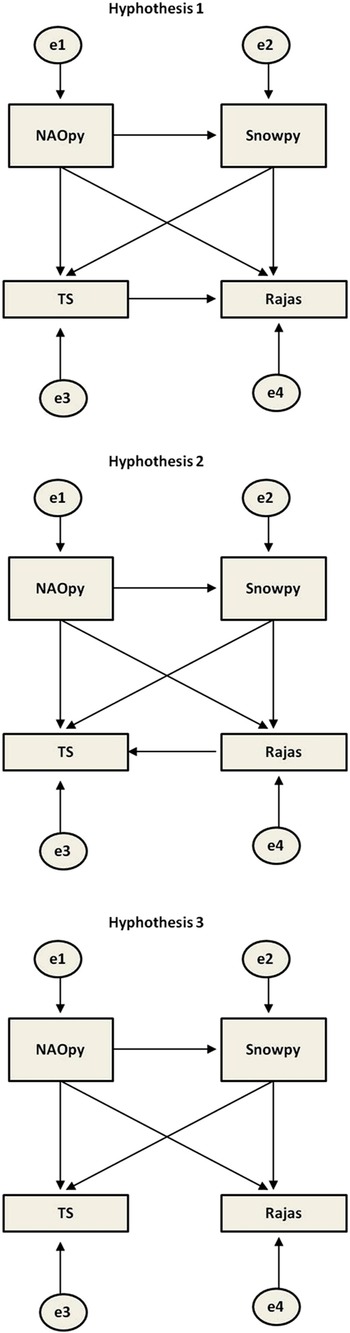
Based on these results, the following hypotheses were tested: (i) there is a negative interaction between a higher abundance of migrating tope shark and a decrease in Raja spp. mediated by the negative NAO and accumulated snow, due to the effect of pressure associated with tope shark migration (Hypothesis 1); (ii) there is a negative interaction between a higher abundance of migrating tope shark and a decrease in Raja spp. mediated by the negative NAO and accumulated snow, due to the effect of Raja spp. migrating to deep water (Hypothesis 2); and (iii) the increase in tope sharks and decrease in Raja spp. are two independent effects derived from a single common cause mediated by the negative NAO and accumulated snow (Hypothesis 3) (Figure 4).
Path diagrams representing relationships between the North Atlantic Oscillation, Accumulated snow, and tope shark and Raja spp. landings. Three hypotheses were tested: Hypothesis 1 (negative interaction between an increased abundance of migrating tope shark and a decrease in Raja spp. mediated by the negative NAO and accumulated snow, due to the effect of pressure associated with tope shark migration); Hypothesis 2 (negative interaction between an increased abundance of migrating tope shark and a decrease in Raja spp. mediated by the negative NAO and accumulated snow, due to the effect of Raja spp. migrating to deep water); and Hypothesis 3 (the increase in tope sharks and decrease in Raja spp. are two independent effects derived from a single common cause mediated by the negative NAO and accumulated snow). Key: North Atlantic Oscillation in the previous year (NAOpy), Accumulated snow in the previous year in l m−2 (Accumulated Snowpy), tope shark landing (TS), Raja spp. landings (Rajas).

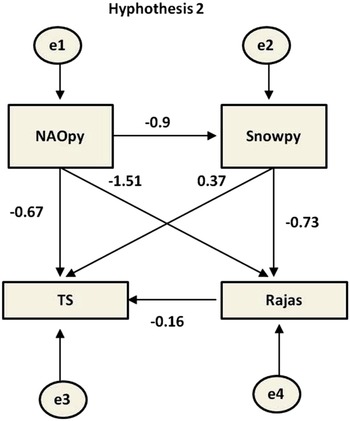
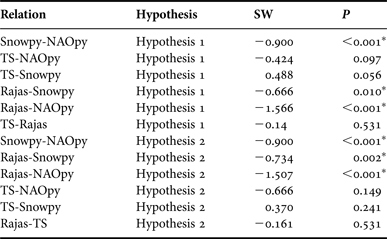
Structural equation modelling showed that Hypothesis 3 was not significant, whereas Hypothesis 2 had the greatest explanatory power (Figure 5, Table 3).
Path diagram of Hypothesis 2 (negative interaction between an increased abundance of migrating tope shark and a decrease in Raja spp. mediated by the negative NAO and accumulated snow, due to the effect of Raja spp. migrating to deep water), taking into account the most consistent and greatest standardized weights. Key: North Atlantic Oscillation in the previous year (NAOpy), Accumulated snow in the previous year in l m−2 (Accumulated Snowpy), tope shark landings (TS), Raja spp. landings (Rajas).

Standardized weights (SW) and statistical significance (P) of regression from the two significant hypotheses (Hypothesis 1 and Hypothesis 2). Key: North Atlantic Oscillation in the previous year (NAOpy), Accumulated snow in previous year in l m−2 (Accumulated Snowpy), tope shark landings (TS), Raja spp. landings (Rajas), Hypothesis 1 (negative interaction between an increased abundance of migrating tope shark and a decrease in Raja spp. mediated by the negative NAO and accumulated snow, due to the effect of pressure associated with tope shark migration), and Hypothesis 2 (negative interaction between an increased abundance of migrating tope shark and a decrease in Raja spp. mediated by the negative NAO and accumulated snow, due to the effect of Raja spp. migrating to deep water). Significant correlations are indicated by asterisks.

DISCUSSION
The results indicate that the local abundance of tope shark and Raja spp. could be mediated by the NAO in the previous year. This study is limited by the fact that the landings involved different gear types and different landing harbours; furthermore, data on the fisheries activity by gear type was not available. However, the inter-annual variation in the ratio of Raja spp. to tope shark (TRP) is not mediated by the fisheries activity, because this ratio ultimately depends on the relative abundance of these taxa in the area and both species are captured using the same gear. In summary, climatic oscillations have an influence on the regime shifts between these two taxa in the Alboran Sea, given that transformed TRP is correlated with total snow in the North Alboran watershed in the previous year, and that total snow in the North Alboran watershed for a given year is associated with the average NAO index for this year.
Few studies have investigated the dependence of deep-sea communities on biological and physical processes in near-shore pelagic environments mediated by large-scale atmospheric phenomena (for example, see Menge et al., Reference Menge, Daley, Wheeler, Dahlhoff, Sanford and Strub1997; Ruhl & Smith, Reference Ruhl and Smith2004; Maynou, Reference Maynou2008, Reference Maynou, Vicente-Serrano and Trigo2011; Meynecke et al., Reference Meynecke, Grubert, Arthur, Boston and Lee2012). Similar to the results of this study, strong associations have been found between deep-water animal landings in the Mediterranean Sea and the NAO. For example, Maynou (Reference Maynou2008) found an association between the annual abundance of red shrimp (Aristeus antennatus) and the NAO, and Báez et al. (Reference Báez, Macías, De Castro, Gómez-Gesteira, Gimeno and Real2014) found an association between blackspot seabream (Pagellus bogaraveo) landings in the Strait of Gibraltar and the NAO. In both cases, decreased rainfall during positive NAO years may increase water-mass mixing in the north-west Mediterranean, enhancing meso-zooplankton production and moving food resources to deeper areas, especially in late winter (Maynou, Reference Maynou2008; Báez et al., Reference Báez, Macías, De Castro, Gómez-Gesteira, Gimeno and Real2014).
Nevertheless, the process in the present case is more complex because it involves the highly migratory tope shark. The NAO index can be positive or negative. It is widely known that the positive phases of the NAO cause higher than average westerly winds across northern mid-latitudes with a dry climate (e.g. the Iberian Peninsula), whereas the negative phases of the NAO cause greater precipitation in the Iberian peninsula (Hurrell, Reference Hurrell1995; Vicente-Serrano & Trigo, Reference Vicente-Serrano and Trigo2011; Báez et al., Reference Báez, Gimeno, Gómez-Gesteira, Ferri-Yáñez and Real2013a). Thus, the negative NAO phase favours rainfall and snowfall, whereby snowmelt increases the flow of land-based nutrients into the sea, which could increase plankton productivity. In this context, the negative NAO phase has been implicated as driving nutrient-induced blooms along the coast of the Iberian Peninsula (e.g. Martínez-García et al., Reference Martínez-García, Fernández, Álvarez-Salgado, González, Lønborg, Marañón, Morán and Teira2010).
Raja spp. migrate over short distances from deeper waters in autumn and winter to shallower areas in spring (Froese & Pauly, Reference Froese and Pauly2011). According to the present results, the negative NAO phase could induce Raja spp. migrations into deeper waters. Thus, the shallower waters could be occupied by migrating tope sharks.
The main characteristic of the Alboran Sea fishery fleet is that it is determined by marine traffic. The Alboran Sea is a globally important area for marine traffic, because it is an important corridor that connects the Mediterranean Sea with the Atlantic Ocean and is used by 25% of global maritime traffic (Robles, Reference Robles2007). Thus, despite the wealth of fisheries in this area, large industrial fleets do not use the Alboran Sea and the main fishing grounds are close to the coast (Báez et al., Reference Báez, Real, Camiñas, Torreblanca and Garcia-Soto2009). Thus, an early migration of Raja spp. mediated by the NAO, which would increase the depth of its distribution, could make Raja spp. inaccessible to most fishing gear operating in the Alboran Sea.
It is widely accepted that the planet is currently experiencing a period of rapid global warming (e.g. Oreskes, Reference Oreskes2004), which is primarily driven by human activity (e.g. Keller, Reference Keller2007). This global trend could affect the future regional impact of the NAO (Vicente-Serrano et al., Reference Vicente-Serrano, Trigo, López-Moreno, Liberato, Lorenzo-Lacruz, Beguería, Morán-Tejeda and El Kenawy2011) and thus its effect on marine ecosystem dynamics.
ACKNOWLEDGEMENTS
I acknowledge the use of the Maptool program, which was used for the graphics presented in this paper. Maptool is a product of seaturtle.org. I would also like to thank two anonymous referees for their comments, Dr Ana Luz Marquez for her help in the use of Path-ways software, and Simon Coxon for style corrections.
FINANCIAL SUPPORT
This study was partially funded by contract no. 44/2013 with IUCN-Med in the framework of the project P00863-consultant ‘RAC/SPA MedOpenSeas’: MoU no. 7/RAC/SPA_2013 MedOpenSeas between RAC/SPA and IUCN-Med.