Suppose an individual does something seemingly clever: it may leave a food patch when its intake rate falls below the current average in its habitat, recognize a rare item as food, build a complicated nest, bite through a liana to allow a tree to be bent by the animal’s weight and so get it into the next tree, or use a tool to extract hidden food from a matrix. How do we explain such behavior?
There are three basic possibilities. First, the behavior can reflect a long history of natural selection, and be largely innate, i.e., based on strong intrinsic predispositions, perhaps additionally honed by individual practice. If there is learning involved, it is highly prepared, much like imprinting. Second, it may be individually learned, based on one of the well-documented powerful conditioning processes, such as trial-and-error during exploration. Third, the behavior may be acquired through social learning, by attending to the behavior of more knowledgeable conspecifics. In many real-world cases, there may be some mix, in that some innate predispositions produce a bias toward a particular kind of asocial or social learning, but in the latter case, the learning remains essential to acquiring the adaptive behavior.
Historically, ethologists tended to assume the first option (Lorenz, Reference Lorenz1981; Tinbergen, Reference Tinbergen1951), comparative psychologists plumped for the second option (Shettleworth, Reference Shettleworth2010), whereas anthropologists and developmental psychologists generally go for the third option (Geertz, Reference Geertz1973; Tomasello, Reference Tomasello1999). Notice that those who study animals tend to expect strong genetic foundations and little learning, but where it happens, assume individual learning, whereas those who study humans automatically expect cultural processes to underlie our cognitive abilities.
These traditional default models are tenacious. Behavioral ecologists, the heirs of ethology, still tend to make optimization arguments based on general models of animal behavior, and then implicitly or explicitly assume that natural selection will have provided the individuals with ‘rules of thumb’ that will on average produce near-optimal behavior (Krebs & Davies, Reference Krebs and Davies1978). These rules of thumb are assumed to be largely innate. In practice, however, there is actually little evidence for this, except for life-history switches or situations with acute threats to life and limb (Kacelnik, Reference Kacelnik, Hammerstein and Stevens2012). Since behavioral ecologists, like the ethologists before them, spend much time in the field, it is clear that learning, be it social or asocial, is not easily noted in non-manipulated field conditions.
Things are changing, however. West-Eberhard (Reference West-Eberhard2003) noted that “learning is a neglected aspect of adaptive evolution,” and various fieldworkers have begun to argue that birds and mammals are more like humans than commonly thought, in that they acquire many of their skills through learning (Lefebvre, Reference Lefebvre2011; Lefebvre, Reader, & Sol, Reference Lefebvre, Reader and Sol2004; Reader & Laland, Reference Reader and Laland2002; Schuppli, Meulman et al., Reference Schuppli, Meulman, Forss, Aprilinayati, van Noordwijk and van Schaik2016). The next section of this paper will be devoted to reviewing the overwhelming empirical support for the claim that far more animal behavior than traditionally assumed (and not just that of primates) is not just learned but in fact often learned socially.
This discovery is momentous, because it means we can no longer ignore the role of (social) learning in shaping an individual’s cognitive adaptations. In fact, it invites us to take seriously a more neurobiologically inspired (Anderson & Finlay, Reference Anderson and Finlay2014) perspective on the structure of cognition, namely domain-general cognition, i.e., intelligence. Over the past decade or so, it has become clear that we find evidence of intelligence in mammals (Deaner, van Schaik, & Johnson, Reference Deaner, van Schaik and Johnson2006; Matzel, Wass, & Kolata, Reference Matzel, Wass and Kolata2011; Reader, Hager, & Laland, Reference Reader, Hager and Laland2011) and birds (Lefebvre, Reference Lefebvre2011). In a subsequent section, we will connect social learning and intelligence by arguing that the evolution of intelligence is facilitated when a species shows a strong reliance on social learning as the main mode of learning. The idea arguing this is called the cultural intelligence hypothesis (van Schaik & Burkart, Reference van Schaik and Burkart2011), discussed in detail below.
This hypothesis receives empirical support from comparative studies (Graber et al., in preparation; van Schaik, Isler, & Burkart, Reference van Schaik, Isler and Burkart2012). However, as explained in the final section, we will need to complement these comparative tests with more detailed tests that include mechanisms or reliable proxies for these mechanisms. We begin this task by using the findings on vertical skill transmission in the wild to develop a functional classification of social-learning contexts in the hope that it will help us to identify the cognitive demands of the various kinds of social learning used by animals.
Vertical Skill Transmission in Nature
Social learning (more formally socially mediated learning) is commonly defined as learning under the influence of the behavior or the products of the behavior of conspecifics (or in rare cases heterospecifics, as in enculturated apes). If social learning is more efficient and less risky than individual exploration and learning, we should expect naïve animals to use this option whenever they can: they should show a preference for social learning when the choice is available. In nature, social learning from peers, be they adults or immatures (horizontal), often concerns perishable information. In contrast, immatures tend to focus on socially acquiring knowledge and skills from more knowledgeable parents (vertical) or other adults or older immatures (oblique), for the obvious reason that there is a clear asymmetry in experience. We will focus entirely on this latter constellation, because in nature most social learning of skills or knowledge will be of this sort (cf. Lehmann, Wakano, & Aoki, Reference Lehmann, Wakano and Aoki2013). In general, we therefore expect that whenever one or both parents associate with their offspring once those are out of the nest or able to move independently, young should attempt to learn socially, leading to vertical skill transmission.
The problem, as already noted above, is that it is difficult to assess the amount and kind of social learning in the wild. In this section, we review a variety of studies that together should serve to convince ourselves that social learning is abundant among animals with opportunities to do so. Because such studies cannot reveal the mechanisms, we will discuss those in a later section.
Social deprivation
The simplest prediction is that where offspring are prevented from associating with their parents, their skill set will be strongly impaired. Although such deprivation experiments are impossible in the wild because orphans will soon die, those conducted in captivity have abundantly shown major cognitive deficits in the animals involved (overview in van Schaik et al., Reference van Schaik, Burkart, Damerius, Forss, Koops, van Noordwijk and Schuppli2016). To give just one example, chimpanzees growing up in peer groups or hand-reared by humans have difficulty building proper nests or being proper mothers (Gilmer & McKinney, Reference Gilmer and McKinney2003; Videan, Reference Videan2006).
Selective attention
An obvious, albeit weak prediction, but one about which there is extensive evidence from a range of species, is that offspring pay special attention to skills or food choices shown by parents. For primates in nature, there is a wealth of studies showing this in numerous species, as compiled by Rapaport and Brown (Reference Rapaport and Brown2008). It has also been shown experimentally in aye-ayes (Krakauer, Reference Krakauer2005) and chimpanzees (Biro et al., Reference Biro, Inoue-Nakamura, Tonooka, Yamakoshi, Sousa and Matsuzawa2003).
There is also experimental evidence that ecological skills are socially learned. Thus, in a variety of birds, naïve immatures tend not to recognize their predators, and learn this from their parents when they associate with them after fledging (Griesser & Suzuki, Reference Griesser and Suzuki2016; Kullberg & Lind, Reference Kullberg and Lind2002).
Given the sheer ubiquity of such selective attention toward parental behaviors, the cases where offspring do not show any such specific interest, as expressed in co-feeding or food begging, are perhaps more informative. We are only aware of a few such studies. Thus, Krakauer (Reference Krakauer2005) experimentally showed that infant ruffed lemur (Varecia variegata) did not show selective attention to foraging adults, readily tried novel foods and never received shared or scrounged food from their parents. O’Mara and Hickey (Reference O’Mara and Hickey2012) suggested that immature ring-tailed lemurs (Lemur catta), while engaging in basic response facilitation and stimulus enhancement, did not engage much in selective co-feeding with adults, and explored independently, as shown by their much broader diet than that of adults. In this respect, these two small-brained lemurs may be different from other primates.
Skill transmission
Another prediction that is that in species with individual specialization and prolonged parent-offspring association, we should see that such specializations tend to be inherited by the offspring. Especially when these specializations are found within a single population, this strengthens the case that we are dealing with vertical social transmission. There are several well-documented examples. First, sea otters (Enhydra lutris) show extensive and persistent individual specialization in feeding behaviors and diets, with no one individual showing the full variety (Estes, Riedman, Staedler, Tinker, & Lyon, Reference Estes, Riedman, Staedler, Tinker and Lyon2003). These specializations are passed on matrilineally. Second, bottlenose dolphin (Tursiops truncatus) females show a great variety of individual feeding specializations, and these are passed on from mothers to daughters, based on social learning (Mann & Sargent, Reference Mann, Sargent, Fragaszy and Perry2003; Mann, Sargeant, & Minor, Reference Mann, Sargeant and Minor2007). None of the calves developed a feeding technique their mother did not engage in. A special example of the same vertical skill transmission is sponging, in which dolphins use a sponge as a tool to catch bottom-dwelling fish (Krützen et al., Reference Krützen, Mann, Heithaus, Connor, Bejder and Sherwin2005). Third, killer whales (Orcinus orca) show various specialized forms of feeding, such as the intentional self-beaching to capture pinnipeds observed in an Argentinian population. Mothers teach this behavior to their offspring (Guinet & Bouvier, Reference Guinet and Bouvier1995), who subsequently acquire this technique. Fourth, a more tentative case involves the Cocos finch (Pinaroloxias inornata), from the small Cocos Island off Costa Rica, which shows remarkable intra-population variation, for which observational social learning is held responsible. Finally, somewhat more anecdotal evidence concerns the inheritance of a maternal specialization on human foods in black bears (Mazur & Seher, Reference Mazur and Seher2008) or humans as prey in tigers (Kitchener, Reference Kitchener1999).
On this topic, too, there is experimental evidence. Oystercatchers (Haematopus ostralegus) show two kinds of basic foraging techniques on mussels: stabbing and hammering. Learning them takes about one year. A cross-fostering experiment by Norton-Griffiths (Reference Norton-Griffiths1969) showed that these specializations are passed on socially from parents to offspring, rather than being genetically inherited.
Repertoire inheritance
The most detailed observational prediction is that the skill set of maturing individuals will be a fairly precise copy of the skill set of the parents and may include population-specific skills that arose through innovation and are transmitted socially: culture. This prediction is implicitly confirmed by the very presence of culture that persists for more than a generation, as if now commonly seen in the various species for which culture has been described.
This prediction has been tested in wild orangutans. We could show that infants peer selectively at those food items and skills of their mothers they did not yet know and subsequently feed on them, practice selectively right after peering for skills that require practice (Schuppli, Meulman et al., Reference Schuppli, Meulman, Forss, Aprilinayati, van Noordwijk and van Schaik2016), and avoid food items not consumed by their mothers (Forss, Schuppli, Haiden, Zweifel, & van Schaik, Reference Forss, Schuppli, Haiden, Zweifel and van Schaik2015). A population with abundant opportunities for social learning had more complex skills than one with fewer such opportunities (Schuppli, Meulman et al., Reference Schuppli, Meulman, Forss, Aprilinayati, van Noordwijk and van Schaik2016) and also a larger skill repertoire (Schuppli, Zweifel, Forss, van Noordwijk, & van Schaik, Reference Schuppli, Meulman, Forss, Aprilinayati, van Noordwijk and van Schaik2016).
Similar selective attention and acquisition of specializations, but limited to tool use, has been shown for chimpanzees, Pan troglodytes (Lonsdorf, Reference Lonsdorf2005), capuchin monkeys, Sapajus apella (Coelho et al., Reference Coelho, Falótico, Izar, Mannu, Resende, Siqueira and Ottoni2015; Ottoni, de Resende, & Izar, Reference Ottoni, de Resende and Izar2005), and New Caledonian crows, Corvus moneduloides (Holzhaider, Hunt, & Gray, Reference Holzhaider, Hunt and Gray2010).
Interspecific cross-fostering
Perhaps the strongest prediction is that where offspring grow up with parents of a different species, as experimentally induced by so-called interspecific cross-fostering (ICF) experiments, they will acquire a different skill set. Many such experiments have been done in the past, although this approach has recently fallen out of favor due to ethical concerns. In many cases, these experiments focused on mate recognition and mate choice preferences in birds (Slagsvold & Wiebe, Reference Slagsvold and Wiebe2011), fishes (Verzijden & ten Cate, Reference Verzijden and ten Cate2007), and rodents (McDonald & Forslund, Reference McDonald and Forslund1978), song learning in birds (Slagsvold & Wiebe, Reference Slagsvold and Wiebe2011), or male parenting in meadow voles (McGuire, Reference McGuire1988). They were successful often enough to demonstrate an important role of association with parents in the development of song and sexual imprinting of mate preferences in a variety of species.
We know of only one experiment in which the effects of ICF on social behavior were documented. In a pioneering experiment, de Waal and Johanowicz (Reference de Waal and Johanowicz1993) placed captive juvenile rhesus macaques (Macaca mulatta) either together or amidst juvenile stumptail macaques (M. arctoides). The former species has a more dominance-oriented dominance style accompanied by lower rates of reconciliation than its more relaxed congener. The rhesus juveniles in the mixed groups became three times more conciliatory than the controls.
Although most ICF experiments in nature generally did not study the impact of association with parents on behavioral ecology, some found that migratory species adopt the migratory behavior of their foster parents (e.g., Fabricius, Reference Fabricius1991), suggesting at least that subjects follow their foster parents, which may also affect various other aspects of ecology.
We know of only two studies have directly examined the effect of ICF on diet and foraging niches, but those that did showed surprising results:
-
a. Rowley and Chapman (Reference Rowley and Chapman1986) examined inadvertent cross-fostering of one cockatoo species due to mixed clutches, where galah (Cacatua roseicapilla) young were raised by Mitchell’s cockatoos (C. leadbeateri). In general, these cross-fostered galahs identified as Mitchells’ cockatoos and continued to ignore their conspecifics when adult. They began to forage like Mitchell’s, both in terms of food choice and at least some of the special foraging techniques, acquired their vocal repertoire, and even flew like them. These effects were permanent.
-
b. Slagsvold and Wiebe (Reference Slagsvold and Wiebe2007; Reference Slagsvold and Wiebe2011) have shown that great tits (Parus major), which are habitat generalists, growing up with blue tit parents (Parus caeruleus), which are more specialized in their habitat use, permanently adopt many aspects of the latter’s foraging niche, including foraging height, foraging substrates (twigs versus trunks), and prey sizes. Blue tits growing up with great tits showed more limited changes in their niche, consistent with their being habitat specialists.
Finally, the failure of ICF experiments to affect major aspects of a species’ ecology is equally informative. Thus, Taggart et al. (Reference Taggart, Schultz, Fletcher, Friend, Smith, Breed, Temple-Smith, Coulson and Eldridge2010) found that various species of macropod marsupials eventually adopted the niche of their own species and also retained their species-specific sexual preferences. These findings may suggest that most macropods rely less on social learning to acquire their ecological niches than placental mammals.
Discussion
This combination of long-term observational field studies and field experiments strongly suggest that a wide variety of animals, including many birds and a variety of primates and other mammals, acquire critical elements of their ecological niche through social learning from the parental generation. We can deduce from this that maturing individuals will often have an innate preference for social learning.
This overview suggests that learning is far more common in nature than traditionally assumed by ethologists and behavioral ecologists. Of course, we are not the first to point this out, but the study of skill learning is not receiving much mainstream attention (Schuppli, Isler, & van Schaik, Reference Schuppli, Isler and van Schaik2012; Schuppli, Meulman et al., Reference Schuppli, Meulman, Forss, Aprilinayati, van Noordwijk and van Schaik2016). The overview also strongly implies that the classical paradigm of learning – the individual separated from others in some standardized learning device, such as a Skinner box, to exclude confounding effects – does not reflect the natural situation for many, perhaps even most, birds and mammals. As a result, although the mechanisms revealed by learning theory are almost certainly correct, these experiments do not paint a full picture of learning in nature.
Taken together, this body of evidence suggests that social learning in nature goes well beyond sexual imprinting and song learning, and may in fact be an essential part of development in many species. This finding is of course consistent with the success of most experimental tests of social learning, not just among primates (Custance, Whiten, & Fredman, Reference Custance, Whiten and Fredman2002), but also among birds (Lefebvre & Bolhuis, Reference Lefebvre, Bolhuis, Reader and Laland2003) and even turtles (Wilkinson, Kuenstner, Mueller, & Huber, Reference Wilkinson, Kuenstner, Mueller and Huber2010).
A strong reliance on social learning makes good functional sense. Too many rigid innate predispositions lead to inflexible diets and great risk of starvation, and so to poor local adaptation. Too few innate predispositions without social learning produce a long period of highly inefficient and especially risky trial and error. But if the expert to whom the naïve individual is attending is reliable, social learning can greatly enhance the efficiency of acquitting locally relevant skills and knowledge. It is no coincidence that the operational criterion for demonstrating social learning is that a subject learns something faster than in the control, which is the individual-learning situation. Of course, this does not imply the absence of innate predispositions. Without them, systems are bound to drift away from optima. Even so, the point remains that social learning is an adaptive strategy to acquire the species-specific skills and knowledge faster than otherwise possible and achieve a better fit to local conditions in a broad array of species.
We found remarkably few probable cases where animals did not seem to use the opportunities afforded by intergenerational association to engage in social learning: in lemurs and macropod marsupials. At present it is probably best to withhold judgment on these cases until more quantitative information is available (see below).
Social learning and the evolution of intelligence
Having established the use of some form of social learning by numerous organisms with overlapping and associating generations, we can now examine the implications of this fact for the evolution of problem-solving or innovative ability, in other words intelligence (Lefebvre, Reference Lefebvre2011). The most obvious way of thinking about the evolution of intelligence is that some animals simply became better at solving problems than others because this was adaptive. This is possible when the costs of spending time learning, in terms of the allocation of attention and the energetic maintenance of the requisite nervous tissues, are compensated by the improved survival or reproduction enabled by the innovations. However, this traditional scenario faces some problems.
First, in the absence of social learning, the successful innovations are not transmitted to the next generation, which therefore will merely inherit the genetic potential to make innovations but not the actual beneficial innovations. Innovations that arise rarely but are quite beneficial will therefore provide their inventors only with a one-off fitness benefit. Obviously, if there is a way to make the developmental process of gaining experience more efficient, then natural selection should favor this. Second, we now know that some of the most intelligent species strongly avoid novelty and are not the curious explorers the standard approach makes them out to be (Forss et al., Reference Forss, Schuppli, Haiden, Zweifel and van Schaik2015; van Schaik et al., Reference van Schaik, Burkart, Damerius, Forss, Koops, van Noordwijk and Schuppli2016). However, this approach has trouble explaining large innovation repertoires without a strong motivation to explore. These problems are resolved when both skills and innovative ability are acquired through socially elicited individual learning. Thus, although intelligence can evolve up to a particular level along the asocial pathway envisaged by the traditional account, it can reach far higher levels if social transmission is involved.
To illustrate this point, imagine two species or populations that are similar in all respects, except that one is more sociable, and thus its members have more abundant opportunities for social learning. Also imagine that this difference, being ecologically grounded, persists for numerous generations. Given the increased efficiency of social learning, and given the larger size of skill repertoires afforded by more plentiful opportunities for social learning, one expects the more sociable population to be under greater selection to improve their ability to acquire the skills present in its population, so as to acquire them sooner and make sure to acquire all of them. The actual selection can be on social learning abilities, but also on parental tolerance for close association, longer pre-dispersal periods, or even teaching.
Such selection will make animals better social learners, but that is not the whole story. It is becoming increasingly clear that we should not think of social learning as something distinct from individual (asocial) learning, but instead should see it as a specific input filter for the latter (Behrens, Hunt, Woolrich, & Rushworth, Reference Behrens, Hunt, Woolrich and Rushworth2008; Heyes, Reference Heyes2012). In other words, social learning involves the combination of two closely integrated processes: a first, social one that decides whether and where exactly to direct the individual’s active attention and a second one that deploys the individual-learning abilities the animal has at its disposal. This applies not just to stimulus or local enhancement, but even to the cognitively most demanding forms of social learning, production imitation, where complex unfamiliar actions are copied.
There are two reasons for this. First, in many cases in nature, it is impossible for the learner to imitate detailed actions. Think of learning how to remove honey from a stingless bees’ nest inside a tree-hole using a stick (cf. van Schaik et al., Reference van Schaik, Ancrenaz, Borgen, Galdikas, Knott, Singleton and Merrill2003). One can only see the expert’s actions from the outside, but cannot perceive the feedback from inside the tree-hole that guides particular actions. As a result, in nature, imitation is always accompanied by practice, clearly temporally contingent on the expert’s action, in an oft-repeated cycle (Galef, Reference Galef2015; Jaeggi et al., Reference Jaeggi, Dunkel, van Noordwijk, Wich, Sura and van Schaik2010; Schuppli, Meulman et al., Reference Schuppli, Zweifel, Forss, van Noordwijk and van Schaik2016; Whiten, Reference Whiten2015). Second, even when actions are perfectly visible, it is often impossible to copy them without explicit instructions, lengthy practice, or both, because the learner must learn the full sequence of coordinated actions that lead to a goal, not a single action (Byrne & Russon, Reference Byrne and Russon1998). A nice example of such program-level imitation is trying to learn to tie one’s shoes. If one does not know how to do so, watching someone do it does not suffice to learn it.
The view that socially elicited individual learning is a critical component of all social learning is a fundamental assumption of the cultural intelligence hypothesis. Developmental evidence supports this view: social deprivation (or enculturation) experiments have shown dramatic declines (or improvement) in individual learning ability in a variety of species from rodents to primates (van Schaik & Burkart, Reference van Schaik and Burkart2011).
As a result, selection on social learning necessarily implies improved individual learning: the individuals automatically also become better problem solvers. Over time, when opportunities for social learning during development are plentiful, this process may potentially generate a positive evolutionary feedback loop (depending on the net fitness benefits of accumulating the various skills). This is a key prediction of the cultural intelligence hypothesis (van Schaik, Reference van Schaik2006; van Schaik & Burkart Reference van Schaik and Burkart2011; Whiten & van Schaik, Reference Whiten and van Schaik2007). Developmental psychologists will recognize the logic, since it is a generalized and evolutionary version of the argument proposed specifically and exclusively for humans by Vygotsky (Reference Vygotsky1978) and especially Tomasello (Reference Tomasello1999).
Interestingly, this perspective suggests that the original adaptive significance of intelligence is that it enables immatures to acquire as much of the population’s skill pool as fast as possible, thus preparing them for adult life, rather than the production of ever more sophisticated innovations. In fact, the latter may rarely arise as a consequence of curious exploration (van Schaik et al., Reference van Schaik, Burkart, Damerius, Forss, Koops, van Noordwijk and Schuppli2016; but see Tebbich, Griffin, Peschl, & Sterelny, Reference Tebbich, Griffin, Peschl and Sterelny2016). But obviously, the adaptive significance of intelligence has become that it allows the animal to behave flexibly rather than simply get stuck in routines (Byrne, Reference Byrne1995). Indeed, comparative studies in birds and primates have shown innovative ability, which reflects individual-learning ability, to be correlated with brain size (Lefebvre et al., Reference Lefebvre, Reader and Sol2004; Reader & Laland, Reference Reader and Laland2002; Sol, Duncan, Blackburn, Cassey, & Lefebvre, Reference Sol, Duncan, Blackburn, Cassey and Lefebvre2005; Timmermanns, Lefebvre, Boire, & Basu, Reference Timmermans, Lefebvre, Boire and Basu2000), which is a good proxy for intelligence (cf. Deaner, Isler, Burkart, & van Schaik, Reference Deaner, Isler, Burkart and van Schaik2007; Reader et al., Reference Reader, Hager and Laland2011).
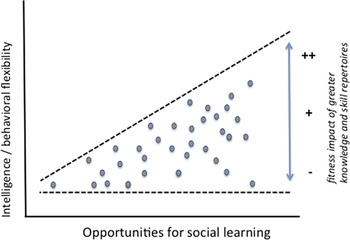
How can this hypothesis explain the immense variation in intelligence and brain size across lineages and species within lineages? Of course, species may vary in the opportunities for social learning, varying from having no contact between generations all the way to growing up in a highly sociable group in which all adults are highly tolerant or even teach immatures. But this is not the whole story, as illustrated in Figure 1. The process of increased learning abilities and skill levels in the presence of increased opportunities for social learning will stop when the fitness costs due to opportunity costs (time spent learning, risk of learning) or the delay in reaching adulthood (the investment in the brain tissue needed to support this ability competes with growth) begin to outweigh the fitness benefits of larger skill repertoires and improved innovation ability. Where this point lies may vary from species to species, depending on details of their ecology, such as unavoidable predation, disease or starvation. Thus, some species may end up having very limited intelligence even at abundant opportunities for social learning. It all depends on the fitness benefits of learned skills and the costs of acquiring them.
The cultural intelligence hypothesis: Over evolutionary time, a species’ intelligence is will depend on the opportunities for social learning (time in association, social tolerance, number of experts, and role of experts) experienced by its immatures. Whether a species actually fulfills this potential and evolves greater intelligence when these opportunities exist depends mainly on the fitness effects of increased skills and cognitive performance.

Critical tests of the central prediction of the cultural intelligence hypothesis – an evolutionary feedback-loop between abundance of social learning opportunities and intelligence – will necessarily be comparative. At present, we only have a few such tests. They concern birds, where post-fledging association time as a proxy of opportunities for (social) learning is correlated with relative brain size, when controlling for a large variety of confounding variables (Graber et al., in preparation; van Schaik et al., Reference van Schaik, Isler and Burkart2012) and solitary carnivores, where time remaining with the parent post-weaning is correlated with relative brain size (van Schaik et al., Reference van Schaik, Isler and Burkart2012). While these outcomes are promising, they remain indirect. They test the potential for vertical skill transmission against brain size, rather than relating estimates of actual skill transmission to intelligence or problem-solving ability.
More definitive tests require measurement of the importance of vertical and oblique skill transmission in the wild in relation to intellectual abilities. Because the review showed that almost all studies show evidence for social learning, we need more quantitative measures of social learning, and especially of the use of the various kinds of social learning, which vary in efficiency but also in cognitive difficulty.
An important requirement for more refined tests, therefore, is the presence of methods that can estimate the relative importance of the social-learning profile of a given species. In the final section, we present a first attempt to develop a field-based system of social-learning categories that can be validated and refined in future work.
Estimating a species’ social-learning profile
To make progress, we need to identify the full range of social-learning mechanisms used by a species under naturalistic conditions. There has been virtually no work on this. For obvious reasons, most work on identifying the mechanisms involved in social learning during the past 40 years or so has been conducted in the laboratory, whereas field experiments have focused on patterns of transmission (Kendal, Galef, & van Schaik, Reference Kendal, Galef and van Schaik2010). They were inspired by the question of animal culture and thus did not focus on identifying mechanisms. The main obstacle to progress is that we cannot easily identify the mechanisms through observation only. What we can identify are the contexts in which immatures engage with novel tasks, practice skills or adopt new behaviors or new choices.
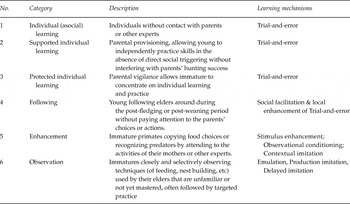
Our task, then, is to recognize these contexts in nature and to identify the mechanisms corresponding to these contexts. Ideally, these mechanisms are ranked by the cognitive demands they place on the learner. Although the experimental work has led to various classification systems of social-learning mechanisms (e.g., Subiaul, Reference Subiaul2007; Whiten, Horner, Litchfield, & Marshall-Pescini, Reference Whiten, Horner, Litchfield and Marshall-Pescini2004), there is no consensus, and it is hard to clearly demarcate them and identify their underlying cognitive abilities (Hoppitt & Laland, Reference Hoppitt and Laland2013). Here, inspired by Hoppitt and Laland’s (Reference Hoppitt and Laland2013) discussion, we propose a preliminary order of mechanisms, corresponding to contexts (Table 1).
The social learning spectrum: a functional classification of categories of vertical and oblique social learning found in nature. From top to bottom, the social input, and thus efficiency of transmission, increases, as does the cognitive demands of the mechanism involved

At the lower end is fully individual or asocial learning. Minimal social inputs are also found in supported learning, where the learner is provisioned by others so it can learn without suffering the costs. Next is protected learning. Again, the learner learns independently, but relies on the vigilance of experts so it can concentrate on learning. In all these cases, social inputs are minor, and what the learner acquires is mainly dependent on its own innate predispositions. The next class is following, where the learner’s use of space is biased because it follows experts around. There is therefore stronger social influence on the choices of the learner, but still no direct inputs. In the final two categories, there are direct social inputs, in that the learner closely associates with the experts and attends to the their behavior. In enhancement, the learner attends to the items the expert engages with, whereas in the case of observation, the learner attends to the actual actions or action sequences of the experts.
Although this classification of Table 1 is basically functional, the ranking involves ever more direct social inputs and ever closer and more detailed attention to the expert’s actions, and thus potentially greater efficiency of the transmission of specific actions and thus skills that are novel to the learner. There is some support for the assumption that they vary systematically in cognitive demand: across species, the presumed cognitive complexity of the kinds of social learning employed is correlated with innovative ability and relative brain size (review: van Schaik & Burkart, Reference van Schaik and Burkart2011). More difficult actions should therefore only be transmitted if the learner uses the higher-level mechanisms, which in turn require specific contexts. In the same direction, we also expect the need for longer and especially more tolerant association with one or more parent or caregivers to increase.
We now present the preliminary categories.
Individual (asocial) learning
All learning happens in the complete absence of contact between the generations, and no vertical and oblique social learning is therefore possible. This is the case in many invertebrates, many fishes, and most reptiles and amphibians.
Among avian and mammalian species, this is much less common, and this ‘control’ situation will be rare. Exceptions include many birds foraging on open sea as well as species of the family Megapodiidae. In fact, the latter’s offspring grow up without any parental care, dispersing immediately after hatching, and seem not to rely on social learning during development. A study in brush-turkeys (Alectura lathami) has shown that they do not even use opportunities for social learning when these are offered experimentally (Göth & Evans, Reference Göth and Evans2005). In general, this suggests that in those species any skills are either genetically predisposed or learned through exploration based on trial-and-error.
Supported individual learning
In supported individual learning, the offspring learn largely independently, but continue to be provisioned at some level by one or both parent during this period, allowing them to be highly inefficient. The only precondition is cohabitation on the same territory or regular encounters with the parent(s) in species without individual territories. There are therefore no direct social inputs into learning.
Studies of Eurasian dippers (Cinclus cinclus) and white-breasted mesites (Mesitornis variegata) have shown that individuals relying more on parental provisioning showed delayed dispersal and were more successful in the usage of complex foraging techniques (Gamero & Kappeler, Reference Gamero and Kappeler2015; Yoerg, Reference Yoerg1998). Various other cases presumably fit this category as well. Thus, immature gulls hunt basically independently even when in association with adults, but are less efficient in their dives, prey capture and handling (MacLean, Reference MacLean1986), and are less successful in klepto-parasitism (see also Burger & Gochfeld, Reference Burger and Gochfeld1981).
In carnivores hunting alone, success would be severely compromised when inexperienced young would accompany their mother. Thus, adults often return live prey to young to practice their prey killing and handling and perhaps learn other features of prey. This amounts to teaching (Thornton & Raihani, Reference Thornton and Raihani2008).
Protected individual learning
The third category is protected individual learning, where the expert vigilance provided by the parents provides the offspring with more opportunities for individual exploration and learning (i.e., trial-and-error). In these cases, prolonged parent-offspring association is therefore a necessary precondition for full skill acquisition, so the parent needs to tolerate the offspring nearby. However, close-range association and visual inspection of parental actions is not present. This may be especially important where individual practice is a major component for skill acquisition, even if the skills themselves have major innate components, such as prey capture and handling.
In birds, several studies have shown that parental protection alleviates the trade-off between vigilance and foraging in offspring, and thus increases their opportunities for skill learning (Alonso & Alonso, Reference Alonso and Alonso1993; Gamero & Kappeler, Reference Gamero and Kappeler2015; Heinsohn, Reference Heinsohn1987). Many studies provide indirect evidence for protected individual learning, such as the acquisition of shell-cracking in herring gulls (Larus argentatus, Ingolffson & Estrella, Reference Ingolfsson and Estrella1978) or attacking prey in loggerhead shrikes (Lanius ludovicianus, Smith, Reference Smith1973), where the young individuals feed near their parents but do not observe killing and food handling in adults, implying largely individual learning. Where parents provide both vigilance and provision, both categories apply simultaneously.
Following
The fourth category is following, where maturing individuals are in close association but do not directly engage in any social learning. This category exposes individuals to particular microhabitats, and thus to a particular predation risk and particular food items. For instance, some birds or primates prefer to forage high in tree canopies, whereas others forage near or on the ground under trees; some may go into more open parkland whereas others stay in dense forest. Immatures thus automatically develop a skill set through local enhancement, as a result of the travel decisions made by the individuals they follow. In some species, parents actually call their offspring to good foraging spots.
A study in Northwestern Crows (Corvus caurinus) shows that fledglings follow their parents to the appropriate food patches, targeting clams of similar size as the parents. However, the refined prey handling to crack-open the shells seems to need extensive practice based on trial-and-error (Richardson & Verbeek, Reference Richardson and Verbeek1987). A similar form of local enhancement learning is observed in white-tailed ptarmigans (Lagopus leucurus), where the parent calls the chicks to patches with specific plants, where they then start with predisposed pecking (Allen & Clarke, Reference Allen and Clarke2005). Juvenile marsh harriers (Circus aeruginosus) hunt more successfully when following adults around than when foraging alone (Kitowski, Reference Kitowski2009). The previous example of ICF with the two tit species (Slagsvold & Wiebe, Reference Slagsvold and Wiebe2007) also illustrates this category.
Obviously, animals are unlikely to learn more complicated skills this way. Indeed, they need not even feed on the same foods, since the extent of co-feeding will depend on food-patch size. Likewise, this category excludes behaviors like close-range adult-directed behaviors such as peering or sniffing, or begging and sharing.
Enhancement
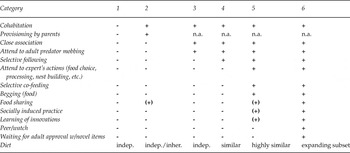
The last two categories are usually considered social learning in the strict sense. Enhancement involves attention to objects or places where experts were active. Burkart, Kupferberg, Glasauer, and van Schaik (Reference Burkart, Kupferberg, Glasauer and van Schaik2012) suggested for marmosets (Callithrix jacchus) that to elicit stimulus enhancement the expert must be engaged in goal-directed activities. This kind of social learning does not require close proximity or detailed observation of the expert’s actions, but it does require visual social attention and also suggests action-elicited focused activity. It may also involve begging and food sharing (e.g., Jaeggi, van Noordwijk, & van Schaik, Reference Jaeggi, van Noordwijk and van Schaik2008). The social element is that it defines which parts of the environment to pay special attention to. The part of the skill repertoire for which this mechanism is relied on should be a gradually expanding skill set of that of the elders. This category cannot always be separated from the next one (see Table 2).
A preliminary attempt to recognize social-learning mechanisms by listing the behavioral indicators for each of the functional social-learning categories

Observation
The final category is observational learning, where the learner actually pays attention to what the expert is doing, either its actual actions (imitation), the outcomes of these actions (emulation), or the expert’s goals. Here there must be close-range attention or social interaction, such as begging, and the actions must be complex and unfamiliar enough to warrant the observations of the actual actions. Because of the actions’ complexity, observation is usually followed by selective practice (Jaeggi et al., Reference Jaeggi, Dunkel, van Noordwijk, Wich, Sura and van Schaik2010; cf. Schuppli, Meulman, et al., Reference Schuppli, Meulman, Forss, Aprilinayati, van Noordwijk and van Schaik2016). Attention should cease once the learner has acquired the skill.
Discussion
This classification must be tested by naturalistic observations on a wide set of species. The connection with the cognitive complexity of the mechanisms must be validated by looking for the presence of indicators in the field that have been validated as being characteristic for the mechanisms in controlled conditions. A preliminary set of indicators is presented in Table 2. Once the categories are validated, one can estimate the frequencies of the various categories used by immatures in a given species, to estimate its (vertical/oblique) social learning profile. Given the controversy over mechanisms of social learning, perhaps the best way to validate is to examine the complexity of what is actually socially learned: choice of habitat or micro-habitat or locality, choice of items to attend to, simple, but novel actions, and complex novel actions (action sequences).
Conclusion
The studies reviewed above support the notion that socially supported skill learning is important in a large range of birds and mammals. This is in line with the cultural intelligence hypothesis. Preliminary comparative tests using proxy measures confirm its predictions, but more detailed work is needed. This work should focus on detailed species comparisons that link a species’ problem-solving ability or relative brain size to its skill acquisition pattern in a variety of domains (food, predation, shelter production, communication, locomotion, migration, etc). The functional categorization presented here, arranged in a spectrum of intensity of social inputs and cognitive complexity of the social-leaning mechanisms, is meant as a first step in this direction.
Tests can then examine the effect of opportunities for social learning to a species’ category-profile and its brain size or performance in standardized cognitive test batteries, while controlling for the effects of opportunities for selective attention and practice (perhaps affected by predation risk) and the presence of teaching (Thornton & Raihani, Reference Thornton and Raihani2008).