INTRODUCTION
In accordance with European law, various international agreements address whales and dolphins as species of community interest in need of defined conservation, research and strict protection from exploitation. The IUCN (International Union for Conservation of Nature) Red List of Threatened Species criterion A2dce (Bearzi et al., Reference Bearzi, Holcer and Notarbartolo di Sciara2004, Reference Bearzi, Fortuna and Reeves2012; IUCN, 2016) presently lists the common bottlenose dolphin (Tursiops truncatus Montagu 1821) (hereafter ‘bottlenose dolphin’) as vulnerable in the Mediterranean Sea. In the Adriatic Sea alone, the population declined by as much as 50% in the second half of the 20th century due initially to deliberate killing (Bearzi et al., Reference Bearzi, Fortuna and Reeves2008). This was followed by habitat degradation and overfishing as cited in several references in the 2014 UNEP (United Nations Environment Programme) report regarding conservation of cetaceans in the Adriatic Sea (UNEP-MAP-RAC/SPA, 2014). Upon entering the European Union in September 2013, Croatia was tasked with aligning national laws with the EU's legislated pact, such as in NATURA 2000, to recognize protected flora and fauna sites. The NATURA 2000 network is the EU's main nature and biodiversity policy to protect the most threatened habitats and species across Europe and is listed under the Birds Directive (Directive 2009/147/EC) and Habitats Directive (Council Directive 92/43/EEC). Within NATURA 2000s recommendations, the Croatian region of Istria is the only site designated for the protection of marine mammals, and, therefore, bottlenose dolphins. To reinforce the conservation of regularly present bottlenose dolphins off the west coast of Istria, a site with the number HR 5000032 was established (Hrvatska Agencija za okoliš i prirodu, 2016), extending from the middle geographic part of Istria towards the south and reaching around its southernmost promontory, Cape Kamenjak. However, current, official NATURA 2000 data suggest the deficiency of the local dolphin population data off the west coast of Istria, where the category is used when the population size cannot even be roughly estimated (NATURA 2000, 2016).
Whilst there is no Adriatic agreement on the protection of biodiversity in the basin, several initiatives do exist, such as the Adriatic-Ionian Initiative between countries around the Adriatic (including Greece) or NETCET (Network for the Conservation of Cetaceans and Sea Turtles in the Adriatic) project, which ended in 2015, representing a cross-border collaboration platform. Furthermore, there is a Marine Strategy Framework Directive 2008/56/EC that aims to achieve Good Environmental Status (GES) in all EU marine waters by 2020 and the European Commission's NATURA 2000.
Due to its geomorphological setting, the Adriatic Sea is identified by many research bodies as one of the most worthy of protection in the Mediterranean basin (UNEP-MAP-RAC/SPA, 2015). It is ecologically sensitive, being semi-enclosed, with 783 km prolonged indentation in the European continent and connected with the Mediterranean Sea at the south through the 72 km wide Strait of Otranto. In relation to its size and productivity, and due to its oceanographic characteristics, the Adriatic is probably one of the most intensely fished areas, with a high commercial value. The region faces major impacts from over-fishing, pollution and maritime use that are still insufficiently managed at both national and international levels (Ferretti et al., Reference Ferretti, Myers, Serena and Lotze2008; UNEP, 2015). Additionally, the research area off Istria has political boundaries divided between Croatia to the south, Slovenia to the far north and Italy to the west.
Some geographic and distribution studies of Cetaceans have been done already along the east Adriatic coast, including studies of the identified long-term resident communities of bottlenose dolphins (Gomerčić & Huber, Reference Gomerčić, Huber and Grgić1989; Notarbartolo di Sciara et al., Reference Notarbartolo di Sciara, Bearzi and Bonomi1991; Bearzi et al., Reference Bearzi, Notarbartolo di Sciara and Politi1997; Gomerčić et al., Reference Gomerčić, Huber, Gomerčić and Gomerčić1998, Reference Gomerčić, Đuras Gomerčić, Gomerčić, Škrtić, Ćurković, Lucić, Galov, Vuković and Huber2004; Ribarič, Reference Ribarič2002, Reference Ribarič2003; Ribarič & Robinson, Reference Ribarič and Robinson2006; Fortuna, Reference Fortuna2007; Ribarič & Herlec, Reference Ribarič and Herlec2008; Pleslić et al., Reference Pleslić, Rako Gospić, Mackelworth, Wiemann, Holcer and Fortuna2013), however data for the west coast off Istria are completely missing. Studying dolphin abundance and determining distribution of the individuals are important for their long-term conservation (Shane, Reference Shane1980). Systematic observation and mark–recapture photo identification method in the recognition of individual animals are among the most important methods to obtain quality data. They enable life history and animal ecology studies, as well as estimations of the population size based on the individual sighting history (e.g. Seber, Reference Seber1982; Schwarz & Seber, Reference Schwarz and Seber1999; Whitehead et al., Reference Whitehead, Cristal, Tyack, Mann, Connor, Tyack and Whitehead2000; McCrea & Morgan, Reference McCrea and Morgan2015).
Baseline information is required for the estimation of potential threats in order to implement sustainable management plans for the protection of these last resident marine mammals. Especially more so, as it is evident from past experience that due to the lack of effective management two species of dolphins, the striped dolphin (Stenella coeruleoalba) and the short beaked common dolphin (Delphinus delphis), are no longer present in the North Adriatic (IUCN Red List of Threatened Species, 2016).
The aim of the present study is to provide a first insight into the ecology of the local bottlenose dolphin population off the west Istrian coast in the North-eastern Adriatic Sea where the above-mentioned factors might negatively influence these apex animals (Kolarić et al., Reference Kolarić, Đuras and Gomerčić2011). Therefore obtaining knowledge about dolphins’ abundance, distribution and population dynamics is of crucial importance for the sensitive marine ecosystem under investigation (Krebs, Reference Krebs2016). Data from this study can further be linked with the existing practices where local populations are currently managed separately.
MATERIALS AND METHODS
Mark–recapture photo-identification surveys and data collection
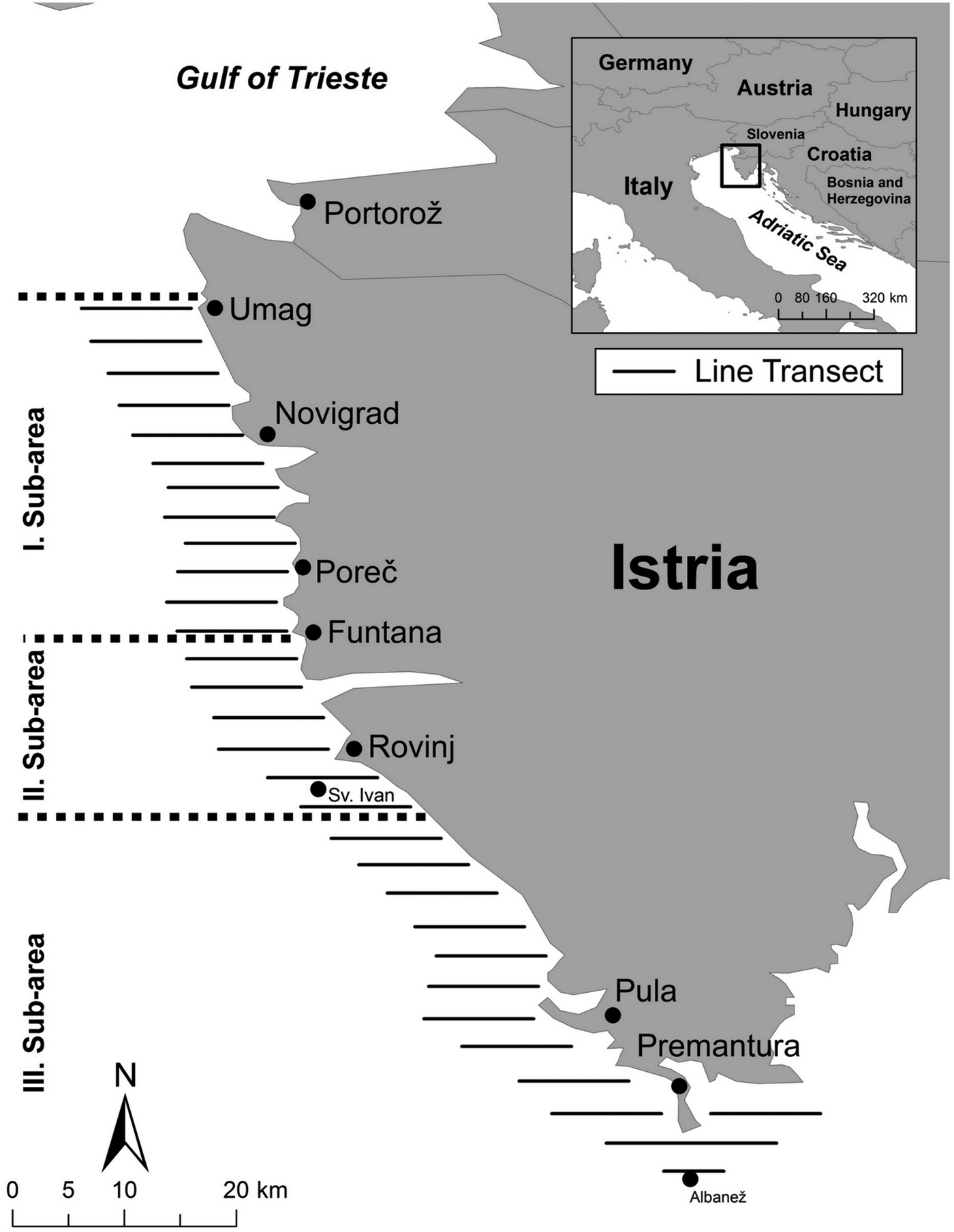
The survey effort comprised a 927 km2 area off the west coast of Istria, Croatia, in the North-eastern (NE) Adriatic Sea, from Umag in the north (45°26′N 13°31′E) to the south side off Albanež lighthouse in the south (44°44′N 13°54′E) off the tip of Istria peninsula (Figure 1). To facilitate the geographic location of dolphins, the coastline was divided into three sub-areas, mostly according to the physiographic characteristics of the coast: (I) Umag to the south of Poreč (to the border of NATURA 2000 site); (II) from the NATURA 2000 site border to the south of Saint Ivan lighthouse; and (III) from the south of Saint Ivan lighthouse to the south of Albanež lighthouse. Photo-identification surveys were conducted across several seasons and years. The systematic research was conducted in April, May and August 2012; May and August 2013; April and September 2014; and June to September 2015. Data collection for distribution purposes was started in Slovenia (Slovenian Istria) in 2001 and it continued opportunistically thereafter in Istria, from 2003 to 2011. The attempt was to cover the months between April–September 2012–2015 evenly which was, among weather conditions, affected by the fiscal limitations. To cover the research area, a survey design followed 9.3 km (5 NM) long east-west line transects from the coast mostly in the first and the third sub-area between the years 2003 to 2011, respectively. In the second (core) research sub-area line transects were lengthened to 13 km (7 NM) east-west, mainly between the years 2012–2015, to maximize a capture probability and to improve insight into site fidelity within the core area used by the dolphins in this region. Line transects were spaced 1.85 km (1 NM) apart. The contour transects followed the coastline. They were at a distance of 500 m and 1 km from the shore and were mainly followed from 2012 onwards. The main effort was performed out of three different ports: in Portorož (Slovenia), Funtana and Premantura (Croatia) (Figure 1). On the same survey day, mostly only one research sub-area was covered and it was chosen depending on a boat was berthed. A mark–recapture photo-identification technique was chosen from dedicated boat surveys for the recognition of individual dolphins. For each encounter a start and end time was recorded and a start and end position in longitude and latitude. The total number of dolphins seen at the same time (defined as a group size), the number of subgroups, group structure, behaviour (travelling, socializing, foraging/feeding) and any potential disturbance factors such as human interference (fisheries interactions, dolphin watching) were noted as well. The general behaviour and the number of subgroups were assessed before a focal group was defined (adopted by Shane, Reference Shane, Leatherwood and Reeves1990). During each encounter, attempts were made to photograph all individuals present, to minimize the bias between well-marked and less well-marked animals (Bearzi, Reference Bearzi, Notarbartolo di Sciara, Evans and Politi1994; Urian et al., Reference Urian, Gorgone, Read, Balmer, Wells, Berggren, Durban, Eguchi, Rayment and Hammond2015). Depending on the sea state, or at times due to the low light conditions, it was not always possible to meet all these conditions. In such cases dolphin behaviour was recorded for as long as the animals could be visually observed. Behavioural data were collected in successive 10 min observation cycles after Scheinin (Reference Scheinin2010). Gender was determined for as many animals as possible from direct observations of the genital region or in the case of females being regularly accompanied by a calf. Age classification was obtained by the body size of dolphins following the description of Bearzi et al. (Reference Bearzi, Notarbartolo di Sciara and Politi1997), either as a newborn, calf, sub-adult (or juvenile) or adult. Environmental data such as Beaufort Sea state and the moon phase were recorded. Surveys were carried out with the Beaufort Sea state 3 or less and with good visibility. The crew consisted of up to five trained observers and had a standing position on a fisherman boat of 5.50 m that was powered by a four stroke 80HP outboard engine and had the travel speed between 12–15 NM h−1. Standard photo-identification procedures were used to obtain high quality data with two digital single reflex cameras (Nikon D70 and Nikon D7100) equipped with a 70–200 mm f/2.8 APO lens.
Photo-identification survey area in the NE Adriatic Sea, off west coast of Istria. Straight lines indicate east–west transect lines, dotted lines demarcate the research sub-areas by latitude.

Catalogue, distinctiveness rate, dolphin capture history table and discovery curve
Dorsal fin images were examined and edited using the Irfanview graphic viewer program whilst matching was performed using DARWIN Photo ID 2.22. Photographic examination took place with at least two experienced judges who independently re-checked the identified dolphin matches. To avoid potential errors due to fatigue, a catalogue was constructed, divided into different categories according to respective fin characteristics for the marked individual dolphins. Each identified dolphin was numbered and listed into the catalogue by a chronological order. In the study a photo analysis developed by Urian et al. (Reference Urian, Hohn and Hansen1999) and adjusted by Read et al. (Reference Read, Urian, Wilson and Waples2003) was used. Images were scored by individual distinctiveness rate (D) of a dolphin fin and by photo quality after Balmer et al. (Reference Balmer, Wells, Nowacek, Nowacek, Schwacke, McLellan, Scharf, Rowles, Hansen, Spradlin and Pabst2008). The degree of marking and the quality was ranked from 1 (high quality) to 3 (low quality) and a classification followed recommendations for photo-identification methods used with cetaceans described in Urian et al. (Reference Urian, Gorgone, Read, Balmer, Wells, Berggren, Durban, Eguchi, Rayment and Hammond2015). Following this definition, D1 score was given to highly marked, D2 to the moderately distinctive features and D3 to less or no recognizable characteristics of the fin (Urian et al., Reference Urian, Gorgone, Read, Balmer, Wells, Berggren, Durban, Eguchi, Rayment and Hammond2015). The quality (Q) of the photos was scored similarly from 1 (high) to 3 (low). The Q1 score was given to a photo with a good focus and the entire dorsal fin in the image field. Q2 images were intermediate and those with poor focus and partial fin in the image field were scored as Q3. The latter, from D1–D3 distinctiveness, were excluded from the analysis. D3 images of the identified calves associated with the mother's presence were included in the analysis, to obtain a realistic population size. The proportion between well marked and poorly marked dolphins as a ratio for distinctive (D1 and D2) against the un-distinctive (D3) dolphins, known as a distinctiveness rate, was calculated as decribed in Balmer et al. (Reference Balmer, Wells, Nowacek, Nowacek, Schwacke, McLellan, Scharf, Rowles, Hansen, Spradlin and Pabst2008) and Urian et al. (Reference Urian, Gorgone, Read, Balmer, Wells, Berggren, Durban, Eguchi, Rayment and Hammond2015).
To calculate the number of marked and unmarked individuals for the whole survey duration the number of identified animals was divided by the distinctiveness ratio as follows:
 $$N_{{\rm total}} = {\mathop {N} \limits^{\sim}} / \theta $$
where N total is the total population size estimation, Ñ is the number of permanently marked individuals, θ is the proportion of permanent marks in each survey year (Williams et al., Reference Williams, Dawson and Slooten1993; Read et al., Reference Read, Urian, Wilson and Waples2003).
A dolphin capture history (DCH) table was created upon the chronological encounter of the dolphins. The DCH table served to obtain site fidelity results and to determine a discovery curve by obtaining the frequency of sightings per research season and the total number of encounters for a single dolphin from 2012 to 2015, respectively. The number of newly identified dolphins or resighted individuals was plotted for each observation month and a cumulative curve was determined for the dolphins identified during the period between 2012–2015. The shape of the cumulative curve indicated the level of saturation and the animal count valuation in the survey area.
Abundance estimate from the mark–recapture data
Survey effort (2012–2015) was divided into nine primary periods (38 secondary sessions) and three models were tested for the best fit to estimate dolphin abundance from a range of mark–recapture closed and robust models (Williams et al., Reference Williams, Nichols and Conroy2002; Read et al., Reference Read, Urian, Wilson and Waples2003; Olsen, Reference Olsen2006; Balmer et al., Reference Balmer, Wells, Nowacek, Nowacek, Schwacke, McLellan, Scharf, Rowles, Hansen, Spradlin and Pabst2008; Urian et al., Reference Urian, Gorgone, Read, Balmer, Wells, Berggren, Durban, Eguchi, Rayment and Hammond2015). The tested models that were selected were based on those that have been used to estimate abundance in other bottlenose dolphin populations (e.g. Wilson et al., Reference Wilson, Hammond and Thompson1999; Read et al., Reference Read, Urian, Wilson and Waples2003; Balmer et al., Reference Balmer, Wells, Nowacek, Nowacek, Schwacke, McLellan, Scharf, Rowles, Hansen, Spradlin and Pabst2008): (i) Chapman modification of the Lincoln–Petersen estimator for a closed population (Chapman, Reference Chapman1951); (ii) a random population abundance model; and (iii) a robust Markovian model. There are a variety of assumptions that need to be considered when using open and closed population models to estimate abundance. Demographic closure (i.e. no permanent immigration or emigration occurs, no births or deaths are happening) is one of the assumptions that have to be met for a closed model to be applied (Campbell et al., Reference Campbell, Bilgre and Defran2002). Other assumptions for a closed population are short sampling period, identification marks that are not lost on recapture events and a capture homogeneity (Seber, Reference Seber1982; Culloch, Reference Culloch2004). A combination between closed and open population models is the robust design model (Pollock, Reference Pollock1982). It provides additional information on capture probability that can be used to obtain less biased and more efficient estimates (Kendall, Reference Kendall2001). It can also be used to estimate the probability of being available for capture. This situation can be modelled as a random process, Markovian or with temporary trap dependence. To analyse these kind of data a program MARK can be used where parameters and covariates can be modelled for appropriate best fit model selection (White et al., Reference White, Anderson, Burnham and Otis1982; Kendall, Reference Kendall2001). Akaike's Information Criterion (AIC), which is a measure of the goodness of fit, was used to compare all tested population models (Burnham & Anderson, Reference Burnham, Anderson, McCullough and Barrett1992). The Markovian model had the lowest AIC value and has also been identified as an optimal model for estimating small cetacean abundance (Read et al., Reference Read, Urian, Wilson and Waples2003) which allows for unequal emigration and immigration rates that are not equal throughout survey periods. Markovian model estimates were extrapolated to total abundance, as mentioned above, by dividing Ñ (model abundance) by θ (proportion of individuals with permanent marks).
Site fidelity and distribution
To examine site fidelity patterns a recapture rate for all marked dolphins was obtained from the DCH table for the study period, from April 2012 to the end of September 2015. Data recorded prior to 2012 were not considered for the site fidelity indices. A total number of sightings for each individual was determined. Based on the number of recaptures, dolphins were sorted into four sighting classes after Culloch (Reference Culloch2004) and adjusted from the ‘common’ to the ‘most seen’. Those recaptured 1–2 times were classified as rare, 3–4 times as occasional, 5–6 times as frequent and 7–10 times as most seen.
A plot for the distribution data was determined using ArcMap 10.4.1 (ESRI, Redlands, CA, USA) software to obtain a basic knowledge about dolphins’ presence in the NATURA 2000 as well as habitat usage in the whole study area. Data for the distribution purpose were considered since the year 2001.
RESULTS
Photo-identification and data collection
The effort from 2012 to 2015 was in total 304.2 h on the positive survey days. The encounter duration, i.e. the time spent with dolphins, was 18%. The highest number of encounters was in the second sub-area with 76.7% success rate, which was therefore determined as the core or II research sub-area. The group sizes of marked individuals ranged from 1–36 animals with a mean of 9.27(±6.53 SD); Me = 7.5; Mo = 4; N = 56. The northern border of the core sub-area coincides with the NATURA 2000 site (HR 5000032) where both extend towards south. At the same time the core area showed the most intense anthropogenic burden, thus the emphasis of research moved in great part to this sub-area (Figure 1). The study design was intensified and east-west transect lines were prolonged by 3.7 km (2 NM) to the west.
Catalogue, distinctiveness rate, dolphin capture history table and discovery curve
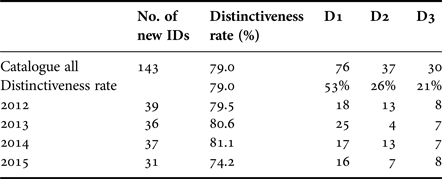
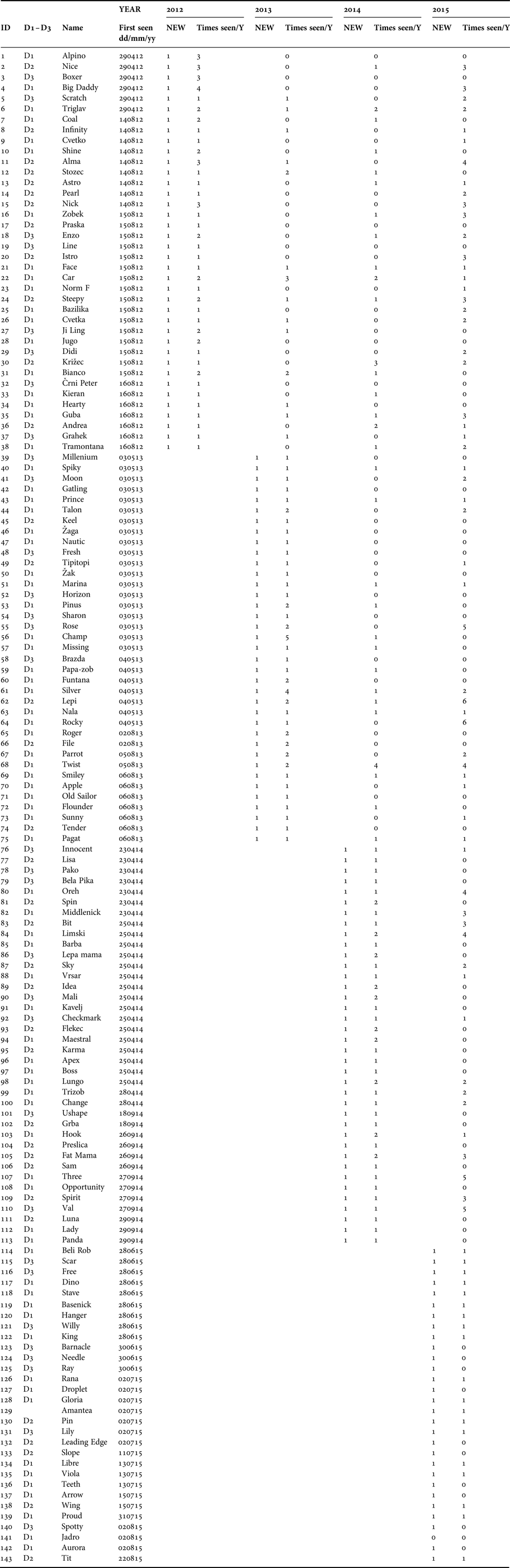
One hundred and forty-three dolphins were photo-identified and sorted into a catalogue during the systematic study, from 2012–2015. Sighting and recognition data were used for creating the DCH table in order to determine the frequency of sightings per individual for the whole survey duration (Appendix 1). Data obtained prior to 2012 were not used for the DCH table creation. The number of newly identified dolphins ranged from 31 to 39 per year with the distinctiveness rates of 53% for D1, 26% for D2 and 21% for D3 (Table 1). The average rate for distinctiveness throughout the survey period from 2012–2015 was 0.79 ± 0.03 SD. According to equation (1) the total number of marked and unmarked dolphins in the population was 181, between the years 2012 to 2015.
The number of identified (ID) dolphins per year and a distinctiveness rate (D1–D3), expressed in % and in the number of animals for the entire research period and for each year separately.

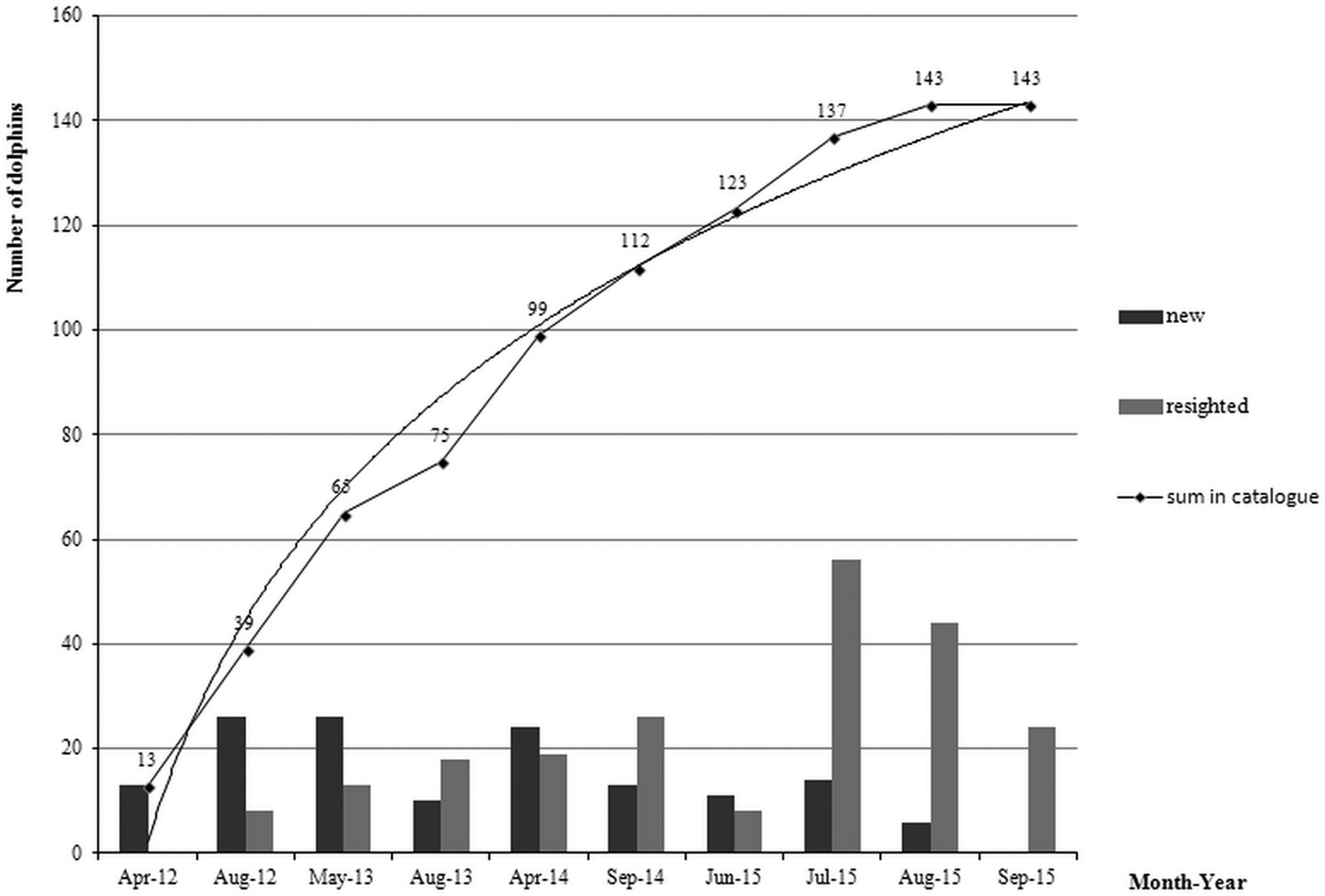
The discovery curve had a standard shape, increasing from April 2012 to July 2015 with a cumulative number of 137 photo-identified dolphins. After July 2015, the curve showed a typically lower rate of increase, since the rate of the newly identified dolphins slowed down and the curve presumably approached its asymptote, with the majority of animals already having been encountered. However, the added non-linear logarithmic regression curve showed a still increasing trend that had not yet reached a plateau. The highest number of newly identified individuals throughout the survey seasons was in August 2012, May 2013 and April 2014 with 26, 26 and 24 dolphins, respectively. The resighting rate was the highest in July and August 2015 with 56 and 44 already known dolphins (Figure 2).
Discovery curve with the cumulative number of dolphins identified during 2012–2015 and with the added logarithmic regression curve. Histograms show newly encountered and resighted individuals per month in each research season.

Abundance estimates
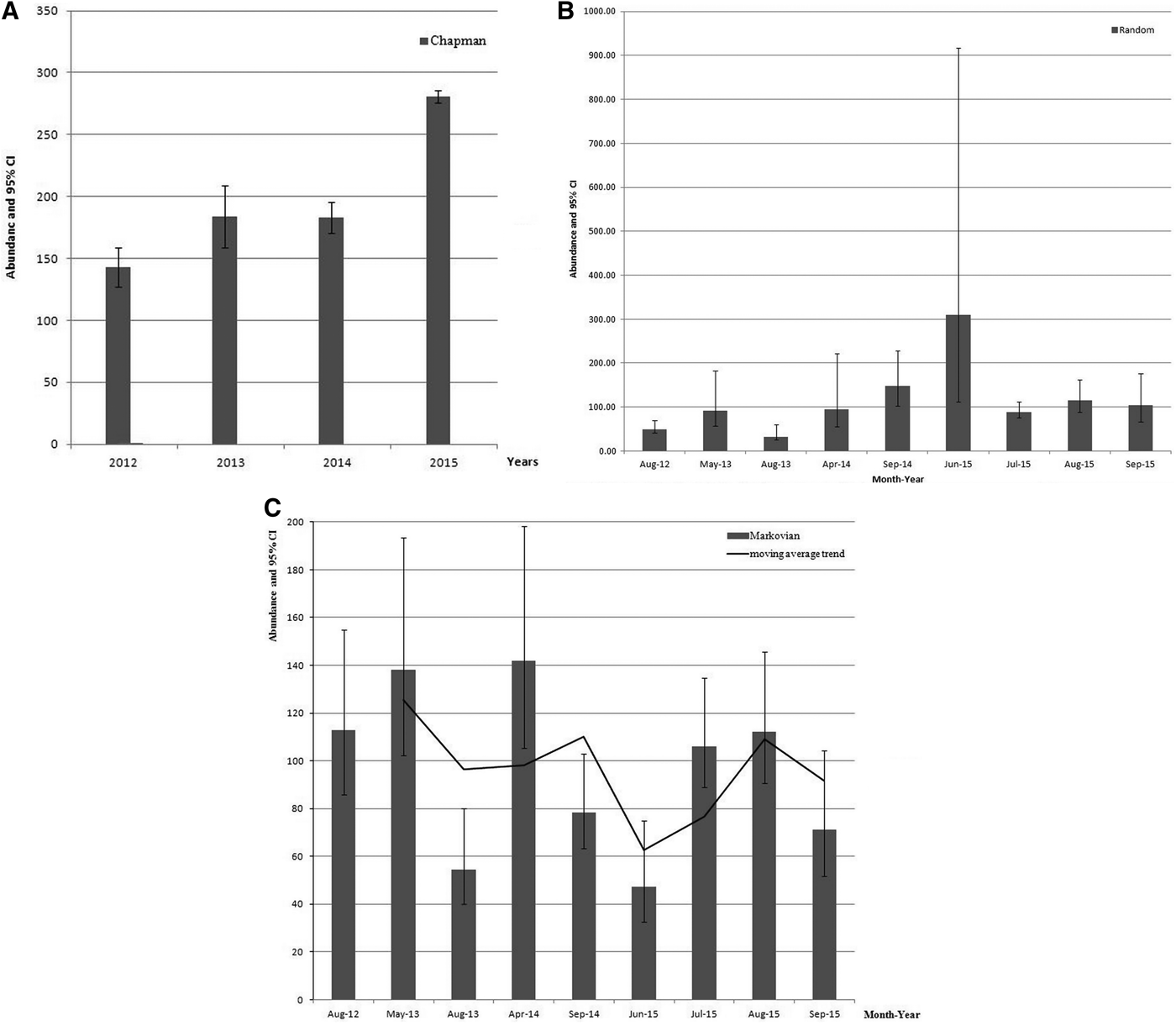
Abundance estimates were analysed with the closed (Chapman modification of the Lincoln–Petersen) model for the years 2012, 2013, 2014 and 2015, respectively. A random population abundance model and robust (Markovian Emigration) model (Figure 3A–C) were used for sampling periods in: August 2012; May & August 2013; April & September 2014; and June, July, August & September 2015. The robust Markovian Emigration model was the most appropriate fit for the dolphins in the study area as it estimated abundance across survey periods and permitted immigration between the survey periods. The results of the Markovian Emigration model identified comparable abundance estimates across most month-year survey periods which was evident by the overlapping 95% confidence intervals (CI). The random population abundance model showed an unusual 95% CI peak for June 2015, whereas the Chapman modification of the Lincoln-Petersen model showed no overlap for the CI intervals between the years 2014 and 2015. Overall, there were no clear seasonal abundance fluctuations observed throughout the surveyed months. In the Markovian robust model the highest abundance estimate was in April 2014 with 141 animals (95% CI 105–198) and the lowest in June 2015 with an estimation of 47 animals (95% CI 33–75). The added moving average trend line to this model indicated a slightly negative trend in abundance estimates for the west coast of Istria for the research period from 2012 to 2015 (Figure 3C).
Abundance estimate results, using the (a) Chapman modification of the Lincoln-Petersen model for the closed population, (b) random population abundance model and (c) robust Markovian Emigration model, for the survey period and with the 95% confidential intervals.

Site fidelity and distribution
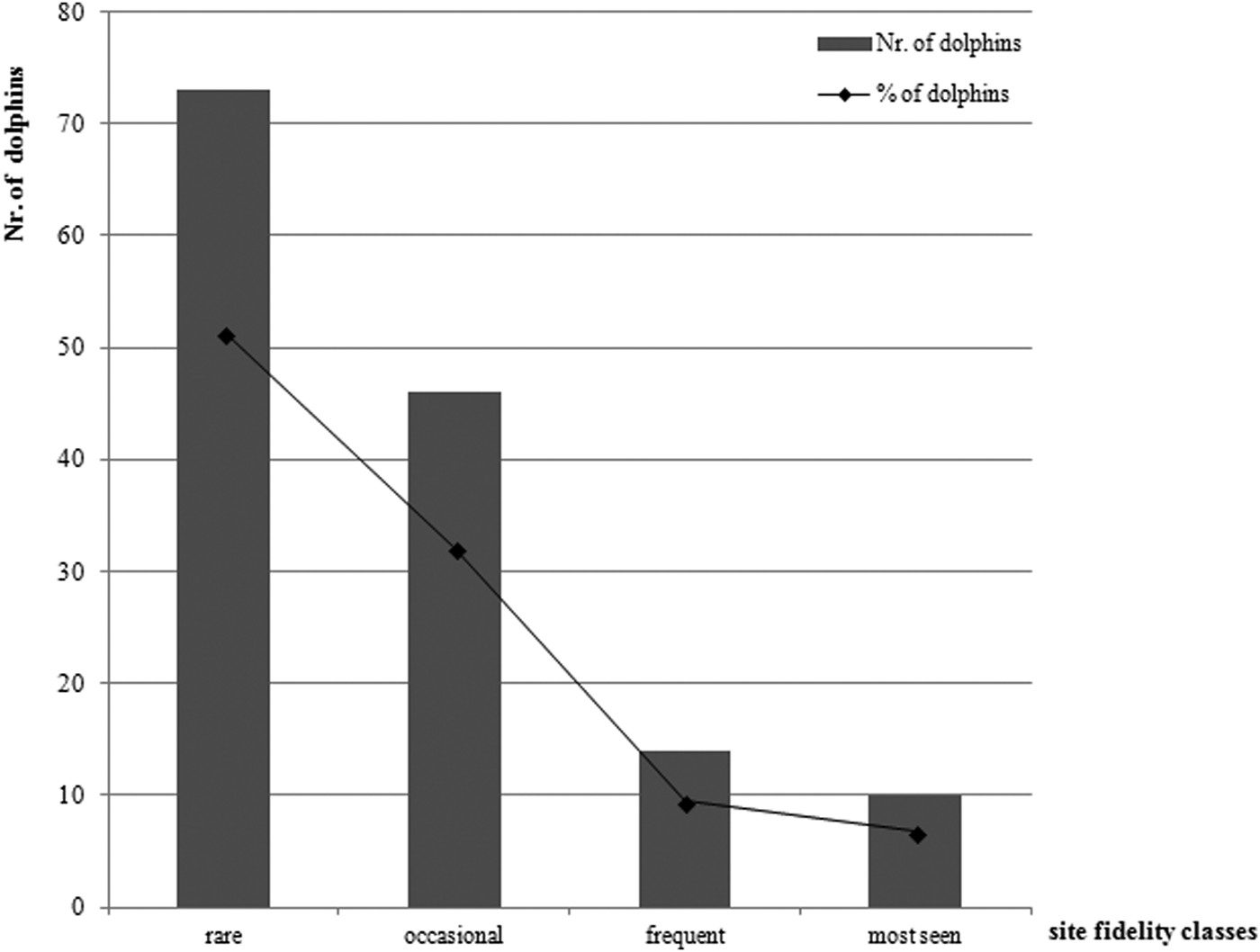
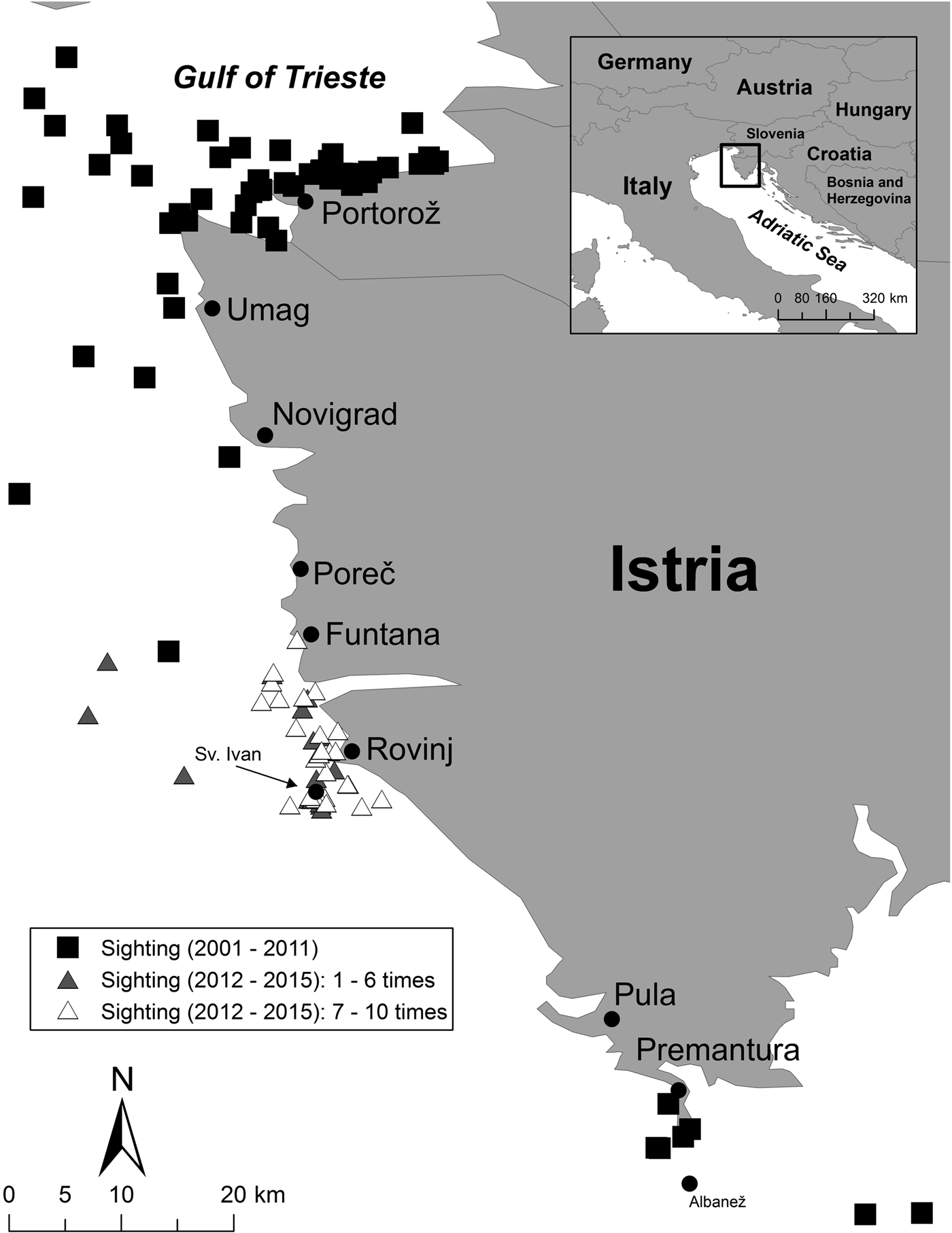
The number of times that an individual marked animal was sighted again is defined as a recapture rate. The latter was grouped into site fidelity index classes as: rare, occasional, frequent and most seen, for the observation period from April 2012–September 2015. 51.4% (N = 73) of identified dolphins were seen one to two times throughout the study period and were classified as rare. 32.2% (N = 46) were seen three to four times and were determined as occasionally present. 9.6% (N = 14) were frequently resighted animals. Those identified individuals seen from 7–10 times were classified as most seen and represented 6.8% (N = 10) from all identified dolphins (Figure 4). The mean of the resighting rate was 2.88 and the median was two recaptures. Distribution GIS positions of bottlenose dolphins along the entire west coast off Istria, including Slovenian Istria are shown in Figure 5. Data obtained from 2001–2011, including ad libitum surveys, are represented by rectangles. Triangles represent the data collected in the seasons from 2012–2015. Filled triangles indicate the locations of animals sighted rarely, occasionally or frequently. Empty triangles indicate locations of most present individuals.
Site fidelity indices with the number and % of identified dolphins sighted from 1–10 times through the entire observation period from April 2012 to September 2015.

Distribution and site fidelity GIS positions of bottlenose dolphins along the west coast off Istria, including Slovenian Istria. Rectangles represent data obtained from 2001–2011, including ad libitum surveys. Data collected from 2012–2015 are shown as triangles. Filled triangles indicate the locations of animals sighted from 1 to 6 times; empty triangles indicate locations of most seen individuals, seen 7–10 times.

DISCUSSION
Bottlenose dolphin (Tursiops truncatus) is the last constantly present marine mammal species in the North-eastern Adriatic Sea out of the three dolphin species that were common in this area just a few decades ago. The short beaked common dolphin (Delphinus delphis) is regionally extinct and the striped dolphin (Stenella coeruleoalba) is occasionally reported but not considered to be a regular species (IUCN Red List of Threatened Species, 2016). The geomorphological properties of the Adriatic, especially at its north, make the area ecologically very sensitive. Being shallow, especially in the northern section, the Adriatic plays a crucial role in direct ecosystem functioning. Istria, being in the north-eastern part of the Adriatic Sea, is a peninsula with the indented west coast measuring 327 km, including islands, while a straight line across measures ~100 km. The bathymetry of the area between Istria and Rimini (on the Italian side) is generally shallow with few areas exceeding 50 m and it is intensely influenced by ecological factors such as river discharges, currents, vertical water circulation and wind speeds. This makes the area ecologically sensitive to pollution, climate change and especially to overharvesting of natural resources. Besides intense fishing activities, Istria is burdened by nautical tourism and more new yachting marinas are foreseen. The Republic of Croatia's Ministry of the Sea, Transport and Infrastructure (2008), published a developmental strategy report for nautical tourism for the years 2007–2018, with a predicted growth of 9.8% compared to the 5% GDP growth estimation which shows a rapid development of this industry and the necessity of thoughtful planning and management.
It is therefore challenging to preserve the species that could be, due to these conditions, more vulnerable for survival than elsewhere (Reed et al., Reference Reed, Julian, O'Grady, Barry, Brook, Ballou and Frankham2002). Ponti et al. (Reference Ponti, Perlini, Ventra, Grech, Abbiati and Cerrano2014) indicate that predicting the consequences of potential species loss is critically important in this region, with a SWOT (strengths, weaknesses, opportunities and threats) analysis for the northern-central Adriatic showing already a high depletion of biodiversity. In December 2014, the Croatian government issued a decree to adopt an action programme on strategy for marine and coastal ecosystem management which comprises also marine mammals (Narodne novine, 2014). It advises to cover monitoring and observation over the whole Adriatic Sea and in collaboration with neighbouring countries to obtain a realistic picture of abundance and distribution for the species. The recommendations to adopt an action plan were not met for the dolphins off west Istria, even though the NATURA 2000 site was established particularly for these marine mammals. Its borders on the maps are not reflecting activities in practice. The lack of management for the bottlenose dolphins was notable throughout the time of the presented study, especially for the second research sub-area where the dolphin watching boat industry is completely unregulated and where other anthropogenic pressures were the highest, as preliminary data collection indicates (Ribarič et al., in prep.). The presence of dolphins was obviously recognized by the authorities in the past but no population data were being collected through a regular monitoring or observation programme to date. Due to lack of data, the official web site of the NATURA 2000 describes the status about the local dolphin population off west Istria as deficient (Državni zavod za zaštitu prirode, 2015). With no information being available, no effective steps have been taken to ensure favourable conservation of the dolphins in the NATURA 2000 site, HR 5000032.
As suggested by Fortuna (Reference Fortuna2007) conservation issues should be addressed at the sub-regional, if not even the local population level, when speaking of the Mediterranean basin. The phylogenetic structure study of Gaspari et al. (Reference Gaspari, Holcer, Mackelworth, Fortuna, Frantzis, Genov, Vighi, Natali, Rako, Banchi, Chelazzi and Ciofi2013) (cited in UNEP-MAP-RAC/SPA, 2014, pp. 15) would support this idea, since it was found that bottlenose dolphins from the Adriatic Sea indicate differences in population structure between the individual parts of the Adriatic in relation to other parts of the Mediterranean, which might be a result of the physiographic properties of the Adriatic Sea. To add to the complexity, more countries share the same geographic area at the northernmost Adriatic, therefore an advised cross-country collaboration in the Croatian strategy mentioned above, with synergistic actions for conservation, is even more necessary. The current population trend for bottlenose dolphin in the Mediterranean is inferred as decreasing and is listed as having a vulnerable status by the IUCN Red List of Threatened Species in the Adriatic. A long-term study of dolphins in Kvarnerić, which is the neighbouring local population in Cres-Lošinj archipelago, south-east to the dolphins presented in this study, suggests that it should be listed as endangered under the Criteria C and E (Fortuna, Reference Fortuna2007). As of the year 2012, the results of our study point at a slightly negative trend for the average local population size. Continuous studies will reveal more in the future as it might be too short a study period to confirm this statement, however the situation hints at this trend currently.
The results of the systematic studies (between 2012–2015) and distribution data (since 2001) indicate that dolphins were regularly present throughout the investigated months along the entire west coast of Istria, including Slovenian territorial waters and other areas in Trieste Gulf, north to the study boundaries. Additionally, occasional land-based observations in the research area showed that animals are present through all seasons of the year. While collecting data, the attempt was to strive to photograph all individuals in an encounter. Marked individuals were taken as a data source in the same way as unmarked animals to avoid biased results when using the mark–recapture method (Otis et al., Reference Otis, Burnham, White and Anderson1978). There was only one experienced photographer taking photo ID pictures which lessened possible survey sampling variance. At times significant changes on dorsal fins of some individuals occurred, especially in the adults with a lot of (conspecific) interactions. A wound with a torn piece of a trailing edge was completely healed in about a week. Such changed profile of the trailing edge could result in potential misidentifications and false doubles when resighting the same animal after a longer time. The photo identification technique enables a broad band of studies based on obtained individual sighting history, whereas a computer-assisted mark–recapture analysis represents an important tool to recognize and follow individual animals over space and time. The latter allows vital rates estimation, quantifying fitness, life-history trade-offs and classifies social behaviour (Bolger et al., Reference Bolger, Morisson, Vance, Lee and Farid2012). At times, in our study, a naked eye identification analysis was better used vs a computer-assisted identification, especially where photos were not ideally oriented perpendicular to the animal, but where distinctive dolphin fin features were nonetheless recognizable. From the data obtained a discovery curve was derived that had a standard shape. By observing the rate of resighted and newly discovered individuals as a function of time, the discovery graph can further indicate whether a population is open or closed (e.g. Williams et al., Reference Williams, Dawson and Slooten1993; Karczmarski et al., Reference Karczmarski, Winter, Cockcroft and Mclachlan1999; Wilson et al., Reference Wilson, Hammond and Thompson1999). The added logarithmic curve to our graph showed that few additional dolphins are expected to be discovered with further observation efforts (Figure 2), however, the curve is approaching its asymptote, suggesting that the majority of animals were sighted during surveys in this region.
Population size estimates were obtained through several models (Figure 3). They were generally comparable but showed some fluctuations in abundance across months and years. The best to represent the population size was the Markovian Emigration robust model which generally revealed comparable abundance estimates through most month-year survey periods, as evidenced by overlapping 95% confidence intervals (CI). There were some variations in abundance across several survey periods, such as in April 2014 (141; 95% CI 105–198) which had the highest abundance estimate, and in June 2015 (47; 95% CI 33–75) with the lowest abundance estimate (Figure 3C). The Chapman modification of the Lincoln–Petersen closed model proved to be the most conservative and is generally appropriate when there are just two sampling occasions, and the population is closed between them. In closed models the abundance estimate increases as the number of the assumptions is reduced (Thompson et al., Reference Thompson, White and Gowan1998; Balmer et al., Reference Balmer, Wells, Nowacek, Nowacek, Schwacke, McLellan, Scharf, Rowles, Hansen, Spradlin and Pabst2008). This is seen also in the study results, where the abundance estimates are bigger compared with the other two models (Figure 3A). The third tested was the random model which showed similar figures as the Markovian model, except for June 2015 with an unusual peak with the value 309 and with a comparably high 95% CI (Figure 3B).
It is worth mentioning a comparison of group sizes between the research sub-areas and the neighbouring areas, outside the study boundaries. The average group size in the core research sub-area, for data since 2012, being 9.27 (±6.53 SD); Me = 7.5; Mo = 4; N = 56, was slightly bigger vs ad libitum observations in Slovenia, from 2001 to 2006, with 8.4 (±9.6 SD); Me = 4; N = 40 (Ribarič & Robinson, Reference Ribarič and Robinson2006; Ribarič, Reference Ribarič2013); it also had a higher median and a smaller standard deviation and had more encounters. The group size in the core research sub-area was also bigger when comparing the results from the report for the Cres-Lošinj archipelago, just 37 km south-east from the tip of Istria, with 5.9–9.3 animals, for the years from 2004 to 2011 (Pleslić et al., Reference Pleslić, Rako Gospić, Mackelworth, Wiemann, Holcer and Fortuna2013). However, compared with the efforts off the Cape Kamenjak, from 2003 to 2007, the average group size in this, third, research sub-area was bigger, with 12.4 (±16.1 SD) animals; Me = 6; N = 30 (Ribarič & Herlec, Reference Ribarič and Herlec2008). At the same time the latter had a lower encounter success rate of 47%.
As the assessment of general behaviour has shown for the area within 2 NM from the coast, foraging is the main activity in the core research sub-area and was present in 38% of the time in dolphin observations (Ribarič, Reference Ribarič2013), whereas travelling was the dominant behavioural description in the third research sub-area, occurring during 61% of the total encounter time (Ribarič & Herlec, Reference Ribarič and Herlec2008). Although dolphins might congregate in slightly bigger groups for foraging, the fact of being daily disturbed by nautical tourism in the second research sub-area close to the coast, and throughout the tourist season, could explain a smaller average group size vs the third sub-area. The group size in the core research sub-area was still bigger than in areas outside the study boundaries. Nautical tourism close to the coast in the third research sub-area is notably lower, with dolphin watching boats being almost never present. At the same time, regarding interactions, regular dolphin inspections and time spent around gillnets and fishing traps were noted in the area close to the coast, similarly to that described in the work from Diaz Lopez (Reference Diaz Lopez2006) and Jaiteh & Allen (Reference Jaiteh and Allen2012). Preliminary collected data show that dolphin–trawls interactions, in the deeper waters of the second research sub-area (5–7 NM from the coast), were observed every time. This coincides with other studies about the opportunistic feeding behaviour observed in the Mediterranean (Bearzi, Reference Bearzi, Notarbartolo di Sciara, Evans and Politi2002) and as demonstrated in Gonzalvo et al. (Reference Gonzalvo, Valls, Cardona and Aguilar2008), Gonzalvo et al. (Reference Gonzalvo, Giovos and Moutopoulos2015). Both nautical tourism influence and fisheries interactions will be reported elsewhere due to the limited space in this article (Ribarič et al. in prep). However, due to nautical tourism pressures, within 2 NM from the coast in the core research sub-area, having an influence on the distribution and the abundance of the animals, a brief comment is justified. It is known from several studies that human interference has an impact on group sizes and on animal behaviour (Yazdi, Reference Yazdi2005; Bas et al., Reference Bas, Öztürk and Öztürk2015; Pirotta et al., Reference Pirotta, Merchant, Thompson, Barton and Lusseau2015). They might similarly have an impact on movement patterns and displacement and therefore consequently on distribution and abundance. Istria is reported to be one of the most burdened by human activities and most developed in terms of the infrastructure along the whole east Adriatic coast (Institute of Lexicography Miroslav Krleža, 2016). This corresponds to both nautical tourism as well as to the fishing industry. Severini (Reference Severini2013) notes in his study that fishing has been expanding since the 1970s, posing an additional burden to the marine environment. At the same time, the Croatian government states in the proposal for the tourism development strategy until 2020, that the country is one of the most desirable destinations in the world regarding nautical tourism. Similarly, nautical tourism is supposed to develop even faster as is illustrated in the strategy of the Ministry of the Sea, Transport and Infrastructure (2008), since estimations do not include the supporting industries, nor the black market boating operators. Usually, in the developed coastal European regions up to 40% of the GDP belong to nautical tourism (Government of the Republic of Croatia, 2013). All taken into account, it plays an important fiscal role for the country. As such, it calls for a well planned nautical tourism management that might, the same way as fisheries, have a significant impact on marine life. Due to these facts being most intense in the coastal part of the core research sub-area, as the preliminary research shows, and to minimize the financial costs of the study, observation efforts were intensified in this part off the west coast of Istria. Modification of the observation area might have produced slightly different results, due to sampling bias. However, at the same time the approach used revealed valuable information by providing the first insight into areas where dolphins were directly affected by anthropogenic pressures.
Site fidelity, or return of the same individuals to a more circumscribed site, indicates the importance of the research area along the west coast of Istria (Figure 4). A spatial context of sampling has to be considered (Parra et al., Reference Parra, Corkeron and Marsh2006; Urian et al., Reference Urian, Gorgone, Read, Balmer, Wells, Berggren, Durban, Eguchi, Rayment and Hammond2015) since it is evident from the site fidelity results and population model estimates that about half (51.4%) of the dolphins were seen only one to two times. Such ranging patterns (Lusseau et al., Reference Lusseau, Wilson, Hammond, Grellier, Durban, Parsons, Barton and Thompson2006) might suggest that the fluctuations in abundance between some of the survey periods may be from dolphins that are only utilizing part of the survey region and have ranges outside the survey area boundaries (Bouveroux et al., Reference Bouveroux, Le Boulengé, Nowacek and Mallefet2007; Balmer et al., Reference Balmer, Wells, Nowacek, Nowacek, Schwacke, McLellan, Scharf, Rowles, Hansen, Spradlin and Pabst2008; Conn et al., Reference Conn, Gorgone, Jugovich, Byrd and Hansen2011). Extending survey boundaries may provide insight to those animals’ ranges with a few sightings to define residence patterns (Simoes-Lopes & Fabian, Reference Simoes-Lopes and Fabian1999; Zolman, Reference Zolman2002; Jacalyn et al., Reference Jacalyn, Hohn, Able and Gorgone2010) as well as to define transient and resident dolphins more accurately. Indeed some dolphins that had first capture locations in the core research sub-area were identified also during ad libitum surveys in Slovenia (Trieste Gulf), above the north boundaries of the present study and within the same research years. This was not surprising due to dolphins being a highly mobile species, and reinforced the fact that a home range of at least some dolphins extends beyond the area under investigation, which included about 100 km of shoreline. This could correspond to observed daily movement patterns along the coast towards the north. Regarding animals’ movements, temporary emigration might decrease a capture probability (Kendall & Nichols, Reference Kendall and Nichols2002; Urian et al., Reference Urian, Gorgone, Read, Balmer, Wells, Berggren, Durban, Eguchi, Rayment and Hammond2015) and it may change as a function of time (Hammond, Reference Hammond and Hammond1990). On the other hand, in our study a possible immigration of dolphins with low site fidelity could make the unusual abundance estimation peak in June 2015 more interpretable, as observed from a tested random abundance model (Figure 3B). The importance of the core research sub-area as an irreplacable foraging ground could further hint at possible immigration movements of the dolphins and explain a bigger average group size in the core research sub-area as compared with Slovenia or the Lošinj archipelago. Supporting the findings about the movement patterns of the same individuals outside the northern research boundaries were similar encounters of dolphins at the south boundaries of the research area. Here animals were sighted at a distance from 1–5.5 km off Cape Kamenjak towards the south-east, which coincides with the coastline orientation. Sighting locations for the area around Kamenjak and outside the study boundaries, towards the south-east (SE), were at times additionally reported by trusted sources of personally known experienced people active at sea (sailors, divers). This hints to the movements of at least some individuals between aquatorium off Istria towards the islands of Unije, Cres and Lošinj. These animals might migrate from and to the neighbouring resident local bottlenose dolphin population of the Cres-Lošinj archipelago, which has been studied there since 1987 (Notarbartolo di Sciara et al., Reference Notarbartolo di Sciara, Bearzi and Bonomi1991). Prediction of greater movements could be confirmed by the estimation of Bearzi and Notobartolo di Sciara in 1993 where they estimate the average ranging capability of a single dolphin as being 543 km2 in 24 h for the area of the North-east Adriatic (Fortuna, Reference Fortuna2007). More impressive is a reported example of huge dispersal of bottlenose dolphins with distances covered of up to 1277 km (Robinson et al., Reference Robinson, O'Brien, Berrow, Cheney, Costa, Eisfeld, Haberlin, Mandleberg, O'Donovan, Oudejans, Ryan, Stevick, Thompson and Whooley2012). Therefore it is not surprising to have confirmed fluctuations to and from Slovenia and it would be of no surprise to confirm them as well between the Istrian west coast and neighbouring areas towards the south-east.
Even if the strategies mentioned above about the ecologically sustainable development were to be achieved, at least certain areas along the East Adriatic coast are missing the relevant management and execution of the action plans for the apex marine species, as was discovered within this study. The information about the distribution, abundance and site fidelity data suggest that there are resident dolphins in this region as well as some extended movements of other animals. Comparison of the mark–recapture photo identification studies outside the boundaries of the current study might help in determining the extended movements of the animals. Further focal follows sampling of impacts of anthropogenic stressors may help in defining the threat level and a preparation of appropriate steps for their mitigation. The bottlenose dolphin population off the west coast of Istria constitutes a non-negligible part of the east Adriatic stock, which was estimated in the year 2010 on over 5000 individuals, as reported in the National Report of the Republic of Croatia to the Convention on Biological Diversity (2014). The present study confirms that no single country has a unique local dolphin population (or part of one), and that a joint management plan would be sensible, as already advised in the Croatian strategy for the marine and coastal ecosystems. Building upon the baseline data provided in this study could encourage the authorities to act more quickly in the execution of a management plan for this marine mammal community. Knowing about the species’ importance for the health and functionality of the entire marine ecosystem, such sustainable management, mirrored in action, might not be too far away.
ACKNOWLEDGEMENTS
Many thanks go especially to three native English-speaking colleagues and experienced marine mammal researchers. Brian C. Balmer, a NOAA associate researcher, helped tremendously in modelling data for statistical analysis; James E. Eckman, a Director of Sea Grant Institute, Scripps Institution of Oceanography, made invaluable comments and additionally reviewed the text to improve it; Kevin P. Robinson, from CRRU, is specially thanked for his enthusiastic support for this study and for encouraging it all from the year 2005. Lastly, there are further valuable people to this study: professors and researchers from different Italian universities, from Ljubljana University and from the Slovenian Academy of Sciences and Art who indirectly helped in the development process of the study and I want to thank them all for their intellectual support.
FINANCIAL SUPPORT
This research was funded largely by the author herself but was also supported through a collaboration of many volunteers which was of key importance to make this research financially feasible. I thank them all for the enthusiastic approach and help in the project. I thank also Betty Boyse, Stephanie Adamczak and Julie Carpenter, alumni student members, who essentially help in activities of Vivamar. Marina Funtana (Montraker Ltd) proves to be environmentally aware and supports Vivamar's research. I'd like to thank Petra Slapar (Raček d.o.o.), Nataša Potočnik (Connecta d.o.o.) and Rozana Šestan (Aktiva i pasiva d.o.o.) who offer their companies’ services pro bono and by this importantly support Vivamar's existence.
APPENDIX 1
Dolphin capture history table (DCH) for the individual dolphins off the west coast off Istria, from April 2012 to the end of September 2015, with first seen dates and recapture cumulative number per year.