It occurs to me to wonder whether the external world exists—that is, whether anything exists other than my own stream of conscious experience. Radical solipsism, I’ll say, is the view that my conscious mind is the only thing in the universe; there are no material objects, no other minds, not even a hidden unconscious side of myself. On radical solipsism, this (here I gesture inwardly at my sensory, emotional, and cognitive experiences) is all there is, nothing more. I find myself, now, contemplating radical solipsism. I want some sort of evidence or proof of its falsity.
You might think—if you exist—that my desire for proof is foolish. You might think it plain that I could never show radical solipsism to be false, that I can only assume that it's false, that any attempt to prove solipsism wrong would inevitably turn in a circle. You might think, with (my seeming memory of) Wittgenstein ([1950–51] Reference Wittgenstein, Anscombe and von Wright1974), that the existence of an external world is an unchallengeable framework assumption necessary for any inquiry to make sense, that it's a kind of philosophical disease to want to rationally refute solipsism, that I might as well hope to establish the validity of logic using no logical assumptions. Now I’ll grant that I might be philosophically sick. There's something admittedly crazy about solipsistic doubt. But it's not entirely clear to me, at least not yet, that I can't find my cure from within the disease, by giving my sick mind exactly the proof it wants.
At first blush, the historical evidence—or what I think of as the historical evidence—looks unpromising. The two most famous attempts to cure solipsism from within come from Descartes, in his Meditations ([1641] Reference Descartes, Cottingham, Stoothoff and Murdoch1984), and from Kant, in his ‘Refutation of Idealism’ (from his first Critique [1781–1787] Reference Kant and Smith1929). Neither appears to work. Descartes's proof of the external world requires accepting, as an intermediate step, the very dubious claim that the thought of a perfect God could only arise from a being as perfect as God. (See discussion in Broughton Reference Broughton2002; Nolan and Nelson Reference Nolan, Nelson and Gaukroger2006.) Kant's proof turns on the assertion that I cannot be ‘conscious of my own existence as determined in time’ or conscious of change in my representations unless I perceive some permanent things that actually exist outside of me. He offers no clear argument for this assertion. Why couldn't a sense of representational change and of my determination in time arise innately or from temporally overlapping experiences or from hallucinatory experiences as of seeing things that exist outside of me? (See discussion in Guyer Reference Guyer1987; Dicker Reference Dicker2008; Stroud Reference Stroud1984, Reference Stroud and Parrini1994.) Most philosophers today, it seems, regard as hopeless all such attempts to prove radical solipsism false using only general logic and solipsism-compatible premises about one's own conscious experience.
So we might, with Hume ([1740] Reference Hume, Selby-Bigge and Nidditch1978), yield to the skeptic and grant her the argument, then turn our minds aside for a while, play some backgammon, and go on living and philosophizing just as before, only avoiding the question of radical solipsism. Or we might, with Moore (Reference Moore1939), defend the existence of an external world by means of solipsism-incompatible premises that beg the question: ‘Here is a hand, here is another, therefore there are external things; what, you want stronger proof than that?’ Or we might, with Wittgenstein, try to undercut the very desire for proof. However, none of these responses seems to me to be preferable to actually delivering a proof that does not beg the question, if such a proof is discoverable. They are all fallback maneuvers. Another type of fallback maneuver can be found in those recent versions of contextualism and reliabilism that concede to the radical solipsist that we cannot know that the external world exists once the question of its existence has been raised in a philosophical context, while insisting that we can still nonetheless have ordinary knowledge of the mundane facts of practical life (Williams Reference Williams1991; DeRose Reference DeRose1995; Lewis Reference Lewis1996; Dretske Reference Dretske and Luper2003). And of course, responses to skepticism that assume I already believe that the external world exists (such as Sosa's [Reference Sosa2000] ‘safety’ response) do not apply to the present case since I have suspended belief.
The historical landscape has been dominated by the two broad approaches described above. The first approach aims high, hoping to establish with apodictic or deductive or ‘transcendental’ certainty, in a non-question-begging way, that the external world really does exist. The second approach abandons hope of a non-question-begging proof, seeking in one way or another to make us comfortable with its absence. But there is a third approach, historically less influential, that has not yet been adequately explored. Its most famous advocate is Bertrand Russell.
Russell writes:
In one sense it must be admitted that we can never prove the existence of things other than ourselves and our experiences. . . . There is no logical impossibility in the supposition that the whole of life is a dream, in which we ourselves create all the objects that come before us. But although this is not logically impossible, there is no reason whatsoever to suppose that it is true; and it is, in fact, a less simple hypothesis, viewed as a means of accounting for the facts of our own life, than the common-sense hypothesis that there really are objects independent of us, whose action on us causes our sensations. (Reference Russell1912: 22–23, emphasis in original)
Russell also states that certain experiences are ‘utterly inexplicable’ from the solipsistic point of view and that the belief in objects independent of us ‘tends to simplify and systematize our account of our experiences’. For these reasons, he says, the evidence of our experience speaks against solipsism, at least as a ‘working hypothesis’ (Reference Russell1912: 23–24; Reference Russell1914: 103–104). Russell aims lower than do Descartes and Kant; and partly as a result his goal seems more plausibly attainable. Yet Russell also promises something that Hume, Wittgenstein, and Moore do not: a non-question-begging positive argument against solipsism. It's a kind of middle path between certainty and surrender or refusal.
Unfortunately, there are two major shortcomings in Russell's argument. One is Russell's emphasis on simplicity. The most natural way to develop the external world hypothesis, it seems, involves committing to the real existence of billions of people, many more billions of artifacts, and naturally occurring entities vastly more numerous even than that, manifesting in highly complex and unpredictable patterns. On the face of it, it's odd to say that such a picture of the world is simpler than radical solipsism. (Admittedly, simplicity is a complex business: see Sober Reference Sober1975; Vogel Reference Vogel1990; Zellner et al. Reference Zellner, Zeuzenkamp and McAleer2001; Peacocke Reference Peacocke2004.)
The second shortcoming is the uncompelling, gestural nature of Russell's supporting examples. What is it, exactly, that is ‘utterly inexplicable’ for the solipsist? The utterly inexplicable thing, Russell says, is a cat's seeming hunger, after an interval during which the cat was not experienced:
If [the cat] does not exist when I am not seeing it, it seems odd that appetite should grow during non-existence as fast as during existence. And if the cat consists only of sense-data, it cannot be hungry, since no hunger but my own can be a sense-datum to me. Thus the behaviour of the sense-data which represent the cat to me, though it seems quite natural when regarded as an expression of hunger, becomes utterly inexplicable when regarded as mere movements and changes of patches of colour, which are as incapable of hunger as a triangle is of playing football. (Reference Russell1912: 23, emphasis in original)
To this example, Russell appends a second one: that when people seem to speak ‘it is very difficult to suppose that what we hear is not the expression of a thought’ (24).
But are such experiences really so utterly inexplicable for the solipsist? Consider hallucinations or dreams, which arguably can involve apparent hungry cats and apparent human voices without having real feline hunger or real human minds behind them, independent of my own. Russell considers this objection, but he seems satisfied to give only a cursory, single-sentence response: ‘But dreams are more or less suggested by what we call waking life and are capable of being more or less accounted for on scientific principles if we assume that there really is a physical world’ (24). The inadequacy of this response is revealed by the fact that the solipsist might be able to say something quite similar: If I assume solipsism then I can account for the appearances of the cat and the interlocutor as imperfect projections of myself upon my imagined world, grounded in what I know about myself though introspection. Such an explanation is sketchy, to be sure, but so also is the current scientific explanation of dreaming and hallucination. At best, Russell's argument is problematically underdeveloped.
Although I am dissatisfied with Russell's particular argument, as I sit here (or seem to) with my solipsistic doubts, I still feel the attraction of that general approach. The core Russellian idea I want to preserve is this: Although in principle (contra Descartes and Kant) all the patterns in my experience are compatible with the nonexistence of anything behind that experience, I still can evaluate two competing hypotheses about the origins of those experiences: the solipsistic hypothesis, according to which all there is in the universe are those experiences themselves, and the external world hypothesis, which holds that there is something more. I can consider these hypotheses not by the standards of apodictic or transcendental proof, but rather as something like scientific hypotheses, with epistemic favor accruing to the one that appears to do the better job accounting for the experiential evidence at hand. Although Russell's own remarks are too cursory, that doesn't speak against the general project. Indeed, they invite the hope that a more patient effort might still bear fruit.
More recently, Laurence BonJour (Reference BonJour1985, Reference BonJour, BonJour and Sosa2003), Jonathan Vogel (Reference Vogel1990, Reference Vogel, Steup and Sosa2005, Reference Vogel and Greco2008), Christopher Peacocke (Reference Peacocke2004), and others have argued against radical skepticism on explanationist grounds, thus pushing Russell's project a bit farther.Footnote 1 Vogel, for example, asserts that the skeptic will be forced to choose between leaving her experiences unexplained and deploying ad hoc explanations: ‘Niceties aside, the fact that something is spherical explains why it behaves like a sphere (in its interactions with us and with other things). If something that is not a sphere behaves like one, this will call for a more extended explanation’ (Vogel Reference Vogel1990: 663–64). This seems exactly right. But despite these authors’ good start, their remarks remain scientifically sketchy—and the discussions tend to focus on deceiver skepticism rather than on radical solipsism. What I really want is a rigorous, scientific experimental test in which I, from within the position of solipsistic doubt, give the solipsistic hypothesis what I judge to be its most plausible and appealing form, make specific predictions from it, see whether those specific predictions are borne out, and if the predictions are not borne out, consider whether there are plausible post hoc explanations. As far as I know, this sort of thing has never been properly done.
Thus, in place of Russell's vaguely scientific appeal, I will try an actual empirical test of the two competing hypotheses, in formal scientific style. I will generate specific empirical predictions from radical solipsism and from nonskeptical external-world realism, pitting the two hypotheses against each other in what I hope is a non-question-begging way, and then I will quantitatively analyze the empirical results and consider how well the competing views can accommodate them.
In other words, I aim to do some solipsistic science. There is no contradiction in this. Skepticism about the external world is one thing, skepticism about induction and scientific reasoning quite another. I aim to see whether, from assumptions and procedures that even a radical solipsist can accept, I can generate experimental evidence for the existence of an external world—an exercise in what I might think of as the experimental philosophy of cosmology.
Let me emphasize: I don't hope to prove something from nothing. The skeptic's position is unassailable if its opponent must prove all the premises of any potential argument. I aim to refute not all of skepticism, but rather only radical solipsism. I aim only to move from solipsism-compatible premises to an anti-solipsistic conclusion. Accordingly, for purposes of this project, I don't plan to entertain any more than the usual doubt about (solipsism-compatible versions of) induction or deduction or short-term memory or introspective self-knowledge.
More specifically, I will allow myself to assume the following:
-
• introspective knowledge of sensory experience and of other happenings in the stream of experience;
-
• memories of past experience from the time of the beginning of the series of experiments but not before;
-
• concepts and categories arrived at I-know-not-how and shorn of any presupposition of grounding in a really existing external world;
-
• the general tools of reason and scientific evaluation to the extent those rules don't build in any assumptions about affairs beyond my stream of experience.
Leaning only on these resources, I will try to establish, to a reasonable standard of scientific confidence, the existence of an external world.
I will not assume that I or anything else existed yesterday. Solipsistic doubt invites doubts about the past: From what I’m experiencing now and going forward can I establish an external world? From a radical skeptical break in which I cut away the past and all things external, can I build things back up? Furthermore, if my memory of days before today does in fact serve me correctly, then one of the things it tells me is that it itself is highly selective and unsystematic and that the free recall of what is salient and readily available is not usually good scientific method. Though I can pull together memories of events that seem best explained by the hypothesis that there is an external world, it is more scientifically rigorous to restart at square one.
If solipsism implies that I have complete control over my stream of experience, I can easily refute it. I could, for example, take in my hands a deck of cards (or at least seem to myself to do so) and resolutely will that I draw a queen of clubs. Then I might note the failure of the world to comply with my will. In fact, I have now attempted exactly this, with an apparent ten of diamonds as my result. But unfortunately for the prospects of such an easy proof, solipsism has no such voluntaristic implications and thus admits of no such antivoluntaristic refutation. Certain remarks of Locke ([1689] Reference Locke and Nidditch1975, IV.xi), Berkeley ([1710] Reference Berkeley and Turbayne1965, sec. 29 ff.), and Fichte ([1797] Reference Fichte, Neuhouser and Bauer2000, sec. 2) suggest a view of solipsism on which the solipsist has full voluntary control of all experience. But such compliant-world solipsism is a flimsy cousin of the more robust version of solipsism I have in view (see also Descartes [1641] Reference Descartes, Cottingham, Stoothoff and Murdoch1984, Meditations 3 and 6).
To think through this last issue more clearly, I close my eyes—or rather, not to assume the existence of my body, I do something that seems to me to be a closing of the eyes. What I visually experience is an unpredictable and uncontrollable array of colors against a dark gray background, the Eigenlicht (see Schwitzgebel Reference Schwitzgebel2011). This uncompliant Eigenlicht is entirely compatible with radical solipsism as long as I conceptualize the patterns it contains as nothing but patterns in, or randomnesses in, my stream of sensory experience; that is, patterns governed by their own internal coherences rather than by anything further that stands behind them. The unpredictability and uncontrollability of these visual patterns no more compels me to accept the existence of nonexperiential entities than irresolvable randomness and unexplained laws in the material world, as I conceptualize it, would compel me to accept the existence of immaterial entities behind the material ones.
What sorts of tests, then, might put radical solipsism at risk? Interpreting this question as straightforwardly as possible, I see three types of potential evidence that would be difficult to accommodate on a solipsistic view: evidence of the existence of something with theoretical reasoning powers that exceed my own, evidence of the existence of something that can retain its properties over a period during which those properties are lost to my sensory experience and memory, and evidence of the existence of something with practical reasoning powers that exceed my own.
I could ensure the impossibility of refuting solipsism by insulating it in advance against making any predictions that conflict with the predictions of the external world hypothesis. But although this might be an interesting form of solipsism to consider aprioristically, empirically insulated solipsism is a defective hypothesis by ordinary scientific standards. Either it avoids making predictions that conflict with the external world hypothesis by predicting nothing—and thus is unfalsifiable and less confirmed by observations compatible with it than are theories that make risky predictions—or it avoids the conflict by being jury-rigged post hoc to precisely match the predictions of the competitor hypothesis without generating any new organic predictions of its own. Better, I think, to treat the solipsistic hypothesis as one that accommodates ordinary sensory patterns, like Eigenlicht patterns, but that generates riskily different predictions about how those patterns will evolve in cases of the sort soon to be described.
I have characterized solipsism as the view that only my stream of conscious experience exists. Another, wider solipsism might allow also the existence of an unconscious part of my mind but no world beyond that. I will consider only narrow solipsism. It is the more natural target, both historicallyFootnote 2 and epistemically. The epistemic asymmetry between consciousness and everything else is what is striking.
I will now describe three experiments, all conducted in one uninterrupted episode on a single day. To the extent possible, the remaining text, apart from the final concluding section, reflects real thoughts on the day of experimentation, with a few subsequent modifications for clarity. To fit all of these thoughts into the timespan of a single day, I drafted a version of the material below in the present tense using dummy results based on pilot experiments. I entered into the experiment with the intention of genuinely thinking the thoughts below with real data as the final results came in.
1. Experiment 1: The Prime Number Experiment
Method. I have prepared for this experiment by programming Microsoft Excel to calculate whether a four-digit number is prime, displaying ‘prime’ next to the number if it is prime and ‘nonprime’ if it is not. Then I programmed Microsoft Excel to generate arbitrary numbers between 1000 and 4000, excluding numbers divisible by 2, 3, and 5. Or rather, I should say, without assuming the existence of a computer or Microsoft Excel, this is what I now seem to remember having done. Version A of this experiment will proceed in four stages, if all goes according to plan. First, I will generate a fresh set of 20 new qualifying four-digit numbers. Second, I will take my best guess at which of those 20 numbers are prime, allotting myself approximately two seconds for each guess. Third, I will paste this set of numbers into my seeming prime number calculator function, noting which ones are marked as prime by the seeming machine. Finally, by laborious manual calculation, I will determine which among those twenty numbers actually are prime. Version B will proceed the same way, except using Roman numerals as the initial basis for my guesses.
My hypothesis is this: If nothing exists in the world apart from my stream of conscious experience, then the swift, seemingly Excel-generated answers should not be statistically more accurate than my own best guesses. For if they were more accurate, that would suggest the existence of something more capable of swift, accurate prime-number detection than is my own solipsistically conceived conscious self.
Results. I have just now conducted the experiment as described. The main results are displayed in Figure 1. For Version A, my best guesses yielded an estimate of 11 primes. In most cases, this felt like simple hunchy guessing, though 3913 did pop out as nonprime. The apparent Excel calculation also yielded an output of 11 seemingly machine-calculated primes. Manual calculation confirmed the seeming machine results in 19 out of the 20 cases.Footnote 3 In contrast, manual calculation confirmed my best-guess judgments in only 11 out of the 20 cases. The difference in accuracy between 19/20 and 11/20 is statistically significant by Fisher's exact test (manually calculated), with a two-tailed p value of < .02. For Version B, again both my best guesses and the apparent Excel outputs yielded 11 estimated primes, and again manual calculation confirmed the apparent Excel outputs in 19 of the 20 cases,Footnote 4 while manual calculation confirmed my best guesses in 13 of the 20 cases. The difference in accuracy between 19/30 and 13/20 is marginally significant by Fisher's exact test (manually calculated), with a two-tailed p value of approximately .05.Footnote 5
Accuracy of prime number estimates, as judged by manual calculation, for my best guesses before calculating, compared to what would seem to be the output of an Excel spreadsheet programmed to detect primes. Error bars are manually calculated 95% confidence intervals using the normal approximation and a ceiling of 100%.

Discussion. I believe the most natural interpretation of these results is that something exists in the external world that has calculation capacities exceeding my own. Although I was able to confirm manually most of the answers, I could not do so swiftly, nor recognize them as correct when they arose. The best explanation seems to be that, in that instant that I seemed to drag down the Excel function, something outside my solipsistically conceived stream of experience performed calculations of which I was not conscious.
As mentioned before, I am setting aside radically skeptical concerns about memory within the span of the experiment (what if the world was created two seconds ago?) and introspection (what if I delusionally misjudged all my intentions and/or sensory experiences?). (From within the perspective of this project I intend my judgments to be not perceptual judgments about the outside world but rather introspective judgments about my experiences of that seeming outside world. See Schwitzgebel [Reference Schwitzgebel, Smithies and Stoljar2012] for more discussion of the relationship between perception and introspection.) My aim, as I have emphasized, is not to employ radically skeptical standards generally, but rather to employ the normal standards of science insofar as they can be employed by someone open-minded about radical solipsism. I also set aside concerns about whether this seeming computer really calculates rather than only being designed to give outputs interpretable by users as the results of calculation. Either way, the results suggest the existence of someone or something with prime-number-detection capacities that exceed those present in my solipsistically conceived stream of experience. Even if that thing is only my own unconscious mind, bent on tricking my conscious mind into misinterpreting my experimental results, radical solipsism as I’ve defined it would still be false, since radical solipsism denies the existence of anything outside of my stream of experience.
As I reflected earlier, I believe that solipsism can readily allow that the stream of experience contains patterns within it as long as those patterns are not caused by anything behind that experience. The anti-solipsistic interpretation of these results thus turns crucially on the question of whether the outcome of this experiment might plausibly be only a manifestation of such solipsistic patterns of experience. So, how plausible would such a pattern be, really, given solipsistic assumptions? What should I expect patterns of experience to look like if solipsism is true?
These are hard questions to answer. And yet I don't want to be too hard on myself. I’m looking only for scientific plausibility, not absolute certainty.
Examining my own experience, one typical kind of pattern is this: When I do something that feels like shifting my eyes to the left, my experienced visual field seems to shift to the right—a fairly simple law of experience, a simple way in which two experiences might be directly related with no compelling explanatory need of a nonexperiential intermediary. Likewise, when I seem to see a spherical thing and then seem to reach out to touch it, I seem also to have a tactile experience of something spherical. This more complex pattern is not fully expressible by me, but still it seems a fairly straightforward set of relationships among experiences. It's tempting to think that there must be a genuine mind-independent physical sphere that unifies and structures those cross-modal experiences. But if I am to be genuinely open-minded about solipsism, I must admit that the existence of a radically new ontological type is a heavy cost to pay to explain this relationship among my experiences. They might be related to each other directly by an admittedly somewhat complex set of intrinsically experiential laws (as in Mill Reference Mill1867). Similarly when I close my eyes, there are regularities—the visual field changes radically in roughly the way I expect, though it also gains some highly unpredictable elements. Solipsism can also allow the existence of unrecognized patterns of relationship among my experiences. For example, afterimages of bright seeming-objects might be in perfect complementary colors even if I don't realize that fact. There might be discernible but as-yet-undiscerned regularities governing temporal evolutions in the flight of colors I experience when my eyes are closed. All of this seems plausibly explicable by solipsistic laws that relate experiences directly to one to another. The core question is: Could laws of broadly this sort suffice to explain my present results?
To explain the results of Experiment 1 solipsistically via such unmediated laws of experience, something like the following would have to be true. There would have to be an unmediated relationship between, on the one hand, the visual experience, for example, of the numeral ‘2837’ in apparent black Calibri 11-point font in an apparent Excel spreadsheet, accompanied by the inner speech experience of saying to myself, with understanding, ‘twenty-eight thirty-seven’ in English, and, on the other hand, the visual experience of suddenly seeing ‘prime’ in the matched column to its right if the number is prime or ‘nonprime’ if the number is nonprime. At first blush such an unmediated relationship seems to me at least a little strange. On radical solipsism, I’m inclined to think, it should be some feature of the visual experience that drives the appearance of ‘prime’ or ‘nonprime’ on the seeming screen; but what feature could that be? The visual appearance of the numeral ‘1867’ (prime) doesn't seem to share anything particularly more in common with the visual appearance of ‘3023’ (also prime) than with ‘1387’ (nonprime)—and still less with ‘MMCCCXXXIII’. What seems to unify the pattern of results is instead a semantic feature, primeness of the represented number, something that is neither on the sensory surface nor, seemingly, present anywhere else in my conscious mind at the beginning of the experiment. Such a property seems an unlikely candidate to drive unmediated regularities in a solipsistic universe. How would it get traction? ‘Display “prime” if and only if the squiggles happen to represent a prime number in some recognizable numeral system’ seems too complex or arbitrary to be a fundamental law; on the other hand, the structural pattern seems too disconnected from the particular complexities on the surface of my experience at the moment to be driven directly by those surface complexities. Solipsism more naturally predicts, I think, what I did in fact predict on its behalf: that just as I might expect in a dream, the assortment of ‘prime’ and ‘nonprime’ should be unrelated to actual primeness except insofar as I have guessed correctly.
Given my acknowledged bias against solipsism, though, it would be imprudent for me to leap too swiftly to the conclusion that solipsism is false from this evidence alone. Maybe this is exactly the sort of law of experience that I should expect on a solipsistic worldview, if understood charitably enough? Maybe solipsism can be developed to accommodate laws that directly relate unrecognized semantic properties of numeral experiences to semantic properties of English orthography experiences or something like that. One awkward result does not a decisive refutation make. So I have some further experiments in mind.
2. Experiment 2: Two Memory Tests
Method. I am currently having a visual experience of an apparent person. I am inclined to think of this apparent person as my graduate student collaborator, Alan. I have arranged for this seeming ‘Alan’ to test my memory. In the first test, he will orally present to me an arbitrary-seeming series of 20 three-digit numbers. He will present this list to me twice. I will first attempt to freely recall items from that list, and then I will attempt to recognize those items in a list of 40 items, half of which are new three-digit combinations. The second test will be the same procedure with 20 sets of three letters each and with a two-minute enforced delay to further impair my performance. In both cases, I expect that seeming-Alan will tell me that my memory has been less than perfect. He will then, if all goes according to plan, tell me that he is visually re-presenting the original lists. If solipsism is true, nothing should exist to anchor the advertised visual ‘re-presentation’ to the earlier orally presented lists, apart from my own memory. In those cases, then, where my memory has failed, the supposed re-presentation should not contain a greater number of the originally presented elements than would be generated by chance. I shouldn't be able to step in the same stream twice except insofar as I can remember that stream (though maybe I could have the illusory feeling of having done so). The contents of experience should not have a fixity that exceeds that of my memory, because there is nothing beyond my own experience that can do the fixing. At least, this seems to me the most straightforward prediction from within the solipsistic worldview.
The final move in the experiment will be to test whether the re-presented list does indeed match the original list despite the gap in my memory. The method of test will be this: Seeming-Alan will state the procedure by which he generated the seemingly arbitrary lists. By (seeming) prior arrangement, he will have used a simple arithmetic procedure for the numbers and a simple semantic procedure for the letters (such as the decimal expansion of a four-digit fraction and a simple transformation of a familiar text). I should then be able to test whether the later-presented full lists of 20 three-element items are indeed consistent with generation by the claimed procedures. If so, this will suggest that the original lists were also generated by those same procedures. It will do so, if all goes well, because (as I will later estimate) there's only a very small chance that two arbitrary lists of 20 three-element items would have several items in common—the several items I will presumably remember across the temporal gap—unless they were generated by the same procedure. This would then allow me to infer that the entire re-presented list does indeed match the entire original list despite my failure to recall some items across the interval—in conflict with the no-same-stream prediction of the solipsistic hypothesis.
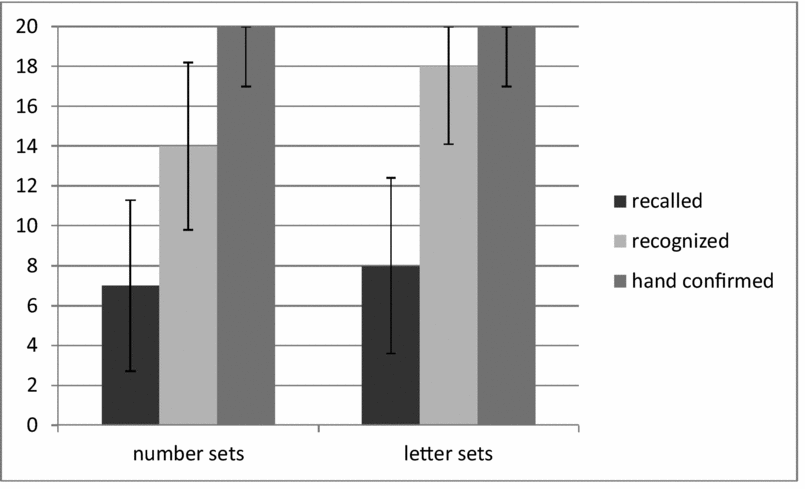
Results. The main results are displayed in Figure 2. According to seeming-Alan, in the number test, I correctly recalled 7 of the 20 three-digit items (with no false recall), and I accurately recognized 14 of the items. In the letter test, I correctly recalled 8 of the 20 three-letter items (with no false recall) and accurately recognized 18. The generating patterns, he claims, were the decimal expansion of 1/2012, excluding the initial zeroes, and the most famous lines of Martin Luther King Jr.'s ‘I Have a Dream’ speech, skipping every other letter and excluding one repeated item. In both cases I manually confirmed that the re-presented lists conformed to the purported generation procedure. Manual application of the two-tailed Fisher's exact test shows my recollections to match significantly less well to the re-presented lists than do the manually confirmed results (both p's < .001). At a p < .05 confidence level, the recognition results are statistically significant for the three-digit items but not for the three-letter items.
Number correct out of 20 as judged by comparison with the lists ‘re-presented’ by seeming-Alan, for my recall guesses, my recognition-test guesses, and my manual confirmation of the purported generating procedure. Error bars for ‘recalled’ and ‘recognized’ are manually calculated 95% confidence intervals using the normal approximation. Error bars for the ceiling results use the ‘rule of three’.

I found myself trying hard in both memory tasks. Since I am inclined to believe that the external world does exist and thus that some other people might read what I now appear to be writing, I was motivated not to come across as sieve-brained. This created a substantial incentive to answer correctly, which I did not feel as strongly in Experiment 1.
Discussion. I believe the most natural interpretation of these results is that something existed in the external world that retained the originally presented information across my gap of memory.
Alternative interpretations are possible as always. The question is whether I should find those alternative interpretations scientifically attractive, considering the truth or falsity of solipsism as an open question. Can solipsism accommodate the results naturally, without the strained, ad hoc excuses that are the telltale sign of a theory in trouble?
Might there have been a direct, unmediated connection between the original auditory experience of ‘IAE’, ‘DEM’, etc., and the later visual experience of those same letter arrangements? If I am willing to countenance backward causation, then a neat explanation offers itself: I might have solipsistically concocted the generating patterns at the moment seeming-Alan seemed to be informing me of them, and then these generating patterns might have backwardly caused my initial auditory experiences and guesses. However, temporally backward causation seems a desperate move if my aim is to apply normal scientific standards as I conceptualize them. A somewhat less radical possibility is temporally gappy cross-modal causation from auditory experience at the beginning of the experiment to visual re-presentation later; however, this requires, in addition to the somewhat uncomfortable provision of temporally gappy causation, a further seeming implausibility absent from the backward causation case, namely, the seeming implausibility, similar to that in Experiment 1, of an unmediated law of experience that operates upon semantic contents of those experiences that are unrecognized as such by me at the time of the law's operation. In this case the relevant semantic contents would be nothing as elegant as primeness but rather the decimal expansion of one divided by the current calendar year, excluding the initial zeroes, and the English orthography of the words of a familiar-seeming speech, skipping alternate letters and excluding one repeated triplet.
The thought occurs to me that some of the laws of external-world psychology, as I conceive of it, are also weird and semantical. For example, an advertisement might trigger a tangentially associated memory. But the crucial difference is this: In the case of external-world psychology, I assume that the semantic associations, even if not conscious, are grounded in mundane facts about neural firing patterns and the like. A bare solipsistic tendency to create and then recreate, unbeknownst to myself, the same partial orthography of a familiar speech while meanwhile being unable to produce that partial orthography when I consciously try to do so—well, that's not impossible perhaps, but neither does it seem as natural a development of solipsism as does the view that the stability of experience should not exceed the stability of memory.
My argument would be defeated if I could have easily found some simple scheme, post hoc, that could generate twenty items including exactly those seven numbers recalled and eight letter sets recalled. My anti-solipsistic interpretation requires that there be only one plausible generating scheme for each set; otherwise there is no reason to think the items not recalled would be the same on the list presented initially as on the list presented subsequently. So, then, what are the odds of a post hoc fit of seven or more items from each set? Fortunately, the odds are very low—about one in a million, given some plausible assumptions and the mathematics of combination.Footnote 6
Perhaps, then, the best defense for solipsism, if it's not to collapse into a general radical skepticism about short-term memory or induction or arithmetic, is temporally gappy cross-modal forward causation grounded in unrecognized weird semantic features of the relevant experiences. I’m inclined to think this is a somewhat awkward position for the solipsistic hypothesis. But maybe I’m still being too unsympathetic to solipsism? Maybe I should have expected that scientific laws would look somewhat weird in a solipsistic world and rather unlike the scientific laws I think of as characteristic of the natural sciences and naturalistic psychology? So I have planned for myself one final experiment of a rather different sort.
3. Experiment 3: Defeat at Chess
Method. Seeming-Alan tells me that he is good at chess. I believe that I stink at chess. Thus, I have arranged to play 20 games of speed chess against seeming-Alan, with a limit of approximately five seconds per move. If solipsism is true, nothing in the universe should exist that has chess-playing practical reasoning capacities that exceed my own, and so I should not experience defeat at rates above statistical chance when directing all of my conscious efforts on behalf of one color. Figure 3 displays the procedure, as presented to me by a seeming camera held by a seeming Gerardo Sanchez.
The procedure of Experiment 3. (Photo credit: Gerardo Sanchez)

Results. Seeming-Alan defeated me in 17 games of 20, with one stalemate. Seventeen out of 19 is statistically higher than 50% with a p-value < .001 (manually calculated).
Discussion. It occurs to me that I might have hoped to lose, so as to generate results confirming my preferred hypothesis that the external world exists. Against this concern, I reassure myself with the following thoughts. If it was an unconscious desire to lose, then that seems to imply that something exists in the world besides my stream of conscious experience, namely, an unconscious part of my mind, and thus radical solipsism as I have defined it is false. If it was, instead, a conscious desire to lose, I should have been able to detect it, barring an unusual degree of introspective skepticism. What I detected instead was a desire to win as many games as I could manage, given my background assumption that if Alan actually exists I would be hard pressed to win even one or two games. Playing with what I experienced as determination and energy, I found myself forcefully and repeatedly struck by the impression that the universe contained a practical intelligence superior to my own and bent on defeating me. The most natural scientific explanation of the pattern in my experience is that that impression was correct.
Does it matter that, if the external world exists in something like the form I think it does, some chess-playing computer programs could have defeated me as handily as seeming-Alan did? I don't see why it should. Whether the strategy and intentionality is manifested directly by a human being or instead through the medium of a human-programmed chess-playing computer—or in any other way—as long as that strategy and intentionality exceeds the abilities of my own conscious mind, the solipsistic hypothesis faces a substantial explanatory challenge. It can try to address this challenge by appealing to intrinsic relationships among experiences of mine—relationships among seeming chess moves countered by other seeming chess moves whose power I only recognize in retrospect—but the more elegant unifying explanation of the results would seem to be the existence of a hostile goal-directed intelligence.
Could I then maybe just abandon the pursuit of explanation? Could I just say it's a regularity unexplained, end of story? But why settle myself so quickly into defeat when the existence of a hostile intelligence seems so readily available as an alternative explanation? Simply shrugging, when I am not forced to do so, runs contrary to the exploratory, scientific spirit of this exercise.
I might easily enough dream of being consistently defeated in chess. Maybe some dreamlike concoction of a seeming chess master could equally well explain my pattern of experience without need of an external world? But dreams of this sort, as I seem to remember, differ from the present experiment in one crucial way: They are vague on the specific moves or unrealistic about those moves. In the same way, I might dream of proving Fermat's last theorem. Such cases involve dreamlike gappiness or irrationality or delusive credulity—the type of gappiness or irrationality or delusive credulity that might make me see nothing remarkable in discovering I am my own father or in discovering a new whole number between 5 and 6. Genuine dream doubt might involve doubt about my basic rational capacities, but if so, such doubts outrun simply solipsistic doubts. And even if I am dreaming or in some other way concocting for myself an imaginary chess master, radical solipsism in the intended sense would still be defeated if the dream explanation implies that there is some unconscious part of my mind that excels at chess and on which I draw, unwittingly, to select those startlingly clever moves. I can easily imagine a world in which I am regularly defeated at chess, but leaning on the resources only of my own chess-inept conscious mind, I can no more specifically imagine the truly brilliant play of a chess expert than I can specifically imagine a world in which twenty four-digit numbers are all, in an instant, properly coded as ‘prime’ or ‘nonprime’. If I consistently experience genuinely clever and perceptive chess moves that repeatedly exploit flaws in my own conscious strategizing, moves that I experience as surprising but which I retrospectively appreciate, it seems hard to avoid the conclusion that something exists that exceeds my own conscious intelligence in at least this one area.
4. General Discussion
When I examine my stream of experience casually, nothing in it seems to compel the rejection of solipsism. My experience contains seeming representations of outward objects; it follows patterns unknown to me and that resist my will. But those basic facts of experience are readily compatible with the truth of radical solipsism. Once I find myself with solipsistic doubts, ‘here is a hand’ does not help me recover; but neither do ambitious proofs in the spirit of Descartes and Kant seem to succeed. I could try to reconcile myself to the impossibility of proof, but that feels like giving up.
Fortunately, the external world hypothesis and the solipsistic hypothesis do appear to make different empirical predictions under certain conditions, at least when interpreted straightforwardly. The external world hypothesis predicts that I will see evidence of theoretical reasoning capacities, memorial retention, and practical reasoning capacities exceeding those of my narrowly conceived conscious self, while solipsism appears to predict the contrary. I can then scientifically test these predictions and avoid begging the question by using only tools that are available to me from within a solipsistic perspective.
The results come out badly for solipsism. To escape my seemingly anti-solipsistic results requires either adopting other forms of radical skepticism in addition to solipsism (for example, about memory, even in the short duration of these studies) or adopting what strike me as increasingly ad hoc, strained, and convoluted accounts of the nature of the laws or regularities connecting one experience to the next.
Did I really need to do science to arrive at this conclusion, though? Maybe instead of running formal experiments, I simply could have consulted long-term memory for evidence of my frustration by superior intelligences and the like? Surely so! And thus maybe also even before conducting these exercises I implicitly relied upon such evidence informally to support my knowledge that the external world exists. Indeed, it would be nice to grant this point, since then I can rightly say that I have known for a long time that the external world exists. But still, the present procedure has several advantages over attempts to remember past frustrations and failures. For one thing, it achieves its goal despite conceding more to the skeptic from the outset, for example, unbelief in yesterday. For another, it more rigorously excludes chance and confirmation bias in evidence selection. And for still another, it forces me to consider, starkly and explicitly, the best possible alternative solipsistic explanations I can devise to account for specific, concrete pieces of evidence—giving solipsism a chance, I hope a fair chance, to strut its stuff, if stuff it has.
Perhaps it's worth noting that the best experiments I could concoct all involved pitting my intelligence against another intelligence or against a device created by another intelligence—a device or intelligence capable of generating semantic or strategic patterns that I could appreciate only subsequently. Whether this is an accidental feature of the experiments I happened to design or whether it reflects some deeper truth, I am unsure.Footnote 7
I conclude that the external world exists. To be clear, I don't at this point conclude anything about its metaphysical character. It is consistent with my experimental results that the external world be material or divine or an unconscious part of myself or an evil demon or an ectoplasmic computer, as long as it can host intelligence. I’ll go out on a limb, though, and tentatively conclude that Alan exists,Footnote 8 a genuine independent-minded coauthor, and I will do something that seems to me to be the act of circulating this essay for him and others to read.