Introduction
Loneliness is a subjective and distressing experience arising from inadequate social relationships, about which much has been written (see Weiss, Reference Weiss1973; Peplau and Perlman, Reference Peplau, Perlman, Peplau and Perlman1982; Andersson, Reference Andersson1998). It has been characterized in terms of frequency, severity and duration of episode, and illustrating the heterogeneity of the loneliness experience (Victor et al., Reference Victor, Scambler, Bowling and Bond2005).
The links between loneliness and its harmful physical and mental health correlates have been the subject of much research (Luanaigh and Lawlor, Reference Luanaigh and Lawlor2008; Holt-Lunstad et al., Reference Holt-Lunstad, Smith and Layton2010; Valtorta et al., Reference Valtorta, Kanaan, Gilbody, Ronzi and Hanratty2016). Efforts to alleviate loneliness have largely focused on interventions to increase contact with others and several systematic reviews have reported on the effectiveness of interventions on loneliness and social isolation. The majority is limited to quantitative outcome studies (Cattan and White, Reference Cattan and White1998; Findlay, Reference Findlay2003; Cattan et al., Reference Cattan, White, Bond and Learmouth2005; Dickens et al., Reference Dickens, Richards, Greaves and Campbell2011; Hagan et al., Reference Hagan, Manktelow, Taylor and Mallett2014; Cohen-Mansfield and Perach, Reference Cohen-Mansfield and Perach2015), and have produced some contradictory and inconclusive findings (Windle et al., Reference Windle, Francis and Coomber2011). A recent integrative mixed-methods review reiterated the poor quality of the evidence base and called for more qualitative studies to understand the mechanisms underlying successful interventions (Gardiner et al., Reference Gardiner, Geldenhuys and Gott2016).
These efforts are not reflected in the proportion of older people reporting loneliness over the last few decades (Victor et al., Reference Victor2002; Honigh-de Vlaming et al., Reference Honigh-de Vlaming, Haveman-Nies, Bos-Oude Groeniger, de Groot and van ’t Veer2014); European studies have reported either a small decrease or no change (Dykstra, Reference Dykstra2009) and a recent American survey reported an increase in loneliness over the last decade (Wilson and Moulton, Reference Wilson and Moulton2010).
The subjective nature of loneliness pertains not only to how loneliness is experienced but also to how people respond to and cope with the feelings (Hauge and Kirkevold, Reference Hauge and Kirkevold2013). There is little research into broader strategies older people employ to cope with feelings of loneliness. We have reported the private nature of loneliness and the desire to manage these feelings without involvement of others (Kharicha et al., Reference Kharicha2017). This may be a matter of personal preference or due to the stigma of admitting to loneliness (Mental Health Foundation, 2010). Qualitative studies are key to understanding not only the type, but also the extent of support lonely older people might want and would accept. The aim of this review is to (i) systematically review qualitative data to identify strategies employed by community dwelling lonely older people to manage feelings of loneliness themselves, and (ii) develop a model for managing loneliness.
Methods
A systematic review of qualitative studies was carried out using a narrative synthesis approach and followed guidance from the Economic and Social Research Council (ESRC) methods program (Popay et al., Reference Popay2006), using the stages and tools relevant for this review. The individual stages are outlined in further detail below.
The following databases were searched: Medline, Embase, PsychInfo, CINAHL, WoS, Social policy and practice, ASSIA. Search terms addressing three areas: (i) older people, (ii) social isolation and loneliness, and (iii) coping strategies, were developed iteratively and Mesh terms were used where available (see Appendix 1). The search was run in January 2017 and included papers in the English language from 1990 to January 2017.
Papers were included if participants were aged 65 years and over, were identified or self-identified as lonely, living in the community (including assisted housing arrangements/supported care), reported coping strategies for loneliness, and in which loneliness is the focus of the study. Papers were excluded if study participants were living in residential/nursing care/long-term care facilities or in hospital settings, and those who were terminally ill/receiving palliative care.
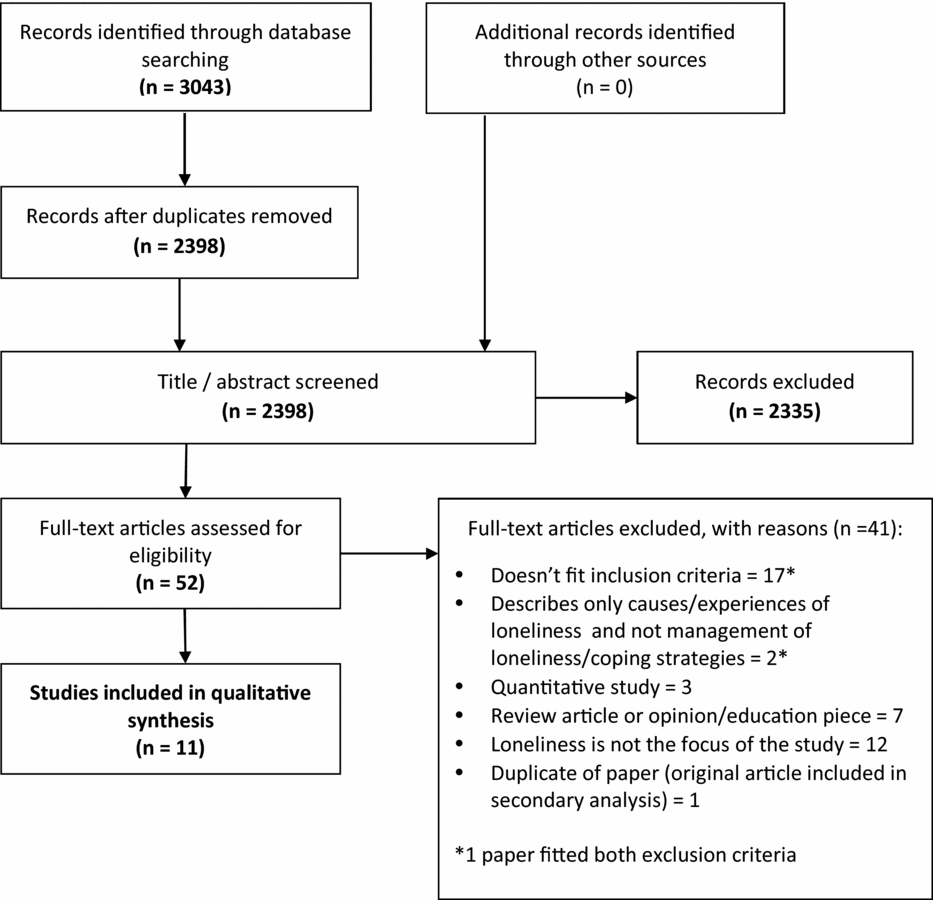
Database searches identified 3,043 records and no additional papers were identified from reference lists of included papers or citation tracking. After de-duplicating records, the lead author (KK) reviewed 2,398 titles/abstracts and identified 52 papers for full-text review. A random sample of over 10% of full papers was reviewed by second reviewer (ND). Eligibility of final papers and any papers where there was disagreement were discussed with all co-authors and a consensus reached.
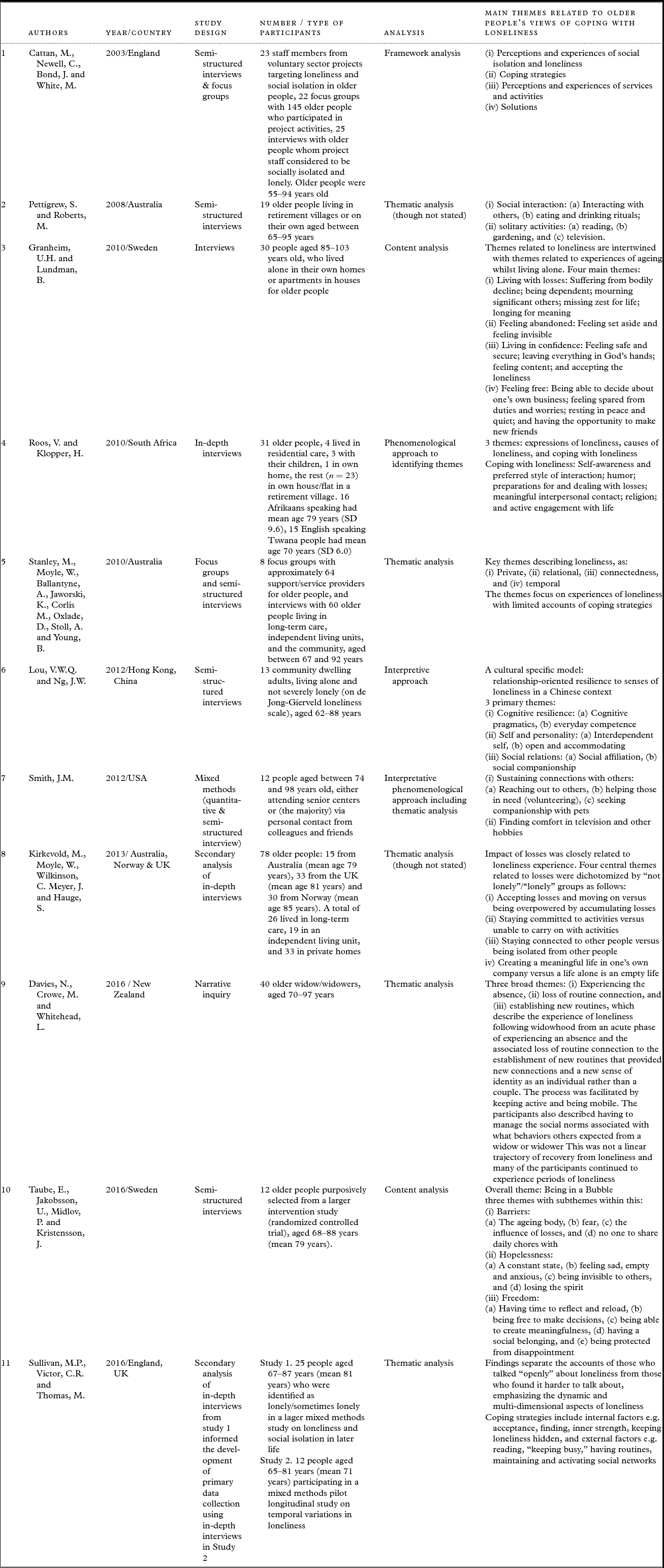
The narrative synthesis approach included the following. A preliminary synthesis extracted relevant data into a pre-defined table and enabled brief textual description of the 11 studies. Data extracted included author, year, country, study design, number/types of participants, analysis, and main themes related to older people's views of coping with loneliness (see Table 1). The Critical Appraisal Skills Programme tool (Critical Appraisal Skills Programme [CASP], 2017) was used to critically reflect on the included studies, but not as a basis to exclude studies. Thematic analysis of text (Strauss and Corbin, Reference Strauss and Corbin2008) from the findings and conclusions of the papers was carried out; authors' comments in discussion sections were not included in data extraction or synthesis. Finally, a conceptual model was developed by all co-authors to visually represent the relationship between key emergent themes from the review (Popay et al., Reference Popay2006). This review paper addresses the 21 items in the guidelines for enhancing transparency in reporting the synthesis of qualitative research (ENTREQ) (Tong et al., Reference Tong, Flemming, McInnes, Oliver and Craig2012).
Description of studies included, in chronological order, n = 11

Results
Description of studies included
A total of 11 eligible papers were identified as shown in the PRISMA flow chart (see Figure 1), and a summary of each paper is reported in Table 1.
PRISMA flow chart.

Data from a total of 502 participants are reported predominantly from interviews or from focus groups. Sample sizes varied from 12 to 170 reflecting the data collection method used. Nine papers reported primary analysis of data and two reported secondary analysis (Kirkevold et al., Reference Kirkevold, Moyle, Wilkinson, Meyer and Hauge2013; Sullivan et al., Reference Sullivan, Victor and Thomas2016) with one of these combining both secondary and primary analyses of data (Sullivan et al., Reference Sullivan, Victor and Thomas2016). Two studies also collected professionals’ views (Cattan et al., Reference Cattan, Newell, Bond and White2003; Stanley et al., Reference Stanley, Moyle, Ballantyne, Jaworski, Corlis and Oxlade2010); these findings were reported separately in the papers and were excluded from this review. The nine papers reporting primary research all used one-to-one, face-to-face interviews, either semi-structured or in-depth. In addition, two also used focus groups (Cattan et al., Reference Cattan, Newell, Bond and White2003; Stanley et al., Reference Stanley, Moyle, Ballantyne, Jaworski, Corlis and Oxlade2010), while another was a mixed method study collecting additional quantitative data (Smith, Reference Smith2012).
All studies included participants aged 65 year and over, although age ranges varied from 55–94 years (Cattan et al., Reference Cattan, Newell, Bond and White2003) to 85–103 years (Graneheim and Lundman, Reference Graneheim and Lundman2010). Similarly, all studies included community dwelling older people living either in their own homes or living independently in retirement villages or independent living units. Two studies also recruited older people living in more supported housing, including long-term care (Stanley et al., Reference Stanley, Moyle, Ballantyne, Jaworski, Corlis and Oxlade2010) and residential care facilities (Roos and Klopper, Reference Roos and Klopper2010). Findings are not differentiated by age band, the type of housing, or support/care the participants received, including whether participants required assistance to leave their homes.
Quality appraisal
Overall the studies were of mixed quality. Several papers reported both experiences of loneliness as well as responses to loneliness (e.g. Smith, Reference Smith2012; Taube et al., Reference Taube, Jakobsson, Midlov and Kristensson2016; Davies et al., Reference Davies, Crowe and Whitehead2016; Sullivan et al., Reference Sullivan, Victor and Thomas2016) and in two papers the data on responses were particularly limited (Cattan et al., Reference Cattan, Newell, Bond and White2003; Stanley et al., Reference Stanley, Moyle, Ballantyne, Jaworski, Corlis and Oxlade2010). Two papers used the term social isolation interchangeably with loneliness (Cattan et al., Reference Cattan, Newell, Bond and White2003; Pettigrew and Roberts, Reference Pettigrew and Roberts2008). Other papers categorized participants as being “lonely” or “not lonely” and inferred that strategies described by those who were “not lonely” were potential strategies to prevent loneliness (e.g. Lou and Ng, Reference Lou and Ng2012; Kirkevold et al., Reference Kirkevold, Moyle, Wilkinson, Meyer and Hauge2013). The implications of how lonely older people are identified were important and are discussed below. These papers were included in this review, but the contribution of the data is limited accordingly.
Recruitment in primary studies was reported in varying detail. Some employed multiple strategies reflecting the potential difficulty in recruiting lonely older people to loneliness research. Information on notice boards (Roos and Klopper, Reference Roos and Klopper2010) or newsletters and flyers (Stanley et al., Reference Stanley, Moyle, Ballantyne, Jaworski, Corlis and Oxlade2010) was used alongside asking key contacts within organizations to recruit potential participants. Recruitment via professionals was common (Cattan et al., Reference Cattan, Newell, Bond and White2003; Pettigrew and Roberts, Reference Pettigrew and Roberts2008; Roos and Klopper, Reference Roos and Klopper2010; Stanley et al., Reference Stanley, Moyle, Ballantyne, Jaworski, Corlis and Oxlade2010; Lou and Ng, Reference Lou and Ng2012; Smith, Reference Smith2012; Davies et al., Reference Davies, Crowe and Whitehead2016). One study changed its recruitment approach after failing to recruit sufficiently (Smith, Reference Smith2012). Only Taube et al. (Reference Taube, Jakobsson, Midlov and Kristensson2016), who recruited from a larger intervention study, report any detail of response rates. The papers reporting secondary analyses refer to the original sources of data and little can be gleaned about recruitment from reading the two papers alone.
There was no direct reference to reflexivity although two studies (Davies et al., Reference Davies, Crowe and Whitehead2016; Taube et al., Reference Taube, Jakobsson, Midlov and Kristensson2016) described researchers’ professional backgrounds and any previous knowledge of the study participants. One (Roos and Klopper, Reference Roos and Klopper2010) recognized the importance of being wary of researchers’ views of loneliness while interviewing. Two studies (Cattan et al., Reference Cattan, Newell, Bond and White2003; Pettigrew and Roberts, Reference Pettigrew and Roberts2008) involved participants in respondent validity (by sharing transcripts or early themes) but did not report if the analysis or interpretation were shaped by this. Two papers referred to having used the COREQ checklist (Tong et al., Reference Tong, Sainsbury and Craig2007) for reporting (Davies et al., Reference Davies, Crowe and Whitehead2016; Taube et al., Reference Taube, Jakobsson, Midlov and Kristensson2016).
Results were well mostly well-presented with core themes and verbatim quotes. However, authors’ reflections were not consistently backed by data (Sullivan et al., Reference Sullivan, Victor and Thomas2016), or quotes were merged within the descriptive text without accompanying demographic data for information or to gauge the spread of participants’ views (Roos and Klopper, Reference Roos and Klopper2010). Two papers reported the hierarchy of themes (Roos and Klopper, Reference Roos and Klopper2010; Taube et al., Reference Taube, Jakobsson, Midlov and Kristensson2016). However, one paper combined data from older people attending community groups, and those attending who were thought to be lonely by the staff, not differentiating between the two data sets in their findings (Cattan et al., Reference Cattan, Newell, Bond and White2003).
Culturally bound interpretations, specific to Hong Kong Chinese and South African culture, are reported by Lou and Ng (Reference Lou and Ng2012) and Roos and Klopper (Reference Roos and Klopper2010), respectively, but there is no discussion of cultural differences in the secondary analysis of the three-country dataset by Kirekevold et al. (Reference Kirkevold, Moyle, Wilkinson, Meyer and Hauge2013).
Identifying older people who are lonely
Four different approaches were used to identify older people who might be lonely, summarized in bold text here (most studies used more than one approach). First, older people self-identified as lonely in 3 of the 11 studies. Smith (Reference Smith2012) interviewed those responding positively to the question: “Have you experienced loneliness within the last six months?” although it is unclear whether this initial question was asked verbally or presented in written form. Others had reported being “lonely,” “sometimes lonely” or given an indication of strength of loneliness feelings in an earlier study from which they were then purposively sampled for interview (Taube et al., Reference Taube, Jakobsson, Midlov and Kristensson2016; Sullivan et al., Reference Sullivan, Victor and Thomas2016) or reported being lonely or sometimes lonely during an interview (Sullivan et al., Reference Sullivan, Victor and Thomas2016).
In four studies, participants had not necessarily identified themselves as lonely but simply reported that they were willing to talk about loneliness, (Pettigrew and Roberts, Reference Pettigrew and Roberts2008; Roos and Klopper, Reference Roos and Klopper2010; Stanley et al., Reference Stanley, Moyle, Ballantyne, Jaworski, Corlis and Oxlade2010; Kirekevold et al., Reference Kirkevold, Moyle, Wilkinson, Meyer and Hauge2013). Several studies (6 out of 11) relied on practitioners at community organizations running groups or activities for older people, general practices, or elder care/retirement village managers, to identify potential participants, that is, older people they thought were lonely or at risk of loneliness and likely to be interested in participation (Cattan et al., Reference Cattan, Newell, Bond and White2003; Pettigrew and Roberts, Reference Pettigrew and Roberts2008; Roos and Klopper, Reference Roos and Klopper2010; Lou and Ng, Reference Lou and Ng2012; Smith, Reference Smith2012; Davies et al., Reference Davies, Crowe and Whitehead2016). Lou and Ng's (Reference Lou and Ng2012) culturally specific approach to coping strategies for loneliness was the only study to use a validated loneliness measure (de Jong-Gierveld scale) (de Jong-Gierveld, Reference de Jong-Gierveld1987). They excluded those whose scores indicated severe loneliness and included all others who were hence considered to be coping with loneliness as they did not report being severely lonely despite living alone. Finally, in 8 of the 11 papers, a range of “risk factors” was used as proxy measures to identify loneliness. These included being widowed (Davies et al., Reference Davies, Crowe and Whitehead2016) or being very old (85 years and over) and living alone (Graneheim and Lundman, Reference Graneheim and Lundman2010), attending community groups/day centers or those living in retirement villages (Cattan et al., Reference Cattan, Newell, Bond and White2003; Pettigrew and Roberts, Reference Pettigrew and Roberts2008; Roos and Klopper, Reference Roos and Klopper2010; Stanley et al., Reference Stanley, Moyle, Ballantyne, Jaworski, Corlis and Oxlade2010; Lou and Ng, Reference Lou and Ng2012; Smith, Reference Smith2012; Davies et al., Reference Davies, Crowe and Whitehead2016). These participants may or may not have been lonely themselves; they often talked of “others” rather than themselves. Furthermore, Sullivan et al. (Reference Sullivan, Victor and Thomas2016) reported that some who had previously rated themselves as lonely did not go on to volunteer this when interviewed.
Findings of the synthesis
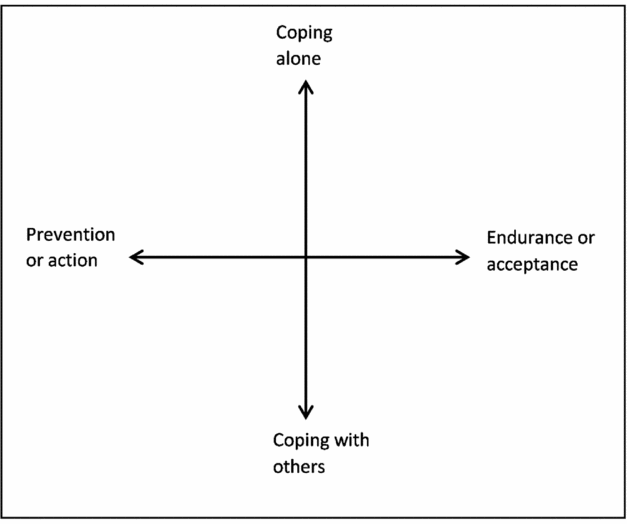
The thematic analysis identified strategies employed by older people to manage their loneliness. The themes can be grouped into two overarching themes or dimensions. The first dimension relates to context and describes whether people cope (and choose to manage) alone or prefer to cope with/in reference to others (that is, with others in mind). The second dimension refers to the type of strategy employed, and represents a spectrum ranging from prevention or action in response to loneliness or acceptance or endurance of loneliness. Prevention of loneliness describes both the strategies participants reported they would put in place if they felt lonely, as well as actual strategies practised in an attempt to deter loneliness. The former “hypothetical actions” may arise as a result of how participants were identified (as discussed above) and the uncertainty in whether or not they were in fact lonely, and/or the difficulties of disclosing or describing feelings of loneliness. Actions were the strategies people described they performed to alleviate their distress. Acceptance and endurance of loneliness overlap to some extent in their definition but differ in that “acceptance” is taken to mean an adequate resolution to the experience of loneliness and “endurance” that the unpleasant feelings continue and are “lived with.” The two dimensions can be represented as a model of managing loneliness, as presented in the Discussion section of this paper (see Box 1).
A model for managing loneliness in later life.

The findings of the synthesis are presented below, with themes grouped within the two overarching dimensions, as appropriate. Some themes, including personality-related factors, the effort involved in planning, cognitive strategies, and going outdoors, are mentioned more than once as they describe strategies that can be placed within both dimensions. Verbatim participant quotes are used to illustrate themes where possible from papers that reported primary data.
Coping alone
A range of factors were identified across studies that supported coping alone with loneliness.
Prevention and action
∙ Personality-related strategies included being determined and motivated to stay active, focusing on good times, taking pride in yourself and your environment, the ability to shift the focus away from yourself, and onto the outside world and finding humor in situations (Roos and Klopper, Reference Roos and Klopper2010; Stanley et al., Reference Stanley, Moyle, Ballantyne, Jaworski, Corlis and Oxlade2010; Lou and Ng, Reference Lou and Ng2012; Kirkevold et al., Reference Kirkevold, Moyle, Wilkinson, Meyer and Hauge2013), as this quotation illustrated.
∙ “You have to keep pushing yourself all the time. I am actually conscious of not sitting in my chair. I have to keep getting up and doing something” (Stanley et al., Reference Stanley, Moyle, Ballantyne, Jaworski, Corlis and Oxlade2010, p. 410).
∙ The driver for these strategies was the belief that it is an individual's responsibility to manage their feelings of loneliness (Roos and Klopper, Reference Roos and Klopper2010; Stanley et al., Reference Stanley, Moyle, Ballantyne, Jaworski, Corlis and Oxlade2010; Sullivan et al., Reference Sullivan, Victor and Thomas2016) and a lack of response would mean they could possibly lead to depression or worsen it (Roos and Klopper, Reference Roos and Klopper2010). Some personality-related strategies may have been lifelong traits while others were age related, for example, feeling a “freedom of expression” in later life that allows a license to behave differently (Taube et al., Reference Taube, Jakobsson, Midlov and Kristensson2016).
∙ The efforts involved in establishing and maintaining plans, structure, and routines were described by many, often in an effort to fill the time. This was in relation to daily structures as well as re-establishing routines and adjusting after significant life events and losses and planning for inevitable loneliness (Roos and Klopper, Reference Roos and Klopper2010; Lou and Ng, Reference Lou and Ng2012; Kirkevold et al., Reference Kirkevold, Moyle, Wilkinson, Meyer and Hauge2013; Sullivan et al., Reference Sullivan, Victor and Thomas2016; Davies et al., Reference Davies, Crowe and Whitehead2016). A common element within daily routines was going outdoors regularly for stimulation (e.g. Roos and Klopper, Reference Roos and Klopper2010; Lou and Ng, Reference Lou and Ng2012).
∙ The idea of “keeping busy” was mentioned in most accounts. Solitary pastimes ranged from activities, interests, and hobbies that were considered more engaging or “meaningful” than others such as reading, gardening, walking, and following current events, compared with those that were considered a distraction or more “passive” such as watching TV other than the news (Pettigrew and Roberts, Reference Pettigrew and Roberts2008; Roos and Klopper, Reference Roos and Klopper2010; Lou and Ng, Reference Lou and Ng2012; Smith, Reference Smith2012; Kirkevold et al., Reference Kirkevold, Moyle, Wilkinson, Meyer and Hauge2013; Taube et al., Reference Taube, Jakobsson, Midlov and Kristensson2016; Sullivan et al., Reference Sullivan, Victor and Thomas2016). As one study participant reported: “. . . I keep busy and I don't get lonely” (Kirkevold et al., Reference Kirkevold, Moyle, Wilkinson, Meyer and Hauge2013 p. 397).
∙ Religion, spirituality, and philosophical approaches were raised in papers reporting the experiences of the very old living alone and of a South African older population. Having a religion or faith and a belief that you are not alone as God is with you, in life as well as death, made them less fearful. Spiritual practices reported included prayer, singing, and reading alone as well as engaging in meditation or “forced calmness” (Graneheim and Lundman, Reference Graneheim and Lundman2010; Roos and Klopper, Reference Roos and Klopper2010), as illustrated by one study participant: “I know I'm never alone, the Lord is always with me” (Roos and Klopper, Reference Roos and Klopper2010, p. 286).
Acceptance and endurance
1. Loneliness as inevitable. Perceiving loneliness as inevitable, commonplace, and experienced by all was a way of coming to terms with feelings of loneliness and accepting them (Pettigrew and Roberts, Reference Pettigrew and Roberts2008; Graneheim and Lundman, Reference Graneheim and Lundman2010; Roos and Klopper, Reference Roos and Klopper2010).
2. Personality-related strategies relating to an acceptance or endurance of loneliness portrayed a positive attitude, an ability to draw on “inner strength,” a sense of control over one's experience of loneliness and the extent to which it is experienced (Roos and Klopper, Reference Roos and Klopper2010; Sullivan et al., Reference Sullivan, Victor and Thomas2016). For the very old this was described as having a “fateful” approach and living in the moment, being happy for each new day and not wanting more: “Yes, you should take everything as it comes . . . nothing is that important . . . I am just a little dot in the universe and still I am wonderful . . . a wonderful creation” (Graneheim and Lundman, Reference Graneheim and Lundman2010, p. 436).
3. Acknowledging the temporal nature of loneliness helped people cope. Learning from previous episodes of loneliness and understanding that both the episode and how acutely it is felt can pass (Roos and Klopper, Reference Roos and Klopper2010; Stanley et al., Reference Stanley, Moyle, Ballantyne, Jaworski, Corlis and Oxlade2010; Sullivan et al., Reference Sullivan, Victor and Thomas2016). The strategies were not described as “cures” for loneliness, and there was no sense of permanent resolution. Rather they were strategies that could be drawn on to bring temporary relief to feelings of loneliness which came and went at different times of day, week or season, after specific life events and over their life course and varied in intensity at different times. One paper summarized such a situation thus: “. . . he felt lonely at night after his wife had gone to bed, but his salvation was his reading – this time provided an opportunity for him to become aware of his loneliness but able to temporarily escape it . . .” (Sullivan et al., Reference Sullivan, Victor and Thomas2016, p. 174).
4. Another strategy was comparative thinking in which people found some relief by comparing their current situation and feelings to times of life that had been more difficult emotionally, for example, when younger (Graneheim and Lundman, Reference Graneheim and Lundman2010; Lou and Ng, Reference Lou and Ng2012; Sullivan et al., Reference Sullivan, Victor and Thomas2016).
5. Re-framing loneliness to consider the advantages of being alone was reported by some who focused on their time alone as an opportunity to reflect and rest, or enjoy the freedom to do what one wanted and a pride in one's ability to live alone in later life (Graneheim and Lundman, Reference Graneheim and Lundman2010; Roos and Klopper, Reference Roos and Klopper2010; Taube et al., Reference Taube, Jakobsson, Midlov and Kristensson2016), as mentioned by this one study participant: “When you're alone and have chosen to be alone. When you think, ‘oh, how nice it is to sit here’” (Taube et al., Reference Taube, Jakobsson, Midlov and Kristensson2016, p. 637).
6. For loneliness that is private and persistent, one paper used the metaphor of “fighting” to describe the constant effort to fight the feelings of loneliness, including an acknowledgment of its persistence, and efforts to find small relief where possible (Taube et al., Reference Taube, Jakobsson, Midlov and Kristensson2016).
Coping with/in reference to others
In this section, we describe strategies identified from studies on coping through the involvement of other people.
Prevention and action
1. Establishing, maintaining, nurturing, repairing relationships, and connections throughout life were described in most papers. This most commonly referred to family and friends, but also pets (Smith, Reference Smith2012) and care workers (Graneheim and Lundman, Reference Graneheim and Lundman2010). These contacts took place both inside and outside the home (including the use of the telephone), and were for social and/or emotional loneliness, that is from “simple” contact to having confidantes. As one paper noted, this could be routinized: “I look forward to being able to wander over there (the retirement village's communal lounge area) at 5 o'clock each night and be able to sit and have a couple of drinks for an hour and then come home and have tea” (Pettigrew and Roberts, Reference Pettigrew and Roberts2008, p. 306).
Within this was a sense of hierarchy of relationship between families and friends, as well as the need for both, while having boundaries around what is shared within these groups in order to maintain the relationship(s) (Pettigrew and Roberts, Reference Pettigrew and Roberts2008; Roos and Klopper, Reference Roos and Klopper2010; Stanley et al., Reference Stanley, Moyle, Ballantyne, Jaworski, Corlis and Oxlade2010; Lou and Ng, Reference Lou and Ng2012; Smith Reference Smith2012; Kirkevold et al., Reference Kirkevold, Moyle, Wilkinson, Meyer and Hauge2013; Davies et al., Reference Davies, Crowe and Whitehead2016; Sullivan et al., Reference Sullivan, Victor and Thomas2016; Taube et al., Reference Taube, Jakobsson, Midlov and Kristensson2016).
2. The effort to plan and initiate arrangements in reference to “others” most commonly occurred over food and drink rituals, both more “formal” meals or special occasions that may have been practised throughout life and “informal” exchanges such as “having a drink” (alcohol), “going for coffee,” “having tea,” which were often culturally bound (Pettigrew and Roberts, Reference Pettigrew and Roberts2008; Lou and Ng, Reference Lou and Ng2012; Smith, Reference Smith2012). People also described having plans or “back up” strategies if they were to start feeling lonely (Sullivan et al., Reference Sullivan, Victor and Thomas2016) such as this study participant's practice: “I mean I could always go up and talk to the girl, the sisters, or go and talk to Sam and Catherine. There are several people, if I felt lonely, which I don't. Or they'd come and see us [. . .] I mean if I really felt lonely I'd take the dogs over to the common and I'd find someone to talk to very, very quickly” (Sullivan et al., Reference Sullivan, Victor and Thomas2016, p. 173).
3. Again, going outdoors regularly as a strategy was discussed this time with the hope to initiate or increase the likelihood of chance encounters and exchanges with others (Cattan et al., Reference Cattan, Newell, Bond and White2003; Lou and Ng, Reference Lou and Ng2012; Sullivan et al., Reference Sullivan, Victor and Thomas2016). One person described this approach: “I try not to get lonely but I do. I go out to try to stop being lonely. I sit and talk to people in the park. I get lonely a lot – that's why I go out a lot” (Cattan et al., Reference Cattan, Newell, Bond and White2003, p. 25).
4. Shifting the focus away from yourself and onto others either by engaging in activities that were considered meaningful and worthwhile such as volunteering and caring responsibilities as well as socializing for the sake of others and not just yourself also emerged (Pettigrew and Roberts, Reference Pettigrew and Roberts2008; Roos and Klopper, Reference Roos and Klopper2010; Smith, Reference Smith2012; Kirkevold et al., Reference Kirkevold, Moyle, Wilkinson, Meyer and Hauge2013; Taube et al., Reference Taube, Jakobsson, Midlov and Kristensson2016).
5. Being open to new experiences such as clubs or activities to establish contact with others was raised in a few papers and conveyed a reluctant necessity in the description. It required courage and was often challenging. This was sometimes due to a loss of confidence that had developed over time in initiating such contacts or following life events such as bereavement. Those that had tried this approach described it as a “life-line” when there were no other alternatives, where they had found some enjoyment in a safe environment (Cattan et al., Reference Cattan, Newell, Bond and White2003; Lou and Ng, Reference Lou and Ng2012; Kirkevold et al., Reference Kirkevold, Moyle, Wilkinson, Meyer and Hauge2013; Davies et al., Reference Davies, Crowe and Whitehead2016), for example, “I go to a club now you see, it's nothing fancy but it serves a purpose . . . It took me three or four visits before I started to settle in. We play games and that sort of thing, it takes you mind off things” (Davies et al., Reference Davies, Crowe and Whitehead2016, p. 536).
6. Having a religion or faith and engaging in religious practices including contact with religious leaders as well as social gatherings helped some and provided particular support after a traumatic event or loss. Religious leaders helped “to pull the wagon through the ditch” (Roos and Klopper, Reference Roos and Klopper2010).
Acceptance and endurance
1. Keeping loneliness hidden or a secret was described in a few papers. People reported distancing themselves from others or denying their own loneliness and describing the loneliness of “others.” This was due to the perception of admission of loneliness as failure and not wanting this to impact on relationships or the difficulties of speaking about loneliness (Stanley et al., Reference Stanley, Moyle, Ballantyne, Jaworski, Corlis and Oxlade2010; Lou and Ng, Reference Lou and Ng2012; Sullivan et al., Reference Sullivan, Victor and Thomas2016). Such a view was expressed by one study participant: “Society sees it as a nasty problem that they don't want to know about and also people who are lonely . . . [feel unable] to express this without feeling that they are a failure of some kind” (Stanley et al., Reference Stanley, Moyle, Ballantyne, Jaworski, Corlis and Oxlade2010, p. 410).
2. Comparisons were made either to other people or situations perceived as being “worse” or times when they themselves were “worse off.” For example, loneliness may be safer than disappointment, preferring living alone rather than finding a new partner (Cattan et al., Reference Cattan, Newell, Bond and White2003; Taube et al., Reference Taube, Jakobsson, Midlov and Kristensson2016). One participant expressed such wariness thus: “I guess maybe I could have found myself a woman. . . but. . . I haven't felt that lonely. . . I've preferred being alone. . . If you had a wife who was sick for ten years and it was only trouble, then. . . for the most part . . . you think of that. . . you don't want to experience that again” (Taube et al., Reference Taube, Jakobsson, Midlov and Kristensson2016, p. 637).
3. Taking the focus away from yourself and onto “collective well-being,” for example, by living alone rather than with families, thus reducing the potential pressures on wider family, was described in a cultural context by Lou and Ng (Reference Lou and Ng2012) and without any reference to culture by Kirkevold et al. (Reference Kirkevold, Moyle, Wilkinson, Meyer and Hauge2013). These papers described an adjustment of expectations to fit with the needs of the wider family, rather than their individual needs.
As might be expected, most of the strategies identified in this review were positively framed. However, a small number of instances were described or alluded to in which people described coping less well, reflecting the fact that it is probably easier to talk about how you cope or would cope, rather than how you might not be managing. These include feelings of desperation (Cattan et al., Reference Cattan, Newell, Bond and White2003), boredom, gloominess, and feeling abandoned (Graneheim and Lundman, Reference Graneheim and Lundman2010), boredom and meaninglessness (Kirkevold et al., Reference Kirkevold, Moyle, Wilkinson, Meyer and Hauge2013), feeling fearful, vulnerable and hopeless (Taube et al., Reference Taube, Jakobsson, Midlov and Kristensson2016), descriptions of guilt and shame of not coping, and crying (Roos and Klopper, Reference Roos and Klopper2010), heavy alcohol consumption (Pettigrew and Roberts, Reference Pettigrew and Roberts2008), and talking about “others” rather than themselves (Sullivan et al., Reference Sullivan, Victor and Thomas2016). These have not been included this analysis as they were only briefly mentioned in the papers.
Discussion
Summary of findings
This review of strategies employed by lonely older to manage their loneliness identified two main dimensions. First, the context of coping which was either alone or with/in reference to others. Second, the approach to coping which ranged from prevention or action as a response, or acceptance, or endurance of loneliness. The two dimensions can be represented as a model of managing loneliness in later life (see Box 1).
An individual at a given point in time could be placed on these continuums according to their desire to involve others in their loneliness and their preference of strategy type within the spectrum. This model is novel in that it moves beyond understanding the phenomenon of loneliness itself to consider the range of ways older people with loneliness wish to address the issue.
Within the main dimensions, a range of strategies were described, drawing on individual personality-related coping styles, the considerable efforts in managing time, making contact with others, and keeping loneliness hidden. Cognitive strategies were used to re-frame negative feelings, to make them more manageable or help shift the focus from the present time or themselves. As such these themes may appear within more than one dimension of the model. Difficulty talking about loneliness may account for strategies that might be perceived as being less successful and were infrequently described.
Strengths and limitations of this review
While much has been written about the experience of loneliness in later life and how it might be alleviated, the papers identified in this review of strategies to self-manage loneliness were limited to only 11 in number, all except one having been published within the last 10 years. Over time there appears to have been a slight shift from exploring how services and interventions can help alleviate loneliness to understanding how people manage their distress themselves.
Limitations
Although a systematic approach was taken to this review, it is possible some papers were missed. This review was mainly secondary analysis of primary research based on both verbatim quotes and original author interpretations, but also included papers reporting secondary analysis. The analysis and interpretations reported in this review build on previous interpretations from the authors of the included studies and increasing distance from the views of older people themselves.
Caution is also needed regarding the positive framing of coping with loneliness; it appears as if most lonely people have successful coping strategies. It was not possible to differentiate between those with temporary and chronic loneliness; coping strategies are likely to differ according to length and intensity of loneliness experience. It may also be harder to talk about not coping and those who were struggling may not have volunteered to be interviewed.
Methodological limitations
The range of settings from which older people were recruited meant this review included participants from a wide age range, and varying health needs, living circumstances, and cultural backgrounds. Papers also included both those who self-identified as lonely and those willing to talk about it who may or may not have been lonely. This latter group was often recruited on the basis of a risk factor for loneliness, such as living alone. There were no differentiation or sub-group analyses, although these characteristics may well impact on experience or views of loneliness and/or coping strategies.
Strategies employed by those who were not lonely despite being considered “at risk” were inferred as being protective factors against loneliness. There is an implication that these protective factors could be used as coping strategies by those who were lonely, especially if symptoms of loneliness were “caught early,” including by professionals in contact with these older people. However, this may be more attributable to personality factors, lifelong traits, ways of doing things, and individual coping styles.
Comparison with other literature
The heterogeneity of coping mechanisms for loneliness in later life identified in this review mirrors the breadth of experiences of loneliness that have been reported (Peplau and Perlman, Reference Peplau, Perlman, Peplau and Perlman1982; Andersson, Reference Andersson1998; Victor et al., Reference Victor, Scambler, Bowling and Bond2005). Defining loneliness as a discrepancy between actual and desired levels of social engagement (Peplau and Perlman Reference Peplau, Perlman, Peplau and Perlman1982) aligns with a deficit model of ageing. This review identified responses to loneliness, both private and with others, which are largely initiated by an older person suggesting that older people should be regarded as active agents in managing their loneliness (Elder and Johnson, Reference Elder and Johnson2003).
Most people experience loneliness at some point in their lives; identifying who might benefit from more intensive psychological support and what this should include is less clear. Services for loneliness currently focus mainly on promoting engagement in group social activities or one-to-one befriending; however, the evidence for effectiveness of existing interventions is mixed (Cattan et al., Reference Cattan, White, Bond and Learmouth2005; Hagan et al., Reference Hagan, Manktelow, Taylor and Mallett2014; Cohen-Mansfield and Perach, Reference Cohen-Mansfield and Perach2015; Gardiner et al., Reference Gardiner, Geldenhuys and Gott2016). There are no interventions to our knowledge currently widely used in practice that explicitly aim to facilitate older people to develop cognitive strategies including acceptance.
Additionally, it has been argued that loneliness is not only about how people view themselves, but also about how they feel they are positioned in society. Societal and community level responses to loneliness include both a normalization of loneliness and manufactured opportunities to re/engage with local communities in later life (Barke, Reference Barke2017).
Implications
Based on the findings of this review, we have proposed a tentative model to describe ways in which older people may wish to manage their loneliness. Given the dynamic nature of feelings of loneliness it should not be regarded as static. The model has potential for use by practitioners to engage in discussion with lonely older people to identify ways in which they may want to address their feelings of loneliness drawing on individual coping styles and preferences. Further research is required to explore the acceptability of the model to lonely older people and its applicability to different contexts, settings, and groups.
Conclusions
Based on the findings of this review of qualitative studies, we have developed a model for managing loneliness in later life. The model conceptualizes coping styles for loneliness as being on two-key dimensions representing a spectrum of strategies from prevention or action through to acceptance or endurance, and coping alone or coping with/in reference to others. Older people who choose to deal with their loneliness by themselves may find it difficult to articulate an inability to cope. This taxonomy of coping with loneliness could have implications for interventions to reduce loneliness, if validated by other studies.
Conflicts of interest
None.
Description of author roles
KK designed the review, carried it out, analyzed the data, developed the conceptual model, and led the write up of the paper. JM supervised the review, discussed and agreed eligibility of final papers, contributed to the analysis, conceptual model development, and write up of the paper. SI supervised the review, discussed and agreed eligibility of final papers, contributed to the analysis, conceptual model development, and write up of the paper. ND was second reviewer and reviewed a random sample of papers, discussed and agreed eligibility of final papers, contributed to the write up of the paper. KW supervised the review, discussed, and agreed eligibility of final papers, contributed to the analysis, conceptual model development, and write up of the paper.
Appendix 1: Search terms
Older people
1. elder*.mp.
2. exp Geriatrics/
3. exp “Aged, 80 and over”/
4. old* person.mp.
5. old* people.mp.
6. exp Aging/ or ag?ing.mp.
7. old* age.mp.
8. senior*.mp.
Loneliness and social isolation
1. exp Loneliness/
2. lonel*.mp.
3. exp Social Isolation/
4. social isolation.mp.
5. solitude.mp.
6. solitary.mp.
7. liv* alone.mp.
8. exp Social Alienation/
Coping strategies
1. exp Self Care/
2. self manag*.mp.
3. exp Adaptation, Psychological/
4. (emotion* adj3 manag*).mp.
5. (feeling* adj3 manag*).mp.
6. (psycholog* adj3 manag*).mp.
7. (coping adj3 mechanism*).mp.
8. (psychological* adj3 adjust*).mp.
9. (emotion* adj3 adjust*).mp.
10. (behavio?ral* adj3 adjust*).mp.
11. (psychological* adj3 adapt*).mp.
12. psychological adjust*.mp
13. (psychological adj3 strat*).mp.
14. (emotion* adj3 strat*).mp.
15. exp Self Efficacy/
16. (coping adj3 strat*).mp.
17. (coping adj3 behavio?r).mp.
18. exp Coping/
19. coping skill*.mp
20. self reliance.mp.
21. exp Resilience, Psychological/
22. resilience.mp.
23. manag* lonel*.mp
24. exp adaptive behavior/
25. exp coping behavior/