Introduction
Aphids in the genus Tamalia Baker are known only from North America and form galls (Fig. 1), feed, and reproduce strictly on plants in the subfamily Arbutoideae of family Ericaceae. These aphid species have a combination of morphological characters that set them apart from other aphids as a unique group (subfamily Tamaliinae) (Remaudière and Stroyan Reference Remaudière and Stroyan1984) that is distinct from other gall-inducing aphid taxa (Nováková et al. Reference Nováková, Hypša, Klein, Foottit, von Dohlen and Moran2013).
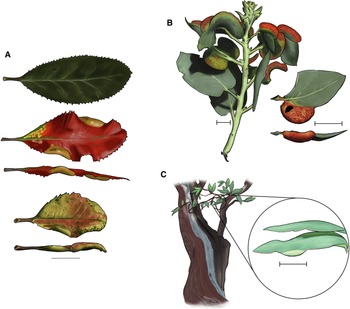
Drawings of galls of new Tamalia species: A, ungalled leaf and leaves with galls of Tamalia cruzensis on Comarostaphylis diversifolia (Ericaceae: Arbutoideae); B, galls of Tamalia glaucensis on Arctostaphylos glauca (Ericaceae: Arbutoideae); and C, gall of Tamalia moranae on Arbutus arizonica (Ericaceae: Arbutoideae). Scale bars: 10 mm.

The earliest published mention of these aphids was by Cowen in Gillette (Reference Gillette1895), collected near Fort Collins, Colorado, United States of America, on Arctostaphylos uva-ursi (Linnaeus) Sprengel (Ericaceae: Arbutoideae), briefly described but unnamed. The first formal description was that of Pemphigus coweni Cockerell, 1905, also collected on A. uva-ursi in the Colorado Front Range, for which Baker (Reference Baker1920) erected the genus Tamalia. Four additional species have since been described, all of them from western North America, namely Tamalia keltoni Richards, 1967; Tamalia dicksoni Remaudière and Stroyan, 1984; Tamalia inquilinus Miller and Sharkey, 2000; and Tamalia milleri Kanturski and Wieczorek, 2015. Two additional names, Cryptosiphum tahoense Davidson, 1911 and Tamalia pallida Richards, 1967, are currently considered synonyms of T. coweni. Based on published records, T. coweni as generally understood (referred to hereafter as the T. coweni complex) is by far the most widely distributed of the species in question in the present study and is reported to feed on at least 32 species of Arctostaphylos Adanson (Miller Reference Miller2005).
Beyond representing an origin of gall induction independent from the more familiar subfamilies Eriosomatinae and Hormaphidinae, Tamalia aphids are noteworthy for their primitive social behaviour in the form of communal gall occupation by genetically distinct (i.e., nonclonal) individuals, as well as for the presence of congeneric inquilines on some Arctostaphylos host plants (Miller Reference Miller1998; Miller and Sharkey Reference Miller and Sharkey2000; Taylor and Miller Reference Taylor and Miller2014). Phylogenetic analyses based on the cytochrome oxidase 1 (CO1) region of the mtDNA genome and based on loci in the nuclear and endosymbiotic genomes indicate the presence of additional species or species complexes (Miller and Crespi Reference Miller and Crespi2003; Miller et al. Reference Miller, Lawson, Rinker, Estby and Abbot2015). The present paper provides a formal description of three new species of Tamalia. Illustrations, information on biology, distribution, seasonal occurrence, and DNA barcode sequences, and a key to the apterae of Tamalia species are presented.
Materials and methods
Species descriptions and character measurements were based on specimens from the authors’ field collections and comparisons with known species in other collections, including holdings of the Essig Museum of Entomology, University of California, Berkeley, California, United States of America (EMEC); California State University–Chico Collection, Chico, California, United States of America (CHSC); Canadian National Collection, Ottawa, Ontario, Canada (CNC); National Museum of Natural History Aphidoidea Collection, Beltsville, Maryland, United States of America (USNM); Utah State University Collection, Logan, Utah, United States of America (EMUS), and Washington State University Aphid Collection, Prosser, Washington, United States of America (WSU).
Galls were sampled from populations of various Arctostaphylos species (manzanita and bearberry) from sites in the United States of America (Alaska, California, Colorado, Oregon, Utah, and Washington) and Canada (Alberta, British Columbia, Manitoba, and Ontario), on Arbutus arizonica (A. Gray) Sargent (Arizona madrone) in the Santa Catalina Mountains, Arizona, United States of America, and on Comarostaphylis diversifolia (Parry) Greene (summer holly) on Santa Cruz Island and in the Santa Barbara area of California. Galls were dissected under a stereo-microscope, and specimens were preserved in 95% ethanol for use in slide mounting in Canada balsam, according to the methods of Foottit and Maw (Reference Foottit and Maw2017) and for DNA barcoding (see methods, below).
Plant names follow the United States Department of Natural Resources, Conservation Service plant profiles (United States Department of Agriculture 2009). Descriptive terminology follows Foottit and Richards (Reference Foottit and Richards1993) and Pike et al. (Reference Pike, Boydston and Allison2003). The basal and distal segments of the two-segmented tarsi are referred to as “tarsomere I” and “tarsomere II,” respectively. The pair of setae arising on the ventral sclerite of the pretarsus are referred to as the “pretarsal setae.”
Information on the specimens examined and descriptive terminology were shortened to conserve space. The abbreviations used include: coll., collector; Co., County; Cr., creek; E, east; FR, forest road; Hwy, highway; mi, mile or miles; Mtn, mountains; N, north; Rd, road; S, south; W, west; and morphological characters (ASI, II, antennal segment I, II, etc.; B, basal length of ultimate antennal segment (part up to and including primary rhinarium; see Fig. 3E); L/W, length/width; PT, terminal process of ultimate antennal segment (part beyond primary rhinarium; see Fig. 3E); and URS, ultimate rostral segment (fused penultimate and ultimate segments IV + V).
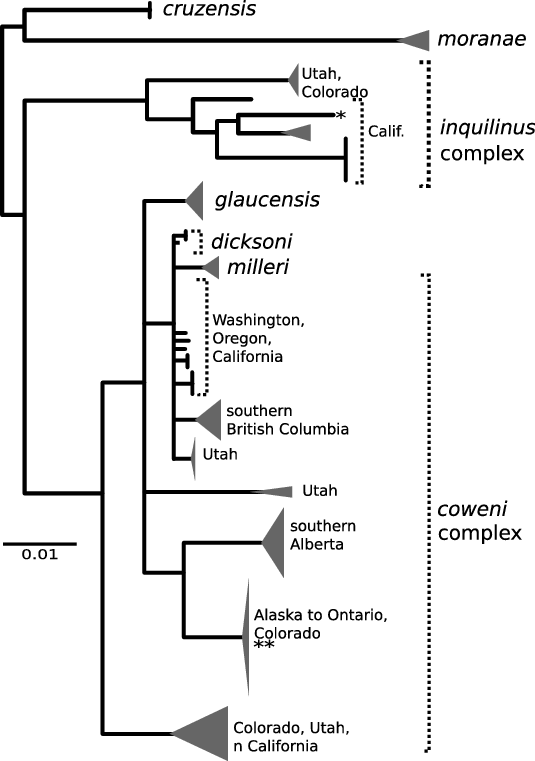
Simplified neighbour-joining tree representation of distance matrix for mitochondrial 1, 5´-end sequence (CO1-5P DNA barcode) from 167 Tamalia specimens. Height of triangles is proportional to number of specimens represented, and depth of triangles represents maximum distance of included leaf nodes from respective internal node. *Position of inquiline specimen on the same host plant and from the sample locality nearest to the collection locality for the holotype of Tamalia inquiline; **position of “T. coweni complex” specimen on the same host plant and from the sample locality nearest to the type locality for Tamalia coweni. Scale is the number of substitutions per nucleotide base.

Specimens were photographed using a Leica DM 6B microscope fitted with a Leica DMC 4500 camera with LAS X software (Leica Microsystems, Wetzlar, Germany) and optical sections combined using Zerene–Stacker software (Zerene Systems LLC, Richland, Washington, United States of America) with manual intervention to account for specimen transparency. Shaded line drawings were prepared based on the composed images using Inkscape (inkscape.org). Morphological measurements and comparisons (Table 1) were derived from images taken with a DEC13M digital eyepiece camera through a Zeiss Axiolab compound microscope (Carl Zeiss AG, Oberkochen, Germany), using custom image-measuring software (Pike et al. Reference Pike, Foottit, Miller, Idechiil and Allison2005).
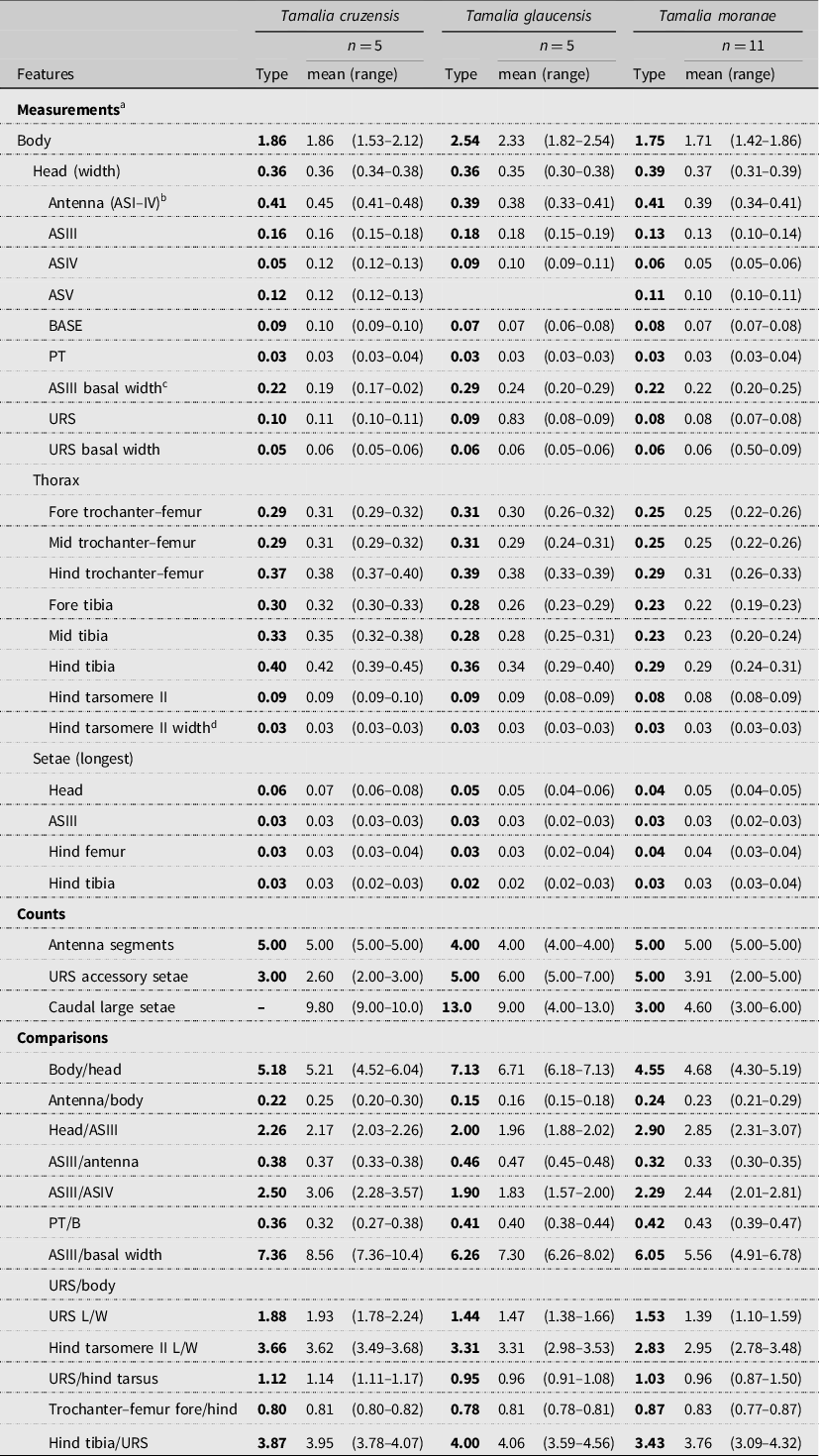
Measurements (mm), counts, and comparisons of apterae of three new species of Tamalia. Bold highlights refer to measurements of the type specimens.

a Segment lengths measured, unless otherwise indicated.
b T. cruzensis and T. moranae ASI–V.
c Measurements in mm × 10.
d Measured at midpoint of the segment.
Abbreviations of morphological characters: ASI, II, antennal segment I, II, etc.; B, basal length of ultimate antennal segment (part up to and including primary rhinarium); L/W, length/width; PT, terminal process of ultimate antennal segment rhinarium; and URS, ultimate rostral segment (fused penultimate and ultimate segments, IV + V).
Sequence data for mitochondrial cytochrome c oxidase subunit 1, 5′ end (CO1-5P; “DNA barcoding” region) were produced for 167 specimens from across the known composite range of Tamalia species, except from north–central Mexico. Some CO1-5P sequences were obtained by submission to the Biodiversity Institute of Ontario (University of Guelph, Guelph, Ontario, Canada) using techniques described by deWaard et al. (Reference deWaard, Ivanova, Hajibabaei, Hebert and Martin2008), whereas later samples were processed at Agriculture and Agri-Food Canada using ABI BigDye, version 3.1, chemistry. Polymerase chain reaction primer pairs were either LepF1 with LepR1, LCO1490 with LCO2198, or M13-tailed primers LCO1491_t1 with HCO2198_t1 (primer sequences and origins are available at http://v4.boldsystems.org/index.php/Public_Primer_PrimerSearch). Sequencing was performed using the amplification primers or M13 primers, as appropriate. Sequences and collection information for each specimen were entered in the Barcode of Life Data System (BOLD; Ratnasingham and Hebert Reference Ratnasingham and Hebert2007; available at http://www.boldsystems.org/index.php/Public_SearchTerms?query=DS-TAMALIA). All sequences obtained in this study were also deposited in the GenBank (accession numbers are available with the corresponding record on BOLD). Barcoded specimens or specimens from the same gall are deposited in CNC, CHSC, USNM, or WSU. Additional sequences generated from collections made by the Biodiversity Institute of Ontario were also included in the analysis.
After primer trimming, the final full CO1-5P fragment length was 658 nucleotide bases. Nucleic acid sequences were translated to amino acid sequences using the standard invertebrate mitochondrial translation table with a reading frame beginning at position 2 of the nucleotide alignment consensus sequence.
Pairwise nucleotide sequence divergences were calculated using the Kimura two-parameter model of base substitution (Kimura Reference Kimura1980), and neighbour-joining analysis (Saitou and Nei Reference Saitou and Nei1987) was used to examine relationships among taxa and population samples. Although distance calculations are based on a particular evolutionary model, the neighbour-joining tree (Fig. 2) is presented as a graphical representation of phenetic sequence divergences among samples and is not intended as a phylogenetic hypothesis.
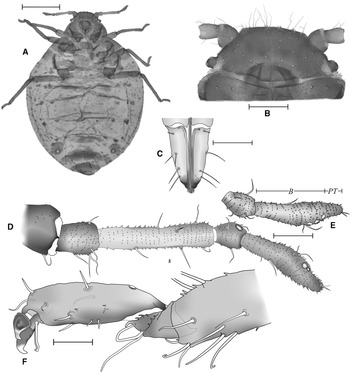
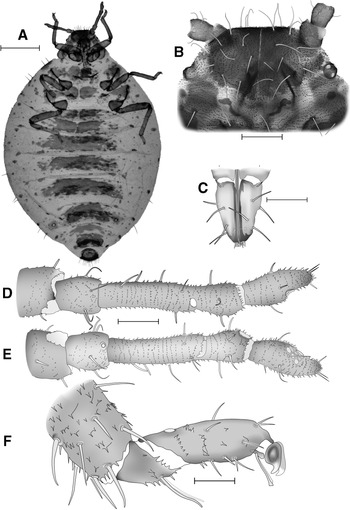
Tamalia cruzensis n. sp., holotype (aptera vivipara, CNC1881682): A, habitus; B, head, dorsal aspect; C, distal rostral segment, anterior aspect; D, left antenna, ventral aspect; E, distal segments of left antenna, dorsal aspect (B, base of distal segment; PT, terminal process); and F, left hind tarsus and apex of tibia, posterior aspect. Scale bars: A, 500 µm; B, 100 µm; C–E, 50 µm; and F, 25 µm.

Results and discussion
Previous work by Miller and Crespi Reference Miller and Crespi2003 and Miller et al. Reference Miller, Lawson, Rinker, Estby and Abbot2015 suggested that DNA sequences of Tamalia collected from Comarostaphylis diversifolia (Ericaceae: Arbutoideae), Arbutus arizonica (Ericaceae: Arbutoideae), and Arctostaphylos glauca Lindley (Ericaceae: Arbutoideae) differ from those of specimens identified as T. coweni or T. inquilinus. Our DNA barcode results (simplified dendrogram in Fig. 2, detailed version in Supplementary material, Fig. S1) support the distinctiveness of at least the first two of these groups. The specimens from A. glauca, derived from several distinct geographic localities, form a discrete uniform cluster, but the minimum distance to the nearest neighbour (identified as T. coweni) is less than 1% and, thus, not by itself convincing evidence of species status. However, the morphologically distinct T. dicksoni and T. milleri are also poorly differentiated by CO1 sequence from certain specimens assigned to T. coweni. Specimens from Arbutus arizonica share a unique change of amino acid residue 158 (relative to start of the barcode fragment, with the reading frame starting at nucleotide position 2) from asparagine to aspartic acid. All inquiline specimens share a change of amino acid residue 160 from methionine to leucine. No other variation in amino acid sequence was observed.
The three previously recognised entities from C. diversifolia, A. arizonica, and A. glauca exhibit distinct morphological characteristics and are described below as new species based on a combination of morphological and molecular characters and host plant use. Our descriptions are principally from late-season apterous viviparae. We include other morphs as available, such as the alate vivipara, the alate male, and the alate ovipara, but the apterous vivipara is always associated with galls on the host plant and is therefore probably the most reliable life history stage for positive identifications. A more complete understanding of the sequence of morphs in the life cycles of these aphids requires further field data and the collection of additional morphs.
In Miller and Crespi’s (Reference Miller and Crespi2003) and Miller et al.’s (Reference Miller, Lawson, Rinker, Estby and Abbot2015) molecular studies of the genus, T. coweni was represented by specimens from either California or Nevada, United States of America. The broader geographic sampling in the present study shows that T. coweni, as currently defined, encompasses several distinct haplotype clusters. Specimens collected near the type locality of T. coweni in Colorado exhibit a haplotype (see annotation “**” on Fig. 2) in common with specimens from a broad area of North America encompassing the boreal forest and Rocky Mountains (from Alaska to Ontario) but not including any samples from west of the Rocky Mountains. We suspect that the name T. coweni (currently including T. pallida and T. tahoensis) represents a complex of several species with different host and habitat associations. Similarly, variation among inquiline specimens suggests that two or more species may also be involved within that group. Resolution of the situation within these groups and determination of the most appropriate taxonomic treatment await a more detailed assessment using additional gene loci and morphometric analysis, with additional sampling from known host species (the hosts for many existing samples are identified to genus only).
The significance of documenting novel species of Tamalia on novel host plant genera extends beyond adding to our taxonomic knowledge of these highly specialised phytophagous insects: it points the way towards wider taxon sampling and testing for congruent patterns between these insects and their patterns of radiation in their host plants. For example, Arbutus may be the oldest lineage within the Arbutoideae (Wahlert et al. Reference Wahlert, Parker and Vasey2010): this phylogenetic pattern is reflected within Tamalia, as published phylogenies position the species associated with Arbutus branching off basally (Miller and Crespi Reference Miller and Crespi2003; Miller et al. Reference Miller, Lawson, Rinker, Estby and Abbot2015). Arbutus likely originated in the Madrean flora (Axelrod Reference Axelrod1958), and thus the centre of radiation of Tamalia may lie in Mexico. Tamalia inquilines might have originated in California, in association with a host plant shift to Arctostaphylos, but these hypotheses require evaluation, with further sampling and phylogenetic analysis. Beyond this, pinpointing the origins of social behaviour in the form of communal gall occupation invites further systematic sampling of Tamalia aphids within and among populations of the host plants (Miller Reference Miller2019).
Diagnosis of Tamalia Baker
The following character states are common to all species and are not repeated under the species descriptions.
All morphs. Body integument without dorsal or lateral thin-walled tubercles; front of head convex, antennal tubercles not developed; antenna with terminal process shorter than base of ultimate segment; tarsomere I of all legs triangular; pretarsal claws normal; pretarsal setae more or less explanate at apex, and reaching to or nearly to tip of claws; siphunculi poriform on low pigmented setose cones or absent; cauda short, rounded. (Note that in Remaudière and Stroyan’s (Reference Remaudière and Stroyan1984) original diagnosis for Tamaliinae, the pretarsal setae are stated to be acuminate (“soies empodiales pointues”). According to our observations, this is not the case for all morphs of all species (Figs. 2, 4, 5, 6), although because the expansion is in a single plane, it is not always apparent in slide-mounted material if the setae are arranged so that the plane of flattening is parallel to the optical axis.)
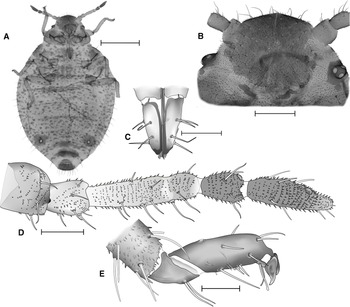
Tamalia glaucensis n. sp., holotype (aptera vivipara, CNC1881683): A, habitus; B, head, dorsal aspect; C, distal rostral segment, anterior aspect; D–E, left antenna: D, ventral aspect; E, dorsal aspect; and F, right hind tarsus and apex of tibia, posterior aspect. Scale bars: A, 500 µm; B, 100 µm; C and D, 50 µm; and E, 25 µm.

Tamalia moranae n. sp.: A–E, holotype (aptera vivipara, CNCHEM081084-1): A, habitus; B, head, dorsal aspect; C, distal rostral segment, anterior aspect; D, left antenna, ventral aspect; and E, paratype CNCHEM081084-2 (aptera vivipara), right hind tarsus and apex of tibia, posterior aspect. Scale bars A, 200 µm; B, 100 µm; C and D, 50 µm; and E, 25 µm.

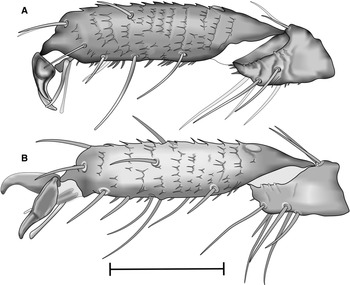
Hind tarsus of alate morphs of Tamalia moranae n. sp.: A, alate vivipara, paratype CNCHEM081078-2; and B, ovipara, paratype CNCHEM081079-4. Scale bar: 50 µm.

Apterous vivipara (including fundatrix). Body integument densely spinulose; dorsal pigmentation of abdomen various, ranging from spots around setal bases to fully sclerotic dorsum; eye represented by triommatidion only; antenna with 4–6 segments, flagellar segments with rows of spinules and without secondary rhinaria; trochanter more or less fused with femur; tibiae spinulose; tarsomere I of all legs typically with two ventral setae and without dorsal setae; tarsomere II of all legs with few (essentially smooth surface) to numerous spicules or spinules.
Alate vivipara. Compound eye well developed, triommatidion distinct, raised; secondary antennal rhinaria transverse-oval (or some at base of antennal segment III small and rounded), present on segments III and usually IV, rarely on segment V; tarsomere I of all legs with typically six ventral setae and a pair of dorsal setae, pretarsal setae explanate; media of wing with three branches.
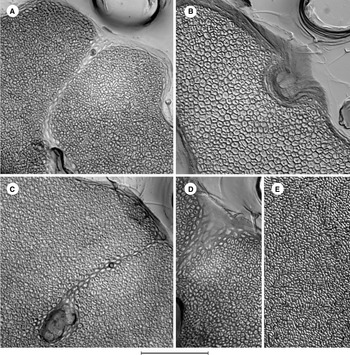
Ovipara. Alate, similar to alate vivipara; abdomen with a pair of large posterior ventro-lateral cribriform wax plates (Fig. 7). The fine structure of the wax plates varies from polygonal (Fig. 7A–C), with (Fig. 7B) or without obvious substructure (Fig. 7A), to granular (Fig. 7E).
Structure of wax gland plates of oviparae of Tamalia species: A, T. cruzensis n. sp. (paratype 10DG38-1); B, T. glaucensis n. sp. (paratype A6DB9); C, T. moranae n. sp. (CNCHEM081079-4); D, T. keltoni Richards (paratype CNCHEM072490-11); and E, Tamalia sp. (coweni group, coastal haplotype, CNCHEM004275-2). Scale bar: 50 µm.

Male. Alate, similar to alate vivipara; siphunculi lacking.
Grammatical gender of Tamalia
In proposing the genus Tamalia, Baker (Reference Baker1920) neither explicitly nor implicitly fixed the grammatical gender of the name. Richards (Reference Richards1967) implicitly treated the name as feminine in the combination Tamalia pallida. Subsequently, Nieto Nafría and Favret (Reference Nieto Nafría and Favret2011, p. 459) listed the gender of this name as masculine in the “Registers of family-group and genus-group taxa of Aphidoidea”. Although apparently derived from the masculine Spanish word tamal (either directly or indirectly via the English version tamale), the name was latinised by the addition of the suffix “-ia” and, thus, in the absence of an indication in the original description, should be considered feminine under article 30.2.4 of the International Code of Zoological Nomenclature, fourth edition (International Commission on Zoological Nomenclature 1999).
Note that the Latin word “inquilinus” was historically used substantively (Glare Reference Glare2012). Therefore, as a specific epithet, it may be treated as a noun in apposition and hence invariant, as in the combination Tamalia inquilinus.
Descriptions of new species
Supplementary material, Table S1 lists the material examined of previously described species (T. coweni complex, T. dicksoni, T. inquilinus, and T. milleri) against which the new species described below were compared.
Tamalia cruzensis Miller and Pike, n. sp.
ZooBank registration number: urn:lsid:zoobank.org:act:EB9B96EF-F935-4B77-BD11-4BBCDE8F26E3
Tamalia cruzensis: Miller and Crespi Reference Miller and Crespi2003. Nomen nudum.
Tamalia species B: Miller et al. Reference Miller, Lawson, Rinker, Estby and Abbot2015.
Specimens examined. Holotype (aptera vivipara): UNITED STATES OF AMERICA. California: Santa Barbara Co., Santa Cruz Island, 25-v-2010, ex Comarostaphylis diversifolia, coll. D.G. Miller (deposited in CNC [CNC1881682]; holotype designation on slide marked in upper-case bold red letters). Paratypes (paratype designation on slide in upper-case bold blue letters, all collections ex Comarostaphylis diversifolia by D.G. Miller): 5 apterae, 4 oviparae, 3 males, 1 immature collected with holotype; additional specimens collected near type location: 6 apterae, 4 immatures, 21-iii-2003; 8 apterae, 2 immatures, 7-v-2006; 2 apterae, 3 oviparae, 21-v-2016. Paratypes deposited in CNC, CHSC, USNM, and WSU.
Etymology. The species is named after Santa Cruz Island, the type locality.
Diagnosis. Tamalia cruzensis is most similar morphologically to T. moranae n. sp., but the apterae are distinguished by the more slender hind tarsomere II (L/W ratio 3.49–3.68 versus 2.78–3.49); few spinules on tibiae, longer URS (0.10–0.11 versus 0.07–0.08 mm, L/W 1.8–2.2 versus 1.1–1.6), shorter terminal process of the antenna (PT/B 0.27–0.38 versus 0.39–0.47), longer ASIII (0.15–0.18 versus 0.10–0.014 mm), and larger number of large caudal setae (9–10 versus 3–6). Additional comparative biometric data on the two species (aptera vivipara) are provided in Table 1. Furthermore, the two species have different host plants and distributions (see below).
Description. Aptera vivipara (Fig. 3): In mounted specimens (Fig. 3A), head and thorax brown, fore and mid-abdominal segments pale with variably developed spot pigmentation, posterior abdominal segments with mid-dorsal or dorsolateral transverse bands, and siphuncular sclerites, anal and genital plates, and cauda brown. Coxae, legs, and antennae pale brown to brown. Dorsal and ventral integument conspicuously spiculate (abundant spicules) on head, thorax, and abdomen. Tibia with spinules largely restricted to the ventral surface, a few on the dorsal surface near the tibial apex; surface of tarsomere II nearly smooth or with few spicules or spinules (Fig. 3F). Body ovoid to pyriform, length 1.53–2.12 mm; width across eyes 0.34–0.38 mm; antenna (Fig. 3D, E) five-segmented, 0.20–0.30 × body length; ASIII 0.33–0.38 × total antennal length; longest seta on ASIII 0.03 mm, slightly longer than ASIII basal width; setae on head (Fig. 3B) and abdomen tapering, pointed, usually greater than 2.50 × ASIII basal width; PT/B 0.27–0.38; rostrum extending to mesocoxa; URS (Fig. 3C) 0.10–0.11 mm in length, about 2.0 × basal width, with 2–3 accessory setae; hind trochanter–femur length 0.37–0.40 mm, hind tibia length 0.39–0.45 mm, tarsomere II length 0.09–0.10 mm; tarsomere I chaetotaxy 2–2–2; diameter of siphunculus 0.03–0.05 mm; cauda with 9–10 setae. For a full range of morphological measurements and comparisons, including values for the holotype, see Table 1.
Alate vivipara: Not observed.
Alate ovipara (Fig. 7A): Body length 1.42–1.99 mm; head width across eyes 0.35–0.44 mm; antenna 0.86–1.20 mm, about 0.6 × body length; ASIII length about 2 × ASIV; PT/B 0.31–0.39; ASIII, IV, and V secondary rhinaria 7–10, 1–3, and 0, respectively; longest setae on head and ASIII between 0.01 and 0.02 mm, comparable with basal width of ASIII; URS length 0.11–0.14 mm, 2.7–3.5 × basal width, 8–10 accessory setae; hind trochanter–femur length 0.44–0.58 mm; hind tibia length 0.56–0.77 mm; hind tarsomere II length 0.10–0.11 mm; diameter of siphunculus 0.04–0.05 mm, cauda with 7–10 setae. Wax gland plate (Fig. 7A) composed of fine polygonal units averaging about 2 µm in diameter.
Alate male: In mounted specimens, head, thorax, legs, and tarsi light brown; abdomen pale. Body length 1.14–1.22 mm; head width across eyes 0.35–0.36 mm; antenna 0.98–1.05 mm, about 0.85 × body length; ASIII length 2.0–2.3 × ASIV; PT/B 0.46–0.56; ASIII, IV, and V secondary rhinaria 3–6, 0–2, and 0, respectively; longest setae on head and ASIII between 0.01 and 0.02 mm, comparable with basal width of ASIII; URS length 0.10–0.12 mm, 2.5–3.6 × basal width, 6–7 accessory setae; hind trochanter–femur length 0.36–0.46 mm; hind tibia length 0.56–0.66 mm; hind tarsomere II length 0.11 mm; pretarsal setae reaching tip of claw; diameter of siphunculus 0.03 mm; cauda with 6–8 setae.
Biology, host plant, and distribution. The aphid is holocyclic and monoecious on Comarostaphylis diversifolia (Parry) Greene (summer holly; Fig. 1A). It is known only from this host plant on Santa Cruz Island and in the Santa Ynez Mountains around Santa Barbara, California, at elevations from 100 to 450 m. The gall is bright green, mottled with yellow and red; it is induced along leaf edges and averages 15.5 mm in length (range 7.9–20.4 mm; n = 20; Fig. 1A). Apterae occur from about March to May, and alate oviparae and males from May to June.
DNA characterisation. Sequences of mitochondrial cytochrome c oxidase subunit 1, 5′ end (DNA barcode) are available on GenBank, with accession numbers MN536028–MN536030. The minimum uncorrected sequence distance from the nearest neighbour is 4.5%, including seven base states differing from those found in all other Tamalia specimens.
Sequences for nuclear DNA loci are available in Miller et al. (Reference Miller, Lawson, Rinker, Estby and Abbot2015): 1-phosphatidylinositol 4,5-bisphosphate phosphodiesterase (GenBank accessions KM604560, KM604561, and KM604639); lysine-specific demethylase Lid (KM604396 to KM604398); double-stranded RNA-specific editase (KM604314, KM604315, and KM604390); topoisomerase (KM604232, KM604233, and KM604308); and chaperonin (groEL) from Buchnera aphidicola bacterial endosymbiont (accessions KM604478, KM604479, and KM604505).
Tamalia glaucensis Miller and Pike, n. sp.
ZooBank registration number: urn:lsid:zoobank.org:act:C7B922BB-C95A-4BC6-9011-D673198D5F88
Tamalia sp. nov.: Miller and Crespi Reference Miller and Crespi2003. Nomen nudum.
Tamalia species C: Miller et al. Reference Miller, Lawson, Rinker, Estby and Abbot2015.
Specimens examined. Holotype (aptera vivipara): UNITED STATES OF AMERICA. California: Riverside Co., Elsinore Mountain, Killen Trail, 4-vii-2006, ex Arctostaphylos glauca, coll. D.G. Miller (deposited in CNC [CNC1881683]; holotype designation on slide marked in upper-case bold red letters). Paratypes (paratype designation on slide in upper-case bold blue letters, all collections ex Arctostaphylos glauca by D.G. Miller): 5 apterae, 3 oviparae, 4 males, 3 immatures collected with holotype. Other material: all ex Arctostaphylos glauca. California: Orange Co., Santa Ana Mountain, El Cariso Village, 4-vii-2006, coll. D.G. Miller, 2 apterae, 6 oviparae, 1 male, 3 immature; San Bernardino Co., Cajon Canyon, 28-v-2001, coll. D.G. Miller, 6 apterae, 9 alatae viviparae. MEXICO: Tecate (Baja California del Norte), elev. 550 m, 21-vi-1981, coll. G. Remaudière, 4 apterae, 2 alatae viviparae, 8 immatures.
Etymology. The species is named after its known host plant, Arctostaphylos glauca.
Diagnosis. Tamalia glaucensis is very similar morphologically to members of the T. coweni complex, but the apterae are distinguished by the relatively short URS (hind tibia/URS 3.6–4.6 versus 2.2–3.4, URS/hind tarsomere II 0.9–1.1 versus 1.1–1.4, and URS/body 0.03–0.05 versus 0.05–0.08). The wax plate of the ovipara has a distinctive coarse two-level structure. Additional comparative biometric data on the species (aptera vivipara) are provided in Table 1. The limited distribution and host plant are also diagnostic (see below).
Description. Aptera vivipara (Figs. 4, 7B): In mounted specimens (Fig. 4A), head, pro- and meso-thoracic margins, cauda, anal and genital plates, and area surrounding siphunculi margins brown; remainder of thorax and abdomen with pigmented spots and variably developed darkened segmental dorsal and dorsolateral transverse bands. Antennae, coxae, and legs brown. Dorsal and ventral integument conspicuously spiculate (abundant spicules) on head, thorax, and abdomen. Tibia with spinules on all surfaces; tarsomere II with spicules more or less arranged in several rows (Fig. 4F). Body ovoid, length 1.82–2.54 mm; head vertex flat or slightly rounded, width across eyes 0.30–0.38 mm; antenna (Fig. 4D, E) four-segmented (rarely five), 0.15–0.18 × body; ASIII/ANT 0.45–48; setae on head (Fig. 4B) and abdomen tapering, pointed, 1.8–3.5 × ASIII basal width; PT/B 0.38–0.44; rostrum short, not extending beyond mesocoxae; URS (Fig. 4C) 0.08–0.09 mm, length 1.4–1.7 × segment width at base, with 5–7 accessory setae; hind trochanter–femur length 0.33–0.39 mm, hind tibia 0.29–0.40 mm, hind tarsus II 0.08–0.09 mm; tarsomere I chaetotaxy typically 2–2–2; diameter of siphunculus 0.04–0.05 mm; cauda with 7–13 setae. For a full range of morphological measurements and comparisons, including values for the holotype, see Table 1.
Alate vivipara: In mounted specimens, head, antennae, thorax, legs, and tarsi light brown to brown; abdomen pale with variably developed brown spot and mid-dorsal bands brown. Body length 1.00–1.39 mm; head width across eyes 0.30–0.38 mm; antenna 0.67–0.81 mm; ASIII length 1.09–2.1 × ASIV; PT/B 0.25–0.37; ASIII, IV, and V secondary rhinaria 12–16, 0–3, and 0, respectively; longest setae on head and ASIII between 0.01 and 0.02 mm; URS length 0.08–0.09 mm, 1.5–2.0 × basal width; hind trochanter–femur length 0.43–0.47 mm; hind tibia length 0.56–0.64 mm; hind tarsomere II length about 0.11 mm; pretarsal setae reaching tip of claw; diameter of siphunculus 0.03– 0.04 mm; cauda with 7–8 setae.
Alate ovipara (Fig. 7B): In mounted specimens, colouration and surface features similar to alate vivipara; abdomen with large wax plates. Body length 1.54–1.80 mm; head width across eyes 0.38–0.43 mm; antenna 0.77–0.84 mm, 0.4–0.5 × body length; ASIII 1.9–2.2 × ASIV; PT/B 0.27–0.31; ASIII, IV, and V secondary rhinaria 16–19, 1–4, and 0, respectively; longest setae on head and ASIII between 0.01 and 0.02 mm, comparable with basal width of ASIII; URS length 0.08–0.09 mm, 1.8–2.1 × basal width, with 4–8 accessory setae; hind trochanter–femur length 0.45–0.48 mm; hind tibia length 0.52–0.57 mm; hind tarsomere II length 0.11–0.12 mm; pretarsal setae reaching tip of claw; diameter of siphunculus 0.04–0.05 mm; cauda with more than 20 setae. Wax gland plate (Fig. 7B) with relatively coarse polygonal reticulate (about four polygons/µm), each polygon radially subdivided.
Alate male: In mounted specimens, head, thorax, legs, and tarsi light brown; abdomen pale. Body length 1.38–1.60 mm; head width across eyes 0.40–0.44 mm; antenna 1.00–1.11 mm, about 0.70 × body length; ASIII 1.7–2.0 × ASIV; PT/B 0.33–0.39; ASIII, IV, and V secondary rhinaria 3–8, 0–1, and 0, respectively; longest setae on head and ASIII between 0.01 and 0.02 mm, comparable with basal width of ASIII; URS length 0.08–0.09 mm, 1.5–1.9 × basal width, 4–5 accessory setae; hind trochanter–femur length 0.47–0.57 mm; hind tibia length 0.63–0.76 mm; hind tarsomere II length 0.12–0.15 mm; pretarsal setae reaching tip of claw; no siphunculi; cauda with 4–9 large setae.
Biology, host plant, and distribution. The aphid is holocyclic and monoecious on Arctostaphylos glauca (bigberry manzanita) and known only from California and adjacent Baja California Norte, Mexico. This is the only Tamalia aphid known to induce galls on A. glauca. The gall is distinctively flattened and shaped like a lima bean, unlike other Tamalia galls, which tend to be cylindrical (Fig. 1B). The early-stage gall is bright green, ripening to red, and averages 13.8 mm in length (range 7.5–17.6 mm; n = 20).
DNA characterisation. Sequences of mitochondrial cytochrome c oxidase subunit 1, 5′ end (DNA barcode) are available, with GenBank accession numbers MN536079–MN536089. The maximum uncorrected within-species distance was 0.6% (11 individuals, 10 galls, four localities), whereas the minimum sequence distance from the nearest neighbour is 0.93%. All specimens of T. glaucensis are uniquely characterised by a single change from A to G relative to all other Tamalia specimens; in addition, G (instead of A) was found at barcode position 28 among only specimens of T. glaucensis.
Sequences for nuclear DNA loci are available in Miller et al. (Reference Miller, Lawson, Rinker, Estby and Abbot2015): 1-phosphatidylinositol 4,5-bisphosphate phosphodiesterase (GenBank accessions KM604610, and KM604627); lysine-specific demethylase Lid (KM604434 and KM604459); double-stranded RNA-specific editase (KM604359 and KM604360); topoisomerase (KM604241 and KM604244); and chaperonin (groEL) from Buchnera aphidicola endosymbiont (KM604509 and KM604511).
Tamalia moranae Miller and Pike, n. sp.
ZooBank registration number: urn:lsid:zoobank.org:act:0E43E505-A935-46C2-9F86-FEEB0E459878
Tamalia morani: Miller and Crespi Reference Miller and Crespi2003. Nomen nudum.
Tamalia species A: Miller et al. Reference Miller, Lawson, Rinker, Estby and Abbot2015.
Specimens examined. Holotype (aptera vivipara): UNITED STATES OF AMERICA. Arizona: Pima Co., San Pedro Overlook, 20-viii-2014, ex Arbutus arizonica, coll. D.G. Miller (deposited in CNC [CNCHEM081084-1]; holotype designation on slide marked in upper-case bold red letters). Paratypes (paratype designation on slide in upper-case bold blue letters, collections ex Arbutus arizonica by D.G. Miller): 5 apterae, 1 alata collected with holotype. Other material: all collected from Arbutus arizonica by D.G. Miller. Arizona: Cochise Co., Chiricahua Mountains, Cave Creek Canyon, 18-viii-2014, 8 apterae, 2 immatures; Cathedral Vista, 18-viii-2014, 10 apterae, 6 alatae viviparae, 9 oviparae; Pima Co., Santa Catalina Mountains, Esperero Canyon, 1600 m elev., 6-ix-1998, 3 apterae, 2 immatures; Santa Catalina Mountains, Hitchcock Canyon, 1850 m elev., 30-vii-1998, 8 apterae, 3 alatae, 3 oviparae, 1 immature.
Etymology. The species is named after Nancy Moran, who discovered it.
Diagnosis. Tamalia moranae is most similar morphologically to T. cruzensis but is distinguished by its broader hind tarsomere II (L/W ratio 2.78–3.49 versus 3.49–3.68); shorter URS (0.07–0.08 mm versus 0.10–0.11 mm), URS L/W (1.1–1.6 versus 1.8–2.2); PT/B (0.39–0.47 versus 0.27–0.38), number of large caudal setae (3–6 versus 9–10); and shorter ASIII (0.10–0.014 mm versus 0.15–0.18 mm). Additional comparative biometric data on the species (aptera vivipara) are provided in Table 1. Moreover, the two species have different host plants and distributions (see Biology, host plant, and distribution section below).
Description. Aptera vivipara (Fig. 5): In mounted specimens (Fig 5A), head partially and lightly pigmented, pro- and meso-thoracic margins brown, remainder of thorax and abdomen pale or pale with pigmented spots, except siphuncular sclerites, anal and genital plates, and cauda pale brown. Antennal segments I–III pale, IV–V distinctly darker. Coxae and legs pale to very light brownish in colouration. Dorsal and ventral integument conspicuously spiculate (abundant minute spicules) on head, thorax, and abdomen. Tibia with spinules on all surfaces; tarsomere II with surface smooth except for some spinules ventrally at midlength (Fig. 5E). Body ovoid, length 1.42–1.86 mm; width across eyes 0.31–0.39 mm; antenna (Fig. 5D) five-segmented, 0.21–0.29 × body; ASIII 0.30–0.35 × total length of antenna; longest seta on ASIII (0.02–0.03 mm) slightly longer than ASIII basal width; longest seta on head (Fig. 5B) and abdomen 1.8–3.1 × ASIII basal width; PT/B 0.39–0.47; rostrum extending to near mesocoxa; URS 0.07–0.08 mm, length 1.1–1.6 × segment width, with 2–5 accessory setae; hind trochanter–femur length 0.26–0.33 mm, hind tibia 0.24–0.31 mm, hind tarsomere II 0.08–0.09 mm; tarsomere I chaetotaxy typically 2–2–2; diameter of siphunculus 0.03 mm; cauda with 3–6 setae. For a full range of morphological measurements and comparisons, including values for the holotype, see Table 1.
Alate vivipara (Fig. 6A): In mounted specimens, head, antennae, thorax, legs, and tarsi light brown to brown; abdomen pale with variably developed lateral, spot, and mid-dorsal bands brown. Colouration surface integument similar to ovipara. Body length 1.60–1.84 mm; head width across eyes 0.41–0.43 mm; antenna 0.87–0.98 mm; ASIII length 2.0–2.5 × ASIV; PT/B 0.30–0.39; ASIII, IV, and V secondary rhinaria 16–19, 3–5, and 0–3, respectively; longest setae on head and ASIII 0.01–0.02 mm, always shorter than basal width of ASIII; URS length 0.08–0.09 mm, 1.8–2.2 × basal width, with six accessory setae; hind trochanter–femur length 0.49–0.55 mm; hind tibia length 0.68–0.76 mm; hind tarsomere II length 0.10–0.11 mm; pretarsal setae reaching tip of claw; diameter of siphunculus about 0.04 mm; cauda with 5–7 setae.
Alate ovipara (Figs. 6B, 7C): In mounted specimens, colouration and surface features similar to alate vivipara. Large wax plates brown. Body length 1.63–1.85 mm; head width across eyes 0.42–0.44 mm; antenna 0.82–0.91 mm, about half the length of body; ASIII length 2 × ASIV; PT/B 0.24–0.30; ASIII, IV, and V rhinaria 16–19, 2–4, and 1–2, respectively; longest setae on head and ASIII between 0.01 and 0.02 mm, slightly shorter than basal width of ASIII; URS length 0.08–0.10 mm, 1.9–2.1 × basal width, 6–8 accessory setae; hind trochanter–femur length 0.46–0.52 mm; hind tibia length 0.54–0.65 mm; hind tarsomere II length 0.11–0.12 mm; pretarsal setae reaching tip of claw; diameter of siphunculus about 0.04 mm; cauda with 8–10 setae. Wax gland plate (Fig. 7C) composed of polygonal units of irregular size (average about 3 units/µm), at least the larger units radially subdivided.
Male: Not observed.
Biology, host plant, and distribution. This aphid is holocyclic and monoecious on Arbutus arizonica (Arizona madrone) and is known only from Arizona. No other Tamalia species has been recorded from Arbutus spp. The gall is green and restricted to the edge of leaves of the host plant (see Fig. 1C); mean length of gall is 21.5 mm (range 13.1–39.5 mm; n = 20).
DNA characterisation. Sequences of mitochondrial cytochrome c oxidase subunit 1, 5′ end (DNA barcode) are available, with GenBank accession numbers MN536031–MN536036. The maximum observed within-species divergence was 0.6% (n = 6 from four galls from three localities), whereas the minimum sequence distance from the nearest neighbour is 6.7%. All specimens assigned to T. moranae share 14 base states found in no other Tamalia specimens; one base change results in replacement of the amino acid asparagine with aspartic acid at residue position 158.
Sequences for nuclear DNA loci are available in Miller et al. (Reference Miller, Lawson, Rinker, Estby and Abbot2015): 1-phosphatidylinositol 4,5-bisphosphate phosphodiesterase (GenBank accessions KM604562, KM604563); lysine-specific demethylase Lid (accessions KM604399, KM604400); double-stranded RNA-specific editase (accessions KM604355, KM604356); topoisomerase (KM604301, KM604302); and chaperonin (groEL) from Buchnera aphidicola bacterial endosymbiont (accessions KM604506, KM604507).
Key to Tamalia (aptera vivipara morph) found in leaf galls on Arbutus, Arctostaphylos, and Comarostaphylis in North America
-
1. Ultimate rostral segment 0.16–0.20 mm long and with more than 20 accessory setae; antenna with five or six segments; on Arctostaphylos spp.; California and Oregon 2
-
—. Ultimate rostral segment 0.07–0.14 mm long and with fewer than 12 accessory setae; antenna typically with four or five segments 3
-
2(1) Abdominal dorsum completely sclerotised; length of the terminal process of the last antennal segment 0.33–0.44 times the length of the basal part of the segment (see Fig. 2E for individuals with five antennal segments) T. dicksoni
-
—. Abdominal dorsum partially sclerotised (mainly crossbands and spots); terminal process–base ratio 0.38–0.56 T. milleri
-
3(1) Abdominal dorsum completely dark, sclerotised; living in galls induced by other Tamalia species; California, western Colorado, southern Nevada, southern Oregon, southern Utah, and northern Baja California T. inquilinus complex
-
—. Abdominal dorsum membranous to partially sclerotised 4
-
4(3) Antenna with five segments (rarely six); abdominal dorsum pale or with small pigmented spots scleroites, without transverse bars; tarsomere II surface essentially smooth or with very few spicules; on Arbutus arizonica (Arizona madrone) or Comarostaphylis diversifolia (summer holly) 5
-
—. Antenna with four segments (sometimes five); abdominal dorsum commonly with transverse cross bars and spots; tarsomere II surface with or without spicules; on Arctostaphylos spp. 6
-
5(4) Hind tarsomere II length/width 3.49–3.68; URS length 0.10–0.11; URS length/width 1.8–2.2; PT/B 0.27–0.38; large caudal setae 9–10; AS III length at least 0.15 mm (range 0.15–0.18); on Comarostaphylis diversifolia (summer holly); California (Santa Cruz Island and Santa Barbara area) T. cruzensis n. sp.
-
—. Hind tarsomere II length/width 2.783.48; URS length 0.07–0.08 mm; URS length/width 1.1–1.6; PT/B 0.39–0.47; large caudal setae 3–6; AS III length no longer than 0.14 mm (range 0.09–0.14 mm; on Arbutus arizonica (Arizona madrone); southeastern Arizona T. moranae n. sp.
-
6(4) Hind tibia/URS 3.54–4.56; URS/hind tarsomere II ratio usually less than 1.0 (range 0.91–1.08); URS usually less than 0.05 (range 0.03–0.05) times body length; on Arctostaphylos glauca (bigberry manzanita); California, and adjacent Baja California Norte, Mexico T. glaucensis n. sp.
-
—. Hind tibia/URS 2.21–3.41; URS/hind tarsomere II at least 1.1 (range 1.06–1.41); URS/body usually greater than 0.05 (range 0.05–0.08); on Arctostaphylos patula (greenleaf manzanita), Arctostaphylos uva-ursi (kinnikinnick), and numerous other Arctostaphylos spp. but not known on Arctostaphylos glauca; widespread from Alaska to northern Mexico, and eastwards across Canada and the northern United States of America to Ontario and New York T. coweni complex
-
Collection data and GenBank accession numbers for sequenced material are available at http://www.boldsystems.org/index.php/Public_SearchTerms?query=DS-TAMALIA
Supplementary material
To view supplementary material for this article, please visit https://doi.org/10.4039/tce.2022.41.
Acknowledgements
The authors thank the Essig Museum of Entomology, University of California, Berkeley; California State University–Chico Collection, Chico; Canadian National Collection, Ottawa; National Museum of Natural History Aphidoidea Collection, Beltsville, Maryland; Utah State University Collection, Logan; and Washington State University Aphid Collection, Prosser for the loan of voucher specimens. The project was funded in part by Washington State University. D.G.M. was supported by a David and Helen Lantis Award from California State University, Chico, and the CSU, Chico Center for Water and the Environment. A National Science Foundation Research Opportunity Award and an Award to Enhance Transfer of Taxonomic Knowledge Society of Systematic Biologists further supported D.G.M. Financial support for DNA sequencing was provided in part by the Genomics Research and Development Initiative of the Government of Canada, by operating funds of Agriculture and Agri-Food Canada to R.G.F., and through funding by Canadian Barcode of Life Network from Genome Canada (through the Ontario Genomics Institute). The authors also thank David J. Voegtlin, Laura Thill, Marshall Hedin, Badri Ghimire, and Dessie Underwood for help with sampling Tamalia populations, Sai-Priya Anand, Amanda Biernacka, Jean-Paul Nadeau, and Tian Wu for DNA sequencing, and Bradley Richardson for slide-mounting voucher specimens. Trevor Moore prepared the illustrations of Tamalia galls, and Jessica Hsiung assisted in production of the line drawings of specimen details. The authors are grateful to Nancy Moran, who first showed them the galls of Tamalia moranae. They also thank the staff of the University of California Santa Cruz Island Reserve, the Stunt Ranch Santa Monica Mountains Reserve, the Boyd Deep Canyon Desert Research Center, and the American Museum of Natural History’s Southwestern Research Station for access to populations of Tamalia host plants.