Introduction
In the mammalian reproductive system, oocytes are arrested within ovarian follicles at the diplotene stage of the first meiotic prophase; this is termed as meiotic arrest. During meiotic arrest, the intact nuclear membrane forms a germinal vesicle characteristic of this phase. Once signal transduction is triggered by gonadotropin in cumulus cells surrounding the oocyte, germinal vesicle breakdown (GVBD) is induced by the closing of gap junctions and a decrease in intra-oocyte cAMP concentration in mice and pigs (Webb et al., Reference Webb, Marshall, Swann and Carroll2002; Fan et al., Reference Fan, Huo, Chen, Schatten and Sun2004). Intriguingly, as mammalian oocytes cultured in vitro undergo GVBD, it has been suggested that an inhibitor of meiotic resumption is present in vivo (Pincus & Enzmann, Reference Pincus and Enzmann1935). Indeed, hypoxanthine isolated from porcine follicular fluid prevents oocyte maturation (Downs et al., Reference Downs, Coleman, Ward-Bailey and Eppig1985). Hypoxanthine has been also found in follicular fluids from other species (Kadam & Koide, Reference Kadam and Koide1990), and induction of meiotic arrest by hypoxanthine has been observed in a wide range of species (Eppig & Downs, Reference Eppig and Downs1987; Warikoo & Bavister, Reference Warikoo and Bavister1989; Gotze et al., Reference Gotze, Kauffold, Schuffenhauer, Torner and Spitschak1990); hypoxanthine is considered one of the active meiotic inhibitors in mammalian ovary.
C-type natriuretic peptide (CNP) belongs to the natriuretic peptide family, which comprises three similar but genetically distinct peptides: atrial natriuretic peptide (ANP), brain natriuretic peptide (BNP), and CNP (Potter et al, Reference Potter, Abbey-Hosch and Dickey2006). These peptides have different affinities to their receptors. In contrast to ANP and BNP, which have high affinity to natriuretic peptide receptor 1 (NPR1), CNP has high affinity to natriuretic peptide receptor 2 (NPR2). The signature characteristic of natriuretic peptides is the production of cyclic guanosine monophosphate (cGMP), and their biological activities are mediated through a cGMP-dependent pathway. Several functions of natriuretic peptides have been reported, such as regulation of blood pressure (Woodard & Rosado, Reference Woodard and Rosado2008) and natriuresis (Ballermann & Brenner, Reference Ballermann and Brenner1987).
Natriuretic peptides also play an important role in oocyte meiotic resumption. cGMP has been reported to be a crucial factor in maintaining meiotic arrest by entering into the oocyte through gap junctions and inhibiting the activity of oocyte phosphodiesterase 3, which hydrolyses cAMP in mice (Norris et al., Reference Norris, Ratzan, Freudzon, Mehlmann, Krall, Movsesian, Wang, Ke, Nikolaev and Jaffe2009). Törnell et al. (Reference Törnell, Carlsson and Billing1990) have reported that ANP induces cGMP production in rat cumulus–oocyte complexes (COCs), and thereby inhibits spontaneous meiotic resumption. cGMP also acts as a GVBD inhibitor in porcine oocytes (Petr et al., Reference Petr, Rajmon, Chmelíková, Tománek, Lánská, Pribánová and Jílek2006), and the function of ANP as a meiotic inhibitor has also been reported. Recently, CNP has been reported to act as a meiotic inhibitor in mice (Zhang et al., Reference Zhang, Su, Sugiura, Xia and Eppig2010). The report showed that cGMP produced in cumulus cells diffuses into oocytes through gap junctions and helps maintain the cAMP level in the oocytes, thereby preventing meiotic resumption. Histological analysis of cnp- and npr2-mutant mouse ovaries revealed that these models failed to maintain meiotic arrest, strongly suggesting the importance of the CNP-NPR2 pathway in oocyte maturation. However, the effect of CNP on porcine oocyte meiotic resumption was not determined. This study aims to demonstrate the effect of CNP on porcine oocyte meiotic resumption.
The present study also aims to investigate the regulation mechanism of CNP cognate receptor, npr2, in a porcine model. In the mouse model, npr2 mRNA expression was regulated by oocyte-derived paracrine factors (ODPF). To demonstrate the effect of ODPF in the porcine model, we examined npr2 mRNA expression in oocytectomised COCs (OXCs).
Materials and methods
Chemicals
The chemicals used in the study were obtained from Sigma-Aldrich unless stated otherwise.
Histological analysis of NPR2 localisation in porcine ovarian follicles
Porcine ovaries in prepubertal gilts were transected and fixed in a methacarn solution (methanol/chloroform/acetic acid, 6:3:1) for 48 h. After dehydration, the samples were embedded in paraffin and cut into 10-μm sections. The sections were kept until histological staining. For immunohistochemistry, deparaffinised sections were boiled for 25 min at 90°C to retrieve the antigen in HistoV (Nacalai Tesque, Kyoto, Japan). Then, the sections were treated with a blocking buffer (Blocking One; Nacalai Tesque) for 1 h at 4°C and with an antibody against NPR2 (Santa Cruz Biotechnology, diluted 1:10) overnight at 4°C. After being washed with phosphate-buffered saline (PBS), the sections were reacted with anti-goat Alexa 488-conjugated antibody (Molecular Probes, # A11078, Lot: 602–1, diluted 1:1,000) and propidium iodide (diluted 1:10,000) for 2 h at room temperature. The cells were observed under a confocal laser scanning microscope (LSM700; Zeiss, Jena, Germany).
In vitro maturation of porcine oocytes
Ovaries were collected at a local slaughterhouse and transported to the laboratory in warm saline (37°C). COCs were aspirated from ovarian follicles of 3- to 5-mm diameter with a 10-ml syringe attached to an 18-gauge needle. Twenty compact COCs with uniform ooplasm were selected in PBS supplemented with 0.1% (w/v) polyvinyl alcohol (PVA). After being washed in PBS-PVA, the 20 COCs were cultured in 200 μl of bovine serum albumin (BSA)-free North Carolina State University 23 (NCSU23) medium (Petters & Wells, Reference Petters and Wells1993) supplemented with 50 μM β-mercaptoethanol, 0.6 mM cysteine (Sigma), 0.5% insulin, 10% (v/v) porcine follicular fluid, pregnant mare serum gonadotropin (10 IU/ml) (Serotropin; Teikokuzouki, Tokyo, Japan), and human chorionic gonadotropin (10 IU/ml) (Puberogen; Sankyo, Tokyo, Japan). The COCs were cultured at 38.5°C in 5% CO2 in air with maximum humidity. Before analysis of the CNP effect on GVBD occurrence, COCs were pre-cultured in medium with 1 mM dibutyryl cyclic adenosine monophosphate (dbcAMP) for 22 h to synchronise nuclear maturation. After the 22-h pre-culture, denuded oocytes (DOs) were prepared from some of the incubated COCs by removing cumulus cells by pipetting. Then, the COC and DO groups were further cultured for 22 h in a medium without hormones and dbcAMP in the presence of various concentrations of CNP (10, 50, 100, 500, or 1000 nM). Each concentration of CNP was prepared as a 100× stock solution in PBS and added into the medium at the indicated final concentration. After 22 h of culture, cumulus cells were removed and oocytes in both groups were fixed in acetic acid/ethanol (1:3) for 48 h. Then, fixed oocytes were stained with 1% aceto-orcein and observed under a phase-contrast microscope to evaluate GVBD induction.
Oocytectomy of porcine COCs
Oocytectomy of oocytes was performed as described by Kimura et al. (Reference Kimura, Konno, Miyoshi, Matsumoto and Sato2002). Briefly, a COC was fixed to the bottom of the dish with precision tweezers, and a puncture was made through the layer of cumulus cells and the oocyte with the tip of a 26-gauge needle. Then, the oocytoplasm was pressed out gradually with the tweezers. Twenty COCs, OXCs, or OXCs with DOs were cultured in 20 μl of NCSU23 medium without dbcAMP and hormones for 24 h.
RNA isolation and cDNA synthesis
After the COCs were cultured for the indicated periods, the oocytes and cumulus cells were separated from the COCs. Cumulus cells were removed from COCs with a glass pipette and transferred into a microtube, washed twice in PBS, and centrifuged at 1,000 rpm for 3 min. Total RNA was extracted from oocytes or cumulus cells with an RNeasy Micro Kit (Qiagen), following the manufacturer's instructions. Reverse transcription was performed in a 20-μl mixture containing 1 μl of cDNA and RNase inhibitor, 4 μl of 5× buffer and dNTP, 2 μl of dithiothreitol (DTT), and 1 μl of reverse transcriptase (SuperScript II; Invitrogen, Carlsbad, CA, USA). The mixture was then incubated at 42°C for 50 min and at 70°C for 15 min.
Reverse transcription-PCR
For detection of npr2 mRNA in cumulus cells and oocytes, RT-PCR was performed. Specific primers for npr2 and β-actin were designed with the following sequences: npr2 (NCBI accession no. AY550069), ggcacaggaatcaccttcat (forward) and tgaagcgagtgagatggttg (reverse); β-actin (NCBI accession no. NM_001244322), aggtcatcactattggcaac (forward) and actcatcgtactcctgcttg (reverse) (Roh et al., Reference Roh, Song, Cho, Katoh, Wittamer, Parmentier and Sasaki2007). The generated product size for npr2 and β-actin was 364 bp and 363 bp, respectively. The reaction volume was 20 μl, and Taq polymerase (Takara Bio, Otsu, Shiga, Japan) was used. cDNA was amplified using the following program: 35 cycles of denaturation at 95°C, annealing at 57°C for npr2 or at 57.5°C for β-actin, and elongation at 72°C for 45 s).
Real-time PCR quantification
For quantitative analysis of npr2 mRNA expression, real-time PCR was performed. Total RNA (250 ng) was reverse-transcribed. The specific primers were designed based on the sequences of npr2 (forward: atggtcaacgccatgccccg, reverse: cccgtgtgcacccctatgcg) and β-actin (forward: atcgtgcgggacataag, reverse: ctcgttgccgatggtgat); product sizes of 123 and 251 bp, respectively, were generated. The program consisted of 44 cycles of denaturation at 94°C for 5 s, annealing at 61°C for 20 s, and extension at 72°C for 15 s, with additional extension at 72°C for 5 min. To confirm whether the correct gene was amplified, the obtained products were loaded onto 2% agarose gels and electrophoresed. The npr2 mRNA expression levels were normalised to the β-actin level. The mean sample and endogenous control threshold cycles (Ct) for each sample were calculated with the (2−ΔΔCt) method. The experiments were performed at least three times.
Statistical analysis
Each experiment was replicated three times. Statistical differences between the means of the two groups were analysed using Student's t-test. Differences between more than two groups were assessed by analysis of variance followed by a Bonferroni-Dunn test with STATVIEW (Abacus Concepts Inc., Berkeley, CA, USA). P-values less than 0.05 were considered to be significant. Data were represented as mean ± standard deviation (SD).
Results and Discussion
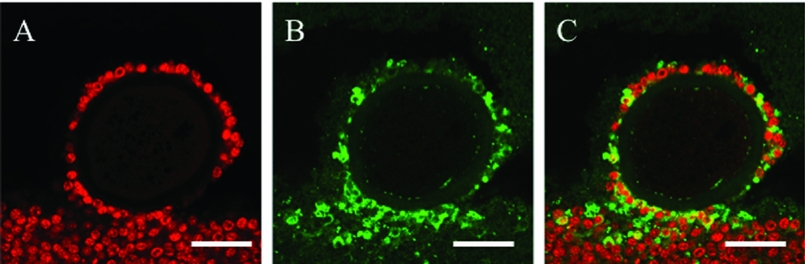
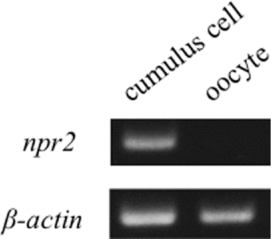
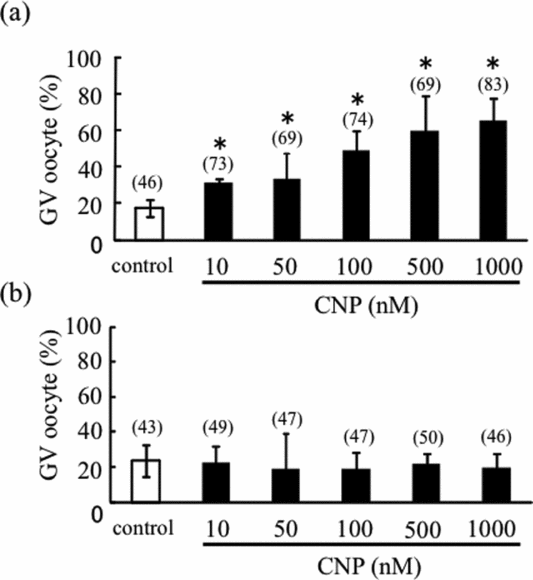
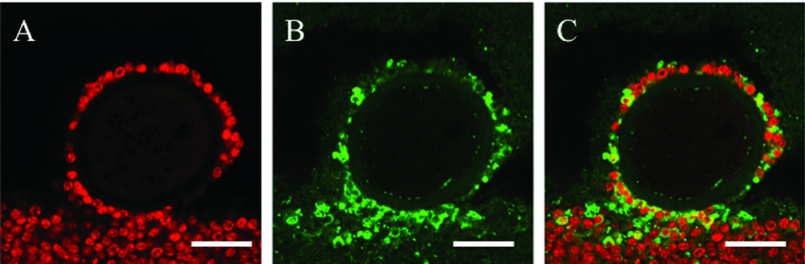
As shown in Fig. 1, intense NPR2 immunoreactivity was detected in oocyte surrounded cumulus cells, suggesting the presence of NPR2 in porcine ovarian follicles. We examined the expression of npr2 mRNA in cumulus cells and oocytes by RT-PCR, and confirmed that npr2 mRNA is expressed in porcine cumulus cells but not in oocytes (Fig. 2). This result suggests that CNP targets cumulus cells but not the oocytes. In order to demonstrate the hypothesis, oocytes with CNP were cultured in vitro. When COCs were cultured with CNP for 9 h after 22 h of pre-culture in medium containing dbcAMP, significant GVBD inhibition was observed at CNP concentrations of more than 10 nM (Fig. 3). In contrast, when DOs were cultured, CNP did not significantly inhibit the GVBD at any concentration. Our result clearly demonstrates that CNP also acts as a meiotic inhibitor in porcine oocytes. Because the bioreactivity of CNP is attributed to a cGMP-dependent cascade (Schulz, Reference Schulz2005), it seems that CNP-generated cGMP in cumulus cells is transported into the oocyte and that it plays an important role in meiotic arrest.
Analysis of natriuretic peptide receptor 2 (NPR2) localisation in porcine ovarian follicles by immunohistochemistry. (A) Counterstaining with PI; (B) NPR2 staining; (C) merged image. Intense positive reaction against anti-NPR2 antibody was observed in oocyte surrounded cumulus cell. Scale bars indicate 100 μm.
npr2 mRNA detection in porcine cumulus cells and oocytes. Reverse transcription polymerase chain reaction (RT-PCR) was performed with cDNA prepared from cumulus cells and oocytes. Npr2 mRNAs were detected only in the cumulus cells but not in the oocytes. The resultant PCR products were separated on a 2% agarose gel and stained with ethidium bromide.

Effect of C-type natriuretic peptide (CNP) on porcine oocyte germinal vesicle breakdown (GVBD) inhibition. Cumulus–oocyte complexes (COCs) (a) or denuded oocytes (DOs) (b) were further cultured with various concentrations of CNP (10–1,000 nM) for 9 h after 22 h of pre-culture in the presence of dbcAMP. Oocytes were fixed and stained with 1% aceto-orcein, and GVBD occurrence was evaluated. The numbers in parentheses represent the numbers of oocytes examined. Data were analysed by t-test. *P < 0.05.

Npr2, the cognate receptor of CNP, is widely expressed, such as in aortic smooth muscle cells (Rahmutula & Gardner, Reference Rahmutula and Gardner2005) or the spinal cord (Schmidt et al., Reference Schmidt, Stonkute, Jüttner, Schäffer, Buttgereit, Feil, Hofmann and Rathjen2007). However, there is limited information about the role of CNP in the ovary. Jankowski et al. (Reference Jankowski, Reis, Mukkadam-Daher, Dam, Farookhi and Gutkowska1997) reported that cnp and npr2 mRNA expression levels in the ovary are modulated by the oestrous cycle in a rat model. In addition, they reported changes in npr2 expression with hormone administration. With oestrogen analogue or equine CG treatment, the npr2 expression level in granulosa cells was significantly increased. A recent study in mice has shown that CNP stimulates ovarian follicle development (Sato et al., Reference Sato, Cheng, Kawamura, Takae and Hsueh2012), and a study on Nppc- and Npr2-mutant mice revealed that lack of the NPPC/NPR2 cascade results in a defective female reproductive system, emphasising the importance of CNP and NPR2 (Kiyosu et al., Reference Kiyosu, Tsuji, Yamada, Kajita and Kunieda2012).
However, while the CNP function has been well established in a rodent model, studies in large domestic animals, including porcine models, have not been done. This result is the first evidence that CNP acts as a meiotic inhibitor in porcine oocytes.
Based on our results showing that npr2 is expressed in cumulus cells and functions as a CNP receptor, we investigated the regulation mechanism of npr2 in cumulus cells.
In a previous report in mice, npr2 expression in cumulus cell was also sustained by the ODPF (Zhang et al., Reference Zhang, Su, Sugiura, Xia and Eppig2010). To demonstrate whether ODPF affects the level of cumulus cell npr2 expression in the porcine model, we quantitatively compared the level of npr2 expression in oocytectomised COCs.
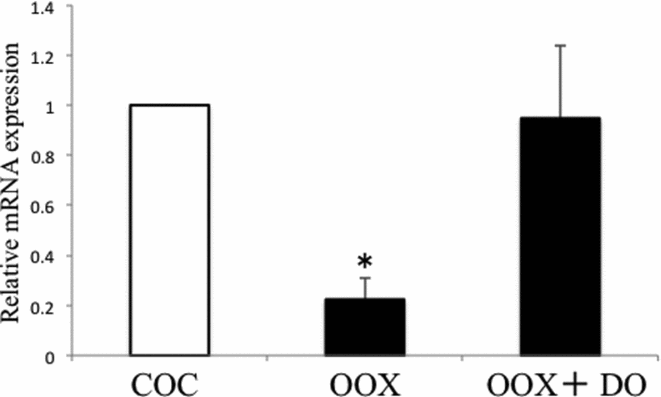
As shown in Fig. 4, the relative mRNA expression level of npr2 was significantly lower than that in the oocytectomised group (OXC) in the COCs group. However, npr2 mRNA level was restored by co-culture with DOs (OXC + DO), suggesting that porcine ODPF also helps maintain npr2 expression in cumulus cells. In mice, it has been reported that npr2 level in cumulus cells was increased by the combination of GDF9, BMP15, and FGF8 (Zhang et al., Reference Zhang, Su, Sugiura, Xia and Eppig2010). In our work, the effects of these factors on npr2 were not investigated because of the limited availability of these recombinant proteins for porcine studies. Further study is required to identify the main factor(s) involved in the regulation of npr2 mRNA expression in porcine cumulus cells.
Relative mRNA expression levels of npr2 in cumulus cells by real-time polymerase chain reaction (PCR) analysis in cumulus–oocyte complexes (COCs), oocytectomised COCs (OXCs), or OXCs with denuded oocytes (DOs) cultured for 24 h. Npr2 mRNA expression level was normalised to that of β-actin. Data are mean ± standard deviation (SD) of three independent experiments. Data were analysed by Bonferroni-Dunn test *P < 0.05.

In summary, our data show that CNP acts as a meiotic inhibitor in porcine oocytes through a mechanism indirectly mediated by cumulus cells. Furthermore, OXCs showed decreased levels of npr2 mRNA expression, suggesting that ODPF also regulates npr2 expression in the porcine model. Our finding provides a new insight on the underlying mechanism of meiotic resumption in porcine oocytes and raises the possibility of developing techniques to control in vitro maturation in porcine oocytes.
Declaration of interest
None.
Acknowledgement
This work was supported by a grant from the Japan Society for the Promotion of Science to E. Sato (No. 21248032).