1. Introduction
Participatory reform is widely known to be the most promising means of implementing unpopular policies with more legitimacy and popular support (Fung and Write, Reference Fung and Write2001). The present study examines this idea using the recent case of Japanese pension reform, where participatory measures were employed by the government in an effort to respond to the growing influence of civil society. A typical deliberation council (shingikai), the traditional policymaking vehicle of the Japanese government, was installed for the reform but with a new element of civic participation in an effort to encourage open discussions among government policymakers, interest group members, and citizen representatives. The participatory measure, however, did not bring about meaningful changes in the traditional policymaking pattern but justified the government's reform initiatives. This paper explores why Japanese civil society, which has been significantly empowered over recent decades, has failed to effectively intervene in the policymaking process despite the institutional changes and how the bureaucracy has been able to maintain its dominance over the reform process in the midst of mounting popular criticism and competitive party politics.
Japanese civil society had traditionally been perceived as weak and accommodating, controlled and manipulated by intervention of the strong state (e.g., Garon, Reference Garon1998), until recent studies portrayed a contrasting picture, depicting vibrant community-based activities among Japanese citizens, especially after the so-called ‘nonprofit organization boom’ triggered by the NPO Law in 1998 (Hasegawa et al., Reference Hasegawa, Shinohara and Broadbent2007; Ogawa, Reference Ogawa2009; Imada, Reference Imada and Vinken2010). An eclectic ‘dual civil society’ thesis, claiming that neighborhood-based, community-oriented organizations are seen as strong, whereas nationwide, advocacy-oriented activity is conspicuously weak, has become the most widely circulated discourse on the status of Japanese civil society (Pekkanen, Reference Pekkanen2006; Tsujinaka et al., Reference Tsujinaka, Choe and Ohtomo2007; Kawato et al., Reference Kawato, Pekkanen, Yamamoto and Gaunder2011). Empirical studies have demonstrated that political agendas are constrained to either local or overseas issues, leaving national politics largely autonomous from the direct pressures of civil activism (Tsujinaka et al., Reference Tsujinaka, Pekkanen and Yamamoto2009; Tsujinaka and Mori, Reference Tsujinaka and Mori2010). Developmental institutions of the Japanese state are regarded as the primary culprit of the historical transformation of this dualistic civil society structure (Schwartz and Pharr, Reference Schwartz and Pharr2003; Avenell, Reference Avenell2010).
Change first began when the Japanese government attempted to initiate a series of structural reforms in the early 2000s. To encourage its massive economic stimulus packages, the government had to rectify the chronic budget deficit that was aggravated by the weakening economic performance and continuing growth of the aged population. Taxation, employment, and social welfare systems, including pension schemes, had to be overhauled in order to address the government's ambitious reform intentions. However, the likelihood that the general public would wholeheartedly approve of these reform measures for fiscal austerity was quite low. This was especially true for the issue of pension reform, as it focused on reducing benefits and increasing contributions. Party politics were also becoming increasingly competitive, which then politicized the reform issue.
Sensing popular protest, the Japanese government opted to introduce a participatory policymaking procedure that had become a global fashion, and for which there was an increasing demand from civil society (Meguro and Kamoshida, Reference Meguro and Kamoshida2005; Roberts, Reference Roberts and Roberts2008). A number of governmental decision-making bodies recruited citizen representatives in an effort to increase policy legitimacy and efficiency, i.e. to accomplish unpopular reform goals in a more democratic manner. Reforming the public pension program was one of the unpopular policies, and it has been carried out in this participatory manner since the early 2000s.
The earliest reform in 2004 ended up revising the existing pension scheme in favor of bureaucratic convenience with the introduction of an automatic rate adjustment system, new cuts to benefits, and increases to contributions. More fundamental issues with respect to, for instance, the establishment of a unified and fully tax-funded pension system designed to curb the increasing generational inequality, a general demand of the civil society, were not effectively discussed through participatory deliberation but were ignored or postponed until the following reforms in 2009 and 2014. In those reforms, the roles and influences of citizen representatives in the policymaking bodies, i.e. civil society, were very limited or marginal at best. The research challenge is, thus, to determine the factors that have prevented Japanese civil society from becoming an influential political actor, playing meaningful roles in the participatory reform process despite its remarkable growth and timely institutional change.
The reform procedure clearly demonstrates the manner in which the Japanese state handled the pension issue. A deliberation council established by the Ministry of Health, Labor, and Welfare (kōseirōdōshō, MHLW) administered the pension reform. From the outset, the welfare bureaucracy in the council had a clear goal to increase contributions and decrease benefits in order to achieve fiscal austerity. The citizen representatives, on the other hand, despite their clear visions and opinions with respect to the public pension system, were not able to affect the policy deliberation dominated by the bureaucrats armed with technical expertise and professional knowledge. The citizen members on the committee did not represent any politically influential civil society associations, which otherwise could have substantially empowered them.
The findings suggest that the introduction of a participatory institution per se has not produced a meaningful change in the traditional pattern of policymaking in Japan. On the contrary, it served to legitimize the government's claims, helping those claims be legislated and implemented as planned. The increasing number of civil associations and the galvanized competition among political parties were not effectively translated into the increasing political influence of Japanese civil society because of the limited institutionalization of the voices of civil society and the overwhelming presence of bureaucratized institutions across policymaking procedures.
Theoretically, this research aims to identify the mechanism of inclusion/exclusion of civil society in the governmental decision-making process. Second, the legacy of the developmental state and the social consequences of the intervention of a strong state in civil society are critically examined. Third, this study demonstrates the importance of professional knowledge and the organizational power of civil society associations in empowering Japanese civil society. Finally, the research contributes to the ongoing theoretical debates on the state–society relationship in Japan by revisiting the roles of the bureaucracy and policymaking institutions, as well as the unique characteristics of Japanese civil society.
The discussion begins with the background of pension reform attempts in the 2000s, followed by a detailed description of the policymaking process, focusing on the interplay of bureaucratic agencies, political parties, and civil society. The main discussion on the roles and strategies of welfare bureaucracy, as well as the limited influence of civil society, in welfare policymaking is presented, followed by concluding remarks on the theoretical implications of this research and the prospects for state–society relations in Japan.
2. Initiating the reform
The national pension program in Japan (kokumin kainenkin) was enacted in 1961, and its benefits steadily increased. The payment level reached 10,000 yen in 1965, which doubled in four years and then quintupled in eight years (Estévez-Abe, Reference Estévez-Abe2008: 138). That is, the standard pension benefit for employees and the national pension benefit for married couples increased to 20,000 yen in 1969 and 50,000 in 1973. The benefit level was set at three-fifths of the monthly salary of the model pensioner, i.e. a 60% replacement rate, in 1975 and was annually scaled to consumer price and wage indices.
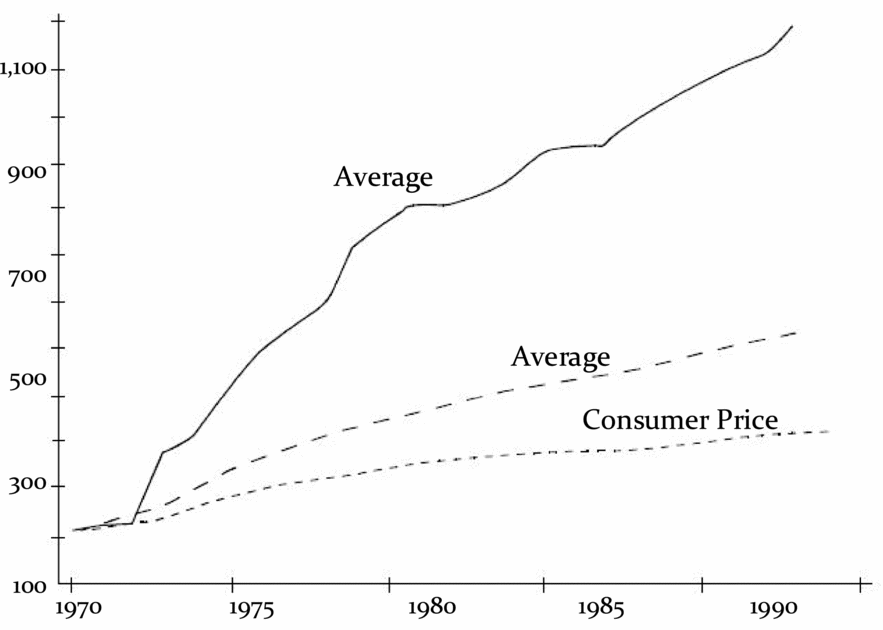
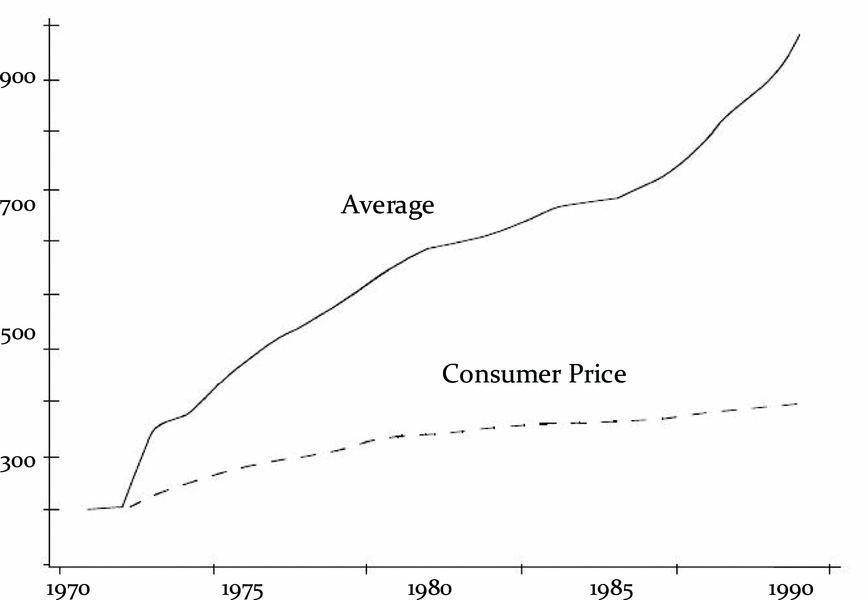
As illustrated in Figure 1, the growth rate of the employee pension benefit outpaced the rates of the average wage and consumer price index, on which the levels of pension contribution hinged. The national pension was not exceptional, as shown in Figure 2. The benefit level of the national pension program continued to increase as rapidly as employee pensions.
Trends of employee pension benefit, wage, and consumer price, 1970–1995

Trends of national pension benefit and consumer price, 1970–1995
The rapid development of the pension system resulted in inherent problems. The system assumed steady and continuing growth of the economy, which actually began to worsen after its peak in the mid-1980s. A dwindling birthrate, which decreased much faster than the government's projections, accelerated the aging of society. Several revisions to the pension programs were thus made in the 1980s and 1990s. The 1985 revision introduced the basic old-age pension (rōrei kiso nenkin) for all citizens. While aiming to expand benefits to all citizens, the revision simultaneously intended to subsidize the dissipating pension funds with contributions from new subscribers. It also proposed increasing the pensionable age—the retirement age at which contributors become eligible to receive benefits—of women for the employees’ pension program from 55 to 60 years. Four years later, college students were also compulsorily subscribed to the national pension program (MHLW, 2009a: 10).
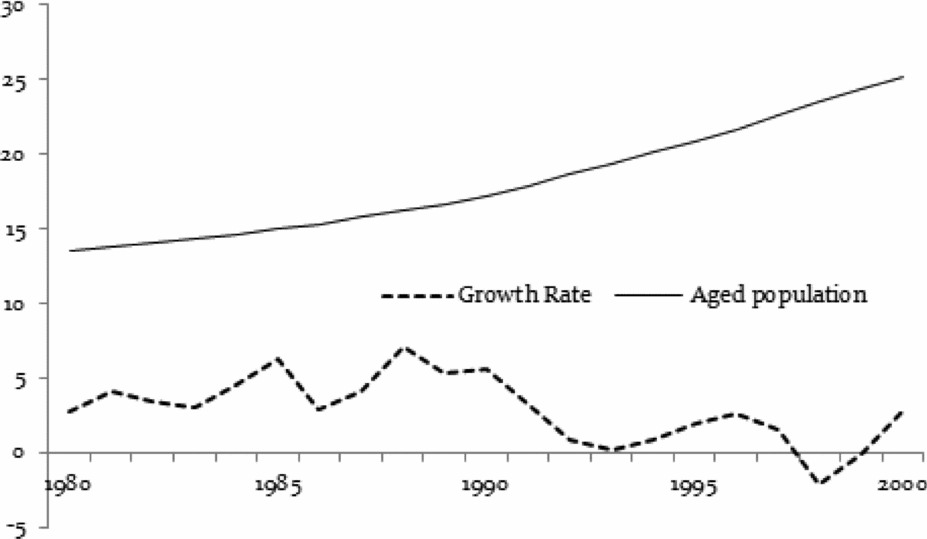
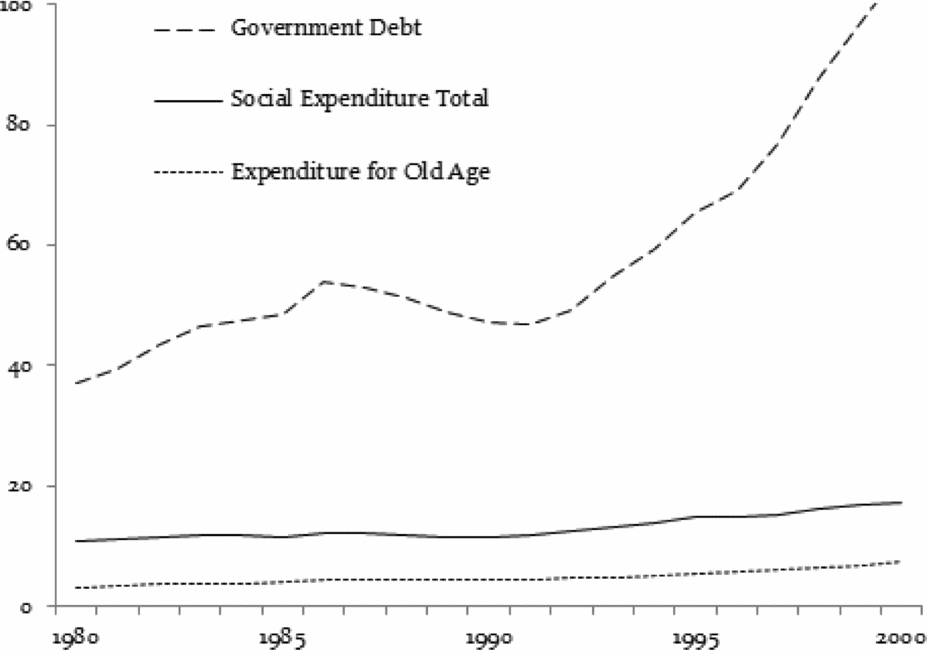
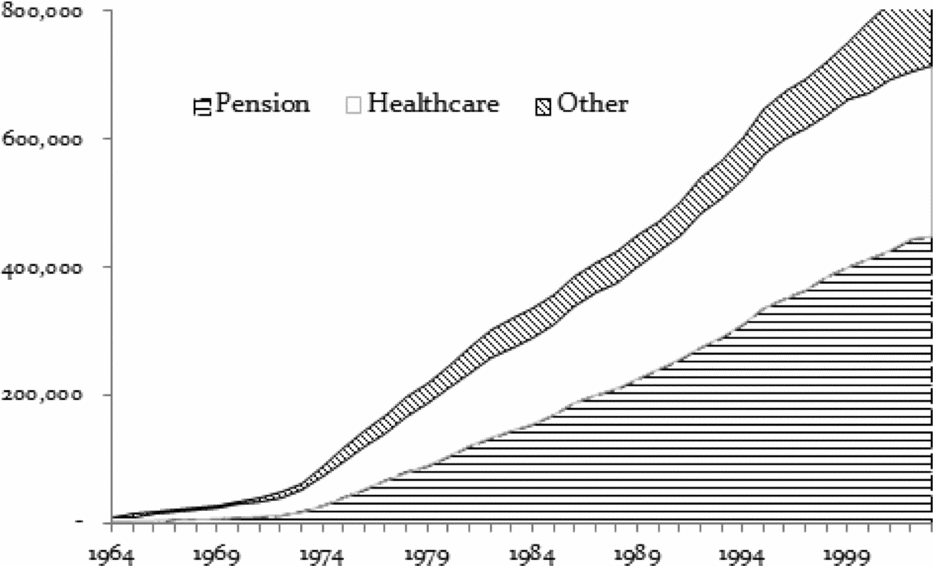
The situation further deteriorated in the early 1990s when the asset price bubble finally burst. Whereas economic growth rates began to decrease, the aging of society continued to proceed, as indicated in Figure 3. The central government's debt also greatly increased, partly because of the gradual increase in social expenditures. The social expenditures for the aged population, both public and mandatory private, in percentage of GDP more than doubled from 3.1% in 1980 to 7.4% in 2000 (see Figure 4). This increase was primarily driven by the skyrocketing pension expenditures from the 1970s to the 1990s, as illustrated in Figure 5.
Rates of GDP growth and population aging, 1980–2000 (%)
Rates of government debt and social spending, 1980–2000 (%)
Trends of social expenditure by type, 1964–2003 (100 million yen)
The Ministry of Health and Welfare (kōseishō, MHW) attempted to implement the pensionable age extension—the easiest makeshift fix for the fund exhaustion—several times throughout the 1980s but failed due to the National Diet's objection (Shinkawa, Reference Shinkawa2001: 11; Nihon Keizai Shimbun [Nikkei hereafter], 20 April 2002: 26). In the 1994 revision, the government increased the normal pension age from 60 to 65 years, but only for the fixed-rate portion (teigaku bubun) of the old-age employees’ pension scheme. Also, the pension premium began to be imposed not only on regular wages, but also on extra-salary income, including bonus payments.Footnote 1 Through the 2000 revision, the pensionable age was finally set at 65 years both for the fixed-rate and the proportional (remuneration-based) portions (hōshūhirei bubun) (MHLW, 2009a: 10).
Nevertheless, adjusting the pensionable age was not sufficient to avert the impending collapse of the pension program; significant adjustments had to be made to the contribution and benefit levels immediately. Consequently, MHW (1997) published a report that presented five potential options, ranging from maintaining the current system to privatizing the entire system. Over the course of the series of reforms, manipulating benefits and contributions in order to restore fiscal soundness of the pension funds became the underlying guideline for the MHW bureaucrats in handling pension problems.
At this same time, people's distrust of the overall pension programs was becoming obvious. Since the government's demographic and fiscal projections continued to be wrong and changes to the pension schemes continued to include ways to reduce benefits and increase payments, there was a growing concern about the collapse of the public pension system among the general public. In addition, the reported inequality between active and retired citizens was increasing due to persistent intergenerational transfer problems. Default and non-payment of pension contributions were rapidly increasing, which further aggravated the sustainability of the current pension schemes (Takegawa, Reference Takegawa2006: 88–90).
Japan's economic status did not show any sign of recovery in the early 2000s. Economic stimulus packages were restricting the government budget, but social expenditure had to be increased due to the dismal performance of the Japanese pension funds. In fact, in 2001, the pension fund in Japan showed a deficit for the first time in its history. Japan's pension expenditures comprised almost half of the total social expenditures as of 2003, a larger percentage than any other advanced country (IPSSR, 2007: 39). Therefore, although a major reform in the public pension programs was inevitable, the problem was how to initiate the change, considering the increasing popular discontent. The time for another financial revaluation was approaching, and the MHLW set a timetable for public pension reform. The first step in this process was to organize a council to consider the direction of the reform.
Upon initiating the pension reform, the MHLW organized a deliberation council to discuss various issues of the reform.Footnote 2 On 13 July 2001, in the third regular session of the Social Security Council (shakai hoshō shingikai, SSC), the government proposed the installation of the Pensions Subcommittee of the Social Security Council (shakai hoshō shingikai nenkin bukai, PS/SSC) to ‘review the overall pension issues for the coming financial revaluation scheduled in 2004’.Footnote 3 It was also reported that the recruitment of PS/SSC members would be discussed with the SSC Chair, Kaizuka Keimei, an economics professor emeritus who had had a long career as an active member of a number of government deliberation councils.Footnote 4
While the SSC followed the traditional rule for organizing its members (see Pempel, Reference Pempel1974), the PS/SSC was somewhat distinctive in that it officially offered citizen representation. Whereas 17 members of the PS/SSC were primarily experts i.e. professors or researchers and representatives of interested parties such as the business and labor sectors,Footnote 5 three citizen members were also appointed. Ide Akiko was a branch manager of NTT DoCoMo and was well known for her successful career, starting as a regular employee and advancing to an executive director of NTT Corporation.Footnote 6 Imai Nobuko was affiliated with the Women's Farmers Association (zenkoku jyosei nōgyō keieisha kaigi, WFA), a non-governmental non-profit organization established in 1995 in order ‘to improve the social status of female farmers, as well as to exchange and develop knowledge and skills related to farming and agricultural business’ (W.F.A., July 1995: 1). Sugiyama Chika was a small business owner and was invited to the committee because of her career as an energetic writer on childcare and parenting.Footnote 7
The member composition itself clearly demonstrates the government's approach to the reform issue. Most of the recruited experts were economists who had already been serving on various deliberation councils of the government when the PS/SSC was launched. In fact, half of the expert members on the committee were jointly affiliated with the Pension Actuarial Subcommittee (nenkin sūri bukai) (MHLW, 2001). Two non-economists were appointed as the specialists for gender issues, which the welfare bureaucracy regarded as one of the most important agenda items for the upcoming pension reform. In other words, although the MHLW announced that it would discuss ‘overall issues’ related to the pension system, it implicitly set boundaries for the agenda to be deliberated by the committee.
3. Deliberating the reform
The initial goal of the welfare bureaucracy in the 2004 reform was outlined in its official report, ‘Direction and Issues of the Pension Reform Framework’ (MHLW, 2002). This report states that a significant revision of the current pension scheme was inevitable because of the aging of society, distrust of the pension system, changing role of women in society, and the financial deficit. Since the welfare bureaucracy could not control the aging of society, the primary goal of the reform was to reduce the budget deficit (Nikkei, 17 January 2002: 3). The other important issue was to revise the pension system to amend the gender inequality of the pension benefits, i.e. to adjust benefits among male and female members of households. This issue did not have a significant budget impact but did have profound social implications, which was the reason for inviting three female citizens to the deliberation council. Finally, the welfare bureaucracy believed that the issue of pension distrust could be resolved by successful implementation of the reform through participatory means.
From its onset, the welfare bureaucracy tried to control the agenda, leading the committee to focus primarily on parametric adjustments of the contribution and benefit levels. The MHLW proposed that the contribution rate of the employee pension should be increased to 20% from the current 13.58% (of annual income) by 2020 in order to achieve a 54% replacement rate, which was a significantly lower figure from the current 60% of the average model income (Nikkei, 17 January 2002: 3). The introduction of the defined contribution (DC) system was also suggested in order to bridge the increasing difference between expected revenue and available funds. This new system, if introduced, would cause the pension payment to depend on the macro-economic and demographic condition, or the ‘macro-economic slide formula’, at the time of retirement instead of on a fixed payment rate as in the defined benefit (DB) system. Most of the discussion on employee pensions among the representatives of employers (e.g., Keidanren), employees (e.g., Rengo, JAM), and MHLW officials focused on these levels of adjustment. In terms of the basic pension (kiso nenkin) for the general public, the ministry suggested an increase in the ratio of state funding to 50% from the current 33%.
In addition to these two main points, i.e. the introduction of the DC system and the macro-economic slide formula, other issues such as alleviating generational and gender inequality were not sufficiently discussed and a consensus was not reached. The citizen members, as well as some of the expert members, wanted to discuss an overhaul of the current pension system and its transformation into a fully tax-funded system. One study actually demonstrated that the mounting intergenerational inequality could only be compensated by a reform toward a tax-financed, funded pension system (Kunieda, Reference Kunieda2002). The welfare bureaucracy, however, proactively shunned this issue from being discussed, because the financing of pension programs with tax revenue might result in loss of control over the pension assets. Since the ruling Liberal Democratic Party (LDP) also did not want to discuss tax-related issues, the MHLW discouraged it from becoming part of the main agenda of the PS/SSC deliberation (Shinkawa, Reference Shinkawa, Bonoli and Shinkawa2005: 176–8). With respect to the gender issue, the MHLW launched another committee, the Women and Pension Review Committee (josei to nenkin kentōkai), which submitted its final report to the SSC in December 2001 (Nikkei, 15 December 2001: 7).Footnote 8 Therefore, the remaining issues were little more than adjusting the benefit and contribution rates, which was a completely technical matter.
Nevertheless, there were a number of heated debates among the representatives of employees and employers on reform issues. The committee could not reach a decision because the former simply argued for fewer cuts, while the latter asserted that more cuts were needed (PS/SSC Minutes, 15th session, 7 March 2003). The government broke the deadlock by involving the general public. An opinion survey was conducted by the Cabinet Office on the three options proposed by the PS/SSC: (1) no change in benefits with an increase in contributions; (2) slight decrease in benefits with a slight increase in contributions; and (3) major decrease in benefits with no change in contributions.Footnote 9 The second option, as expected, received the most votes (46.7%), which served as one of the key arguments to support the welfare bureaucracy stance.
Right before finalizing the decision of the PS/SSC deliberation, welfare minister Sakaguchi submitted a preliminary draft.Footnote 10 This ‘Sakaguchi Draft’ was primarily aimed at revising the levels of benefits and contributions of the existing pension scheme. The only noticeable difference between the original ‘Direction and Issues’ and the ‘Sakaguchi Draft’ was the income replacement rate, which was increased slightly from 52% to 54%. Subsequently, the PS/SSC finalized its report in September 2003, which concluded the committee's 20 months of deliberation.Footnote 11 Although the report does not contain unanimous decisions, it clearly states that the majority of the members agreed to the ministry's reform initiatives. This was no surprise considering the member composition of the committee.
Based on the deliberation results, the MHLW finalized its reform bill, which can be summarized as follows: (1) maintain a 50% income replacement rate; (2) increase the government financing of the basic pension fund to 50%; (3) increase the contribution rate to 20%; (4) introduce a macro-economic slide with the DC system. The MHLW encountered immediate social and political contention. Keidanren requested more radical decreases in benefits and contributions. Rengo, on the other hand, insisted that the benefit level should be maintained with a lowered contribution level (Nikkei, 18 November 2003: 3). The Council on Economic and Fiscal Policy (keizai zaisei shimon kaigi) of the Cabinet Office criticized the reform plan for focusing only on ‘the rates of benefit, premium, and the government's contribution’.Footnote 12 Political parties also publicized their manifestos, or public pledges, on a variety of reform issues, including pension reform, for the upcoming election (Nikkei, 28 October 2003: 2; 1 November 2003: 3). The ruling coalition underscored the increased subsidy on the basic pension but remained vague on the issue of overhauling the pension system into a tax-based one (Nikkei, 11 November 2003: 3; 13 November 2003: 1), whereas the opposition Democratic Party of Japan (DPJ) pledged a unified pension system with a fully tax-financed basic pension (Estévez-Abe, Reference Estévez-Abe2008: 279).
The LDP won the lower house election in November 2003 but was significantly challenged by the opposition DPJ. As another election was scheduled in July 2004, the government wanted to complete the pension reform as soon as possible without addressing politically unfavorable issues, including fundamental restructuring and tax-based financing. With slight modification, the MHLW finalized the official reform plan on 17 November 2003 (Nikkei, 18 November 2003: 1).
As soon as the bill entered into the deliberation process in the Diet on 1 April 2004, the opposition submitted an alternative reform bill to the Committee on Health, Labor and Welfare. Supported by its growing popularity, the DPJ advocated for a more radical reform, endorsing a unified pension system and tax-based financing, including an increase in sales tax. The LDP instantly downplayed the feasibility of the opposition's bill. ‘It [the unified pension system] is a matter for 20 or 30 years later’, said Prime Minster Koizumi to the House of Representatives (Nikkei, 2 April 2004: 2). ‘It would take five years to discuss these agenda items’, criticized an LDP lawmaker. ‘What are we going to do during that long period?’ (Nikkei, 10 April 2004: 7). Whereas the DPJ criticized the government bill for being ‘nothing but a makeshift budget fix’, the LDP defied the DPJ plan as a cursory ‘let's-discuss-it bill without any discussible numbers’ (sūji ga nani mo nai ‘kentō shimasu’ hōan) (Nikkei, 15 April 2004: 5). Meanwhile, the MHLW published official pamphlets implicitly criticizing the DPJ reform proposal (Yoshida et al., Reference Yoshida, Guo and Cheng2006: 398).
Despite these controversies, the legislation process of the pension reform plan was relatively swift and smooth, mostly because there were not many things to change about this basically parametric reform bill, filled with technical calculations of the future balance of the pension funds and macro-economic projections. The only contentious matters were some of the symbolic figures, such as the 18.35% contribution and 50% income replacement rates, which were politically inflammable in the upcoming election. As a result, many of the government's claims were left largely unverified (Takagawa, Reference Takegawa2006). Furthermore, the occurrence of pension scandals caused the reform debate to drift in an unexpected direction that party politicians could not effectively handle (Los Angeles Times, 8 May 2004; see also El-Agraa, Reference El-Agraa2009).
The series of pension scandals, which prompted the Chief Cabinet Secretary Fukuda Yasuo and the DPJ leader Kan Naoto to step down, rapidly turned popular attention toward political and governmental corruption issues and away from pension reform. The fundamental issues of the pension reform played a limited role in the election (Yamamoto, Reference Yamamoto2005: 217). While the pension reform issues were becoming less of a focus, the government's reform bill, barely revised from its original plan, was tabled on the Diet and passed without substantial resistance. It was finally promulgated on 11 June 2004, ending two and a half years of reform deliberation. After the promulgation of the new pension act, the media, politicians, and intellectuals warned of the shortcomings of the new pension system, which could not be revised for five more years (Nikkei, 29 June 2004: 2; 30 July 2004: 5; 8 August 2004: 3; 17 August 2004: 2; 19 December 2004: 21).
Additional pension reform committees were installed by the MHLW, mostly for parametric adjustments, after the epochal 2004 reform. One existed between December 2006 and May 2009, and the other was organized in April 2011 and was functioning as of September 2014. The PS/SSC installed in 2006 made a slight change in its member composition but was largely identical to the previous PS/SSC. Among the 18 members, eight were professors or researchers in the disciplines of economics or business finance. Two of the citizen members from the previous PS/SSC continued their membership in the new committee. In addition, two journalists, one from Yomiuri Shimbun and the other from Nihon Keizai Shimbun, joined the committee. The other members were two social welfare professors and four representatives of interest groups, two from the business sector and two from the labor sector. The main deliberation agenda was set by the government and focused on parametric adjustment based on the 2004 reform, including the expansion of pension coverage to part-time workers (MHLW, 2006). This subcommittee was dissolved in May 2009 after 15 meetings, producing only an interim report (PS/SSC, 2009) right before the historic regime change.
After the landslide victory, the newly launched DPJ regime ambitiously advanced its pension reform blueprint (DPJ, 2009). As addressed in the legislative deliberation process in 2004, the DPJ consistently pledged a fundamental overhaul of the public pension programs into a unified, tax-based system. After assuming power, however, they were not ready to initiate a structural reform of the program. Thus, the DPJ administration focused on fixing the pension payment record problems and other minor issues while preparing for a grand reform. Although a number of deliberation councils and committees were established by the Cabinet Office and by the DPJ, the new government's reform program remained highly abstract and vague, as shown in the ‘Seven Basic Principles of the New Pension System’ issued on 20 June 2010 (National Policy Unit, 2010). In short, since its inception, the pension reform under the DPJ regime has gradually leaned toward a simple parametric adjustment of the existing system instead of a radical reform (Nikkei, 15 January 2011: 5; Shūkan Tōyō Keizai, 5 February 2011).
The initiation of a fundamental reform was continually delayed, mostly because of the decreasing approval rates and the political turmoil after the 3.11 earthquake. The Cabinet Office and the DPJ finally confirmed the principle of ‘comprehensive reform of social security and tax systems’ (shakai hoshō zei ittai kaikaku) as their official reform guideline (Asahi Shimbun, 2 July 2011). Although Maehara Seiji, Chair of the Policy Research Committee of the DPJ, announced that the pension reform would be enacted by 2013 (Asahi Shimbun, 21 November 2011), the DPJ government did not concede any of its requirements, trapped in the sales-tax increase controversy, until it eventually relinquished power to the LDP in 2012.
Meanwhile, following the statutory revaluation schedule, the MHLW established another PS/SSC in August 2011. The basic organizational form of the new PS/SSC was similar to that of the previous committee despite the regime change (PS/SSC, 2011a). Three new female members were recruited; the WFA continued to send its representative, Vice President Koyama Fumiko. The other two members, Fujisawa Kumi, Vice President of the Think Tank SophiaBank, and Komuro Yoshie, CEO of Work Life Balance Co., Ltd., were energetic writers and social entrepreneurs. Unlike the previous committees, however, the MHLW did not impose a strict deliberation goal or schedule, mostly because the DPJ's reform goal was still at issue. In fact, the committee's official goal was simply ‘to deliberate the establishment of a new pension system, based on the discussion for establishing national consensus and a reform environment, along with progress of the DPJ reform policy’ (PS/SSC, 2011b).
Therefore, while the DPJ regime was stagnating around the sales–tax controversy and the aftermath of the earthquake, the PS/SSC focused on parametric adjustments of the public pension scheme and other minor issues (PS/SSC, 2012). The fundamental issue of the pension system was deliberated by the National Council on Social Security System Reform (shakai hoshō seido kaikaku kokumin kaigi, NCSSSR) of the Cabinet Office, which was proposed by the DPJ regime but finally launched under the LDP government in November 2012. The NCSSSR was a typical, although bipartisan and statutory, unlike other consultation bodies, ad hoc advisory council composed mostly of experts with some renowned public figures (Nikkei, 1 December 2012). In short, since the current PS/SSC in 2014 has addressed mostly technical issues of the public pension programs, the NCSSSR might have been a more suitable place for citizen representatives; however, there were no seats reserved for them.
4. Bureaucracy and civil society in the reform
Technical discources in the bureaucratic setting
It is obvious that the Japanese pension reform was more successful than other recent cases in France and Greece, where the governments’ reform initiatives experienced massive setbacks that eventually undermined their political stability.Footnote 13 The most obvious difference in the Japanese case was the strong role of the welfare bureaucracy throughout the process. First of all, the Japanese pension bureaucrats achieved organizational coherence and personnel stability; the MHLW had a dedicated pension bureau composed of personnel specialized in pension issues, such as Tsuji Tetsuo, who was as knowledgeable as the other experts on the committee.Footnote 14 Also, the MHLW had clear policy goals and procedures to follow. The government officials in the deliberation council played a key role in keeping the discussion on track. The committee members, the majority of whom had close ties to the ministry, were largely cooperative with the government's guidance. Deliberation remained within technical discussions instead of political or ideological debates.
Each session began with highly technical briefings of MHLW officials, accompanied by stacks of reference materials. That was followed by a main session offered in a question-and-answer style. If MHLW officials were asked potentially controversial questions, instead of providing an instant response, they generally provided a detailed explanation in the subsequent meeting held several weeks later. Each session had pre-assigned discussion topics, making it very unlikely that a debate would develop.
Throughout the deliberation, the MHLW regularly published progress reports summarizing the major issues and the committee's opinions. Despite disagreements among the committee members, the outcomes of the deliberations recorded in the reports were harmonious. On the issue of amending the pension system in order to alleviate the inequality among the older population, for instance, the MHLW progress report states that it is the general consensus of the committee that ‘the primary goal of the pension reform is to resolve generational inequality and it is thus beyond the scope of pension reform policy’ (PS/SSC, 2011c: 8). If an issue failed to achieve a consensus, it was usually addressed through public hearings or expert surveys held and administered by the welfare bureaucracy. No issue has been overturned by the hearings or surveys against MHLW's policy goal in the recent reforms.
Since the debates were kept within the boundaries of a predetermined agenda, politicians or the general public, who were largely unfamiliar with the complicated technical issues, were not able to intervene or redirect the course of the deliberation. For instance, the ‘macro-economic slide’ formula that was introduced by the 2004 reform was a desirable solution for the bureaucracy since the government did not have to actuarially revalue the benefit level with new demographic or macro-economic projections, which could have potentially politicized the issue. Even Prime Minister Koizumi did not fully understand the formula when it was first implemented; had he, he might not have endorsed the idea.Footnote 15
A technical discussion of a predetermined agenda with a tight schedule was the primary tool for the bureaucracy to persuade the committee members to push the reform forward. In a session held in 2008, while committee members exchanged personal opinions, the discussion proceeded into highly technical details. ‘It goes into too much detail’, said the chair Inagami, a sociology/business professor: ‘It seems we're in an academic conference’.Footnote 16 This instance was followed by a journalist councilman's suggestion to conclude on the tax-financing issue before the session was over, which was interrupted by Deputy Chair Watanabe: ‘Absolutely no way. It is better to collect all the opinions of the pension subcommittee with free discussions. Free discussions should not be discouraged’ (PS/SSC Minutes, 7th session, 22 April 2008). Although Okamoto Yasuo, CEO of Dainippon Sumitomo Pharma, subsequently criticized the indecisiveness of the committee, the conversation was not further developed and instead moved to another topic as scheduled.
The role of journalist members on the committee is worth noting. These members were in a position to politicize the deliberation process using the media. As illustrated by Campbell (Reference Campbell, Pharr and Krauss1996), the media's role in government policymaking in Japan is substantial. In fact, the welfare bureaucracy has proactively utilized the media to advertise the inevitability of a parametric revision of the pension scheme. The MHLW frequently invited the media to briefings, usually one day before PS/SSC sessions, distributing official press releases as well as unofficial information. The media framed the pension reform discussion within the predetermined agenda throughout the deliberation process. When opinions reported by the media were contrary to the MHLW intention, the bureau was quick to resolve any controversy by issuing a press release or calling the news editors directly (e.g., Nikkei, 2 October 2002: 4). Whereas there were at least two journalists in the previous PS/SSCs, the current PS/SSC formed in 2011 does not include any members of the media (PS/SSC, 2011a).
The media was invited to every session but was asked to leave after the briefings by government officials. Deliberation was open to the public, in principle, but anyone who wished to observe the deliberation session had to be preapproved, as seats were limited. No recording or photography was allowed. Recent PS/SSC sessions have moved to larger conference rooms that can accommodate more than 100 audience members (MHLW, 2013a), but the same rules have been applied. In short, the bureaucracy has effectively limited the deliberation's exposure to the media as well as to the public, preventing the issues of pension reform from being politicized.
5. Limited influence of civil society
The organizational environment of the committee was favorable to the bureaucracy, and the predetermined deliberation schedule effectively avoided potential hazards to the government's predefined goals. However, the committee was still affected by societal influences. During the 2004 reform deliberation, for instance, the business sector resolutely denounced the government's pension plan (Nikkei, 19 November 2003: 5, 23); 150 business associations including Keidanren, JCCI, and Japan Association of Corporate Executives (keizai dōyūkai) held an emergency meeting and established an ad hoc organization opposing the increase in pension contributions (Nikkei, 6 December 2003: 5). They exerted sufficient pressure to cause the government to revise the proposed rate increase from 20% to 18.35%. Also, responding to the opposition from the Japan Franchise Association (Cheinkyō),Footnote 17 the expansion of the employees’ pension to part-time workers was eliminated from the bill (Nikkei, 4 December 2003: 5; Asahi Shimbun, 1 February 2004).
With its rich resources, Keidanren was involved in the pension reform even before it was initiated. Its report ‘Basic Thoughts on Reforming the Public Pension System’ (kōteki nenkin seido kaikaku ni kansuru kihonteki kan'gaekata, 7 December 2002) was widely circulated and thoroughly discussed in the PS/SSC sessions. The Public Pension Reform Research Group (kōteki nenkin kaikaku kenkyūkai), a subsidiary research organization of Keidanren, also criticized the MHLW proposal, arguing that it would significantly exacerbate the intergenerational transfer problem (Kōteki Nenkin Kaikaku Kenkyūkai, 2003). The group submitted its reports to the PS/SSC for discussion (Kyōdō Tsūshin, 1 April 2003),Footnote 18 and they were thoroughly discussed.
Other reports and statements produced by Keidanren's subsidiary research organization, the Pension Reform Committee in the Keidanren Social Security Council (keidanren shakai hoshō iinkai nenkin bukai), were frequently discussed in PS/SSC sessions. Additionally, between October 2002 and June 2004, Keidanren officially issued statements on the pension reform, and Chairman Imai even met Koizumi to present the business sector's concerns about pension issues (see Keiei Taimuzu, 2649, 2691, 2692, 2700, 2701, 2703, 2720, and 2725). The annual New Year's Address by the Keidanren chairman included Keidanren's opinions on pension reform issues. As the outline of the pension reform became clearer, Keidanren invited influential figures, including minister Sakaguchi and high-profile welfare bureaucrats, to discuss the proposed reform bills (see Keizai Kurippu, 13, 28 January 2003; 25, 22 July 2003; 35, 13 January 2004).
Another interest group that actively participated in the decision-making process was organized labor, represented by Rengo, JAM, and JSD. Rengo in particular sent two representatives to the past and current PS/SSCs formed in 2006 and 2011 (PS/SSC, 2006, 2011a). The power of unions in Japan is a controversial topic, but a study on the role of Japanese unions in the welfare reform suggests that the unions, despite their organizational weakness, are able to convince the government to consider their policy preferences using their institutional and political resources (Miura and Palier, Reference Miura and Palier2003). It is also argued that unions are able to ‘block legislation of labor law because the Ministry of Labor's advisory councils are the de facto veto points, and it is within these councils that union veto power is institutionalized’ (p. 34).
Similarly, whenever the policymaking was contrary to their interests, the represented labor organizations issued statements and often mobilized popular demonstrations. The managing director of Rengo, for instance, issued 14 official statements the year before the conclusion of the 2004 reform. Public conferences, hearings, and lecture events were frequently organized; several mass demonstrations were planned and mobilized, especially after the establishment of the Pension Struggle Headquarters (nenkin tōsō honbu) in March 2004. Demonstrating its power, Rengo met high-profile politicians both from the LDP and the DPJ, as well as minister Sakaguchi, to discuss the direction of the pension reform. It even made a joint statement with Keidanren in order to encourage changes in the finalized reform bill (Keizai Kurippu, 35, 13 January 2004).
While the pillars of Japanese conservative corporatism (Yun, Reference Yun2010), i.e. the government, business, and organized labor, worked closely to draft the reform bill, the largest population that would be substantially affected by the reform, i.e. civil society, was alienated from the policymaking procedure. In the participatory decision-making scheme of the pension reform case, the representatives of civil society were designated to participate as individuals regardless of their organizational affiliation. Ideally, organizational representatives have the backing of their organizations, and the organizations mobilize for their representatives if they are not satisfied with the progress and outcomes. However, the organizations with which the citizen members were affiliated did not organizationally support their representatives’ activities, as in the case of WFA. In fact, the citizen members were independent activists rather than representatives of civil society groups. The citizen members of the PS/SSC were far from satisfied with the decisions of the committee, but there was really nothing their organizations could do for them, unlike the interest group representatives on the committee. The voice of the citizen representatives was thus barely reflected in the final reform bills. The issues of the general public that were not addressed by the welfare bureaucracy or the business/labor representatives, such as intergenerational inequality and the tax-funded structure, were ignored and simply postponed.
Although there existed two nationwide civil society organizations representing pensioner interests, the National Federation of Employees’ Pensioners’ Association (zenkoku nenkin jukyūsha dantai rengōkai, established in 1968) and the Japan Pensioners’ Union (zennippon nenkisha kumiai, established in 1989), neither effectively influenced the pension reform. The National Federation, which had one million members, was basically a quasi-governmental organization (gaikaku dantai). The only full-time staff members in the organization were ex-bureaucrats of the Social Insurance Agency (shakai hokenchō amakudari). The Pensioners’ Union, on the contrary, was an advocacy-based organization with 100 thousand members actively voicing their opinions on various pension issues. The Union, however, was not represented on the committee by any of the citizen representatives, who were not effectively linked to the civil society.
No statements issued by the Pensioners’ Union, not even those by the National Federation, were discussed in the PS/SSC. Even if they had been a topic of discussion, the citizen members could not have effectively represented the voice of civil society because they did not have sufficient knowledge or information on the details of the pension problems to allow them to debate with other expert members. A committee member who served twice, in the 2004 and 2009 reforms, remarked in a panel discussion that she ‘came to realize that the aging problem is really serious while listening to the discussion at the committee’ (Kōsei Rōdō, August 2008: 6), which illustrates the experience of the citizen representatives.
In summary, although citizen members in the PS/SSC did express their concerns and showed objections to the ways in which the reform issues were discussed, they were not represented or officially supported by any influential civil society organization. While established interest groups had substantial impact on the course of the reform through their organizational power (e.g., Negishi, Reference Negishi2012: 53), citizen representatives could not effectively advocate for civil society because of the lack of organizational association, which could have enabled their voices to be heard in such a participatory decision-making setting.
6. Concluding remarks
The traditional policymaking pattern of Japanese bureaucracy can be epitomized by its ‘monopolizing information, manipulating procedures, delaying decisions, simple stubbornness and other means of passive resistance’ (Campbell, Reference Campbell1989: 93). The process of the pension reform issue in the 1990s was criticized by the International Labor Organization (Estienne and Murakami, Reference Estienne, Murakami and Reynaud2000: 61–2):
It is clear that the Consultative Committee on Pensions is run by the Ministry of Health and Social Affairs. But the degree of control enjoyed by the civil servants leaves them open to the temptation to fence on the committee's work not only by managing appointments and reappointments (or non-reappointments), but by choosing the rapporteurs from the Committee and thus becoming de facto drafters of the report . . . Apart from the reinforcement of bureaucratic power, the absence of public debate on pensions should be recognized. The social partners may naturally have divergent views, but the debate which could allow the public to see different sides based on the airing of little-known facts is not on the table.
This quote elucidates that, despite its proper timing, flexible solutions, and formal consensus-building, the pension reform in Japan used to be driven by the welfare bureaucracy for the sake of bureaucratic interests.
Given the widespread criticism, the bureaucracy adopted a participatory governance measure, which was becoming popular among academic professionals and practitioners because it was believed to promote good governance through effective participation of all stakeholders and to be a time-tested option for combatting the problems of social exclusion and political apathy in a democratic society (Osmani, Reference Osmani2008). The introduction of participatory measures was also political in nature since Japanese politicians wanted to use civil participation to increase their influence over the bureaucracy. The Japanese participatory pension reforms over the past decade, however, were by no means immune to the ILO's criticism.
This study demonstrates that the participatory procedure, per se, has not brought about significant changes in the state–society relationship. On the contrary, the preexisting state-society relationship was not only recapitulated, but also, in a sense, reinforced by the enhanced participatory procedure. The PS/SSC in Japan was overwhelmed by technical discourses dominated by the bureaucratic elite. Civil participation, selectively tailored by the government from the outset, was limited. Against the politicians’ influence, the Japanese bureaucracy was able to handle the political challenges by manipulating its own administrative arms and techniques. Eventually, the long-delayed pension reform was successfully enacted, despite the political opposition. It was, ironically, the participatory measure itself that served as a useful tool for the welfare bureaucracy to initiate and execute the unpopular reform.
Kato (Reference Kato1991: 111) succinctly identifies four elements of successful reform initiation by special commissions: formal endorsement by a top leader, substantial support from the government and the legislature, balanced member composition for broad public support, and professional capacity to make the reform plan technically feasible. In the case of the PS/SSC, the member composition, which appeared impartial and open but was actually substantially biased and limited, was the critical problem from the outset. Committee members were drawn from a narrow elite pool of people with close connections either with government agencies or established interest groups. In the 2004 reform, for example, Keidanren was officially represented by one member, Yano, but Okamoto, who was appointed as a representative of employers (CEO of Sumitomo Chemical) voiced the same opinions on the reform issues. In fact, Okamoto became the Chair of Keidanren's Pension Reform Committee and subsequently joined the National Social Security Council (shakai hoshō kokumin kaigi) of the Cabinet Office. The citizen members, who were actually independent and free from organizational support from any influential civil society groups, were not able to have a substantial impact on the decision-making process. They also had limited expertise and technical knowledge, the essential elements of effective participation in a policy community, which created ‘bureaucratic primacy’ over civil society (Pekkanen, Reference Pekkanen2006: 171–2).
The participatory reforms could not conciliate popular contention, nor did they bring about meaningful consensus among contending political and social actors. In fact, Japanese citizens’ dissatisfaction with the pension system was further aggravated after the activities of the deliberation council. In a survey conducted by the Cabinet Office in February 2003, 47.1% of respondents expressed their understanding of the direction and necessity of the pension reform.Footnote 19 At the beginning of 2004, more than 90% of the respondents expressed their concern about the pension reform (Yomiuri Shimbun, 29 January 2004). According to Mainichi Shimbun’s surveys in May 2004, a majority of respondents said that the bill should be repealed (62% in the 17 May surveyFootnote 20 and 58% in the 25 May survey). After the bill was promulgated, 78% responded that the bill should be revised (Mainichi Shimbun, 19 July 2004). Diminishing confidence in the pension system was reflected in the pension due payment rate, which decreased from 67.1% in 2005 to 63.9% in 2008 and then to 59.0% in 2012 (MHLW, 2013b).
Estévez-Abe (Reference Estévez-Abe, Rothstein and Steinmo2002: 173) aptly points out that the ‘lack of a public forum where organized groups could come together to negotiate the allocation of benefits and responsibilities of the welfare state’ is one of the fundamental problems in Japanese welfare reform. Thus, the participatory institution was established and has been in effect during the past pension reforms. It, however, failed to bring about meaningful changes in the traditional policymaking process. The increasing size and activities of civil society have not been effectively translated into its larger influence in government policymaking. Since the stability of the Japanese pension system is not improving and its funds are expected to be completely depleted in 30 years (Nikkei, 24 June 2014), reforms will need to be continuously initiated and implemented. It is thus urgent to devise a way to represent the un- or under-represented civil society in the state governance system in Japan, which has been dominated by the agents of conservative corporatism. Otherwise, the participatory institutions are likely to reinforce the dominance of established actors in the government's policymaking processes.
About the author
Sunil Kim is assistant professor in the College of International Studies, Kyung Hee University, South Korea. He earned his Ph.D. in political science from the University of California, Berkeley, in 2011. Before joining Kyung Hee University, he has been a postdoctoral research fellow at the Institute of East Asian Studies, University of California, Berkeley, and the Jackson School of International Studies, University of Washington, Seattle. Kim's research interests include welfare reform, social policy, state–society relations, and the transformation of developmental states, with a regional focus on East Asia, Japan and South Korea in particular.