Implications
Social housing of gestating sows has been mandated in much of the commercial swine industry across the globe. These sows live the longest lives of any domesticated swine and thus it could be considered that they are at greatest risk to endure the negative effects of sub-optimal welfare. A better understanding of the ontogeny of behavioral traits among gestating sows promises to improve both sow welfare and productivity. Identifying early indicators of future behavioral traits in sows could help producers to predict the social compatibility of a group, inform breeding practices and could identify certain individuals which are more susceptible to the possible negative effects of increased environmental and/or social stress in group housing.
Introduction
Animal personality is defined as a set of correlated behavioral responses that are consistent across time and contexts within an individual or a population (Gosling, Reference Gosling2001). Research on animal personality suggests that certain traits may impact an individual’s hypothalamic–pituitary–adrenocortical axis reactivity (Koolhaas, Reference Koolhaas, Korte, De Boer, Van Der Vegt, Van Reenen, Hopster, De Jong, Ruis and Blokhuis2008), immunity strength (Bolhuis et al., Reference Bolhuis, Parmentier, Schouten, Schrama and Wiegant2003), productivity (e.g. milk yield, weight gain) and health (e.g. disease resistance) (Capitanio et al., Reference Capitanio, Mendoza and Baroncelli1999). Therefore, increasing our knowledge of the ontogeny and consistency of personality traits in agricultural animals can potentially impact both animal welfare and productivity.
Individual differences in behavior (called personality traits, temperament, or coping styles) have been identified in domestic swine (Sus scrofa) across ~50 previous studies (Horback, Reference Horback2017). The majority of these studies have been limited to animals aged 7 months or younger, with <10% of the literature on swine behavior variation focusing on behavioral traits among gestating sows. Current research on behavioral variation among domestic sows tends to focus on differences in maternal behavior, such as the response to audio playback of piglet squeals (Hellbrügge et al, Reference Hellbrügge, Tölle, Bennewitz, Henze, Presuhn and Krieter2008), or variation in farrowing behavior (e.g. posture changes, inter-birth intervals) (Janczak et al., Reference Janczak, Pedersen, Rydhmer and Bakken2003). While there is ample information on behavioral variation in weaned and grower piglets, there is a lack of such information on consistent personality traits or coping styles in sows.
Insight into the behavior of gestating sows is only becoming more important as social housing of this animal population has been mandated in much of the commercial swine industry including 10 US states, the entire European Union, United Kingdom, Canada, Australia, New Zealand and South Africa (EU Council Directive 2001/88/EC; Schulz and Tonsor, Reference Schulz and Tonsor2015). Transitioning and maintaining sows in pens rather than individual stalls can be difficult due to the multilayered considerations of pen size, group composition, feeding system and individual health care and nutrition requirements (Bench et al., Reference Bench, Rioja-Lang, Hayne and Gonyou2013a, Reference Bench, Rioja-Lang, Hayne and Gonyou2013b). While housing sows in pens allows for a greater freedom of movement for the animals, group housing may result in increased injuries as the hierarchy is established through social aggression (Hodgkiss et al., Reference Hodgkiss, Eddison, Brooks and Bugg1998). Sows also live the longest lives of any domesticated swine and could endure the negative effects of sub-optimal welfare the longest. Thus, a better understanding of the ontogeny of behavioral traits among gestating sows has the potential to impact both sow welfare and productivity.
We recently reported three personality traits (aggressive/dominant, avoidant of humans and active/exploratory) among a cohort of commercial sows which were found to be significantly correlated across two consecutive gestation periods (Horback and Parsons, Reference Horback and Parsons2016). Given that this genetically similar commercial sow herd includes individuals with different personality traits, we wanted to investigate whether there are early behavioral indicators of adult behavioral traits. The current study investigated the ontogeny of behavioral traits among a cohort of commercial sows from birth through the second gestation cycle. Individuals were placed in behavioral experiments at ages 5 weeks, 3 months, after first farrowing (10 to 17 months) and during second gestation cycle (11 to 18 months). The objectives of this study were to assess: (1) whether the behaviors observed at each age point could be clustered into composite traits similar to previous study, and (2) whether any early behaviors or traits were predictive of adult traits.
Material and methods
Animals and housing
At the Swine Teaching and Research Center of the University of Pennsylvania, School of Veterinary Medicine, ~130 gestating sows are housed in one large pen as a dynamic group and fed via electronic sow feeding. The 300.0 m2 pen (~2.4 m2/sow) includes nine 2.9×2.2 m concrete lying areas, two 3.6×8.2 m deep bedded straw pits, and a total of 184.0 m2 of slatted flooring. The sows are fed a commercial corn-soy diet via two electronic sow feeding stations. Every week, 10 pre-implantation sows were mixed into the group, while a corresponding number of sows were removed for farrowing. Sows farrowed in hinged farrow crates (4.1 m2) which were opened at 10 to 14 days of lactation to provide the sow with additional mobility. Piglets were weaned once a week at the facility, corresponding to a range of 28 to 35 days of lactation depending on farrowing date.
Eight out of the 130 sows from the PIC 1050 genetic line (Yorkshire×Landrace) with the highest farrow-to-weaning performance were bred with doses of single-sire semen from the PIC 210 genetic line (also Yorkshire×Landrace). All gilts from these eight litters (n=36) were retained at the University of Pennsylvania swine facility after weaning at 5 weeks. The 36 weaned gilts were housed in two pens of 18 gilts (>0.4 m2/animal) until ~3.5 months of age and were randomly split across nine small pens of four gilts (>0.7 m2/animal) until the age of ~6.5 months.
Gilts were fed ad libitum corn-soy diet from weaning to 6.5 months. At ~6.5 months of age, the gilts were mixed into a single pen (>1.7 m2/animal) located in the gestational barn. After 3 weeks of training to use the ESF stations, the 36 gilts were mixed into the larger gilt pen of ~60 other animals (nulliparous gilts and primiparous sows). The gilt pen is equipped with a single ESF feeder, allows for >1.7 m2/animal, includes seven 30.0×2.0 m concrete lying beds, and a total of 130 m2 of slatted flooring.
Behavioral measurements
Teat order
The teat rank position of each piglet (n=36) (ranked 1 to 6, with teats 1 to 2 being the most anterior on the sow’s udders, teats 3 to 4 in the middle, and teats 5 to 6 being the most posterior) was recorded at 0900 and 1600 h 2 days a week for 4 weeks post-farrowing. The mean teat rank for each gilt was then calculated from the aggregated data and the piglets were stratified into three groups: anterior teat region (mean teat rank <2.5, n=9), middle teat region (mean teat rank=2.5 to 4.0, n=15) and posterior teat region (mean teat rank >4.0, n=12).
Restraint test
At 5 weeks of age, each piglet (n=36) was evaluated for behavioral response to being held in the arms of an experimenter for 30 s. This experiment was intended to mimic the routine handling procedures on the farm, such as during piglet processing. Researchers use similar restraint tests (i.e. back-test) as a non-social measure of stress response in order to classify piglets as ‘high-resistant/proactive’ or ‘low-resistant/reactive’ based on pre-determined cut points in the behaviors that are measured. The experimenter stood in one corner of the farrowing pen for 60 s to allow for the piglets to acclimate to the presence of a human. During the restraint test, the sow was kept in a closed farrowing crate (0.6×1.7 m) to protect the experimenter. The piglets were tested in a random order, with the experimenter bending down to pick up one piglet at a time. The experimenter lifted each piglet by a back leg, while supporting the piglet’s chest with their other hand. The test began once the experimenter was standing still while supporting the piglet’s body with both hands, with one hand cradling the torso and the other hand supporting the hips, and resting a side of the piglet body on the human’s chest. The experimenter held the piglet in a prone position firmly and did not move their hands or change the piglet’s position during the 30 s experiment.
Each piglet was given a score by a secondary experimenter based on the following scale: 1: No vocal response or physical movement; 2: <5 s of soft vocalizations (grunts, squeaks) and/or physical thrashing; 3: 5 to 10 s of squealing, grunting and/or physical thrashing; 4: 10 to 20 s of high-arousal vocal response (squealing) and/or physical thrashing; 5: >20 s of high-arousal vocal response (squealing) and/or physical thrashing. The primary experimenter holding the piglet counted the duration of vocalizing and struggling and a secondary experimenter observing the test recorded the duration of physical struggling and vocalizations using a stopwatch. The scores of each piglet were compared between the two experimenters in order to assess the interobserver reliability (Cohen’s κ >0.85).
Open field test (OFT)
Four days after the restraint test, each piglet (n=36) was placed in an open field test to evaluate individual differences in activity and exploration when isolated in an unfamiliar environment. The open field was a 3.3 m2 walled arena (0.9 m in height) in a room that was visually and acoustically isolated from the piglet’s home pen. The linoleum floor of the arena was visually divided with gray duct tape into nine 0.6×0.6 m squares. Each piglet was placed in a 0.6×0.6 m start box for 30 s before the test. The test began once a guillotine door in the start box was lifted and the piglet had access to the open field arena. An experimenter video recorded the piglet’s behavior (Sony Handycam DCR SX85; Sony Corporation of America, New York, NY, USA) from the opening of the start box door until the end of the 5 min test. The video data was coded using continuous sampling (The Observer XT v. 11; Noldus Information Technology, Wageningen, the Netherlands). Specific behavior states recorded include duration of nosing walls and floor, duration of vocalizing (grunt and squeal), and the duration of standing, lying down and walking. Behavior events recorded include the latency to exit the start box, total number of grid lines crossed, returning to the start box, and attempting to jump over arena walls (Supplementary Material Table S1). All video data was coded by one observer. To assess the reliability of the behaviors recorded, 20% of the video data was also coded by a secondary observer, and a high level of agreement was determined (Cohen’s κ >0.9).
Human approach test (HAT)
At ~3 months of age, each gilt (n=36) was placed in a voluntary human approach test to assess individual differences in exploration of, and proximity to, an unfamiliar human. The setting for this experiment was 1.2×2.6 m concrete arena, with a grid of 12 rectangles painted on the floor and 0.9 m high walls. An unfamiliar human sat cross-legged in the farthest corner from the entrance gate of the arena and did not move or interact with the animals. The test began as soon as the gilt’s entire body entered the arena via a sliding door. Video recording of this experiment was coded for specific behaviors, including the latency to touch human, the duration of time spent near human (three squares touching human square), duration of time spent in physical contact with human, orienting toward human, and general activity (nose environment, walk, rest and lie down) (Supplementary Material Table S1). All video data were coded by two observers with a high level of interobserver reliability (Cohen’s κ >0.8).
Response during litter restraint test
Four gilts were removed from the study after the age of 3 months due to illness or severe lameness. The remaining 32 gilts were split across ten breeding groups (2 to 3 gilts per group) and bred in standard gestational stalls (2.0×0.6 m). The gilts were housed together with ~60 other animals (nulliparous gilts and primiparous sows) in a single pen (>1.7 m2/animal) for the entire gestation length. These 32 gilts farrowed at a median age of 13 months (range=10.5 to 16.4 months). Each sow’s reaction toward a human handling her first litter during piglet processing was recorded 24 h post-farrowing to assess individual differences in maternal behavior and aggression toward humans, similar to procedure in Marchant-Forde (Reference Marchant-Forde2002). The piglet processing procedure involved each piglet being removed from the farrowing pen and being placed in a 1.4×0.5×0.9 m transport cart with straw bedding (QC Supply; Schuyler, NE, USA) to receive iron intermuscular injection. The sow was kept in a closed farrowing crate (0.6×1.7 m) while the piglets were removed.
The test began when the first piglet was removed from the pen and placed in the transport cart, and the test was complete after the last piglet was returned to the pen and the human exited the farrowing pen, with a test duration range of 5.5 to 8.7 min (median=6 min). Each sow was given a score based on the behaviors and vocalizations she exhibited throughout the piglet processing. The operational scale was as follows: 1: Sow does not orient to human or vocalizes and remains recumbent during test; 2: Sow changes posture while remaining recumbent to orient toward human and produces <5 soft vocalizations (grunts); 3: Sow moves from recumbent to sitting posture to orients toward human and produces more than 5 soft vocalizations (grunts); 4: Sow slowly changes posture from recumbent to standing and produces mixture of soft and loud vocalizations (grunts and barks) 5: Sow quickly changes posture from recumbent to standing, produces loud vocalizations (barks), and attempts to bite or lunge at human in the farrowing pen.
Pen mixing
Three sows were removed from the study before the first litter was weaned due to illness or severe lameness. The remaining 29 parity 1 sows were housed in standard gestational stalls (2.0×0.6 m) for 7 days after weaning for breeding purposes. Each sow was moved from the breeding stalls to the multiparous sow pen in batches of 9 to 10 sows ~4 to 5 days post-breeding. Each batch was mixed into the gestation pen ~1 week apart based on weaning dates. Given that previous studies have reported most aggressive encounters occur at the beginning of group formation, sows were observed for 1 h post-mixing (Meese and Ewbank, Reference Meese and Ewbank1973; Løvendahl et al., Reference Løvendahl, Damgaard, Nielsen, Thodberg, Su and Rydhmer2005). Each of the 8 to 10 sows per batch was filmed by a single researcher for a continuous 1 h clip following her introduction to gestation pen. All researchers maintained a distance of at least 2 m from the focal sows when filming. To aid in individual identification, a number was written on each sow’s flank using non-toxic livestock marker.
Video data were coded for the frequency, duration and outcomes of fights (displace other sow from fight location or retreat from other sow) at mixing of focal sows into the group pen. The duration of fighting was recorded as the start and stop of parallel-pressing; defined as the sows standing side-by-side and pushing the shoulders against each other, with frequent bites. Additional behaviors coded included the frequency of aggressive behaviors (bites, chasing, head-to-head hits, head-to-body hits and levering) initiated and received (Supplementary Material Table S2). Video data were analyzed using a continuous focal animal behavior sampling method (The Observer XT 11; Noldus Information Technology, Wageningen, the Netherlands). Video data were coded by three observers with high interobserver reliability (Cohen’s κ >0.85).
Statistical analysis
A separate principal component analysis (PCA), using a varimax rotation, was run on data collected at 5 weeks old, at 3 months old, and as parity 1 sow (IBM SPSS Statistics 24, Armonk, NY, USA). For each PCA, Bartlett’s test of sphericity was significant (P<0.001) and the Kaiser–Meyer–Olkin measure was high (KMO>0.5). Only the components that had eigenvalues >1 were retained for interpretation. Behavioral measurements were clustered based on their loadings to specific principal components using a cutoff of 0.5 or greater. Sows received component scores for each trait determined from PCA by using the least squares regression approach. Regression factor scores predict the location of each individual on the component. This standardized method produces scores similar to a Z-score metric, where values range from approximately −3.0 to 3.0.
Significant relationships among the variables were assessed using a non-parametric Spearman’s rank-order correlation. Simple linear regressions were calculated to determine if each adult personality trait could be predicted by the personality traits determined at 5 weeks and 3 months old. Significant differences in personality traits among the teat rank groups were assessed via Kruskal–Wallis tests, with post hoc Dunn-Bonferroni pairwise comparisons and alpha set to 0.05. Data are presented as mean±SEM.
Results
Identification of behavioral traits across age
Behavioral observations were made from when study animals were still suckling until they entered the breeding herd and had piglets of their own. Correlations among contemporaneous behaviors were observed and motivated principal component analyses at separate age points of 5 weeks, 3 months, and parity 1. However, individual behaviors also were correlated across time epochs. The specific details of these correlations can be found in Supplementary Material Table S3.
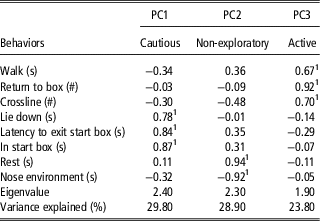
At each of the three age points examined, three principal components were determined from the battery of behaviors observed. At 5 weeks old, three components explained 82.5% of the variance in the data (Table 1). The first principal component was labeled active because it had strong positive loadings for the following behaviors: duration walked in OFT, number of returns to the start box during OFT, and the number of grid lines crossed during OFT. The second principal component from data collected at 5 weeks old was labeled cautious as it has strong positive loadings for the duration of lying down in OFT, latency to exit the start box, and duration spent in the start box during OFT. The final principal component at 5 weeks old was labeled non-exploratory and had a strong positive loading of duration rest in OFT and a strong negative loading of duration nose/explore environment of OFT.
Obliquely rotated principal component loadings for behaviors recorded during open field test when gilts (Sus scrofa) were 5 weeks old

Rotation method: varimax with Kaiser normalization. Rotation converged in five iterations.
1 Component loadings ⩾0.5 were clustered to create composite traits.
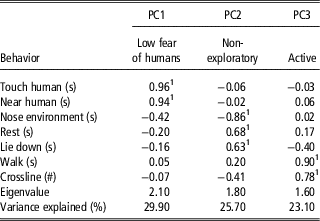
At 3 months old, the three principal components explained 87.7% of the variance (Table 2). The first principal component had strong positive loadings for the duration spent in proximity to a human and the duration of initiated tactile contact with human during HAT and was thus labeled low fear of humans. The second principal component, labeled non-exploratory, had a strong negative loading of duration nose/explore environment in HAT as well as strong positive loadings for the duration in rest or lying down during the HAT. The final principal component was labeled active and had strong positive loadings for duration walk in HAT and the number of grid lines crossed.
Obliquely rotated principal component loadings for behaviors recorded during human approach test when gilts (Sus scrofa) were 3 months old

Rotation method: varimax with Kaiser normalization. Rotation converged in four iterations.
1 Component loadings ⩾0.5 were clustered to create composite traits.
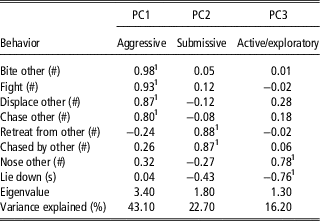
The PCA of data collected when the individuals were primiparous sows introduced to a large, unfamiliar pen revealed three principal components. These components explained 82.0% of the variance (Table 3). The first principal component, labeled aggressive/dominant, had strong positive loadings for the following variables: number of bites, chases and number of fights won, as well as the total number of fights engaged in when introduced into a large, unfamiliar pen. The second principal component, labeled submissive, had strong positive loadings for the number of retreats from another sow and duration of being chased by another sow during pen mixing as a parity 1 sow. The final principal component determined from data collected at pen mixing as parity 1 sow was labeled active/exploratory and had a strong positive loading for the number of nose-investigations of other sows and a strong negative loading for the duration of lying down during pen mixing.
Obliquely rotated principal component loadings for behaviors recorded when animals entered new group pen as primiparous sows (Sus scrofa) (10.5 to 16.4 months)

Rotation method: varimax with Kaiser normalization. Rotation converged in four iterations.
1 Component loadings ⩾0.5 were clustered to create composite traits.
Behavior traits and teat preference
Anterior teat gilts (0.6±0.3) received significantly higher (z=−3.2, P<0.01) active trait scores at 3 months old than middle teat piglets (−0.5±0.2). Both anterior (0.4±0.4) and posterior (0.5±0.3) teat gilts received significantly higher (z=−2.3, P<0.05; z=−2.9, P<0.01, respectively) submissive trait scores as primiparous sows than the gilts which suckled at the middle teats (−0.6±0.1).
Predictability of behavioral traits across age
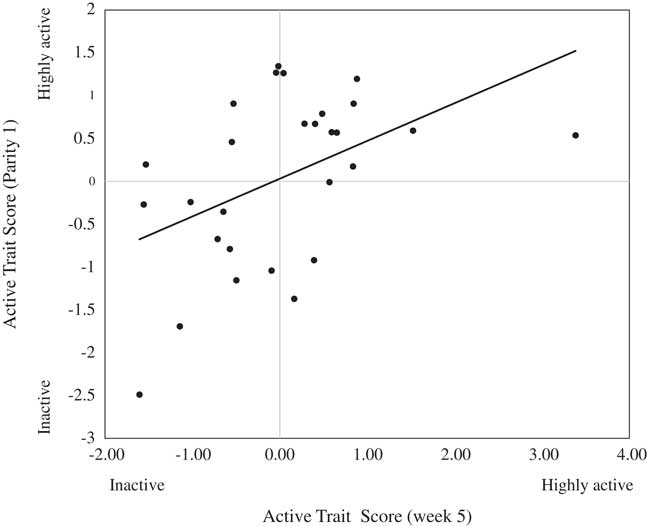
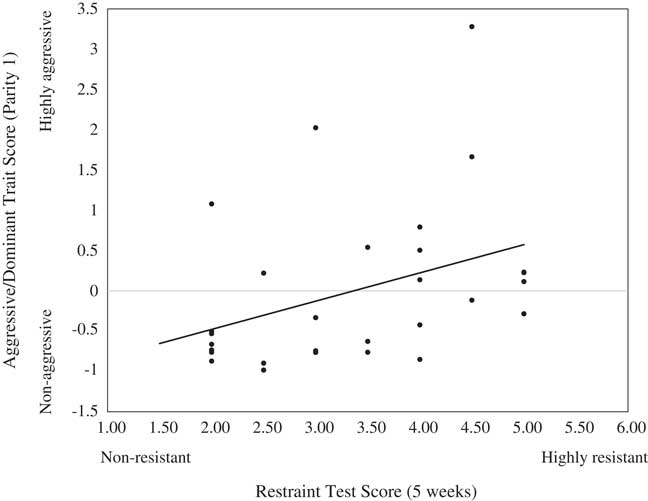
Linear regression analysis indicated that the parity 1 active trait was significantly predicted by the active trait at 5 weeks old (Figure 1; β=0.5, R 2=0.21, F 1,26=7.1, P=0.01) and by the low of fear of humans trait at 3 months old (β=0.4, R 2=0.20, F 1,26=6.5, P=0.02). In addition, the parity 1 aggressive/dominant trait was significantly predicted by the gilts’ resistance to being held during the restraint test at 5 weeks old (Figure 2; β=0.4, R 2=0.14, F 1,27=4.5, P<0.05), as well as by the cautious trait at 5 weeks old (β=0.4, R 2=0.15, F 1,26=4.8, P<0.05) and by the sows’ response to humans handling her first litter (β=0.7, R 2=0.28, F 1,27=10.4, P<0.01). Each significant relationship (β) among these traits was positive, indicating that the higher the trait score was at a younger age, the higher the trait score would be predicted to be in an adult sow.
Significantly positive relationship between active trait at 5 weeks old and active trait as primiparous sow (Sus scrofa) (β=0.5, R 2=0.21, F 1,26=7.1, P=0.01).

Significantly positive relationship between resistance during restraint test at 5 weeks old and aggressive/dominant trait as primiparous sow (Sus scrofa) (β=0.4, R 2=0.14, F 1,27=4.5, P<0.05).

Discussion
This longitudinal study followed a cohort of 36 genetically similar commercial primiparous sows from birth to first parity in order to identify discrete personality traits over time. Based on the behaviors observed in various stress-inducing contexts, six personality traits (active, aggressive/dominant, cautious, low fear of humans, non-exploratory and submissive) were determined. We previously reported three personality traits (aggressive/dominant, avoidant of humans and active/exploratory) among a cohort of 46 sows of nearly identical genetics at our research facility (Horback and Parsons, Reference Horback and Parsons2016). Results from both studies indicate that personality traits in commercial sows may be contingent on an animal’s response to challenges from the environment, humans and conspecifics; a similar conclusion to Forkman et al.’s (Reference Forkman, Furuhang and Jensen1995) report that variation in behavior among piglets <10 weeks old can be explained by differences in aggression, exploration and sociability.
Response to challenges from the environment
Animals were placed in open field tests at 5 weeks old in order to determine behavioral response to social isolation and examine the differences in exploration of a novel environment. Three traits were determined based on most relevant behaviors observed: active, cautious and non-exploratory. Although an active trait was determined from data collected at each age point, only the active trait scores between 5 weeks old and parity 1 data were significantly correlated, indicating a moderate level of individual consistency for this trait. The active trait scores at 3 months old were not correlated to active trait scores from the other age points. It can be argued that the general activity level (walking versus motionless state) of a gilt in an unfamiliar arena may be influenced by human presence. It has been suggested that the lack of correlation among behavioral tests in animal personality research may due to the different dimensions of a single trait, as well as the influence of a social context when evaluating behavioral response (Webster and Ward, Reference Webster and Ward2011).
Response to challenges from humans
The domestication of swine is the result of selective breeding for production traits (e.g. weight gain) as well as for behavioral traits, like a reduction in the fear of humans to increase ease of handling (Price, Reference Price2002). In the swine personality literature, many researchers have used restraint tests to classify piglets as ‘high-resistant/proactive copers’ or ‘low-resistant/reactive copers’ (Erhard et al., Reference Erhard, Mendl and Christiansen1999; Ruis et al., Reference Ruis, te Brake, van de Burgwal, de Jong, Blokhuis and Koolhaas2000; van Erp-van der Kooij et al., Reference van Erp-van der Kooij, Kuijpers, Schrama, Ekkel and Tielen2000; Bolhuis et al., Reference Bolhuis, Parmentier, Schouten, Schrama and Wiegant2003). Researchers use this categorization to determine significant relationships between reactivity during restraint test to ‘boldness’ and ‘aggression’ levels. For example, van Erp-van der Kooij et al. (Reference van Erp-van der Kooij, Kuijpers, Schrama, Ekkel and Tielen2000) reported that piglets which resisted handling at ages 3 to 17 days were observed to have a shorter latency to approach a human at 5 to 7 weeks of age, and Erhard et al. (Reference Erhard, Mendl and Christiansen1999) reported that 3 week old piglets which did not become immobile in the tonic immobility test emerged from a start box to an open field more quickly than piglets which did become immobile (e.g. not resist handling). In the present study, gilts which strongly resisted human handling at 5 weeks of age were not quicker to approach a human at 3 months old, and in fact took significantly longer to exit the start box during the open field tests (Supplementary Material Table S3). With that said, a gilt’s resistance to being held at 5 weeks old predicted the level of aggression toward conspecifics a gilt would perform as a sow in group housing. This relationship between resistance to restraint and aggressiveness has been support by multiple studies of swine personality and coping styles among piglets (Ruis et al., Reference Ruis, te Brake, van de Burgwal, de Jong, Blokhuis and Koolhaas2000; Melotti et al., Reference Melotti, Oostindjer, Bolhuis, Held and Mendl2011).
Research has shown that the attitudes and behavior of a swine stockperson can influence the behavior, health and welfare of the animals under their care (Hemsworth and Barnett, Reference Hemsworth and Barnett1991). It is because of this relationship that human approach tests and stockperson-directed behavior are examined in swine personality research. Contrary to Marchant-Forde’s (Reference Marchant-Forde2002) finding that sows which were bolder in human approach tests were also more aggressive toward a human during the litter restraint test, we did not find a significant relationship between the low fear of humans and aggressive traits.
In another longitudinal study, Scheffler et al. (Reference Scheffler, Stamer, Traulsen and Krieter2016) reported that gilts which quickly approached a human during the approach tests at 12 to 19 days old engaged in more fights and initiated more fights during group mixing at 22 weeks old. In the present study, the latency to approach human at 3 months old did not correlated to the number of fights engaged in at 1 year old, however, the duration of time that the gilt spent in proximity to the human during the test was positively correlated to the number of fights won during pen mixing. In addition, we report that a stockperson-directed aggressive behavior during lactation significantly predicted the aggressive/dominant trait. In their study of the heritability of aggression and maternal behavior in Yorkshire-Landrace sows, Løvendahl et al. (Reference Løvendahl, Damgaard, Nielsen, Thodberg, Su and Rydhmer2005) reported that less aggressive sows are also more responsive to piglets’ screams as mothers. These results suggests that certain sows may hold the key to an ideal temperament: low aggression toward humans at farrowing, low aggression toward others in group pens and high alertness for piglet welfare.
Response to challenges from conspecifics
A consistent report in swine personality literature is that individuals vary in their initiation of aggressive behaviors toward conspecifics. Similar to our previous finding, the variation in social behaviors performed during pen mixing was explained by two traits: aggressive/dominant and submissive. As previously stated, the aggressive/dominant trait was significantly predicted by the gilts’ response to being handled at 5 weeks old and behavior toward a stockperson handling their piglets; relationships which have been previously reported in studies of swine personality or coping styles (Marchant-Forde, Reference Marchant-Forde2002). The aggressive/dominant trait was also predicted by the cautious trait at 5 weeks old. According to the coping styles hypothesis, aggressive proactive individuals are quick to respond to mild, non-social challenges (e.g. approach novelty) and social challenges (e.g. attack latency) (Koolhaas et al., Reference Koolhaas1999). In contrast, we found that gilts which were slow to enter the open field and spent longer durations in the start box were determined to be more aggressive when mixed into gestation pen as primiparous sows. A possible explanation for this discrepancy could be that piglets which returned the start box multiple times were actively looking for an escape from the novel environment, as this was the location of their entrance to this unfamiliar arena.
Teat rank
An additional factor contributing to behavioral variation observed was the teat rank of the gilt. We found that gilts which suckled at anterior region received significantly higher active trait scores at 3 months old than middle teat piglets. Based on behaviors and vocalizations recorded at weaning, Mason et al. (Reference Mason, Jarvis and Lawrence2003) suggest that heavier piglets which suckle at the anterior teats may experience more nutritional deprivation at weaning, while smaller piglets which suckle at the posterior teats may experience more maternal separation stress. Therefore, the motivation to explore the open field (e.g. nutrition or comfort) could have been different among piglets at the anterior/middle regions as compared with piglets at the posterior teat region.
We also found that gilts which suckled at middle teats received significantly lower submissive trait scores as primiparous sows than the anterior and posterior teat gilt. The relationship between teat rank and social dominance has previously been reported in multiple studies, with individuals at the anterior teats being more aggressive and more dominant than piglets at the posterior teats (Hartsock et al., Reference Hartsock, Graves and Baumgardt1977; Ruis et al., Reference Ruis, te Brake, van de Burgwal, de Jong, Blokhuis and Koolhaas2000). While we did not conduct social dominance tests among the gilts at a young age, the finding in the current study is still striking given that it suggests that the teat rank of a gilt could indicate future social dominance in a group pen of gestating sows.
Behavioral traits in swine
The bulk of research on swine behavioral variation is dedicated to the idea that producers could predict future performance of breeding gilts or market hogs based on early behavioral indicators in piglets. Given that the animals of this study were of similar genetics and reared in identical housing systems, it can be suggested that an individual’s personality may be the result of developmental and genetic factors. For example, De Jonge et al. (Reference De Jonge, Bokkers, Schouten and Helmond1996) found that subordinate piglets display more severe signs of chronic stress, such as a delayed onset of puberty, a smaller daily weight gain and elevated basal cortisol levels, when piglets are reared in barren environments. This difference in general welfare between the dominant and subordinate piglets was not found among animals reared in enrichment environments (De Jonge et al., Reference De Jonge, Bokkers, Schouten and Helmond1996). Source of stress for swine may include housing conditions and flooring (Meunier-Salaun et al., Reference Meunier-Salaun, Vantrimponte, Raab and Dantzer1987), transportation (Von Borell, Reference Von Borell2001), mixing with unfamiliar conspecifics (Jensen and Yngvesson, Reference Jensen and Yngvesson1998) and routine handling procedures (Hemsworth and Barnett, Reference Hemsworth and Barnett1991). The wealth of research on domestic animal personality suggests that individual differences in the ability to cope with stress may influence their biological (i.e. illness susceptibility, weight gain) and psychological (i.e. fear, anxiety) welfare (Koolhaas and Van Reenen, Reference Koolhaas and Van Reenen2016), as well as influence the occurrence of stereotypic behaviors (Geverink et al., Reference Geverink, Schouten, Gort and Wiegant2003) and subsequent meat quality (Geverink et al., Reference Geverink, Kappers, van de Burgwal, Lambooij, Blokhuis and Wiegant1998; Terlouw and Rybarczyk, Reference Terlouw and Rybarczyk2008). The results of this study suggest that early behavioral traits of prepuberal gilts can help in the identification of individual sows better suited to cope with the social complexities of group housing. Working in concert with efforts to better the animal’s environment through enrichment and better management, the ability to select the right animal promises to improve the welfare of group housed gestating sows.
Conclusion
There is increasing evidence in the swine literature that individuals of the same age, weight and breed display consistently different behavioral responses to the same stimuli (i.e. during restraint, social isolation and social competition). This research, however, is often limited to evaluating consistency over short periods of time. In the current study, we report that behavioral differences observed in prepuberal gilts significantly predicted certain behavioral traits determined when the animals were in gestation pens, over 1 year later. These results suggest that early behavioral responses of prepuberal gilts during elevated environmental or social stress may predict future behavioral response to such stressors as gestating sows.
Acknowledgments
The authors would like to that the staff and students of the University of Pennsylvania’s Swine Teaching and Research Center for assistance in data collection. This work was supported by the Pig Improvement Company, Pennsylvania Pork Producer Council, Pennsylvania Soybean Growers Board and the American Humane Association.
Declaration of interest
None.
Ethics statement
The care and use of all animals in this study was approved by the University of Pennsylvania’s Institutional Animal Care and Use Committee.
Software and data repository resources
None.
Supplementary material
To view supplementary material for this article, please visit https://doi.org/10.1017/S1751731118000149