Since 2009, the NHSN laboratory-identified (LabID) event-reporting for Clostridioides difficile infections (CDI) has eliminated the use of chart review for clinical symptom onset in favor laboratory surveillance, which is now mandated by payors in the United States.Reference Durkin, Baker and Dicks1,Reference Gase, Haley, Xiong, Van Antwerpen and Stricof2 The NHSN defines a healthcare-facility–onset CDI (HO-CDI) LabID event as one collected >3 days after admission (ie, on or after day 4).3 Although these definitions appear similar, in practice, this results in including cases with testing performed 49–72 hours from admission when either admission or test collection occurs near midnight. We compared HO-CDI incidence using the current NHSN >3 calendar day versus ≥72 hours since admission definitions. We also performed a review of cases with discrepant classifications as HO-CDI to estimate the likelihood that HO-CDI as defined by current LabID surveillance was incubating on admission.
Methods
A retrospective cohort study was conducted at 2 academic medical centers, Medical University of South Carolina (MUSC), a 700-bed facility, and the Ralph H. Johnson Veterans’ Affairs Medical Center (VA), a 152-bed hospital. Both use stand-alone PCR testing for laboratory diagnosis of CDI. We included all LabID cases classified as HO-CDI by the current NHSN definition from June 2011 through September 2019 for the VA and from June 2013 through September 2019 for MUSC. Time of admission and time of CDI specimen collection were available from electronic health records for all cases. HO-CDI incidence rates were calculated using the current NHSN definition and were compared to HO-CDI defined as any positive CDI lab specimen collected ≥72 hours from admission.3 We expressed the HO-CDI incidence rates per 10,000 patient days and corresponding 95% confidence intervals for each rate using normal approximation methods; rates of HO-CDI as defined by the 2 definitions were compared using a χ2 test to evaluate the null hypothesis that the incidence rate ratio for the 2 definitions is 1. Data were analyzed using R version 3.4.4 software (R Foundation for Statistical Computing, Vienna, Austria) with the dplyr 0.7.4 package. Statistical significance was assessed at 5% type I error rate. For a subset of cases with discrepant classifications, we performed chart review to assess the descriptive demographic and clinical features for these patients at admission.
Results
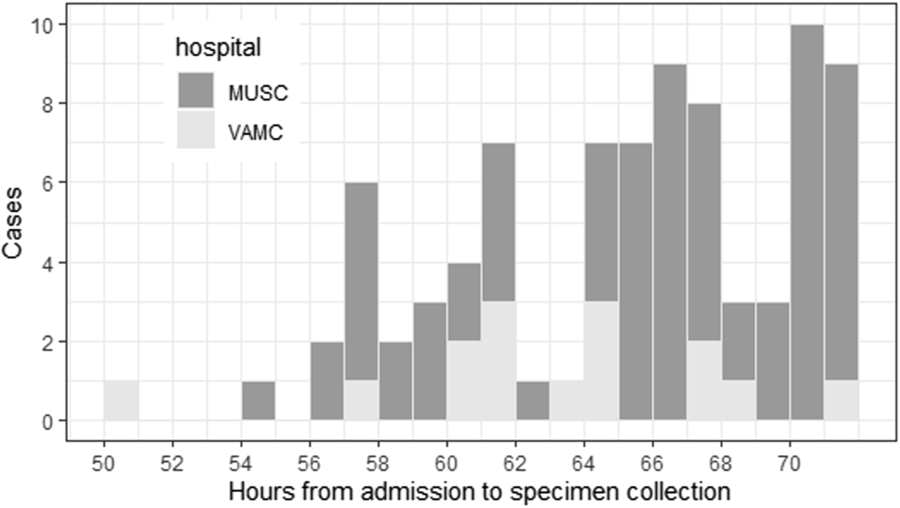
Using the NHSN >3 calendar day definition, 1,013 HO-CDI cases were included (897 at MUSC and 116 at the VA) over 1,336,916 patient days (1,180,132 at MUSC and 156,784 at the VA). Overall, 69 cases (7.7%) at MUSC and 15 cases (13%) at the VA were collected 48–72 hours from admission. Most discrepant cases were collected within 60–72 hours of admission (Fig. 1). The rates of HO-CDI were 7.58 and 6.94 per 10,000 patient days using the NHSN and the revised definitions, respectively. The incidence rate ratio was 1.09 (95% CI, 1.00–1.19; P = .0566).
Frequency of elapsed time interval from admission to collection time for NHSN laboratory-identified, healthcare-facility–onset, Clostridioides difficile infection (HO-CDI) among 84 patients with <72 hours elapsed from admission (VA and MUSC hospitals).

In the analysis of 50 patients with discrepant classifications, location immediately prior to hospitalization was home for 66% and a healthcare facility for 30%. The remaining 4% originated outside the emergency departments. In the 90 days prior to admission, 62% of these patients had received antibiotics, including cephalosporins (42%), fluoroquinolones (14%), and other classes (46%). Also, 26 patients (52%) had previous hospitalizations at MUSC or the VA within the 90 days prior to the current admission. In addition, 19 patients (38%) had diarrhea on admission; 15 (30%) had laxatives prescribed on admission, and of these 15, 5 (33%) had received laxatives 24–72 hours prior to CDI testing.
Discussion
The incubation period for CDI is not precisely known, but prospective studies suggest that most patients develop either colonization with C. difficile versus CDI within 3 days of the first excretion of C. difficile.Reference Samore, DeGirolami, Tlucko, Lichtenberg, Melvin and Karchmer4,Reference Shim, Johnson, Samore, Bliss and Gerding5 The current NHSN definition requires risk adjustment for laboratory assays of varying sensitivity, but we have identified that insufficient granularity of time-since-admission data gives rise to misclassification of CDI that is present on admission as HO-CDI.Reference Marra, Edmond, Ford, Herwaldt, Algwizani and Diekema6 Although the current surveillance for HO-CDI removes subjective determinations about causality on the part of reviewers, the current definition may consistently overestimate HO-CDI rates because it is highly unlikely, based on known biology and excretion dynamics of C. difficile, that any patient first testing positive for CDI 49–71 hours from admission acquired the organism from the facility performing that testing.
Our study has some limitations. We were only able to include 2 facilities, and our point estimate was not able to exclude the null hypothesis that the 2 definitions result in similar rates. Given that our point estimate showed a >9% difference in rates for which US hospitals are currently assessed financial penalties, however, we consider this difference highly clinically significant and worthy of additional study in other settings.
Given the widespread implementation of electronic health records that make time of admission and CDI testing widely available, an onset definition that incorporates time would likely be more accurate not only for the index facility but also for referring facilities whose HO-CDI rates will not reflect the true incidence of facility CDI transmission. The flow of patients from nursing homes to hospitals and from community hospitals to tertiary-care facilities may inflate the HO-CDI rates for each because of these misclassifications. Our chart review of patients discrepantly classified as HO-CDI by the 2 definitions may support this hypothesis: 34% patients originated from other facilities, not the community, and 62% had received antibiotics that put them at risk for CDI well prior to admission. Our results suggest that HO-CDI LabID events defined as diarrheal stool specimens testing positive for CDI when collected >72 hours after a patient’s admission would more accurately reflect the contribution of hospitals to CDI transmission compared to the current definition.
Acknowledgments
None.
Financial support
S.R.C. received grant support from the National Institute of Allergy and Infectious Diseases Mentored Patient Oriented Research Career Development Award (grant no. K23AI25607).
Conflicts of interest
C.D.S. reports that she has received royalties from Oxford Press and Wolters Kluwer for educational textbook editing. S.R.C. has received research support from Cepheid and consulting fees from Ferring Pharmaceuticals. All other authors report no conflicts of interest relevant to this article.