Introduction and background
Martin McGuinness, Sinn Féin's deputy First Minister in the power-sharing Executive in Northern Ireland, recently argued that Ireland is affected by three great evils: sectarianism, racism and partitionism. While the issue of partitionism is central to Sinn Féin's political ideology, it is racism in Northern Ireland which has from 2003/04 attracted censorious media attention both locally and internationally. At that time there were vicious attacks against the Chinese community living in Belfast, the largest settled minority ethnic group. This earned Northern Ireland the unenviable title of ‘race hate capital of Europe’, a place which had no appeal for migrants during the years of political turmoil but now appears unable to cope with multiculturalism, a situation reminiscent of Britain in the 1950s (Chrisafis, Reference Chrisafis2004: 1). Police investigating these racist attacks linked them to two paramilitary groups: the Ulster Defence Association (UDA) and the Ulster Volunteer Force (UVF).
The absence of far-right politics in Northern Ireland offered a mistaken perception that migrants could expect a tolerant and welcoming society. Such was the conviction that racism did not present as a problem, that the legislative framework equivalent to the 1976 Race Relations Act in Britain was not introduced into Northern Ireland until the Race Relations (Northern Ireland) Order 1997, over 20 years later. Rolston (Reference Rolston2004), however, claims that loyalists have had a long-standing, on-off relationship with facist groups in Britain for over three decades, and predicted the rise in racism in Northern Ireland. He argued
it would be wrong to believe that there were parts of Northern Ireland that are not and never could be guilty of racism . . . to paraphrase Brecht, racism is a bitch in heat at the moment [in 2004] and there's no telling how large the litter will be. (Rolston, Reference Rolston2004: 6)
In a society characterised by sectarianism, accompanying violence and mistrust of ‘the other’, racism became a ‘natural’ part of the whole ambit of hate crime to which Northern Ireland is well-accustomed. Overt racism reared its ugly head once again in April 2009, when Northern Ireland and Polish football fans clashed in Belfast before a World Cup qualifying match. The incident spilled over into racist attacks against Polish residents, and some 50 people fled the staunchly loyalist Village area of south Belfast.
In an unrelated incident soon after, one hundred Roma families were forced to take shelter in a church hall, evacuating their homes in the Lisburn Road area of south Belfast after they were targeted by racists. The incident made international news and underscored Northern Ireland's reputation as intolerant and a centre of race hate crime. The scale of this hate crime against the Roma community and the media coverage which it attracted with families fleeing their homes, belongings in hand, prompted high-profile Childline founder, Esther Rantzen, to say of Northern Ireland ‘they are addicted to hatred, they are addicted to violence as if it gives them some kind of exhilaration . . . You see a lot of prejudice in the rest of the UK but why turn it into violence? Maybe people miss the old days of the Troubles’ (BBC Question Time, 18 June 2009). The Anti Racism Network in Northern Ireland were angry about the attacks on the Roma families, claiming the families had been subjected to harassment for some months and had not received adequate protection. They also accused local politicians of deliberately blaming immigrants for the lack of jobs and resources caused by the global recession. The country's only minority ethnic elected representative, Alliance Party MLA, Anna Lo, argued in a debate in the Northern Ireland Assembly (Reference Lo2009) that ‘in order to eliminate racism, we must also tackle sectarianism – the twin evils of prejudice’.
It is against this background that we attempt to examine three key questions:
• What has been the Government's response in seeking to tackle increased racism?
• Using the Government's own performance criteria, how effective has their approach been so far?
• What factors influence racist attitudes among people in Northern Ireland?
We begin with an overview of previous research on racism in Northern Ireland.
The literature
The UK social policy literature, according to Craig (Reference Craig2007), has neglected the issue of ‘race’ both as political practice and academic pursuit. He finds this a striking omission because social policy as a discipline is concerned variously with citizenship rights, welfare, equality, poverty alleviation and social engineering. Craig offers evidence to illustrate that the British state is only marginally concerned with the welfare of minorities. He listed: continuing discrimination against minorities, the failure of social welfare to maintain adequate incomes, residential segregation of minorities and evidence of structural racism and discrimination in education and health services. Craig (Reference Craig2007: 620) concludes that despite a number of ‘community relations’ initiatives and race relations legislative interventions that ‘racism persists in all welfare sectors’.
The most obvious point of comparison for Northern Ireland within the wider UK literature is on the theme of community cohesion. The racial disturbances in Oldham, Burnley and Bradford in May 2001 and subsequent investigations found people living ethnically segregated lives. As a response, policy interventions were aimed at strengthening cohesion, the new framework for British government policy on race relations (Cantle, Reference Cantle2005). The subsequent work of Paul Thomas (Reference Thomas2007), who examined how community cohesion is operationalised by youth workers in Oldham, provides evidence of the intervention in practice. Although community cohesion has been criticised (Kundnani, Reference Kundnani2002) as an attack on multi-culturalism and a throw-back to assimilation policies (Back et al., Reference Back, Keith, Khan, Shukra and Solomos2002; Schuster and Solomos, Reference Schuster and Solomos2004), Thomas is positive about the potential offered by meaningful direct contact among people of different ethnic backgrounds. The interesting comparison with Northern Ireland is that ‘meaningful contact’ has been the underpinning rationale for much of the community relations work addressing religious segregation in the parallel lives of Catholics and Protestants from the 1980s onwards. Hence, a plethora of policy interventions in Northern Ireland have been about increasing interaction, integration, shared space and shared values, culminating in the policy document A Shared Future (OFMDFM, 2005a). The parallel in Great Britain was Cantle's idea of a shared vision around a common set of values which could be homogenising for the different communities. This approach has also informed policies in Northern Ireland aimed at tackling racism as evidenced by the links between the government ‘good relations’ and ‘racial equality’ strategies.
Northern Ireland, understandably, is replete with literature that analyses its protracted conflict and constitutional settlement. Such scholarship has crowded out, to some extent, the academic analysis of the insidious problem of racism. This is the starting point for a review of the literature on racism in Northern Ireland, which could broadly be categorised under four key themes: a denial of the problem, evidence of institutional racism, racism incidents and crime and, finally, suggested links between sectarianism and racism. We structure the reporting of the research under these broad headings.
Denial of the problem
Hainsworth (Reference Hainsworth and Hainsworth1998: 1) drew attention to the whole issue of racism in a collection of research, the aim of which was to counter the suggestion ‘that racism is not a problem in Northern Ireland’. He argued that one of the consequences of the conflict has been ‘the tendency to neglect, ignore or minimise ethnic minority problems, such as individual or institutional racism, as the preoccupation with traditional socio-political matters has left scant room for other agendas’ (Hainsworth, Reference Hainsworth and Hainsworth1998: 3). In the same collection, McVeigh also contended that there was an overt denial that racism existed in Northern Ireland because there were no black people, yet argued that minority ethnic people experienced systematic racism: ‘it is not the absence of racism but rather the relative absence of discussion of racism which makes Ireland different from most European countries’ (Reference Hainsworth and Hainsworth1998: 14). McVeigh goes on to suggest that, because sectarianism pervades Northern Ireland, it also structures the way in which racism is reproduced and experienced. He concluded:
when we look at the ways in which social relations between the minority and majority ethnic communities in Northern Ireland have become racialised, it becomes clear that racism is structured by sectarianism as a dominating feature. . . In other words, racism in Northern Ireland has a certain specificity. (McVeigh, Reference McVeigh and Hainsworth1998: 31)
Evidence of institutional racism
Mann-Kler (Reference Mann-Kler1997) conducted action research using 39 focus groups to capture the experiences of minority ethnic groups using public services in Northern Ireland such as health, social services, social security, education and training, housing and policing, and found widespread evidence of institutional racism. Findings included: minority ethnic groups had little knowledge of preventative healthcare services, due to a lack of accessible information; racial harassment of some families had been severe; and many women felt that the police did not take racial attacks seriously. Mann-Kler contended that it has only been since the ceasefires in 1994 that attention to racism began to emerge on the wider public agenda. Connolly (Reference Connolly2002), in an overview of available research evidence on race and racism in Northern Ireland, found that although there is significant diversity within the minority ethnic population, and hence differing needs, there were several common problems that they faced. These problems included: difficulties accessing existing services by those who speak little or no English, general lack of knowledge and/or awareness of particular services offered, the need for more staff training by service providers in relation to issues of ‘race’, the failure to meet the basic cultural needs of minority ethnic people and significant levels of racism and racist harassment experienced by minority ethnic people in Northern Ireland (see also Bell et al.'s research, Reference Bell, Jarman and Lefebvre2004, on the social problems and personal needs of people moving to Northern Ireland to take up employment).
Racism incidents/crimes
Jarman and Monaghan (Reference Jarman and Monaghan2003) reported on the scale and nature of racial harassment based on an analysis of racist incidents recorded by the police between 1996 and 2001. They noted that, although the number of recorded incidents was relatively small, Northern Ireland had a high ratio of racist incidents for the size of the minority ethnic population compared with England and Wales during this period. Precise comparison between Northern Ireland and Great Britain is difficult to make. Home Office police-recorded crime statistics for England and Wales in 2008/09 show a total of 34,231 incidents involving racially/religiously aggravated crime disaggregated by: inflicting grievous body harm (GBH), less serious wounding, harassment/public, assault without injury, actual bodily harm (ABH) or other injury (Home Office, 2009). During 2008/09, Northern Ireland recorded 1,788 sectarian and racist crimes in 2008/09 (PSNI statistics). Taking into account population size, England and Wales had 0.63 and Northern Ireland 1.00 hate crimes per 1,000 population, respectively. The Republic of Ireland does not record hate crime; figures are subsumed under wider categories such as assaults, harassment and related offences. The most numerous forms of racist harassment in Northern Ireland were abuse and attacks on property, but about one-quarter of the incidents involved a form of physical assault. Almost half the incidents occurred in Belfast, most of which were recorded in Protestant working-class areas.
Empirical findings from a detailed study of the incidence of racial crime in the London Borough of Newham indicated significantly higher rates where there was a large white majority and smaller groups of other ethnicities (Brimicombe et al., Reference Brimicombe, Ralphs, Sampson and Yuen Tsui2001). Given the higher per capita influx of migrant workers to Northern Ireland than other parts of the UK (discussed later), the ethnic mix could well be important in understanding the level of racism in loyalist areas. Jarman (Reference Jarman2003) also examined the relationship between racist harassment and children and young people by considering evidence from police records of cases of such abuse and associated violence. He found that young people are more likely to be subjected to physical assault as part of any harassment, but, equally, young people were also significant perpetrators of racism and racist harassment. Jarman concluded ‘the stereotypical perpetrator of racist harassment in Northern Ireland is a young white male over the age of 16 acting in consort with other young white males’ (Reference Jarman2003: 138). An interesting comparison here is with a Home Office study which looked at the perpetrators of racial harassment and violence in two London boroughs and found that: young children, youths, adults and older people, including pensioners (male and female in all groups) were involved. Their views towards minority ethnic groups were shared by the wider communities to which they belonged. Perpetrators saw this as legitimising their actions (Sibbitt, Reference Sibbitt1997). Ray et al.'s study (Reference Ray, Smith and Wastell2004: 364) on the perpetrators of racist violence in Greater Manchester also found that when ‘inherited meanings of territory and neighbourhood become factured and uncertain’, there is an unacknowledged shame which can be transformed into rage against minority ethnic communities. In this case English communities had once shared experience of the manufacturing industry; territoriality in Northern Ireland is quite different and relates to single-identity communities now seen by perpetrators of racial violence as under threat from ‘outsiders’ (ethnic minorities).
The link between sectarianism and racism
It was Brewer (Reference Brewer1992) who first juxtaposed sectarianism and racism. He began by offering a definition of sectarianism and compared it to the concept of racism. He argued that there were points of convergence but also differences. Racism and sectarianism converge in the sense that both involve ‘social stratification, producing inequality in a structured manner rather than randomly’ and there are similarities in the way in which they are experienced ‘at the level of ideas, individual action and social structure’. The key difference is that ‘race’ is a much more visible and deterministic marker than ‘sect’ and overlaps more completely with other important social boundaries such as class’ – sect is more ambiguous, a sub-type of ethnic stratification, whereas religion is one source of ethnic differentiation. As a result, Brewer contended that ‘sect’ has better explanatory power ‘to account for patterns of stratification and life chances that occur under its name’ (Brewer, Reference Brewer1992: 353).
McVeigh and Rolston argue that sectarianism is a form of racism rooted in the process of British imperialism in Ireland, and sectarianism can be directly attributed to ‘the nature of the state rather than the politics it contains’ (Reference McVeigh and Rolston2007: 7). Sectarianism, they contend, prevailed during the Stormont era of Unionist majority rule (1920–72), continued during direct rule by the British Government, is still evident in the post-Good Friday Northern Ireland and is inadequately addressed through a ‘good relations’ model which seeks to conjoin racism and sectarianism. The Good Friday Agreement, they claim, ‘helped create the context in which new levels of racism were to flourish’. A peaceful Northern Ireland and, in turn, economic growth attracted migrant workers who located in less crowded loyalist working-class areas, so ‘post-Good Friday Agreement, new communities of colour found themselves situated in the midst of this volatile situation and became key targets for loyalist rage’ and, as a result, racism became a ‘close ally of sectarianism’ (McVeigh and Rolston, Reference McVeigh and Rolston2007: 12). The researchers argue that explanations for the rise in racism have included ‘the facile logic that there is a finite amount of hate in Northern Ireland and now, given the dying throes of sectarianism in the wake of the Good Friday Agreement, racism has increased’. They challenge what they see as the errors in this assumption:
For a start, people are perfectly capable of being both sectarian and racist. Moreover, as the concentration of racist attacks in loyalist areas reveals, being sectarian is an advantage in being racist. But the state's approach to racism fails to name the problem, avoiding the obvious and problematic correlation between loyalism and racism to focus on the problem being that of two generic camps: ‘them’ and ‘us’. (McVeigh and Rolston, Reference McVeigh and Rolston2007: 13)
The link between sectarianism and racism is also recognised at the European level. For example, the European Union adopted two directives (2000/43/EC and 2000/78/EC) prohibiting direct and indirect discrimination on grounds of racial or ethnic origin, religion or belief, disability, age and sexual orientation. The Commission has since then set out an overarching strategy for the positive and active promotion of non-discrimination and equal opportunities for all. In the context of Northern Ireland the link between sectarianism and racism and the policy instruments used to address both is made clear by government when it stated that the
Policy and Strategic Framework for Good Relations aims to eliminate both racism and sectarianism . . . the policies and mechanisms being put in place to implement good relations are not just about the scourge of sectarianism. They apply equally to tackling racism and promoting good race relations. (OFMDFM, 2005b: 10)
This joint approach is justified by government on the basis that the common goal is to create a shared society defined by a culture of tolerance, whether on racial or religious grounds, characterised by equity, respect for diversity and recognition of mutual interdependence. Hence, there are common policy instruments to tackle racism and sectarianism: legal protection, policies and practices aimed at mainstreaming the fight against racism and sectarianism, acting in partnership with civil society to tackle the underlying causes and education and awareness raising to encourage human rights education in the school curriculum and higher education institutions.
There are two things which come out of this review of the literature. First, is the problem, as McVeigh and Rolston contend, of ‘an obvious and problematic correlation between loyalism and racism’? They produce no empirical evidence of this. Second, existing research appears to focus on institutional racism and a gap exists in our understanding as to what motivates or influences people in their racist attitudes and behaviour to earn Northern Ireland this media sobriquet, the ‘race hate capital of Europe’.
Connolly and Khaoury (Reference Connolly, Khaoury, Coulter and Murray2008: 207–8) confirm that much of the research to date has concentrated on institutional racism in Northern Ireland, and, while they acknowledge that this has been important in drawing attention to the structural and routine nature of racial discrimination, there has been too much emphasis on this as a way of conceptualising the problem. They suggest the need ‘to begin naming and interrogating whiteness . . . to address racism at its source’ and highlight different approaches taken by nationalist and unionist politicians, leaders of loyalism and republicanism in their responses to race issues in Northern Ireland, calling for research in this area. A recent example is where a Democratic Unionist Party Member of the Legislative Assembly in a debate in the Northern Ireland Assembly, demanded local jobs for local people:
We must face reality. As a result of the recession, a number of migrant workers have returned to their own countries. A practical and sensitive approach must be taken to calls for jobs to be retained for our own local workers. Although we are aware of the immense contribution that migrant workers make, nevertheless, in the middle of a recession and in the face of increased unemployment, we must get our priorities right in securing employment for our local people. (Buchanan, Reference Buchanan2009: 35)
The comparative example here is the debate in Great Britain that racialised tensions are fuelled by competition for scarce resources. Dench et al. (Reference Dench, Havron and Young2006) examined the hostility directed towards Bangladeshis by white East Enders in London. Initially, tensions emerged over competition for work. While this remains an issue, increasingly it has been replaced by competition between the communities over access to welfare support and public services, including education and housing. Dench et al. explain this as follows: ‘the state reception of new comers has ridden over the existing local community's assumptions about their ownership of public resources’ which ‘precipitated a loss of confidence in the fairness of British social democracy’ (Reference Dench, Havron and Young2006: 229). Hence, minority ethnic groups compete for opportunities and social welfare on equal terms with white Britons without ‘appearing to have earned their rights’ to do so. In other words, a stable democracy demands a ‘fair balance between what citizens put into society and what they get out of it’ (Dench et al., Reference Dench, Havron and Young2006: 224). The researchers contend that middle-class liberals have ‘promoted a swathe of political measures and institutions which consolidate the rights of minorities while multiplying the sanctions against indigenous whites who object to this’ (Dench et al., Reference Dench, Havron and Young2006: 6). In short, the increased emphasis on people's rights has been at the expense of their responsibilities.
Although Dench et al.'s work has been criticised by Moore (Reference Moore2008: 350) as ‘lacking in intellectual coherence’ and being conceptually confusing, issues raised in their work resonate in the Northern Ireland context. For example, there is a protracted debate about the introduction of a Bill of Rights in Northern Ireland, which grapples with tensions between rights and responsibilities. Specifically, there are recommendations to strengthen the right to equality and prohibition of discrimination for national minorities, supplementary to the Human Rights Act 1998 and the European Convention on Human Rights (Northern Ireland Human Rights Commission, 2008: 33). Against this backdrop, Northern Ireland politicians claiming protection for local jobs can be accused of racism or xenophobia. These comments have been prompted by the economic downturn. Until recently it was recognised that migrant workers filled skills gaps in specific sectors of the Northern Ireland economy (health, food processing, construction, hospitality and retail). Have attitudes to migrant workers changed as threats to ‘local’ jobs increase? Can the rise in racist incidents and crimes be explained (in part) by competition for jobs?
Before addressing the substantive issues raised by existing research, we consider the size of the minority ethnic community in Northern Ireland, what the Government's existing policies are to tackle racism and how they have performed to date.
The policy context
The minor ethnic population
The 2001 Northern Ireland Census quantified the size of the settled minority ethnic communities as 14,279, or 0.8 per cent of the total population (1.68 million at that time). This figure comprised: Chinese as the largest minority ethnic group (4,100), South Asians (2,500), Irish Travellers (1,700) and African Caribbeans (1,100) (Northern Ireland Statistics and Research Agency, 2005). The census statistics are now dated, and some researchers estimate that the current figure could be as high as 45,000 (Gallagher, Reference Gallagher2007). Transient populations are more difficult to estimate. The number of people who came to live in Northern Ireland was approximately: 25,000 in 2005, 31,000 in 2006, 32,000 in 2007 and 27,000 in 2008, around 5 per cent of the Northern Ireland workforce (Northern Ireland Statistics and Research Agency, 2009). This represents a marked increase in international inflows and is related to the enlargement of the European Union in May 2004, when people from countries in Central and Eastern Europe (the so-called A8 countries) were allowed to come and work in the United Kingdom and Ireland.
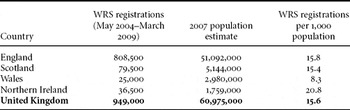
One measure of the influx of migrant workers is the Worker Registration Scheme (WRS) managed by the UK Border Agency on behalf of the Home Office. The scheme is used to register migrant workers from the A8 countries. Border Agency statistics show between 1 May 2004 and 31 March 2009, a total of 949,000 people registered with the WRS in the United Kingdom. Of these, 36,500 (or 4 per cent of the UK total) registered to work in Northern Ireland. In contrast, the Northern Ireland population makes up around 3 per cent of the UK population, thus indicating the scale of A8 migration to Northern Ireland. Table 1 shows that between May 2004 and March 2009, Northern Ireland had about one-third more migrant workers registering on a per capita basis than the rest of the United Kingdom, with about 21 WRS registrations for every 1,000 persons in Northern Ireland compared to nearly 16 WRS registrations for every 1,000 persons in the UK as a whole (Northern Ireland Statistics and Research Agency, 2009: 10). Overall, the statistics indicate an increasing number of settled minority ethnic communities in Northern Ireland and a relatively large influx of migrant workers from 2004 onwards.
WRS registrations per 1,000 population (May 2004–March 2009)

Source: Northern Ireland Statistics and Research Agency (2009).
Government policy
In July 2005, the (direct rule) Government launched its policy document A Racial Equality Strategy for Northern Ireland 2005–10, which aimed: to tackle racial inequalities in Northern Ireland and to open up opportunity for all, to eradicate racism and hate crime and, together with A Shared Future, to initiate actions to promote good race relations (OFMDFM, 2005b: 5; Hughes, Reference Hughes2008). The strategy defined racism to include: racist ideologies, prejudiced attitudes, discriminatory behaviour, structural arrangements and institutionalised practices resulting in racial inequality. The race strategy was underpinned by, and intended to complement, the existing and developing legislative framework including the Race Relations (Northern Ireland) Order 1997 and statutory duties set out in Section 75 of the Northern Ireland Act 1998. The Race Relations (Northern Ireland) Order 1997 made it unlawful to discriminate, either directly or indirectly, on racial grounds in the areas of: employment and training; education; the provision of goods, facilities or services; and the disposal and management of premises and advertisements. The Northern Ireland Act 1998 (section 75) requires departments and other public authorities in carrying out their functions to have ‘due regard to the need to promote equality of opportunity between persons of different racial group’. It also requires them to ‘have regard to the desirability of promoting good relations’ between persons of different racial group. There is an acknowledgement in the strategy that government cannot, by itself, eradicate racism but would play its part alongside other stakeholders in tackling this insidious problem. To achieve the aims as outlined in the Racial Equality Strategy, a follow-on implementation plan was launched in March 2006, which committed government departments and their agencies to a wide range of actions to tackle racism and racial inequalities. The Government's response to racism, according to the First Minister, was robust and well-funded. The problem has been over-hyped by the media and rested with a tiny minority of racist people (Robinson, Reference Robinson2009: 288).
Effectiveness of Racial Equality Strategy?
Does the government's defence of its record on tackling racism stand up to scrutiny? We consider how the government has performed against its own Racial Equality Strategy. The analysis is structured in the following way:
• Using baseline indicators from the Office of First Minister and deputy First Minister's Shared Future and Racial Equality Strategy Baseline Report (2007), we track trends in racism over time. In other words, if the government was reporting progress in tackling racism in Northern Ireland using its own indicators, how effective has it been?
• We consider the social distance scale, an alternative to the government's measures above, as a means of capturing racism in a one-dimensional way. This social distance measure of racism is then used to investigate McVeigh and Rolston's (Reference McVeigh and Rolston2007) assertion in the literature that sectarianism may structure how racism is produced and reproduced. The link between sectarianism and racism is therefore empirically tested.
• Finally, using the most recent Northern Ireland Life and Times Survey data (2008/09), we attempt to model the influences on people's racist attitudes. In other words, which factors are likely to impact on whether someone in Northern Ireland is racist? We do this using multi-variate binary logistic regression and arrive at a combination of factors that predict (within limits) racist attitudes in Northern Ireland.
We begin by assessing government's performance in tackling racism. The Office of the First Minister and deputy First Minister (OFMDFM) developed a number of thematic priorities to improve good relations in Northern Ireland and linked these to a set of measurable outcomes. These were part of the outworking of the Government's Shared Future and Racial Equality strategies. The first priority outcome established by OFMDFM is that: ‘Northern Ireland society is free from racism, sectarianism and prejudice’ (Office of the First Minister and deputy First Minister and Northern Ireland Statistics Agency, 2007: 8).
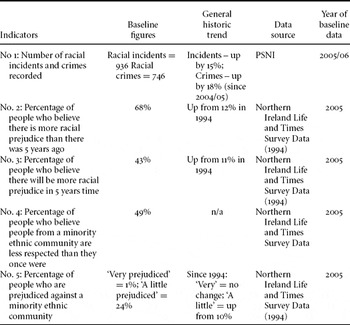
Baseline indicators were established as a way of quantitatively tracking racism trends in Northern Ireland. The specific racism indicators in the OFMDFM report are set out in Table 2. We have collated current information on each of these indicators to provide a rounded picture on the effectiveness of the government's strategy since its inception to tackle racism.
Base line indicators – racism measures

Source: Extracted from: Office of the First Minister and deputy First Minister and Northern Ireland Statistics Agency (2007) A Shared Future and Racial Equality Strategy: Good Relations Indicators Baseline Report.
Indicator 1: Number of racial incidents and crimes recorded
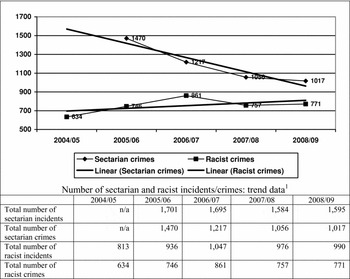
The data on racist incidents and crimes have been collected from the Police Service of Northern Ireland (PSNI) annual crime statistics beginning with baseline year 2004/05. The PSNI define a racial incident as any incident, which may or may not constitute a criminal offence, which is perceived by the victim or any other person as being motivated by prejudice or hate. In addition, we collected data on sectarian incidents and crimes over the same period to provide some basis for comparison. These data are presented in Figure 1. The data show a trend increase over the five-year period in racial incidents/crimes and corresponding decrease in sectarian incidents/crimes. In short, as sectarian crimes have decreased, racist incidents have increased.
Racism and sectarian trends
Source: Collated from PSNI annual crime statistics reports; available at: www.psni.police.uk/index/updates/updates_statistics.htm

It should, however, be noted that data on the number of racial incidents/crimes must be set within a context of an active campaign by the PSNI to encourage reporting. Minority ethnic groups claimed that they had little confidence in reporting hate crime to the police in an enquiry conducted by the Northern Ireland Affairs Committee. This resulted in a recommendation that the police work closely with other statutory agencies and victim support groups to ‘improve general confidence in the reporting system, address reasons for under-reporting and unwillingness to prosecute’ (House of Commons, Northern Ireland Affairs Committee, 2004: 49). The PSNI published a policy directive in 2006, ‘Police Response to Hate Incidents’, in which they acknowledged the reasons for under-reporting and put in place a series of measures to address this problem. The measures included: improved recording, response and investigation procedures on hate crime incidents; having specialist officers (Minority Liaison Officers) available in every police district; support for victims; partnership working with statutory and non-statutory partners to address the problem; and training for officers in the implementation of the directive. The outworking of this policy can be seen in high-profile publicity campaigns launched by the PSNI and aimed at encouraging the reporting and awareness of hate crimes and incidents under the advertising banner ‘nobody deserves it and nobody deserves to get away with it’.
The remaining indicators (nos. 2–5 in Table 2) for measuring racism are attitudinal data collected via an annual probability survey of inhabitants across Northern Ireland. The Northern Ireland Life and Times Surveys gather information through face-to-face interviews with about 1,200 adults aged 18 years or over. The samples for the annual surveys consist of a systematic random sample of addresses selected from the government's Land and Property Services Agency list of private addresses.Footnote 1
Data have therefore been extracted from the yearly surveys to provide an overview of racism in Northern Ireland as defined by OFMDFM indicators. The first two indicators we consider here relate to perceptions of racism now and in five years time.
Indicator 2: Percentage of people who believe there is more racial prejudice than there was five years ago
Indicator 3: Percentage of people who believe there will be more racial prejudice in five years time
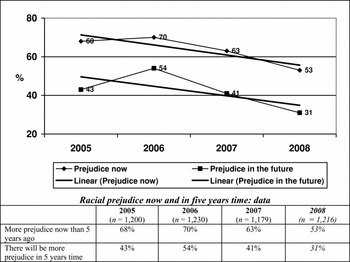
The results of these two indicators are set out in Figure 2, where the trend lines indicate a reduction in perceptions of prejudice: in other words, people believe there is less prejudice now than previously and this trend will continue into the future.
Prejudice trends

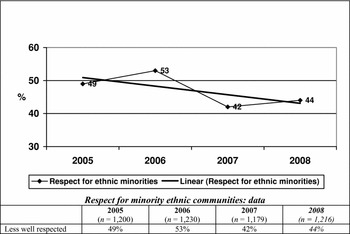
Indicator 4: Percentage of people who believe people from a minority ethnic community are less respected than they once were
The results are set out in Figure 3. The data show the percentage of people who ‘strongly agree’ and ‘agree’ that minority ethnic communities are less respected in Northern Ireland than they once were. The trend would seem to indicate a growing acceptance of, and respect for, minority ethnic groups, although it should be borne in mind that these data do not include the recent high-profile racist incidents in 2009.
Respect for ethnic minorities

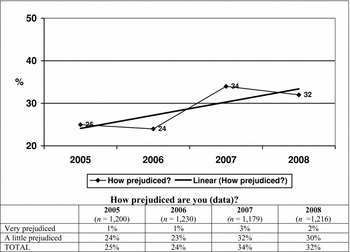
Indicator 5: Percentage of people who are prejudiced against a minority ethnic community
The results are shown in Figure 4 and indicate an increased trend in self-reported prejudice.
How prejudiced are you?

So, what do these results, using measures devised by OFMDFM, tell us about the priority theme of government that ‘Northern Ireland is free from racism and prejudice’? Is the government's Racial Equality Strategy successful, based on its own indicators of effectiveness? If the above indicators constitute a ‘shopping basket’ of composite measures devised by government to capture the extent of racism and prejudice in Northern Ireland, then we can conclude the following:
• There is an upward trend in the number of reported racist incidents/crimes and corresponding decrease in sectarian incidents/crimes officially recorded by the PSNI.
• Respondents think that there is less racial prejudice now than five years ago, and there will be less prejudice in five years time.
• The level of respect for minority ethnic communities has improved over the last four years, although the very public events of 2009 are not reflected in the data, and one suspects would significantly change people's viewpoint on this issue.
• Respondents considered themselves to be increasingly more prejudiced against minority ethnic communities over time – a result which is somewhat at odds with the finding (above) that racial prejudice at the macro level has reduced over time and into the future (but, again, the data do not reflect the events of 2009).
In summary, the Government can take little solace from the implementation of its Racial Equality Strategy. Northern Ireland has some way to go before being described as a country ‘free from racism and prejudice’ – the declared aim of the strategy.
The extent of racism
But are the Government's measures of racism, as outlined above, a true indication of the extent of racism in Northern Ireland? How valid and reliable, for example, are the data from a question which asks people directly if they would describe themselves as prejudiced (indicator 5 above)? Such a measure is more likely to underestimate the extent of racism in Northern Ireland because respondents are unwilling to admit to being prejudiced or racist, as this is a socially undesirable viewpoint. Hence, this type of questioning is flawed and does not take into account the many different kinds of racial prejudice that exist: from blatant forms, such as name-calling, to more subtle racial prejudice that includes racist banter and ‘jokes’. Furthermore, respondents themselves may have different opinions about what constitutes racism and therefore interpret the question differently.
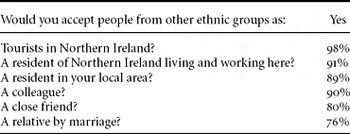
A more reliable measure of racial prejudice can be found in questions relating to social distance, although these are not without limitations and can also underestimate levels of racial prejudice. Questions relating to social distance in the Northern Ireland Life and Times Survey are based on a variant of the Bogardus (Reference Bogardus1925) social distance scale, which measures the willingness of respondents to participate in social contact with specific groups of people. The scale is a psychological test which uses a cumulative or Guttman scale to determine the degree of closeness with members of other ethnic groups. The questions posed in the 2008/09 Northern Ireland Life and Times Survey are as follows:
Would you accept people from other ethnic groups as:
◾ Tourists in Northern Ireland?
◾ A resident of Northern Ireland living and working here?
◾ A resident in your local area?
◾ A colleague?
◾ A close friend?
◾ A relative by marriage?
This type of questioning is cumulative in that if a respondent in the survey accepts or agrees with one particular item, (s)he will also accept all previous items. Hence, if a survey respondent accepts someone from another ethnic group as a relative by marriage, (s)he is also likely to accept people from minority ethnic groups as a close friend, colleague, resident in the local area and so on. The simplicity of such a scale means that we can arrive at a one-dimensional assessment of racial attitudes. Although the scale has been criticised as too simple in that the social distance between intimate relationships may be quite different than those with, for example, tourists in Northern Ireland, it is nonetheless an effective way of probing the extent or degree of racial attitudes. In other words, those respondents who would accept people from other ethnic groups as a relative by marriage exhibit no social distance and therefore no prejudice. This is therefore a one-dimensional measure that becomes useful in further analysis of racism in Northern Ireland.
If we consider the results of 2008/09 Northern Ireland Life and Times Survey on the above questions, they largely confirm the cumulative nature of the social distance approach with respondents ‘pressed’ to discover the degree of social distance they could accept (see Table 3). Respondents become less willing to accept minority ethnic groups the closer the social distance, and hence accepting someone from another ethnic group as ‘a relative by marriage’ is a more accurate measure of racism than simply asking them ‘are you prejudiced’ (indicator 5 above).
Social distance scale on prejudice (n = 1,216)

Source: Calculated from Northern Ireland Life and Times Survey data 2008/09.
Does sectarianism shape racism?
The theoretical literature suggests that racism is the new sectarianism in Northern Ireland or that sectarianism may structure how racism is produced and reproduced (McVeigh, Reference McVeigh and Hainsworth1998). The literature also suggests that racism and sectarianism are inter-related in that they both have similar roots and expression, and sectarianism may lead to less receptive attitudes towards minority ethnic people. This theoretical contention has not been tested empirically. In an effort to explore the relationship between these two variables (sectarianism and racism), the following questions from the 2008/09 Northern Ireland Life and Times Survey data set were used as proxy measures of sectarianism and racism, respectively:
(a) Measuring sectarianism:
◾ Would you mind if a close relative were to marry someone of a different religion?
According to Connolly and Keenan (Reference Connolly and Keenan2000:29), unwillingness to accept those from the other religion, be it Catholic or Protestant, as friends, colleagues or as relatives by marriage ‘could be loosely termed as sectarianism’.
(b) Measuring racism:
The variable which we use as a proxy for prejudice or racism is the social distance measure discussed above:
◾ Would you be willing to accept people from other minority ethnic groups as a relative by way of marrying a close member of your family?
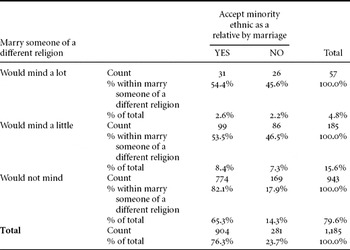
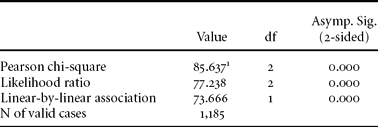
We cross-tabulate these two variables using data from the Northern Ireland Life and Times Social Attitudes 2008/09 to find if there is an association between sectarian and racist attitudes. The results are presented in Tables 4 and 5.
Sectarianism by racism (n = 1,185)

Chi-square tests
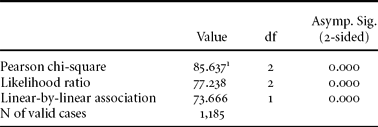
Notes: 1 0 cells (.0%) have expected count less than 5.
The minimum expected count is 13.52.
Summary result: χ2 = 85.64, p < 0.001.
Source: Calculated from Northern Ireland Life and Times Survey data 2008/09.
Considering the results in Table 4 we can see that:
• 82 per cent of those who ‘would not mind’ marrying someone from a different religion would also accept a minority ethnic relative by marriage.
• Whereas only 54 per cent of those who ‘mind a lot’ or ‘mind a little’ marrying someone from a different religion would also accept a minority ethnic relative by marriage.
The results therefore tell us that there is a significant association (see Table 5) between people's attitudes to marrying someone of a different religion and their willingness to accept a member of the minority ethnic community as a close family member. This highly significant result (χ2 = 85.64, p < 0.001) indicates that there is an association between sectarian and racist attitudes which people in Northern Ireland hold: those with sectarian views are more likely to be racist.
What influences racism?
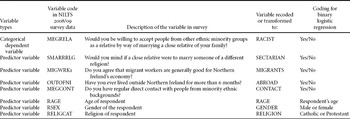
To further understand which factors influence or predict racist attitudes in Northern Ireland, we conducted a binary logistic regression. The purpose of this analysis is to assess the impact of a set of selected predictors on a dependent variable: racist attitudes. In other words, we are interested in finding out which variables predict the likelihood of people in Northern Ireland being racist. Binary logistic regression allows us to test the predictive ability of a set of variables while controlling for the effects of other predictors in the model. Using data from the 2008/09 Northern Ireland Life and Times Survey, we therefore select a categorical dichotomous variable which is a proxy measure of racism and a set of predictor variables.
The social distance variable, discussed above, in relation to whether someone would be prepared to accept a member of the minority ethnic community as a relative by marriage, appears to be a good proxy for measuring racism. We therefore use this measure as the dependent variable in the logistic regression analysis. We also list those predictor variables which we think might influence whether someone is racist. These are set out in Table 6.
Variables in the analysis

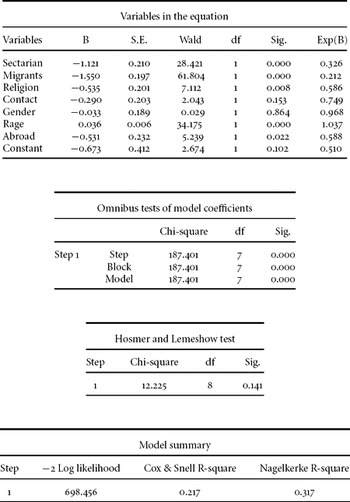
The results of the binary logistic regression analysis using the variables above are set out in Table 7. The omnibus tests of model coefficients show a highly significant value (p < 0.0005), and the Hosmer and Lemeshow test supports the conclusion that the model is a good fit (chi-square value of 12.23 and p > 0.05). In other words, the variables included in the model, when combined, are significant predictors of racism. The model summary statistics indicate that between 21.7 per cent and 31.7 per cent of the variability in the dependent variable is explained by this set of predictor variables. The Wald test shows that there are five variables which contribute significantly (p < 0.05) to the predictive ability of the model, and the negative/positive B values allows us to establish the relative importance of each predictive variable and the direction of the relationship. The results from the binary logistic regression are as follows:
• The most powerful predictor of racist attitudes is a respondent's attitude to whether ‘migrant workers are generally good for Northern Ireland's economy’. Those who hold the view that ‘migrant workers are good for the economy’ are likely to be less racist.
• A respondent's attitude to whether ‘you mind if a close relative were to marry someone of a different religion’ also predicts racism. This question is a proxy (social distance) measure of sectarianism, and hence those who hold sectarian attitudes are more likely to be racist.
• Religion of respondent – Protestants are more likely to hold racist attitudes than Catholics.
• If the respondent had lived outside Northern Ireland for more than six months – those who have only lived in Northern Ireland are more likely to have racist attitudes compared with those who have lived outside Northern Ireland for six months or more.
• Age of respondent – older people in Northern Ireland are more likely to display racist attitudes. This is not to ignore Jarman's work (Reference Jarman2003) which highlighted the role of young people in racist harassment, bearing in mind the survey respondents in the NILTS data were aged 18+ years.
Factors influencing racism in Northern Ireland

Source: Calculated from Northern Ireland Life and Times Survey data 2008.
Interestingly, those variables which were not significant in the model were: frequency of contact with minority ethnic groups, and the gender of respondents.
Conclusions
Given the upsurge in racist violence in Northern Ireland and accompanying international condemnation, this paper has attempted to do several things. First, it has evaluated the effectiveness of the Government's Racial Equality Strategy launched in 2005 using its own performance criteria. The ‘shopping basket’ of measures shows increasing racist crimes, a corresponding decrease in sectarianism and an upward trend in levels of individual prejudice. Second, we tested the assertion in the literature that sectarianism shapes the way in which racism is reproduced/experienced, and found a significant association: those with sectarian views are more likely to be racist. Finally, responding to Connolly and Khaoury's (Reference Connolly, Khaoury, Coulter and Murray2008) call to interrogate individual (as opposed to institutional) racism, we investigated factors likely to predict racist attitudes. We concluded from these analyses that the most likely indicators of racist attitudes were: views on migrants’ contribution to the Northern Ireland economy, sectarian attitudes, religion, whether respondents had lived outside of Northern Ireland and age, respectively.
What are the policy implications of these results? It is clear that the Government's Racial Equality Strategy, based on its own performance criteria, has been ineffective to date. Two things appear to be significant here. The failure of the main political parties (Democratic Unionist Party and Sinn Féin) to agree on a future policy, although one is promised (Cohesion, Sharing and Integration), has allowed government departments and agencies to evade their responsibilities in a public policy vacuum. Yet government departments and agencies can claim that without political agreement there is little imperative to address racism. In addition, there are mixed political messages. Some politicians have called for ‘local jobs for local people’ and accused minority ethnic representative groups of whipping up hysteria to attract greater funding. These remarks are insensitive, at best, during times of racial tension. Yet, others express more inclusive comments, an example of which is given by one political leader during a debate in the Northern Ireland Assembly:
Growing diversity can have a genuinely leavening effect on a society that has long been frozen into a two-traditions divide, and it has the potential to act as a powerful lever on the old attitudes to difference that have maintained that divide. Put simply, the growing richness of our diverse society in Northern Ireland has the power to help healing. (Sir Reg Empey, Minister for Employment and Learning and Ulster Unionist Leader, Reference Empey2009: 41)
This research also points to wider policy implications. The most likely predictor of racist attitudes is how people perceive the role of migrant workers in the Northern Ireland economy. The mantra ‘local jobs for local people’ merely reinforces the notion, particularly during a recession, that migrants are ‘taking’ local jobs and, in turn, contributes to racist attitudes. Because sectarianism and racism are associated there needs to be a combined approach to tackling these issues, yet responsibility is vested in a plethora of bodies and agencies such as OFMDFM, the Equality Commission, the Community Relations Council, local authorities and the now inactive Racial Equality Forum. The latter, somewhat ironically, was established to facilitate a partnership approach and joint working between government departments, statutory bodies and voluntary/community organisations. Finally, government must face up to the fact that locating migrant workers in working-class loyalist areas has merely provided an opportunity for sectarian gangs to engage in racist hate crime, a ‘transferable skill’.