Introduction
The Third Punic War is often seen as the culmination of a deep-seated and unrelenting Roman distrust of Carthage carried over from the first two Punic wars. For decades prior to the Third Punic War, according to this view, the Senate had turned a blind eye to, and even encouraged, Masinissa of Numidia as he enhanced his kingdom’s presence and power in North Africa at the expense of Rome’s constant enemy. Unable to defend itself because of the treaty which ended the Second Punic War, Carthage could only appeal to Rome for arbitration in the face of Masinissa’s depredations, but Rome inevitably enabled Masinissa’s encroachments on Carthaginian territory. After half a century of such treatment, and after paying off the final instalment of the indemnity from the Second Punic War, Carthage gathered an army to resist the latest Numidian attack. Rome seized upon this as an excuse – for it was in no way an actual causeFootnote 1 – to declare war and sent the consuls of 149 to Sicily and thence to Africa. The consuls dissimulated their intentions along the way and demanded of Carthage increasingly harsh concessions, which eventually allowed the declaration of a bellum iustum.Footnote 2
Such, in the broadest of strokes are the origins of the Third Punic War, though scholars have suggested, supported, and criticized various refinements. Le Bohec offers a brief summary of the three major theses explaining the war and some of the difficulties associated with each.Footnote 3 He dismisses two forms of the political thesis – that Rome shifted from seeking a loose dominion over protectorate states to establishing direct control or that Rome sought to prevent political dissidents from taking refuge in Carthage – as lacking.Footnote 4 The condition of Carthage’s economy in the first half of the second century was not, he suggests, sufficient to arouse such fear among the Romans that war could be declared.Footnote 5 The psychological thesis that Carthage was seen, through the memory of the Second Punic War and an ignorance or misunderstanding of Carthaginian culture, as a hereditary enemy is perhaps the most familiar but is not well supported in contemporary literature such as Plautus’ Poenulus. It has also been suggested that Rome feared that Masinissa might absorb all of Carthage’s territory and declared war to prevent the possibility of a North Africa united under a single leader.Footnote 6
Each of these theses is closely connected to the belief that Rome was consistently hostile towards Carthage, its main rival in the western Mediterranean, and anxiously sought a pretext for a third and final war. We have no less an authority for this than Polybius: ‘the Carthaginians always came off second best at Rome, not because they did not have right on their side, but because the judges were convinced that it was in their own interest to decide against them’ (Polyb. 31.21.5-6).Footnote 7 Whatever the substance of the disputes brought to the attention of the Senate by the African embassies, we read in explanations of the Third Punic War that Rome consistently supported its ally and henchman, Masinissa, against its former enemy, Carthage. In the words of Rosenstein, ‘[t]ime and again in these cases, whether judgement was passed by the legates or the senate as a whole, the patres sided with the king.’Footnote 8 It is important to note, though, that Polybius makes his comment not with reference to all of the disputes between Carthage and Numidia but with specific reference to a dispute in the early 160s. It is not immediately clear that his comment should apply to Rome’s attitude and decisions throughout the first half of the second century rather than simply to a single dispute, though it has more often than not been applied to the entirety of the first half of the second century.
I do not propose in this article to re-examine the explanations or justifications for Rome’s declaration of war nor to reassess in its entirety the rivalry between Carthage and Numidia. I also leave aside the question of whether Rome was justified in its treatment of Carthage in the Third Punic War.Footnote 9 Rather, I want to examine the diplomatic exchanges between Rome, Carthage, and Numidia in order to show that we often allow this single statement of Polybius to influence our interpretation of Rome’s attitude towards Carthage. That is, I wish to ask whether the decisions of Roman arbiters were in fact so biased against Carthage throughout the first half of the second century and whether Rome’s decisions evince a consistent desire to undermine the Punic city.
While most historians present Carthage as a consistent victim of Rome’s biased arbitration, both Walsh and Hoyos have noted that Rome’s attitude towards Carthage was relatively neutral in the first decades of the second century. The anti-Carthaginian stance, they argue, began after 167 and the end of the Third Macedonian War, despite the fact that Carthage supported Rome in that conflict.Footnote 10 This raises the question of why Rome’s attitude would have shifted at this point, especially since the Senate had rejected a series of accusations levelled by Numidia against the Carthaginians only a few years earlier in 175. We might suppose that Rome’s changed perception of the Mediterranean world after 167 sufficiently accounts for a new dynamic in its relationship with Carthage. The extent to which Rome truly changed its attitudes and policy after the Third Macedonian War, however, has been questioned. In the eastern Mediterranean, Rome took steps to assert its dominance over Pergamum and Rhodes immediately after the Third Macedonian War, but, as Gruen has argued at length, these steps do not mark the beginning of a new pattern of behaviour. Rather, an initial assertion of Roman authority was followed by a return to a Roman reluctance to act.Footnote 11 Since the Third Macedonian War did not mark the beginning of a new and consistently harsher Rome in the eastern Mediterranean, we should not assume that Rome’s relations with Carthage changed consistently for the worse either. Rome certainly reacted against Pergamum and Rhodes in the aftermath of the Third Macedonian War, but those reactions did not set a new norm.
Polybius himself may have believed that Rome’s policy towards other states in the Mediterranean continued to be moderate after the Third Macedonian War.Footnote 12 His discussion of the origins of the conflict does not survive, but Baronowski offers a reconstruction of Polybius’ analysis of the causes of the war, emphasising Polybius’ interest elsewhere in causes, pretexts, and beginnings. The pretext, misunderstood as a cause by Livy and his annalistic sources, was the Carthaginian war with Numidia in 150 over the city of Oroscopa, but the real causes lie earlier.Footnote 13 Polybius derived his explanation in part from Cato’s speech De Bello Carthaginiensi, but did not consider the orator’s rhetoric of the mortal threat to Rome posed by Carthage as genuinely reflective of senatorial attitudes. He did, however, believe that the Senate was persuaded by Cato that Carthage posed a threat to Roman power in North Africa. Events in the later 150s confirmed for the senators the dangers that Carthage posed to Roman pre-eminence and stability. Carthage was less and less submissive and more ready to engage Numidian forces in disputed territory (App. Lib. 68), rejecting Roman intervention in the conflict over Oroscopa (Plut. Cat. Mai. 26; App. Lib. 69). It delivered the final instalment of the indemnity from the Second Punic War in 151 and might therefore consider the treaty to have expired. Its conflict with Numidia continued under arms down to 150. The prospect of plunder, glory, and success, as well as territorial aggression were also factors. Some senators may have been further motivated by the prospect of acquiring land for its agricultural quality, land whose fertility and productivity was demonstrated by Cato’s display of the Libyan figs; Polybius, however, properly did not see agricultural acquisitiveness as a central motive.Footnote 14 In this case, a change in Rome’s attitude towards Carthage significant enough to cause a change in behaviour occurs only just before the war.Footnote 15
We might note, however, that, for Harris, a shift in Rome’s attitude at any time cannot fully account for the war, since the Third Punic War was one more instance of φιλαρχία, Rome’s continuing desire for new wars, which received a suitable opportunity after the expiration of the treaty with Carthage and the war between Numidia and Carthage over Oroscopa. In his view, there was little real cause for the war beyond aggressive imperialism. Moreover, fear, envy, and even hatred of Carthage were not sufficiently deep to provoke Rome’s actions, even if the Senate had firmly settled on war long before the official declaration. For, Harris suggests, it is unlikely that any of the Roman embassies even in the late 150s discovered much in the armouries of Carthage to cause a genuine fear or anxiety among the senators.Footnote 16 It is probable that many of the details leading up to the war were embellished by later authors in order to display the origins of this final war in as dramatic a fashion as possible, complementing and justifying or explaining the unusually violent finality of Rome’s double destruction of Carthage and Corinth in 146.Footnote 17 Again, though, Carthage was not a special victim of Roman aggression; all states were potential targets of Roman φιλαρχία, the real cause of the war in Harris’ model. Eckstein, however, has argued at length that, while Rome may have been imperialistic and aggressive, it was not exceptionally so in the Mediterranean of the early second century bc.Footnote 18
Nonetheless, the experience of the Second Punic War may have ensured that Carthage was viewed in the Senate as a greater threat than other states. It has certainly encouraged us to accept Polybius’ explanation of the Third Punic War. A re-examination of Rome’s responses to requests for arbitration in disputes between the two North African states will allow us to gauge the extent to which Rome allowed a hatred engendered by the Second Punic War to influence its relationship with Carthage in the first half of the second century bc. Polybius is, of course, fragmentary for this period, but Livy and Appian preserve a number of disputes between Carthage and Numidia which were brought before Roman envoys or the Senate as a whole. These allow us to see that, when the Senate offered a decision, it did so with greater consideration than Polybius suggests at 31.21.5-6. The Senate did not always offer a decision, however, and this may have caused confusion and uncertainty about Rome’s attitude towards Carthage. We will see, though, that there are cases of Rome not only not deciding against Carthage but even deciding in favour of Carthage.
Carthaginian Boundaries
In order to properly assess Rome’s responses to requests for arbitration, a few words about the division of territory at the end of the Second Punic War and the borders of Carthage and Numidia are appropriate. Masinissa’s leadership of the Numidians had been confirmed after the Second Punic War and by the treaty he became entitled to the land which had belonged to his ancestors (Polyb. 15.18.5). That Masinissa was entitled to the land of his ancestors, however, introduced an element of vagueness to the treaty: Masinissa appears to have repeatedly claimed that, since the Carthaginians had arrived as foreigners and received only the Byrsa from his ancestors, only that small territory properly belonged to Carthage; the rest of North Africa should be his (Liv. 34.62.13).Footnote 19 This interpretation, whether justified or not, ensured that the borders between the two states were constantly disputed for the next fifty years.Footnote 20
We should not, therefore, look for anything like a precisely defined modern border. Given that the disputes with which I will be concerned in the remainder of this paper hinge upon territorial claims, though, it is important to have an approximation of the general division between Numidia and Carthage in the first half of the second century bc. Although Appian identifies the ‘Phoenician Trenches’ as the boundary (App. Lib. 32, 54, 59), neither he, nor Polybius, nor Livy clarifies the precise location. Indeed, he may even be taking as fact an invention by late-annalistic sources in identifying the Phoenician Trenches as the boundary following the Second Punic War.Footnote 21 Sallust notes that, at the beginning of the Jugurthine War, the African province encompassed the Punic towns and the territory which had recently been subject to Carthage, suggesting that the boundaries of Numidia before and after the Third Punic War were similar (Iug. 19.7).Footnote 22 Strabo also notes that that part of Africa which had been subject to Carthage became a Roman province, while the remainder was given to Masinissa and his descendants following the Third Punic War, which again suggests that Masinissa did not gain any territory following the destruction of Carthage (17.3.15).Footnote 23 Pliny the Elder states that the Zaina river and the town of Thabraca became the western limit of Carthage. He adds that the province of Africa Vetus was divided from Numidia by a trench down to the town of Thaenae on the northern end of the Lesser Syrtis, near modern Sfax, according to an agreement negotiated by Scipio Aemilianus and Masinissa’s sons (HN 5.3.25).Footnote 24 A similar boundary may have existed before the Third Punic War, if FGrH 178 F2 has been correctly attributed to Eumachos of Naples, writing in the early second century bc. According to the fragment, the Carthaginians surrounded their territory with a trench, which would seem to support Appian’s comment. The fragment, though, offers no date for the digging of the trench, so that it might refer to the mythical foundation of the city rather than the immediate aftermath of the Second Punic War.Footnote 25
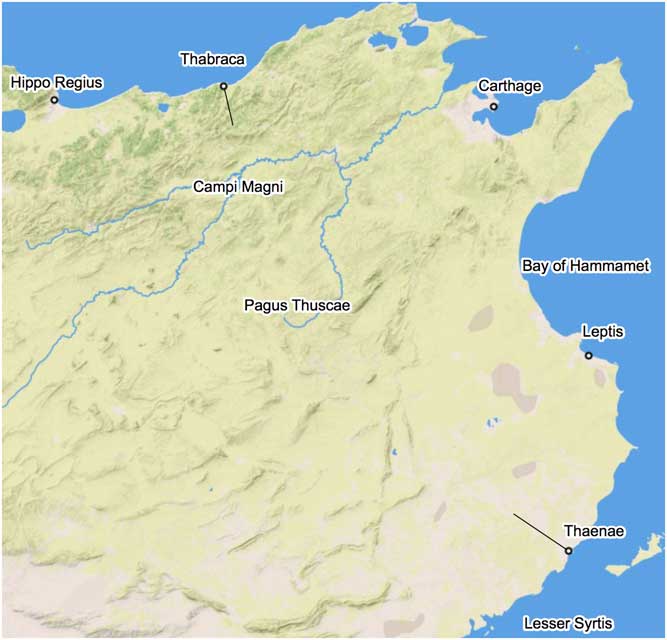
The clearest information we have about the boundaries therefore applies to the division following the Third Punic War and the creation of the Roman province. This in itself is informative, though, for Strabo and Sallust both suggest that Numidia did not gain new territory after the war and so the boundary between Carthage and Numidia should have been similar to that between the Roman province and Numidia. It is, of course, possible to object that the boundaries immediately before the war had already been changed following the infringements by MasinissaFootnote 26 or that the boundaries immediately before the Third Punic War can tell us little about the boundaries immediately after the Second Punic War. Indeed, Kahrstedt produced a map (based on Punic and Libyan names in inscriptions) which traced the receding limits of Carthaginian influence in North Africa between 218 and 150 bc. Kahrstedt himself, however, noted that his map shows only ‘die ungefähren Grenzen der Karthagischen Machtsphäre – nicht etwa des wirklich direkt beherrschten Landes.’Footnote 27 In the immediate aftermath of the Second Punic War, it is natural that Punic names would be found further from Carthage than the boundary imposed by Scipio. We should also expect those names to recede closer towards Carthage in the face of Masinissa’s efforts to unify his kingdom. That is, we should not take the successive contractions of Carthaginian influence in Kahrstedt’s map as support for the idea that Rome successively reduced the territory actually subject to Carthage. We will see below that there were few cases when Rome confirmed or accepted Masinissa’s efforts at expansion. Furthermore, the disputes between Numidia and Carthage generally focused on the same territories. The boundary immediately after the Second Punic War must have run through or close to the Campi Magni and cannot have been much further west than suggested in Figure 1, for the Campi Magni and Pagus Thuscae were disputed from beginning to end.
An approximation of the northern and eastern limits of the boundary between Carthage and Numidia between the Second and Third Punic Wars. Montgomery, Matthew. 2017. “Map Creator.” Custom Software. Tiles from mapbox.com.

If these regions were firmly in Carthaginian hands at the beginning, as a boundary further west would require, Carthage cannot have consistently come off worse in the arbitrations, since Masinissa would not then have had to repeatedly lay claim to them. A vaguely defined boundary running from Thabraca to Thaenae, on the other hand, makes sense of the disputes which arose between the Second and Third Punic Wars. A division which ran through the Campi Magni in the north, the Pagus Thuscae in the west, and the Lesser Syrtis in the south inevitably contributed to the disputes between Carthage and Numidia over the next few decades because those regions could be, and were, claimed by both parties. Such a division, practical though it may have been, was not, however, intended to sow the seeds of future disputes. The boundary was imposed for the sake of imposing a boundary, with little concern for the fact that it cut through several key regions. In the disputes which followed, Masinissa and Carthage were simply asserting their claims to the entirety of these regions. The approximation in Figure 1 shows the northern and eastern limits of Carthaginian territory before any potential changes through arbitrated disputes, running from Thabraca through the Campi Magni and the Pagus Thuscae and stretching towards the Thaenae, the Lesser Syrtis and the Emporia.
Embassies b efore the Third Macedonian War (201-171 bc)
We can now turn to the embassies and the disputes over territory. In 200 bc, immediately after the end of the Second Punic War, so Livy reports, Roman ambassadors came to Carthage, demanding that the Carthaginian senate recall Hamilcar, who was allegedly rousing the Gauls and Ligurians in northern Italy against Rome. At the same time, the envoys raised other issues related to unfulfilled terms of the treaty (Liv. 31.11.4-18, 19.1-6).Footnote 28 The same embassy was to congratulate Masinissa on recovering his ancestral territory and augmenting it with the best parts of Syphax’s territory. They were also to request Numidian cavalry for the war against Philip II. This I take to be the same embassy recorded by Appian in the 144th Olympiad, though the Greek historian reports a rather different mission for the envoys, including the impossible demand that Carthage recall Mago from northern Italy, impossible because Mago, according to Livy, had died in 203 bc (30.19.5).Footnote 29 Masinissa, according to Appian, had occupied territory apparently on the Carthaginian side of the Phoenician Trenches and Rome sent envoys to arbitrate the dispute. Appian tells us that those envoys had special, secret instructions to favour the Numidian king as much as possible. As a result, Masinissa was confirmed in his possession of the seized territory and established a fifty-year treaty with Carthage (App. Lib. 67).
Livy’s version of the embassy appears to be straightforward and relatively neutral, but Appian’s account does seem to support the idea that Rome sought to undermine Carthage from the beginning, perhaps because Appian’s major source for Libyan matters may have been Polybius.Footnote 30 Nonetheless, the embassy deserves further scrutiny, as this is not a straightforward case of Rome helping Numidia by hindering Carthage.
Taking place so soon after the end of the sixteen-year war with Carthage, this embassy is far more likely to have been, as Livy says, related to the implementation of terms of the treaty than, as Appian insinuates, related to a desire to undermine Carthage. The secret instructions are vague and allow Appian to suggest Rome’s continuing hostility, but their existence may be doubted for several reasons. First, the ambassadors who were sent to Carthage and Numidia were, according to Livy, instructed to congratulate Masinissa on his recovery of his ancestral territory and his acquisition of some of Syphax’ territory, not to grant him new territory. This suggests that, in Rome’s eyes, Masinissa already had all of the territory to which he was entitled (Liv. 34.11.8). Second, a few years later, as we shall see, Scipio refused to change the boundaries which he himself had so recently established. Third, it is likely that the boundary set by Scipio was more or less Thabraca to Thaenae. The disputed territories for the next fifty years lie within or on that line. If Masinissa seized territory, it must have been on or just beyond his border with Carthage. All or part of the Campi Magni, so often disputed in the next fifty years, is a possibility. If so, however, he clearly did not retain control of the region, for it continued to be disputed. Finally, Livy seems to be unaware of a territorial dispute in this case, though the congratulations to Masinissa may conceal an ambition on his part for more territory which was quashed by the ambassadors. He gained a treaty with Carthage but not, it seems, Roman encouragement.
The outcome of this first exchange is not, then, a case of Rome favouring Numidia over Carthage. It is only through Appian’s abbreviations and insinuations of secret instructions that it may be seen as such. Any attempted seizure of territory was part of the treaty which ended the war, or Masinissa’s interpretation of the treaty and the land to which he was entitled, not an opportunity for Rome to change the boundaries so soon after the war. The decision of the envoys seems to be little more than a reassertion of the treaty.
Livy reports a second dispute in 193 bc. Following the exile of Hannibal from Carthage, his asylum at the court of Antiochus III of Syria, and rumors that he was encouraging the Syrian king to ally with Carthage in a new war on Rome, Livy says that Masinissa invaded the Emporia and seized a number of cities on the coastline of the Lesser Syrtis. The seized cities included Leptis, which at the time was paying tribute to Carthage, and which lay firmly within the territory of Carthage: it was north of the Lesser Syrtis. Both Carthage and Masinissa sent envoys to Rome to justify their claims to the land. Carthage insisted that the land fell within the boundaries established by Scipio Africanus, noting that Masinissa had recently requested permission from Carthage to travel through the land in pursuits of the rebellious vassal Aphther, thereby implying that he had no claim to the land. The Numidian envoys countered that the Carthaginians were lying. After all, Hannibal’s agents had just been discovered in Carthage, trying to stir up a new war: clearly the Carthaginians were not to be trusted.Footnote 31 The Numidians went on to recount the myth of Carthage’s foundation on the Byrsa, insisting that only the most ancient territory of the city was truly Carthaginian and that the rest of the land claimed by Carthage had actually belonged to Masinissa’s ancestors (34.62.1-9).
Livy’s account of the dispute presents an immediate problem: Masinissa’s pursuit of Aphther occurred in the 160s, not in 193.Footnote 32 This does not, however, mean that Livy’s account of the entire incident should be disbelieved. Livy, or his sources, knew that there had been multiple disputes over the Emporia and the cities on the coast and simply associated Masinissa’s pursuit of Aphther with the wrong one. Most of the disputes between Carthage and Numidia were, after all, focused on the same areas, so that a confusion of details such as this would have been easy to introduce. Livy’s addition of Aphther, however, does not significantly change the importance of this dispute for this inquiry. The Carthaginians could not have argued that Masinissa’s request for permission to pursue Aphther implied a recognition that the territory in question legitimately belonged to Carthage (for the pursuit of Aphther occurred later), but they did not have to in this case. Carthage based its claim to the territory and its complaint to the Senate on the terms of the treaty which ended the Second Punic War. There was no need at this point to demonstrate that Masinissa had acknowledged Carthaginian possession of the Emporia, especially since Rome had recently acknowledged that Masinissa already had all of the territory to which he was entitled and, consequently, that Carthage had its proper territory. Unable to justify Masinissa’s claims to the territory, the Numidian envoys relied on the personal connection between Masinissa and Scipio Africanus, a presumed Roman fear of Carthage and Hannibal, and the vague reference in the treaty to Masinissa’s ancestral territory. While Masinissa may have relied upon his support of Rome at the end of the Second Punic War, on his friendship with Scipio, and on a Roman hatred of Carthage to validate his actions, he acted on his own initiative, not as Rome’s henchman.
Nonetheless, in response to the complaints, the Senate dispatched Scipio Africanus and two others, but these ambassadors did not render a decision. Appian implies that the lack of decision allowed Masinissa to retain control of the land, but the Emporia was disputed again in the early 160s.Footnote 33 Scipio, acting alone or on instructions from the Senate, apparently saw little need to change the boundaries (or further define them) from what he had established a few years earlier (Liv. 34.62.10-18). It was not bad faith or a favouring of his amicus that led Scipio to refrain from action but a disinclination to be further drawn into the rivalry between the two African states. As Walsh notes, Scipio was also in a difficult position, between his personal amicus Masinissa and a not unjustified Carthage.Footnote 34 Livy, however, suggests that Africanus did offer a decision by not changing the boundaries or not confirming Masinissa’s possession of the coast and Leptis. If Masinissa did retain control, he did not do so with Rome’s authorization. Roman indifference is very different from Roman permission and encouragement. That Masinissa retained Leptis, though, should not be assumed: if he gained control of this city in 193 bc with Roman approval, it is odd that he should have been deprived of it fifty years later, for Leptis was in Rome’s possession after the Third Punic War and therefore probably Carthaginian before the war.Footnote 35 If he retained it without Roman approval, he clearly lost it for it to be disputed again in the 160s. That the same region was the subject of dispute several times suggests that Africanus’ response was not a refusal to make a decision but rather an insistence on the terms of the earlier treaty, denying Masinissa’s occupation of the region: Carthage retained the territory that had been left in its possession after the Second Punic War and was not undermined by the Senate.
Before we move on, the first element of the Numidian defense in the embassy of 193, that the Carthaginians were lying, deserves a brief comment. This was a response given by Masinissa or his representatives on at least one other occasion, and by Vermina, the son of Syphax. The weakness, or perhaps the laziness, of the argument is worth stressing: on the surface, it speaks to the tradition of Rome’s hatred and distrust of Carthage, but it also tells us that Masinissa believed that that would be sufficient;Footnote 36 we may be inclined to give it credence as well, not least because it is supported by Polybius’ disenchanted view of Rome’s behaviour in the 150s and 140s. Rome’s lack of action, however, demonstrates that that argument was not sufficient. Alternatively, the accusation may suggest that Masinissa recognized (rightly) that Rome was not particularly interested in minor infractions of the treaty and that so long as major conflicts did not disrupt the entire North African coast, Rome would not take significant action. This, however, implies that Masinissa did not expect Rome to take action to support him either. It was, though, perhaps too early for Masinissa to have recognized this as a Roman modus operandi.
We next hear of disputed territory in 182/181 bc, when Masinissa seized a tract of land occupied by Carthage, probably the Campi Magni and Thuscae (Liv. 40.17.1-6; App. Lib. 68). Though they were on the western frontier, both fell partially within Carthage’s territory as approved by Scipio (Figure 1). Appian suggests that the Roman ambassadors again had secret instructions to support Masinissa as much as possible. He presents a dramatic scene:
[The Roman envoys] would neither say anything nor listen to anything, so that Masinissa might not be worsted in the controversy, but they stood between the two litigants and stretched out their hands, and this was their way of commanding both to keep the peace (App. Lib. 68).Footnote 37
Appian uses the silent arbitration as a suggestion of malicious Roman intent: the envoys were unwilling to hear arguments and investigate the matter lest Masinissa’s guilt be apparent and Rome’s collusion become evident. Livy shows us that there is more to this, though: he tells us that the envoys observed the situation but did not render judgement, referring the matter instead to the Senate in Rome (Liv. 40.17.1-6). Appian is inclined to see the reluctance to make a decision on the ground as evidence of Rome’s animosity and duplicity, but Livy suggests rather that these envoys, like Scipio before them, were not inclined to change the boundaries: they had already been drawn to Rome’s satisfaction. But, far from ignoring the Carthaginian complaint, the Senate, according to Livy again, took action: ‘one hundred hostages … were returned to the Carthaginians, and the Roman people kept the peace for them with regard not only to themselves but also to King Masinissa, who was holding with an armed guard the land which was in dispute’ (Liv. 40.34.13).Footnote 38
We might wish for a clearer resolution, for Livy to tell us that the Senate upheld the original boundaries, that it agreed to Masinissa’s possession of the territory, or even that it required Masinissa to withdraw. Nonetheless, its eventual action, returning hostages and attempting to maintain a peace between Carthage and Numidia, is very far from an active favouring of Numidia and disfavouring of Carthage: Rome insisted on the boundaries and the maintenance of peace. Even if Masinissa retained the territory under question, Carthage received a form of compensation in the return of the hostages. We might even see this as a positive outcome for Carthage, following Hoyos, who suggests that Rome did actually require Masinissa to evacuate the territory:Footnote 39 if it is correct that the land in dispute on this occasion was the Campi Magni and Thuscae, Masinissa must have been required to withdraw, for he again tried to claim those same regions in 172. We need to have assumed that Rome was hostile to Carthage in order to take this dispute as evidence that Rome was hostile to Carthage. If we omit that assumption this seems to be a relatively neutral arbitration or even one in favour of Carthage, whose hostages were, after all, returned. The failure to render a decision on the ground does not indicate Roman animosity, as Appian suggests; rather, it adheres to a pattern of Roman behaviour. Roman unwillingness either to be repeatedly drawn into the same old arguments about the same disputed territories or to appear excessively in favour of one side or another cannot be dismissed.Footnote 40 Moreover, this decision conforms with Rome’s refusal to formalise a change to the status quo of the relationship between Carthage and Numidia in the diplomacy of 193.
Masinissa’s next attempt on the Campi Magni and Thuscae has an important precursor, which we should note before considering the dispute itself. In 175 bc, Roman ambassadors visited both Numidia and Carthage – their dispatch, identity, and the nature of their mission are unknown due to the fragmentary condition of Livy 41. When they visited Masinissa, the king alleged that the Carthaginians had received envoys from Perseus of Macedonia and heard them during a nocturnal meeting of the Carthaginian Senate; he added that the Carthaginians had then sent envoys back to Perseus. The Carthaginians, for their part, acknowledged the receipt of the ambassadors, but denied having sent their own representatives to Macedonia. In response, the Senate in Rome dispatched its own ambassadors to Perseus (Liv. 41.22.1-3).Footnote 41 Rome appears to have been unconcerned with the receipt of ambassadors: we hear of no actions taken by Rome against the Carthaginians. The Senate did not take the accusations of Masinissa seriously and may instead have seen them simply as Masinissa’s continued jockeying for position in North Africa.Footnote 42 Certainly, the accusation did not lead to an attempt to remind Carthage of its place.
Despite the lack of Roman action – and despite the absence of a territorial dispute – this interaction is as important as any of the others considered in this paper. Masinissa was undeniably concerned to expand his territory at the expense of Carthage, but he needed no Roman encouragement. This is clear when we consider the accusation that Carthage had received representatives from Perseus and the possible embellishment that the Carthaginians had visited Perseus in turn in light of events during the Second Punic War. Masinissa was well aware that any disputes between himself and Carthage were to be referred to the Senate for arbitration. His report to senatorial envoys on this occasion must have been designed not to elicit an immediate Roman retaliation against Carthage – though that surely would not have displeased him – but rather to taint and sully Carthage’s standing with Rome, so that subsequent arbitrations might be more favourable to himself. After all, Rome had not so far shown a readiness to punish Carthage simply to benefit Numidia. Masinissa most likely saw nothing but advantage for himself in implying a new attempt to unify Carthage and Macedonia against Rome, reviving a fear of the oldest members of the Senate: the 215 ‘alliance’ between Hannibal and Philip V. Our sources say nothing of the message of Perseus’ ambassadors and I do not in any way intend to imply that such an alliance was at all contemplated. Perseus’ message was quite probably similar to his message to many other states at this time, emphasising Macedonian goodwill, prosperity, and stability. The possibility of contact between Perseus and Carthage, though, reminiscent of Philip and Hannibal, could be used to plant seeds of suspicion in the Roman mind: future Roman arbitrators might take a harsher stance towards Carthage and Masinissa himself might thereby gain a freer hand in North Africa. This, however, implies that Rome had not supported all of Masinissa’s actions up to this time, that Masinissa had not been acting as Rome’s henchman.
The accusation that Carthage had received and returned Macedonian overtures was part of Masinissa’s effort to colour Rome’s view of Carthage. For new ambassadors from Carthage and Numidia arrived in Rome in 172 bc. The Carthaginians complained that Masinissa had, over the previous two years, occupied the Campi Magni and Thuscae, seizing more than 70 cities. The Carthaginians requested permission to defend their territory against the Numidian king.Footnote 43 When called upon by the Senate to answer the Carthaginian accusations, Masinissa’s son, Gulussa, claimed that he had not been sent to answer allegations and that this whole business was unexpected; he begged the Senate not to be deceived by Carthaginian perfidy. Masinissa and Gulussa must have known that, had the insinuations of 175 succeeded in planting even the smallest seed of suspicion, the claim of Carthaginian deception would have been particularly pointed. Far from giving credence to the earlier accusation, however, the Senate reprimanded Gulussa and sent him back to Numidia with a message for Masinissa to send an official embassy to answer the charges, insisting that it ‘would not hand justice over to favouritism’ but would uphold the traditional boundaries established at the end of the Second Punic War.Footnote 44 Those boundaries, then, cannot have officially changed in the earlier disputes. Masinissa and Gulussa were trying to rouse Roman fears of Carthage, but on such slender evidence that Rome did not take it seriously (Liv. 42.23.1-24.10).Footnote 45 Masinissa did not have carte blanche with regard to his attempts at expansion.
This is not to say that Carthage gained the object of its request, to use armed force to defend itself, but it was not obligated to accept Masinissa’s infringement on its territory either. Carthage, in fact, was acknowledged and even supported again. Rome did not side with Numidia, but rather criticised Masinissa’s aggression and required a formal explanation: Rome would maintain the boundaries as set out earlier in the century (42.24.10). It is true that Rome did not send out a representative or an army to remove Masinissa from the occupied territory, but this is the same disinterested attitude that we see repeatedly in the east in this period: when Rome did offer a verdict on a dispute, it often left the implementation of its judgment to the disputants themselves or a third party.Footnote 46
A brief note by Livy soon after this confirms that Masinissa knew he could not rely on Rome’s earlier conflict with Carthage to leave him a free hand thirty years after the Second Punic War. Masinissa supported Rome’s efforts against Perseus, sending one of his sons and a number of elephants to join Publius Licinius Crassus in Macedonia during the Third Macedonian War, but he did so, Livy says, with a clear eye towards his own interests (Liv. 42.29.8-10):Footnote 47 if Rome were victorious in the conflict with Perseus, he would be seen as a loyal and supportive ally; if, on the other hand, Rome lost or fared poorly in Macedonia, Masinissa would be able to move more aggressively against Carthage, as Rome would no longer be willing or able to protect the city. Masinissa’s belief that Rome was protecting Carthage and limiting his territorial ambitions suggests that Rome may not have been simply benevolently neutral. As Walsh noted long ago, Masinissa understood by this point that Rome would not easily be drawn into politics in North Africa and that the probability of Roman interference beyond embassies and aggressively phrased messages was quite low.Footnote 48 The Third Macedonian War was simply an opportunity for Masinissa to benefit himself when the possibility of Roman intervention was even lower. This is shown quite clearly by the similarity of his plans for North Africa and the plans of Antiochus IV for Coele-Syria and Egypt at precisely this time (Liv. 42.29.5-6). The only difference is that Antiochus invaded while Rome was occupied with Perseus, whereas Masinissa awaited the results of the war to determine the feasibility of an invasion. Masinissa must, by this time, have known that Rome’s diplomatic efforts in disputes between foreign states were often ineffective.Footnote 49 Beyond understanding the limits to which he could push Rome, though, Masinissa also recognised, certainly after the failure of his allegations of Carthaginian collusion with Perseus, that he could not rely on a Roman animosity against Carthage persisting from the time of the Second Punic War. Rome simply was not that obsessed with Carthage.
Embassies a fter the Third Macedonian War (167-150 bc)
All of the diplomatic exchanges which we have considered so far predate the Third Macedonian War. Rome’s arbitrations were not particularly hostile to Carthage or supportive of Numidia. Masinissa did not have a free hand in encroaching on Punic territory nor were the Carthaginians always denied justice by Rome. We have seen that the Senate demanded that Masinissa account for his actions and that it may have required his withdrawal from territory which he seized contrary to the treaty which ended the Second Punic War. In each case, Rome seems to have been content to allow the treaty of 201 to dictate the result of arbitrations: Carthage should have what it deserved according to the treaty – and Masinissa the same.
Given the importance of the Third Macedonian War in Rome’s conquest of the Mediterranean, and indeed in Polybius’ perception of Rome,Footnote 50 we may have more success in supporting the idea that Carthage was systematically undermined in diplomatic exchanges after the Third Macedonian War.Footnote 51 As we have seen, however, Rome was not actively undermining Carthage in its arbitrations and I will now attempt to show that that attitude did not in fact dramatically or consistently shift after the Third Macedonian War.
Immediately after the defeat of Perseus, the Senate received congratulatory embassies from a variety of states, including Numidia through Masinissa’s son, Masgaba. He was received lavishly and, besides congratulating the Senate on the victory, recalled all of his father’s previous support for Rome (Liv. 45.13.13-17), perhaps specifically in response to the chastisement which Gulussa had received just before the war and to ward off any accusation of Masinissa’s plotting against Carthage during the recent war. He concluded by requesting that Carthage be required to surrender Hanno, the son of Hamilcar. The Senate refused, noting that it would not be fair to allow Masinissa to select Carthaginian hostages at his own discretion (Liv. 45.14.1-8). This suggests that Rome’s responses to embassies from Africa may not have changed immediately after the Third Macedonian War and that Rome may instead have continued with the same disinterested support for a status quo.
Polybius, however, suggests a changing attitude in 162. In this year, Masinissa succeeded in seizing the coastal areas of the Lesser Syrtis and the Emporia, although Carthage was able to retain control of the cities in these regions. Both Numidia and Carthage sent envoys to the Senate to seek resolution; this is the dispute which elicited Polybius’ comment that Carthage always came off second best. Polybius suggests that Carthage’s claim was just, noting that Masinissa had once requested Carthaginian permission to pursue a renegade across it, thus acknowledging Carthage’s right to the land.Footnote 52 Despite Carthage’s apparent right to the territory, Polybius notes that
the Carthaginians were in such straits owing to the decisions of the senate at the time I am speaking of, that they not only lost the country and the towns in it, but had to pay in addition five hundred talents for the mesne revenue of it since the dispute originated (Polyb. 31.21).Footnote 53
It is at this point particularly unfortunate that we do not have Polybius’ full text, for we can say little about the ‘decisions of the senate at the time’ beyond observing that the resolutions of the disputes of which we do know were not particularly hostile to Carthage. If Polybius and Livy are right that Masinissa had earlier requested Carthaginian permission to enter the territory earlier in pursuit of Aphther, the Senate may very well have ignored justice in this instance and colluded with Masinissa, depriving Carthage of its rightful territory. However, it is not clear that this was part of a persistent attempt to reduce Carthage. Moreover, the decision of the Senate is not quite so straightforward as Polybius suggests.
Leaving aside Aphther and Masinissa’s pursuit of him, the Emporia had been in dispute before. We have seen that Masinissa had attacked the region and parts of the coast of the Lesser Syrtis in 193.Footnote 54 In that dispute, Appian encourages us to believe, Masinissa had retained control of the territory through Scipio Africanus’ refusal to offer a decision against him. If so, his attack now presents a problem, since he should already be in control of the Lesser Syrtis and the Emporia. Badian has suggested that the term Emporia may have been used interchangeably to refer to the area along the coast of the Lesser Syrtis and to the smaller northern portions which Carthage was able to retain after 193. This dispute, then, focussed on the Emporia which Carthage had retained rather than to the entire region.Footnote 55 A problem remains, though: Masinissa had also seized Leptis in 193. This city lies not on the Lesser Syrtis (the Bay of Gabes) but to the north of it, on the Bay of Hammemet (Figure 1). If Masinissa had retained Leptis and even part of the Emporia, Polybius’ mention of the Lesser Syrtis now is odd. He may have meant to include the Bay of Hammemet as part of the Lesser Syrtis, but Strabo suggests that we should not assume this: he notes that Thaenae sits at the northern tip of the Lesser Syrtis (17.3.16-17). That is, the Lesser Syrtis was recognized as distinct from the Bay of Hammemet and we should not assume that Polybius means the Bay of Hammemet when he speaks of the Lesser Syrtis. These problems, however, occur only on the assumption that Scipio awarded Masinissa the territory which he seized in 193. As I have suggested above, Scipio did not actually do that. Appian’s claim that Scipio refused to render a decision should rather be seen as a refusal to change the terms of his original division of territory in the treaty of 201. Since Scipio did not award Masinissa the territory which he had seized in 193, and since Carthage retained nominal control of the northern limits of the Lesser Syrtis as suggested in Figure 1, Masinissa’s attack in 162 is, precisely as Polybius describes it, focussed on cities on the coast of the Lesser Syrtis, including the Emporia.
This makes the dispute particularly interesting. Taking Thaenae-Thabraca as the approximate boundary, we must note that the majority of the Lesser Syrtis lies to the south of Carthage’s territorial limits. The Emporia, then, was not wholly Carthaginian territory according to the treaty of 201. We might, like Masinissa, ask what Carthage was doing in this territory, drawing revenues from the cities in the first place and, if Carthage had not itself bent the terms of the treaty, laying claim to more than was due to it. In either case, Carthage may have held territory to which it may not, have been strictly entitled, so that the Senate’s decision awarding the territory to Masinissa is not an obvious infringement of justice but rather a restoration of the boundaries established by the treaty of 201.
In the late 150s, territorial claims again came to the Senate’s attention, though the chronology and individual emissaries are unclear in our sources – and perhaps hopelessly so. Our knowledge of these embassies comes from the Periochae of Livy (47 and 48), Appian’s heavily abbreviated account (Lib. 68-72), Plutarch’s account of the last political ‘achievement’ of Cato the Elder (Cat. Mai. 26), and Zonaras’ summary of Cassius Dio’s account of the beginnings of the Third Punic War (Zon. 9.26). None of these provide a clear sequence of embassies or results, but they are, nonetheless, informative in the present inquiry.
I will not attempt here to reconcile the various embassies reported in the sources. Briefly and tentatively, though, the exchanges may have been as follows. Envoys were sent to Carthage, following reports that the city had accumulated material for building ships in 153 (Liv. Per. 47). Livy, or his epitomator, may have confused a notice of the dispatch of an embassy in 153 for the actual embassy in 152 (the first reported in Per. 48) due to the similarity in the reported reasons for the embassies: in Per. 47, it is the report of building material for a fleet, while, in Per. 48, it is the possession of a defensive army and a Numidian attack on Carthage. A single genuine report that Carthage had assembled, or could quickly assemble, materials for war might have sparked a duplicate of a single embassy. This embassy of 152 may be identical with Appian’s embassy at Lib. 69. Both Livy and Appian suggest that the embassy was dispatched in response to a new attempt by Masinissa on Carthaginian territory, probably the Pagus Thuscae and the Campi Magni. An additional embassy was sent to North Africa soon after, in the midst of the conflict over Oroscopa, perhaps led by Cato the Elder (App. Lib. 72; Plut. Cat. Mai. 26; Liv. Per. 48 [the second embassy therein reported]). Dio/Zonaras suggests that Scipio Nasica led this embassy, but the account is so abbreviated that it is unclear whether we have in the epitome a single embassy or a conflation of several. The inclusion of Nasica, who is not identified as an envoy in any of the other sources, may itself be the result of confusion of one of the embassies with the unrelated visit during the war over Oroscopa of Scipio Aemelianus, whose visit we will consider briefly below. This tentative arrangement of embassies may well be questioned and even rejected. However, this paper is concerned with the content of the embassies and the decisions of the Senate as reported by our sources. Consequently, I will focus on the content of the embassies as reported in each of the sources in order to determine whether the individual narratives show a favouritism towards Masinissa.
Livy, Periochae 47 AND 48
We may begin with Livy’s Periochae, wherein three embassies appear in the late 150s. There is little we can say about the notice in Per. 47 that Rome sent envoys in response to reports that Carthage had stockpiled materials for a fleet beyond the observation that Carthage did not have any ships to surrender in 149.Footnote 56 If this embassy is distinct from the first reported in Per. 48, it does not appear to have resulted in a verdict worthy of reporting. If it is the same as the embassy first reported in Per. 48, we can say somewhat more, since some details are preserved in the epitome. Livy suggests that envoys were sent in 152 in response to reports that Carthage had a defensive army and that Masinissa had occupied certain territories. Cato demanded war, while Nasica urged an investigative embassy. When the envoys arrived, they urged peace between the two North African states. The Carthaginian Senate accepted the offer of Roman judgment, but one Gisgo roused the population against this and drove the Roman representatives from the city.
Livy’s scenario does not support an entrenched attitude of hostility against Carthage. Rather, it points a continuing neutrality or disinterest. The representatives found that Carthage did have an army and material for ships, but Livy’s Masinissa recognised that that was not enough to ensure Rome’s support of his territorial depredations: Masinissa was already ceding the territory when the Roman representatives arrived. Moreover, Gisgo’s riot threatened the safety of the Roman envoys and insulted the dignity and authority of the Senate which had sent them, but the envoys appear to have restored the old territorial divisions. Masinissa was not favoured.
Livy also tells us that the initial report, which resulted in the dispatch of the embassy, marked the beginning of Cato’s demands for war against Carthage and of Scipio Nasica’s insistence that a declaration of war would be premature. Cato is often taken to be the voice of a majority of the senators who now simply waited for an opportunity for a just war, but Nasica was clearly remembered as a vocal opponent of Cato’s war. He must have had some success and some support (even if not widespread), since the epitome notes his resistance a second time in Per. 48. This suggests that Cato did, in fact, have to persuade the Senate to declare war. That Nasica was remembered for having repeatedly spoken against Cato suggests that Cato was not simply and immediately able to persuade the Senate and that an anti-Carthaginian animosity should not be assumed.
Livy’s Senate does appear to have taken Cato’s warning (if not his war-mongering) seriously, for, in 151, as reports of Carthage’s armament continued to come to the Senate, decemviri were also sent to investigate (Per. 48). The decemviri confirmed the reports and issued an ultimatum: Carthage must disband its fleet and army or the envoys would return to the senate and raise the question of war. A discussion of a declaration of war, however, is very different from an ultimatum offering imminent war, as Cato himself must have known from his opposition to Manius Iuventius Thalna’s proposal of war against Rhodes in 167.Footnote 57 We should not, therefore, see in the message of the decemviri an absolute hardening of Roman opinion against Carthage. We should also note that Carthage did not disband its army, for it continued to resist Masinissa.
We might suppose that Carthage’s refusal on this occasion did rouse Roman wrath, but that the republic was unable to respond immediately. After all, the Second Celtiberian War (154-152 bc) was being fought at this time and affairs in Greece were building towards the Fourth Macedonian War (150-148 bc). This is certainly possible, but Rich has examined Rome’s process of war declarations in this period and notes that Rome would often delay the declaration of a major new war until the beginning of the next consular year.Footnote 58 In those cases, though, the actual declaration followed in the new year and a small advance force was sent to keep an eye on affairs and prevent a full-blown emergency. Neither happens in this case and so the offence cannot have been so great as to spark the war. The lack of stop-gap provisions until the dispatch of a consular army also suggests that Rome did not consider Carthage (even a resurgent and recalcitrant Carthage) a significant threat and that the coming war did not originate in Rome’s fear of Carthage or a lingering suspicion of the North African city. It might be objected that the condition of our sources prevents us from knowing this for certain, but that same condition should prevent us from assuming a constant Roman hostility.
Livy’s account of the embassies in the late 150s does not provide clear evidence of Roman animosity towards Carthage and favouritism towards Masinissa. The Senate, led by Cato, may indeed have been hardening in its attitude towards Carthage, but the Periochae do not show that that attitude influenced all of the diplomacy of the 150s.
Appian, Libyaca 69-72
Let us turn now to Appian’s account of this decade. His first embassy of the 150s has generally, but incorrectly, been dated to 157 rather than 153 bc.Footnote 59 According to his account, Masinissa made a new attempt on Carthaginian territory, resulting in the dispatch of an embassy led by Cato.Footnote 60 When he offered to arbitrate the entire dispute, Masinissa readily agreed, relying on Rome’s favouritism, while the Carthaginians hesitated to submit the matter to the arbitrators, ‘because they knew that the former ambassadors had given unfair decisions’ (Lib. 69).Footnote 61
Appian has implied and insinuated unfair decisions, but I would stress that he has not shown us clearly unfair decisions (nor have Livy or Polybius). The Carthaginians requested a re-imposition of the treaty of 201 bc rather than a re-interpretation or re-assessment of that treaty, something which I have suggested Rome had done all along. Appian’s Romans in this case, though, seem to have been ready to open the issue of the boundaries – ultimately to redraw them. The embassy at the very least appears to have offered to negotiate anew the entire relationship between Carthage and Numidia. When the Carthaginians were unwilling to accept this, the Roman ambassadors observed Carthage’s condition and economic recovery and then returned to Rome. The matter remained unresolved. This was surely an ideal opportunity to undermine Carthage in North Africa and to advance Masinissa’s cause and yet Appian’s Romans chose not to do so.
Appian next reports the arrival of Scipio Aemilianus in North Africa during the conflict between Carthage and Numidia over Oroscopa in 150 (Lib. 72). The Carthaginians, commanded by Hasdrubal, had recently defended their territory with an army of 25,000, driving the Numidians into retreat. Scipio had been dispatched by Lucius Licinius Lucullus to request elephants for the war against the Celtiberians.Footnote 62 Soon after his arrival, and under his observation, Masinissa and his sons advanced again, provoking a second battle.Footnote 63 Scipio simply happened to be present and was not commissioned as an envoy of the Senate. However, following Masinissa’s victory in the battle, Scipio met the king and was approached by Carthaginian envoys, who requested that he negotiate a peace treaty. Scipio agreed to a conference, where the Carthaginians proposed an indemnity of 1,000 talents and territorial concessions but refused absolutely to discuss the surrender of deserters and prisoners of war. That refusal ensured that no agreement was reached.Footnote 64 Scipio took his elephants and returned to Spain, leaving the war to continue. Appian adds that the Carthaginian commander, Hasdrubal, hesitated to attack again, having learned that more Roman ambassadors had been dispatched ‘having instructions if Masinissa were beaten to put an end to the strife, but if he were successful, to spur him on. And they carried out their orders’ (App. Lib. 72).Footnote 65 Masinissa himself resumed the attack.
Several points deserve special attention here. First, Hasdrubal, the Carthaginian general, suspects the orders that were given to the Roman ambassadors were prejudiced against Carthage, but Appian does not tell us as much in his own words. He allows Hasdrubal’s suspicions (and his own knowledge of Polybius’ cynicism) to characterise the embassy – whose dispatch and arrival we do not actually see in Appian’s text. Nor does he tell us what those orders actually were; the Senate’s opinion on the conflict over Oroscopa is left unclear, as Appian buries the view of the Senate as a whole beneath the threat of a threat.
Second, Appian says that the ambassadors whom Hasdrubal anticipated carried out the orders which he imputes onto them, but his subsequent narrative of the war shows little Roman initiative or urging. The Carthaginian army in the disputed territory was besieged and eventually compelled by disease, starvation, and lack of resources to surrender, to return Numidian deserters and prisoners, to welcome back into Carthage pro-Numidian exiles, and pay 5,000 talents over fifty years.Footnote 66 Rome does not appear to have taken any role in bringing about this conclusion to the war.
Third, when the Carthaginian army prepared to leave camp under this agreement, one of Masinissa’s sons attacked the unarmed column ‘either with the connivance of his father or upon his own motion’ (App. Lib. 73)Footnote 67 – no mention of Roman collusion in the sneak-attack. Appian goes on to tell us that
[t]he Carthaginians, having suffered this calamity at the hands of Masinissa, and the city being much weakened by it, began to be apprehensive of the king himself, who was still near them with a large army, and also of the Romans, who were always harbouring ill-will toward them and would make the affairs of Masinissa an excuse for it …. The Romans, when they learned the forgoing facts, straightaway began to collect an army throughout all Italy, not saying for what it was intended, but in order, they said, to have it ready for emergencies (App. Lib. 74).
Again, it must be noted first that Roman ill-will has not, so far, made use of Masinissa to harm Carthage. Had it done so, we might have expected Masinissa to have been more welcoming to the Roman legions at this point rather than being resentful of the consuls for stealing his prize.Footnote 68 In addition, Rome’s intentions are again reported in indirect speech, through the lens of Carthaginian fears: the Carthaginians fear that Rome might intervene more forcefully. Appian has given us much detail about the activities in Africa and the thinking of the Carthaginians and Numidians (though we might wish for more), but very little on Roman thinking and opinions.
Plutarch, Cato Maior 26
Plutarch stresses Cato’s role in the eventual declaration of war on Carthage. He reports that, during the war with Oroscopa, Cato led an embassy to Carthage and discovered Carthaginian armament and economic prosperity. He explicitly did not try to settle the conflict between Numidia and Carthage but rather observed the situation and returned to Rome. That he then began speaking against Carthage and demanding war, trying to persuade the Senate that a final war with Carthage was necessary, suggests again that his opinion was not universal among the Senators. Moreover, if he had to persuade the Senators that war was necessary, we must question the extent to which a hostility against Carthage was entrenched among the Romans.
In considering Plutarch’s account, we must also keep in mind that his focus is Cato, not the Third Punic War or Rome’s reasons for eventually declaring war. Plutarch was writing biography and therefore sought to illustrate his subject, not to describe geo-political decision-making or to assess Rome’s attitude toward Carthage. We must not allow the traditional image of Cato, whom Plutarch presents as the architect of Carthage’s destruction, to overshadow several important points: that Carthage had an army but did not immediately receive any Roman chastisement for it, that a declaration of war did not follow his report to the Senate for some time, and that, while he may have spoken on the topic of war against Carthage often, discussion of a declaration of war is not a declaration of war.Footnote 69
Dio 21 (Zonaras 9.26)
As I have noted above, there is little that we can say about this final account due to its heavily abbreviated nature. We are told that the Senate dispatched Scipio Nasica during the war over Oroscopa to demand that Carthage disarm itself. When Carthage refused, Rome arranged a peace, compelling Masinissa to withdraw from certain territories. The conflict continued, however, and, when Masinissa defeated Carthage in a battle, Rome declared war. Rome then received an embassy from Carthage, in response to which Cato insisted upon war, while Nasica advised peace. The telescoped account appears to conflate all of the other embassies, but it does preserve an element which has run through the embassies as represented in our other sources: on one or more occasions, Carthage refused to accept a Roman instruction with no immediate consequences.
There are similarities and differences to be found when comparing Livy, Appian, Plutarch, and Dio/Zonaras on the embassies of the 150s, but it has not been my purpose here to reconcile the divergent accounts. Rather, I have been concerned simply to consider the narratives of the individual authors. These embassies do not show a consistent Roman favouritism for Masinissa at the expense of Carthage, despite the fact that several opportunities were presented for such favouritism. At worst, the embassies show a Roman reluctance to intervene until a final breaking point is reached; at best, they show a Roman desire to maintain the territorial integrity of both states.
Conclusion
Rome did, of course, declare war on Carthage. That declaration against Carthage was a departure from Rome’s traditional attitude towards Carthage and Numidia, just as the dispatch of Lucius Mummius to Corinth was a departure from its attitude towards the Greeks in the east before the mid-150s. The change was not a response to specific actions and attitudes of Carthage or Numidia but rather to the perception that Roman authority throughout the Mediterranean was not being treated by various allied peoples and states with the dignitas that it deserved.
I hope to have shown, though, that Rome’s relationship with Carthage, as acted out in a series of diplomatic exchanges, does not on its own support a persistent or sudden desire to undermine Carthage’s status relative to Numidia’s status. In the fifty years before 149, we do not have positive evidence that Rome was actively disfavouring Carthage as a policy, trying to undermine the Punic city in African affairs, or taking advantage of small violations of the treaty. Rather, when called upon by either party to settle a dispute, Rome more often than not appears to have avoided formalising changes to the 201 treaty. At the same time, though, the Senate took few steps to enforce its decisions, echoing its responses to disputes among the Greek states in the eastern Mediterranean. Roman reluctance to act is presented by Appian as support for Masinissa and spite towards Carthage, but we see few active measures from Rome favouring Numidia at the expense of Carthage even in his own narrative. The frequency with which certain regions were disputed indicates that Masinissa did not always or even often gain Roman approval for his actions either before or after Pydna. This makes it doubtful that Rome facilitated Masinissa’s seizure of territory. The seeds of the territorial disputes between Carthage and Numidia were sown by the treaty of 201 but were not intentionally encouraged by Rome: the treaty was sufficiently vague (and Rome sufficiently distant) that Masinissa believed it worth trying to infringe upon Carthage’s territory.
While Roman hostility and aggression did play a large role in the Third Punic War, that hostility had not been festering over the entire fifty-year interwar period. Nonetheless, Polybius suggests that it had been. Such is Polybius’ reputation as a historian and such is his influence that we are often ready to take him at his word. When we look at the embassies for which we have somewhat detailed accounts, however, we can see that they do not seem to provide evidence for Polybius’ opinion that Carthage ‘always came off second best at Rome’ – a comment which is applied to a single instance of arbitration. Carthage was not a special target of Rome and Rome’s responses to the envoys from Carthage and Numidia are not unusual when compared to responses to eastern envoys. At first, the Senate tried to keep the two states in line, to keep a general peace through individual treaties which imposed limitations and obligations. When affairs in North Africa (as in Greece) in the 150s boiled over beyond what the treaties could restrain, when the same old disputes kept coming before the Senate, when Roman dignitas was felt to be infringed upon, Rome finally resorted to a much more forceful solution, destroying Carthage, just as it did Corinth, and began the process of provincialising Macedonia and North Africa. Carthage was not an unusual or exceptional target of Roman spite in the war or in the diplomatic interactions that preceded it.