Introduction
The core of evidence-based medicine is the concept of quantitative parameters or metrics.Reference Auf der Heide 1 Quantitative and experimental studies are needed in all the fields of Disaster Medicine and specifically in the study of surge capacity.Reference Handler, Gillam and Kirsch 2 Despite many studies 3 – Reference De Boer 14 and the “Science of Surge Capacity” Consensus Conference organized in 2006 by the Society for Academic Emergency Medicine (Des Plaines, Illinois USA),Reference Koenig and Kelen 15 no single, universally accepted definition or quantification of surge capacity exists.Reference Hirshberg, Holcomb and Mattox 16 – Reference Eastman, Rinnert and Nemeth 23 The lack of standardized systems makes it extremely difficult to adequately plan and prepare for multiple-casualty incidents (MCIs), as well as to compare the response to different MCIs when these are reported.
Surge Capacity, Hospital Acute Care Surge Capacity (HACSC), Hospital Acute Care Surge Threshold (HACST), and Total Hospital Capacity (THC) were developed by Bayram, et alReference Bayram and Zuabi 24 , Reference Bayram and Zuabi 25 as models to quantify surge capacity necessary to adequately manage critical (T1) and moderate (T2) trauma patients during an MCI. Although consistent with other quantitative studies,Reference De Boer 14 , Reference Rivara, Nathens and Jurkovich 21 , Reference Hirshberg, Scott and Granchi 22 HACSC/HACST and THC are still considered theoretical. This study was performed in order to verify applicability, generalizability, and validity of these models in one specific scenario.
The objective of the present study was to verify whether HACSC/HACST and THC represent reliable models in forecasting surge capacity for MCIs in nine hospitals in Milano (Italy) during EXPO 2015. In all, HACSC/HACST and THC were computed for each of the individual hospitals. These were compared with surge capacities declared by the same hospitals during the preparation for EXPO 2015, as well as to capacities measured during a simulation following MCI plan activation.
Methods
Study Design
This was an observational simulation study.
Study Population
An “ad hoc committee” selected the study population. This committee included:
1. The Director of the Milano metropolitan area Sala Operativa Regionale Emergenza Urgenza - Regional Emergency Operations Room (SOREU);
2. The person responsible for the Milano metropolitan area SOREU MCI plan; and
3. The person responsible for the Ospedale San Raffaele (Milan, Italy) MCI plan.
Inclusion Criteria
Milano metropolitan area hospitals are commonly involved in management of major trauma. The committee decided to include in this study hospitals that fulfilled the following requirements:
1. Hospitals of the catchment area of Milano metropolitan area SOREU;
2. General hospitals; and
3. Hospitals with ability in major trauma care.
Nine hospitals met the inclusion criteria: ASST Grande Ospedale Metropolitano Niguarda, Azienda Ospedaliera San Gerardo di Monza, Ospedale San Raffaele, Istituto Clinico Humanitas, Fondazione IRCCS Cà Granda Ospedale Maggiore Policlinico, Ospedale San Carlo, Ospedale San Paolo, Ospedale Fatebenefratelli, and Ospedale Sacco.
Definitions
T1-T2 Trauma Patients
For the purposes of this study, trauma patients are defined according with the standard triage North Atlantic Treaty Organization (NATO; Brussels, Belgium) classification related to the priority of intervention needed.Reference Lennquist 26 This is useful to correctly stratify the patients and to avoid comparing patients with different priorities (and so different medical care needs):
∙ Priority 1 (P1) or Triage 1 (T1): immediate care needed - requires immediate life-saving intervention - color code red;
∙ P2 or T2: intermediate or urgent care needed - requires significant intervention within two to four hours - color code yellow;
∙ P3 or T3: delayed care - needs medical treatment, but this can safely be delayed - color code green; or
∙ Dead is a fourth classification and is important to prevent the expenditure of limited resources on those who are beyond help - color code black.
Multiple-Casualty Incident (MCI)
In this study, the term “multiple-casualty incident (MCI)” is used in accordance with Lennquist’s definition:Reference Lennquist 26 an incident where… “by adjusting organization and methodology [of the response system n.d.r.], we can maintain the level of ambition for our medical care and save all normally salvageable patients.” Alternative terminology includes: major accidents, major emergencies, and compensated incidents.
End Points Examined: Theory and Procedures
Hospital Acute Care Surge Capacity (HACSC)
According with Bayram, et al,Reference Bayram and Zuabi 24 HACSC is defined as the maximum number of critical (T1) and moderate (T2) casualties that a hospital can adequately care for per hour after recruiting all possible additional medical assets. In practical terms, HACSC represents the capacity available in a scenario in which the hospital MCI plan is activated during office hours when hospital capacity is at its peak. Once the number of casualties exceeds HACSC, the quality of care will decline and become inadequate. The HACSC is equal to the number of emergency department beds (EDB) divided by the emergency department time (EDT) where EDT is the average of the duration of a first assessment and stabilization of a T1 or T2 trauma patient, quantified as 2.5 hours.
Hospital Acute Care Surge Threshold (HACST)
The HACST is defined as the maximum number of T1 and T2 trauma patients, for which the hospital can adequately treat per hour, using only immediately available resources. If the number of patients exceeds HACST, activation of a surge capacity plan is necessary in order to continue to provide adequate care. The HACST represents the capacity that exists in any given hospital during non-office hours. It represents the minimum capacity that would be measured during evening and night shifts, weekends, and holiday. The HACST is measured by dividing EDB by a different EDT than that used to calculate HACSC. The EDT for HACST equals 3.75 hours.
Total Hospital Capacity (THC)
Bayram defined THC as the sum of individual hospitals’ HACSC (HACSCi) multiplied by the number of hours (hi) during which these hospitals were actively admitting casualties from the event.Reference Bayram and Zuabi 25 For the purposes of this study, HACST was used rather than HACSC, since the study was based on examining the capacities in the worst-case scenario in which hospitals are not working in their peak capacity. This was justified for the following reasons. First, the peak hours for visitation in the EXPO 2015 were expected to occur during non-office hours. Second, to adequately care for T1 and T2 trauma patients, availability of qualified staff is neededReference Mock, Lormand, Goosen, Joshipura and Peden 27 – 31 and non-office hours represent the most critical time regarding availability of this staff.
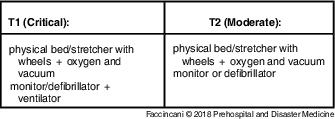
According to Bayram’s model, both HACSC and HACST are linearly related to EDB. Some modification was needed in order to quantify EDB since the emergency departments (EDs) in hospitals within the region of Lombardia (Italy) rarely include a permanent number of beds. Patients admitted to the ED first undergo evaluation and stabilization, followed (if necessary) with transfer to advanced imaging (ie, computed tomography [CT]/magnetic resonance imaging [MRI]). Patients undergoing emergency surgical procedures are also counted as ED occupancy. Not until the patient reaches the final destination is his/her EDB considered free. For the purposes of this study, EDB was defined not solely on the number of beds, but rather on other measures that would better evaluate the reality in the hospitals included in the study. These included the minimum standard ED resources needed to adequately treat T1 and T2 trauma patients (Table 1).
EXPO Capacity
EXPO capacity refers to the capacity for T1 and T2 trauma patients declared by the hospitals participating in the study, for the preparation to a possible MCI during EXPO 2015, during non-office hours. These data were collected before this study by the Milano metropolitan area SOREU.
SIM Capacity
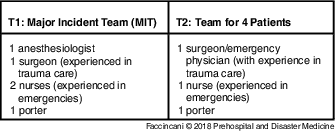
SIM capacity was defined as the capacity declared by hospitals during a simulation organized by the Milan metropolitan area SOREU. The simulation was held on August 23, 2016. It simulated a night-time scenario MCI with many casualties. Each one of the participating hospitals was informed of the timing of the simulation but not of its content. Information regarding available resources, as defined in Tables 1–3, during both office and non-office hours was collected from each hospital during the preliminary contact with the disaster and emergency committee/administration representative.
Minimum Equipment Necessary for Treatment of T1 and T2 Patients

Minimal Personnel for Treatment of T1 and T2 Patients in the ED

Abbreviation: ED, emergency department.
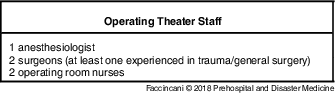
Minimal Personnel for Operating One T1 Patient

On the day of the simulation, at 10:00pm, pre-assigned representatives of the emergency committees of each one of the participating hospitals were contacted by the SOREU and informed that an MCI had occurred. These representatives were informed that an active shooting event had occurred during a rock concert held at the Idroscalo Water Park (Milan, Italy). Over 3,000 people were attending the concert. The first window report indicated many casualties. The exact number and whereabouts of the perpetrators were still unknown. The representatives were asked to report to their EDs, after which each representative was then asked a pre-determined set of questions aimed at determining their hospital’s capacity to receive T1 and T2 trauma patients at the time of the drill (SIM capacity). The different representatives were also asked if they would consider activating their hospital’s MCI plan and what procedures were in place to allow activating it if they chose to do so. In order to quantify the available surge capacity, a minimum standard was agreed upon by the study committee concerning needed personnel in the ED, taking into consideration reference literature (Table 2).Reference Mock, Lormand, Goosen, Joshipura and Peden 27 – 31 The availability of an operating theatre (OT) fully equipped and staffed was also considered necessary to be capable of adequately caring for T1 trauma patients. 31 , 32 The minimum standard staff to perform trauma surgery is detailed in Table 3.
Time for Capacity (CT0-CT30)
Time is a crucial component when assessing surge capacity. 32 , Reference Terndrup, Leaming and Adams 33 This is especially important in trauma-related MCIs where timely access to treatment is critical for T1 victims. As stated above, for the purpose of this study, ED capacity was concentrated on during non-office hours, when treatment capacity is at its minimum. Two capacities, CT0 and CT30, were measured for each of the participating hospitals. The CT0 capacity represented the ED capacity at the time of the alarm. In terms of personnel, capacity was calculated based only on the available staff on-duty. The CT30 represented the capacity available at 30 minutes following the alarm. In terms of personnel, this was calculated based on both staff on-duty and staff on-call who presented to the ED. During the simulation, the information collected from the different hospitals’ representatives included not only their declared capacity, but also the available resources at the time of the alarm and 30 minutes following the alarm. Capacities were than calculated for CT0 and CT30 according to the minimum standards agreed upon by the study committee (Tables 1, 2, and 3).
Data Collection
The following data were collected for each of the participating hospitals (Figure 1):
A. General Data: hospital’s name; name and position of the representative of the emergency committee; information concerning the contingency plan, such as the minimum needed to activate the MCI plan and the function authorized to formally activate it;
B. HACSC/HACST: resources needed to calculate EDB (Table 1);
C. EXPO Capacity: treatment capacity for T1-T2 trauma patients in a possible MCI during EXPO 2015 (night scenario), as declared by each hospital’s emergency committee; and
D. SIM Capacity: treatment capacities CT0 and CT30 for T1 and T2 trauma patients were collected during the August 23, 2016 simulation. This included both the capacities declared by the emergency committee representative of each one of the hospitals and the capacity calculated according to the available resources at the time of the alarm and 30 minutes after the alarm.
Data Collection Form. Abbreviations: ED, emergency department; HACSC, Hospital Acute Care Surge Capacity; HACST, Hospital Acute Care Surge Threshold; ICU, intensive care unit; MCI, multiple-casualty incident; OT, operating theatre.

Data Analysis
EXPO capacity and SIM capacity were compared to HACSC/HACST for each one of the hospitals. The sum of EXPO capacity and the sum of SIM capacity were compared to THC in order to assess the regional capacity.
Ethical Consideration
The Health Direction of each of the hospitals participating in this study was informed in advance of the study’s aims and procedures. It was presented that study results and conclusions would be made available for each of the participating hospitals. Published data would be anonymous with each hospital represented by a letter. All the hospitals agreed to participate. In order not to interfere with the on-going clinical activities, the date, time, and referral person for the simulation were pre-arranged with the Health Direction of the different hospitals. The MCI plan activation involved only the command positions.
Results
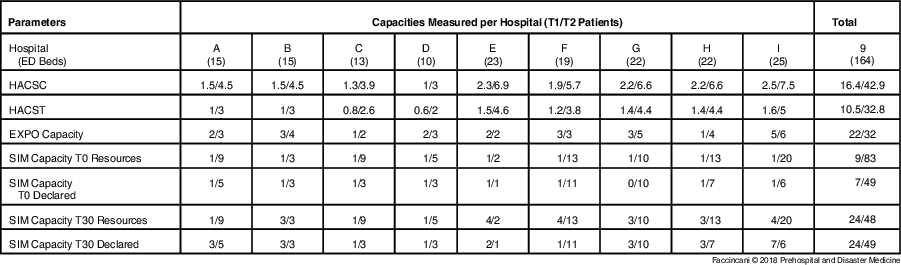
All nine hospitals participated in the study (Table 4). In eight of nine hospitals, the EXPO capacity for T1 patients was higher than HACST. The EXPO capacity for T2 patients was higher than HACST in four hospitals, lower than HACST in four hospitals, and equal in one hospital. Only in one hospital (number eight) did HACST exceed the EXPO capacity in both T1 and T2 trauma patients. Differences in treatment capacity in this hospital, however, were minimal. The HACSC differed considerably from the EXPO capacity in all the nine hospitals. It was lower in seven hospitals and higher in two. The EXPO THC far exceeded THC for both HACSC and HACST for T1 patients.
Capacities Observed for T1 and T2 Patients

Abbreviations: ED, emergency department; HACSC, Hospital Acute Care Surge Capacity; HACST, Hospital Acute Care Surge Threshold.
At CT0, differences measured between SIM capacity and HACSC/HACST were either small or none at all for T1 patients. SIM capacity at the time of the alarm was zero in two hospitals because the only available OT was occupied by a surgical procedure that had started before the MCI simulation.
As for CT30, in seven hospitals, SIM capacity far exceeded both HACSC and HACST. This resulted in a large difference observed in THC between the SIM capacity and the HACST.
Inquiries made with each of the hospitals’ emergency committee representative revealed that in almost all of the hospitals, the decision to activate the MCI plan was made by the Health Direction. No alternatives were reported on how to activate the MCI plan if the Health Direction would not be reachable. Inquiries made into the way different hospital representatives decided on their SIM capacity revealed that the set of criteria used by different individuals was not standardized. Thus, for example, in one hospital at the time of the alarm, the OT staff was on-call at home. The local committee’s representative declared a TC0 of one for a T1 patient. Thirty minutes after the alarm, this same representative declared a TC30 of one, though four fully staffed OTs were available.
Discussion
This study compared several methods meant to assess hospital capacities in MCIs. Both EXPO and SIM capacities resulted in higher capacities compared to HACSC and HACST. Differences observed may have been caused by the fact that the main variable determining capacity in the latter two was the number of qualified trauma teams and OTs rather than number of beds, or alternative indices to the number of beds, as employed in this study.
Both HACSC and HACST do not take into account on-going routine work. Resources allocated for non-office hours are based on the work-load that exits routinely everyday rather than the possibility of the need to respond to an MCI. Thus, the number of personnel that physically work in the ED at non-office hours will depend on everyday needs rather than on the number of beds. The same is true for OT staff. It is for this reason that in one of the hospitals that participated in the simulation, OT staff on-call were at home, unlike most other hospitals in which the OT staff remained in-house. The need to have the OT staff in-house 24/7 depends on the workload routinely encountered in each hospital as well as on the designated trauma level (the OT staff is required in-house 24/7 at a higher level, while for a lower level, it can be on-call). All these considerations do not affect the number of beds that one may count in the ED.
Both HACSC and HACST do not take into consideration the fact that existing resources are engaged by on-going routine work. As did happen during the simulation, in two hospitals, the OTs were busy with operative cases. This will not impact HACST. Conversely, the fact that the OTs were busy did impact the SIM capacity. Both HACSC and HACST are static. Yet, in reality, capacity is dynamic and greatly dependent on the occupancy of available resources. Capacity for severe trauma patients is strongly dependent on very specialized resources like trauma teams and OTs. Even in big trauma centers, these resources are few, especially during the worse-case scenario (night shift in a holiday period) and represent more than EDBs, the real limiting factor to capacity. While these few resources are already engaged, the capacity to surge is then very limited because it is extremely difficult to mobilize some more-qualified resources, especially at the very beginning.
Limitations
All the methods compared in this study have inherent deficiencies. None of the methods take into account the quality of care. While the capacities measured in this study depended on either beds, quantity of critical equipment, or number of personnel, there are other variables that may influence the quality of response which were not quantified. For example, the capacity to adequately care for critical patients, especially T1 with life-threatening injuries, is dependent on the qualifications of available trauma leaders. Quality of staff was not measured, and unlike real life, researchers in this study assumed all staff were equal in their competencies. While number of beds and equipment does not fluctuate significantly during the day and week, the quality of staff probably does fluctuate. Quality of staff is no less important as quantity, and both are independent in determining surge capacity. This should be taken into account when preparing contingency plans in each individual hospital. Competent trauma leaders should be considered as a distinct critical resource when evaluating surge capacity. Last, the study did demonstrate potential delays in declaring an MCI if the local hospital had to wait for the Health Direction. Perhaps this study will lead to further dialogue between the local hospitals and the Health Direction to create MCI declaration guidelines allowing the staff in-house 24/7 to make decisions.
Conclusions
Surge capacity is dependent on the method of measurement. Each method has its inherent deficiencies. In this study, several methods to evaluate hospital surge capacity were evaluated. This comparison allowed to evaluate the inherent deficiencies of each of these methods. Until more reliable methodologies are developed, hospital surge capacity should be evaluated using several methods rather than relying solely on just one method.
When preparing for a large public event, such as Expo 2015, implementation of small changes in the organization may lead to significant increases in treatment capacity. Emergency committee members in each hospital should be aware of their critical resources, and appropriate steps should be planned for in order to increase hospital treatment capacity when responding to an MCI.
Hospital capacity is dynamic, largely dependent on occupation of the available resources. It is important that the regional command center and the hospitals receiving casualties communicate on specifically agreed upon critical resources. This allows the regional command center to evaluate the overall regional capacity and guarantee the appropriate distribution of the patients between the different hospitals responding to the event.
Acknowledgements
The authors would like to give thanks to the following for fundamental contributions to the paper: -SOREU Metropolitana Milano -ASST Grande Ospedale Metropolitano Niguarda -Azienda Ospedaliera San Gerardo di Monza -Fondazione IRCCS Cà Granda Ospedale Maggiore Policlinico -Ospedale San Raffaele -Istituto Clinico Humanitas -Ospedale San Carlo -Ospedale San Paolo -Ospedale Fatebenefratelli -Ospedale Sacco