Introduction
Public and private institutions require trematode metacercariae (the infective stage for mammals) for their research. The most frequent uses are for the experimental infection of domestic ruminants to assess the anthelmintic effectiveness of new drugs or to follow the quantitative variations of different biological parameters in infected animals. More recently, metacercarial requests have been for the development of vaccines against several digenean parasites such as Fasciola hepatica or Paramphistomum daubneyi. The breeding of the snail intermediate host in the laboratory is necessary to obtain metacercariae. In the case of F. hepatica and P. daubneyi, this intermediate host is the mud snail (Galba truncatula) which is mainly reared using blue-green algae for food (Taylor & Mozley, Reference Taylor and Mozley1948; Kendall, Reference Kendall1953; Pécheur, Reference Pécheur1974; Osborn et al., Reference Osborn, Gron and Simmons1982; Fereira Filipa et al., Reference Fereira Filipa, Delgado, Seixa Lopes and Sampaio Silva2000), but this method is time-consuming and expensive (Rondelaud et al., Reference Rondelaud, Abrous and Dreyfuss2002, Reference Rondelaud, Vignoles and Dreyfuss2009). Simple methods are required to breed snails, and easy techniques to collect metacercariae, which may be cheap enough for laboratory use.
Since 1970, we have used aquaterraria-reared G. truncatula which fed on decayed lettuce. Cercaria-shedding snails were later placed in 35-mm Petri dishes and metacercariae were collected by capillarity via the use of slightly wet forceps, attracting these larvae just after water evaporation under an electric light (Abrous et al., Reference Abrous, Roumieux, Dreyfuss, Rondelaud and Mage1998). As these processes were time-consuming (a twice-daily surveillance of aquaterraria and Petri dishes was necessary) and tedious for metacercaria collection, several improvements have been made since 2000. Several high-quality diets for the snails, such as Tetraphyll™ (commercial food for fishes), were proposed for enhancing their shell growth and, consequently, their cercarial production (Belfaiza et al., Reference Belfaiza, Abrous, Rondelaud, Moncef and Dreyfuss2004; Rondelaud et al., Reference Rondelaud, Denève, Belfaiza, Mekroud, Abrous, Moncef and Dreyfuss2004). The high-quality diets, in practice, required more time to feed snails and were often a source of bacterial contamination because of their rapid degradation in water. Another method, based on the use of Petri dishes to rear G. truncatula, as applied by Bruce & Liang (Reference Bruce and Liang1992) for cultivating snail hosts of schistosomes, and the utilization of dried grass and lettuce leaves as food was introduced (Rondelaud et al., Reference Rondelaud, Fousi, Vignoles, Moncef and Dreyfuss2007). We have three questions related to the production of metacercariae: Did the method based on Petri-dish-reared G. truncatula have a better effect on the different characteristics of snail infection (F. hepatica or P. daubneyi) than that using aquaterraria? Was snail dissection more productive for metacercariae than natural cercarial (the pre-infective stage) shedding? Was metacercarial aspiration at the extremity of flame-stretched Pasteur pipettes easier and less time-consuming than the capillarity method? To answer the first question, a retrospective study was undertaken of papers published by our team (references cited above) between 1998 and 2007 on the breeding of G. truncatula under laboratory conditions. The answers to the other two questions were provided by three new experiments on G. truncatula and F. hepatica or P. daubneyi between 2005 and 2010.
Materials and methods
Snail populations
As the maintenance of a snail strain in the laboratory was time-consuming and expensive, we have used for these experiments different populations of G. truncatula living in central France. Three groups were considered. The first comprised four populations living in the communes of Migné (46°40′27″N, 1°21′21″E; 46°40′28″N, 1°21′36″E; 46°40′31″N, 1°22′17″E) and Thenay (46°37′23″N, 1°26′12″E), department of Indre. Their habitats were located on clay (favourable for snail growth) so that the upper shell height of adults was 11–12 mm. Three other populations living in the communes of Blanzac (46°7′2″N, 1°6′53″E), Rancon (46°06′56″N, 1°10′50″E) and Peyrat de Bellac (46°7′29″N, 0°57′50″E), department of Haute Vienne, constituted the second group. As these snail habitats were located on less favourable acidic soil, the upper height of adult snails was less, 8.5 or 9 mm. The final group comprised three populations living in the communes of Saint Michel de Veisse (45°55′28″N, 2°2′37″E; 45°55′48″N, 2°2′35″E), department of Creuse, and Saint Ours (45°50′2″N, 2°54′9″E), department of Puy de Dôme. Like the second group, these last snails were living on acidic soil and showed an upper shell height of 8–9 mm for adults. These ten populations were highly susceptible to experimental infection with F. hepatica (prevalence>60%), as demonstrated by our team in previous experiments (Rondelaud, Reference Rondelaud1993; Vignoles et al., Reference Vignoles, Dreyfuss and Rondelaud2002). Pre-adults (4 mm high) belonging to the spring generation, were collected from these sites in April–May (groups 1 and 2) or June (group 3) between 1993 and 2009. They were kept in the laboratory at 20°C for 48 h, for temperature acclimatization, before being exposed to miracidia, the infective stage for snails.
Eggs of F. hepatica were collected from the gall bladders of heavily infected cattle at the slaughterhouse of Limoges, department of Haute Vienne (central France). To obtain eggs of P. daubneyi, adult worms were collected from the paunch of the same cattle and placed in a saline solution (0.9% NaCl, 0.45% glucose) for 4 h at 37°C. All these eggs were washed several times with spring water and were incubated at 20°C for 20 days in the dark in order to obtain miracidia (Ollerenshaw, Reference Ollerenshaw1971).
Snail breeding
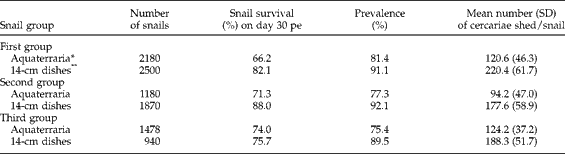
Table 1 gives the method (aquaterraria or Petri dishes) used to rear F. hepatica-infected snails during the first 30 days post-exposure (pe), the time period (1993–1998 or 1999–2004) when each process was applied, and the total number of snails used for each method. As most experimental infections of snails with P. daubneyi were made after 1998, the results obtained with this digenean are not given in this table.
Consequences of the method used to breed snails infected with F. hepatica on characteristics of snail infections at 30 days post-exposure (pe).
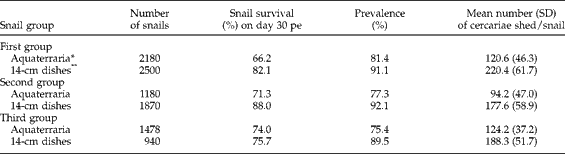
* Experiments were carried out from 1993 to 1998.
** Experiments were carried out from 1999 to 2004.
Individual bimiracidial exposures of G. truncatula with F. hepatica were routinely performed for 4 h at 20°C before the breeding of snails for 30 days using either of the following methods. Uncovered aquaterraria (surface, 0.66 m2), with 100 snails per box, were used between 1993 and 1998 according to the report by Abrous et al. (Reference Abrous, Roumieux, Dreyfuss, Rondelaud and Mage1998). Permanently oxygenated water was introduced into each box (water depth, 0.5 cm) and lettuce leaves, decayed after keeping for 5 days in water, were also put in each aquaterrarium. During twice-daily checks, spring water was added in order to maintain a constant level and the lettuce leaves were changed if necessary. In the second method, single-use Petri dishes measuring 14 cm in diameter (Rondelaud et al., Reference Rondelaud, Fousi, Vignoles, Moncef and Dreyfuss2007) were used. Dried grass (Molinia caerulea) leaves and stems were placed around the walls at the bottom of each dish, while four live stems of spring moss (Fontinalis sp.) and a piece of dried lettuce leaf were put in the centre. Sixty millilitres of spring water and ten pre-adult snails were introduced into each Petri dish. If necessary, water and grass or lettuce leaves, were changed daily. Petri dishes were also cleaned each week. In both methods, water originated from springs located on limestone (60–73 mg/l of dissolved calcium in water) or acidic soils (9–13 mg/l of calcium) for the first group of snail populations and the two others, respectively. All recipients were placed in an air-conditioned room at a constant temperature of 20°C and a 12-h photoperiod at an intensity of 3000–4000 lux above the surface of the water in aquaterraria and above the lids of Petri dishes. At day 30 pe, surviving snails were individually placed in 35-mm Petri dishes for cercarial shedding. A piece of decayed or dried lettuce and 2–3 ml of spring water were added to each dish. These recipients were placed in the same air-conditioned room as above. Daily surveillance was performed up to the time of each snail's death, to count and remove metacercariae, and also to change lettuce if necessary. The parameters studied were snail survival on day 30 pe, prevalence of infection (calculated in relation to the number of surviving snails on day 30 pe) and the number of metacercariae.
Collection of metacercariae
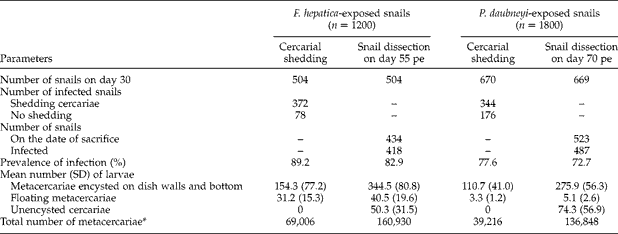
To determine which method (natural cercarial shedding or snail dissection) was the more convenient for obtaining metacercariae, two experiments with F. hepatica or P. daubneyi were carried out from 2005 to 2007 with the first group of G. truncatula populations. Table 2 gives the digenean species used to infect snails, the total number of snails exposed to each parasite, and that of surviving snails used for cercarial shedding or for dissection. Routine bimiracidial exposures with either digenean were performed for each G. truncatula before rearing snails at 20°C in 14-cm Petri dishes according to the report by Rondelaud et al. (Reference Rondelaud, Fousi, Vignoles, Moncef and Dreyfuss2007). The other conditions of snail breeding were similar to those described above.
Metacercarial production by snails infected with F. hepatica (or with P. daubneyi), including cercarial shedding or snails dissected during the patent period.
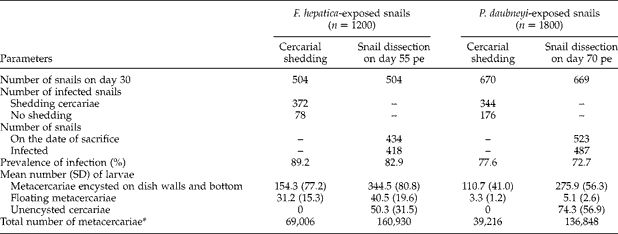
pe, post-exposure.
* Metacercariae settled on dish walls and bottom + floating cysts.
At day 30 pe, half of the surviving snails in each snail group were used to study cercarial shedding, while the rest were dissected. All snails were individually placed in 35-mm Petri dishes as above. In snails studied for cercarial shedding, a daily surveillance was performed to count and remove metacercariae up to the death of snails. In contrast, in the other G. truncatula, surviving individuals were dissected on day 55 pe if exposed to F. hepatica and on day 70 if exposed to P. daubneyi. These dates for snail dissection were chosen according to the results of previous experiments, as the first cercarial shedding of F. hepatica occurred earlier than that of P. daubneyi (a mean of 42 days at 20°C instead of 60 days, respectively). After snail dissection, counts were made of metacercariae encysted on dish walls and bottom, floating metacercariae and unencysted cercariae.
The first parameter examined was prevalence of infection, calculated in relation to the number of surviving snails on day 30 pe. In snails studied for cercarial shedding, the number of G. truncatula shedding cercariae, the number of infected snails not shedding and the number of shed cercariae were considered. In dissected snails, the number of settled metacercariae, the number of floating cysts and the quantity of unencysted cercariae were taken into account.
Transfer of metacercariae
This experiment was performed in 2008, with 900 snails originating from the first group of snail populations. Individual bimiracidial exposures with F. hepatica were performed for 450 G. truncatula, while the other 450 were subjected to P. daubneyi miracidia, using the same protocol. After exposure, snails were bred in 14-cm Petri dishes according to the report by Rondelaud et al. (Reference Rondelaud, Fousi, Vignoles, Moncef and Dreyfuss2007) and were isolated on day 30 pe in 35-mm Petri dishes. Apart from the temperature of the air-conditioned room (24°C), the other conditions of snail maintenance were the same as above. From the metacercariae obtained for each parasite species, 5600 for F. hepatica and 5600 for P. daubneyi were used to study which method (capillarity or aspiration) was easier for transfer of these larvae to 2.5-ml Eppendorf tubes. In the case of each digenean, 2800 metacercariae were transferred by capillarity, while the other 2800 were placed into the Eppendorf tubes by aspiration via a Pasteur pipette.
In the method by capillarity, metacercariae were removed from the walls and bottom of wet 35-mm Petri dishes with the point of a mounted needle under the stereomicroscope and were gathered per groups of 10–12 larvae each. After the loss of humidity under artificial lighting, each group of metacercariae was attracted with the point of a slightly wet hard forceps and placed in the tube containing 2 ml of spring water. In the other method, metacercarial collection was made by aspirating every larva at the extremity of a flame-stretched Pasteur pipette, the internal diameter of which was slightly smaller than that of a metacercaria. In both cases, metacercariae were put per groups of 100 in Eppendorf tubes and were placed at 4–6°C.
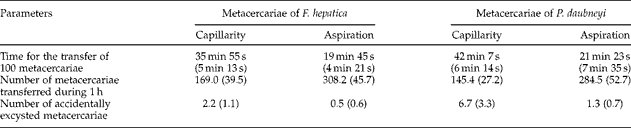
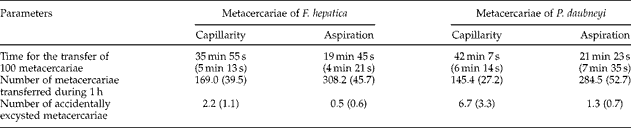
The first two parameters studied for each method were the time necessary for the transfer of 100 metacercariae to an Eppendorf tube and the number of larvae that could be transferred by a technician during 1 h (table 3). The last parameter was the number of accidentally excysted larvae after their removal from Petri dish walls and bottoms. Indeed, the outer wall of some cysts during their detachment might be accidentally taken off, so that the envelope of these larvae was limited to the inner wall only. The consequence was the non-use of these larvae for commercial production.
Mean values (SD) for the transfer of 5600 metacercariae of both F. hepatica and P. daubneyi to Eppendorf tubes, using capillarity or aspiration.
Data analysis
Survival of snails on day 30 pe and prevalences of snail infection were compared using a χ2 test (Stat-Itcf, 1988). In the case of other parameters, individual values were averaged and standard deviations were established. One-way analysis of variance was used to establish levels of significance (Stat-Itcf, 1988).
Results
Snail breeding
Compared to snails raised in aquaterraria (table 1) during the first 30 days pe, the survival of Petri-dish snails was greater in the first (χ2= 154.69, P< 0.001) and second (χ2= 133.68, P< 0.001) groups, whereas the third group showed an insignificant difference. Prevalence of F. hepatica infection was significantly greater in Petri-dish snails (group 1: χ2= 71.77, P< 0.001; group 2: χ2= 109.56, P< 0.001; group 3: χ2= 55.25, P< 0.001). The number of cercariae shed by these Petri-dish snails was also significantly higher, in the first group (F =6.98, P< 0.01) and the second (F =5.08, P< 0.05), as well as in the third group (F =5.14, P< 0.05) of snail populations.
Collection of metacercariae
The prevalence of snail infection (table 2) was significantly lower in dissected snails, in both F. hepatica-infected snails (χ2= 8.49, P< 0.01) and those harbouring P. daubneyi larval forms (χ2= 4.17, P< 0.05). In contrast, the number of metacercariae noted at snail dissection was clearly greater (F. hepatica: F =11.27, P< 0.01; P. daubneyi: F =18.82, P< 0.001) and was 2.3 and 3.4 times higher, respectively, than those found in snails studied for cercarial shedding. The number of floating metacercariae was clearly greater (F =9.85, P< 0.001) in the case of F. hepatica-infected snails. However, for each parasite considered alone, no significant difference between these values was noted. Finally, the difference between the quantities of unencysted cercariae counted in dissected snails for both trematodes was insignificant.
Transfer of metacercariae
Using the aspiration method, the time necessary for transferring 100 metacercariae of F. hepatica from a 35-mm dish to an Eppendorf tube was significantly shorter (F =120.43, P< 0.001). It was 1.8 times lower than that recorded for the same operation by capillarity. A similar finding was also noted in the case of P. daubneyi: the difference between values noted with the two methods was significant (F =98.43, P< 0.001) and the method by aspiration was 2 times shorter. As a consequence, the number of larvae collected during 1 h was also significantly greater when metacercarial aspiration was used (F. hepatica: F =19.97, P< 0.01; P. daubneyi: F =21.90, P< 0.01). The number of accidentally excysted metacercariae was always higher when these larvae were transferred by capillarity (F. hepatica: F =8.25, P< 0.05; P. daubneyi: F =12.36, P< 0.01). However, if metacercarial capillarity was used, the number of excysted larvae was always higher in the case of P. daubneyi (F =8.06, P< 0.05) while there was no significant difference between F. hepatica and P. daubneyi when the aspiration method was used.
Discussion
Compared to lymnaeids bred in aquaterraria during the first 30 days pe, prevalence of F. hepatica infection and the quantity of shed cercariae were significantly higher in all Petri-dish-raised snails. As the differences for these two parameters were insignificant in the report by Rondelaud et al. (Reference Rondelaud, Fousi, Vignoles, Moncef and Dreyfuss2007), an explanation must be proposed. In our opinion, the most valid assumption is to relate these differences to the high number of snails used in the present study (from 940 to 2500 G. truncatula, see table 1), whereas each group of snails in the report by Rondelaud et al. (Reference Rondelaud, Fousi, Vignoles, Moncef and Dreyfuss2007) was only composed of 40 or 80 snails at miracidial exposure. According to Rondelaud et al. (Reference Rondelaud, Vignoles and Dreyfuss2009), the use of Petri dishes to breed snails had several advantages: (1) an obvious gain of space, as Petri dishes can be piled up until five or six per column; (2) a limited mortality of snails because they are in small numbers in every dish and the transmission of iridovirosis (Barthe et al., Reference Barthe, Rondelaud, Faucher and Vago1984), if it exists in several snails of a population, can be easily stopped by the sterilization of the soft forceps used for snail manipulation; and (3) better surveillance of parasite larval development within snails. In spite of a lower (two groups) or similar (one group) survival of G. truncatula in Petri dishes, prevalence of F. hepatica infection was greater, whatever the group. This finding might be explained by the type of anthelminthic used by farmers to treat cattle against fasciolosis. Indeed, most farmers in central France have used triclabendazole since the 1990s (Reynal, Reference Reynal2001) and this operation has been followed, since the 2000s, by an increase in the infectivity of local miracidia towards their host snails (Dreyfuss et al., Reference Dreyfuss, Vignoles and Rondelaud2007).
In snails dissected during the patent period, a greater number of metacercariae was noted. As this was 2.3–3.4 times higher than the number found in snails studied for cercarial shedding (table 2), the use of snail dissection represented a saving in time because all metacercariae are obtained in the same period (from 2 to 4 days). Moreover, metacercariae originated from all infected snails, so their total number was clearly greater (in the case of F. hepatica, a total of 160,930 originating from dissected snails instead of 69,006 obtained by shedding). According to Boray (Reference Boray1969), these cysts formed after snail dissection had the same viability and the same infectivity as those originating from cercariae-shedding G. truncatula. As successful infections of lambs with P. daubneyi metacercariae coming from dissected snails were noted by Vignoles et al. (Reference Vignoles, Rondelaud and Dreyfuss2008), this finding agreed with the report by Boray (Reference Boray1969), with the condition that snail dissection was performed at least 1 week after the first cercarial shedding of infected snails. The difference noted in the numbers of floating cysts (which was greater in the case of F. hepatica) was species dependent, as F. hepatica produced more floating metacercariae than P. daubneyi (Rondelaud et al., Reference Rondelaud, Vignoles and Dreyfuss2009). However, in spite of the infectivity of most floating cysts (Vareille-Morel et al., Reference Vareille-Morel, Dreyfuss and Rondelaud1993), these metacercariae were kept away from commercial production because most of them clung to the Eppendorf tube wall and went down to the bottom with difficulty.
To transfer metacercariae from dishes to an Eppendorf tube, the aspiration of these larvae at the extremity of a Pasteur pipette represents an easier and quicker method than transfer by capillarity. Using the former method allowed the transfer of 1.8 times (F. hepatica) or 2 times (P. daubneyi) more metacercariae during 1 h than the latter. However, metacercarial aspiration was a tiring method because it required a great deal of concentration, so that only 800 metacercariae of F. hepatica could be transferred by the same person during a day (Gayout, Reference Gayout2009). The longer times necessary to put 100 metacercariae of P. daubneyi in an Eppendorf tube and the higher numbers of accidentally excysted larvae during their removal from Petri dishes (see table 3) must be related to digenean species and, consequently, to the greater difficulty of removing P. daubneyi metacercariae from dish bottoms. Indeed, most cysts of F. hepatica were found on dish walls near the surface of the water, while those of P. daubneyi were located on dish bottoms (Dreyfuss et al., Reference Dreyfuss, Abrous, Vignoles and Rondelaud2004).
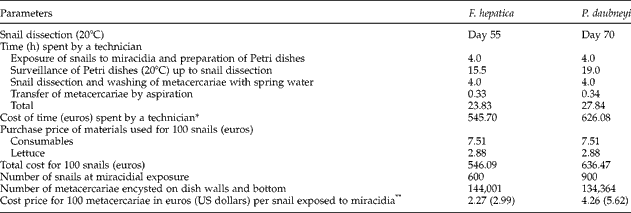
As the use of 14-cm Petri dishes for snail breeding during the first 30 days pe, snail dissection during the patent period and metacercarial aspiration for their transfer were easier and less time-consuming than methods used by our team before the 2000s, it was of interest to determine the cost price for 100 metacercariae. Compared to the cost prices reported by Rondelaud et al. (Reference Rondelaud, Abrous and Dreyfuss2002) for 100 larvae of F. hepatica (from 9.7 to 18.0 euros according to the quality of food provided for snails), the value reported in table 4 (2.27 euros = 2.99 US dollars) was 4.2 to 9.7 times lower. A slightly higher cost price (4.26 euros = 5.62 US dollars) was also noted for 100 metacercariae of P. daubneyi. In view of these figures, the use of the three above-mentioned methods allows a substantial reduction of the cost price of these larvae for commercial production of metacercariae in G. truncatula.
The production costs for 100 metacercariae when snail breeding into 14-cm Petri dishes, snail dissection and metacercarial aspiration were used to obtain these larvae from G. truncatula infected with F. hepatica or P. daubneyi. These costs do not account for the infrastructure required for the commercial production of metacercariae. The costs given in this table were calculated in 2009–2010 using snails belonging to the spring generation.
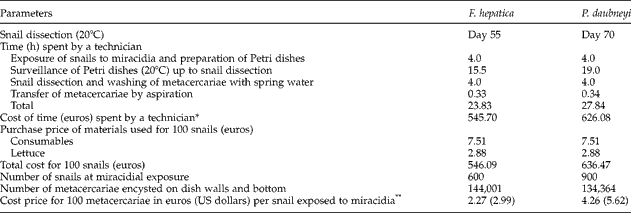
* Cost price (estimated) for a technician: 1 h = 22.9 euros.
** Calculation: Total cost for a group of 100 snails at miracidial exposure/(Total number of metacercariae encysted on dish walls and bottoms/Number of snails at miracidial exposure). 1 euro = 1.32 US dollars.