The costs and consequences of drug dependence and abuse to the community and the lives of young adults are noteworthy (National Institute on Drug Abuse, 2015). For example, costs associated with alcohol abuse and dependence are directly related to lost work productivity, increased healthcare expenditure, and increased criminal justice expenses, including motor vehicle accidents (Centers for Disease Control and Prevention, 2016). The adverse health effects of tobacco dependence are also substantial. Almost $170 billion per year is spent as direct medical care costs for adults who are nicotine dependent (Xu, Bishop, Kennedy, Simpson, & Pechacek, 2014). Smoking cigarettes causes close to 6 million deaths per year worldwide. Smoking will cause an additional approximately 8 million deaths annually by 2030 due to the aging population (World Health Organization, 2011). Marijuana is one of the most widely used drugs in the world. Marijuana abuse and dependence are suggested to increase the risk of various health and psychosocial problems, including psychosis, neurocognitive decline, sexually transmitted diseases, dropout from school, legal issues, and loss of educational and occupational aspirations (Budney, Roffman, Stephens, & Walker, Reference Budney, Roffman, Stephens and Walker2007; Di Forti et al., Reference Di Forti, Iyegbe, Sallis, Kolliakou, Falcone, Paparelli and Handley2012; Meier et al., Reference Meier, Caspi, Ambler, Harrington, Houts, Keefe and Moffitt2012; Rubino & Parolaro, Reference Rubino and Parolaro2016). Of interest, therefore, is an understanding of the ecology of protective factors that predict who is less likely to move an adolescent from drug use exploration to developing problematic behaviors in using substances in early adulthood. The family in general and parenting in particular are important for understanding risk and protection, as such information can be disseminated to the general public and because prevention programs can improve with respect to parenting targets (Spoth, Kavanagh, & Dishion, Reference Spoth, Kavanagh and Dishion2002).
Problematic substance use, such as abuse and dependence, is often understood as behavioral representations of an individual's inability to decide autonomously to control use (e.g., Baumeister, Vohs, & Tice, Reference Baumeister, Vohs and Tice2007; Koob & LeMoal, Reference Koob and Le Moal1997). An individual difference factor that may be closely related to problematic substance use is effortful control. Effortful control reflects an individual's ability to regulate approach and avoidance of behavior in the face of immediate cues for reward or punishment, and involves the regulation of attentional processes, goal-directed attention persistence, and the inhibition of behavior (Miller & Byrnes, Reference Miller and Byrnes2001; Rothbart, Reference Rothbart2012; Rothbart & Posner, 1995). Individual differences in effortful control support complex emotional and behavioral regulation, which underlies appropriate and adaptive life decisions. For instance, a previous study revealed that individual differences in effortful control can account for movement from drug experimentation to dependence from adolescence to early adulthood, while controlling for peer influences (Piehler, Véronneau, & Dishion, Reference Piehler, Véronneau and Dishion2012). Several other studies suggest that individuals with lower effortful control are more likely than those who report higher levels of effortful control to use both legal and illicit drugs (Novak & Clayton, Reference Novak and Clayton2001; Patock-Peckham, Cheong, Balhorn, & Nagoshi, Reference Patock-Peckham, Cheong, Balhorn and Nagoshi2001; Wills, DuHamel, & Vaccaro, Reference Wills, DuHamel and Vaccaro1995). Effortful control ability is regarded as an important facet of drug use disorders (Lyvers, Reference Lyvers2000) in diagnostic evaluations such as the Diagnostic and Statistical Manual of Mental Disorders and International Classification of Diseases (Bell, Foxe, Ross, & Garavan, Reference Bell, Foxe, Ross and Garavan2014). Hence, we may consider effortful control to be an important target of the prevention and treatment of problematic substance use.
Although effortful control is understood as being a facet of temperament with a genetic basis (e.g., Rothbart & Bates, Reference Rothbart, Bates, Damon and Eisenberg1998), the general consensus is that it can be refined and supported by environmental factors such as parenting one receives in childhood (Eisenberg et al., Reference Eisenberg, Zhou, Spinrad, Valiente, Fabes and Liew2005; Karreman, van Tuijl, van Aken, & Dekovic, Reference Karreman, van Tuijl, van Aken and Deković2008; Rothbart & Bates, Reference Rothbart, Bates, Damon, Lerner and Eisenberg2006). However, the connection between parenting and effortful control in adolescence is not well understood. It is generally suggested that effortful control rapidly develops in the early developmental stage ranging from 0 to 11 years (Davidson, Jackson, & Kalin, Reference Davidson, Jackson and Kalin2000; Eisenberg, Reference Eisenberg and Rothbart2012; Kochanska, Murray, Jacques, Koenig, & Vandegeest, Reference Kochanska, Murray, Jacques, Koenig and Vandegeest1996) and it remains as a stable characteristic over the course of the life span. Thus, most studies that examined the environmental factors influencing development of effortful control so far have focused on childhood influences (Eisenberg, Spinrad, & Eggum, Reference Eisenberg, Spinrad and Eggum2010).
Two factors, however, provide a rationale for the importance of examining the association between parenting and effortful control in adolescence. First, during adolescence many children still spend much time with their parents. Adolescents have numerous opportunities to learn skills to regulate their attention, emotions, and behavior to pursue their important personal goals through engaging in interactions and receiving support from their parents. Second, effortful control is under the direct influence of the executive attention network that includes the anterior cingulate cortex (ACC) and lateral prefrontal cortices (Posner, Reference Posner2012; Rothbart & Rueda, Reference Rothbart, Rueda, Mayr, Awh and Keele2005; Rothbart, Sheese, & Posner, Reference Rothbart, Sheese and Posner2007). The ACC and the laternal prefrontal cortices serve key roles in executive functions such as working memory, planning, and inhibition, and they are known to be the last brain areas to mature: they are likely to develop into one's late 20s (Johnson, Blum, & Giedd, Reference Johnson, Blum and Giedd2009; Sowell, Thompson, Holmes, Jernigan, & Toga, Reference Sowell, Thompson, Holmes, Jernigan and Toga1999). Hence, adolescence is still a developmentally important stage for studying the influence of parenting on effortful control.
A parenting skill relevant from infancy through young adulthood is parental monitoring. It entails a collection of parenting skills that involves attention to, monitoring, and structuring a child's whereabouts and activities (Dishion & McMahon, Reference Dishion and McMahon1998). Higher parental monitoring is associated with fewer problem behaviors (Fosco, Stormshak, Dishion, & Winter, Reference Fosco, Stormshak, Dishion and Winter2012; Lippold, Greenberg, Graham, & Feinberg, Reference Lippold, Greenberg, Graham and Feinberg2014; Patterson & Stouthamer-Loeber, Reference Patterson and Stouthamer-Loeber1984; Sampson & Laub, Reference Sampson and Laub1994), and substance use (Blustein et al., Reference Blustein, Munn-Chernoff, Grant, Sartor, Waldron, Bucholz and Heath2015; Branstetter, & Furman, Reference Branstetter and Furman2013; Dishion & Loeber, Reference Dishion and Loeber1985; Flannery, Vazsonyi, Torquati, & Fridrich, Reference Flannery, Vazsonyi, Torquati and Fridrich1994; Fletcher, Darling, & Steinberg, Reference Fletcher, Darling, Steinberg and McCord1995). Others have argued that the effect of parental monitoring on youths’ behavioral problems can be mediated by youths’ self-control ability (Kort-Butler, Tyler, & Melander, Reference Kort-Butler, Tyler and Melander2011). A number of previous studies found that parental supervision and monitoring have a significant association with youths’ self-control (Hay & Forrest, Reference Hay and Forrest2006; Hope, Grasmick, & Pointon, Reference Hope, Grasmick and Pointon2003; Meldrum, Reference Meldrum2008). Perhaps, if their parents track and structure their children's behavior through physical modification and rule setting, children may learn overall guidelines for their behaviors and in regulating emotions. It may be possible that parental monitoring can help prevent youths from abusing and becoming dependent on substances by promoting youths’ effortful control ability.
Parent–child relationship quality is also highly relevant to the development of effortful control. Specifically, a warm and supportive parent–child relationship can contribute to the development of children's effortful control competencies by sustaining optimal arousal levels (e.g., emotionally positive parent–child relationships), providing a predictable and organized home environment, and by parents showing appropriate social skills to maintain good interpersonal relationships (Brody & Ge, Reference Brody and Ge2001; Feldman & Klein, Reference Feldman and Klein2003). Eisenberg, Cumberland, and Spinrad (Reference Eisenberg, Cumberland and Spinrad1998) argued that parents can facilitate their children's effortful control by demonstrating effective ways to handle their emotions and behaviors, and by developing healthy parent–child relationships. A number of previous studies suggest that higher supportive and warm parenting is associated with higher effortful control ability (Belsky, Pasco Fearon, & Bell, Reference Belsky, Pasco Fearon and Bell2007; Gilliom, Shaw, Beck, Schonberg, & Lukon, Reference Gilliom, Shaw, Beck, Schonberg and Lukon2002; Spinrad et al., Reference Spinrad, Eisenberg, Gaertner, Popp, Smith, Kupfer and Hofer2007; Valiente, Lemery-Chalfant, Swanson, & Reiser, Reference Valiente, Lemery-Chalfant, Swanson and Reiser2006). Furthermore, some studies found parents’ emotional support and open communication with adolescents to predict lower likelihood of youth substance use (Wills & Clearly, Reference Wills and Cleary1996; Wills et al., Reference Wills, Cleary, Filer, Shinar, Mariani and Spera2001; Wills & Yaeger, Reference Wills and Yaeger2003). Therefore, along with parental monitoring, having a good quality parent–child relationship appears to be an important factor in promoting adolescents’ effortful control, which, in turn, may attenuate risks for future problematic substance use.
Although both parental monitoring and relationship quality may affect effortful control, no studies have examined whether these two parenting factors are differently associated with youths’ effortful control ability. While both of them may be uniquely related to youths’ effortful control, it is possible that one of the two parenting variables is more strongly associated with effortful control.
The Present Study
To our knowledge, this is the first study to investigate effortful control as a mediator with parental monitoring, parent–adolescent relationship quality, and problematic substance use based upon extensive (early adolescence to early adulthood) longitudinal data. Specifically, the present study followed a community sample of adolescents from ages 11 to 26–27 to test the following two hypotheses. First, we hypothesized that both parental monitoring and parent–adolescent relationship quality measured in early adolescence could predict effortful control in middle adolescence. It is expected that higher parental monitoring and parent–adolescent relationship quality would be associated with greater effortful control. However, the magnitude of these associations might differ. Second, it is hypothesized that the greater level of effortful control in adolescence would be associated with less problematic substance use behaviors in early adulthood.
Method
Participants
The present study is a secondary data analysis of a large randomized control trial (N = 999) of the Family Check-Up intervention study (Dishion & Kavanagh, Reference Dishion and Kavanagh2003). The original randomized longitudinal field trial (PAL 1) included a sample of 999 multiethnic young adolescents who attended three public middle schools in the northeast Portland, Oregon, metropolitan community and their families. The sample is divided into two cohorts of youth. Cohort 1 (n = 676) was recruited and assessed in Grade 6 in the 1996–1997 academic year and Cohort 2 (n = 323) in the 1998–1999 academic year. All families in three public middle schools were invited to complete a light assessment at the school only. Ninety percent of the students consented to complete the light assessment. As we primarily focus on examining a developmental process of problematic substance use, only participants from the control group (n = 498) were drawn and used. Control group participants were observed longitudinally without receiving any interventions. A schoolwide behavioral risk screener (Teacher Risk Perception Questionnaire; Soberman, Reference Soberman1994) assessed students’ self-management, behavior problems, and affiliation with problem peers. The screener enabled the division of the sample into three different risk groups: low-risk group, at-risk group, and high-risk group. Families were invited into an additional assessment if the student was deemed as at risk or high risk (assessment was more intense for these groups). As some baseline predictor variables of the present study were available only for the at-risk and high-risk groups, only participants and families from these two groups were used. As a result, 311 participants from the control group who belong to thr at-risk and high-risk groups were part of the present study.
This subsample included 46.9% females and was ethnically diverse (36.3% Caucasian, 32.5% African American, 6.8% Hispanic, 1.6% Native American, 3.9% Asian, and 18.9% other). Parent reports collected when their adolescent was 16–17 years old revealed that 32.2% of the participants lived with both biological parents, 43.2% lived with their biological mother, 9.7% lived with their biological father, and 14.9% lived in other family configurations. At the initial interview, the median range of gross annual household income was $30,000 to $39,999, with 29.7% of households earning less than $20,000 per year and 9.9% earning more than $90,000. All parents and youth consented to participate in the study, and all procedures of the study were reviewed and approved by the Institutional Review Board at the University of Oregon.
Procedure
A detailed description of the Family Check-Up intervention is available from a number of previously published papers (e.g., Connell, Dishion, Yasui, & Kavanagh, Reference Connell, Dishion, Yasui and Kavanagh2007; Dishion & Kavanagh, Reference Dishion and Kavanagh2003). From ages 11 to 13, yearly surveys primarily took place in the school context and through the mail. Parents and youth were followed and assessed regardless of what school the student was attending. At ages 16–17, participants were assessed at school or through other means (e.g., home visit and mail). After participants graduated from high school, they were primarily assessed through the mail. To minimize attrition, we asked participants at each wave of data collection to provide other people's contact information (e.g., friends or extended family members) who could help us find them if they had moved before the next wave of data collection. Participants received $5 for sending their new contact information when they moved. As a result, longitudinal retention rates were overall high, with approximately 80% of youths being retained across the study span from ages 11 to 26–27. All respondents were assured of the confidentiality of their responses and compensated for their participation.
Measures
Parental monitoring (ages 11 to 13)
Parental monitoring was measured with the House Rules Questionnaire (HRQ; French & Weih, Reference French and Weih1990) annually from ages 11 to 13. It consists of 21 items with a 5-point rating scale ranging from 1 (almost always true) to 5 (almost always false). Parents and youths responded to this measure. The HRQ assesses the extent to which parents control their child's household rules, responsibility, and unsupervised free times. Sample items include “be home after school by a certain time,” “finish his/her chores before s/he is allowed to go out with friends,” and “know(s) which friends my child hangs out with after school.” Parent and youth reports were collected annually. The mean of 21 items was computed for each assessment separately for parent and youth reports. Higher scores indicate greater parental monitoring. This measure has been used in previous peer-reviewed studies (i.e., Kjellstrand & Eddy, Reference Kjellstrand and Eddy2011; Van Ryzin, Johnson, Leve, & Kim, Reference Van Ryzin, Johnson, Leve and Kim2011). Internal consistency for both parent and youth reports were acceptable (parent α = 0.79–0.84 and youth α = 0.84–0.85).
Parent–child relationship quality (P-C RQ; ages 11 to 13)
P-C RQ was measured using two youth-report measures. The first, Positive Parent–Child Relations (Child and Family Center, 2001; Dishion, Ha, & Véronneau, Reference Dishion, Ha and Véronneau2012), consists of six items that are rated on a Likert scale ranging from 1 (never true) to 5 (always true). It assesses the extent to which parents and children show trust, comfort, and enjoyment in their relationships. It includes statements such as “I really enjoy being with my parents” and “My parents trust my judgment.” Mean scores were created for each of the annual assessments; Cronbach αs ranged from 0.89 to 0.90. The second scale, Parent–Child Conflict (Child and Family Center, 2001; Dishion et al., Reference Dishion, Ha and Véronneau2012), included five items reflecting how frequently parents and child engaged in conflict behaviors, such as “parent and youth got angry at each other,” “had big argument about little thing,” and “argued at the dinner table.” Each item was scored on a scale ranging from 0 (never) to 7 (more than seven times). Items describing parent–child conflict were reversed to render the P-C RQ score. Mean scores were created for each annual assessment. Cronbach αs ranged from 0.71 to 0.81.
Effortful control (ages 16 to 17)
Effortful control was measured by youth, parent, and teacher reports at ages 16 to 17. For parent and youth reports, we used the effortful control scale from the Early Adolescent Temperament Questionnaire—Revised (EATQ-R; Ellis & Rothbart, Reference Ellis and Rothbart2001). The EATQ-R effortful control scale consists of 16 items that assess activation control, attention, and inhibitory control. Each item has a 5-point Likert scale ranging from 1 (almost always untrue) to 5 (almost always true). Higher scores indicate greater effortful control. The youth and parent reports of effortful control essentially include the same items, with the pronouns changed appropriately (e.g., “I” to “My child”). For the parent report, participants and caregivers could complete the effortful control scale. When multiple caregivers responded, their answers were averaged into one parent-report score. Cronbach α for this scale was 0.80 for youth reports and 0.87 for parent reports. The teacher report of effortful control consisted of five items similar to those of the EATQ-R effortful control scale and included activation control, inhibitory control, and attention components (i.e., “thinks ahead of time about the consequences of actions,” “plans ahead before acting,” “pays attention to what he or she is doing,” “works toward goals,” and “sticks to what he or she is doing until it is finished, even with unpleasant tasks”). During the family assessment, youths were asked to identify two teachers who know them very well. One of these two teachers was randomly selected and completed the questionnaire. Teachers used the identical 5-point Likert scale to assess how frequently each participant engaged in these behaviors. The internal consistency of the teacher report was 0.94.
Early adulthood problematic substance abuse (ages 18–19 to 26–27)
Problematic substance (tobacco, alcohol, and marijuana) use index scores were measured four times between ages 18–19 to 26–27 (i.e., at ages 18–19, 21–22, 23–24, and 26–27) except tobacco (it was not measured at ages 26–27). The items for problematic substance use behaviors were based upon interview items from the Composite International Diagnostic Interview (Andrews & Peters, Reference Andrews and Peters1998). For problematic alcohol use, the questions were “Have you ever tried to stop using alcohol and found you could not?” (Yes/No); “Have you found that you cannot get as buzzed as used to?” (Yes/No); “Have you ever gone to school or work when you were drunk?” (Yes/No); “When you get buzzed, how much do you get buzzed?” (4-point scale: 0 = did not get buzzed, 1 = a little bit, 2 = quite a bit, and 3 = very much); and “How many times had five or more drinks in a row over the last 3 months?” (6-point scale: 0 = never, 3 = 3 to 5 times, 5 = more than 10 times). The last two items were rescaled to the 0 to 1 range. To be specific, the fourth item was divided by three and the fifth item was divided by five. This rescaling does not affect correlations, the proportion of variance explained, or the significance of results (see Cohen, Cohen, West, & Aiken, Reference Cohen, Cohen, West and Aiken2003). For problematic marijuana use the items were “Have you ever tried to stop using marijuana and found you could not?” (Yes/No); “Have you found that you cannot get as high as used to?” (Yes/No); “Have you ever gone to school or work when you were high?” (Yes/No); “Have you ever had any problems related to school or work, such as not doing assignments or forgetting things, because of marijuana?” (Yes/No); and “When you get high, how much do you get high?” (4-point scale: 0 = did not get high, 1 = a little bit, 2 = quite a bit, and 3 = very much). Again, the last item was rescaled to 0 to 1 range by dividing it by 3. We computed the sum of problematic alcohol and marijuana use items, and the scores ranged from 0 to 5. For problematic tobacco use, we asked only one question (“Have you ever tried stop using tobacco and found you could not?”) because other problematic substance use items were more appropriate for alcohol or marijuana use. Piehler et al. (Reference Piehler, Véronneau and Dishion2012) used and validated these measures previously.
Covariates
Self-control (ages 11 to 13 years)
As we did not measure effortful control at ages 11 to 13, we used self-control from ages 11 to 13 as a proxy covariate measure of effortful control. Children's self-control was assessed by the self-reported Children's Perceived Self-Control Scale (CPSCS; Humphrey, Reference Humphrey1982). CPSCS consists of 11 items that assess children's various cognitive and behavioral self-regulations skills. Cronbach αs for the CPSCS from ages 11 to 13 were low. Systematic investigation showed that 3 items consistently contributed to low reliability; we thus dropped them to increase the internal validity. The three items were “If someone bothers me, I ignore them”; “I know when I am doing wrong without being told”; and “If work is too hard, I switch what I am doing.” After we reduced the items, the reliability was acceptable across ages 11 to 13 ranging from 0.74 to 0.79. Higher scores indicate higher self-control.
Levels of tobacco, alcohol, and marijuana use (ages 16 to 17 years)
At ages 16 to 17, participants reported the level of their tobacco, alcohol, and marijuana use over the past 3 months, respectively. This measure uses a Likert-type scale that ranges from 0 (never) to 7 (2 or 3 times a day or more). This measure has demonstrated good stability and predictive validity of later substance use (Van Ryzin, Fosco, & Dishion, Reference Van Ryzin, Fosco and Dishion2012). It also has been used in a number of intervention studies (e.g., Stormshak et al., Reference Stormshak, Connell, Véronneau, Myers, Dishion, Kavanagh and Caruthers2011; Van Ryzin, Stormshak, & Dishion, Reference Van Ryzin, Stormshak and Dishion2012).
Strategy for analyses
First, we calculated descriptive statistics and multivariate outlier analyses using Cook's distance and leverage statistics to identify influential data (Cook, Reference Cook1977; Neter, Wasserman, & Kutner, Reference Neter, Wasserman and Kutner1989). Second, we employed structural equation modeling to test the two study hypotheses using Mplus software (Version 7; Muthén & Muthén, Reference Muthén and Muthén1998–2012). As there were too many parameters to include all three outcomes (i.e., problematic tobacco, alcohol, and marijuana use) in the same model, we used three models examining one outcome measure at a time. Each of these models tested how parental monitoring and P-C RQ differently predicted effortful control (Hypothesis 1), and whether greater level of effortful control was associated with less problematic substance use while controlling for family ecology factors (Hypothesis 2).
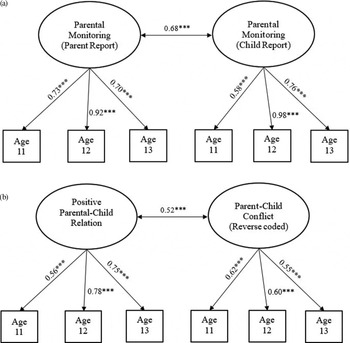
We constructed the parental monitoring latent variable by using factor scores of parent and child reports of parental monitoring latent variables that were measured across ages 11 to 13. P-C RQ latent variable was also constructed by using factor scores of two different child-report latent variables (i.e., Positive Parent–Child Relations and Parent–Child Conflict) that we measured across ages 11 to 13. Prior to exporting these factor scores, we conducted confirmatory factor analyses to examine model fit and factor loadings. Figure 1 presents more detailed results on these confirmatory factor analyses. To determine model fit, we used the comparative fit index (CFI; critical value ≥ 0.90; Bentler, Reference Bentler1990), standardized root mean square residual (SRMR; critical value ≤ 0.10; Kline, Reference Kline1998), and the root mean square error of approximation (RMSEA; critical value ≤ 0.08; Steiger, Reference Steiger1990).
(a) Confirmatory factor analysis of parent- and child-report parental monitoring latent variables. Root mean square error of approximation = 0.05, comparative fit index = 0.99, standardized root mean square residual = 0.04. ***p < .001. (b) Confirmatory factor analysis of parent–child positive relation and parent–child conflict latent variables. Root mean square error of approximation < 0.001, comparative fit index = 1.00, standardized root mean square residual = 0.02. ***p < .001.

For the problematic alcohol and marijuana use models, we used the maximum likelihood estimation with robust standard errors estimator, as indicators of problematic alcohol and marijuana use latent variables were nonnormally distributed. The weighted least squares means and variances (Muthén, du Toit, & Spisic, Reference Muthén, du Toit and Spisic1997) estimator was used for the problematic tobacco use model, as the indicators of this latent variable were all binary variables. Finally, we tested mediated effects using the Rmediation program (Tofighi & MacKinnon, Reference Tofighi and MacKinnon2011), which examines asymmetric confidence limits of mediated effects. This method has shown good statistical power and excellent control of Type I error rates (MacKinnon, Lockwood, & Williams, Reference MacKinnon, Lockwood and Williams2004). The Rmediation software calculates the 95% upper and lower confidence intervals for the mediated effect. If zero is not included in the confidence interval, the mediated effect is assumed as significant. Missing data was handled by full information maximum likelihood based on the missing at random assumption. To increase the estimation precision of missing data, we included teacher's risk perception, antisocial behavior, and substance use level at the baseline as auxiliary variables.
Results
Preliminary analyses
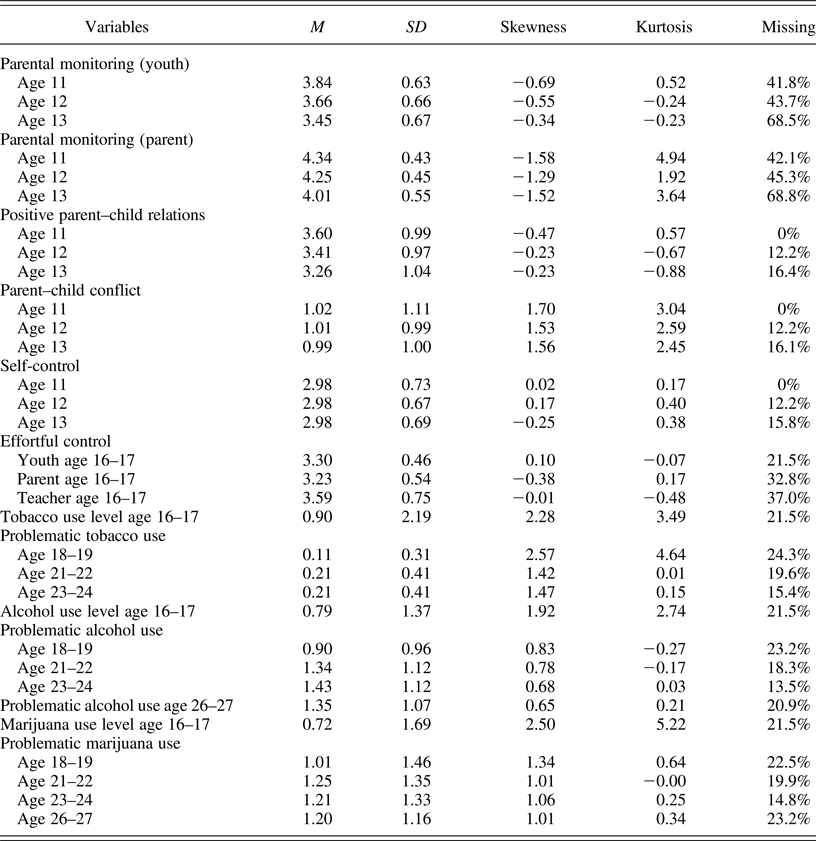
Table 1 summarizes analyses of descriptive statistics and missing data. Skewness (cutoff < 2) and kurtosis (cutoff < 7) of all variables fell within the acceptable range (see West, Finch, & Curran, Reference West, Finch, Curran and Hoyle1995, for a review) except for some substance use variables. There was a large amount of missing data on parental monitoring variables at ages 11, 12, and 13. We conducted attrition analyses using baseline demographic variables (i.e., gender, ethnicity, grade point average, whether biological father and mother living together, teacher ratings of participants’ risk, and substance use) to examine whether there was any systematic bias in the missing data. We found that none of these baseline variables was related to missingness (i.e., participants with and without monitoring data). Multivariate outlier analyses identified no influential cases.
Descriptive statistics for all study variables

Findings of structural equation model
The model fit of all three final models were acceptable: problematic tobacco use model, χ2 (65) = 81.85, p = .08, RMSEA = 0.03, and CFI = 0.96; problematic alcohol use model, χ2 (78) = 100.47, p < .05, RMSEA = 0.03, CFI = 0.98, and SRMR = 0.05; and problematic marijuana use model, χ2 (78) = 134.16, p < .001, RMSEA = 0.05, CFI = 0.95, and SRMR = 0.05.
Problematic tobacco use model
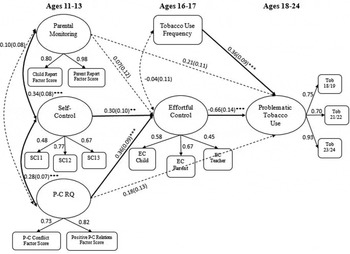
After controlling for self-control in early adolescence, P-C RQ significantly predicted effortful control at ages 16–17 (p < .01). However, the effect of parental monitoring in early adolescence on effortful control was not significant (p > .05). As expected, individuals with higher effortful control in middle adolescence were less likely to report problematic tobacco use in early adulthood (p < .001) over and above the effect of tobacco use in middle adolescence and family-related predictors in early adolescence (Figure 2). Effortful control significantly mediated between P-C RQ and problematic tobacco use, 95% confidence interval (CI) [–0.867, –0.121], but not with parental monitoring, 95% CI [–0.608, 0.283].
Summary of problematic tobacco use as an outcome model. P-C RQ, parent–child relationship quality. Path estimates are standardized regression coefficients. The values in parentheses are standard errors. Dotted lines are nonsignificant paths. **p < .01, ***p < .001.

Problematic alcohol use model
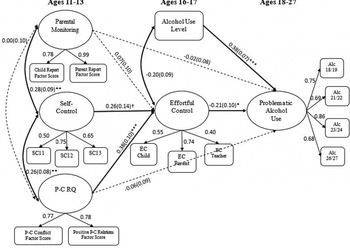
Consistent with the problematic tobacco use model (Figure 3), P-C RQ significantly predicted effortful control (p < .001), but there was no significant association between parental monitoring and effortful control (p > .05). Greater effortful control was associated with less problematic alcohol use in early adulthood (p < .05). Effortful control significantly mediated between P-C RQ and problematic alcohol use, 95% CI [–0.368, –0.002], but not parental monitoring, 95% CI [–0.199, 0.067].
Summary of problematic alcohol use as an outcome model. P-C RQ, parent–child relationship quality. Path estimates are standardized regression coefficients. The values in parentheses are standard errors. Dotted lines are nonsignificant paths. *p < .05, **p < .01.

Problematic marijuana use model
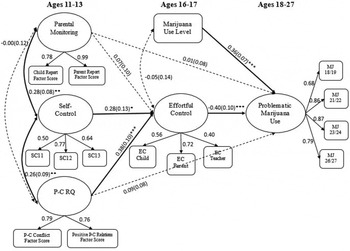
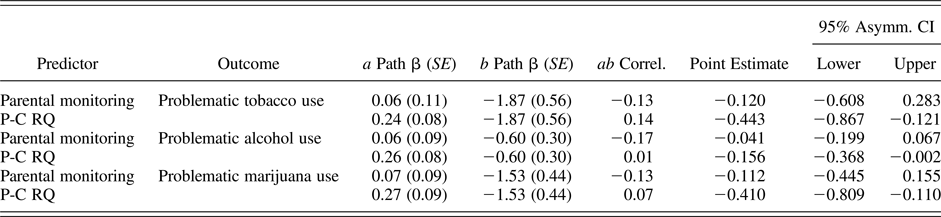
In line with the findings of two previous models, only P-C RQ was significantly associated with effortful control (p < .001). Higher effortful control also predicted less problematic marijuana use in early adulthood (p < .001) while controlling for all covariates (Figure 4). Effortful control again significantly mediated between P-C RQ and problematic marijuana use, 95% CI [–0.809, –0.110], but not parental monitoring, 95% CI [–0.445, 0.155]. Table 2 presents detailed information regarding the mediated effects.
Summary of problematic marijuana use as an outcome model. P-C RQ, parent–child relationship quality. Path estimates are standardized regression coefficients. The values in parentheses are standard errors. Dotted lines are nonsignificant paths. *p < .05, **p < .01, ***p < .001.

Mediated effects of effortful control as mediator and 95% asymmetric confidence interval (CI)

Note: P-C RQ, Parent–child relationship quality.
Findings of post hoc analyses
The measure of parental monitoring (HRQ) includes both measures of active parental effort to monitor child and parental knowledge (see Stattin & Kerr, Reference Stattin and Kerr2000, for a review). As the primary interest of the present study was measuring active parental effort of monitoring, we conducted a post hoc analysis excluding two HRQ items (i.e., “know(s) which friends my child hangs out with after school” and “know(s) or have met most of child's neighborhood friends”) that measure parental monitoring knowledge. The results remained unchanged by including the revised parenting monitoring measure in the mediation models. To be specific, the association between parental monitoring and effortful control (standardized B = 0.03, SE = 0.12, p = .81) remained nonsignificant.
We conducted another post hoc analysis to investigate the effect of the large amount of missing data in parental monitoring measures. We found some items from another child-report questionnaire in the study to represent the concept of parental monitoring. These items include “In the last week, I went places without telling parent”; “In the last week, parent let me go anywhere I pleased”; and “In the last week, I was at friend's house and no parents were around.” We collected these items from ages 11 to 13 and used the 7-point Likert scale. These items had no missing data at baseline (age 11) and a low proportion of missing data at ages 12 and 13. We reversed coded these items and created a new parental monitoring latent variable by using these items from ages 11 to 13, and reran the hypothesized model by switching the parental monitoring latent variable. Findings were consistent with those from our original model. To be specific, we found no significant association between the new parental monitoring variable and effortful control (standardized B = –0.06, SE = 0.14, p = .64). The association between P-C RQ and effortful control also remained significant (B = 0.31, SE = 0.12, p < .05). Hence, it is less likely that there was a systematic bias in the result due to missingness of parental monitoring variables.
Discussion
The primary aim of this study was to examine how family ecology in early adolescence is associated with problematic substance use in early adulthood through effortful control in late adolescence. The present findings mostly support our hypotheses. Effortful control was found to be a significant mediator between P-C RQ and problematic substance use. Contrary to our expectations, although self-control in early adolescence was moderately correlated with parent monitoring, parental monitoring was not a significant predictor of later effortful control.
Effortful control often has been regarded as a dimension of temperament that develops until childhood (Davidson et al., Reference Davidson, Jackson and Kalin2000; Eisenberg, Reference Eisenberg and Rothbart2012; Kochanska et al., Reference Kochanska, Murray, Jacques, Koenig and Vandegeest1996). Hence, most of previous studies that investigate the influence of parental factors on effortful control focus on childhood. However, the findings of the present study support the claim that examining the relationship between parenting practices and effortful control in adolescence can be important. During adolescence youths still spend a significant amount of time with parents and learn to regulate their emotions and behaviors. In addition, over this time, brain areas particularly relevant to function of effortful control, such as the ACC and the prefrontal cortex, continuously develop (Johnson et al., Reference Johnson, Blum and Giedd2009; Sowell et al., Reference Sowell, Thompson, Holmes, Jernigan and Toga1999). Recent developmental neuroimaging studies found that observed positive and negative mother and adolescent interactions significantly predicted structural changes of youths in their prefrontal (e.g., ACC and orbitofrontal cortices) and limbic-striatal regions (e.g., amygdala, hippocampus, and nucleus accumbens), which are known to serve important roles in emotion and behavioral regulations and reward processing (Whittle et al., Reference Whittle, Simmons, Dennison, Vijayakumar, Schwartz, Yap and Allen2014, Reference Whittle, Vijayakumar, Dennison, Schwartz, Simmons, Sheeber and Allen2016). Thus, the findings of the present study support the argument that positive family ecology might be associated with further development and/or refinement of effortful control in adolescence.
Consistent with previous studies in childhood (e.g., Belsky et al., Reference Belsky, Pasco Fearon and Bell2007; Gilliom et al., Reference Gilliom, Shaw, Beck, Schonberg and Lukon2002; Spinrad et al., Reference Spinrad, Eisenberg, Gaertner, Popp, Smith, Kupfer and Hofer2007; Valiente et al., Reference Valiente, Lemery-Chalfant, Swanson and Reiser2008), P-C RQ in early adolescence was associated with higher effortful control in middle adolescence. Several factors can be related to the link between P-C RQ and effortful control. First, supportive and warm relationships between parents and children may prevent youths from experiencing overarousal of negative affect that can undermine their attention flexibility and other cognitive skills, such as planning and problem solving (Eisenberg et al., Reference Eisenberg, Zhou, Spinrad, Valiente, Fabes and Liew2005; Hoffman, Reference Hoffman2000; Raver, Reference Raver1996). Greater relationship quality is likely to increase youth positive emotion, which is suggested to broaden overall cognitive capacity (e.g., attention and problem solving) and increase mental flexibility (Fredrickson, Reference Fredrickson1998, Reference Fredrickson, Devine and Plant2013). Hence, maintaining good relationships between parent and child may have a positive influence in refining youths’ effortful control ability. Second, youths may be more likely to pay attention to and follow their parents’ requests for modifying and controlling behaviors and emotions when they have supportive rather than coercive relationships (Dix, Reference Dix1991; Grusec & Goodnow, Reference Grusec and Goodnow1994). This can be crucial for youths to learn effective ways to handle their emotions and behaviors with the help of the scaffolding their parents provide (Eisenberg et al., Reference Eisenberg, Cumberland and Spinrad1998, Reference Eisenberg, Zhou, Spinrad, Valiente, Fabes and Liew2005). Third, positive family ecology may be biologically important in developing children's regulation abilities and higher cognitive functions. Although it is a beginning stage of research, recent neurobiological prospective studies have found importance of positive parent–child relationships in brain development. For instance, using longitudinal neuroimaging, Luby et al. (Reference Luby, Barch, Belden, Gaffrey, Tillman, Babb and Botteron2012) found that higher observed maternal support predicted larger hippocampal development, which is crucial in memory and modulation of stress, among their children. More recently, Towe-Goodman et al. (Reference Towe-Goodman, Willoughby, Blair, Gustafsson, Mills-Koonce and Cox2014) also found that fathers’ sensitive and supportive parenting of 24-month-olds significantly predicted their children's executive functioning ability a year later.
Although we originally hypothesized that parental monitoring in early adolescence would also predict effortful control in middle adolescence, we found no significant association between the two. We can speculate some theoretical explanations.
First, perhaps the mechanism of parental monitoring on prevention of youth substance use may be different. During adolescence, youth begin to develop their autonomy and identity and therefore often rebel against parents’ suggestions, expectations, or rules (Hashmi, Reference Hashmi2013). Tracking and structuring youth behavior by direct physical modification and setting up rules may be less effective in developing the youths’ ability to regulate emotion and behavior. However, this could be effective in preventing deviant peer association. For instance, in previous research, we found that lower parent monitoring in early adolescence was particularly relevant to clustering with substance-using peers, which in turn predicted increased substance use through late adolescence (Van Ryzin & Dishion, Reference Van Ryzin and Dishion2014).
Second, another possibility is due to the decreased need for parental monitoring on the refinement of effortful control in adolescence. There is a natural decrease in parental monitoring from childhood to adolescence (Hayes, Hudson, & Matthews, Reference Hayes, Hudson and Matthews2003; Matjasko et al., Reference Matjasko, Vivolo-Kantor, Henry, Gorman-Smith and Schoeny2013). Perhaps, as the need for parental monitoring decreases from childhood to adolescence, the magnitude of parental monitoring's influence on refining adolescents’ effortful control capacity may become smaller. Unfortunately, the present study cannot unequivocally test this question as we measured the parental monitoring variable only in early adolescence. Additional research testing this possibility should be conducted before a firm conclusion can be drawn.
Third, this null finding might also be attributed by a somewhat ambiguous conceptualization of parental monitoring. Parental monitoring is usually defined as a collection of parenting skills that involve attention, limit setting, and monitoring a child's whereabouts and behaviors (e.g., Dishion & McMahon, Reference Dishion and McMahon1998). However, this conceptualization could potentially entail a harsh, punitive, and coercive type of parenting to control and monitor youth. We found a small and statistically nonsignificant correlation between parental monitoring and P-C RQ in the present study. This finding suggests that parental monitoring does not necessarily involve positive and supportive interactions between parents and youths. Furthermore, a number of previous studies suggest that permissive and authoritarian parenting styles are associated with lower levels of adolescent self-regulatory ability compared to authoritative parenting style (Brody & Flor, Reference Brody and Flor1998; Brody & Ge, Reference Brody and Ge2001; Patock-Peckham et al., Reference Patock-Peckham, Cheong, Balhorn and Nagoshi2001). Thus, it is possible that parents using overly strict standards to monitor adolescents and using punitive measures in controlling youths’ behavior and emotion may cancel out the positive effect of parental monitoring on further developing effortful control. More nuanced conceptualization and investigations of parental monitoring are required in future studies.
As we hypothesized, individuals with higher effortful control in middle adolescence were less likely to engage in problematic substance use behaviors. This finding is consistent with those of previous studies (Creemers et al., Reference Creemers, Dijkstra, Vollebergh, Ormel, Verhulst and Huizink2010; Novak & Clayton, Reference Novak and Clayton2001; Patock-Peckham et al., Reference Patock-Peckham, Cheong, Balhorn and Nagoshi2001; Piehler et al., Reference Piehler, Véronneau and Dishion2012; Wills et al., Reference Wills, DuHamel and Vaccaro1995). Even controlling for frequency of middle adolescence substance use, effortful control remained a significant predictor of problematic substance use behaviors in the model.
Why would individuals with high effortful control be less likely to report problematic substance use? A number of potential underlying mechanisms can be speculated. First, effortful control involves the ability to regulate attention (selective and sustained) to focus on important personal goals, the ability to inhibit a dominant response, and the ability to activate a subdominant response that is more appropriate, such as planning and detecting errors (Eisenberg, Reference Eisenberg, Oettingen and Gollwitzer2015; Rothbart & Bates, Reference Rothbart, Bates, Damon, Lerner and Eisenberg2006). For example, youth with high effortful control may be able to more effectively maintain their ongoing goal pursuits (e.g., academic goals) by successfully inhibiting themselves from responding to cues for substance use (e.g., peers’ invitations to use) and by switching their attention and activating behaviors back to pursuing their important goals. Second, individuals with higher levels of effortful control may be more successful in regulating negative emotions. For example, a recent longitudinal study on adolescents found that higher effortful control was associated with lower depressive symptoms (Wang, Chassin, Eisenberg, & Spinrad, Reference Wang, Chassin, Eisenberg and Spinrad2015). The failure to regulate negative emotions may increase the risk of using maladaptive coping strategies such as substance use (see Cheetham, Allen, Yücel, & Lubman, Reference Cheetham, Allen, Yücel and Lubman2010, for a review). Third, individuals with high effortful control may be less likely to affiliate with deviant, substance-using peers. Previous studies found that individuals with higher effortful control are less likely to engage in substance use behaviors through affiliating with substance-using peers (Creemers et al., Reference Creemers, Dijkstra, Vollebergh, Ormel, Verhulst and Huizink2010; Wills & Cleary, Reference Wills and Cleary1999). Perhaps, individuals with high effortful control are less vulnerable to progressing toward problematic substance use through the social learning process.
Strength and limitations
The present study has several strengths that add to the literature. First, while most studies were cross-sectional, this model provides a developmental model of how family ecology and problematic substance use behaviors are associated through effortful control from early adolescence to young adulthood. Second, we compared the role of both parental monitoring and P-C RQ on effortful control. Third, effortful control was measured by three different reports including youth, parents, and teacher. Thus, this measure captures youths’ effortful control in a less biased way.
Nonetheless, there are also limitations to the present study. First, although the current study established temporal precedence among study variables and included important covariates, these findings are not causal. Second, effortful control was not measured from ages 11 to 13. However, we used self-control as a proxy variable of effortful control at these ages. Third, the present sample is based upon youth who are at risk for developing problem behaviors. Thus, the findings of the present study are not generalizable to other typically developing youths. However, given that youths who are at risk are often more likely to benefit from preventive family interventions (e.g., Dishion et al., Reference Dishion, Mun, Drake, Tein, Shaw and Wilson2015), studies that focus on at-risk youth are important. Fourth, some measures (e.g., P-C RQ and problematic substance use) were assessed only by youth reports. Future studies that employ direct observation of parent–child interactions and biological markers of substance use will decrease the potential bias of self-report.
Conclusion
To our knowledge, this is the first study to longitudinally investigate the relations between family ecology and problematic substance use mediated by effortful control from early adolescence to early adulthood. Findings show the relative importance of P-C RQ over parental monitoring in predicting effortful control during adolescence. As we expected, individuals with higher effortful control were less likely to report problematic substance use. Interventions that target promoting higher P-C RQ and youth effortful control skills may be important in preventing early adulthood substance use problems.