Implications
Genetic selection towards a lower prevalence of boar taint using the MC4R gene as marker can be used as an alternative to surgical castration of male piglets. The levels of some boar taint compounds in the blood are lower in selected animals without affecting testosterone levels. No negative effects on reproduction characteristics in boars and gilts were observed. Selected pigs, regardless of their sex, are more active and have more skin lesions. Therefore, pig behaviour should be a point of interest when selecting for a lower prevalence of boar taint.
Introduction
Boars are routinely castrated to prevent boar taint, an unpleasant odour present in heated fat or meat of some boars. Social pressure to ban surgical castration of male piglets is rising due to animal welfare concerns and alternative strategies are being evaluated to manage the problem of boar taint in a more humane manner (Vanhonacker et al., Reference Vanhonacker, Verbeke and Tuyttens2009; Tuyttens et al., Reference Tuyttens, Vanhonacker, Langendries, Aluwé, Millet, Bekaert and Verbeke2011). In addition to management and feeding strategies (Aluwé et al., Reference Aluwé, Millet, Nijs, Tuyttens, Verheyden, Brabander, Brabander and Oeckel2009 and Reference Aluwé, Bekaert, Tuyttens, Vanhaecke, De, De Brabander, De Brabander and Millet2011a), selection against boar taint in the sire or dam line using a genetic marker could reduce boar taint in the meat and fat of uncastrated male pigs (Mörlein et al., Reference Mörlein, Lungershausen, Steinke, Sharifi and Knorr2012).
Previous attempts to genetically select against boar taint resulted in a delayed sexual maturation in boars and a delayed first oestrus in gilts (Willeke et al., Reference Willeke, Claus, Muller, Pirchner and Karg1987; Sellier and Bonneau, Reference Sellier and Bonneau1988). Indeed, sex steroids and boar taint compounds are physiologically associated. Androstenone, one of the main compounds of boar taint, is a steroid that is produced in the Leydig cells of the testes along with testosterone (Zamaratskaia and Squires, Reference Zamaratskaia and Squires2009). It is a pheromone that is released in the saliva of boars; it provokes the standing response of female pigs at oestrus (Perry et al., Reference Perry, Patterson, MacFie and Stinson1980; Dorries et al., Reference Dorries, Adkinsregan and Halpern1995). It can also moderate aggressive behaviour in male and female pigs (McGlone and Morrow, Reference McGlone and Morrow1988).
Both androstenone and testosterone are regulated by LH, which maintains the Leydig cell morphology and is in turn stimulated by the gonadotropin-releasing hormone (GnRH). A sufficient level of testosterone in the plasma is needed to maintain spermatogenesis in boars (Walker, Reference Walker2010). Genetic selection should not reduce the levels of sex steroids because this would lead to reduced fertility in the sire lines.
The correlation between the different sex steroids and boar taint compounds in male pigs has been studied extensively (Zamaratskaia et al., Reference Zamaratskaia, Babol, Andersson and Lundstrom2004; Grindflek et al., Reference Grindflek, Meuwissen, Aasmundstad, Hamland, Hansen, Nome, Kent, Torjesen and Lien2011; Strathe et al., Reference Strathe, Velander, Mark, Ostersen, Hansen and Kadarmideen2013). However, correlations differ considerably between studies, which can be partly explained by the effect of breed on the occurrence of boar taint (Aluwé et al., Reference Aluwé, Millet, Bekaert, Tuyttens, Vanhaecke, De and De Brabander2011b). Nevertheless, because of the association between boar taint and reproductive performances, it is important that the marker used to select towards a lower prevalence of boar taint, has no negative associations with reproductive traits in male or female breeding pigs. Selection is only a sustainable alternative when used in sire or dam lines.
We reported earlier (Van den Broeke et al., Reference Van den Broeke, Aluwé, Tuyttens, Ampe, Vanhaecke, Wauters, Janssens, Coussé, Buys and Millet2015) that the Asp298Asn polymorphism of the MC4R gene, a marker mostly associated with increased daily feed intake and daily gain, could serve as a marker for boar taint. The A allele is associated with a higher boar taint odour score assigned by experts compared with the G allele (Schroyen et al., Reference Schroyen, Janssens, Stinckens, Brebels, Bertolini, Lamberigts, Bekaert, Vanhaecke, Aluwé, Tuyttens, Millet and Buys2015) and boars of the AA genotype had higher concentrations of the three boar taint compounds androstenone, skatole, and indole compared with boars of the GG genotype (Van den Broeke et al., Reference Van den Broeke, Aluwé, Tuyttens, Ampe, Vanhaecke, Wauters, Janssens, Coussé, Buys and Millet2015). The aim of this study was therefore to assess the effect of this marker on the plasma profile of boar taint compounds and on testosterone, sexual maturity and behaviour of boars and gilts. The effects of selection on boar taint compounds and behaviour are important in finishing pigs and have been assessed in a commercial cross. The effects on sexual maturity are most relevant to male and female breeding pigs. In this study, commercial cross gilts and boars were used as a model for male and female breeding pigs to assess the effects on sexual maturity.
Material and methods
Animals and management
This study was approved by the Ethics Commission of the Institute for Agricultural and Fisheries Research (ILVO) (EC-2012-180).
The pigs in this study were part of a 2-year project in which we assess the effect of the Asp298Asn polymorphism of the MC4R gene in commercial boars and gilts. The effects on boar taint at slaughter and performance results were reported before (Van den Broeke et al., Reference Van den Broeke, Aluwé, Tuyttens, Ampe, Vanhaecke, Wauters, Janssens, Coussé, Buys and Millet2015). Details of animal handling are given in Van den Broeke et al. (Reference Van den Broeke, Aluwé, Tuyttens, Ampe, Vanhaecke, Wauters, Janssens, Coussé, Buys and Millet2015). Briefly, per round, nine to 15 hybrid sows, heterozygous for MC4R, were inseminated with semen from heterozygous Piétrain terminal boars, to yield both AA (25%) and GG (25%) pigs. In total, 112 litters were born from 77 sows and eight terminal boars. All piglets were genotyped for the MC4R genotype to identify the homozygous individuals. The piglets were raised on ILVO’s experimental farm and weaned at the age of 26±2 days. Every 3 weeks, a new round of piglets was weaned and six pigs per homozygous genotype and per sex were selected and housed together in a pen of 1.85 by 4.8 m (1.48 m2 per pig: including a slatted area of 0.65 by 4.8 m). The four pens (AA boars, AA gilts, GG boars and GG gilts) of the same replicate were located in the same compartment. The two pens of pigs of different sex but same genotype were separated from each other with a metal fence, enabling visual and limited physical contact with each other. The pens were enriched with a chain fitted with a rubber ball. In each replicate, we tried to use piglets from as many sows as possible. This setup was replicated 11 times. In total, 264 pigs were used in this 2×2 factorial experiment.
The pigs had free access to water and were fed ad libitum with a four-phase diet (8 to 25, 25 to 45, 45 to 70, 70 to 115 kg) adapted to their requirements. The pigs were slaughtered in a commercial slaughterhouse by exsanguination after carbon dioxide stunning at an intended average live weight of 110 kg/pen.
Sampling
In eight out of the 11 replicates, we collected blood from all boars of both genotypes at 10, 14, 18, 20, 22, 24 and 26 weeks of age. Blood samples were taken between 8 and 12 h. via venipuncture of the jugular vein and collected in a 10-ml plasma tube with a silicone-coated interior (Becton, Dickinson and Company, Franklin Lakes, NJ, USA). Plasma was obtained by centrifugation at 1499× g for 10 min at 4°C. Plasma was stored at −80°C until analysis of boar taint compounds (indole, skatole and androstenone) and testosterone.
At slaughter, the slaughter weight and age were recorded and testes of all boars and ovaries of all gilts were collected.
Genotyping
Genotyping of the samples by Cleaved Amplified Polymorphic Sequence was performed at KU Leuven. DNA was extracted from blood or tissue samples using the GeneJET Genomic DNA purification kit (Thermo Scientific, Waltham, MA, USA) and from semen using a proteinase K digestion method followed by organic extraction and DNA precipitation. DNA was amplified using PCR performed in a total volume of 25 µl with 400 nM of the forward primer (5′-TTACTCGCCTCAATTTGCAGC-3′) and 400 nM of the reverse primer (5′-ACAAATCACAGAGGCCACC-3′), 0.25 U GoTaq polymerase (Promega), 1× GoTaq Green buffer and 200 µM dNTP. PCR conditions were 3 min at 95°C, 30 cycles of 1 min at 95°C, 1 min at 62°C and 1 min at 72°C, and a final 5 min elongation step at 72°C. Amplicons were digested in a total volume of 30 µl with 10 U of restriction endonuclease TaqI (Fermentas, St. Leon-Rot, Germany) during 2 h at 65°C. DNA fragments were separated on a 2% agarose gel.
Chemical analysis of boar taint compounds
Quantitative determination of the plasma concentration of androstenone, indole and skatole was performed using a U-HPLC-HR-Orbitrap-MS analysis method as described by Bekaert et al. (Reference Bekaert, Vanden Bussche, Francois, Tuyttens, De Brabander, Vandendriessche and Vanhaecke2012). The plasma samples were extracted using diethyl ether followed by centrifugal filtration (30 kDa) before chromatographic separation. The analytics were then chromatographically separated on an Accela UHPLC with a Hypersil Gold column (Thermo Scientific, 50 mm×2.1 mm×1.9 µm) and detected using an ExactiveTM high-resolution mass spectrometer. Limits of quantification (LOQ) were determined based on the outcome of calibration curves for each compound in the analysed matrix. These were 2, 2 and 3 µg/l in plasma for indole, skatole and androstenone, respectively. Limits of detection (LOD) were calculated as LOQ/3.
Chemical analysis of testosterone
Plasma testosterone was measured in a commercial lab with the commercial ‘Cobas Testosterone II’ kit (Roche, Basel, Switzerland) on all collected plasma samples. The LOD was 0.025 ng/ml and the LOD was 0.120 ng/ml.
Sexual maturity
For boars, sexual maturity was monitored by evaluating testosterone concentrations in plasma, the age and weight of the animals at sexual maturity as measured by their first positive preputial smear test, weight of the testes at slaughter and presence of spermatozoa in the testes at slaughter.
The preputial smear technique (Vandenbergh, Reference Vandenbergh1971; Gbore, Reference Gbore2009) was used to estimate sexual maturity in boars of both genotypes. From 16 weeks of age, preputial smear samples were taken weekly on 2 consecutive days in eight out of the 11 replicates. Blood samples and preputial smear samples were taken from the same eight replicates. A swab was taken by gently rotating a slightly moistened cotton swab in the preputium of each boar. The swab was then smeared onto a glass slide and the slide was examined for spermatozoa without staining under a stereo microscope at 40× magnification. When no spermatozoa were present in the smear, a second smear of the same swab was examined. If spermatozoa were present in the first or second smear of at least one of the 2 consecutive days, the test was considered positive. At the time of their first positive preputial smear test, the weight and age of the boars was recorded.
Testes of all boars were collected at the slaughterhouse, individually labelled and weighed after the surrounding tissue was removed. A swab of the fluid inside the testes was then taken and smeared onto a slide. The slides were examined for the presence of spermatozoa using the same method as for the preputial smears. Boars were categorized as ‘prepubertal’ if spermatozoa were absent and as ‘in puberty’ when spermatozoa were found.
Puberty in gilts was assessed by collecting the ovaries after slaughter, labelling them individually and examining them for the presence of corpora lutea (Bagg et al., Reference Bagg, Vassena, Papasso-Brambilla, Grupen, Armstrong and Gandolfi2004). Gilts were categorized as ‘prepubertal’ if corpora lutea were absent and as ‘in puberty’ when one or more corpora lutea were found.
Behaviour
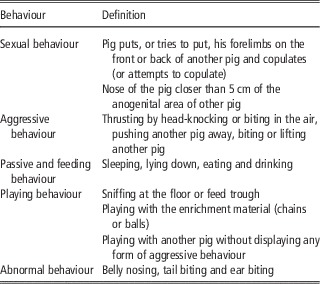
The behaviour of all pigs was observed 2 h after regrouping of the weaned piglets. Between 6 weeks of age and slaughter, the observations took place every 2 weeks. The behaviour at weaning and the behaviour during the remainder of the rearing period were analysed separately. The observations were always performed between 14 and 17 h, as pigs are usually most active during that time of the day (Ingram and Dauncey, Reference Ingram and Dauncey1985). Scan sampling was performed after a 20-min period of habituation to the observer. The animals were observed for 10×1 min per pen, with a 3-min interval between each observation. Their behaviour was recorded according to the ethogram in Table 1. The number of pigs per pen displaying the various types of behaviour during each of the 1 min observation periods was recorded.
Ethogram of recorded behaviours

Skin lesions and lameness
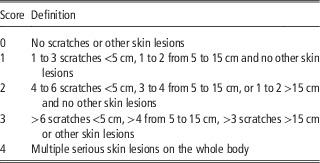
Skin lesions and lameness were monitored as an indication of the cumulative consequence of aggressive and sexual behaviour (Turner et al., Reference Turner, Farnworth, White, Brotherstone, Mendl, Knap, Penny and Lawrence2006). Skin lesions and lameness per individual pig were monitored the first time just before regrouping of the weaned piglets and a second time 24 h after weaning. From then on, the monitoring of skin lesions and lameness took place after the behaviour monitoring. Skin lesions on four body regions (head, anterior area, back and caudal area) were scored separately on a scale from 0 to 4 (Table 2). Mean scores of head and anterior area were used for further analysis, as well as the mean scores of the back and caudal area. Lameness was scored categorical as lame or not lame with lame ranging from a pig which moves not fluid to a pig which does not place his affected limb on the floor and is very unwilling to move.
Scoring scale of the skin lesions

Statistical analysis
For statistical analysis, the pen was considered as experimental unit. Parameters assessed on individual animals were considered as repeated measurements within a pen. All variables were analysed by ANOVA with sex, genotype and the interaction between sex and genotype as fixed factors (R Core Team, 2013). Differences were considered significant if P<0.05. Tukey’s post hoc test was used to compare treatment means. When the P-value for interaction terms was above 0.05, the interaction term was excluded from the statistical models.
Behaviour and skin lesions of the animals were analysed as repeated measurements (age) with genotype, sex, and the interaction term genotype×sex and age as fixed factors and pen and round as random factors. For percentage lame pigs, a logistic regression was used because the data were binomially distributed with genotype, sex, and the interaction term genotype×sex as fixed factor and pen and round as random factors.
Testosterone, androstenone, indole and skatole concentrations in plasma were not normally distributed and were therefore logarithmically transformed (natural logarithms) for further statistical analysis. They were analysed as repeated measurements (age) with genotype, and age as fixed factors and pen and round as random factors.
Testes weight at slaughter, weight and age at the first preputial smear test and performance parameters (weight and age at slaughter) were analysed with genotype as fixed factor and pen and round as random factors. For percentage gilts and boars in puberty, a logistic regression was used because the data were binomially distributed with genotype and age at slaughter as fixed factor and pen and round as random factors.
Results
Ten of the pigs (three AA boars, two AA gilts, one GG boar and four GG gilts) were either euthanized or removed from the experiment due to illness or lameness.
Evolution of plasma testosterone, androstenone, skatole and indole levels
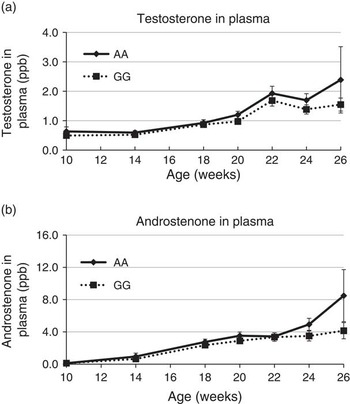
MC4R genotype did not significantly affect testosterone concentrations in blood between 10 and 26 weeks of age (P=0.134, Figure 1). Similarly, we did not observe a significant effect of MC4R genotype on the evolution of plasma androstenone concentrations (P=0.143). Both androgens showed a similar evolution with age with a small increase towards slaughter age. The correlation coefficient between plasma testosterone and plasma androstenone level varied in time between r=0.16 (P=0.421) and r=0.41 (P=0.007) in boars of the AA genotype and between r=0.22 (P=0.137) and r=0.62 (P<0.001) in boars of the GG genotype.
The effect of MC4R genotype on the evolution of testosterone (a) and androstenone (b) in plasma between 10 and 26 weeks of age in boars. Data represented as group mean and s.e.m.

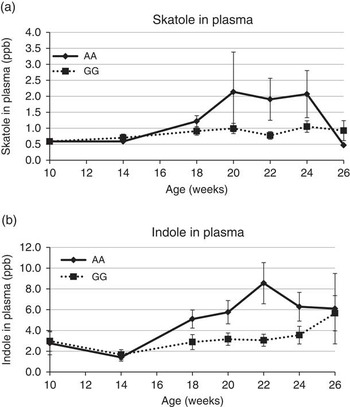
Between the age of 10 and 26 weeks, skatole concentrations differed significantly between AA and GG boars (P=0.003, Figure 2) and indole concentrations tended to be affected by the MC4R genotype (P=0.074) with AA boars having higher concentrations of both boar taint compounds compared with GG boars.
The effect of MC4R genotype on the evolution of skatole (a) and indole (b) in plasma between 10 and 26 weeks of age in boars. Data represented as group mean and s.e.m.

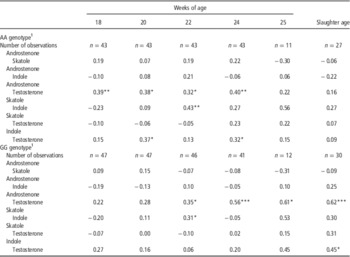
We observed no significant correlations between androstenone and skatole, between androstenone and indole, or between skatole and testosterone at any time point for both AA and GG boars (Table 3). Skatole was significantly and moderately correlated with indole in both genotype groups at 22 weeks of age but not at other pig ages. Indole was correlated with testosterone at 20 and 24 weeks of age in AA boars and at slaughter age in GG boars.
Pearson’s correlation coefficients (r) between boar taint compounds androstenone, skatole and indole and testosterone concentrations in plasma of AA and GG boars at different weeks of age

1 Genotype of codon 893 of the melanocortin-4 receptor gene, coding for the polymorphism Asp298Asn of the melanocortin-4 receptor protein.
Significant correlations are marked as *(P<0.05), **(P<0.01) and ***(P<0.001).
Sexual maturity
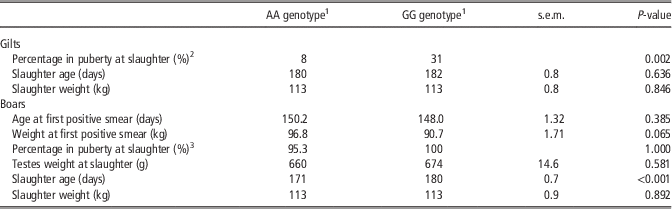
A lower percentage of gilts of the AA genotype (8%) compared with gilts of the GG genotype (31%) were in puberty at slaughter (P=0.002) (Table 4). MC4R genotype did not affect slaughter age of the gilts.
The effect of MC4R genotype on reproduction related variables in boars and gilts (means)

1 Genotype of codon 893 of the melanocortin-4 receptor gene, coding for the polymorphism Asp298Asn of the melanocortin-4 receptor protein.
2 Corpora lutea present in ovaries.
3 Spermatozoa present in testes.
Genotype did not affect age of first positive preputial smear of boars (P=0.385) but tended to affect weight at first positive smear (P=0.065), that is at the onset of puberty (Table 4). Two boars of the AA genotype did not have spermatozoa present in their testes at slaughter. All other boars had reached puberty at slaughter age. MC4R genotype had no significant effect on testes weight at slaughter (Table 4). Boars of the AA genotype were younger (P<0.001) at slaughter compared with boars of the GG genotype.
Behaviour, skin lesions and lameness
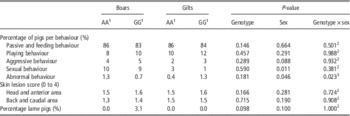
At weaning, an interaction between MC4R genotype and sex was observed for abnormal behaviour although no differences between individual treatments could be determined by Tukey’s post hoc test. The MC4R genotype had no effect on passive and feeding behaviour, playing, aggressive behaviour, sexual behaviour, or skin lesions at weaning (Table 5). A higher percentage of the GG genotype pigs tended to be lame (P=0.098). Boars showed significantly more sexual behaviour (P=0.011) and tended to show more aggressive behaviour (P=0.088) compared with gilts at weaning. Sex had no influence on passive and feeding behaviour; playing behaviour; skin lesions; or lameness at weaning.
The effect of MC4R genotype and sex on behaviour, skin lesion and lameness scores at weaning (LSmeans)

1 Genotype of codon 893 of the melanocortin-4 receptor gene, coding for the polymorphism Asp298Asn of the melanocortin-4 receptor protein.
2 The interaction was not significant (P>0.05). The interaction term was excluded from the statistical model.
3 No differences between individual groups could be determined by Tukey’s post hoc test.
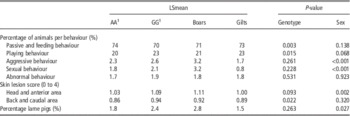
During the period from 6 weeks of age to slaughter, boars showed more aggressive (P<0.001) and sexual behaviour (P<0.001) and tended to show less playing behaviour (P=0.068) compared with gilts. They had more skin lesions on their head and anterior area (P=0.002) and a higher percentage of lameness (P=0.027) compared with gilts. Passive and feeding behaviour and abnormal behaviour and skin lesions on the back and caudal area were not affected by sex. Irrespective of gender, pigs of the GG genotype showed less passive and feeding behaviour (P=0.003) and more playing behaviour (P=0.015) compared with pigs of the AA genotype (Table 6). The pigs of the GG genotype showed more skin lesions on their back and caudal area (P=0.022) and tended to show more skin lesions at their head and anterior area (P=0.093) compared with pigs of the AA genotype. Lameness of the pigs was not affected by MC4R genotype.
The effect of MC4R genotype and sex on behaviour, skin lesion and lameness scores between 6 weeks of age and slaughter (LSmeans)

1 Genotype of codon 893 of the melanocortin-4 receptor gene, coding for the polymorphism Asp298Asn of the melanocortin-4 receptor protein.
The P-values of the interaction terms of all parameters were above 0.05. The interaction terms were excluded from all statistical models and therefore not presented in the table.
Discussion
Schroyen et al. (Reference Schroyen, Janssens, Stinckens, Brebels, Bertolini, Lamberigts, Bekaert, Vanhaecke, Aluwé, Tuyttens, Millet and Buys2015) showed that the Asp298Asn polymorphism of the MC4R gene could serve as a marker for boar taint. The A allele was associated with a higher boar taint odour score assigned by experts compared with the G allele. We reported earlier (Van den Broeke et al., Reference Van den Broeke, Aluwé, Tuyttens, Ampe, Vanhaecke, Wauters, Janssens, Coussé, Buys and Millet2015) that the concentrations of the three boar taint compounds androstenone, skatole, and indole were significantly higher in fat of AA boars compared with GG boars. The aim of the present study was to assess the effect of the marker on plasma boar taint compound and testosterone levels and to detect possible side effects of selection towards the GG genotype on sexual maturity and behaviour of boars and gilts.
Boar taint
The plasma concentrations of skatole differed significantly and the plasma concentrations of indole tended to differ between AA and GG boars. Both boar taint compounds peaked between 20 and 24 weeks of age, but only in the boars of the AA genotype. The pattern of plasma skatole concentration of the AA boars is similar as the pattern observed by Zamaratskaia et al. (Reference Zamaratskaia, Babol, Andersson and Lundstrom2004): they reported a small increase at 20 weeks and a decrease to the baseline at 26 weeks similar to our results for AA animals. However, they observed a second high peak in skatole concentration at 29 weeks, following the peak of testosterone at 25 to 28 weeks. We also observed a similar peak in plasma testosterone level, but could not evaluate if this leads to a peak in skatole as most animals were slaughtered before the age of 29 weeks. We only found a consistent moderate to high correlation between androstenone and testosterone in both genotypes. This is in line with the results of Zamaratskaia et al. (Reference Zamaratskaia, Babol, Andersson and Lundstrom2004) who found a positive correlation from 14 weeks of age until 24 weeks of age between both steroids ranging from r=0.34 (P<0.005) to r=0.79 (P<0.005).
The effect of the MC4R marker on the reduction of the prevalence of boar taint in boars of the GG genotype (Van den Broeke et al., Reference Van den Broeke, Aluwé, Tuyttens, Ampe, Vanhaecke, Wauters, Janssens, Coussé, Buys and Millet2015) is therefore probably due to its effect on skatole and indole concentration in the plasma, rather than an effect on androstenone levels. However, it remains unclear how a polymorphism in the MC4R gene, which is known to affect daily gain and lean meat percentage (Kim et al., Reference Kim, Larsen, Short, Plastow and Rothschild2000), can affect the plasma concentration of skatole and indole. Both compounds are produced in the colon via degradation of the amino acid tryptophan by intestinal bacteria (Zamaratskaia and Squires, Reference Zamaratskaia and Squires2009). The main origin of tryptophan as precursor for skatole and indole is cell debris from the turnover of intestinal cells (Claus et al., Reference Claus, Weiler and Herzog1994; Wesoly and Weiler, Reference Wesoly and Weiler2012). A higher turnover of intestinal cells will lead to more tryptophan in the colon (Claus et al., Reference Claus, Weiler and Herzog1994). The turnover of intestinal cells could be influenced by the daily feed intake of the pigs. Weiler et al. (Reference Weiler, Götz, Schmidt, Otto and Müller2013) showed a significant positive correlation between the feed intake rate and the skatole concentration of barrows and immunocastrates, which both have high daily feed intakes. They speculate that this effect could be explained by changes in the intestinal microbial composition of pigs with a high daily feed intake or a difference in cell turnover leading to higher amounts of cell debris. Boars of the AA genotype have a higher daily feed intake compared with GG boars (Van den Broeke et al., Reference Van den Broeke, Aluwé, Tuyttens, Ampe, Vanhaecke, Wauters, Janssens, Coussé, Buys and Millet2015). Therefore, we hypothesize that the higher daily feed intake of the AA boars could lead to a higher turnover of the intestinal cells and therefore to more tryptophan in the colon, leading to higher plasma concentrations of skatole and indole in AA boars compared with GG boars. To confirm our hypothesis, it would be interesting to perform a study in which the pigs of both genotypes receive the same amount of feed during the finishing period and determine if we can than still observe differences in plasma and fat concentrations of skatole and indole between both genotype groups. However, it is common practice to feed Belgian pigs ad libitum, and selecting towards the MC4R polymorphism will automatically induce a difference in feed consumption.
Sexual maturity
Common methods to evaluate the onset of puberty in pigs are the observation of the first sexual behaviour, first ejaculate, first ejaculate containing spermatozoa, and first ejaculate containing a threshold of number of fertile spermatozoa (Oskam et al., Reference Oskam, Ropstad, Berg, Fredriksen, Larsen, Dahl and Andresen2008). We chose to use the preputial smear test in order to investigate the onset of puberty in male pigs in a cost- and time-effective way. This relies on the assumption that boars are sexually mature when they can copulate and produce fertile spermatozoa.
The mean age of the first positive preputial smear test was at 21 weeks: this did not differ significantly between boars of the AA and GG genotype. Boars of the AA genotype (97 kg) tended to weigh more than GG males (91 kg) at first positive preputial smear test. This may be a result of the increased feed intake and consequently higher daily gain of pigs of the AA genotype (Van den Broeke et al., Reference Van den Broeke, Aluwé, Tuyttens, Ampe, Vanhaecke, Wauters, Janssens, Coussé, Buys and Millet2015). This might suggest that in these pigs, puberty was determined by age rather than by weight. The latter is supported by the finding that there was no significant difference between AA and GG boars in testosterone profile at different ages even though their growth rate and consequently their weight and body composition differed significantly at the same age. Moreover, testes weight did not differ between the two genotype groups. Testes weight is highly correlated with the mean diameter of the seminiferous tubules and can therefore be used to indicate testicular development (Ford and Wise, Reference Ford and Wise2011). Thus, based on the preputial smear test, testes weight and plasma testosterone level, it can be assumed that the onset of puberty in boars is not affected by MC4R marker-assisted selection. Still, with the faster growth of AA animals and therefore their younger age at slaughter, the chance of finding animals in puberty at commercial slaughter weight seems lower in AA v. GG animals. This coincides with the finding that two boars of the AA genotype did not have any spermatozoa present in their testes at slaughter. Those animals were 162 and 165 days of age at slaughter; they were among the youngest boars at slaughter.
A higher percentage of GG gilts were in puberty at slaughter compared with AA gilts. However, we reported earlier (Van den Broeke et al., Reference Van den Broeke, Aluwé, Tuyttens, Ampe, Vanhaecke, Wauters, Janssens, Coussé, Buys and Millet2015) that slaughter age and weight did not differ significantly between females of different genotype groups. Multiple researchers have proposed that the attainment of puberty in gilts is related to the achieving of a certain threshold of body tissue such as fat or lean meat or the growth rate of those tissues (Beltranena et al., Reference Beltranena, Aherne, Foxcroft and Kirkwood1991; Gaughan et al., Reference Gaughan, Cameron, Dryden and Young1997; Kummer et al., Reference Kummer, Bernardi, Schenkel, Amaral Filha, Wentz and Bortolozzo2009).
We did not find a significant correlation between conformation parameters like meat percentage, backfat thickness, muscle thickness, ham width and ham angle and whether or not gilts were in puberty (data not shown) even though body composition between AA and GG animals differed at slaughter. AA gilts had lower meat percentage and muscle thickness, higher fat thickness and lower ham width compared with GG gilts (Van den Broeke et al., Reference Van den Broeke, Aluwé, Tuyttens, Ampe, Vanhaecke, Wauters, Janssens, Coussé, Buys and Millet2015). Our results are therefore in accordance with the results of Rozeboom et al. (Reference Rozeboom, Pettigrew, Moser, Cornelius and El Kandelgy1995) and Patterson et al. (Reference Patterson, Ball, Willis, Aherne and Foxcroft2002), that is that no association can be found between body conformation and the attainment of puberty in gilts.
Therefore, the physiological mechanism behind the observation that AA gilts have a lower chance of being in puberty at slaughter weight remains unclear. In mice, it has been shown that the MC4R receptor is also involved in the regulation of GnRH neuron activity (Israel et al., Reference Israel, Sheffer-Babila, de Luca, Jo, Liu, Xia, Spergel, Dun, Dun and Chua2012) and therefore a mutation of the receptor that causes a loss of function, might delay pubertal development and reproduction. Further research is needed to elucidate if the mechanism observed in mice also exists in pigs.
A practical consequence is that selection towards GG genotyped animals to reduce the prevalence of boar taint will lead to a higher percentage of gilts in puberty at 115 kg. If selection is performed via the dam lines, this could have positive effects on the reproduction characteristics of the gilts. Gilts attaining puberty at a younger age are more fertile, for example produce more total born, born alive or weaned piglets, over their first three parities compared with gilts attaining puberty at an older age (Nelson et al., Reference Nelson, Mabry, Benyshek and Marks1990; Young et al., Reference Young, Tokach, Aherne, Dritz, Goodband, Nelssen and Loughin2008). In commercial growing-finishing pigs, however, sexually mature gilts could become pregnant when reared in mixed pens. Slaughtering pregnant gilts should be avoided for ethical reasons; therefore single-sex rearing of GG pigs is recommended (Rydhmer et al., Reference Rydhmer, Zamaratskaia, Andersson, Algers, Guillemet and Lundstrom2006).
Behaviour, skin lesions and lameness
A higher percentage of AA animals showed passive and feeding behaviour compared with GG animals. Because passive behaviour and feeding behaviour was recorded as one behaviour, we cannot differentiate between them. However, AA animals have a higher daily feed intake compared wit GG animals (Van den Broeke et al., Reference Van den Broeke, Aluwé, Tuyttens, Ampe, Vanhaecke, Wauters, Janssens, Coussé, Buys and Millet2015). Animals of the AA genotype probably spent more time a day at the feeder, leading to a higher feed intake. We can not differentiate if the AA pigs also show more passive behaviour. A lower percentage of AA animals showed playing behaviour compared with GG animals, probably because they were feeding instead of playing.
In boars, androgens such as testosterone and pheromones such as androstenone affect aggressive and sexual behaviour (Dorries et al., Reference Dorries, Adkinsregan and Halpern1991). Influencing the metabolism of testicular steroids and their metabolites by selection towards lower prevalence of boar taint can therefore affect such behaviour. As animals did not differ in the plasma levels of these compounds, it seems logical that we did not detect significant differences in sexual and aggressive behaviour between these genotype groups. Still, pigs of the GG genotype had more skin lesions on their back and caudal area and a tendency towards more skin lesions on their head and anterior area was observed. Skin lesions on the anterior area are mostly caused by reciprocal fights with pen mates (Turner et al., Reference Turner, Farnworth, White, Brotherstone, Mendl, Knap, Penny and Lawrence2006), but scratches on the body can also be caused by mounting (Rydhmer et al., Reference Rydhmer, Zamaratskaia, Andersson, Algers, Guillemet and Lundstrom2006). The discrepancy between the skin lesions and behavioural observations could be due to the rather basic observation method which was limited to a relatively short period of scan-sampling recording once every 2 weeks. On the other hand, our basic observation appeared adequate to detect differences in sexual and aggressive behaviour between boars and gilts, which are in line with common knowledge (Rydhmer et al., Reference Rydhmer, Zamaratskaia, Andersson, Algers, Guillemet and Lundstrom2006). Therefore, we tentatively conclude that possible differences in sexual and aggressive behaviour between AA and GG boars – if any – will be less compared with the differences between gilts and boars. Nevertheless, our findings indicate that selection towards a lower prevalence of boar taint may lead to boars with more skin lesions. Management strategies may therefore be warranted to reduce skin lesions.
Conclusions
In conclusion, the polymorphism in the MC4R gene reduces the prevalence of boar taint by reducing the levels of skatole and a tendency to reduce the levels of indole in the plasma. It did not affect the androstenone or testosterone production during the lifetime of fattening boars, thus reproduction characteristics are not negatively affected in boars. A higher percentage of gilts may be in puberty at slaughter age when selecting towards lower prevalence of boar taint. Moreover, activity level and skin lesions in boars and gilts may increase due to selection.
Acknowledgements
This research was funded by a grant of the Agency for Innovation by Science and Technology (IWT080491). The authors thank M. Audenaert, B. De Bock, J. Devos, L. Dewilde, K. Dierkens, R. Limpens, J. Staels and H. Uitterhaegen for their excellent practical support. The authors also thank M. Levenson for English-language editing.