The letter printed here is preserved in the Bibliothèque municipale at Toulouse, copied into what would otherwise have been a blank space on the final folio of manuscript 152, a mid to late twelfth-century compilation which includes Cassian's Collations and various saints’ Lives, ending with a life of St Hylarion, after which the letter is introduced with the simple, contemporary heading ‘Monachi’.Footnote 1 The manuscript belonged to and so far as can be judged was originally written by the monks of Grandselve in Languedoc, whence it passed to the Franciscan convent at Toulouse and thence into public custody.Footnote 2 In 1686, whilst the manuscript was still in the possession of the Franciscans, the letter was noticed by the Benedictine antiquary Dom Jean Martianay, who sent a transcript of it to Dom Thierry Ruinart, intended for the attention of Mabillon and the Maurists of St-Germain-des-Prés. Martianay's transcript, which today survives amongst Ruinart's correspondence in the Bibliothèque municipale at Reims, has twice been published, but on both occasions in places so obscure as entirely to have escaped the notice of historians of the Anglo-Norman realm.Footnote 3 Martianay himself believed that the letter dated to the tenth century, despite apparently confusing its addressee with the eleventh-century Henry i of France (1031–60).Footnote 4 The inaccuracies and lacunae in Martianay's transcription suggest that even by the 1680s the letter was partially illegible, various characters and on occasion entire words having been rubbed away, particularly those in the left- and right-hand margins and towards the end, presumably at a time when the manuscript was disbound and this, the final folio, was made to serve as an outer cover.Footnote 5 Fortunately, and despite the fact that ultra-violet light fails to reveal the lost characters, the letter quotes so extensively from Scripture that virtually all the missing portions can be satisfactorily reconstructed. The scribe's method of quoting from Scripture is itself indicative of the manuscript's monastic provenance, since he cites only the opening two or three words of each scriptural quotation, thereafter supplying initial letters to complete each passage. The other works collected in this manuscript, all of them turning upon the Lives of the earliest monastic Fathers, would have been peculiarly appropriate for a monastic community which, as at Grandselve, was newly embarked upon the search for a rule by which to live.
The letter is in fact to be identified as one addressed by Bishop A(melius) of Toulouse (c. 1105–39) to King Henry – clearly Henry i – of England (1100–35).Footnote 6 Having learned of the king's great works, ‘the sound of which has gone out to all the land’ (Psalm xviii.5), and having heard tell that Henry – unlike those who, the Psalmist says, ‘Sank into sleep, and all the men of war were unable to use their hands’ (Psalm lxxv.6) – is a king who stores up treasure in heaven (Matthew vi.19–20) and who, like God himself, does not deign to appear ‘poorer than the paupers of Christ’, the bishop proceeds to practicalities. Stating that he has no intention of tiring Henry with a lengthy sermon (and how many times, one wonders, must kings have listened to just such words with a dread sense of foreboding), the bishop asks that Henry receive the abbot and monks of Grandselve who have begun to build a Benedictine church and cloister in the great wood, known as La Grande Forêt (‘Grandis Silva’), within the diocese of Toulouse. The king is enjoined ‘out of fear and love’ and ‘through penitence and true obedience’ to bestow alms on the monks, so that he may earn the praises of Christ as expressed in the beatitudes: ‘Come to me you blessed ones to receive the kingdom’, and ‘What you did to the least of my brethren you did to me’ (Matt. xxv.34, 40).
Throughout, the bishop's letter quotes extensively from Scripture, giving some insight both into Bishop Amelius' spiritual concerns and the perceived interests of King Henry. In particular, the terms of the bishop's appeal chime with the newly emerging emphasis upon charity to the poor and penance for sins as the defining features of twelfth-century lay spirituality. Not only does the letter lay heavy stress upon Christ's poverty, but through emphasising Henry i's penitential obligations might serve to remind us that Henry is the first English king known to have sought confession from his own court confessor.Footnote 7 Indeed, Bishop Amelius' injunction to the king to bestow alms ‘out of fear and love’ (‘timore et amore’) very neatly encapsulates the transformation taking place in the Church's approach to its benefactors, in which fear of damnation was being replaced by a striving after penance and the love of Christ as the predominant features of lay piety to which appeal might be made. By the same token, the letter supplies some indication of the sort of written petition that early twelfth-century kings must have received on a more or less daily basis. Only seldom have such letters been preserved, but, as in this instance, their language tends, even as early as this, to display a sophisticated rhetoric in which the simplest requests are advanced within an elaborate captatio benevolentiae. Footnote 8 Elements of this are to be observed in the address, in which King Henry's name precedes that of the bishop writing the letter; the use of the second person plural for the king matched to the first person plural used by the bishop; and in such phrases as ‘the greatest highess of your wisdom'and ‘as befits your magnificence’.Footnote 9
The letter demonstrates that the reputation of Henry i, and in particular his reputation for pious generosity towards monks, had travelled as far south as Toulouse. Henry i's contacts with monasticism beyond the Anglo-Norman realm have been explored by most modern historians of his reign, and are known to have included patronage extended to the religious of Cluny as well as to others of the monastic congregations of Flanders, Picardy and the Ile-de-France.Footnote 10 South of the Loire, too, Henry is known to have patronised the new community at Fontevraud on the frontier between Anjou and Poitou, to which in 1129 he granted substantial annual pensions both in England and Normandy, increased yet further in 1131, apparently as part of the king's wider diplomatic strategy to establish relations with the county of Anjou.Footnote 11 In England, he confirmed various grants of land made to the Benedictine monks of Charroux in Poitou, to Conques in the Rouergue north of Rodez, and to La Sauve-Majeure near Bordeaux.Footnote 12 It was in Henry's reign, too, that Ralph fitz Brian and his wife founded an Augustinian priory at Great Bricett in Suffolk as a dependency of the abbey of St-Léonard-de-Noblat near Limoges, which itself may have attracted a charter from Henry i, now lost.Footnote 13 Most of these grants, it should be noticed, were made as the result of pilgrimages by Anglo-Norman barons, either to Compostela (as in the case of La Sauve-Majeure), or to the greater shrines of southern France (as at Conques or St-Léonard) themselves lying on the pilgrim route to Spain.Footnote 14 Pilgrimage, in other words, served as a significant, perhaps as the most important, point of contact between the Anglo-Norman realm and southern France.
Despite these contacts, the decision of the monks of Grandselve to seek support from Henry i must be accounted somewhat surprising. Grandselve itself was never a major pilgrimage centre and lay some way from the routes to Compostela. Founded in about 1114, it was the latest in a series of monastic communities, hovering on the margin between the monastic and heremetical life, established by St Gerard de Sales (d.1120), founder in turn of the houses of Dalon in the Limousin, Cadouin in Périgord and Les Châteliers in Poitou, each of which was to establish itself as the mother-house of a small monastic congregation, in the majority of cases later subsumed within the wider family of Cîteaux.Footnote 15 Grandselve was established, like both Dalon (1114) and Cadouin (1115×1119), as a Benedictine house, but at least as early as 1117 is purported, in a charter attributed to Bishop Amelius of Toulouse, to have been following the custom of the Cistercians under whose custody it had been placed (‘regulam beati Benedicti teneant more Cisterciensium qui laudabiliter eam custodiunt’).Footnote 16 Full affiliation with the Cistercians was none the less not achieved for at least a further thirty years. In the meantime, Grandselve was placed under the obedience of Benedictine Cadouin: an arrangement which was clearly challenged by Grandselve's monks, but which Pope Innocent ii required to be observed in a mandate addressed to the bishop of Toulouse in Cadouin's favour at some time after 1138.Footnote 17 In 1142, however, the pope could once again refer to Grandselve as established ‘secundum beati Benedicti regulam et institutionem fratrum Cisterciensium’,Footnote 18 and by 1147, perhaps as the result of St Bernard's tour of Aquitaine in 1145, the monks had achieved admission into the Cistercian congregation, henceforth being treated as a daughter house of Clairvaux.Footnote 19 Dalon was likewise affiliated to the Cistercians by 1162: Cadouin not until the early thirteenth century and even then somewhat ineffectively.Footnote 20
The incorporation of these houses within the Cistercian family supplies a splendid illustration of Constance Berman's argument that it was through such incorporations of pre-existing houses rather than through the foundation de novo of fully affiliated Cistercian houses that Cistercian ideals were first widely broadcast.Footnote 21 As Berman has shown, whatever the later claims of such houses to have been Cistercian from their earliest beginnings, many such claims were the result of wishful thinking supported by pious forgery of documents. In this respect our letter is of particular significance since it makes no mention of any affiliation to Cîteaux or Cadouin, and defines Grandselve merely as a Benedictine house dedicated to an impressive list of patron saints: the Virgin Mary, St Michael, St John the Baptist, SS Peter and Paul and at least one other saint whose name is now illegible. This in itself may suggest that the bishop believed Cîteaux to be too obscure a house to refer to in writing to the king of England, or that the letter itself should be dated very early in Grandselve's history, or most probably that Grandselve's affiliation to Cîteaux was only a gradual and perhaps a long-delayed process. Cistercian houses traditionally admitted no dedication other than to the Virgin Mary, and it was as a house dedicated to God and St Mary that Grandselve was to be described in all of its charters, at least from the 1120s onwards.Footnote 22 In the very earliest surviving charter, however, issued by Bishop Amelius, the community is described as dedicated to God, St Mary and St Mary Magdalene, suggesting to Constance Berman that there may have been an intended link, not between Grandselve and Cîteaux but, at this early stage, between Grandselve and Robert of Arbrissel's foundation at Fontevraud.Footnote 23 The even more impressive list of patron saints in Bishop Amelius’ letter to Henry i suggests that the letter itself was written before the adoption of Mary as sole patron, and hence very early in the abbey's history.
The references to SS Peter and Paul and to St Michael the Archangel in this context are particularly intriguing. Peter and Paul would suggest a desire for papal protection. The patronage of St Michael, however, appears in no other charter of Grandselve, and can perhaps be read as an indication of Bishop Amelius’ desire to appeal to the particular sympathies of King Henry of England, already a patron of the monks of Mont-St-Michel in Normandy. Indeed, one potential channel of communications between Grandselve and Henry i passed via Mont-St-Michel, since Grandselve's founder, Gerard de Sales, is said to have had a disciple who resided at Mont-St-Michel, presumably as a Benedictine monk. Through calling upon Gerard's intercession, this man was miraculously rescued from shipwreck.Footnote 24 Mont-St-Michel, however, was by no means the only or indeed the most probable link between Grandselve and England. Much more significant is the fact that Gerard de Sales, Granselve's founder, had begun his monastic career as a follower of Robert of Arbrissel, and that it was Robert who was credited with a leading role in the establishment of Gerard's various foundations. As the founder of Fontevraud, Robert and his pious reputation were already well known both in England and in Normandy, with Henry i making the first of a series of grants to Fontevraud in the 1120s, only shortly after Robert's death in 1116.Footnote 25 Robert of Arbrissel may well have supplied the principal link between England, Amelius of Toulouse and Gerard de Sales's new abbey, thereby further strengthening Constance Berman's suggestion that it was as a Fontevraudist foundation that Grandselve was originally conceived, although it is important to notice here that the bishop's letter to Henry i refers to an abbot and monks rather than to hermits, and to men alone rather than to a double foundation, as at Fontevraud, for both men and women.
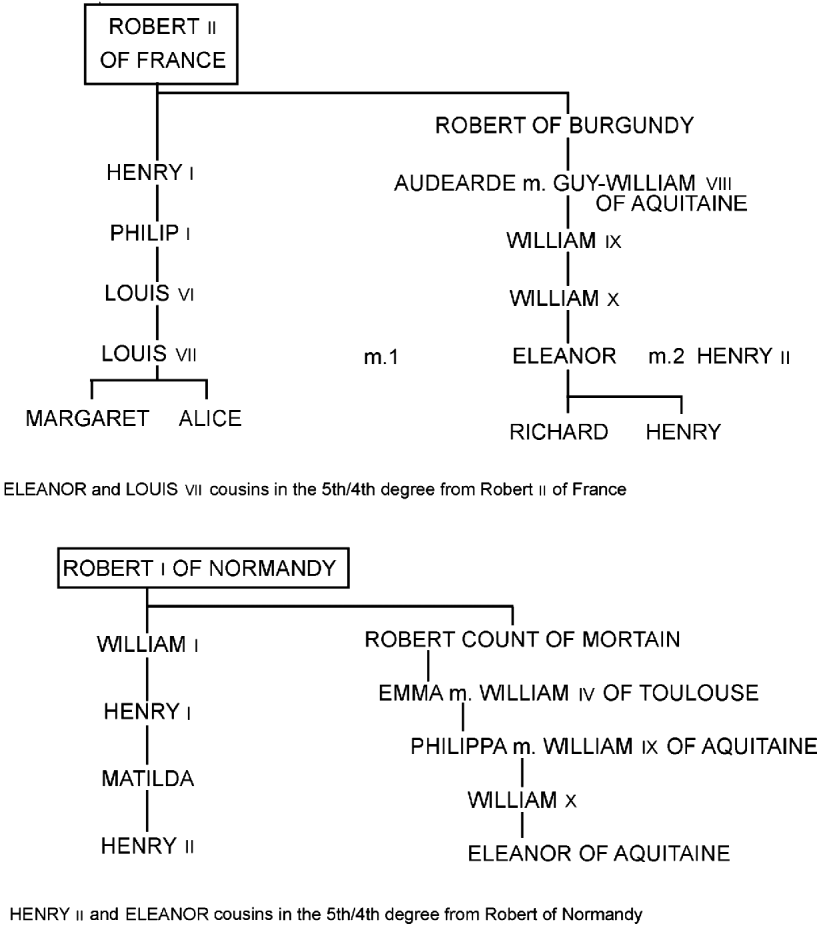
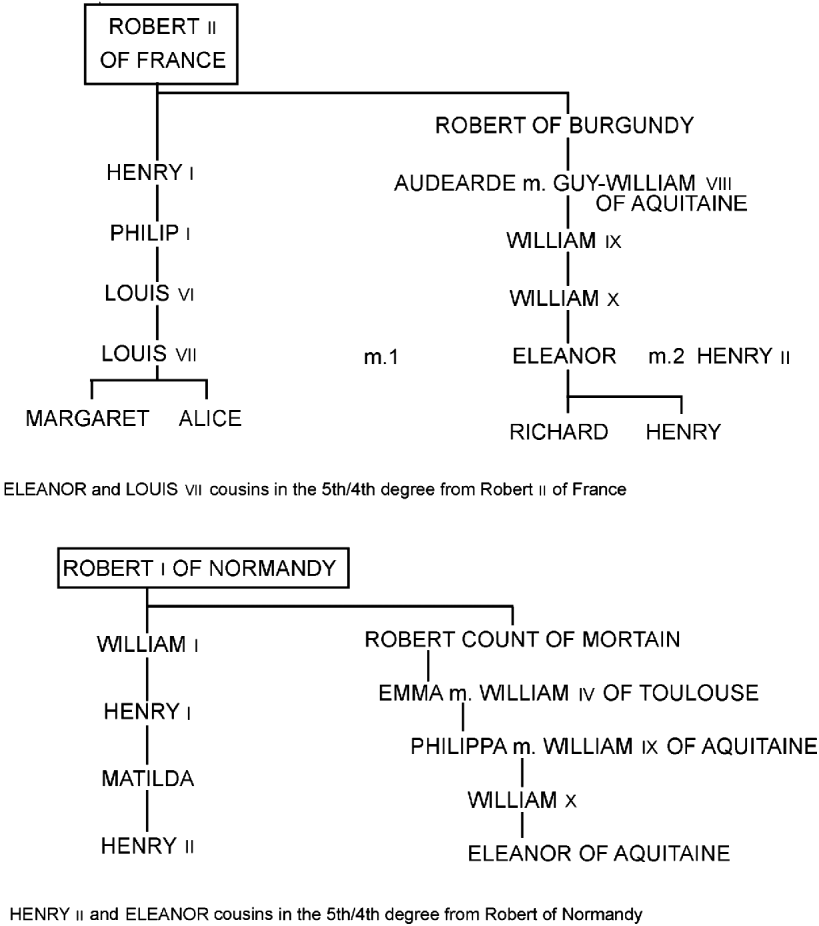
One other potential point of contact between Grandselve and England remains to be explored, that may in addition make it possible to confirm an early date for Bishop Amelius' appeal to King Henry. Toulouse and its surrounding region had achieved notoriety in early twelfth-century Europe not, as was later to be the case, because of the perceived heresy of its local population, but because of the political fortunes of the counts of Toulouse. Count Raymond iv had served in company with Henry i's brother, Robert Curthose, as one of the leaders of the First Crusade. Raymond and Robert, indeed, were close kinsmen, since Raymond's brother, count William iv of Toulouse (d.1093) had married Emma, a daughter of Robert of Mortain, the half-brother of Robert Curthose's father King William i: a relationship that is complicated to describe in words, but which when plotted on a family tree is clear (see fig. 1).
Family tree illustrating the relationships between the kings of England and France and the counts of Toulouse.
It was the refusal of Raymond iv, after 1093, to permit the succession to the county of Toulouse of Philippa, Count William iv's daughter by Emma of Mortain, that was to spark a thirty-year campaign by Philippa and her husband, William ix of Aquitaine, to obtain possession: a campaign that was to result, in 1098, again in about 1112, and finally around 1123, in periods during which William ix and Philippa rather than Raymond iv or his sons Bertrand and Alfonso-Jordan, appear to have ruled in Toulouse.Footnote 26
For present purposes, what is significant about these disputes is that they must necessarily have been of interest to the kings of England, to begin with because Philippa of Toulouse was kin to Henry i, and thereafter because Philippa and her husband may well have called upon English assistance in their bids to gain control of Philippa's inheritance. In 1098, in the same year that he acquired his first temporary control over Toulouse, William ix is to be found in the Vexin, as an ally of William ii of England against the French king, Philip i.Footnote 27 Eighteen months later, in the aftermath of the crusaders’ capture of Jerusalem, William ix is said, both by Orderic Vitalis and by William of Malmesbury, to have proposed leading a great expedition of his own to the Holy Land, to be paid for by pledging the duchy of Aquitaine to William Rufus, in much the same way that Rufus had previously purchased control of Normandy from his brother, Robert Curthose, during the First Crusade. Rufus is said to have been so keen to accept this proposal that he boasted of spending Christmas 1100 at Poitiers and of extending the boundaries of his empire as far south as the river Garonne.Footnote 28 Together with the projected purchase of Aquitaine and Gascony, Rufus would also, presumably, have been in a position to pursue William ix's claims to the county of Toulouse.
In the event, of course, Rufus died before any such plan could be brought to fruition. None the less, the memory both of his negotiations with Aquitaine and of the links between the ruling houses of Normandy, Aquitaine and Toulouse may well have lingered on into the reign of Rufus' brother, Henry i, the kinship between Robert Curthose of Normandy and Raymond of Toulouse having already played its part, perhaps, in the joint participation by Robert and Raymond in the First Crusade. Certainly, by the 1120s, Henry i of England would have been aware of a new crisis looming in southern France, this time over the succession to the duchy of Aquitaine following the death of Duke William ix and the installation of his son, William x, with no son of his own to succeed him. It was surely with an eye to this succession dispute and the potential advantages that might accrue from it that King Henry i provided shelter in England to William x's younger brother, Raymond, known, as a result of recent researches by Jonathan Phillipps, to have been resident in England by 1130 at the latest.Footnote 29 Raymond's claim to Aquitaine, as a younger brother of the ruling duke, exactly paralleled that advanced in the 1090s by Raymond of St-Gilles to the county of Toulouse. In both instances, the claims of a younger brother were set against those of a daughter: Philippa in the case of Toulouse; Eleanor, daughter of William x, in the case of Aquitaine. Whereas Raymond of St-Gilles was to succeed in his claims to Toulouse after 1093, Raymond, the brother of William x, was effectively to abdicate his rights to Aquitaine, retiring to the Holy Land to rule as Prince of Antioch by virtue of his marriage to Constance, daughter of Bohemund ii of Antioch. The parallels between the Toulouse and the Aquitaine succession disputes must none the less have been obvious to contemporaries, and may help to explain one of the greater sources of gossip in twelfth-century political history: the close understanding that seems to have grown up between Eleanor of Aquitaine and her uncle, Raymond of Antioch, during the course of the Second Crusade. Later rumour would have it that, at Antioch, in 1148, Eleanor and Raymond became involved in an incestuous sexual liason.Footnote 30 In reality, one cannot help wondering whether their mutual understanding, and the consequently deep resentment of this by Eleanor's husband, Louis vii, was more political than sexual in nature, being based upon Eleanor and Raymond's shared desire to vindicate their inherited rights to Aquitaine and to loosen the Capetian influence established there as a result of Eleanor's marriage to Louis. If Raymond of St-Gilles could acquire Toulouse, Eleanor may well have speculated, then might not she and her own uncle, Raymond of Antioch, advance a similar claim to rule in Aquitaine?
For present purposes the events of the 1140s remain intriguing but largely irrelevant. What matters is that the succession to Aquitaine and hence the claims of Aquitaine over Toulouse would both have been topics familiar to Henry i. In these circumstances, the decision of the bishop of Toulouse to address a petition to England appears far less surprising than might otherwise be supposed. It is also worth noting that at much the same time that the letter was dispatched to England, Bishop Amelius of Toulouse was closely engaged in the wider diplomatic initiatives of the papacy. In 1118, it was at Toulouse and in the presence of bishop Amelius that the pope's legate issued his appeal for a new expedition against the Moslems of Spain, an appeal that was answered, within the Anglo-Norman realm, by several men close to King Henry i, most notably by Rotrou count of Perche, Henry i's son-in-law: yet another reminder of the connections between southern Europe and the Anglo-Norman realm.Footnote 31 If, as seems likely, Bishop Amelius’ letter to Henry i is to be dated early in the history of Grandselve, then it might sit best with a date around 1118, at a high point in Toulouse's international reputation, mid-way between the occupations of the region by William ix of Aquitaine in c. 1112 and c. 1123.
Quite how Henry i responded to the bishop's call for assistance remains uncertain. The bishop's letters imply not merely a request for alms, but a personal visit to England by the abbot and monks of Grandselve. Such a visit would not have been unprecedented, since other religious communities, from well beyond the frontiers of the Anglo-Norman realm, did organise expeditions to England to solicit alms. The most famous and best documented such visit was that of the canons of Laon cathedral in 1113, but there are hints too of other, perhaps many other, such begging tours by foreign religious, only occasionally and by accident recorded in documentary sources.Footnote 32 At some time after 1128, for example, the Premonstratensian canons of Mariënweerd in the diocese of Utrecht, whose abbot claimed kinship with the Norman kings, obtained from Henry i rich gifts including a golden chalice, precious vestments, a mosaic pavement and a large sapphire.Footnote 33 Perhaps similar gifts, rather than land, were anticipated in the case of Grandselve. But if Grandselve did indeed send envoys to England, no trace of them is to be found in any English source. Nor are any gifts from the kings of England enumerated in the various papal privileges of Grandselve, including a confirmation of the abbey's possessions and liberties issued in 1162 by Pope Alexander iii.Footnote 34 Only in the 1170s did Richard, count of Poitiers, son of the English King Henry ii, begin to award the monks of Grandselve protection and trading privileges on the Garonne, various charters issued by Richard, by his mother Eleanor of Aquitaine, and by his successors as kings of England being preserved in the Grandselve cartularies.Footnote 35 The Plantagenet interest in Grandselve reflects the efforts made by Henry ii, since 1159, to extend his authority as duke of Aquitaine over the county and religious foundations of Toulouse. This in itself, however, carries us back to the dynastic disputes of the early twelfth century, since not only did Henry ii act here in pursuit of the claims to Toulouse vested in his wife, Eleanor of Aquitaine, as a descendant of Philippa and William iv of Toulouse, but Eleanor's descent was itself to be cited in the 1160s as a potential impediment to the legitimacy of her marriage to Henry Plantagenet. As the great-grandaughter of Emma of Mortain, and hence the great-great-great-grandaughter of Duke Robert of Normandy, Eleanor was related, well within the forbidden degrees of kinship, to her second husband, Henry ii, himself Duke Robert's great-great-grandson. Had Henry Plantagenet so wished, he could have sought the annulment of his marriage to Eleanor in much the same way that Eleanor's marriage to Louis vii of France had been annulled on grounds of consanguinity (see fig. 1 above). At least two sources – the record of an ecclesiastical council held at Poitiers in the 1160s, and the Norman chronicler, Robert de Torigny – refer explicity to Henry and Eleanor's common descent from Duke Robert, and is was perhaps this same common descent that lay behind the remarks of Walter Map that, following her divorce from Louis vii, Eleanor began to cast ‘incestuous glances’ in the direction of Henry ii Plantagenet. During Henry's dispute with archbishop Becket, it may well have been the case that Becket earned the yet further hatred of Henry ii by reviving the memory of Henry's kinship to Eleanor as a weapon to be used against the king.Footnote 36 In the 1170s, after Becket's martyrdom, and after Eleanor's abortive rebellion against her husband in 1173, Henry himself is said to have investigated the possibility of a divorce.Footnote 37 That these investigations went no further, and that Henry failed to adopt the strategy adopted earlier by Louis vii of France, reflects Henry's political intelligence, and above all his determination to maintain control over Eleanor's duchy of Aquitaine. Without these political considerations, a divorce would surely have been obtainable both on the grounds of consanguinity and, if the chroniclers are to be believed, because Eleanor, before her marriage to Henry, had enjoyed a brief sexual liason with Henry's own father, Geoffrey Plantagenet.Footnote 38 Relics of Becket, meanwhile, seem to have been acquired by the monks of Grandselve as yet a further reminder of the links between England and the religious of southern France.Footnote 39
As a means of focusing attention upon the complicated but politically significant relations between Toulouse, Aquitaine and the English crown, as a means of access to lay spirituality, and as a reminder of the reputation of King Henry i, in this instance broadcast even as far south as Languedoc, our letter can claim to be something more than a mere curiosity. Certainly, it deserves henceforth to join the other evidences cited in proof of Henry i's wider European interests.
Appendix
Letters of Bishop Amelius of Toulouse to King Henry (I) of England, requesting assistance for the monks of Grandselve. [1114×1135, ?c. 1118]
- B
Bibliothèque municipale, Toulouse, ms 152, fo. 142v, s.xii.
- C
Bibliothèque municipale, Rheims (Carnegie site), ms 1932, no. 8, copy from B by Dom Jean Martianay, 2 Oct. 1686.
Pd (from C) Henri Jadart, Dom. Thierry Ruinart (1657–1709): notice suivie de documents inédits sur sa famille, sa vie, ses oeuvres, ses relations avec D. Mabillon, Paris–Reims 1886, 124–5, no. 25, whence A. Quilhot, ‘Deux Lettres concernant l'abbaye de Grandselve’, Bulletin archéologique et historique de la Société Archéologique de Tarn-et-Garonne xv (1887), 200–1.
Date: after the traditional date for the foundation of Grandselve and before the death of King Henry i. Perhaps early in the abbey's history, before the adoption of a single dedication to the Virgin Mary, and, if so, perhaps associated with the renown acquired by Bishop Amelius as a result of the council held at Toulouse in 1118.
Excellentissimo atque benignissimo Anglorum regi Hen(rico)a A(melius) Dei gratia Tolosanus episcopus salutem et benedictionem. Auditis laudabilibus sanctitatis vestre preconiis quorum in omnem terram sonus exivitFootnote 1, non modicum gaudemus qualiterb vos in cel(um) ubi nec erugo nec tinea demolitur et ubi fures non effodiunt nec furantur, dominicum sequendo preceptum thesaurizare vobis thesaurosFootnote 2, multorum relatione comperimus. O beatu<m> regem qui, in divitiis positus, pauperum Cristi pauperiem humiliter relevare non dedignatur immo regem omnium regum qui, cum dives esset, pauper pro nobis factus estFootnote 3, in pauperibus suis pascere ac vestire karitat<ive> delectatur. Non rex iste de numero illorum nobis esse videtur de quibus dicit psalmista: Dormier(unt) somn<um> suum et nichil invener(unt) o(mnes) v(iri) d(ivitiarum) in m(anibus) s(uis)Footnote 4. Cui tamen non inmerito convenit versus iste: Dispersit, dedit pauperibus, iusticia eius m(anet) in s(eculum) s(eculi)Footnote 5. Sed ne maximam sapi(enti)e vestre celsitudinemc longis videamur gravare sermonibus, pro isto pauperrimo abbate et monachis eius qui in qu<adam> horrenti silva nostre diocesis que iuste propter magnitudinem ab antiquo Grandis Silva vocatur, ad Dei servicium faciendum iuxta regulam beati Benedicti ecclesiam et claustrum edificare nituntur, vestramd deprecamur clementiam ut eos benigne suscipiatis et pro Dei timore et amore sicut vestram decet magnificentiam pietatis eis affectu consulatis. Pontificali quoque auctoritate qua, licet indignee, perfruimur, per penitentiam et per veram vobis obedientiam iniungimus ut ad edificandam ecclesiam ad honorem Dei omnipotentis et beate virginis M(arie) sanctique Michaelis archangeli et beati Iohannis Baptiste, beatorum quoque apostolorum Petri et Pauli sanctique ….ri et omnium sanctorum vestref largitatis elemosinasg eis largiri dignemini, ut illam dulcissimam …is et salvator noster sanctis suis ad dextram positis dicturus est, <au>dire mereaminih: Venite b<enedicti> percipi<te regnum>Footnote 6, et quod uni ex minimis meis fecistis, michi fecistisFootnote 7.
acorrected over the line from En(rico) Bb quia Quilhotc sapientia nostre celcitudinem Quilhotdvostram Quilhoteindigni Quilhotfnostri et omnium sanctorum nostre Quilhotgeleemosinas Quilhothmereamur Quilhot