Introduction
Ongoing patterns of biodiversity loss and disease emergence have raised questions about whether and how these two phenomena are linked. In particular, proposed associations between community diversity and patterns of infectious disease have spurred research examining how parasites and pathogens (hereafter ‘parasites’) are transmitted in complex ecological communities. Theory suggests that multi-host communities can regulate parasite transmission through several pathways. First, community composition dictates the range of host species that are available to a parasite for potential infection. Second, host species densities (or biomass) determine the contact, or exposure rates, between host and parasite. Finally, the competence of each species determines the extent to which it can successfully transmit a parasite. Together, these three factors (community composition, species' densities and species' competence) provide a conceptual framework for linking diversity with the spread of infection (Fig. 1). But while community composition and species densities are well-understood metrics in disease ecology, competence is much less so, often with widely varying definitions across studies and systems. Consequently, a limited understanding of competence may impede progress in diversity–disease research.
The role of competence in diversity–disease theory. Ecological communities may regulate parasite transmission through a simple pathway. Community composition (top) establishes the range of potential hosts available to a parasite. This suite of potential hosts varies in both rates of exposure (centre left) and degree of competence (centre right). Together, exposure and competence determine the degree to which each species can contribute to overall transmission. Our review raises key questions regarding competence in this pathway (bold arrows) and provides a framework to guide future attempts at answering them: What mechanisms underlie among-species variation in competence? What are the drivers and extent of within-species variation? Do species' competence values change as a function or correlate of diversity? And how does host–parasite co-evolution strengthen or decouple the relationship between exposure and competence?

Within the diversity–disease framework, the dilution effect has emerged as a prominent hypothesis through which the loss of species might result in an increase in parasite transmission (Dobson et al., Reference Dobson, Cattadori, Holt, Ostfeld, Keesing, Krichbaum, Rohr, Perkins and Hudson2006; Keesing et al., Reference Keesing, Belden, Daszak, Dobson, Harvell, Holt, Hudson, Jolles, Jones, Mitchell, Myers, Bogich and Ostfeld2010; Ostfeld and Keesing, Reference Ostfeld and Keesing2012). Disease dilution operates when the presence of additional species directly or indirectly inhibits parasite transmission, resulting in a negative relationship between species diversity and disease (Keesing et al., Reference Keesing, Holt and Ostfeld2006). While there are multiple mechanisms through which dilution can occur (Keesing et al., Reference Keesing, Holt and Ostfeld2006; Johnson and Thieltges, Reference Johnson and Thieltges2010), competence is a core component in mediating the effect. When low-diversity communities have higher average competence than high-diversity communities, transmission will increase as diversity declines (Ostfeld and LoGiudice, Reference Ostfeld and LoGiudice2003; Johnson et al., Reference Johnson, Preston, Hoverman and Richgels2013), assuming no concurrent changes in host density. This pattern can occur when community disassembly (loss of species) is non-random, such that the most competent hosts are also the least likely to go extinct (Joseph et al., Reference Joseph, Mihaljevic, Orlofske and Paull2013). Although the dilution effect offers a compelling direct connection between diversity and disease, the search for negative diversity–disease relationships has yielded varied findings, including strong support, contradictory evidence and sometimes non-linear relationships (Randolph and Dobson, Reference Randolph and Dobson2012; Wood and Lafferty, Reference Wood and Lafferty2013; Mihaljevic et al., Reference Mihaljevic, Joseph, Orlofske and Paull2014; Wood et al., Reference Wood, Lafferty, DeLeo, Young, Hudson and Kuris2014; Civitello et al., Reference Civitello, Cohen, Fatima, Halstead, Liriano, McMahon, Ortega, Sauer, Sehgal, Young and Rohr2015; Huang et al., Reference Huang, Langevelde, Estrada-Pena, Suzán and De Boer2016; Halliday and Rohr, Reference Halliday and Rohr2019). These conflicting results have not dampened interest in biodiversity–disease relationships by any means. Rather, they have encouraged a more mechanistic understanding of the type and strength of processes generating diversity–disease associations (Johnson et al., Reference Johnson, Ostfeld and Keesing2015; Halsey, Reference Halsey2019; Rohr et al., Reference Rohr, Civitello, Halliday, Hudson, Lafferty, Wood and Mordecai2020). This mechanistic understanding will, on the one hand, require continued focus on transmission between individuals, or how host–parasite exposure rates are shaped by processes in the environment (Fig. 1, left). Equally important, on the other hand, is a careful consideration of the within-host environment, including how competence regulates transmission and whether it changes predictably with community disassembly (Fig. 1, right).
The classic mathematical models of Anderson and May (Reference Anderson and May1981) emphasized the importance of competence for parasite transmission by incorporating parameters for host susceptibility to initial infection, recovery and parasite production (which we propose together comprise competence). Empirical studies have echoed this theory, demonstrating that different patterns of parasite spread can be effectively predicted by measuring these parameters. At the within-species level, genetic variation in plankton susceptibility was found to directly fuel the size of fungal epidemics in experimental mesocosms (Strauss et al., Reference Strauss, Bowling, Duffy, Cáceres and Hall2018), where susceptibility was measured as each genotype's prevalence of infection following controlled exposures. In the same system, intraspecific variation in host recovery (measured using dose–response curves for separate populations and time periods) was also linked with the timing of fungal epidemics in temperate lakes (Stewart Merrill, Reference Stewart Merrill2019). Similarly, Halliday et al. (Reference Halliday, Umbanhowar and Mitchell2018) identified a key competence trait in Lolium grasses (the immune signalling hormone, salicylic acid) which, when manipulated, decreased parasite production and altered the transmission of an aggressive fungal pathogen. Hence, variation in competence, even within a species, can strongly influence parasite transmission and resulting disease.
Despite broad acknowledgement that competence is critical for transmission, this property is a missing link in diversity–disease research for several reasons. Inconsistency in the definition and quantification of competence has led to non-standard interpretations in the literature. A paucity of metrics for competence and its underlying traits (Martin et al., Reference Martin, Burgan, Adelman and Gervasi2016) has also led to its empirical absence from many diversity–disease studies. In essence, competence is the product of an organism's ability to acquire, support and maintain infection to enable transmission (Huang et al., Reference Huang, Langevelde, Estrada-Pena, Suzán and De Boer2016), and emerges from an interaction of host and parasite traits. Owing to the technical and logistical challenges of measuring these complex properties, researchers have often relied on assumed or coarsely measured estimates of competence. So although the dilution effect proposes that parasite transmission depends on the competence of hosts (or vectors) in a system, we often lack refined competence values to test the theory. Furthermore, because competence is the outcome of multiple processes encompassing a host–parasite interaction – any of which can exhibit a broad range of variation – it is also likely that competence is a highly variable property (Gervasi et al., Reference Gervasi, Civitello, Klivitis and Martin2015; Martin et al., Reference Martin, Burgan, Adelman and Gervasi2016). Despite this potential variation, studies of the dilution effect often attribute a species' competence to a single, static value, and within-species variation is rarely addressed. These knowledge gaps leave our empirical tests incomplete: while parasite transmission is evaluated in response to carefully measured changes in community composition and species' densities, the competence values of those same species are either unknown or treated as fixed constants. To better understand the regulatory role of competence, efforts that move beyond approximations and simplifying assumptions may be particularly valuable, as will research that determines the drivers and extent of competence variation, from the level of the host species down to that of the individual host. In addition, identifying the relative importance of competence for generating infection patterns will allow for a more synthetic understanding of how species identities shape diversity–disease relationships.
In this review, we advocate for a more mechanistic understanding of competence and a deeper consideration of its role in diversity–disease research (see bold arrows in Fig. 1). We begin by developing a concrete definition of the term, informed by the stepwise interactions of hosts and parasites, and use this definition to decompose competence into its constituent mechanisms (Box 1). In essence, we describe competence as a parasite's within-host R 0; given exposure, competence refers to the capacity of the host to transmit infection. We then discuss two competence-related criteria that increase the likelihood of disease dilution: first, that a species' competence is inversely related to its extirpation risk, and second, that competence is a robust trait (possessing limited within-species variation). Finally, building on the theme of trait robustness, we evaluate competence as a highly variable property, and consider its variation through the lens of host–parasite co-evolution. Our emerging questions and future priorities span the biological basis of competence, the roots of its variation and its role in the community ecology of infectious disease.
How do we measure competence?

Unpacking competence: towards a unifying definition and systematic quantification
What is competence, and how do we measure it? Competence is a notoriously vague term, with multiple definitions and metrics appearing throughout the diversity–disease literature (e.g. Telford and Spielman, Reference Telford and Spielman1993; Komar et al., Reference Komar, Langevin, Hinten, Nemeth, Edwards, Hettler, Davis, Bowen and Bunning2003; Hall et al., Reference Hall, Becker, Simons, Duffy, Tessier and Cáceres2009; Paaijmans et al., Reference Paaijmans, Blanford, Chan and Thomas2012). The first cause for this ambiguity may be an ‘endpoints’ problem. Competence is generally thought to represent the outcome of a host–parasite interaction (or how successful a parasite is within a host), but existing definitions vary in where the interaction begins, as well as where it ends. The second cause for this ambiguity may be a quantifiability problem. As ecologists, we often count discrete frequencies (i.e. individuals in a population) and measure tangible traits (i.e. body mass) – but competence is neither. Support of a parasite is the outcome of a multistep process that can be influenced by both host and parasite traits (Barron et al., Reference Barron, Gervasi, Pruitt and Martin2015; Gervasi et al., Reference Gervasi, Civitello, Klivitis and Martin2015; Martin et al., Reference Martin, Burgan, Adelman and Gervasi2016; Downs et al., Reference Downs, Schoenle, Han, Harrison and Martin2019; Stewart Merrill et al., Reference Stewart Merrill, Hall, Merrill and Cáceres2019); it can thus be hard to denote competence with a single numerical value.
Despite the sources of this ambiguity, a clear definition of competence is necessary for both isolating competence from other ecological processes and for measuring it in a currency that is comparable across systems. Here, we discuss competence as it has been historically treated, with the goal of landing on a unifying definition. To aid in our comparisons, we break the timeline of host–parasite interactions into the following steps which comprise the various definitions of competence: (i) exposure, the host is exposed to a parasite infectious stage, (ii) infection, the parasite establishes within or upon the host, (iii) development, the parasite develops, grows and/or reproduces within the host to produce the infectious stage, (iv) pre-transmission survival, the host survives long enough to enable transmission, and (v) infectivity, the infected host (as a donor host) successfully transmits infectious stages to the environment, a recipient host or a recipient vector. This timeline can be generally applied across parasite types and disease systems (Barron et al., Reference Barron, Gervasi, Pruitt and Martin2015; McCallum et al., Reference McCallum, Fenton, Hudson, Lee, Levick, Norman, Perkins, Viney, Wilson and Lello2017), whether transmission occurs in the environment, via direct contact, via vectors or through trophic transmission. Our consideration of competence seeks to maintain this generality and identify key ingredients of competence that are translatable among systems.
Perhaps the broadest definitions of competence arise in vector-transmitted systems, where competence is an integrated measure of interactions between hosts, parasites and their vectors. For example, in early studies of tick-borne disease, rodent competence was assessed by allowing naïve ticks to feed on wild caught rodents and establishing whether or not the ticks became infected (termed ‘xenodiagnosis’; Mather et al., Reference Mather, Wilson, Moore, Ribeiro and Spielman1989; Telford and Spielman, Reference Telford and Spielman1993; Ostfeld and Keesing, Reference Ostfeld and Keesing2000). This measure is effectively the product of infection prevalence and infectivity (Van Buskirk and Ostfeld, Reference Van Buskirk and Ostfeld1995) and integrates rodent exposure, infection, parasite development and pre-transmission survival in the wild, as well as the rodent's capacity to infect ticks in the laboratory. Although the ticks in the referenced studies were well-known vectors for the parasite of interest, vectors themselves have competence that, in part, determines infectivity. Vector competence has also been broadly defined as any portion of the interaction – from initial bloodmeal to infection of the subsequent host – that is governed by intrinsic factors (Beernsteen et al., Reference Beernsten, James and Christensen2000). The problem with these two definitions is that they blur the lines of competence. That is, when competence includes a donor host's ability to give parasites to a vector, and a recipient vector's ability to acquire those parasites, it becomes unclear where the recipient's competence begins and the donor's competence ends. Ultimately, such definitions can lead to difficulty in partitioning competence values. For instance, if infection of a vector is used to measure host competence and the vector itself has limited competence, then the host's competence will be underestimated. Competence may therefore be better measured and interpreted when it is restricted to a given host–parasite interaction or vector–parasite interaction.
At the other end of the spectrum are studies that narrowly define competence as whether or not infection occurs following exposure. This step, also often referred to as host susceptibility, neglects subsequent variation in parasite development that can be important for transmission. For instance, while multiple birds can be infected by West Nile virus, variation in their competence emerges from the magnitude and duration of their viremia (Komar et al., Reference Komar, Langevin, Hinten, Nemeth, Edwards, Hettler, Davis, Bowen and Bunning2003), which can depend on both host resistance and the quality of the host as a resource. Similarly, pre-transmission survival (which can be a component of tolerance) may be an essential component of competence that is often overlooked in susceptibility assays (Box 1). American Crows exemplify the importance of pre-transmission survival: while crows are highly susceptible to West Nile virus and support high viral loads, their high pathogen-induced mortality decreases their efficacy in transmitting infection back to mosquito vectors (Komar et al., Reference Komar, Langevin, Hinten, Nemeth, Edwards, Hettler, Davis, Bowen and Bunning2003; LaDeau et al., Reference LaDeau, Kilpatrick and Marra2007; Nemeth et al., Reference Nemeth, Thomsen, Spraker, Benson, Bosco-Lauth, Oesterle, Bright, Muth, Gidlewski, Campbell and Bowen2011).
Between these broad and narrow definitions lies a rich middle ground for defining competence. Parasitism is an intimate interaction (Combes, Reference Combes2001), and we propose that competence should also be considered as an intimate property. That is, only the infection processes that are self-contained within a host–parasite interaction comprise competence. These fundamental processes are infection, parasite development and pre-transmission survival and together encompass an organism's capacity to transmit infection (Box 1). Exposure should be treated as distinct from competence, because it can be influenced by movements, behaviours and interactions of multiple players in an ecological community, as well as parasite choice (Johnson et al., Reference Johnson, Calhoun, Riepe and Koprivnikar2019a) or vector selectivity (Kilpatrick et al., Reference Kilpatrick, Daszak, Jones, Marra and Kramer2006). Likewise, infectivity (the likelihood of transmission from donor to recipient) depends on the behaviour and susceptibility of a recipient host or vector outside of the host–parasite interaction, so should not be treated as a component of competence. Competence is then strictly the capacity of a host to transmit infection. Given exposure, we can think of competence as host quality in the currency of a parasite's potential fitness, or the parasite's within-host R 0 (Box 1).
Both host and parasite traits can lead to deviations from the infection pathway and thereby reduce competence (Box 1, transitions to U and D). Host resistance, which ultimately serves to reduce the burden of infection, can remove parasites at the point of exposure (Box 1; μ or ‘barrier resistance’) or lead to host recovery from infection (Box 1; γ or ‘internal clearance’). Death of a host can likewise nullify a parasite's transmission, whether mortality occurs in response to high host vulnerability or high parasite pathogenicity (Box 1). Although tolerance is not relegated to one specific pathway in the infection process, it can broadly permeate host–parasite interactions, thereby shaping competence (Baucom and de Roode, Reference Baucom and de Roode2011; Adelman and Hawley, Reference Adelman and Hawley2017; Burgan et al., Reference Burgan, Gervasi, Johnson and Martin2019). Host tolerance is a strategy by which hosts limit the fitness costs from parasites (Råberg et al., Reference Råberg, Sim and Read2007) and is generally thought to be inversely related to both resistance and mortality (Rohr et al., Reference Rohr, Raffel and Hall2010). By allowing parasites to progress to their transmittable forms, tolerance should hence promote competence.
Growing from a functional definition of competence is the need to quantify competence more systematically. For many diversity–disease relationships, species' differences in competence have not been measured or have been assumed based on prior estimates, due to technical and logistic barriers that limit measurement (Kilpatrick et al., Reference Kilpatrick, Daszak, Jones, Marra and Kramer2006; Allan et al., Reference Allan, Langerhans, Ryberg, Landesman, Griffin, Katz, Oberle, Schutzenhofer, Smyth, de St Maurice, Clark, Crooks, Hernandez, McLean, Ostfeld and Chase2009; Clay et al., Reference Clay, Lehmer, St. Jeor and Dearing2009; Gottdenker et al., Reference Gottdenker, Chaves, Calzada, Saldaña and Carroll2012). For others, competence has been inferred from the prevalence of infection in natural populations (Telfer et al., Reference Telfer, Brown, Sekules, Begon, Hayden and Birtles2005; Carver et al., Reference Carver, Kuenzi, Bagamian, Mills, Rollin, Zanto and Douglass2011). Infection prevalence as a proxy is especially problematic because it conflates competence with exposure. That is, a given species may be highly suitable for infection but experience only limited parasite exposure; in this case, low infection prevalence would incorrectly designate the species as a low competence host. While estimates of host competence from the field are highly desirable, it is essential that field studies adequately control for variation in parasite exposure. In addition, infection prevalence does not provide information on the number of parasite infective stages produced from an infection. By neglecting the magnitude of parasite production (and for continuously-transmitted parasites, the duration of parasite production), prevalence is a poor approximation of an organism's capacity to transmit infection.
Quantifying exposure has been historically challenging, but parasite and disease ecologists across several systems have developed creative solutions. For environmentally transmitted parasites, eDNA has been used to quantify the density of parasite propagules where they co-occur with hosts (Huver et al., Reference Huver, Koprivnikar, Johnson and Whyard2015; Hall et al., Reference Hall, Crespi, Goldberg and Brunner2016). Similar technological innovations include using host DNA from vector bloodmeals to establish host–vector contact rates (Alcaide et al., Reference Alcaide, Rico, Ruiz, Soriguer, Muñoz and Figuerola2009) as well as the use of radio tracking and radio frequency identification to measure contact among hosts (Adelman et al., Reference Adelman, Moyers, Faine and Hawley2015; Manlove et al., Reference Manlove, Cassirer, Plowright, Cross and Hudson2017). Basic natural history observations can also be leveraged to quantify per-capita exposure. For instance, Stewart Merrill (Reference Stewart Merrill2019) counted the number of infectious fungal spores contacting the site of infection in wild-caught Daphnia hosts and assessed the prevalence of established infections within the same populations. Resistant (and thereby non-competent) populations could then be identified as those that faced high levels of contact with fungal spores but experienced low or zero prevalence of transmittable infections. Simple empirical and quantitative methods that disentangle infection from exposure may be a valuable first step towards describing natural levels of competence in the field, while the second step will entail also quantifying the magnitude of parasite production.
Competence is a key variable in diversity–disease theory, and it is thus important to obtain reliable estimates of competence that encompass infection, parasite development and pre-transmission survival. Importantly, each of these fundamental processes can be dependent on the magnitude of exposure or on time. For instance, pre-transmission mortality may increase as a function of infection intensity [e.g. chytridiomycosis in frogs (Stockwell et al., Reference Stockwell, Clulow and Mahony2010), white nose syndrome in bats (Langwig et al., Reference Langwig, Frick, Hoyt, Parise, Drees, Kunz, Foster and Kilpatrick2017)], and parasites may be immunologically cleared with increasing time since infection (trematode metacercariae in frogs; LaFonte and Johnson, Reference LaFonte and Johnson2013). Dose-dependence and temporal dynamics of a host–parasite interaction should thus be considered when quantifying competence. Obtaining these refined values will require a strong empirical foundation. To that end, controlled infection assays, with high replication, can be especially powerful tools. Through extending studies of competence to include multiple host genotypes, populations, time periods and environmental conditions, we can estimate average competence values for particular species, and quantify the range of within-species variation (Box 2). In addition, we can begin to explore how the components of competence correlate with one another and determine which components may serve as proxies or simplifications of competence.
How to measure competence will vary from system to system, but there are some essential ingredients that can guide our attempts. First and foremost, any attempt to measure competence should focus on ultimate parasite output given exposure (the ratio between transmittable parasites and parasites exposed, or T/E in Box 1). In an experimental setting, controlled exposures will provide both of these pieces of information. For parasites that replicate within the host, such as viruses, fungi and bacteria, this ratio will exceed one (unless the host recovered or died from infection). In Daphnia-Metschnikowia interactions, for example, the number of fungal spores produced per inoculated fungal spore can range from zero to the tens of thousands, providing ample variation for making comparisons. For parasites that do not undergo within-host replication, such as many flatworms, this ratio will scale from zero to one. For example, competent amphibian hosts may allow up to 100% of administered trematode cercariae (E) to form metacercariae that are infective to bird predators (T), whereas in entirely non-competent amphibians, this value will be 0% (Box 2). When a parasite is transmitted in one discrete event, as with parasitoids and trophically-transmitted parasites, the ratio of transmittable parasites to parasites exposed may be a valuable representation of competence.
A test drive of ideas

But what about when parasites possess continuous transmission? When hosts continually shed infective stages, be they virions in circulation or helminth eggs exiting with feces, the competence ratio should also be multiplied by the average lifespan of the infection. The duration of this patent infection period will be influenced by host recovery, natural parasite mortality and host mortality (Komar et al., Reference Komar, Langevin, Hinten, Nemeth, Edwards, Hettler, Davis, Bowen and Bunning2003). Although measuring ultimate competence from interactions is important for making biological comparisons, the crux of our perspective piece is that we should also determine its proximate causes. To that end, the model we provide in Box 1 can be applied to longitudinal data (hosts experimentally exposed in the lab, or sentinel hosts naturally exposed in the field) to determine which components of the interaction are bottlenecks or amplifiers of parasite production (see also Supplementary Materials). By collecting infection state data from hosts sampled through time, transition rates and associated probabilities for the infection process can be estimated (Stewart Merrill, Reference Stewart Merrill2019). Critical components of competence can then serve as guides for identifying biomarkers for competence (Gervasi et al., Reference Gervasi, Burgan, Hofmeister, Unnasch and Martin2017; Burgan et al., Reference Burgan, Gervasi and Martin2018), as well as the molecular and physiological mechanisms that comprise competence.
Sources and scales of competence variation: evaluating criteria for the dilution effect
The dilution effect is expected to operate when two competence-related criteria are met: first, when species' competence values are inversely correlated with their local extirpation risk, and second, when competence is robust (possessing less within-species variation than among-species variation). For biodiversity loss to result in communities with higher average competence, competent species must persist during community disassembly (Young et al., Reference Young, Griffin, Wood and Nunn2013; Johnson et al., Reference Johnson, Ostfeld and Keesing2015). For species identities to be a primary predictor of parasite transmission, each species' competence value should be robust and possess limited variation. But how often are these two circumstances met? Although life history theory provides a framework for linking competence to demographic patterns, empirical evidence supporting this link is rarely studied. Moreover, the growing discovery of super-spreading individuals (or hosts that contribute disproportionately to transmission) suggests that species may generally exhibit broad intraspecific variation in competence (Woolhouse et al., Reference Woolhouse, Dye, Etard, Smith, Charlwood, Garnett, Hagan, Hii, Ndhlovu, Quinnell, Watts, Chandiwana and Anderson1997; Lloyd-Smith et al., Reference Lloyd-Smith, Schreiber, Kopp and Getz2005; Vazquez-Prokopec et al., Reference Vazquez-Prokopec, Perkins, Waller, Lloyd, Reiner, Scott and Kitron2016; Martin et al., Reference Martin, Addison, Bean, Buchanan, Crino, Eastwood, Flies, Hamede, Hill, Klaasen, Koch, Martens, Napolitano, Narayan, Peacock, Peel, Peters, Raven, Risely, Roast, Rollins, Ruiz-Aravena, Selechnik, Stokes, Ujvari and Grogan2019). Moving diversity–disease theory forward will thus involve testing these two key questions and assessing the sources and extent of competence variation across biological scales.
Is competence inversely correlated with local extinction risk?
Among-species variation in competence is thought to emerge from species life history strategies. Life history theory suggests that species fall on a spectrum from slow to fast pace of life, which is characterized by differential investment in current reproduction or maintenance and long-term survival (Stearns, Reference Stearns1992; Montiglio et al., Reference Montiglio, Dammhahn, Messier and Réale2018). Species that invest heavily in current reproduction tend to be short-lived, small-bodied and reproduce frequently. Conversely, species that invest in future reproduction (maintenance and survival) are more long-lived, large-bodied and slow reproducing. In theory, these reproductive strategies correspond with both the competence values and demographic parameters that are central to diversity–disease theory (Joseph et al., Reference Joseph, Mihaljevic, Orlofske and Paull2013). Species that maximize reproduction may be environmentally persistent and resilient to extirpation (Cardillo et al., Reference Cardillo, Mace, Gittleman, Jones, Bielby and Purvis2008, but see also Isaac and Cowlishaw, Reference Isaac and Cowlishaw2004), but may also be more suitable for parasitic infections because their high investment in reproduction trades off against immune defences that might combat infection (Lee, Reference Lee2006; Cronin et al., Reference Cronin, Welsh, Dekkers, Abercrombie and Mitchell2010; Previtali et al., Reference Previtali, Ostfeld, Keesing, Jolles, Hanselmann and Martin2012). Hence, life history strategy, extirpation risk and competence come together in a triad that is (theoretically) linked by trade-offs. Establishing the validity of each proposed trade-off is important for predicting whether average community competence will or will not change as a function of species' extirpations and community disassembly.
There is some work in support of competence–life history associations (reviewed in Joseph et al., Reference Joseph, Mihaljevic, Orlofske and Paull2013). For instance, Han et al. (Reference Han, Schmidt, Bowden and Drake2015) used machine-learning to identify life history traits associated with reservoir status in rodents and found that fast-pace-of-life rodents, which begin reproduction early in life and reproduce frequently, were more likely to serve as reservoirs for zoonotic pathogens. Although this study did not explicitly measure competence, it provides broad evidence for the idea that life history traits are linked with an organism's capacity to support infection. Similarly, Johnson et al. (Reference Johnson, Rohr, Hoverman, Kellermanns, Bowerman and Lunde2012) found that amphibian species with higher rates of development (a fast pace-of-life trait) were the most competent, being more likely to experience trematode infection, as well as trematode-induced malformations that increase the likelihood of trophic transmission. Among avian hosts, competence (assessed using xenodiagnosis) for Lyme disease, West Nile encephalitis and Eastern Equine encephalitis was also partially explained by host body size and clutch size (Huang et al., Reference Huang, de Boer, van Langevelde, Olson, Blackburn and Prins2013), which can covary with extinction risk. To date, a direct link between competence and extirpation risk remains a largely understudied endeavour (Young et al., Reference Young, Griffin, Wood and Nunn2013; Huang et al., Reference Huang, Langevelde, Estrada-Pena, Suzán and De Boer2016). There has been work demonstrating that natural community disassembly is non-random and that competent hosts are the most likely to persist in low richness communities (LaCroix et al., Reference LaCroix, Jolles, Seabloom, Power, Mitchell and Borer2013; Johnson et al., Reference Johnson, Calhoun, Riepe, McDevitt-Galles and Koprivnikar2019b). While such studies make use of static gradients in community composition, future research should work towards capturing the species' dynamics that lead to community disassembly. Ground-truthing the extirpation–competence relationship can be accomplished by measuring species' competence values alongside their natural population trends, such as colonization rates, local extinction rates, densities and turnover (Box 2).
How robust a trait is competence?
Phenotypic variation within a species can approach that of trait variation among species (Messier et al., Reference Messier, McGill and Lechowicz2010; Bolnick et al., Reference Bolnick, Amarasekare, Araújo, Bürger, Levine, Novak, Rudolf, Schreiber, Urban and Vasseur2011; Violle et al., Reference Violle, Enquist, McGill, Jiang, Albert, Hulshof, Jung and Messier2012) and such broad intraspecific variation can affect the outcome of species interactions (Des Roches et al., Reference Des Roches, Post, Turley, Bailey, Hendry, Kinnison, Schweitzer and Palkovacs2018). When competence exhibits similar variation, species identities alone (i.e. their average competence values) will become less useful as predictors of infection pattern and process. Consequently, an important challenge in diversity–disease research will be to reconcile intraspecific variation in competence with the trait robustness assumption that often dominates community ecology.
Within-species variation in competence emerges at several biological scales (VanderWaal and Ezenwa, Reference VanderWaal and Ezenwa2016). Populations of a given species can vary in average competence over space and time due to local environmental factors, seasonal variation and local adaptation (Ostfeld and Keesing, Reference Ostfeld and Keesing2000; Kilpatrick et al., Reference Kilpatrick, Fonseca, Ebel, Reddy and Kramer2010; Altizer et al., Reference Altizer, Dobson, Hosseini, Hudson, Pascual and Rohani2006; Becker et al., Reference Becker, Albery, Kessler, Lunn, Falvo, Czirják, Martin and Plowright2019; Mordecai et al., Reference Mordecai, Caldwell, Grossman, Lippi, Johnson, Neira, Rohr, Ryan, Savage, Shocket, Sippy, Stewart Ibarra, Thomas and Villena2019). Moving down a scale, individual variation in body size (Stewart Merrill et al., Reference Stewart Merrill, Hall, Merrill and Cáceres2019), sex (Zuk and McKean, Reference Zuk and McKean1996) and developmental stage (Johnson et al., Reference Johnson, Kellermanns and Bowerman2011; Merrill et al., Reference Merrill, Stewart Merrill, Barger and Benson2019) can further shape a host's capacity to support infection, as can the individual's somatic state, owing to resource availability (Cressler et al., Reference Cressler, Nelson, Day and McCauley2014) or stress levels (Gervasi et al., Reference Gervasi, Burgan, Hofmeister, Unnasch and Martin2017). Central questions arising from these observations are how fixed or static species' competence values are, and to what degree within-species variation rivals among-species variation (i.e. how robust species' values are). Partitioning variation in competence into both biological and environmental sources will help identify which biological scales (e.g. environment, species, population, age class, individual) play strong roles in regulating transmission.
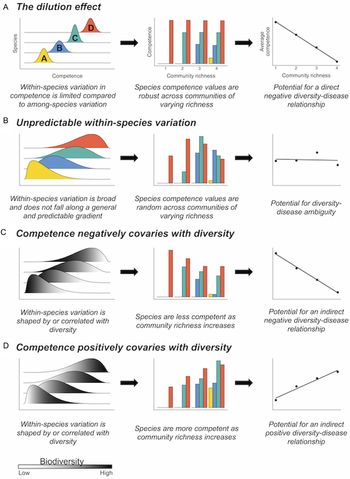
There are multiple ways by which within-species variation in competence might influence the direction or magnitude of diversity–disease relationships (Fig. 2). If host species exhibit high overlap in their competence distributions (as demonstrated in Box 2D), then their roles as competent or diluter hosts may be reversed under different environmental contexts (Fig. 2B: Broad within-species variation). This possibility could lead to null patterns between diversity and disease because community competence does not predictably change with species losses or gains. If the environmental drivers of biodiversity loss, like urbanization, habitat degradation or pollution, also influence competence (Martin et al., Reference Martin, Hopkins, Mydlarz and Rohr2010; Messina et al., Reference Messina, Edwards, Eens and Constantini2018), then the competence of a particular species may vary depending on whether it is observed in an intact or disassembled community. Likewise, the loss of biodiversity itself may shape the competence of persisting species, because the physiological underpinnings of competence can be affected by species interactions (de Roode et al., Reference de Roode, Rarick, Mongue, Gerardo and Hunter2011; Martin et al., Reference Martin, Hopkins, Mydlarz and Rohr2010; Adamo et al., Reference Adamo, Easy, Kovalko, MacDonald, McKeen, Swanburg, Turnbull and Reeve2016). One mechanism that might mediate either of these pathways is chronic stress, which has immunosuppressive effects (Råberg et al., Reference Råberg, Grahn, Hasselquist and Svensson1998; Adamo, Reference Adamo2017) that could increase competence (LaFonte and Johnson, Reference LaFonte and Johnson2013; Gervasi et al., Reference Gervasi, Burgan, Hofmeister, Unnasch and Martin2017). When persisting species' competence increases as a direct response (or as an indirect correlate) of biodiversity loss, a negative biodiversity–disease correlation can emerge (Fig. 2C: Competence negatively covaries with diversity). The converse is also true: if persisting species become less competent with biodiversity loss (e.g. Young et al., Reference Young, Griffin, Wood and Nunn2013), reductions in diversity may be associated with less transmission (Fig. 2D: Competence positively covaries with diversity). These potential outcomes highlight the need to move beyond diversity–disease correlations alone and investigate competence as a mechanism mediating their shape. Mathematical models represent a valuable tool for exploring the potential consequences of differing competence distributions, as well as exploring the relative contribution of competence to diversity–disease relationships (Luis et al., Reference Luis, Kuenzi and Mills2018).
Within-species variation in competence may influence or obscure diversity–disease relationships. (A) The dilution effect can occur when within-species variation in competence is limited compared to among-species variation. Here, competence is a robust trait such that each species' competence value is roughly equivalent across communities. When communities are nested and competence is inversely related to extirpation risk (two of the requirements for dilution; Johnson et al., Reference Johnson, Ostfeld and Keesing2015), average community competence will decrease with richness, yielding strong potential for a negative diversity–disease relationship. But when within-species variation in competence is broad, there are several possibilities for the shape of diversity–disease relationships. (B) If within-species variation is idiosyncratic (species competence values do not fall along a similar gradient), then species may reverse roles depending on environmental context, being more competent in some communities and less competent in others. Even when communities are nested, the random values of each species can lead to a null relationship between community richness and average competence; leading to diversity–disease ambiguity. If within-species variation falls along a predictable gradient (C and D), shaped by either community-level processes or environmental correlates of biodiversity, then there is potential for either a positive diversity–disease relationship or a negative one, depending on how competence correlates with richness. [See also Gervasi et al. (Reference Gervasi, Civitello, Klivitis and Martin2015) for a helpful depiction of how within-species variation can scale up to affect transmission at the community level.]

We have presented competence as both complex and (potentially) variable. Integrating this complexity with that of ecological communities may make diversity–disease relationships seem intractable. However, we view competence as an exciting opportunity to delve into complexity, so that we may extract generality. With a clearer understanding of the biological basis of competence, we can make informed predictions about its relationship to species' life history traits and species' demographic patterns. If the traits or processes underlying competence consistently co-vary (explored in Vazquez-Prokopec et al., Reference Vazquez-Prokopec, Perkins, Waller, Lloyd, Reiner, Scott and Kitron2016), or if one trait in particular drives variation in competence (Box 2), then there are additional opportunities for simplifying competence and identifying proxies that can be tracked in natural systems (Gervasi et al., Reference Gervasi, Burgan, Hofmeister, Unnasch and Martin2017; Burgan et al., Reference Burgan, Gervasi and Martin2018). With such proxies, we can begin considering competence as a functional trait (McGill et al., Reference McGill, Enquist, Weiher and Westoby2006) and predict how it may be generally distributed within ecological communities, and how the shape of the competence distribution might change under community disassembly. Ultimately, the balance of organismal process with ecological pattern may provide insight into when and where the dilution effect operates.
Competence as an emergent property of host–parasite interactions
Antagonistic co-evolution can strengthen or decouple links between a species' exposure in the environment and its competence for infection. For parasites, selection may favour traits that reinforce positive exposure–competence associations. The opposite is true for hosts: if infection is costly, selection may favour traits that produce negative exposure–competence associations. This fluctuating selection may ultimately produce variation in competence over space and time (Thompson, Reference Thompson2005). Furthermore, the evolutionary push and pull between host and parasite means that competence is not just a host trait but is an emergent property of their interaction.
We can envision evolution at play when the dilution effect operates on environmentally-transmitted parasites. In this scenario, a parasite is broadly exposed to an assemblage of host species, some of which are competent for transmission and others of which are less so. This is thought to be the case for the fungal parasite, Metschnikowia bicuspidata, whose abundant aquatic fungal spores are indiscriminately consumed by multiple plankton species that vary in their competence (Hall et al., Reference Hall, Becker, Simons, Duffy, Tessier and Cáceres2009). Broad parasite exposure among multiple host species may impart two selection pressures on the players in the system. First, the parasite may face pressure to adapt to its low competence hosts. Alternatively, high competence hosts may face pressure to avoid, resist or tolerate infection.
There is evidence for antagonistic co-evolution playing out in both hosts and parasites. Weinstein et al. (Reference Weinstein, Moura, Mendez and Lafferty2018) found that the rodent species experiencing the highest pathogenicity to raccoon roundworms also tended to exhibit the strongest avoidance behaviours at spatial hot spots of transmission. Likewise, host resistance has been observed to increase in response to elevated parasite exposure through time (amphibian responses to chytrid fungus; Voyles et al., Reference Voyles, Woodhams, Saenz, Byrne, Perez, Rios-Sotlea, Ryan, Bletz, Sobell, McLetchie, Reinert, Rosenblum, Rollins-Smith, Ibáñez, Ray, Griffith, Ross and Richards-Zawacki2018) and over space (stickleback occurring in sympatry with helminths; Kalbe and Kurtz, Reference Kalbe and Kurtz2006). On the parasite's side, Ebert (Reference Ebert1994) demonstrated that the ability of microsporidians to infect and reproduce within Daphnia decreases as a function of geographic distance between host genotype and parasite genotype. An added dimension to parasite adaptation is parasite choice (Johnson et al., Reference Johnson, Calhoun, Riepe and Koprivnikar2019a), which may evolve to strengthen or relax host–parasite encounter rates beyond those expected by density- and frequency-dependent processes alone. As hosts vary in frequency and quality over the landscape, their importance for parasite transmission may also vary, and the potential for local adaptation may make competence an evolutionary dynamic property. Further understanding the factors that produce negative or positive co-variation in exposure and competence is important for identifying key hosts in transmission (Box 3; Hawley et al., Reference Hawley, Etienne, Ezenwa and Jolles2011; Ezenwa et al., Reference Ezenwa, Archie, Craft, Hawley, Martin, Moore and White2016).
Host–parasite co-evolution counters the view that competence is shaped by life history strategy. That is, while the co-evolutionary viewpoint considers competence a unique outcome of the pressures and constraints of a particular host–parasite interaction, the life history viewpoint considers competence a more general host property. It is therefore important to divide competence into its host vs parasite sources, asking: How common is it for a single host species to be generally competent for multiple parasite species? How common is it for a single parasite to perform well in multiple host species? And how much of observable variation in competence is unique to a given host–parasite interaction? Answering these questions and relating them to parasite transmission strategy and host life history may provide clarity in how competence is distributed among diverse host–parasite interactions.
Conclusion
Competence may be critical for understanding disease in a changing world. However, attempts to define this property have yet to adequately capture its complexity. While research on diversity and disease acknowledges that species presences and densities are dynamic through space and time, the competence values of those same species are often assumed to be static and invariable. Embracing the dynamic nature of competence may elevate our understanding of how parasite transmission responds to changes in biodiversity and may resolve controversy on the mechanisms generating diversity–disease relationships. This endeavour will require careful empirical work, and research at the laboratory-field interface will be especially important for identifying the mechanisms of competence and connecting them to ecological processes. Advancing our understanding of competence may take several approaches, such as quantitative tools to better measure it, eco-immunological theory to understand the forces shaping it and mechanistic studies that evaluate its consequences for transmission (Box 3). Ultimately, a more rigorous framing of competence will bridge within-host processes to the community ecology of infectious disease.

Supplementary material
The supplementary material for this article can be found at https://doi.org/10.1017/S0031182020000943
Acknowledgements
The authors thank Matthew Bitters, Brendan Hobart, Travis McDevitt-Galles, Loren Merrill, Wynne Moss and Zachary Phillips for their feedback on early drafts of the manuscript. Additionally, Andrew Dean, Andrew Fenton and Zoi Rapti provided helpful ideas on the quantification of competence.
Financial support
Tara Stewart Merrill is a Simons Foundation fellow of the Life Sciences Research Foundation. This material is based upon work supported by the David and Lucile Packard Foundation, the National Science Foundation (DEB 1754171) and the Burroughs Welcome Fund Travel Grant. Any opinion, findings, and conclusions or recommendations expressed in this material are those of the author(s) and do not necessarily reflect the views of the National Science Foundation.
Conflict of interest
The authors declare no conflicts of interest.
Ethical standards
Not applicable.
Glossary