INTRODUCTION
The main aim of this study is to examine the relationship between social support, on the one hand, and emotional functioning and stress reactions, on the other hand, among terminally ill cancer patients.
The pioneering prospective study in Alameda County (Berkman & Syme, 1979) showed that social relationships had independent effects on mortality, and several replication studies two decades later confirmed this finding (House et al., 1982, 1988). Two commonly described generic theoretical models have been central in terms of explaining the effects of social support on health (Cohen & Wills, 1985). The main-effect model asserts that social support has a direct effect on health independent of the stress level experienced. That means that social support is related to health outcomes because social support renders an overall beneficial effect, irrespective of whether persons are under stress (Cohen & Wills, 1985). In the buffering model, social support is assumed to promote positive health outcomes because the presence of supportive networks buffers the effects of stress. According to the buffer model, social support can protect the individuals to some extent or totally against the negative impact of stress on health. Social support has an effect only when the person experiences a stressor. In the case of terminal cancer patients, this means an extreme stressor (Priestman & Baum, 1976; Cella et al., 1993; Ringdal, 1995; Vachon et al., 1995; Ramirez et al., 1998; Ringdal & Ringdal, 2000; Jordhøy et al., 2001; Kaasa & Loge, 2002; Ringdal et al., 2004).
Social support has been conceptualized in many ways (Thoits, 1986; Hogan et al., 2002). Highlighted features are the structural aspects of social networks, for example, the size of a person's social circle or the number of resources provided; functional aspects of social support, for example, emotional support or a sense of acceptance; and enacted support, for example, provision of specific supportive behaviors, such as reassurance or advice, in times of distress. Support has been defined in a more interpersonal light as an exchange between providers and recipients. Three main types of supportive social interactions have been described: emotional, informational, and instrumental (Schaefer et al., 1981). Emotional support involves verbal and nonverbal communication of caring and concern and is believed to reduce distress by restoring self-esteem and permitting the expression of feelings. Informational support, which involves the provision of information used to guide or advise, is believed to enhance perceptions of control by reducing confusion and providing patients with strategies to cope with their difficulties. Instrumental or practical support involves direct assistance with household tasks and provision of material goods (transportation, money, physical assistance), and it may also help decrease feelings of loss of control.
The support needs of cancer patients may vary with the adaptive tasks they confront (Broadhead & Kaplan, 1991; Nelles et al., 1991). At diagnosis, one form of support that is needed is access to information about prognosis and treatment. During a hospitalization, tangible or practical support is needed. Patients hospitalized for long periods may require assistance with household tasks to meet their family responsibilities. When the patients experience fears or terminal illness, emotional support becomes important. In the cancer patient, the sources of support become critical, particularly from the spouse, the immediate family, and the support of peers with similar diagnoses (Broadhead & Kaplan, 1991). Our study is based mainly on a measure of emotional support (MacAdam & Smith, 1987).
Prospective, intervention studies of the effects of social support groups indicate that those who participated in such a group had a better psychosocial adjustment to the disease compared to those in a control group without such support (Spiegel et al., 1981, 1989; Greer et al., 1992; Spiegel, 1994; Fawzy et al., 1996; Spiegel & Kato, 1996; Fawzy & Fawzy, 1998; Koopman et al., 1998; Goodwin et al., 2001; Weber et al., 2004).
Although participation in support groups might be an important source of social support, we will focus on the social support from the significant others the patients are most emotionally attached to, their spouses and other close family members. Their social support has been shown, with some exceptions (Wortman & Dunkel-Schetter, 1979; Dakof & Taylor, 1990), to be the most important source of support for the cancer victims (Taylor et al., 1986; Slevin et al., 1996; Guidry et al., 1997; Lee et al., 2004; Lehto-Jaernstedt et al., 2004). Social support from family has been associated with reduced psychological distress (Hann et al., 2002; Baider et al., 2003; Taniguchi et al., 2003) and enhanced coping with cancer (Taniguchi et al., 2003). In another study (Birkhaug et al., 2002) the researchers found, however, that the level of family support was not associated with the quality of life of the cancer patients. None of these studies did, however, focus explicitly on the importance of social support for the terminally ill, but they examined heterogeneous groups of patients with different disease stages.
Thus, based on these theoretical and empirical findings we formulated the following hypothesis: Patients who report a high degree of social support will experience fewer stress reactions and better emotional functioning than patients with a low degree of social support.
METHODS
Study Design
The sample comprised patients who participated in a cluster randomized trial of palliative care conducted at the Palliative Medicine Unit (PMU), University Hospital of Trondheim. The trial was carried out to compare comprehensive palliative care (intervention group) to conventional care (control group). The design has been thoroughly described elsewhere (Jordhøy et al., 1999, 2001; Ringdal et al., 2004). The inclusion criteria were incurable malignant disease, aged over 18 years, and a predicted survival time of 2–9 months.
Data Collection
Sample Characteristics
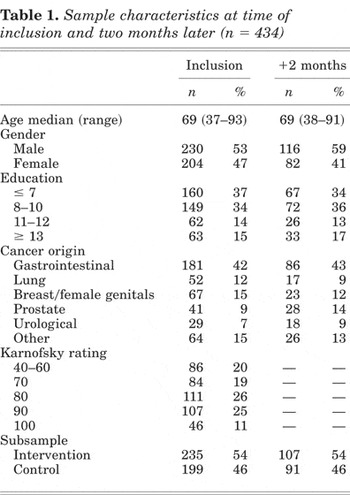
Characteristics of the sample are described in Table 1. By the time of trial entry, 434 patients were enrolled, 235 in the intervention and 199 in the control group. An earlier analysis of these data has shown that there were no significant differences between the intervention and the control group on the outcome variables considered in our study (Jordhøy et al., 2001). Therefore, all 434 patients are treated as one sample in our study. A dummy variable with the value of 1 for the intervention group and with the value of 0 for the control group is, however, used as a control variable in the regression analysis.
Sample characteristics at time of inclusion and two months later (n = 434)

The sample consisted of 53% male and 47% female patients, with a median age of 69 years (aged 37–97 years). The majority of the patients had gastrointestinal cancer (42%), and other main cancer diagnoses were lung (12%), breast/female genitals (15%), prostate (9%), urological (7%), and other (15%).
The Questionnaire
The patients completed a questionnaire monthly, at baseline in the hospital, the remaining distributed by mail. Those who did not respond within 2 weeks received a written reminder. If still no answer was given, the patients received no further questionnaire and were referred to as drop-outs. The questionnaire included items on social support and quality of life. Social support was measured by four questions about emotional support, based on MacAdam's Scale of assessment of suffering (MacAdam & Smith, 1987; Fowlie et al., 1989). In addition, the questionnaire included six items on instrumental support from family, friends, and neighbors.
The emotional functioning subscale from the European Organization for Research and Treatment of Cancer Quality of Life Questionnaire (EORTC QLQ-C30; Aaronson et al., 1993; Ringdal & Ringdal, 1993) includes two questions on anxiety and two on depression. Subjective stress was measured by the Impact of Event Scale (IES; Horowitz et al., 1979). The IES is a 15-item self-report instrument that assesses patients' reactions to stressful events such as having incurable cancer. In the present study, using a Norwegian translation, each item was scored on a six-point categorical response scale, ranging from 0 (not at all) to 5 (very much). The IES is composed of two subscales: intrusion and avoidance. The intrusion subscale describes how thoughts and impressions related to the disease reappear. The avoidance subscale assesses behavior characterized by denying the meaning and consequences of the disease.
Missing items were imputed for the EORTC QLQ-C30 and the IES multi-item scales, using the method advocated by the EORTC Quality-of-Life Study Group (Fayers et al., 1995; Jordhøy et al., 2001). If at least half of the items from a scale were completed, the values of missing ones were imputed as the mean value of the completed items.
Statistics
The psychometric aspects of the scales were assessed by means of the Reliability analysis routine in SPSS 11.0. The analysis of the effects of social support on emotional functioning and the two IES subscales were performed by means of OLS regression in SPSS 11.0
RESULTS
Scale Development
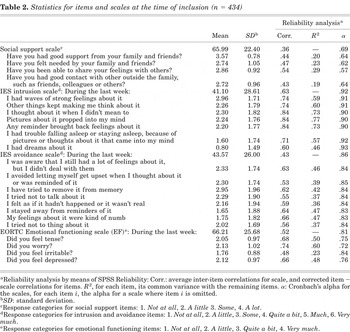
Some statistics for items and scales based on the first questionnaire, at the time of inclusion, are displayed in Table 2. The response categories of social support items vary from “1. Not at all” to “4. A lot”, that is, high values indicate high support. The item “Have you had good support from your family and friends?” gave the highest mean value (3.57), whereas the remaining three items: “Have you felt needed by your family and friends?” “Have you been able to share your feelings with others?” and “Have you had good contact with other outside the family, such as friends, colleagues or others?” had about the same mean values (2.72–2.86). The social support scale is computed as the mean score of these four items, rescaled to vary between 0 and 100. High scale values indicate high social support. The psychometric properties of the scale are acceptable: the average inter-item correlation is .36 and Cronbach's alpha is .69, that is, just below the recommended satisfactory value of .7.
Statistics for items and scales at the time of inclusion (n = 434)

We have also tried out two measures of instrumental support from family and friends. A one-dimensional scale (alpha = .73) may be formed from three items on practical support from family members (help from family/friends, help from spouse, help from children), and another one-dimensional scale (alpha = .62) from three items on practical support from friends and neighbors (help from other families, help from friends, help from neighbors). However, these scales turned out to be unrelated to emotional functioning and stress reactions. Because of this, only results for emotional functioning are presented in the tables below.
The next two panels in Table 2 report statistics for two IES subscales. The response categories for the IES items range from “1. Not at all” to “6. Very much”. The intrusion subscale is computed as the mean score of the seven items, and the avoidance subscale as the mean score of the eight remaining items. Both subscales are rescaled to vary between 0 and 100, and high scores on both subscales mean high intrusion or avoidance, that is, a high level of stress. The psychometric properties of both subscales are excellent: The average inter-item correlation is .63 for the intrusion scale and .43 for the avoidance scale. Cronbach's alpha is .92 for the intrusion subscale and .86 for the avoidance subscale.
The final panel in Table 2 reports statistics for the emotional functioning scale (EF) from the EORTC QLQ-C30. The response categories for the four items range from “1. Not at all” to “4. Very much.” The scale is computed as the mean of the reversed score of the four items, rescaled to vary between 0 and 100. Thus high values mean good emotional functioning, that is, a low level of anxiety and depression. The psychometric properties of the scale are also excellent: The average inter-item correlation is .52 and the Cronbach's alpha is .81.
A Regression Analysis of Emotional Functioning and Stress Reactions
We have performed two regression analyses of emotional functioning and stress reactions, one with all variables measured at the time of inclusion and one where the dependent variables were measured 2 months later. The first analysis is based on all 434 patients, whereas the number of patients after 2 months was reduced to less than 200.
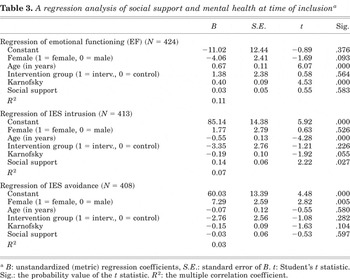
Table 3 reports the regression analysis with all variables measured at the time of inclusion. The table includes one panel for each of the three dependent variables: the Emotional functioning scale, the IES intrusion subscale and the IES avoidance subscale. The main regressor is the social support scale. In addition sex, age, intervention group, and the Karnofsky Performance Status measure are added as controls.
A regression analysis of social support and mental health at time of inclusiona

The social support scale is quite unrelated to emotional functioning (b = .03, t = 0.55, p > .5). The results for the IES avoidance subscale are quite similar (b = −.03, t = −0.53, p > .5). The results reported in the middle panel show that social support is significantly related to the IES intrusion subscale (b = .14, t = 2.22, p < .03). The finding for IES intrusion subscale is, however, quite contrary to our expectations: The higher the scores on the social support scale, the higher feelings of intrusion.
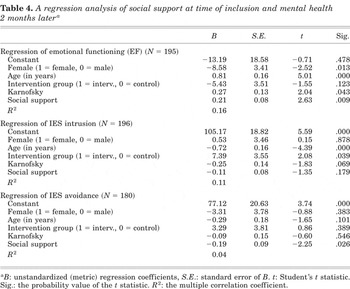
Table 4 reports the results from a parallel regression analysis with the three outcome variables measured 2 months after the inclusion. This study is based on patients with an incurable malignant disease and with a short predicted survival time. As a result of this, less than 200 patients had completed the questionnaire 2 months after the inclusion.
A regression analysis of social support at time of inclusion and mental health 2 months latera

The results show that the regression coefficient of the social support variable has the predicted sign for all three dependent variables, and the relationships are statistical significant at the .05 level for the emotional functioning scale (b = .21, t = 2.63, p < .01), and for the IES avoidance subscale (b = −.19, t = −2.25, p < .03), but not for the IES intrusion subscale (b = −.11, t = −1.35, p < .18).
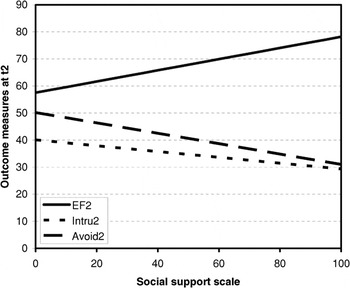
The estimated effects of the social support scale at the second assessment (t2) are illustrated in Figure 1. The figure shows the predicted scores on the three outcome scales by levels of social support with the control variables set to their means. The heaviest line shows that the scores on the emotional functioning scale are predicted to vary from about 57 for patients with the minimum level of social support to 78 for those with the maximum level of social support. The IES subscales are scored so that low scores mean less experience of stress reactions. The maximum predicted effect by social support for the IES avoidance subscale is to lower the score by about 10 points. The nonsignificant effect for the IES intrusion subscale is shown by the dotted line.

Predicted values of outcome scales for levels of social support. Based on the regressions in Table 4, the control variables are set to their means. EF2: Emotional functioning, Intru2: IES intrusion scale, Avoid2: IES avoidance scale.
DISCUSSION
Although there is some research on the effects of support groups on cancer victims' adjustment to the disease and their changed life situation (Spiegel et al., 1981, 1989; Greer et al., 1992; Spiegel, 1994; Fawzy et al., 1996; Spiegel & Kato, 1996; Fawzy & Fawzy, 1998; Koopman et al., 1998; Goodwin et al., 2001; Weber et al., 2004), only a few studies have focused on how emotional support from family members affects adjustment to the cancer disease (Taylor et al., 1986; Slevin et al., 1996; Birkhaug et al., 2002; Hann et al., 2002; Baider et al., 2003; Taniguchi et al., 2003; Lee et al., 2004; Lehto-Jaernstedt et al., 2004). We will compare our findings to the latter type of studies.
Our study indicates that social support is not related either to emotional functioning or to stress reactions as postulated in our hypothesis at the time the patients were included into the study. We did, however, find a significant relationship between social support and two of the three outcome variables in the second analysis, where the latter variables were measured 2 months later. That means our hypothesis was confirmed at the second assessment, 2 months after the inclusion, when we found that patients with high social support reported better emotional functioning and less serious stress reactions, in terms of lower scores on the IES avoidance subscale, than patients with a low degree of social support. This is in accordance with some other findings (Slevin et al., 1996; Hann et al., 2002; Taniguchi et al., 2003; Lee et al., 2004), but contrary to another study (Birkhaug et al., 2002). The comparison of our results with other studies is, however, complicated due to other factors, such as sample composition (terminally ill vs. good or heterogeneous prognoses), assessment time points, measures of social support and stress, methods of data collection (self-instructed questionnaire vs. interview), sample size, and age and gender groups.
How can these findings be explained? Because the number of respondents is reduced from around 400 at the time of inclusion to less than 200 two months later, it is reasonable to suspect a selection effect. Therefore, we have rerun the analysis in several ways. First, we did this by selecting the respondents alive at t2 and estimating the model at the time of inclusion for this subset of respondents. If the significant outcomes at t2 were due to a selection effect, we would expect to find significant outcomes, also at the time of inclusion for this subset. This is, however, not the case. Also, estimating the effects of social support using a repeated measurement design confirms our findings.
Another possible explanation for the lagged effect of social support is the effect of the intervention. In Table 4, the overall effect of the intervention is controlled for, but the intervention may also affect the relationship between social support and the dependent variables through an interaction effect. We have checked this, and the intervention group by social support interaction is negligible and not statistically significant. Therefore, this explanation may be rejected.
A third likely explanation is that as the patients are getting weaker and closer to the terminal phase of their illness, social support becomes more important. A problem is that the Karnofsky performance status was only measured at the time of inclusion. For later points in time, only the EORTC physical functioning scale is available. The overall means of physical functioning does not go down in the 2-month period from the time of inclusion. However, the physical functioning scale score is significantly lower at t2 than at the time of inclusion in a paired sample t test, that is, comparing only those alive at t2 with their score at t1. We have estimated models at t2 adding the physical functioning scale and let it replace the Karnofsky performance status. The results are, however, only marginally different from those reported in Table 4.
A fourth explanation of the weak effects of social support in our study may be that the measure of social support only taps the emotional dimension. In the introduction, we argued that emotional support is probably the most important aspect of social support for terminally ill cancer patients. We have, however, tried out measures of instrumental support from family, friends, and neighbors. These measures were not at all related to emotional functioning and stress reactions.
In conclusion, the mixed findings may indicate that social support has only small effects on emotional functioning and stress reactions. Our results on the second assessment indicate, however, that social support might work as a buffer against reactions toward external stressful life events such as terminal cancer.
ACKNOWLEDGMENTS
We thank all the cancer victims whose positive cooperation made this study possible. The study was supported by grants from The Norwegian Cancer Society (no. 95147 and 98004). The study was approved by the Regional Committee for Medical Research Ethics (REK), The Norwegian University of Science and Technology (NTNU). This study was presented as a poster at the Third Research Forum of the European Association for Palliative Care, Stresa, Lago Maggiore, Italy, June 3–6, 2004, and as a paper at the Ninth Congress of the European Association for Palliative Care, Aachen, Germany, April 8–10, 2005.