I. INTRODUCTION
Thermoelectric materials that can be used as solid-state Peltier cooler or power generator from waste heat will play an important role in solving the global fossil energy crisis and minimizing the environmental pollution.Reference Bell1 The thermoelectric property of a thermoelectric device can be evaluated by a dimensionless figure of merit (ZT), which is given by the following formula:
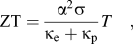
where α is the Seebeck coefficient, σ is the electrical conductivity, T is the absolute temperature, and κ e and κ p are the thermal conductivity contributed from electrons and phonons, respectively. It is clear that a material with excellent thermoelectric properties needs a high electrical conductivity, a large Seebeck coefficient, and meanwhile a low thermal conductivity.Reference Snyder and Toberer2 Lead telluride (PbTe), which can be used in a moderate temperature range, has a maximum ZT of about 1.1 at around 700 K for p-type PbTe and 425 K for n-type PbTe.Reference Mahan3 It possesses a rocksalt structure, a small and high-symmetry unit cell, a high coordination of both atomic species and no obvious rattling ion, and hence its thermoelectric properties can be optimized by atoms doping or substitution.Reference Fano and Rowe4 During the last several decades, many efforts have been made to improve the thermoelectric coefficient of PbTe-based materials.Reference Hicks and Dresselhaus5–Reference Heremans, Thrush and Morelli8 Recently, the highest ZT value of about 2.2 at 800 K for AgPb18SbTe20 has been reported.Reference Hsu, Loo, Guo, Chen, Dyck, Uher, Hogan, Polychroniadis and Kanatzidis9 The large enhancement in ZT could be ascribed to the strong reduction of the thermal conductivity by forming inhomogeneous Ag(Sb) precipitates in PbTe matrix.Reference Barabash, Ozolins and Wolverton10, Reference Lin, Božin, Billinge, Quarez and Kanatzidis11 So, introducing the compositional and structural fluctuation or inhomogeneity into materials can be regarded as an effective way to obtain a higher ZT value. Moreover, nanoengineering is also a possible approach to improve the thermoelectric properties of PbTe-based materials. Nanostructure can increase the density of state near Fermi level, enhance the effective mass of carriers, and introduce more interfaces into materials, and thereby can increase the electrical conductivity and the Seebeck coefficient and suppress the thermal conductivity simultaneously.Reference Heremans, Jovovic, Toberer, Saramat, Kurosaki, Charoenphakdee, Yamanaka and Snyder12–Reference Toprak, Stiewe, Platzek, Williams, Bertini, Müller, Gatti, Zhang, Rowe and Muhammed14 Importantly, the electron and phonon transport in different nanostructure is different, so the thermoelectric properties can also be optimized by controlling the nanostructure.Reference Zhao, Zhang, Liu and Li13 The binary-phased composites with a mixed morphology of different nanostructures can be expected to have a higher ZT due to the increased interface scattering caused by the compositional and structural fluctuation.Reference Zhao, Shi, Chen, Zhang, Bai, Pei, Li and Goto15, Reference Alboni, Ji, He, Gothard and Tritt16
Actually, the effects of the binary-phased composites on the thermoelectric properties of materials have been studied widely. As for the binary-phased YbCo4Sb12–Sb materials, the nanosized Sb semimetallic phase, which was disorderly dispersed at the grain boundaries among the large YbCo4Sb12 skutterudite particles, could enhance the electrical conductivity by 1.5 times and reduce the thermal conductivity by 33% although the Seebeck coefficient was decreased by 45% and consequently the ZT at 800 K was increased by 30%.Reference Li, Tang, Su and Zhang17 In addition, the power factor of the binary-phased PbTe–PtTe2 nanocomposites could be enhanced by 1000 times as compared to that of the single-phased PbTe or PtTe2.Reference Zhou, Zhu, Li, Hng, Boey, Ma, Zhang and Yan18 The lattice thermal conductivity of the binary-phased YbyCo4Sb12–Yb2O3 materials was reduced by 32%, and the electrical conductivity was increased by 71%, and thus the ZT at 850 K could be improved by 30%.Reference Alboni, Ji, He, Gothard and Tritt16 The nanosized ZrO2, NiSb, or FeSb2 particles could also be introduced into the CoSb3-based materials to reduce the thermal conductivity or increase the electrical conductivity.Reference He, Stiewe, Platzek, Karpinski, Müller, Li, Toprak and Muhammed19–Reference Katsuyama, Kanayama, Ito, Majima and Nagai21 Bergman and FelbReference Bergman and Felb22 pointed out that the power factor of a material could be improved obviously by fabricating a binary-phased material composed of an excellent thermoelectric phase and a metallic phase, and the improved thermoelectric properties were closely related to the microstructure of the binary-phased material such as the dispersion and the shape.
To reduce the thermal conductivity of PbTe material and meanwhile increase its Seebeck coefficient, we have fabricated the binary-phased PbTe–Sb2Sb3 nanopowders composed of PbTe nanoparticles and Sb2Te3 nanoribbons via a hydro/solvo-thermal route. Our results suggest that a largely enhanced ZT can be realized by fabricating the binary-phased PbTe–Sb2Te3 materials with a mixed nanostructure.
II. EXPERIMENTAL PROCEDURE
The binary-phased xPbTe–ySb2Te3 nanopowders (x = 1.0, 0.8, 0.7, and 0.6 mol, y = 0.0, 0.2, 0.30, and 0.40 mol, respectively) were fabricated via a hydro/solvo-thermal route. We selected acetic lead (Pb(C2O4), 99.5% purity), potassium antimony tartrate (C4H4KOSb.1/2H2O, 99.95% purity), and sodium tellurite (Na2TeO3, 99.5% purity) as the precursors, sodium borohydride (NaBH4, 99.0% purity) was used as reducing agent, and cetyltrimethylammonium bromide (CTAB, 99.0% purity) was selected as surfactant. The precursors of 12 g were weighed according to the stoichiometric composition and then put into a Teflon-lined autoclave (FTXD-1000 ml) filled with about 400 ml deionized water and 1 g CTAB, 15 g NaOH, and 10 g NaBH4. The autoclave was sealed and heated to 280 °C at a rate of 20 °C /min and then maintained at 280 °C for 96 h with a continuous stirring of 1000 rpm. After the system was cooled down to room temperature, the dark grey powders in the autoclave was filtered and washed with distilled water, ethanol, and acetone for several times in sequence to remove the residual precursors and by-products and then dried in vacuum at 100 °C for 6 h.
The phases of the obtained powders were identified by x-ray diffraction (XRD) (PANalytical, X′Pert Pro, Almelo, Netherlands). The morphologies were observed by field-emission scanning electron microscopy (JEM, JSM-6700F, Tokyo, Japan) and transmission electron microscope (TEM, TECNAI20, Philips, Eindhoven, Netherlands). Then, the powders were hot-pressed (833 K, 100 MPa, 20 min) into pellets with a diameter of 15 and 12.5 mm in a vacuum circumstance. The hot pressed xPbTe–ySb2Te3 bulk (x = 1.0, 0.2, 0.3, and 0.4 mol) had a density of 7.99, 7.63, 7.43, and 7.27 g/cm3, respectively, which is about 96% of the theoretical density. The electrical conductivity and the Seebeck coefficient were measured from 330 to 623 K by using a four-probe technique and a temperature-differential method on a designed apparatus in a tube furnace under nitrogen gas flow. The electrical conductivity measurement was performed by using a chopped direct current (10 mA) to eliminate the voltage produced by the circumstance temperature and the contact condition. The Seebeck coefficient was determined by the slope of the linear relationship between the thermal electromotive force and temperature difference (6–9 K) between the two ends of the sample. The errors of the measured electrical conductivity and Seebeck coefficient were not more than 6%. The thermal conductivity was measured by a thermal diffusivity system (Flashline 3000, Anter Corporation, Pittsburgh, PA) using pyroceramic as a reference sample at several temperature points.
III. RESULTS AND DISCUSSION
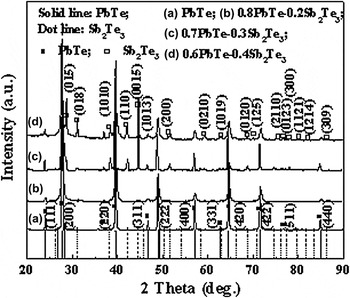
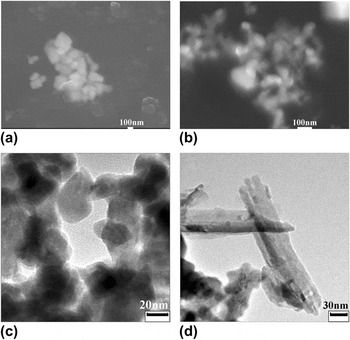
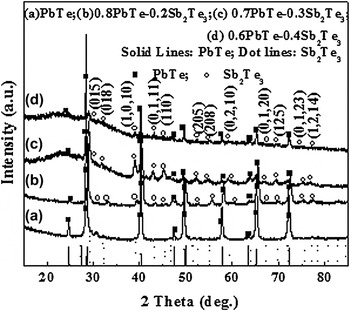
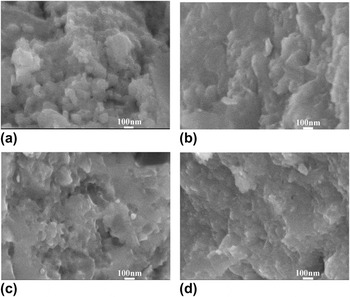
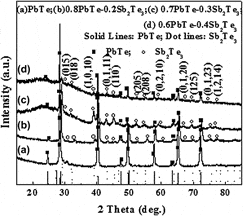
The XRD pattern of the binary-phased PbTe–Sb2Te3 nanopowders is presented in Fig. 1. The XRD diffractions of the single-phased PbTe powders can be identified as standard PbTe phase and no other secondary phase can be detected. However, the binary-phased PbTe–Sb2Te3 powders exhibit two sets of XRD diffractions corresponding to the single-phased PbTe and Sb2Te3, which is different from those of the PbTe materials doped with small Sb2Te3.Reference Su, Zhu, Ma, Rend, Guo, Iami and Jia23, Reference Su, Zhu, Ma, Ren, Chen, Guo, Iami and Jia24Figures 2(a) and 2(b) show the scanning electron microscopy (SEM) images of the single-phased PbTe and the binary-phased 0.7PbTe–0.3Sb2Te3 powders. It can be seen that the single-phased PbTe powders are irregular cubic particles with an average size of 120 nm, but the binary-phased 0.7PbTe–0.3Sb2Te3 powders exhibit a mixed morphology of nanoparticles of about 70 nm and nanoribbons with a size of 150 nm × 20 nm × 30 nm. The size and shape of the binary-phased 0.7PbTe–0.3Sb2Te3 powders can also be illustrated from the TEM images [Figs. 2(c) and 2(d)]. It should be noted that the mixed morphology is different from that of the binary-phased PbTe–PtTe2 nanocomposites in which only a single nanosphere could be observed. The mixed morphology may be resulted from the large mismatch of the crystal structures between PbTe and Sb2Te3 during the self-assemble process under the hydro/solvo-thermal condition. The mixed morphology can introduce more interfaces into the materials to increase the electron and phonon scattering and, so, should have profound influences on the thermoelectric properties. The XRD pattern of the binary-phased PbTe–Sb2Te3 hot-pressed bulks is shown in Fig. 3. It can be observed that the bulks, except for the pure PbTe, are composed of PbTe phase and Sb2Te3 phase at the same time. And a wide maximum peak below 30° can be observed clearly, which is an indication of amorphous phase. We guess that the introduced amorphous phase could be formed during the hot-pressing process and should be mainly composed of PbTe phase, which may be distributed in the matrix disorderedly. The resultant amorphous phase will also affect the thermoelectric properties.Reference Lu, Wu, Han, Wang, Shen and Hu25Figure 4 shows the SEM images of the binary-phased PbTe–Sb2Te3 bulks. In comparison with the powders, an obvious grain growth and melting phenomenon exists in the bulks. The grain size of the bulks decreases continuously from about 100 to 80, 60, and 35 nm with increasing Sb2Te3 content.
X-ray diffraction (XRD) pattern of the binary-phased PbTe–Sb2Te3 powders.

(a, b) Scanning electron microscopic (SEM) images of PbTe and 0.7PbTe–0.3Sb2Te3 powders and (c, d) transmission electron microscopic images of 0.7PbTe–0.3Sb2Te3 powders.

XRD pattern of the binary-phased PbTe–Sb2Te3 bulks.

SEM images of the binary-phased PbTe–Sb2Te3 bulks: (a) 1.0PbTe–0.0Sb2Te3, (b) 0.8PbTe–0.2Sb2Te3, (c) 0.7PbTe–0.3Sb2Te3, and (d) 0.6PbTe–0.4Sb2Te3.

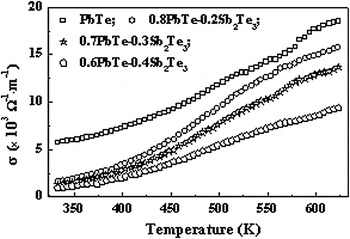
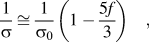
Figure 5 shows the electrical conductivity of the binary-phased PbTe–Sb2Te3 bulks as a function of temperature. The electrical conductivity of all the bulks increases with increasing temperature and belongs to a typical semiconductor behavior.Reference Zhao, Shi, Chen, Zhang, Bai, Pei, Li and Goto15, Reference Nolas, Kaeser, Littleton and Tritt26 Moreover, the electrical conductivity of the binary-phased PbTe–Sb2Te3 bulks is decreased sharply as compared to that of the single-phased PbTe bulk, which is different from the results of Su et al.Reference Su, Zhu, Ma, Rend, Guo, Iami and Jia23, Reference Su, Zhu, Ma, Ren, Chen, Guo, Iami and Jia24 The electrical conductivity of a binary-phased material can be explained by a formula proposed by KlemensReference Klemens27:
Electrical conductivity of the binary-phased PbTe–Sb2Te3 bulks.

where σ is the electrical conductivity of the binary-phased PbTe–Sb2Te3, σ 0 represents the electrical conductivity of Sb2Te3, and f is the volume proportion of the single-phased PbTe. Additionally, the electrical conductivity is determined by the following parametersReference Ziman28:

where n, e, m, τ, m*, k B, T, ℏ, and F 1/2 are the carrier concentration, electron charge, carrier mass, scattering time of carriers, effective mass of carriers, Boltzmann constant, absolute temperature, Planck reduced constant, and Fermi–Dirac function of order one half, respectively. Our calculated electron structure indicates that Sb2Te3 has a poor electrical conductivity for its lower density of states at Fermi level and larger effective mass of carriers. Importantly, the introduced interfaces in the binary-phased PbTe–Sb2Te3 bulks can increase the electron scattering at interfaces and thus deteriorate the electrical conductivity. We think that the existence of the amorphous phase can also lower the electrical conductivity.
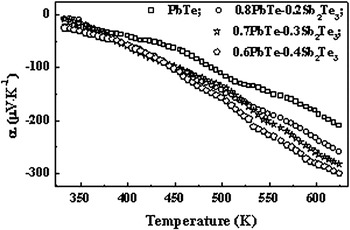
The Seebeck coefficient of the binary-phased PbTe–Sb2Te3 bulks is shown in Fig. 6. The observed negative Seebeck coefficient of all the bulks implies that the dominant carriers at the measured temperature should be electrons of n-type semiconductors. The Seebeck coefficient of the binary-phased PbTe–Sb2Te3 bulks can be increased from 209 μV·K−1 for PbTe to 258, 281, and 299 μV·K−1, which is also different from the reported results of Su et al.Reference Su, Zhu, Ma, Rend, Guo, Iami and Jia23, Reference Su, Zhu, Ma, Ren, Chen, Guo, Iami and Jia24 but is consistent with that of Li et al.Reference Li, Cai, Wang, Wang, Yin and Zhou29 The Seebeck coefficient of alloys is determined by the concentration and effective mass of carriers as followsReference Cutler, Leavy and Fitzpatrick30:

Seebeck coefficient of the binary-phased PbTe–Sb2Te3 bulks.

where e, k B, E F, ℏ, n, and m* are the electron charge, Boltzmann constant, Fermi energy, Planck constant, carrier concentration, and effective mass, respectively. On the one hand, the lowered electrical conductivity can enhance the Seebeck coefficient of the binary-phased PbTe–Sb2Te3 bulks. On the other hand, interface scattering has also profound influences on the Seebeck coefficient according to the formula suggested by GoldsmidReference Goldsmid31:
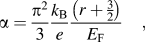
where k B is the Boltzmann constant, e is electron charge, E F represents the Fermi energy, and r denotes the scattering factor. The mixed morphology and the amorphous phase of the binary-phased PbTe–Sb2Te3 bulks can increase the interface scattering and thus enhance the Seebeck coefficients obviously.
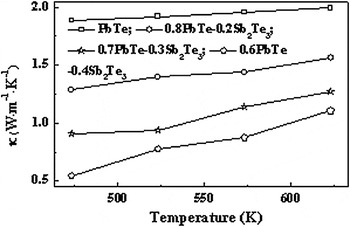
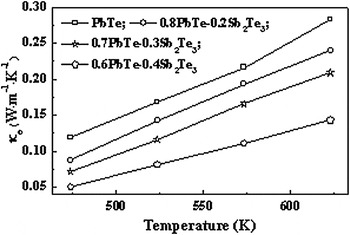
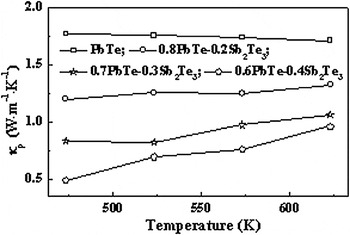
Figures 7, 8, and 9 show the total thermal conductivity κ, the electron thermal conductivity κ e, and the phonon thermal conductivity κ p of the binary-phased PbTe–Sb2Te3 bulks. The obtained thermal conductivity κ of 1.99 W·m−1·K−1 at 623 K for the single-phased PbTe bulk is smaller than the reported result of Su et al.Reference Su, Jia, Ma, Guo, Jiang, Dong, Deng, Zhao, Zhu and Wei32 And the thermal conductivities of the binary-phased PbTe–Sb2Te3 bulks can be reduced to 1.56, 1.27, and 1.11 W·m−1·K−1. The electron thermal conductivity κ e can be calculated using the Wiedemann–Franz law with the Lorenz number equal to 2.45 × 10⁻⁸ V2·K−2, and the phonon thermal conductivity κ p can be obtained by subtracting κ e from κ.Reference Ashcroft and Mermin33 It can be seen that the electron thermal conductivity of the binary-phased PbTe–Sb2Te3 bulks is decreased continuously with increasing Sb2Te3 content, which may be resulted from the decreased electrical conductivity. Otherwise, the phonon thermal conductivity of the binary-phased PbTe–Sb2Te3 bulks can be suppressed significantly as compared to that of the single-phased PbTe bulks. The large reduction in the phonon thermal conductivity can be attributed to the increased phonon scattering of interfaces and the formed amorphous phase in the binary-phased PbTe–Sb2Te3 bulks.
Thermal conductivity of the binary-phased PbTe–Sb2Te3 bulks.

Electron thermal conductivity of the binary-phased PbTe–Sb2Te3 bulks.

Phonon thermal conductivity of the binary-phased PbTe–Sb2Te3 bulks.

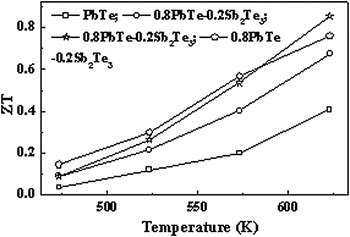
The ZT of the binary-phased PbTe–Sb2Te3 bulks is presented in Fig. 10. The ZT value of 0.41 at 623 K for the single-phased PbTe bulk is larger than that of McGuire’s work but is smaller than the reported maximum value.Reference Mahan3, Reference McGuire, Malik and DiSalvo34 In comparison with the PbTe bulk, the ZT value of the binary-phased PbTe–Sb2Te3 bulks can be increased to 0.67, 0.85, and 0.76. The largely enhanced ZT value may be a result from the significant suppression of the thermal conductivity and the increase of the Seebeck coefficient caused by the lowered carrier concentration and the increased interface scattering in the binary-phased PbTe–Sb2Te3 materials.
Figure of merit of the binary-phased PbTe–Sb2Te3 bulks.

IV. CONCLUSIONS
In conclusion, the binary-phased PbTe–Sb2Te3 nanopowders with a mixed morphology of nanospheres and nanoribbons could be synthesized via a hydro/solvo-thermal route successfully. Although the electrical conductivity of the binary-phased PbTe–Sb2Te3 bulks is decreased sharply, the thermal conductivity can be reduced significantly and the Seebeck coefficient can be increased obviously. Consequently, a largely enhanced ZT of 0.85 at 623 K can be realized for the binary-phased 0.7PbTe–0.7Sb2Te3 bulk. Therefore, increasing interface scattering by fabricating a binary-phased structure with a mixed morphology of different nanostructures can be regarded as an effective way to obtain a higher ZT value.
ACKNOWLEDGMENT
The author (Lu) acknowledges financial supports by Henan University of Technology under Grant No. 09XJC020.