1. Introduction
Many pension savers know little or nothing about the type of old-age pension that is going to provide their regular income in retirement. At this stage of life, your financial conditions typically depend substantially on how your pension scheme works during the decumulation period. In this paper, we aim at contributing with insight and transparency in the pension area. We therefore compare different pension products as seen from the consumer’s point of view. In this connection, it is vital to take a look at the benefits in the form of the retirement income that the customer can expect to receive under different pension schemes.
We address this question in relation to two different life-cycle (target date) products in comparison to the product, TimePension, which belongs to the new product class we call “smoothed investment-linked annuities” (or smoothed income annuities as opposed to variable income annuities). This paper is a continuation of and a supplement to the paper by Jørgensen & Linnemann (Reference Jørgensen and Linnemann2012). In the older paper TimePension was compared with a “traditional” with-profits scheme involving bonus entitlements and a market-based (investment-linked) Unit Link scheme.
In both papers we analyse the following questions: What income profile can you expect in retirement? Will your pension scheme provide a stable or fluctuating income from one year to the next? What is the overall performance of the products?
In this paper, we also deal with the question: How will your retirement income be affected in case of sharp price falls in the financial markets? Moreover, the products being analysed in this paper are designed with different assumed interest rates in the annuity factor being used for determining the annual retirement income. We therefore study the effect of this complicating factor on the expected retirement income profiles. This proves to be of vital importance.
Both papers show the importance of paying attention to the retirement income profile associated with your pension scheme and the need for research that contributes to insight and transparency in the area of pensions.
As is the case in Jørgensen & Linnemann (Reference Jørgensen and Linnemann2012), we compare annuity certain pension schemes (involving benefit payments for a set period of time) in this paper. Therefore, the products being analysed are pure savings products and do not involve mortality risk. We use stochastic financial simulation and the same underlying model for the uncertainty of the underlying financial market in both papers.
2. Life-Cycle Products and Smoothed Income Investment-Linked Annuities
In this paper, we compare TimePension to two different life-cycle (target date) products and investigate the impact of different investment profiles on the retirement income payments.
Life-cycle products were introduced in the United States as early as at the beginning of the 1990s. The first life-cycle product in Denmark was launched in 2004, and the products have gained ground over the last decade. This development is seen in many countries, with some variation in the timing of and demand for life-cycle product development and with some variation in the design of the products introduced. Grosen (Reference Grosen2005) provides an overview of the introduction of life-cycle products in Denmark. See also Faurdal (Reference Faurdal2006a, Reference Faurdal2006b) for a description of product development within investment-linked products in Denmark.
On the other hand, the new product class, smoothed investment-linked annuities, was invented in Denmark. This development began in 2002 when TimePension with its return smoothing mechanism was launched. In 2009, TimePension with smoothed income life annuities based on realistic assumptions of future mortality (avoiding conservative margins) was finally launched.
It is well known that variable income annuities were launched in 1952 by US-based TIAA-CREF. The product class – smoothed income annuities – has been created to overcome concerns over both fluctuations in payments from variable income annuities as well as the lack of transparency and the need to build up and maintain collective bonus reserves (as a buffer against price fluctuations) of with-profits policies.
The fundamental return smoothing mechanism behind TimePension is unique and simple (cf. Jørgensen & Linnemann, Reference Jørgensen and Linnemann2012) and the references therein. The product works on the basis of two accounts: (1) The individual pension benefit account that is used for calculating the smoothed income payments. The pension benefit account balance does not fluctuate with realised investment returns. (2) The individual smoothing account that serves as an investment buffer to smoothen out investment return. The account balance fluctuates with realised financial returns and can be negative.
It is noteworthy that TimePension has been analysed by researchers in several published papers (see Grosen & Jørgensen, Reference Grosen and Jørgensen2002; Nielsen & Jørgensen, Reference Nielsen and Jørgensen2002; Jakobsen, Reference Jakobsen2003; Guillen et al., Reference Guillen, Jørgensen and Nielsen2006; Jørgensen, Reference Jørgensen2007; Steffensen & Waldstrøm, Reference Steffensen and Waldstrøm2009; Jørgensen & Linnemann, Reference Jørgensen and Linnemann2012). Moreover, a presentation of the new product class smoothed investment-linked annuities and TimePension products can be found in Gatzert & Schmeiser (Reference Gatzert and Schmeiser2013).
TimePension is a product comprising a high allocation to equities and other so-called high risk assets – also after retirement. This engenders expectations of high returns and high expected pension benefits. The new and noteworthy aspect is that the product design ensures the concurrent achievement of great stability in retirement income payments (see Jørgensen & Linnemann, Reference Jørgensen and Linnemann2012).
The fundamental idea behind the life-cycle products is, for instance, mentioned in Grosen & Nielsen (Reference Grosen and Nielsen2006). Young people’s aggregate net assets are primarily made up of their future labour income – known as human capital. For most savers, this capital resembles more an investment in bonds than in equities. “Conventional portfolio theory is therefore in favour of a high allocation to equities in the younger years and a lower allocation later on when the remaining labour income is moderate”. In addition, “By working more hours per year or postponing retirement, the investor can insure against poor returns in for instance the equity market” (see Engsted et al., Reference Engsted, Larsen and Møller2011: 27). These conditions support investment in a high equity allocation in the younger years and a lower allocation later on.
The idea underlying the life-cycle products is to reduce the investment risk associated with the financial portfolio, as a function of age, by decreasing the allocation to equities and other so-called high risk assets. The question is to what extent this provides stability in retirement income payments and what the trade of is. As stated by Svendsen (Reference Svendsen2010): “One of the product-related disadvantages of life-cycle products is that senior citizens and old-age pensioners have difficulty maintaining both a high expected return and a reasonable investment risk”. This challenge has been addressed with TimePension. It is therefore also interesting to include a product type like TimePension, which has a different investment profile and product design in comparison with life-cycle products.
3. Presentation of the Three Pension Products
We compare pension conditions for “senior citizens” who have another 10 years to reach the expected retirement age of 65 and where pension benefits are payable over a 20-year period. This paper focuses exclusively on annuity pension schemes that provide periodic benefits for the specified period and where calculations include no mortality assumptions.
It is assumed that the investment profiles in the three selected pension products can be represented by two main classes of assets; equities and other so-called risky assets and bonds. In the following sections we refer to these investments as “equities” and “bonds”, respectively.
The investment profiles for the two life-cycle products and TimePension is shown in Figure 1. For the two life-cycle products, the investment profiles are inspired by profiles of actually sold Danish products. Especially, for LifeCycle1, the investment profile is determined by a method taking into account the size of the human capital. According to Jørgensen (Reference Jørgensen2005), this is set as the net present value of future premium contributions. The method “is based on the fact that most pension schemes involve periodic premium contributions, which, as far as most of the schemes are concerned, are associated with relatively small fluctuations”. Note that the two life-cycle products reflect two different views on what is the “natural” shape of the investment profile. For LifeCycle1 the profile is concave whereas for LifeCycle2 the profile is convex as a function of age. This is a key property that separates these two products.
Investment profiles – allocation to equities for the three products.

In TimePension, we model a constant equity allocation of 60% (and 40% bonds) during both the accumulation and decumulation periods, as shown in Figure 1. It should be emphasised, that when we refer to the equity allocation here and below in connection with TimePension, it means the allocation to equities in the underlying investments (the sum of the pension benefit and individual smoothing accounts). Owing to the smoothing mechanism, this allocation reflects only partially the customer’s real exposure to equity risk. This is contrary to the life-cycle products where real exposure is precisely determined by the equity allocation of invested funds.
In the following, we assume that investments correspond to the investment profiles in Figure 1 for the three products. Thus, we assume that the paid premiums are continuously invested in equities according to the allocations specified in Figure 1, whereas the rest is invested in bonds. Furthermore, we model that the investment portfolio is rebalanced at the beginning of each quarter of the year during both the accumulation and decumulation periods.
The retirement income is determined annually by means of an annuity factor (equalling the capital value of a pension benefit of DKK 1 per annum paid during the remainder of the decumulation period). The annuity factor is calculated under the assumption that future yearly returns equals what is known as the assumed interest rate.
As far as the two life-cycle products are concerned, the value of pension savings included in the determination of retirement income payments equals the market value of savings. When it comes to TimePension, it is the size of the pension benefit account that is used for calculating the amount of retirement income.
4. The Financial Model
In this paper, we address the questions mentioned in the introduction in connection with a comparison of the three pension products. We do this by simulating the underlying investments over the accumulation and decumulation periods 50,000 times for the three pension schemes. This gives an opportunity to compare the return and risk profiles of the products.
For the investment market simulation, we employ the model used in Jørgensen & Linnemann (Reference Jørgensen and Linnemann2012). The model is based on Wachter (Reference Wachter2002), Munk et al. (Reference Munk, Sørensen and Vinther2004) and Vasicek (Reference Vasicek1977). Moreover, parameters for the model are also taken from Jørgensen & Linnemann (Reference Jørgensen and Linnemann2012), and are set in a manner ensuring compliance with the economic assumptions for pension projections for 2009, prepared by the Danish Bankers Association and the Danish Insurance Association (see e.g. Danish Insurance Association, 2008). Parameter values are specified in the Technical Appendix in Jørgensen & Linnemann (Reference Jørgensen and Linnemann2012).
5. Basis of Comparison
As previously mentioned, we want to compare the three annuity pension products for “senior citizens” who have another 10 years left until retirement at age 65 and where pension benefits are payable over a period of 20 years. Persons who are 55 years old typically have a certain level of pension savings. In our calculations, we include these savings as a lump-sum payment (contribution) to the pension scheme. In addition, we expect periodic contributions to be made throughout the accumulation period. Hence, at age 55 it is assumed that a person has savings of DKK 2,500 (∼330 Euro). The amounts can be thought of in thousands in order to obtain realistic figures. The annual contribution during the accumulation period has been set at DKK 100 (∼15 Euro) in the 1st accumulation yearFootnote 1 and is subsequently adjusted for inflation by 2.5% per annum. The inflation rate is in compliance with the economic assumptions for pension projections for 2009 (see Danish Insurance Association, 2008).
We expect both the periodic contributions and the retirement income decumulations to be made on a monthly basis and to be prepaid (i.e. at the beginning of each month). The amount of retirement income is adjusted (i.e. modified) once a year. This is in contrast to the discretisation of investments that are rebalanced quarterly, as explained above. Pension investment returns are subject to 15% tax, corresponding to the effective tax rate under the Danish Taxation of Pension Investment Returns ActFootnote 2. We have not taken costs and expenses into account. In other words, we analyse the basic structure of the products.
6. Account Returns
Initially, we compare the account returns achieved in connection with the three pension products. This is an easy and simple way of gaining fundamental insight into both the return performance and risk levels of the respective products. As mentioned above, account returns are thought of as the interest or returns credited to the account that is used for determining annual retirement income payments. The level of account returns then, essentially, reflects how much the annually determined retirement income is adjusted.
For the two life-cycle products, the account returns are given as the actual market returns achieved on the underlying investments at the age in question. For TimePension, the account returns are given as the returns accrued in the pension benefit account (cf. Jørgensen & Linnemann, Reference Jørgensen and Linnemann2012).
For each pension product, we have carried out 50,000 simulations of the full 10-year accumulation and 20-year decumulation phases. Against this background, we have calculated average (i.e. expected) full-year account returns and standard deviations in these for the respective ages. Here, the standard deviation is the usual (risk) measure for the size of the dispersion of or variation in the 50,000 cases of simulated account returns. The more the account returns vary, the greater is the standard deviation.
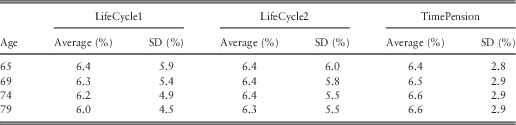
In Table 1 we show average account returns and standard deviations, for a few selected ages in the decumulation period for the three products. As far as the two life-cycle products are concerned, it is the allocation to equities (see the investment profiles in Figure 1) that solely determine the percentages in Table 1. A higher allocation to equities generates higher average account returns (i.e. investment returns) and standard deviations (i.e. risk) in the distribution of annual account returns.
Average (i.e. expected) pre-tax annual account returns (before pension investment returns tax) and standard deviations for the distribution of annual account returns for the ages specified below in the three pension products.
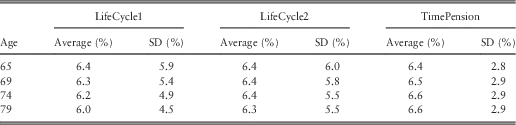
It further appears from Table 1 that average account returns for TimePension slightly exceed the corresponding account returns for the two life-cycle products. It is noteworthy that this result is achieved while the standard deviation in the distribution of account returns is smaller in TimePension than in the two life-cycle products. This is the consequence of the unique product design in the new product category, smoothed investment-linked annuities, of which TimePension forms part.
Note that a life-cycle product investing exclusively in 2.5-year zero-coupon bonds throughout the decumulation period achieves a standard deviation in the distribution of annual account returns that equals 2.9%. This offers stability on level with TimePension, but expected returns are on the other hand substantially lower than the returns achieved with TimePension.
In further sections we analyse the extent to which the three pension products are able to provide year-over-year stability in retirement income payments. Before carrying out this analysis, however, we clarify the importance of the three pension products’ different assumed interest rates for determining retirement income payments. This proves to be of vital importance for the associated retirement income profiles.
7. Expected Retirement Income Profiles
The assumed interest rates are not identical in the different products. For example, we use an assumed interest rate equal to 1.5% for LifeCycle1, whereas the assumed interest rate for LifeCycle2 is equal to 0%. Both rates are taken from the actual sold products inspiring the life-cycle products analysed here. TimePension currently offers an assumed interest rate equal to 3.5%. The question is which retirement income profiles we can expect with the three products, given the difference in their assumed interest rates.
Figure 2 shows – for each of the products – the average (expected) adjusted retirement income for each year of the decumulation period based on the 50,000 simulations of the financial market. The retirement income is specified in per cent of the amount of 1st-year expected retirement income for TimePension.
Average (i.e. expected) annually adjusted monthly retirement income payments for the three products, specified in per cent of the amount of 1st-year expected retirement income for TimePension.
It appears from the figure that the LifeCycle1 product provides higher average retirement income than the LifeCycle2 product up to and including age 72. TimePension provides higher average retirement income up to and including age 73 compared with the LifeCycle2 product and up to and including age 74 compared with the LifeCycle1 product.
For many retirees, the need is typically greatest in the first years after retirementFootnote 3. This is the stage where the retirement income profile of TimePension offers the highest expected pension benefits.
If we sum up (without adding interest on) average retirement income payments for the individual product over the years of the decumulation period, it turns out that TimePension provides higher accumulated expected pension benefits than the LifeCycle2 product up to and including age 80, whereas TimePension outperforms the LifeCycle1 product up to and including age 83. Finally, the LifeCycle1 product outperforms the LifeCycle2 product up to and including age 78Footnote 4.
It also appears from Figure 2 that a product based on a lower assumed interest rate provides lower expected initial retirement income and a higher rate of increase in the following expected pension benefits than does a product based on a higher assumed interest rate. Generally, a higher assumed interest rate will, all else being equal, result in higher expected retirement income payments in the beginning of the decumulation phase but lower rate of increase for expected pension benefits.
The results described above demonstrate the importance of paying attention to the retirement income profile associated with your pension scheme. Another important factor is whether and to what extent retirement income payments fluctuate from one year to the next. This issue is addressed in the next section.
8. Are Retirement Income Payments Stable or Variable?
As mentioned earlier, the idea underlying the life-cycle products is to reduce the investment risk associated with the financial portfolio, as a function of age, by decreasing the allocation to equities (see Figure 1). The question is to what extent this provides stability in retirement income payments.
We therefore analyse how retirement income varies from one year to the next within the two different life-cycle products, LifeCycle1 and LifeCycle2. Moreover, we compare the results with the corresponding results for TimePension, which has a different investment profile and product design.
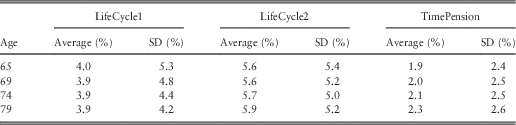
To illustrate the retirement income variation, for each of the 50,000 simulated accumulation and decumulation phases we calculate the percentage change in retirement income for each year in the decumulation period, i.e., from one given age to the next. This presents an opportunity to calculate the expectation and the standard deviation in the distribution for the percentage change in retirement income at the end of each year in the decumulation period. Table 2 shows the results for selected ages for the three products.
Average (expected) percentage change and standard deviation in the annual adjustment of retirement income and standard deviation in the distribution of the percentage change in annually adjusted retirement income at the end of the specified ages for the three pension products.
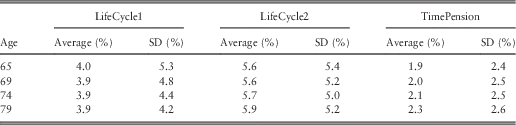
It comes as no surprise that the average change in annually adjusted retirement income is smaller for the LifeCycle1 product (at an assumed interest rate of 1.5%) than for the LifeCycle2 product (at an assumed interest rate of 0%) and that TimePension (at an assumed interest rate of 3.5%) has the smallest expected percentage changes in annually adjusted retirement income. This matches the results in Figure 2.
There is a link between account returns and percentage changes in annually adjusted retirement income payments (paid-out monthly). This is owing to the fact that the percentage change in annually adjusted retirement income is practically equal to account returns after tax less applied interest. As account returns are credited monthly whereas retirement income is adjusted annually, the above-mentioned link is not exact.
The variation in account returns is therefore significant to how much retirement income varies from one year to the next. A smaller standard deviation in the distribution of annual account returns is associated with a smaller variation and, hence, greater stability in retirement income payments from one year to the next. The standard deviations in the distribution of annual account returns in Table 1 correspond to the respective standard deviations for the percentage changes in annually adjusted retirement income payments in Table 2. The difference in values primarily emerges because account returns are calculated before pension investment returns tax, whereas a minor difference also emerges because account returns are credited monthly and retirement income annuallyFootnote 5.
It appears from Table 2 that TimePension has the smallest standard deviation in the distribution for the percentage change in annually adjusted retirement income. This means that TimePension offers the greatest stability in actual retirement income payments, which is achieved in spite of the fact that the equity allocation is substantially higher in TimePension, throughout the decumulation phase, than it is in two other products.
The smoothing mechanism of TimePension is designed to offer stable returns on the pension benefit account and, accordingly, stability in retirement income payments. On the other hand, life-cycle products transfer the full variation in annual returns to variation in annual pension benefits.
We have also illustrated this in Figure 3 by showing the annual pension benefit for a simulation of one and the same financial scenario for each of the three products. The pension benefits are specified in per cent of the amount of 1st-year retirement income for TimePension. It is evident that the variability (over time) in retirement income payments is greater for the two life-cycle products than for TimePension. It appears that TimePension provides great stability in retirement income throughout the decumulation period. This corresponds to the analysis in Jørgensen & Linnemann (Reference Jørgensen and Linnemann2012), where the conclusion is that TimePension provides stability in retirement income payments in line with traditional with-profits pension products.
Annually adjusted monthly retirement income payments from the three products, specified in per cent of the amount of 1st-year retirement income for TimePension.
It is also interesting to compare the overall performance of the three products. Here, it is necessary to decide how to measure performance over time for products characterised by widely different withdrawal profiles. We have chosen to compare the amounts of aggregate retirement income payments for the three products. To increase comparability, we have set an assumed interest rate of 3.5% for all three products. Furthermore, pension benefits are assumed to generate no returns after they have been paid out. This method is also employed by Jørgensen & Linnemann (Reference Jørgensen and Linnemann2012).
For each of the 50,000 simulated accumulation and decumulation phases, we have thus calculated the amount of aggregate retirement income that is realised over 20 years of decumulation. When considering aggregate retirement income payments, the TimePension and LifeCycle2 products are at the same level in terms of expected value and standard deviation, whereas LifeCycle1 is lower on both counts. This means that the choice between the different products, when considering aggregate retirement income payments, corresponds to a classic balancing of return and risk. In addition, however, the customer may have preferences for stability in the paid-out pension benefits, and this is achieved only with TimePension.
9. Major Price Falls in the Financial Markets
Experience from recent years and from the beginning of the millennium has demonstrated the importance of paying attention to how pension products function in the event of financial crises (see also the chapter “Pensions and financial crises” in Dengsøe, Reference Dengsøe2009 and Mowbray, Reference Mowbray2010).
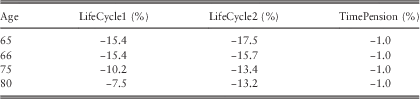
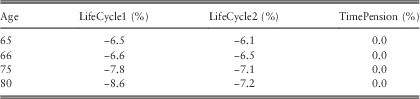
We thus compare how the average retirement income payment is affected by a major price fall of 45% for equitiesFootnote 6 and 10% for bondsFootnote 7, respectively. We calculate the percentage change in annual retirement income (paid monthly) in the 1st year (i.e. initial retirement income), 2nd year, 11th year and 16th year, respectively, on the assumption that the above-mentioned price falls occur in the last quarter of the year before pension payments for the year in question start. Table 3 presents the numbers for the 45% fall in equity prices and Table 4 for the 10% fall in bond prices.
Percentage change in average (i.e. expected) annual retirement income (paid monthly) at the beginning of the specified ages in case of a 45% fall in equity prices (relative to expected retirement income with no price fall).
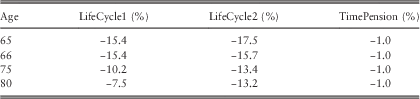
Note: The price fall is assumed to occur in the last quarter of the year before the person attains the specified age.
Percentage change in average (i.e. expected) annual retirement income (paid monthly) at the beginning of the specified ages in case of a 10% fall in bond prices.
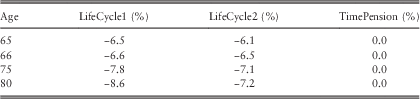
Note: The price fall is assumed to occur in the last quarter of the year before the person attains the specified age.
When comparing the two life-cycle products, the drops in expected annual retirement income in Tables 3 and 4 correspond to the allocation invested in equities and bonds, respectively (see Figure 1). TimePension, in contrast, has a loss-restraining property in connection with price falls in the financial markets. Although the equity allocation is 60% in TimePension, the percentage change in expected annual retirement income is only −1% in case of a 45% fall in equity prices. The change in expected annual retirement income is limited by the smoothing mechanism. As mentioned above, for the results in Table 3, we assume that the price fall happens during the last quarter of the year before the pension benefit is determined at the beginning of the following year. Returns are smoothed on a monthly basis at 1.84% (corresponding to 20%/annum) of the individual smoothing account balanceFootnote 8.
Note that in case of a stock market rebound, TimePension smoothes out the effect of these downward and upward movements in the financial markets. Contrary to this, retirement income payments vary with the annual market returns actually realised in the life-cycle products. Hence, we conclude that TimePension offers stability in the determination of retirement income payments, also in relation to sharp price changes in the financial markets.
10. Concluding Remarks
It is demonstrated in this paper that TimePension has particularly attractive return-risk properties, also seen in relation to life-cycle products. This is because of the unique product design of TimePension, which allows risky investment throughout the decumulation period with high expected returns and high expected pension benefits, along with great stability in retirement income payments and the underlying returns accrued in the pension benefit account.
Contrary to this, retirement income payments vary with the annual market returns actually realised in the life-cycle products. These fluctuations can be reduced by less riskier investments. However, such a step would also imply a reduction in expected returns and expected pension benefits.
Up until now, it has been widely accepted that the life-cycle products are going to succeed the traditional with-profits/participating pension products. Contrary to this belief, our research shows that products of the type smoothed investment-linked annuities are serious alternatives that can deliver the next generation of pension products. Danish design may give many retirees – also on the international scene – an opportunity to combine “the better of two worlds”.
Acknowledgements
The authors thank Per Klitgård and Frank Pedersen for inspiring discussions in connection with the paper. Suggestions for improving the presentation from an anonymous referee are also acknowledged.