Introduction
In this article, we draw on a national study of health-related work in Family Intervention Projects (FIPs). Through interviews with families and professional stakeholders involved in FIPs, the research examines understandings and experiences of health, broadly defined, to consider critical questions about the kinds of trouble that families experience in their lives, and how they are recognised in the policy and practice of intensive family intervention.
Policy contexts
The study was commissioned by the UK government (the Department of Health) in 2009, under New Labour, coinciding with the announcement of extra dedicated funding for developing work with families with multiple problems. It was completed in 2012, almost two years after the election of the Conservative-Liberal Democrat Coalition government, during which time New Labour's Family Intervention Project (FIP) programme was discontinued and the Coalition's Troubled Families programme began. New Labour's investment in FIPs was framed within a well-established strategy of using intensive family intervention as a ‘flagship mechanism’ for tackling anti-social behaviour (Batty and Flint, Reference Batty and Flint2012: 345), and was further situated in the context of a preventive agenda of ‘progressive universalism’ (for example, Balls, Reference Balls2007). At the time the research reported here was commissioned, funding for FIPs was extended across all local authorities in England, and the remit of FIPs expanded to address families who were judged to be at risk of child poverty, offending or other significant problems such as drug and alcohol misuse, mental health problems and domestic violence.
After the Coalition government took office in 2010, non-statutory services including family support bore the brunt of swingeing spending cuts to children's services, cuts which coincided with a broader debate about the appropriate role for the state in family life. Families defined as having ‘multiple problems’ remained on the policy agenda, which now combined a ‘near apocalyptic vision of family life’ in Broken Britain (Daniel, Reference Daniel, Bochel and Daly2014: 315) with an ideological retreat from universalism (Churchill, Reference Churchill2013). Following the ‘August riots’ of 2011, intervention with ‘troubled families’ moved to the centre of Coalition family policy, centring a highly publicised commitment to ‘ensure that 120,000 troubled families are “turned around” by the end of this Parliament’ (Department for Communities and Local Government, 2012: 1).
The Troubled Families programme is not equivalent to Family Intervention Projects: Louise Casey (Reference Casey2012: 3044e) was at pains to point this out in response to Fletcher and colleagues’ (Reference Fletcher, Gardner, McKee and Bonell2012) critique in the British Medical Journal, arguing that the suggestion that Troubled Families is ‘scaling up “a non-negotiable version of the previous government's Family intervention Projects” is wrong’. However, two distinct strands of rhetoric remained constant in the policy rhetoric of New Labour and the Coalition.
First, as Burney (Reference Burney2009: 2) observes, there is ‘a distinct, personal implication’:
anti-social behaviour is something done by individuals who are thereby singled out and blamed for the harm they inflict on communities.
The policy rhetoric of both the Respect/FIP and Troubled Families agendas singles out parents in particular as the (ir)responsible individuals. David Blunkett (Home Office, 2003) highlighted the role of Parenting Orders in compelling parents to take responsibility for their children's behaviour, and Gordon Brown's (Reference Brown2009) announcement of extra funding for FIPs came with a warning to ‘those who let their kids run riot’. Two years later, David Cameron (Reference Cameron2011) announced the Troubled Families programme as ‘fixing the responsibility deficit’ amongst the families it targeted.
The second constant is an economic argument, namely that a small proportion of ‘dysfunctional families’ incur a disproportionate cost to the public purse, such that potential financial savings to the public purse provide a crucial motivation for intervention. Within the Troubled Families initiative, this argument is at the foundation of a model of ‘payment by results’, whereby local authorities secure funding on the basis of providing evidence that families have been ‘turned around’ against measurable indicators. The Department for Communities and Local Government recently announced (2015) that precisely 105,671 families have had their lives ‘turned around’ as the result of the Troubled Families intervention. As Thoburn (Reference Thoburn2013: 474) warns, this conceptualisation carries risks for families:
the trouble with the Payment by Results offer is that, if local authorities decide to take it up, they will be tempted to invest their skilled professional time and resources, not on those parents and children who most need an intensive outreach service, but on those most likely to ensure that the service provider gets the results that trigger the payment.
Her words are a timely reminder that an economic imperative for family support, combined with a stigmatising individual responsibilisation of social disadvantage, means that we risk losing sight of the complex interconnected and dynamic realities of families’ lives, and hence of their support needs. Do families have a right to support, or merely a responsibility to change? Can they simply be ‘turned around’? That surely depends on how we understand the troubles they face.
Ribbens McCarthy et al. (Reference Ribbens McCarthy, Hooper and Gillies2013) highlight the ways in which families are defined as ‘troubled’ because they are ‘troubling’ to society, in terms of the costs and consequences of the difficulties they face. The social and structural causes of inequality, and child poverty in particular, are reframed,
as primarily a problem of welfare dependency, poor parenting, psycho-social problems and family dysfunction. Churchill (Reference Churchill2013: 218)
The ethical problems of these stigmatising discourses have been well discussed elsewhere (for example, Churchill, Reference Churchill2013; Tyler, Reference Tyler2013; Featherstone et al., Reference Featherstone, White and Morris2014). But there is also a practical problem. Policy responses which demonise particular families as ‘irresponsible’ or ‘broken’ are unlikely to be helpful in generating adequately theorised approaches to intervention that recognise the complexity and contexts of family lives, and of the difficulties that families face. Not least, as Ridge (Reference Ridge2009: 65) notes:
Health and disability are also common and recurrent themes in other studies of low income family life, appearing as a backdrop and compounding factor in families’ experiences.
The anti-social behaviour focus of both the FIP and the Troubled Families initiatives has been criticised for insufficient attention to families’ health needs, and in both cases policy has responded to this criticism, albeit in a limited way. At the time the research reported here was commissioned, the Department of Health had invested £19,000 per local authority to enhance the health contribution to FIPs. The Coalition's Troubled Families initiative also announced increased funding for work with family health, with a particular focus on high-level health needs, such as mental illness and domestic violence (Department for Communities and Local Government, 2014).
Intervening with ‘troubled families’
One striking feature of the international literature on intensive support for families who face multiple problems is the emphasis on family-centred, ‘whole family’ system approaches, consistently described as necessary to address the specificity of families’ experiences, and the complex dynamism of ‘family’ (for example, Berry et al., Reference Berry, Cash and Brook2000; Boddy et al., Reference Boddy, McQuail, Owen, Petrie and Statham2008; Sousa and Costa, Reference Sousa and Costa2010; Tausendfreund et al., Reference Tausendfreund, Knot-Dickscheit, Post, Knorth and Grietens2014). Writing about the concept of ‘family’, Edwards and colleagues (Reference Edwards, Ribbens McCarthy and Gillies2012: 731) observe:
Maintaining attention to ‘families’ is crucial in understanding people's senses of connection and belonging in ways that stand over and above the sense of being an ‘individual’.
To argue this is not to reify a particular concept of family with all its ‘normative baggage’ (Morgan, Reference Morgan2013: 4). Rather, we need to attend to family precisely to avoid the policy binary of successful (the white middle-class heterosexual ideological stereotype) and unsuccessful families (Edwards et al., Reference Edwards, Ribbens McCarthy and Gillies2012).
Within family-focused approaches, research has also highlighted the need for practical help to meet families’ needs. Thus, one German social pedagogue in the study of Boddy et al. (Reference Boddy, McQuail, Owen, Petrie and Statham2008: 114) of work at the ‘edges of care’ spoke of doing ‘very close work with family’, to ‘help them to see what it is possible to achieve with the child’. This approach has roots in a key concept in Germanic social pedagogy, the ‘lifeworld orientation’ (Lebensweltorientierung; see Grunwald and Thiersch, Reference Grunwald and Thiersch2009). In contrast to policy perspectives that repeatedly other, and hence distance, troubled families as ‘the objects or abjects of stigma’ (Tyler, Reference Tyler2013: 26), this conceptualisation of the ‘close work’ of intensive family support necessitates ‘family minded practice’ (Morris, Reference Morris2013): a humanising consideration of families’ own perspectives on their lives and their support needs.
Previous evaluations of FIPs have highlighted the extent of significant health needs amongst families referred to them, but also the challenges in achieving and sustaining improvements in relation to family health (for example, White et al., Reference White, Warrener, Reeves and La Valle2008; Dixon et al., Reference Dixon, Schneider, Lloyd, Reeves, White, Tomaszewski, Green and Ireland2010). It was in this context that our research was commissioned by the Department of Health, to consider the ways in which FIP services work with health and with families’ health needs, and to identify models of good practice in overcoming barriers to work with family health. Our aim here is not simply to summarise findings from that study which have been reported elsewhere (Boddy et al., Reference Boddy, Statham, Warwick, Hollingworth and Spencer2012), but rather to highlight the ways in which attention to family health serves to challenge the two underpinning policy assumptions of both the FIP and ‘Troubled Families’ programmes, in terms of the stigmatising rhetoric of individual blame for families’ difficulties, and the economic rhetoric of turning families around.
Methods
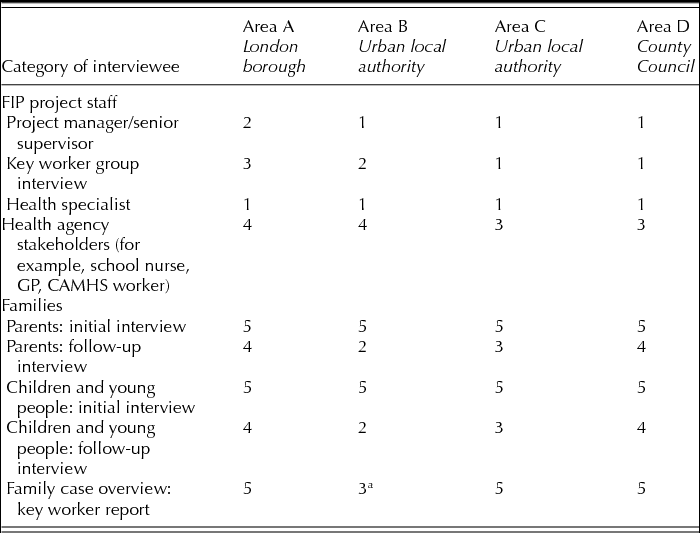
The research was conducted in two phases. First, interviews were conducted with FIP specialist advisors and regional leads, and subsequently with FIP managers/coordinators in eighteen local authority areas in England (selected to include a range of urban and rural areas, large and small local authorities). Subsequently, in-depth case studies were carried out in four local authorities, selected as examples of well-developed practice in relation to health, incorporating variation in relation to geographical spread; urban and mixed urban/rural areas; local authority types; and variation in types of FIP delivered (for example, anti-social behaviour, child poverty). The case studies involved group interviews with FIP workers; and interviews with FIP managers and with workers in health agencies that worked with the case study FIPs (ranging from primary care to specialist provision). In addition, in-depth interviews were carried out with parents and young people from twenty families across the four areas, when the FIP intervention had recently ended, or was close to completion, and subsequently, approximately seven months later.Footnote 1 With families’ permission, their FIP key worker was also interviewed to gain an overview of their case file (for example, recorded referral issues, agencies involved). Interviews were recorded and a detailed note was made of professional stakeholder interviews and interviews with family members were transcribed. Table 1 shows the distribution of interviews across the four case study areas.
Case study area interviews

Note: a Interview with one key worker providing information about three families, as other key workers had left.
Parents/carers and children were interviewed face to face in the family home, with initial permission to contact them secured through the FIP, and subsequent consent sought by telephone when arranging the visit, and then again at the beginning of each interview. Families were only included in the study if both parent/carer and child consented. We interviewed sixteen mothers, three fathers and one grandmother, and children and young people ranging in age from four to seventeen years (mean 11.6 years; seven girls). Parents and children were interviewed using parallel topic guides, designed to be sufficiently flexible to allow family members to discuss areas that they considered to be significant, whilst ensuring a focus on health needs and practices, and their experience of the FIP's work in relation to their health needs. Data were analysed using the constant comparative method, an iterative thematic approach derived from grounded theory (for example, Fram, Reference Fram2013); cases presented here are representative of the key themes relevant to the focus of the article. In the discussion that follows, where interviews or case accounts are unattributed to specific families, or where gender is disguised by using ‘(s)he’, this has been done in order to protect anonymity for potentially distinctive cases.
Findings
The study's focus on learning from well-established practice means that our research did not aim to describe what was typical of FIPs at the time. Relatedly, the sampling of families who had completed, or were close to completing, the FIP intervention (rather than those initially referred for intervention, or those who withdrew from the intervention) may mean that the research describes a group of families with less challenging needs or more positive experiences than was typical of those initially referred to FIPs.
Trouble with health
The study adopted a broad definition of ‘health’, including physical, emotional and social health and well-being, encompassing issues such as interpersonal and familial relationships. Within this conceptual frame, it was evident that health was a critical issue for many families, and that health needs (whilst varied) were often unrecognised, unmet and/or poorly managed at the time of referral.
The experience of chronic poverty was highlighted as a key barrier to basic health. For example, one FIP manager (Project Manager 2) commented that children who used their service often ‘go hungry’ during the summer when they did not receive free school meals. Health problems were also linked to poor housing conditions for some families. In Area B, a key worker spoke of an ‘uphill battle’ with the landlord of a family living in privately rented accommodation, where the home was very damp, partly as a result of flooding in the cellar. In Area C, another key worker cited a shortage of adequate social housing as a key component in a wider chain of problems for one family:
This is a family with mum and dad, three secondary school-aged children, a primary school-aged child, and a toddler. They are living in a very small house – there is a severe lack of social housing in this area. So there is a lot of overcrowding and conflict in this home, and along with lack of cleanliness and poor diet, family members are often getting ill and illnesses pass easily between family members. That means children are missing lots of school and playing up at school – leading to them getting excluded and being at home more which leads to more overcrowding and conflict. (FIP worker group interview, Area C)
Not surprisingly in the context of examples such as these, social and emotional health problems were also frequently reported. Some young people spoke specifically of feeling stressed or short-tempered, and feelings of stress could be accompanied by physical symptoms, such as headaches or sleep problems. For example:
I get so stressed and just so stressed. I’m just a stressy person really, like if something's not right I just don't like it. (Young person initial interview, Area C)
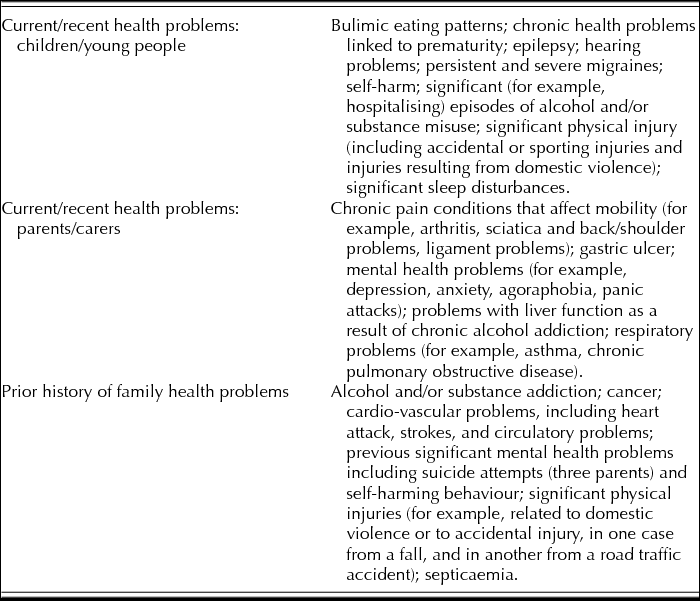
Families and key workers also described a high incidence of significant and/or chronic health problems, as summarised in Table 2. Parent and child health problems were often complex, with inter-related physical and mental health issues that were often exacerbated by poor housing and family environments, and because underlying health conditions were not being managed as a result of difficulties with access to services. The complexity of families’ health needs were eloquently illustrated by one mother's account of her experiences:
Health problems reported amongst 20 case study families
P: Years ago [my health was] not too good really. I went through cancer, lost babies, [I was an] emotional wreck really. Depression kicked in, but the last two years I’m gradually building myself back up and my confidence as well. It does take a lot though. I’m still up and down with my stress levels now, trying [to] find my footing, but I’m doing quite well at the moment.
I: You said you had cancer . . . [Did you have] your children at that time?
P: Yeah, I had all three, yeah . . . It was hard really to be honest. I didn't think I’d survive, because my mum died, passed away with the same disorder. So, I thought, well, all I can go and do is party and I did party in front of the kids too and then I clicked in that I shouldn't be doing things like that, moved away from the area and tried to sort myself out from there really.
I: Yeah, and you talked about depression. Has that been, is that ongoing or is that something that's . . .?
P: No, that's been going on since [I was] fifteen, sixteen because I had abuse from my father when I was a kid. So it's just been uproar really, and but now I haven't got all that and I’ve got to think about the future now. (Parent initial interview, area unattributed to protect confidentiality)
Examples such as this suggest that families’ troubles are in no small part related to complex and poorly met health needs, rather than recklessness and irresponsibility as policy discourse implies.
Trouble with services
When families had not engaged with health services, this was often attributed by workers to prior traumatic experiences, or to a normalisation of low expectations of health and well-being. One key worker (Area D) gave the example of ‘a mother that won't allow her children to be inoculated because she has a fear of child death’, a fear which, she said, stemmed from the mother's experiences of child bereavement. A consistent theme among regional leads, project managers and key workers was that families could have difficulty in dealing with professionals when they did engage with health services. For example:
Mental health is very difficult to get sorted. [FIP workers have had] to re-broker appointments with hospitals because two strikes [missed appointments] and you are out. No one ever followed up why they were missing – [it may be about] literacy, [but it is] assumed they were being defiant. Health service delivery is very much [organised] for the service provider not the service user. (Regional Lead 4)
A further potential barrier was that families could struggle to co-ordinate and manage specialist appointments, particularly when they had multiple professional involvement. One FIP manager said these difficulties were exacerbated by a ‘chasm’ between adults’ and children's services:
I think it's a mix of thresholds and a mix of pathways that can lead to confusion . . . one of the things that we’ve discovered at our last Think Family Board was . . . the perceptions around the lack of working between adults and children's services, and I think it was a clear consensus there was a big kind of chasm between the two services. That has been [caused] in part by the break-up of what used to be adult and children's social care, but also [by] the different legislations, the different directions we’ve kind of travelled in. (Project Manager 15)
Many professional respondents also commented that specialist health services were rarely organised with the kind of flexibility that is needed by families with complex lives, and this was seen as particularly problematic for access to adult and child mental health services. An educational psychologist in Area B also commented on the value of FIP workers providing practical support in helping families get to appointments:
It's like CAMHS . . . there's a logistical arrangement of actually getting to a clinic. Whereas the FIP, if needed, they will take you there. So you don't have to worry about it's going to cost me ten pounds in a taxi and I’ve got to catch three buses and the appointment's at this time, so I can't do that because I’ve got to go and fetch the children, you know. So I think there's that whole logistical arrangement around it as well which they very, very aptly bypass and make it accessible.
Even when families were keen to access specialist services, long waiting lists and referral criteria were said to pose a barrier to meeting health needs, particularly for mental health services. A General Practitioner in Area D, discussing a family where the mother's mental health problems meant she would not leave the house, said that he had been unable to secure timely access to the mental health services she needed:
We’re on our own with mental health, waiting lists for counselling in this city are six months plus, if they’re not closed.
Supporting families with their troubles
Contrary to the dominant policy rhetoric, both families’ and workers’ accounts described an approach to intervention that was, for the most part, responsive to families’ own understandings of their needs. Several case study families had struggled to access help, as with one mother, who described her feelings on being referred to the Family Intervention Project:
My actual thought was ‘Thank God someone's coming to help me’. Because it actually took me to get down on my hands and knees and beg a police officer to get me help – because social services were doing nothing. (Parent initial interview, Area D)
In a context where underlying health problems were often either normalised or hidden because of fear of stigma or child protection proceedings, FIP workers frequently described cases where health problems only became apparent, or were disclosed by parents or children, after a trusting relationship had been established with family members. Physical health needs were rarely highlighted in initial referrals, but were often identified once work with the family was established, and several workers and managers noted the need to attend to subjective constructions of health among family members. For example:
I think if the family perceive it as a health need, it needs to go in the assessment. ‘Cause if they believe, just the fact that they believe [it makes it] a need. (Project Manager 8)
Parents and young people also spoke about disclosure of health concerns in the context of trust and empathy in the relationship with the FIP key worker, as one young person explained:
At first like my mum didn't let her in for a couple of times because she thought that she’d just be all like . . . and then she like sneakily like went down to the school and was like . . . ‘hello, I’m [FIP worker]’ and they just got on since then. Like my mum was like she's really nice do you know I met her and she's just so – she's lovely. She's lovely. I couldn't have asked for like a better person. (Young person initial interview, Area C)
Accounts such as these sit in apparent contrast to the assertive language of official policy discourse. Persistence and assertiveness were discussed, but were framed by family members and workers as part of a relationship of trust, described by one parent, simply, as ‘no bullshit’. But workers did not merely persist with families, they persisted on their behalf, as advocates enabling access to agencies including health, as one family key worker explained:
I had to keep chasing it every minute of the way . . . And I could easily see how families lose the threads easily, I found it quite hard to get through to the specialist, quite hard to pin him down to a meeting and actually discuss [family member’s] care with an interpreter so that she could understand, that was quite hard. But we did manage to do it, and she did have [the medical procedure] in June last year. (Family key worker, Area A)
Within the highly targeted and residual service framework of FIPs (or Troubled Families) the ‘troubles’ that attract professional attention may not be the troubles that families most want (or need) help with. But the continuity of involvement and family-centred approach evidently enabled FIP workers to identify what really troubled families, and so to understand and support health needs, with attention to the whole family, and relationships based on openness and trust. A parent explained:
Because it's help for everybody and everyone in that family is getting help you know. Or anyone in the family that needs help is getting it . . . They worked again with me to sort of build my family, you know what I mean, carried me through. And that's how we sort of done it. (Parent initial interview, Area A)
Turning families around? Conceptualising outcomes in the context of family health
The last government's confident precision in announcing that 105,671 families have now been ‘turned round’ following Troubled Families intervention (Department for Communities and Local Government, 2015) raises the question of what a successful outcome might look like for a family that is turned around. Our research indicates that complexity and chronicity of families’ health needs, and the extent to which those health needs were unmet at the time of referral, had implications for the ways in which ‘success’ or ‘effectiveness’ might be defined. Eleven of the twenty case study families had achieved significant and stable change, including change in relation to family health, but that is not to say that their lives were trouble-free. For six families, positive or stable outcomes were limited by factors, including chronic health problems, beyond the immediate scope of the FIP intervention. For example, one mother's physical and related mental health problems had deteriorated in the months following the end of the intervention. At the time of our follow-up interviews and key worker interview, the family's only daughter (who was the mother's main carer) had just disclosed to the key worker a recurrence of her own mental health problems. The key worker explained:
Since yesterday [some time after the end of the FIP intervention] I received the information [the daughter’s] not coping well . . . She used to self harm before we came in two years ago, when the family was a bit crazy. When everything got better she stopped. She told me that . . . now there are times, she goes any problem, this is her words, any problem that happens ‘I just want to go to the bathroom again’. She's starting to think about self harming again.
In response to this information, and despite the fact the case had previously been closed, the key worker took steps to activate support for the young person and her mother. This flexibility was seen as crucial in averting deterioration in the family's situation when problems recurred.
But, as one FIP project manager (Area D) noted, the way in which the purpose of intervention is framed could restrict that kind of flexibility. Within the context of an Anti-Social Behaviour (ASB) FIP, she observed that ASB, and not health, was the trigger for referral, and so the FIP service could not ‘retain a family in FIP just because there are outstanding health issues’ once the presenting problem of anti-social behaviour was resolved. If successful outcomes in relation to health are not a requirement for the end of intervention, this may reduce the chances of securing stable change in relation to health.
Conclusions
In common with other evaluations of intensive family intervention (and with the caveat that this was a study of well-developed practice), the research reported here found that intensive family intervention could make a positive contribution to identifying and addressing families’ health needs (see Boddy et al., Reference Boddy, Statham, Warwick, Hollingworth and Spencer2012). But the study also identified a clear disjuncture between the politician's rhetoric of assertive intervention with the reckless and irresponsible troubled family, and the complex health troubles and support needs that families and professionals described.
Health, broadly defined, was a critical issue. Across more than 100 interviews, a highly consistent picture emerged of unrecognised, unmet, and/or poorly managed health needs, relating to key aspects of basic health and significant and chronic physical and mental health problems, for children and parents or carers. The ‘troubles’ that triggered referral often had their roots in poor health or unmet health needs, and health and other problems were intertwined: there were connections between parents’ and children's health and well-being, and historic and inter-generational patterns of adversity and maltreatment affected current health practices. The high prevalence of poor health is perhaps not surprising, given a wide body of literature documenting health-related difficulties amongst families with multiple problems (for example, Flaherty et al., Reference Flaherty, Thompson, Litrownik, Theodore, English, Black, Wike, Whimper, Runyan and Dubowitz2006).
As noted earlier, Thoburn (Reference Thoburn2013) cautioned that Payment by Results could mean that attention, and resources, become focused on families for whom change is more readily achieved against measurable criteria. The chronicity and complexity of families’ health needs are particularly significant in this context. This complexity, along with the time, trust and multi-agency involvement that could be needed to address unmet needs, means that success (or ‘turning families around’) may not be straightforward. Families’ situations were likely to improve with support and access to appropriate services, but there are caveats to understanding change in that context.
First, is a question of how one might define a ‘theory of change’ against which to evaluate success as a basis for Payment by Results. The framing policy rhetoric of assertive intervention, challenging those ‘who let their kids run riot’ (Brown, Reference Brown2009) to ‘fix the responsibility deficit’ (Cameron, Reference Cameron2011), is an ill fit with the remarkably consistent accounts, across stakeholder groups in our study, of respect for people's dignity, valuing truthfulness, and helping families’ to access the support that will allow them to manage complex lives in difficult circumstances. These depictions of family support have more in common with the ‘lifeworld orientation’ of social pedagogic theory (for example, Grunwald and Thiersch, Reference Grunwald and Thiersch2009) and the ‘humane social work’ described by Featherstone et al. (Reference Featherstone, White and Morris2014). Given that studies, including our own, provide evidence that this approach can help families, a shift in policy rhetoric might be of practical value in helping to theorise family support, as well as of ethical value in moving away from the stigmatising abjection of the other (Tyler, Reference Tyler2013).
The research also showed how the troubles of individual families were shaped by chronic adversity, including poverty and difficulties in accessing support. Families clearly benefited from improved access to specialist and universal health services, but within the framework of ‘payment by results’ it must be recognised that this may increase costs (at least in the short to medium term). In addition, resolution of problems (including the problems that triggered referral) may not be stable in the long term, unless wider difficulties (including recurrence or deterioration of chronic underlying health problems) can be addressed. Given these considerations, what counts as success?
The former UK Government's announcement of additional investment in meeting the health needs of troubled families (for example, Department for Communities and Local Government, 2014) comes at a time of continuing reductions in public sector spending. A recent House of Commons Health Committee review of mental health services for children and young people raised significant concerns about cuts to early intervention services as a result of financial pressures on local authorities, and commented that difficulties with access to services ‘shifted the focus of care to crisis management, rather than preventative measures’ (House of Commons Health Committee, 2014: 31). Arguably, the Troubled Families agenda is part of this wider shift to crisis management, alongside the diminution of early help. One FIP project manager in our study argued:
It's not about throwing money at it, I think it's about making sure they [families] engage with our health services, and that [health services] respond to those needs. (Project Manager 7)
But health (and other) services can only respond to families’ needs if they have the resources to do so. Otherwise, the benefits experienced by families in the present study may not be experienced by others, or may not be maintained. There may be limited practical value in increasing the targeting of intensive support whilst reducing the surrounding services that enable targeted support to be successful. Only by recognising families’ needs can this contradiction can be addressed.
The recognition of the health needs of so-called troubled families requires a fundamental shift in policy framing. Health is not only instrumentally important, as the current Troubled Families agenda suggests, in enabling families to ‘to secure and remain in work, play a full part in their communities and realise their potential’ (Department for Communities and Local Government, 2014: 6), health is ‘a fundamental part of our human rights and of our understanding of a life in dignity’ (Office of the United Nations High Commissioner for Human Rights/World Health Organisation, 2008: 1). Recognising the health needs of troubled families means recognising their rights, and society’s responsibilities to support families with their troubles.