1 Introduction
Necessity is one of the two basic modal meanings, the other being possibility (see, for example, van der Auwera & Plungian Reference van der Auwera and Plungian1998). Given that necessity is a central meaning for speakers, it is not surprising that languages usually have a wide range of possible ways of expressing it. In the history of English several verbs have been found to mean ‘need’, OE *þurfan, beþurfan, behofian, ME misteren and need (see Molencki Reference Molencki2002, Reference Molencki, Ritt and Schendl2005; Taeymans Reference Taeymans2006; Loureiro-Porto Reference Loureiro-Porto, Dury, Gotti and Dossena2008, Reference Loureiro-Porto2009). Interestingly, some of these verbs also had morphologically related nouns (meaning ‘necessity’) which could occur in combination with be and have to convey similar meanings, namely þearf, neod and mister, as well as the compounds neodþearf and neodþearfnis.Footnote 2 Despite the relevance of these verbo-nominal constructions of necessity, which competed with the verbs they derive from in Old and Middle English, and their subsequent fossilization in highly frequent expressions such as if need be and had need, their emergence and development has received little attention. This article intends to fill this gap and to compare their evolution with that of the verbs of necessity. Of all five nouns found in verbo-nominal constructions of necessity, the most promising ones in terms of their behaviour are þearf and need, as illustrated in sentences (1) and (2). These represent the same fragment of the New Testament, translated in different periods, and appear to show that verbo-nominal constructions of necessity with need replaced constructions with þearf, just as their corresponding verbs did:
(1)

(2)

In addition, a later version of the same text shows that the translator opted for the verb need, as seen in the following example:
(3) But Iesus put not him selfe in their hondes, because he knewe all men, and neded not, that eny man shuld testify of man. For he knewe what was in man. (1534, The New Testament, translated by William Tyndale)
The fact that one translator selects verbo-nominal constructions of necessity in an earlier period, while another translator chooses a verb in a later version of the same text, suggests that a study of the relationship between the verbs (which are grammaticalized items) and the nouns (which, in isolation, are lexical items) would be of interest. In addition, examples (1) and (2) differ from (3) in the formal marker of the experiencer (oblique in the former, nominative in the latter). How this syntactic change took place and what its semantic implications are appears to be related to the overall evolution of verbo-nominal constructions and verbs of necessity. For this reason, I will in this article address the issue of verbo-nominal constructions of necessity involving the verbs have and be plus the nouns of necessity þearf and need, adopting a corpus-based approach, and paying special attention to their distribution and to their syntactic and semantic features as compared to their corresponding verbs. Taking into account that the verb *þurfan, a preterite-present which already exhibits features of early auxiliaries in Old English, is replaced by the verb need in Middle English, which in turn will develop into a clear eModE auxiliary verb (see section 1.1), the aim of this article is to answer the following questions:
1. Is there a correlation between the substitution of the verb need for the verb *þurfan, and that of the noun need for the noun þearf?
2. Do the verbo-nominal expressions with þearf and need grammaticalize as *þurfan and need did in Old and early Modern English respectively?
3. If so, can we establish any connection between the grammaticalization of the verbs and that of the verbo-nominal constructions?
With the aim of answering these questions, section 1.1 briefly reviews the history of the verbs, and section 1.2 describes the corpus studied. Section 2 offers an overview of all verbo-nominal constructions of necessity, and sections 3 and 4 analyse verbo-nominal constructions with þearf and need respectively. Finally, section 5 summarizes the main conclusions.
1.1 The verbs *þurfan and need in the history of English
The verbs *þurfan and need are illustrated in the following sentences (as studied in Loureiro-Porto Reference Loureiro-Porto2009):
(4)
(5) You needn’t type the report, I’ll do it later.
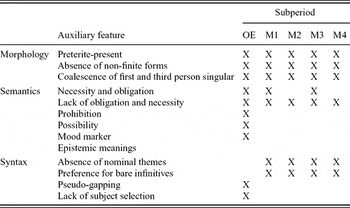
OE *þurfan is a preterite-present verb whose grammaticalization is well attested on morphological, semantic and syntactic grounds, as shown in table 1.Footnote 3
Degree of grammaticalization of tharf through history: auxiliary features (from Loureiro-Porto Reference Loureiro-Porto2009: 107)Footnote 4

Table 1 shows how from Old English onwards, *þurfan exhibited clear morphological auxiliary features, such as its membership of the preterite-present group, its absence of non-finite forms, and the coalescence of the first and third person singular. Semantically, it also expresses a wide range of possible modal meanings, such as necessity, obligation, prohibition, possibility and abnormal time reference,Footnote 5 which effectively renders it a mood marker. Consider (6):
(6)
The only typical modal meaning absent from OE *þurfan is epistemic necessity, a semantic value that was in any case only marginally grammaticalized this early in the history of English (see Traugott Reference Traugott and Hogg1992: 198).
As far as syntax is concerned, the auxiliary features of *þurfan have been identified following Warner (Reference Warner1993). These include the absence of nominal complements, a strong preference for bare infinitives, occurrence in elliptical and pseudo-gapping constructions, and lack of subject selection, which with *þurfan materializes as occurring with impersonal verbs (and, therefore, adopting their syntactic valence), and as occurring with passive infinitives (therefore accepting the subject of the infinitive as proper).
As will be discussed in section 3, some verbo-nominal constructions of necessity are similar to beþurfan, a verb morphologically related to *þurfan, which coexists with it until subperiod M1 (1150–1250) and which never undergoes grammaticalization. This verb exhibits a strong preference for the expression of internal necessityFootnote 6 and is primarily found with NPs and that-clauses as complements (see Loureiro-Porto Reference Loureiro-Porto2009: 107).
Concerning need and its degree of grammaticalization, although its status as an auxiliary in Present-Day English is highly debated (see Krug Reference Krug2000; Nokkonen Reference Nokkonen2006; Müller Reference Müller2008, among many others), it is generally agreed and demonstrated that in early Modern English it belonged to the same group as can, may, must, etc. (i.e. the modal group). This can be seen in sentence (7), where need shows that it has gone all the way down the grammaticalization scale: it exhibits absence of the third-person singular -s, it occurs with a bare infinitive, it has an inanimate subject (which constitutes another context of lack of subject selection) and expresses epistemic necessity:
(7) The knowledg of this dependeth upon the proportion which the Equator beareth to the Parallels, which is learned out by the skill of Trigonometrie, but need not now bee so hardly attained to; for the Proportions are alreadie cast up into a Table. (1649, The Description and Use of the Terrestrial Globe; cited from Loureiro-Porto Reference Loureiro-Porto2009: 167)
The auxiliary status of OE *þurfan and eModE need, then, is clearly seen. In the remainder of this article we will ask whether their corresponding verbo-nominal constructions underwent similar paths of development, by analysing all their occurrences in the 4.1-million word corpus described in section 1.2.
1.2 The corpus
My corpus comprises the Helsinki Corpus (Rissanen et al. Reference Rissanen, Ihalainen and Kytö1991), plus a selection of texts from the Dictionary of Old English Corpus (diPaolo et al. Reference Healey, Antonette, McDougall and Mielke2000), the Corpus of Middle English Prose and Verse (as found in the Middle English Compendium in its 2003 edition), the Corpus of Early English Correspondence Sampler (Nevalainen & Raumolin-Brunberg Reference Nevalainen and Raumolin-Brunberg1999) and the Lampeter Corpus (Schmied Reference Schmied1999). A random selection of texts was made, drawing from different periods in such a way that no temporal gap was left.Footnote 7 It contains a total of 4.1 million words, which are distributed in diachronic subperiods as shown in table 2.
Number of words in the corpus

2 Frequency and taxonomy of the verbo-nominal constructions of necessity
2.1 Frequency of the nouns used in verbo-nominal constructions of necessity
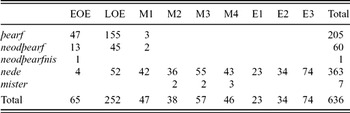
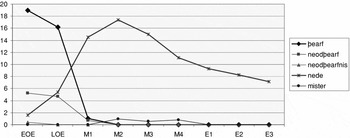
The diachronic distribution of the verbo-nominal constructions of necessity is illustrated in table 3 (gross numbers) and in figure 1 (normalized frequencies).Footnote 8
Distribution of each noun found in verbo-nominal constructions of necessity

Normalized frequencies of each necessity noun in verbo-nominal constructions

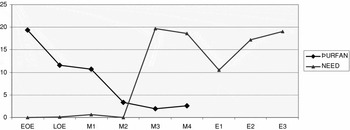
If we compare these data to the frequency of the corresponding verbs (see figure 2 below), we observe two interesting facts. Firstly, verbo-nominal constructions with need replace verbo-nominal constructions with þearf about two centuries before the verb need replaces *þurfan (M1 vs M3).Footnote 9 Secondly, the frequency exhibited by the verb *þurfan in early OE and the verb need in E3 (figure 2) is similar to that exhibited by the noun þearf in early OE and the noun need in M2 (figure 1). Interestingly enough, it is precisely when *þurfan and need show their highest frequency that they are fully grammaticalized as modal auxiliaries, as seen above. This finding is highly significant in that high frequency is usually associated with the sort of changes that occur in grammaticalization, such as semantic fading, positional fixing and phonological erosion. Thus, for example, Krug (Reference Krug2000: 182 and passim) shows that frequency plays an important role in the grammaticalization of emerging modals such as want to, have to, going to and got to, since they exhibit a high degree of phonological reduction and undergo a number of morphosyntactic changes that bring them close to central modals once they undergo drastic increases in frequency. Therefore, stemming from the assumption that frequency is often a concomitant of grammaticalization (Hopper & Traugott Reference Hopper and Traugott2003: 126–7), it makes sense to hypothesize that constructions with nouns þearf and nede could also have grammaticalized at those moments when they exhibit their highest frequency. This will be tested in sections 3 and 4.
Normalized frequencies of þurfan and need (from Loureiro-Porto Reference Loureiro-Porto2009: 160)

2.2 Taxonomy of verbo-nominal constructions of necessity
While scholars typically mention be and have as the only verbs with which þearf and need could feature in verbo-nominal constructions of necessity (Visser Reference Visser1963–73: §1352–4, for example), I have also found examples with other verbs (such as agan, require, befall and hold), as illustrated in example (8):
(8)
Needless to say, the most common constructions involve be, clearly dominant in Old English, and have, which gains ground progressively over the course of time. In spite of this, be never disappears from the panorama and it is mainly found in three types of construction:
1. With a possessive determiner (e.g. his þearf is), though with a low frequency and restricted to LOE, M1 and M3 in my corpus:
(9) God ælmihtig helpe ure and sancta Maria . . . swa swa ure ealra þearf sy.
‘God almighty and Saint Mary help us . . . as it is our necessity' (950–1050, Wulfstan's Institutes of Polity: Ad sacerdotes: Jost)
2. With a dative pronoun (e.g. him is þearf/neod). Although in Old English him is þearf is much more common than him is neod (see figure 1), interestingly enough, the only translation provided in Ælfric's Grammar for Latin necesse est mihi is me is neod (<ÆGram, 235.10>):
(10) Ac utan don swa us þearf is, warnian us be swilcan; & soþ is þæt ic secge . . .
‘But do as we must, warn us by such; and the truth is that I say . . .’ (950–1050, Wulfstan's Homilies)
3. With no reference to the person experiencing the necessity (þearf is, neode is):
(11) ffor the more thei be youre frendes the better, and withe the more tendir herte shull thei do youre message as is nede, (1450–60, Merlin, or the early history of King Arthur)
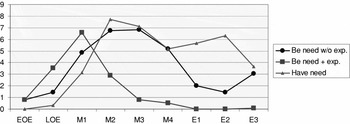
Therefore the main constructions in which need/þearf be are recorded involve constructions with an experiencer (constructions 1 and 2) and without an experiencer (construction 3). Their evolution is shown in figure 3 for the noun need, which is the one that survives longer.
Be need (with and without experiencer) and have need

Although the construction with an experiencer is more common in the earliest periods of the language, after M1 this tendency is reversed up to the point that be need without an experiencer is the only survivor of this expression in eModE. The reason for the decay of the construction him is need is undoubtedly related to the rise in frequency of have need, which always takes an experiencer subject. Figure 3 shows that it is precisely at the moment at which be need with an experiencer decays (M2) that the frequency of have need rises and reaches approximately the same ratio as be need + experiencer in earlier periods. Consider sentence (12), from M2:
(12)
Thus the frequency and taxonomy of the verbo-nominal constructions of necessity considered in this article reveal two important statistical replacements:
1. Firstly, verbo-nominal constructions with þearf are replaced with constructions with neod (LOE–M1, figure 1). This precedes the replacement of the verbs *þurfan and neden (M2–M3, figure 2), as shown in Loureiro-Porto (Reference Loureiro-Porto2009). Therefore it makes sense to think that the verbal replacement was somehow related to, among other causes, the nominal replacement that had taken place two centuries earlier.
2. Secondly, beon neod is replaced by habban neode: M1–M2 (figure 3). The reasons for this must be sought in the very implications of the replacement itself. This verbal replacement implies a change in the formal marker of the experiencer of the necessity: while the experiencer of be need is oblique, that of habban nede is nominative. Thus the replacement of be for have follows the general trend to replace oblique experiencers with nominative ones, as is seen in the evolution of impersonal constructions (cf. OE me licode vs PDE I like; see Jespersen Reference Jespersen1927: 208–9, §11.21, for example). In addition, the change in the formal marker of the experiencer suggests an intuitive change in the pragmatic implications of the verbo-nominal construction, since an oblique experiencer is expected to undergo necessity as a patient entity, while a nominative experiencer, conversely, may be actively involved in the necessity they experience. Although this intuition is not always supported by data (cf. the history of like), it does appear to be consonant with what we observe for be need and have need in the sections on semantics below.
These two replacements are of great interest because they reveal that the nouns þearf and neod change faster than their related (auxiliary) verbs, in line with the universal difference between the evolution of lexical and grammatical categories: while lexical categories are open and absorb new members easily (i.e. lexical categories are more prone to undergo expansion), grammatical categories are closed and ‘rarely absorb new members, and that only slowly’ (Croft Reference Croft2002: 224). The counterpart of expansion is reduction, and therefore it makes sense to suggest that lexical categories are also more prone to lose elements than grammatical ones. This is what apparently happened with the elements under discussion here: the decay of the construction with the noun þearf takes place two centuries before that of the verb þurfan (M1 vs M3), and this seems to be related to the fact that nouns are lexical elements (and therefore more prone to undergo expansion or reduction), while auxiliary verbs are grammatical ones (and therefore more reluctant to undergo changes).
Nevertheless, the fact that the nouns are lexical elements does not imply that the verbo-nominal constructions are lexical too. In fact, as seen in sentences (1)–(3), the constructions seemed equivalent to the verb need. Therefore the following sections provide a detailed semantic and syntactic analysis of the constructions to find out if any underwent grammaticalization.
3 Verbo-nominal constructions with þearf vs *þurfan
Semantic analysis will be carried out within the theoretical framework of force-dynamics, and therefore necessity is described in terms of forces (see Sweetser Reference Sweetser1990; Talmy Reference Talmy2000; Loureiro-Porto Reference Loureiro-Porto2009). Forces may originate inside or outside the experiencer undergoing the necessity, hence they may be internal (I need to eat –because there is a force within me that leads me to eat) or external (I must do military service – because, regardless of my own wishes, an external requirement obliges me to do so). Also, forces may have an ambiguous general origin, one which is neither internal nor external for the experiencer (e.g. I need to use the flash for this picture), but which is exerted by a ‘nebulous, generalized authority’ (Langacker Reference Langacker1999: 308). From an evolutionary point of view, I will assume that external and internal forces, as more concrete meanings, precede general forces, which appear in a developed stage as a result of desemanticization (one of the processes of grammaticalization; see Heine Reference Heine1993) and which constitute a bridge between root modality and epistemic modality. As seen in Loureiro-Porto (Reference Loureiro-Porto2009: 205, 214), the referential, social meanings conveyed by external and internal forces (at least as far as verbs of necessity are concerned) occur earlier in time than general meanings, which originated in a nebulous authority, and which pave the way for root meanings to develop into epistemic meanings (e.g. he need not be in the library, he may be somewhere else). Epistemic meanings constitute a further step in the semantic development of modals, implying loss of referential meaning (as general forces) and pragmatic enrichment (see Hopper & Traugott Reference Hopper and Traugott2003: 94). External and internal meanings may vary along a gradient of strength, and therefore they may be strong (if the unfulfilment has severe consequences on the experiencer) or weak (if their unfulfilment does not have severe consequences) (see Loureiro-Porto Reference Loureiro-Porto2009: 30). As for general forces, since they originate in an ambiguous authority, the consequences of their unfulfilment are very difficult to measure, and therefore they will not be considered strong or weak, but simply neutral. They correspond, broadly speaking, to Nordlinger & Traugott's (Reference Nordlinger and Traugott1997) wide scope of deontic modals, because the scope of the modal is the whole proposition, rather than a particular agent (see Loureiro-Porto Reference Loureiro-Porto2009: 29).
For the syntactic features of the constructions under scrutiny here, I will use the criteria for the identification of auxiliary characteristics in early English as mentioned above (see table 1; Warner Reference Warner1993), and for early Modern English I will follow the widely known features used by Barber (Reference Barber1997: 197) and Rissanen (Reference Rissanen and Lass1999: 234–6).
3.1 Semantics
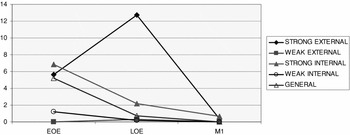
The semantic features of beon / habban þearf, on the one hand, and *þurfan, on the other, are similar in that both the verbo-nominal constructions and the verb show a strong tendency to express strong external forces (see figure 4), so they could be considered equivalent. However, they differ in one important aspect, already noted by Molencki (Reference Molencki2002: 376) and Taeymans (Reference Taeymans2006: 136), in that while *þurfan has a strong preference for non-affirmative contexts, beon/habban þearf is mostly found in affirmative contexts.
Semantics of verbo-nominal expressions with þearf

The semantic similarity between beon/habban þearf and *þurfan is therefore restricted to the selection of strong external forces. Unlike *þurfan, verbo-nominal constructions with þearf do not show semantic evidence of grammaticalization, since they never express abnormal time reference or epistemic meanings in their history and always select human experiencers. Therefore verbo-nominal constructions with þearf are closer to beþurfan, a verb which did not grammaticalize, than to *þurfan (see section 1.2).
3.2 Syntax
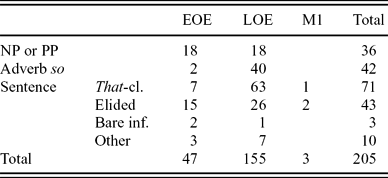
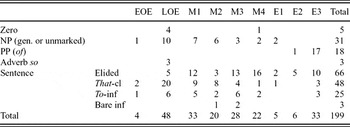
The complementation pattern of the verbo-nominal constructions with þearf n. is comparable to that of *þurfan, since both select either nominal or sentential complements. However, they differ substantially as to the type of sentential complement they prefer: while *þurfan has an evident preference for bare infinitives, the preferred sentential complement of beon/habban þearf is that-clauses (see sentence (1) above), again just like beþurfan. Consider table 4.
Complement patterns of beon/habban/agan þearf diachronically
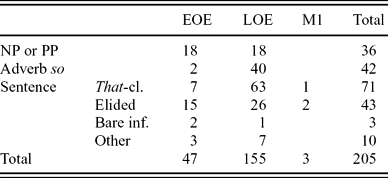
Table 4 also shows that beon/habban þearf occurs with elided complements with a high frequency (43 out of 205 examples, i.e. 21 per cent of its occurrences). This being a typical context of auxiliaries, as mentioned above, the ample range of examples of elided complements in this case is not representative of evidence of the auxiliary status of beon þearf, because these examples occur in comparative clauses and, as mentioned by Warner (Reference Warner1993), ellipsis in this context is not revealing of auxiliarihood.
In addition, the noun þearf clearly retains its nominal character in these constructions, since in 50 per cent of its occurrences (102 out of 205) it exhibits typical nominal features such as the presence of a determiner or a quantifier. This indicates that it has not undergone decategorialization, one of the processes of grammaticalization.
Summing up, since there is no trace of grammaticalization in the expression beon þearf of either a semantic or a syntactic sort (i.e. there is no desemanticization of the expression or any decategorialization of the linguistic elements involved), it never comes to develop the auxiliary features of its related verb *þurfan, but it is rather closer to its derived verb beþurfan, with which it never enters into semantic competition since beþurfan prefers the expression of internal sorts of necessity (see Loureiro-Porto Reference Loureiro-Porto2009: 86–7). In this respect, the expression beon/habban þearf seems to fill the semantic gap left by *þurfan (mainly conveying negative external forces) and beþurfan (mainly conveying positive internal forces).
4 Verbo-nominal constructions with need vs the verb need
Contrary to the analysis of verbo-nominal constructions with þearf, a distinction will be made in those with need between occurrences with the verb be and occurrences with the verb have, because they follow different paths of evolution.
4.1 Be need
Be need is the only verbo-nominal construction involving the noun need that exists throughout the whole period studied, from early Old English to E3. Its frequency, however, decreases from M1 onwards, although at the end of the eModE period it seems to undergo a slight increase which goes hand in hand with a preference for non-affirmative contexts. This preference for non-affirmative contexts at the end of the eModE period is caused by the high frequency of the parenthetical construction if need be, which is discussed in greater detail in the sections on semantics and syntax below.
4.1.1 Semantics of be need
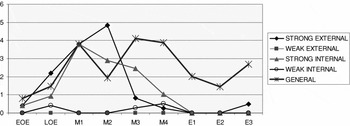
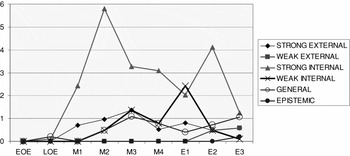
The semantic features of be need are sketched in figure 5, following the cognitive approach described in section 3.
Semantics of be need

Figure 5 shows that be need was used to express all kinds of forces with similar frequencies in early Old English (with the exception of weak external forces and weak internal forces). Over the course of time, strong external forces take the lead, and at the end of the ME period their predominance is replaced by that of general forces. This rise in frequency of general forces is the consequence of the rise in frequency of if need be, in which no explicit experiencer occurs, which implies that the force expressed by the verb does not affect a specific person and likewise is not exerted by an identifiable source:
(13) therefore, good Ihon, intreate my Lord, of all loves, to excuse me himself, and, if nede be, in his wisdome to excuse my absence to his Majestie upon this no fayned excuse (1625, The Correspondence of John Cosin)
4.1.2 Syntax of be need
As far as syntax is concerned, be need is found with a wide variety of complements throughout history. Consider table 5.
Complementation patterns of beon neod, be need

The two preferred complements of be need in Old English are that-clauses and genitive NPs, very much like OE neodian ‘be necessary’ (see Bosworth & Toller Reference Bosworth, Toller and Toller1898s.v. neodian, neadian v.), as seen in (14) and (15):
(14)
(15)
Over time, the range of complements available for this expression reduces to the point that the only complements that remain in early Modern English are of-PPs (as an analytic alternative to genitive NPs; see (15)), that-clauses, to-infinitives and, especially, elided sentential complements, also related to the common parenthetical construction if need be. It is important to highlight the point, therefore, that be need, just like beon þearf, does not show any trace of grammaticalization from Old to early Modern English, because it never shows a preference for bare infinitival complements, never shows lack of subject/experiencer selection, and most of the instances of elided complement are cases of comparative and conditional clauses, for which the ellipsis of complement is not indicative of auxiliary status.
Nevertheless, it is precisely the occurrence of be need in conditional clauses that renders the most interesting results concerning the analysis of this expression in early Modern English. In Old and Middle English the conditional construction with be need did not show special features, since it selected an oblique experiencer and need exhibited prototypical nominal features, as seen in sentence (16):
(16) 13577 seouentene þusend; selere cnihten . . . if him neod weore.
‘17,000 skilled knights . . . if it was necessary for him’ (1205, Layamon's Brut)
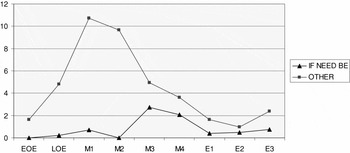
The similarity in behaviour of this conditional construction and other expressions with be need would lead us to conclude that all of them would undergo the same fate, i.e disappearance from the language after the ME period. However, if need be not only survives in early Modern English, together with there is need, but also undergoes a slight increase in frequency, as seen in figure 6.
Frequency of if need be vs other occurrences of be need

In addition, and as opposed to what happened in earlier periods (see sentence (16)), if need be never occurs with an experiencer in early Modern English but on the contrary is usually found in constructions such as (13) above. Although, of course, inflectionally marked experiencers like the one in (16) were not expected (given the general decrease of oblique experiencers in this period; see Görlach Reference Görlach1991: 106), if need be could have occurred with an analytic prepositional experiencer (as is the case with there is need on several occasions in my corpus, as in there was no need for the Parliament to provide a Convenient Remedy). Nevertheless, it never does, which seems to indicate that if need be is a fixed expression.
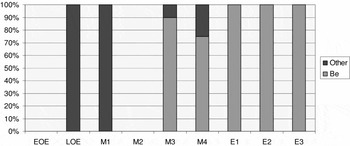
Another revealing feature of if need be is that the verb be may be inflected for tense and mood in earlier periods of the language (see sentence (16) above), but over the course of time it mostly chooses present subjunctive, i.e. be, rather than is, was, were, etc., which become impossible forms in early Modern English. With the aim of illustrating this progressive reduction of verbal variation over time, figure 7 provides a representation in percentages of be and of other forms of the verb to be in this conditional context.
Proportion of forms of be in the construction if need be

This figure clearly shows that be ceased to be inflected in this construction at the very beginning of early Modern English (earlier examples of inflected be are gyf mycel neod sy from Old English, and yf hit nede were from subperiod M4). Therefore eModE if need be shows morphological fixation, which makes this construction an idiom that survives even in Present-Day English (see OED s.v. need. n. 3.a). In addition, the conditional construction involving be need persistently lacks any intervening linguistic element between need and if (with only three exceptions, all in Middle English),Footnote 10 which further supports the claim that if need be survives as an idiom.
Therefore taking into account its eModE formal features, i.e. the complete absence of experiencers, the fixation of the verbal form (be) and the absolute impossibility of it being found with intervening material, it makes sense to posit that in this period of the language if need be exhibits syntactic fixation. In addition, from a semantic point of view, if need be includes an already obsolete expression (be need) whose meaning cannot be understood on the basis of analogy with similar structures (in early Modern or in Present-Day English), which implies that it has undergone a partial decrease in compositionality. In other words, the extent to which the meaning of the construction can be reconstructed from the meaning of its constituents is low (see Brinton & Traugott Reference Brinton and Traugott2005: 32), but the construction still has an overall meaning, and thus warrants an entry in the lexicon. In this respect, it could be argued that if need be has undergone idiomaticization, a process which, according to Brinton & Traugott (Reference Brinton and Traugott2005: 55), exhibits three main features:
(i) semantic opacity or noncompositionality.
(ii) grammatical deficiency, i.e. there is no variability in the forms of the idiom (*if need is / was).
(iii) lack of substitutability, i.e. no other noun with the same meaning can be substituted for the noun need (e.g. *if necessity be).
The present study, thus, shows that if need be is a clear idiom from 1500 onwards, when it exhibits these three features for the first time.
4.2 Have need
4.2.1 Semantics of have need
Figure 8 shows that, as opposed to beon/habban þearf and to be need, have need exhibits an overall preference for the expression of strong internal forces throughout its history, as illustrated in sentence (17).
(17) A man had need be very sure of his Reasons, and of the Sincerity of his Kindness too. (1702, The Present State of Jacobitism in England)
The emergence of internal necessity in have need may be accounted for as a result of the ‘nominativization’ of the experiencer. While be need selects an oblique experiencer that can mostly undergo an external necessity, the nominative experiencer of have need is actively involved in the necessity. Since, as seen in figure 3, be need is statistically replaced by have need, it can be claimed that verbo-nominal constructions with need evolve historically from the preference for the expression of external necessity to a strong tendency to favour the expression of internal necessity. The evolution of external meanings into internal ones is a necessary step in the semantic development of modals, especially as far as the emergence of epistemic meanings is concerned (cf. Traugott's Reference Traugott1989 Tendency I, Loureiro-Porto Reference Loureiro-Porto2009).
Semantics of have need

Indeed, have need does develop epistemic modality, the last step of the development of modal meanings, in E3, at exactly the same time as the verb need expresses epistemic meanings for the first time (see Loureiro-Porto Reference Loureiro-Porto2009: 167).Footnote 11 Consider sentence (18):
(18) And truly, he had need be naturally ingenious, that attempts such lofty, crabbed, coy, and difficult studies. (1670, Some Remarks on the Life and Death of Mr Vincent Wing)
His being ingenious is a logical conclusion drawn from the fact that he faces such lofty, difficult studies. Here, the necessity does not emerge out of the social world, but rather is based in the logical domain, that which reflects the speaker's knowledge of the world. The epistemic meaning developed by have need is typical of grammaticalization. Have need is therefore the first verbo-nominal construction which shows traces of becoming an auxiliary.
4.2.2 Syntax of have need
Of all the syntactic environments in which have need tends to feature,Footnote 12 two stand out as particularly interesting. Firstly, as opposed to be need, the preferred sentential pattern of have need from M3 onwards is to-infinitives, as seen in sentence (19):
(19)
If we take into account Bolinger's (Reference Bolinger, Brettschneider and Lehmann1980, as cited in Heine Reference Heine1993: 27) maxim that ‘[t]he moment a verb is given an infinitive complement, that verb starts down the road of auxiliariness’, from M3 onwards there seem to be grounds for a possible grammaticalization of have need.
Secondly, have need also exhibits lack of subject selection from M3 onwards, since then it accepts passive infinitival complements for the first time,Footnote 13 with which the subject of the passive infinitive becomes the subject of the verb. This may result in have need having an inanimate subject which cannot experience the necessity expressed by the verb. This ‘unnatural’ relation between subject and verb (i.e. lack of subject selection) is already observed with this expression in M2, in contexts in which passive infinitives are not involved, as illustrated by (20):
(20) This vershas mare nedeof sorowynge than of expownynge. . .
‘This verse has more need of mourning than of interpretation. . .’ (1250–1350, Richard Rolle's The Psalter or Psalms of David)
It must be noted, however, that have need is not an auxiliary in (20), because the cohesion between nede and have is low, since need is preceded by the intensifier more and its complement is not an infinitival clause but an of-PP. The only conclusion we can draw from the tendencies illustrated in (20) is that have need exhibits symptoms of a potential grammaticalization as early as M2. These symptoms are corroborated when in early Modern English bare infinitives become a prominent sentential complement. The occurrence with bare infinitives as late as E3 is an important auxiliary indicator, since by this time this was exclusively the complement of auxiliaries (see Barber Reference Barber1997: 197). What is even more interesting is that this preference is found exclusively with a variant of have need, namely had need (see sentence (18) above), which exhibits enough idiosyncratic features to be considered a verbo-nominal construction of its own, as discussed further in section 4.2.2.1.
4.2.2.1 Had need
Had need would appear to be, in principle, the preterite form of have need, were it not for the fact that there are morphological, syntactic and semantic reasons that set it apart. To begin with, it is morphologically invariable and expresses abnormal time reference (one of the typical features of eModE auxiliaries; see Rissanen Reference Rissanen and Lass1999: 233–7) from M3 onwards, as can be seen in (21):
(21) Also y wille and ordeyne þat alle the godes weche y haue be-quethe katerine, þat it be in kepyng of my too executours, here for to take as sche had ned.
‘Also I want and ordain that all the things that I have assigned to Katherine are in the keeping of my two executors, here for to take as she needs.’ (1350–1420, Thomas Usk's Appeal)
The internal necessity expressed in contexts such as this will evolve into weak or polite external obligation, as in (22), where the meaning of had need is very close to that expressed by PDE should or ought to:
(22) though, for the first, I am more angry than sad: it seemes a kynd of ridle, you had need expound it to me, how you can wish to dye, pretending love to her, who, by yr death, would dye yet ten times more. (1660, Tixall Letters)
The semantic change ‘need > obligation’ is a well-attested one, and it is recorded by Heine & Kuteva (Reference Heine and Kuteva2002: 215–16) as a universal kind of semantic change. Indeed, the verb need (to) is undergoing the same development in Present-Day English, when it has become an emerging modal of weak obligation used in affirmative contexts, as shown, for instance, by Nokkonen (Reference Nokkonen2006), who studies the modals must, need and have to, and concludes that they are rivals in the expression of obligation (see her example You need to bring that in because he'll be waiting for that, Reference Nokkonen2006: 43).Footnote 14 This again shows how the changes undergone by the verbs of necessity were preceded by changes undergone by their related verbo-nominal constructions.
Another similarity between need and had need is that the different meanings they acquire over time pave the way for the development of modal meanings other than those belonging to root necessity (obligation and the like). Indeed, all the examples of epistemic necessity contained in figure 8 are examples of had need, as seen in (18). With the ability to convey epistemic meanings, had need proves to have undergone all semantic changes typical of modal auxiliaries.
From a syntactic point of view, had need also exhibits characteristics that bring it close to the auxiliary group. The most evident of these is its exclusive selection of bare infinitival complements, which in Middle English does not necessarily imply that had need is an auxiliary, but which by early Modern English (as in (18)) becomes a distinctive feature of modal verbs (see, for example, Barber Reference Barber1997: 197; Rissanen Reference Rissanen and Lass1999: 234–6).
In addition, had need shows enough internal properties to be considered a single syntactic unit. In this construction, need is no longer a noun, since it never shows prototypical features of the members of this class: it does not take a determiner (*had the need) and it is never modified by a quantifier/intensifier (*had more/much need etc.). This was noted by Visser (Reference Visser1963–73: §1354), as well as the OED (s.v. need n. 6.c). Visser claims that in this kind of construction the word need loses ‘its distinct nominal character’ and becomes a ‘modifying element, almost equivalent in meaning to the adverb needs’. In fact, by the end of the eModE period, the degree of cohesion between had and need is as high as that in other expressions involving had such as had better, which Mitchell (Reference Mitchell2003) studies in detail and considers to be, both formally and semantically, more central to the modal system of English than has usually been recognized. Thus formally, had better is phonologically weakened (as in You better be careful; see also Denison & Cort Reference Denison, Cort, Davidse and Vandelanotte2010,Footnote 15 on the use of better as a verb), morphologically defective (only has past tense form) and syntactically exhibits all the NICE properties (see Huddleston Reference Huddleston, Greenbaum, Leech and Svartvik1980). In addition, had better also exhibits semantic properties of central modal auxiliaries such as the ability to express deontic modality (as in You had better check that, Mitchell Reference Mitchell2003: 143), and meanings close (if not belonging) to epistemic modality (as in It had better be important, Mitchell Reference Mitchell2003: 145).Footnote 16
Had better is indeed considered a modal idiom by Quirk et al. (Reference Quirk, Greenbaum, Leech and Svartvik1985: 141, §3.45), a ‘modal quasi-auxiliary’ by Traugott & Dasher (Reference Traugott and Dasher2002: 107), and ‘among the non-central members of the modal auxiliary class’ by Huddleston & Pullum (Reference Huddleston and Pullum2002: 113), who also consider that there might be grounds to consider had as a distinct lexeme from have in constructions such as had better, because it has undergone reanalysis as a present tense form (like must), there is no agreement between the subject and the verb (*he hads better), it has only primary forms (*hadding, etc.), and it takes only bare infinitival complements (*you had better to come). These four features are also observed in had need, since:
– it exhibits non-past reference from as early as M3 (see (21) above)
– it never takes a third person singular present indicative-s (18)
– it does not have non-finite forms (*hadding need or even having need)
– in early Modern English it only takes bare infinitival complements (see (18) and (22)).
In addition, from a semantic point of view, it also departs from other constructions with have need in that it is confined to the expression of weak external forces (see (22)) and it is the only verbo-nominal construction studied in this article that develops epistemic meanings (18), which brings it very close to PDE modals such as should or ought to. For all these reasons, the special grammatical status of this construction is justified, and we could conclude that the whole expression had need has grammaticalized as a periphrastic modal auxiliary and, therefore, constitutes a distinct lexeme from both have and need n.
5 Discussion and conclusions
Verbo-nominal constructions of necessity consisting of the nouns þearf and need and the verbs be and have have been analysed in detail with the aim of effecting a description of their diachronic competition and of discovering if they undergo grammaticalization to any extent (questions 1–3 in section 1). In answering question 2, we have seen that while constructions with þearf never enter the grammaticalization cline (just like the verb beþurfan), constructions with neod do exhibit two interesting developments. The first one concerns the expression if need be, and the second one, had need.
This article has shown that the eModE parenthetical construction if need be is an idiomaticized expression that originated from OE beon neod. The OE and ME construction is usually found with a non-nominative experiencer and mostly conveys an externally originated necessity. This expression, most frequent in subperiod M1, undergoes a sharp decrease from M2 onwards in favour of have need. However, it never disappears from the language, but survives in early Modern English in two forms: there is need and if need be, which exhibits interesting grammatical features. To begin with, the noun is unsubstitutable by any other synonym (cf. *if necessity be). Secondly, from 1500 onwards, this construction occurs exclusively with the present subjunctive be, while in earlier periods be could be inflected for other tenses. Finally, the occurrence of this construction is restricted to fixed parenthetical expressions. For all these reasons, we could say that the meaning of the construction cannot be recovered from the meaning of its components, but it must be listed in the lexicon as an independent unit, as indeed is the case in, say, OED (s.v. need. n. 3.a). Since grammatical deficiency, lack of substitutability and noncompositionality have all been identified as features of idiomaticized constructions (Brinton & Traugott Reference Brinton and Traugott2005: 55), it has been suggested that if need be becomes an idiom in 1500 and survives as such in early Modern (and Present-Day) English.
Idiomaticization and lexicalization have often been viewed as the other side of grammaticalization, in the sense that the former implies adherence to a lexical paradigm (i.e. inclusion in the lexicon) and the latter a detachment from lexical categories and an inclusion in grammatical ones. Interestingly enough, verbo-nominal constructions with the noun need exhibit both developments. In addition to the idiomaticization of if need be in early Modern English, this period witnesses the grammaticalization of had need as a periphrastic modal of weak obligation.
Had need, the apparent past form of have need, begins to exhibit auxiliary features as early as M2, when it first accepts inanimate experiencers (= lack of subject selection), a tendency that continues in M3, when it first expresses abnormal time reference, and becomes a full auxiliary in E3, when it exhibits different modal features, such as exclusive occurrence with bare infinitives, reanalysis as a present tense form, and even expression of epistemic necessity, just like its morphologically related verb need.Footnote 17 In this way, the current article suggests that this construction should be included in a group of periphrastic modals such as had better, which are constructed with the same verb, have, and which share the following features: reanalysis as a present tense form, no agreement between the subject and the verb, existence of primary forms and infinitival complements only.
Then, as if need be was idiomaticized, had need was grammaticalized. Both evolutionary patterns share formal fixation (i.e. reduction of verbal inflectional variability) and in both cases the original nominal character of need is lost. However, the processes differ in a crucial aspect: while the idiomaticization of if need be implies the enlargement of the lexicon, the grammaticalization of had need implies the enlargement of the grammatical category of auxiliaries.
In addition to the study of the idiomaticization and grammaticalization of these expressions, this article has also compared the verbo-nominal constructions with þearf and neod to their respective morphologically related verbs, *þurfan and need, with the aim of finding out whether the evolutionary pattern of both groups influenced one another. For this reason, this article has examined the chronological distribution of these verbo-nominal constructions of necessity as compared to that of their corresponding verbs and has shown that a series of changes undergone by the verbo-nominal constructions may have been the trigger for two phenomena: the evolution of the verb need, and the substitution of the verb need for *þurfan.
As for the evolution of the verb need, it has been shown here that some of its syntactic and semantic developments were first undergone by the verbo-nominal constructions involving the noun neod/nede (question 3 in section 1). Firstly, the transition from the selection of oblique experiencers to the selection of nominative experiencers (from beon neod to habban neode), which takes place in M1–M2 (figure 3), precedes that of the verb need, which takes place in M3–M4 (see Loureiro-Porto Reference Loureiro-Porto2009: 181). Secondly, the semantic evolution of have need, from the expression of internally rooted necessity to external obligation (see sentence (22)), also appears to be a prelude to the PDE development of need (to) as a modal of external polite obligation (as highlighted by Nokkonen 2008 and Müller Reference Müller2008). Thus it appears that the evolution of need, an auxiliary verb, is preceded by the evolution of its lexical counterpart, the noun neod/nede, in keeping with the universal tendency for lexical items to change faster than grammatical items. There is only one exception to this tendency: the development of epistemic meanings in had need takes place in the same period as that of the verb need (namely E3). This can be explained as follows. The changes in which have need precedes need are outside the scope of grammaticalization (i.e. lexical replacement of constructions with þearf, selection of nominative experiencers, development of externally rooted meanings). However, the development of epistemic meanings is a semantic change that occurs within grammatical items and, therefore, have need needs to grammaticalize as the modal auxiliary had need (expressing weak obligation) before it reaches the possibility of expressing epistemic necessity. It is only when had need grammaticalizes that it develops the possibility of expressing epistemic meanings, as with need. At this moment, then, need in this verbo-nominal expression of necessity can no longer be said to be a lexical element, a noun, but the expression had need behaves as a single linguistic unit which evolves within the group of auxiliaries like any other auxiliary.
The second phenomenon related to the evolution of the verbo-nominal expressions with þearf and neod is the substitution of the verb need for *þurfan (question 1 in section 1), which takes place in M2–M3 (see figure 2) and which has been only tentatively identified as caused by the phonological confusion between ME durren ‘dare’ and ME thurven ‘need’ (see Visser Reference Visser1963–73: 1423, §1343; Loureiro-Porto Reference Loureiro-Porto2009: 72). The current article has shown that verbo-nominal constructions with þearf were replaced by their analogous forms with neod in LOE–M1 (figure 1), much earlier, then, than the replacement of the verb *þurfan with the verb need, and it has also been claimed here that the replacement of the auxiliaries was (at least partially) caused by the replacement of the nouns in the verbo-nominal constructions of necessity. Thus the substitution of the verb need for the verb *þurfan cannot be solely explained on the basis of phonological confusion between ME thurven and ME durren, but on the basis of a previous lexical substitution of their related nouns, which may have paved the way for the auxiliary verb substitution. Nevertheless, one question remains unanswered, that of why the noun neod should substitute for the noun þearf, which was not phonologically confused with any other word at the end of the OE period. Answering this question, however, would be the subject of another paper.