Introduction
Depression is common among older people living in aged care facilities. A recent review of international studies reported that, depending on the methodology used, prevalence estimates of Major Depressive Disorder in such homes ranged from 5% to 25%, with a median prevalence of 10% (Seitz et al., Reference Seitz, Purandare and Conn2010). Depressive symptoms had a high median prevalence rate of 29%. Despite widespread general awareness of this high prevalence of depression in aged care facilities, it has been reported that clinically significant depression is recognized and treated in only one third to one half of all cases (Phillips and Henderson, Reference Phillips and Henderson1991; Rovner et al., Reference Rovner1991; Teresi et al., Reference Teresi, Abrams, Holmes, Ramirez and Eimicke2001; Davison et al., Reference Davison2007).
In order to address the serious issue of the undertreatment of depression, several authors (e.g. Conn et al., Reference Conn2006; Koopmans et al., Reference Koopmans, Zuidema, Leontjevas and Gerritsen2010) have called for the routine use of depression screening instruments in aged care facilities. Screening for depression assists in identifying those residents who require further investigation, and ideally the screening will trigger a referral for further assessment, and lead to a formal diagnosis and the commencement of appropriate treatment when necessary (Conn et al., Reference Conn2006; Pachana et al., Reference Pachana2010). This has been demonstrated in a study in the USA where the introduction of mandatory screening in two nursing homes resulted in a substantial increase in the number of depressed residents who were prescribed antidepressant medications (Cohen et al., Reference Cohen, Hyland and Kimby2003). A consensus statement issued by the American Geriatrics Society (AGG) and the American Association for Geriatric Psychiatry (AAGP) is typical of guidelines for aged care, recommending that “screening for depression should be conducted 2 to 4 weeks after admission and repeated at least every 6 months” (2003, p. 1289). These guidelines also recommend the use of a screening tool to assess the effectiveness of treatment for depression.
Given survey findings that approximately half of all aged care residents have a diagnosis of dementia (Australian Institute of Health and Welfare (AIHW), 2009), it is important that any screening tool used in aged care has been validated for use with older adults with varying levels of cognitive dysfunction. The Cornell Scale for Depression in Dementia (Alexopoulos et al., Reference Alexopoulos, Abrams, Young and Shamoian1988a) is the instrument most commonly recommended for screening populations with high rates of dementia (e.g. AGG and AAGP, 2003). It was demonstrated to have good psychometric properties with two small samples of patients with and without dementia (Alexopoulos et al., Reference Alexopoulos, Abrams, Young and Shamoian1988a; Reference Alexopoulos, Abrams, Young and Shamoian1988b), and has been shown to have high sensitivity and specificity for depression among aged care residents (McCabe et al., Reference McCabe2006). The Cornell Scale was designed to be administered through interviews with both the older person and their caregiver, and their responses are integrated with the assessor's behavioral observations, with scores on each item reflecting the assessor's final clinical judgment (Alexopoulos et al., Reference Alexopoulos, Abrams, Young and Shamoian1998a).
The Cornell Scale was introduced into routine use across Australian aged care facilities in March 2008 as part of the Aged Care Funding Instrument (ACFI), a tool used by the Australian Government Department of Health and Ageing to determine funding allocations for the care of individual residents. Under the new model, the residential care subsidy is determined by each resident's profile of care needs, in areas that include activities of daily living, cognitive impairment, disturbed behavior, and depression. The documentation that is completed by the nursing staff for each resident may include the Cornell Scale, with the Government providing increased subsidies grouped into four categories related to the resident's Cornell Scale score. Specifically, scores of 9 or more are determined to indicate symptoms of depression with at least mild interference in the resident's ability to participate in their regular activities. Although completion of the Cornell Scale is not mandatory, the association with supplementary funding acts as an incentive for facilities to use this instrument with residents. Further details regarding the aims of including the Cornell Scale in this national initiative from the perspective of those involved in its implementation can be found in the Appendix. A specific training program targeted to the care staff administering the Cornell Scale was provided during the trials of the ACFI tool and full implementation of this new model of funding. Nurses are provided with a semi-structured interview schedule (developed by Dr Richard Rosewarne and Janet Opie; available from the Commonwealth of Australia, 2007), which gives guidance about which questions to ask when interviewing or observing residents and interviewing staff informants.
The new ACFI model has now been in place for over three years, offering an ideal opportunity to investigate the outcomes. A previous study by Snowdon and colleagues in three nursing homes in Sydney, Australia found that the Cornell Scale was used widely with residents, but there was little evidence that the use of this assessment instrument by the staff had led to substantial changes in the clinical management of residents (Snowdon et al., Reference Snowdon, Rosengren, Daniel and Suyasa2011). Further research with a larger, random sample of aged care facilities is required to determine whether the intended routine use of the Cornell Scale has been associated with an improvement in the detection and treatment of late-life depression.
The present study aimed to examine the use of the Cornell Scale in a random sample of ten aged care facilities in Sydney and Melbourne, Australia, to determine whether it was used as a screening instrument to detect and respond to indications of depression among residents rather than just to obtain supplementary funding for the facility, and whether its use was associated with positive outcomes for depressed residents. Specific aims included: (i) an estimation of the proportion of aged care residents who were assessed with the Cornell Scale; (ii) an examination of the outcomes for those residents who received high scores, with a focus on rates of referral to medical professionals, evidence of changes introduced to treat depressive symptoms, and ongoing monitoring of symptoms; and (iii) an investigation of any barriers to using the Cornell Scale as a screening or clinical tool in aged care facilities. These research questions were examined using multiple sources of information, including a review of each participating resident's file, an interview with the staff member who completed the Cornell Scale assessment for each resident, and an interview with the facility manager at each of the ten participating facilities.
Methods
Procedure
Ethics approval for this project was granted by the University Ethics Committee. A random number generator was used to select ten potential aged care facilities from a list of all residential facilities (n = 688) within 30 km of the center of Melbourne or Sydney. The Facility Manager from each selected facility was mailed a written invitation to participate in the study, and then contacted by telephone. Facilities whose manager declined to participate in the study were replaced with randomly selected substitute facilities, until a total of ten residential facilities was obtained; this required contacting a total of 21 facilities across both cities. Managers cited a number of reasons for their decision not to participate in the study, including existing commitment to other research projects (n = 3), time constraints (n = 1), a perception that involvement in the project would be burdensome for the staff or residents, or that the research was of little benefit to the facility (n = 1), and turnover among the senior nursing staff (n = 2). In addition, three facility managers did not return multiple phone calls from the research team.
The ten participating facilities included equal numbers of private and not-for-profit facilities (religious, charitable, and local government), which were diverse in size and in the level of care provided. The total number of places in each facility varied from 49 to 144, with a mean of 86 places (compared to a somewhat lower mean of 68 places in metropolitan residential facilities across Australia; AIHW, 2009). This group of facilities included two low-level care (20%) and eight mixed low- and high-level care (80%) facilities. Five facilities had specified places for residents with dementia. This sample of facilities is representative of aged care facilities in Australia, which provide high-level care places (where residents require 24-hour nursing care, and are unable to move around and care for themselves due to a physical disability, or have a severe dementia-type illness), and/or low-level care places (where residents require some minimal assistance with personal care or support services, but are mobile and can typically engage in more independent self-care activities than people requiring high-level care).
A total of 867 older people resided across the ten facilities participating in this study. Residents were excluded from the study if they were in temporary care (respite or posthospital transitional care, n = 30), or had died (n = 8), were in hospital (n = 16), or had been discharged from the facility (n = 5) prior to data collection. In four facilities, the staff requested that researchers not approach selected residents in palliative care (n = 14) or who were experiencing complex family issues (n = 13).
Given the high prevalence of cognitive impairment in this study population, it was important to ensure that participants possessed the required cognitive capacity to give informed consent to participate in the research. Potential participants took part in an assessment to confirm their capacity to provide informed consent, following criteria suggested by Warner et al. (Reference Warner, McCarney, Griffin, Hill and Fisher2008). In cases where the resident was unable to provide informed consent due to cognitive impairment, the resident's next of kin was contacted to provide consent on the resident's behalf. From a pool of 781 eligible older people residing in the ten aged care facilities, 567 residents and/or their next of kin were able to be located and contacted by the researchers on the days that data collection occurred. Of those contacted, 155 potential participants declined to participate in the study (72 directly, 83 via next of kin). Repeat visits were made for participating residents newly admitted to the facility who had not yet received an ACFI assessment, to enable these data to be collected. These repeat visits were scheduled four weeks after the main data collection period.
Participants
The final sample consisted of 412 residents, representing 52.8% of eligible older people residing across ten aged care facilities who took part in the research, and 72.7% of cases where participants and/or their next of kin were contactable for this study. The sample consisted of 201 participants from five Melbourne facilities and 211 participants from five Sydney facilities. Participants ranged in age from 51 to 102 years old (M = 86.18, SD = 7.49), and 73.6% of the participants were female. These characteristics are typical of the gender ratio and age distribution of residents in aged care residential facilities (AIHW, 2009). Participants had resided in their facility for a mean of 32 months, with 75% of the sample having resided in the facility for at least one year. Medical records indicated that 195 participants (47.3%) were diagnosed with dementia, similar to the prevalence documented for the wider aged care population (AIHW, 2009).
Materials
A questionnaire was developed specifically for this study to assist researchers in collecting data from the nursing staff and residents' files. This 31-item questionnaire consisted of four sections:
(i) The first section was completed for all participants, and gathered demographic information, medical history, items regarding whether depression had been diagnosed and treated prior to the Cornell Scale administration, a record of antidepressant medications prescribed in the last 12 months (dosages, commencement, cessation, and alteration dates), and scores and administration dates for the Cornell Scale over the previous 12 months. This information was collected from the resident's admission records, current medical documentation, ACFI records, progress notes, care plans, and medication charts.
(ii) The second section was a full file review, conducted only for participants who had a total Cornell Scale score of ≥9. The file review gathered information on any actions taken by the staff or medical practitioners in response to the resident's high score, in the 2 months following the Cornell Scale administration. This included referral to medical practitioners, documented monitoring of symptoms (informally by nurses' clinical observations or formal assessment using validated instruments), and treatment for depression (pharmacological and nonpharmacological). Documentation reviewed included the residents' admission records, medical documentation, ACFI records, progress notes, care plans, and medication charts.
This section of the questionnaire consisted of questions to assist the researchers locate the appropriate information. The questions were answered “yes” or “no,” with space provided to record explanatory notes in order to ensure that information collected was consistent across both sites. Example items included “Was the resident's depression known to the facility or GP prior to Cornell Scale administration (check for diagnosis or recognition of depression in file and admission documents),” and “Is there evidence that the high Cornell Scale score has been recognised and/or communicated with other staff (check progress notes for 2 months after Cornell Scale assessment and ongoing care plans).”
(iii) The third section was completed for all residents, and consisted of open-ended staff report questions, administered in an interview format to the staff member who was responsible for assessing each participant with the Cornell Scale. The staff member was asked to give a rationale for why they chose to administer or not administer the Cornell Scale to each participant within the previous 12 months. They were also asked to indicate what steps were taken if the resident received a high score (≥9). This interview allowed for identification of any cases where nurses had taken action in response to a high score, but had not documented the action in the resident's file.
(iv) The final section consisted of a brief semi-structured interview with the manager of each aged care facility, to determine their perceptions of barriers to the effective implementation of the Cornell Scale in their facility. Each manager was asked “What do you and/or other staff think of the Cornell Scale?” and “Can you identify any barriers to using the Cornell Scale?” Follow-up prompts were used to elicit further details of managers' perceptions where required, e.g. “Is the Cornell Scale helpful in aged care?”
Results
Staff rationale and procedure for administering the Cornell Scale
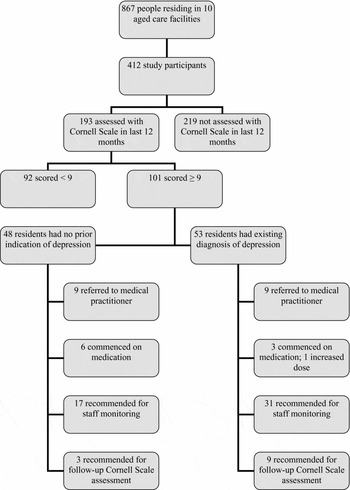
The Cornell Scale had been administered to 193 of the 412 participating residents (46.8%) within the last 12 months (see Figure 1). In most cases (n = 176, 91.2%), the instrument was administered by a Registered or Enrolled Nurse, with 17 cases (4%) administered by a Nursing Assistant. Nursing staff were asked to indicate their rationale for administering the Cornell Scale to each participant who had been assessed. The most common responses were that the Cornell Scale had been administered as part of the scheduled assessment for funding purposes (n = 137; 71.0%) or because the resident had a previous diagnosis of depression (n = 30; 15.6%). However, the staff reported they had administered the tool in response to changes in the presentation of residents or changes in their perceived care needs in 26 cases (13.5%). Only eight participants (4.1%) had received a second administration of the Cornell Scale within the previous 12 months.
Cornell Scale administration and resident responses.

There were 219 participants (52%) who had not been assessed with the Cornell Scale within the previous 12 months. Nursing staff were asked to provide a rationale for choosing not to administer the instrument to each of these residents. The most common response was related to the nurse's perception that the resident displayed no depressive symptoms (n = 135, 61.6%). In 23 cases (10.5%), it was reported that depressive symptoms were likely to be present but that the resident's care needs had not changed. Cognitive impairment was considered to be too severe to administer the Cornell Scale to 37 residents (16.9%), and language barriers prevented assessment of five cases (2.3%). In 19 cases (8.7%), the staff reported that they had not yet had an opportunity to assess the resident.
Residents' scores on the Cornell Scale
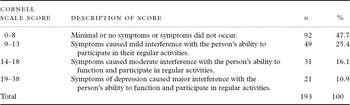
The 193 participants who were assessed with the Cornell Scale had a mean score of 9.37 (SD = 6.85). Of this group, 101 (52.3%) scored 9 or above, indicating the presence of depressive symptoms. Total scores were examined to determine the severity of symptomatology, with 27.0% of the total sample assessed with the Cornell Scale receiving scores of 14 or more, indicative of moderate or severe interference with the person's ability to function and participate in regular activities (see Table 1).
Total scores on the Cornell Scale

Note: The descriptions and cutoff points are those provided by the Australian Government in their manual regarding use of the Cornell Scale.
Fifty-three participants with scores of 9 and above on the Cornell Scale (52.5%) already had a diagnosis or indication of depression listed in their medical notes or resident file (see Figure 1). In most of these cases, the diagnosis of depression had been recorded on the medical notes provided to the facility when the resident was first admitted to the facility. Forty-eight people (47.5%) with no indications of depression documented prior to the Cornell Scale assessment scored in the depressed range (9 or more).
Recording of Cornell Scale scores
There was little evidence in the 101 files that the high Cornell Scale score had received attention from the care staff, with only 12 cases where the score was recorded in the resident's care plan or progress notes. There were some indications in residents' files that the nursing staff were aware of the presence of symptoms of depression; however, with these 12 exceptions, the staff did not explicitly refer to the Cornell Scale in their notes or documentation about care needs.
Monitoring symptoms of depression
Examination of all files of residents with high scores on the Cornell Scale (n = 101) was conducted to determine if depressive symptoms were monitored by the staff. The file review indicated that the staff had recommended a follow-up Cornell Scale assessment for only 12 residents (11.9%). More common were entries in the resident's progress notes recommending that the staff informally observe the resident's mood. There were indications in 48 residents' files that informal monitoring of this nature was conducted by the staff (47.5%). Monitoring was somewhat more commonly recommended for residents who had been previously diagnosed with depression (n = 31/53, 58.5%), rather than for newly identified cases (n = 17/48, 35.4%), χ 2(1,101) = 5.38, p < 0.05. The Cornell Scale scores of residents who were monitored by the staff (15.10) were not significantly different from the scores of residents who were not monitored (14.06), t(99) = 1.02, p = 0.31. Nurses' notes in the residents' files were compared with the reports of the staff members who had administered the assessment. In individual interview, these staff could recall 19 cases (18.8%) where a high score on the Cornell Scale had led to informal monitoring of depressive symptoms by the nursing staff.
Medical referral
Resident files for 101 cases with high scores on the Cornell Scale were examined to determine whether the high score had led to a referral to a doctor or other mental health practitioner for further assessment and treatment of depression within two months of the assessment. Files indicated that 18 residents (17.8%) with possible depression (Cornell Scale score ≥ 9) had been referred to their general practitioner (GP) for further assessment or review. Scores were significantly higher for residents who had been referred to their GP (18.11) than for residents who had not been referred (13.74), t(98) = 3.41, p < 0.01. Among the 48 residents who were not previously identified as depressed, 9 (18.8%) were referred to a GP for an assessment. A similar referral rate was found among the 53 residents previously diagnosed as depressed (n = 9, 17.3%).
Information from the files was compared to the reports of individual staff members who had administered the Cornell Scale to each resident. In interview, the staff were able to recall 17 residents (16.8%) who had been referred to their GP for further assessment or a medication review following administration of the Cornell Scale. Eleven of these cases did not have a diagnosis of depression prior to the assessment, while six were already diagnosed with depression. The staff recalled a small number of residents who had been referred to a mental health specialist, either an Aged Persons' Mental Health Service (n = 6) or a psychogeriatrician from the local area health service (n = 8).
Treatment for depression
Antidepressant medications were commonly used by this sample of aged care residents, with 136 residents (33.8%) prescribed an antidepressant at some point during the previous 12 months. In 15 cases, residents were prescribed a tricyclic at a dose considered subtherapeutic for the treatment of mental health disorders, and these cases were subsequently recoded, leaving a total of 121 residents receiving a therapeutic dose of antidepressant medication (30.1%). The antidepressants prescribed were SSRIs (n = 67, 55.4%), mirtazapine (n = 33, 27.3%), venlafaxine (n = 18, 14.9%), and tricylics (n = 2, 1.7%). Although in all facilities the staff provided support and activities which may well have helped reduce depression among residents, formally documented nonpharmacological interventions for depression were identified in the files of only two residents (0.5%): one received counseling and the other received animal-assisted therapy.
Among the 101 residents with high scores on the Cornell Scale, 39 (38.6%) were taking an antidepressant at the time of the administration. Of interest was whether medication had been commenced or changed in response to the high score on the Cornell Scale, defined in this study as within two months from the date of the assessment. Only nine residents with possible depression (8.9%) were newly prescribed an antidepressant. Six of these residents did not have a previous diagnosis of depression, while the depression of three residents was already known to the medical practitioner or facility. In addition, one resident with a previous diagnosis of depression received an increase in the dose of the antidepressant following the Cornell Scale administration. There were no cases where the medication was changed to an alternative antidepressant.
Managers' perceptions of barriers to using the Cornell Scale
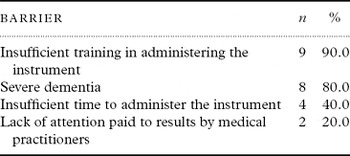
Interviews with facility managers elicited the presence of four barriers to using the Cornell Scale effectively in facilities (see Table 2). The most common barrier identified was insufficient training and understanding of the Cornell Scale by the nursing staff who administer the tool. Managers indicated that the standard administration protocol was not always adhered to, with one facility reporting that it based scores on only the staff interview, without interviewing the resident concerned, due to time constraints. One manager stated that the staff regularly omit questions relating to suicidal thoughts, as these questions are perceived by the staff as “too confrontational.” Two managers reported that the nursing staff experience difficulty integrating information from their observations of the resident with the information from the staff and resident interviews when determining what score to allocate.
Barriers to using the Cornell Scale reported by facility managers

Managers commonly identified severe dementia as a barrier to using the Cornell Scale. One manager reported that even among residents with less severe cognitive impairment, there were concerns about the residents' ability to understand the interview questions, and that these questions were consequently often omitted by the administering staff. Lack of time to administer the measure was identified as a barrier by four managers, with one manager suggesting that the instrument was too long and complex to be practical for routine use. In two cases, managers reported a preference for a brief self-rated tool or a staff-rated checklist to be used in place of the Cornell Scale. Two managers reported that although copies of the Cornell Scale forms are provided to GPs, the latter often disregard results from screening tools completed by the aged care nurses.
Discussion
The results of this study suggested that while the Cornell Scale was used regularly in all aged care facilities, less than half of the participating residents had been assessed within the last 12 months. Residents were most commonly assessed for depression only when first admitted into the facility, in order to obtain the supplementary governmental funding that a depressive disorder attracted. Interviews with nurses suggested that there were only a small number of cases in which the Cornell Scale was administered at a later time in response to a change in the resident's presentation. Nurses reported that they commonly chose not to assess residents whom they felt did not display symptoms of depression. No facility in this study adhered to expert recommendations to screen for depression at least every six months (AGS and AAGP, 2003), and the Cornell Scale was not used to evaluate treatment effectiveness, with postassessment changes in medications very rare.
From these results, it appeared that the Cornell Scale was not used as a routine screening instrument in this sample of aged care facilities, and those residents not perceived by the staff to be depressed were less likely to be assessed. Given previous findings that aged care nurses correctly identified only 42%–65% of their care recipients who had a diagnosis of depression (Brühl et al., Reference Brühl, Luijendijk and Muller2007), it is highly likely that a large number of the residents who were not assessed with the Cornell Scale under this national initiative did in fact have depression. While it is encouraging to note that funding providers have recognized the increased care needs of residents with depression, use of the Cornell Scale is optional for supplemental funding, and the failure of facilities to routinely screen all residents for depression represents a missed opportunity to improve the detection of depression in aged care. A model that provides inducements for screening all residents may prove more effective in addressing the low detection rates.
Approximately half of the participants who were assessed with the Cornell Scale received scores indicative of depressive symptoms, and more than one quarter had an indication of moderate or severe depression. These figures are higher than in a previous study of 1,758 Australian aged care residents, which found that just over one third of the residents assessed by the staff received a score of 8 or above (Snowdon and Fleming, Reference Snowdon and Fleming2008), and is consistent with nurses' reports of selectively assessing residents more likely to receive a high score and who will thus qualify for supplementary funding.
While this initiative identified residents suitable for further assessment and treatment, many of whom had not been previously diagnosed with depression, in most cases this did not translate to a change in their management. The results suggested that the Cornell Scale assessment was not typically used by aged care nurses to inform the care of residents, with both the file review and the reports of the individual nurses who had administered the Cornell Scale failing to demonstrate a clear clinical response to residents with high scores on the instrument. The scores were rarely documented in residents' files and the assessment was not referred to by the nursing staff who developed the residents' care plans or the staff who provided daily care for these residents. While the file review found that nurses had recommended monitoring of symptoms for more than half of the residents with a previous diagnosis of depression, only one third of newly identified cases appeared to have been monitored in any way by the staff, and it was rare for a resident to have been reassessed with the Cornell Scale. Recommendations for monitoring were unrelated to the severity of the resident's presentation, suggesting that even moderate or severe symptomatology did not trigger automatic monitoring by the nursing staff. In interview, nurses could recall only 18.8% of depressed residents actually being monitored by the staff following the assessment.
The findings of this study raise some concerns about the difficulties experienced by nurses in administering the Cornell Scale to aged care residents. Managers commonly identified time shortage as a barrier to routine screening with the Cornell Scale, and many reported a preference for a simpler assessment tool. The use of a brief checklist by the staff to screen all residents may be a practical alternative to the current protocol, with the Cornell Scale subsequently administered to those residents who evidence any signs of depression. Cognitive impairment was also identified as a significant barrier, with 9.2% of the total sample unable to be assessed at all with the Cornell Scale due to the severity of their dementia. Although the challenges of diagnosing depression among individuals with severe dementia are well known, no instrument has yet been identified as superior to the Cornell Scale for use with this population (Barca et al., Reference Barca, Selbæk, Laks and Engedal2008). The development of valid and reliable assessment instruments for aged care settings represents a priority area of study.
Facility managers also commonly reported a view that the training received by nurses in how to administer the Cornell Scale was insufficient. Managers suggested that some staff appeared to be unclear about how to administer items and how to score the instrument, and called for further training for aged care nurses. The routine omission of items and of the whole resident interview for reasons of time constraints raises concern. The disappointing findings of this study could be partly attributed to insufficient training of nurses in administering the instrument and responding appropriately to high scores.
It is not surprising that the aged care nurses in this study experienced difficulty in administering the Cornell Scale. Determination of the score for each item requires integration of behavioral observations with interviews with both the resident and a direct carer. It is not uncommon for these sources to provide contradictory information, and the assessor must clarify reasons for the discrepancy and make an appropriate clinical judgment (Davison et al., Reference Davison, McCabe and Mellor2009a). Clinical expertise must also be exercised in order to determine whether symptoms are due to depression or result from dementia or some other illness, which is a particularly difficult task with a population characterized by medical illness, functional disability, and cognitive impairment (Kurlowicz et al., Reference Kurlowicz, Evans, Strumpf and Maislin2002). The Cornell Scale was originally designed to be administered by clinicians (Alexopoulos et al., Reference Alexopoulos, Abrams, Young and Shamoian1988a), and expert guidelines typically call for interview-rated instruments such as the Cornell Scale to be administered by trained clinicians (e.g. AGS and AAGP, 2003). Certainly, the Cornell Scale has been administered by trained mental health clinicians in most validation studies in aged care settings (e.g. McCabe et al., Reference McCabe2006). This can be contrasted with a study in residential care facilities in the USA which found that a modified version of the Cornell Scale administered by the trained aged care staff failed to discriminate cases of depression, with poor inter-rater reliability among staff (Watson et al., Reference Watson, Zimmerman, Cohen and Dominik2009). This raises serious questions about the routine use of the Cornell Scale by aged care nurses, particularly in the context of limited training. The version of the Cornell Scale currently used in Australian facilities contains clearer instructions for observing and interviewing staff and residents, and research is required to determine whether it is a valid indicator of depression when administered by nursing staff.
While there are concerns about the sensitivity and specificity of the nurse-administered Cornell Scale in relation to DSM-IV diagnoses, this instrument is recommended for use in screening, rather than diagnosing older people (Snowdon and Fleming, Reference Snowdon and Fleming2008). It was disappointing, therefore, to find a low rate of referral of potentially depressed older people by nurses to a doctor for further assessment. The file review indicated that nurses only referred 17.8% of residents with Cornell Scale scores of 9 or above for further assessment and treatment of depression. Thus, in contrast to expert guidelines (e.g. Conn et al., Reference Conn2006), the administration of the Cornell Scale did not trigger further investigation for the majority of positive cases, although nurses were more likely to refer residents with more severe symptoms. Consistent with previous studies (e.g. Davison et al., Reference Davison2007), nonpharmacological interventions (other than usual supportive care provided by the care staff) had not been made available to this sample of aged care residents, and only a small minority were referred to a mental health or geriatric specialist.
The findings of this study support previous research in three Sydney nursing homes (Snowdon et al., Reference Snowdon, Rosengren, Daniel and Suyasa2011). While results of these studies require replication, it appears that this national scheme to assess aged care residents using the Cornell Scale is unlikely to have resulted in a substantial improvement to the long-standing issue of undertreatment of late-life depression. The staff who administered the Cornell Scale and the treating medical practitioners did not appear to use the results to inform the medical care of depressed residents. Only 9.9% of residents in this study with high scores were started on an antidepressant medication or had an increase in dose following the Cornell Scale assessment. The file review suggested that almost half of the residents with scores indicative of depression had not been previously identified as depressed by the staff or treating medical practitioners, and so further assessment of these cases was clearly indicated, with treatment likely to be appropriate for a substantial proportion. More than one third of residents who scored 9 or above were already prescribed an antidepressant at the time of the assessment, and it may be argued that they were already receiving appropriate treatment. However, given that these residents continued to present with symptoms of depression, a change in dose or trial of another antidepressant may have been warranted in many of these cases. Our findings are consistent with a recent Australian study which found that prescriptions for antidepressant medications for aged care residents were rarely changed (O'Connor et al., Reference O'Connor, Griffith and McSweeney2010).
While the results of the present study investigating this Australian initiative are disappointing, introduction of a screening tool in aged care facilities has previously been demonstrated to improve the treatment of residents with depression. For example, when the Cornell Scale was introduced as a mandatory screening instrument for nursing home residents with dementia, one third of the residents who had been receiving antidepressants had their dose increased (Cohen et al., Reference Cohen, Hyland and Kimby2003). Similarly, a screening program introduced in Canadian aged care facilities using the Geriatric Depression Scale (GDS) led to an impressive response by medical practitioners in terms of increased prescription of antidepressants (Soon and Levine, Reference Soon and Levine2002). However, these practitioners received written notification of the GDS scores of individual residents, along with interpretation of the GDS, hand delivered by the researchers.
It may be the case that simply administering an assessment instrument without a clear structure in place to ensure communication of results and facilitate pathways to treatment for residents with depression does little to improve depression management. There is growing evidence that aged care staff are unclear about how best to respond to depression among their care recipients (McCabe et al., Reference McCabe, Davison, Mellor and George2008), and there are indications that a significant number of care staff hold false beliefs about depression and see depressed mood as a natural and expected phenomenon among aged care recipients (Davison et al., Reference Davison, McCabe, Mellor, Karantzas and George2009b). Such beliefs and limited confidence in taking appropriate actions may impede staff referrals for residents exhibiting signs of depression. The development of specific guidelines and training in how to implement them would likely be helpful in assisting the staff to determine the appropriate clinical pathway following the Cornell Scale assessment, with clear recommendations for recording scores, using the results of the assessment in residents' care plans, and making appropriate referrals for further assessment and treatment.
In addition to poor knowledge and confidence among the care staff, there may be other barriers in the aged care system that limit the potential for the staff to identify and respond appropriately to residents with depressive disorders. For example, comments made by two facility managers in the present study suggested that some medical practitioners may have little regard for the results of the nurse-administered Cornell Scale, and it appeared that nurses and doctors rarely engaged in discussion about the Cornell Scale score in order to inform the management of depressed residents. Further research into the barriers to adequate mental health assessment and treatment in aged care is clearly warranted.
The present research project employed a multisource design, interviewing managers and nurses and conducting a comprehensive file review. The reports made by the nursing staff appeared to be broadly consistent with the file review, suggesting that poor documentation did not account for the findings. However, there were a number of limitations in the study, particularly concerning the representativeness of the participants. Only metropolitan facilities from two states were recruited and the results may not apply to regional or rural aged care facilities, or to smaller facilities, which may have been under-represented in our sample. While facilities were randomly selected, the participation rate of facilities was low, with several facility managers failing to return calls to discuss the project or declining on account of staff turnover, lack of time, or other commitments. Not-for-profit facilities in Sydney were less likely to participate than private organizations, although overall, the non-participating facilities did not appear to differ from participating facilities in terms of the level of care provided. However, it may be the case that the facilities which agreed to take part were more confident in their procedures and so were willing to allow their records to be examined. In addition, only half of the population of residents and/or their next of kin in the ten participating facilities could be contacted and consented to take part in the study. A substantial proportion of the cases of non-participation related to the difficulty of gaining consent from residents' next-of-kin, who frequently did not respond to the invitation to participate. Further research is required with a broader sample and more involved procedures to recruit residents' next-of-kin, to confirm that these findings apply to the wider aged care sector.
In addition, this paper focused on the medical responses of nursing staff to indications of resident depression, including symptom monitoring and referral. It is possible that high scores on the Cornell Scale led to the introduction of nurse-led strategies to support residents in coping with symptoms of depression. While nurses did not volunteer information of this nature when asked what steps had been taken in response to high scores, more systematic investigation of the care provided by nurses may reveal a more positive picture of the non-pharmacological management of depression in aged care.
Conflict of interest
None.
Acknowledgments
This study was supported by a grant from the Centre for Mental Health and Wellbeing Research, Deakin University. The authors would like to thank the residents and staff of aged care organizations who participated in the study. The authors also thank Dr Richard Rosewarne and Janet Opie for comments on an earlier draft of this paper.
Description of authors' roles
T. Davison designed the study, supervised the data collection, and wrote the paper. J. Snowdon assisted with the design of the study and with writing the paper, and supervised data collection in Sydney facilities. N. Castle coordinated the data collection and assisted in analyzing the data. M. McCabe, D. Mellor, and G. Karantzas assisted in the study design, project supervision, and in writing the paper. J. Allan collected data in Sydney facilities.
Appendix
Below is the information regarding the purpose of including the Cornell Scale in the funding model for Australian aged care facilities, as described by Dr Richard Rosewarne and Janet Opie from Applied Aged Care Solutions. These authors were responsible for developing guidelines and recommendations for use of the Cornell Scale, including the semi-structured interview schedule for use by the aged care staff, as well as other aspects of the ACFI.
“The purpose of the CSDD in the ACFI process was to help address the lack of sensitivity to mood issues, enjoyment of life factors and the underreporting and treatment of depression by including it in the funding tool. It was also meant to encourage the inclusion of nurses and direct care staff in the assessment process to make them more aware of these issues. Training support was to be provided to reinforce this process. The total score was to be used in the funding tool but the primary purpose was the journey staff had to go through to get there and the interventions that would flow from this. We were hoping that this would provide a vehicle for better insights into the psychological health of residents by staff and then this would encourage more use of professionals in this area to assist staff with the management of the identified issues” (R. Rosewarne and J. Opie, personal communication, 26 August 2011).