Introduction
Many new technologies appear with an inherent power. Unless those technologies disappear prematurely, that power sooner or later pushes them into all areas of life where they effectively evolve as they are adapted to the circumstances, resistances and needs of producers and users. To some extent their trajectory can be predicted, but as with history in general there always remains a “discrepancy between intention and occurrence” and for something which evolutionists call “emergence.”Footnote 1
So it is that we are invited to reflect on the impact of digital or information technologies on photographs and photographic archives in Africa. Today, “digital image technologies have literally eliminated a photographic model of representation” and “the very foundation of the ontology of the photographic image as conceived by the likes of Kracauer and Benjamin, and later by Bazin and Barthes, has been shaken.” It is said, too, that “even the index theory, which follows Charles S. Pierce, now appears to be obsolete.” However, we are now confronted with the normative power of the factual, meaning that more and more photographs and photographic archives are being digitized and placed online. That therefore changes how we look at and work with photographs.Footnote 2
Projects in Europe and the US were implemented in the early 1980s but similar initiatives reached the African continent only some ten years ago. As in the North, projects in the South were inspired by the need for digital preservation of collections, the prospect of making photographic archives accessible online whether on a global scale or within an institution, and to avoid direct contact with physically delicate records. However, outside Africa far more than within it, digitization projects were understood as salvage projects echoing the tradition of salvage ethnography; and they were criticized as such. That therefore explains why the “pros and cons” of digitizing African photographic archives and the arguments that accompany them are diverse and complex. They will be presented in the following from two perspectives and will be further elaborated.
On the one hand digitization in its effect as a transubstantiational technique has triggered a vivid and continuing discussion which addresses photography’s materiality and questions the ontological and indexical status of photographs. A photograph is not necessarily a material object, something that “carries on it the marks of its own history, of its chemical deterioration.”Footnote 3 Digitization, indeed, has far-reaching consequences because, as will be examined later, although a photograph after the digitization process is still an image, of course it is no longer a three-dimensional object. How it exists changes, as does how it is used within the possibilities of a given social and cultural experience; a digitized photograph changes therefore relationally as well as materially.Footnote 4 “Meaning,” as Elizabeth Edwards argues, “does not reside only in the mutable semiotic structures of images, but in their material forms and in the social function and sensory apprehension of those material forms.”Footnote 5 However, it should not be forgotten that many photographs have never enjoyed such sensory apprehensions even in the pre-digital age. In fact, apart from their ubiquity on screens today they have been reproduced and distributed in ways that do not differ significantly from current forms and practices.
On the other hand, digitizing projects offer the opportunity to make collections known and available to a wider public. The meeting point between African photographic archives and the digital age therefore simultaneously offers considerable challenges and genuinely exciting possibilities. There could be a complete re-imagining, repurposing and democratization of previously inaccessible archives. There is an opportunity for agency and the curating and re-curating of material that can question staid ideas of what “Africa” is. This article deals essentially with questions of the multi-layered effects of information technology, the opportunities it presents, and its implications for African photographs and photo archives.
The African Photographic Archive
As Christopher Morton and Darren Newbury in “The African Photographic Archive” aptly state:
Any attempt to define or locate African photography in terms of the cultural background of the photographer, the geographical location of the photographic encounter or its subsequent archival location faces numerous challenges. As a putative theoretical entity, the “African photograph” is at best a highly distributed object, with endless micro-histories and a vast number of custodians, archivists, curators, consumers and re-producers.Footnote 6
The consumption and production of African photographs are indeed closely linked in the sense of the French cultural theorist Michel de Certeau who speaks of a form of consumption which is, in reality, a form of production. That “other” production, as de Certeau writes, “does not manifest itself through its own products, but rather through its ways of using the products.”Footnote 7 In that regard, archival practices are significant, “since it is through the selective publication, exhibition and mediation of collections and archives that ‘African photography’ is created and recreated over time.”Footnote 8 Such archival practices were in fact essential to the shift in rhetoric from “Photography in Africa” to “African photography” which happened “at a moment of radically shifting geopolitical and economic realities, or, to phrase it differently, postcolonial uncertainties.”Footnote 9 Eventually, it was the weighty exhibition catalogue Snap Judgments: New Positions in Contemporary African Photography (published in 2006 in conjunction with the exhibition of the same title at the International Center of Photography in New York), which “solidified the use of the term ‘African photography’ as a global phenomenon.”Footnote 10 In Snap Judgments Enwezor proposed that “the paradigmatic shift from colonial and Western documentary photography in Africa to modern and contemporary African photography is captured by the attempt by African photographers and artists to re-establish the priority of an extant African visual archive.”Footnote 11
Just as the definition of African photography is blurred and ever-changing, so too is the African photographic archive. As a basis for further considerations we shall adhere to a conception of archives “not simply as historical depositories but as complex structures, processes, and epistemologies situated at the critical point of intersection between scholarship, cultural practices, politics, and technologies.” We shall consider them too as sites that “produce knowledge, legitimize political systems, and construct identities.”Footnote 12 The question, then, as to what the African photographic archive consists of, what it contains, where its boundaries are to be drawn – in short how it can be conceived methodologically and conceptually – cannot have a simple answer. The African photographic archive is not limited to a clearly definable geographical unit, nor is it limited to a cultural context. Instead it is fragmented in its location, ownership, purpose, and organizational principles. It is our view that what is understood as African photography is heavily influenced and shaped by the notion of archival practices, and consequently the African photographic archive finds itself in the evolving context of a “changing global image ecology.”Footnote 13 In many respects therefore the African photographic archive is what people like scholars, artists, curators, and journalists actually do with photographs; they establish it by creating subsets and adding new layers of meaning to contexts and content, thereby shaping its future existence and discursive potential.
Considering that many archives today appear as disrupted units all over the world and circulate in and among different socio-cultural contexts and places, the questions of expatriation and repatriation acquire a prismatic complexity beyond the political and social. The situation raises the question of the location of the archive – digital and physical – as well as the question of what should be expatriated or repatriated. The archive’s integrity, its wholeness and place become critical when we think, for instance, of displaced archives that have been removed from where they were created and then consider the requests for their restitution. Or we may ponder initiatives such as the British Library’s Endangered Archives Programme (EAP) the aim of which is the digital preservation of African photographs. In this case the digital archive is hosted by the British Library and accessible on the EAP’s website while the originals have remained where they were created.Footnote 14 That touches too on the responsibility for the sustainable preservation of an archive and access to it. The former is, on the level of international conventions – and if we agree that there is such a thing as a shared world heritage – obviously a shared responsibility, although too often the sense of responsibility is limited by national politics or even personal sensitivities.
Liam Buckley took a radically different view of accountability and responsibility for the national visual heritage of African states. Asking “who has the right to look after the artefacts of material culture as they inevitably expire” he argued that “the decay causes controversy because it reminds us of our feelings for, and intimacy with, colonial culture and asks that we imagine ways of finally letting go.”Footnote 15 What Buckley suggested was that, “letting certain things go – literally, letting them rot – in the existing institutional contexts may itself be a sign of modernization, and the supreme expression of sovereignty.”Footnote 16 Buckley’s de-romanticizing reflections on a mainstream “lover’s discourse,” as he put it, brought his article much deserved attention, but passed over the point of whether the neglect of governments might be countermanded by the interest and concern of the population for their own visual national heritage. The sovereignty of states is one thing, but the matter of citizens’ potential influence over it and shaping of it, is quite another.
For a complete series of photographs and photographic archives, however, a different question of responsibility arises because the items themselves have been removed from the African continent. Such removals might have been done for political reasons and to keep the material safe, as with photographs during apartheid. There are also more recent instances, such as the South African photographer David Goldblatt who announced his intention to move his entire archive to Yale University in New Haven in 2017.Footnote 17 Relocations such as these were initiated voluntarily by photographers in response to particularly trying circumstances, but the same cannot be said of material removed – pilfered, in the words of art historian Candace Keller – in breach of fair practice and against the better judgement of its owners to be “exploited by international scholars, collectors, curators, and dealers.”Footnote 18 The pilfering of negatives is not only detrimental to Africa’s cultural heritage and to the legacy of its professional image-makers but it creates, for the Western but eventually for the African public too, a distorted idea of the African photographic archive and of what “African photography” and even what “Africa” is. African photography is a diverse and complex phenomenon. While ethnographic practice dominated the nineteenth and twentieth centuries, as did the discourse that followed, other photographic practices emerged to make it dynamic and diverse. Press photography, both institutional and independent, vernacular, and more modern visual forms that work with historical, identity and gender questions as well as the use of archival material, all contribute to what constitutes African photography.
The Case for Digitization
Since the dawn of the twenty-first century the digital landscape has evolved seismically. Conway and Punzalan note that:
[O]ver a span of just two decades, the creation of collections of “historical digital objects” has transitioned from rarefied experiment to nearly ubiquitous activity across both the commercial and the non-profit sectors. Within the cultural heritage community of libraries, archives, and museums, the multibillion dollar investment in building digital collections from photographic and other cultural resources has been framed by community-based guidelines and best practices developed by tightly circumscribed but overlapping networks of technical experts.Footnote 19
Proponents of the digital era have endorsed the phenomenon enthusiastically. Ross Parry, of the Leicester School of Museum Studies and acclaimed author on heritage in a digital age, has stated that “[d]igital media has allowed the museum to become everywhere, to become 24 hours, to be connected to all visitors irrespective of their location.”Footnote 20 Virtual platforms created for breaking down institutional walls can be viewed on a variety of media, from computers to mobile phones.
In 2015/2016 the Europeana project reported that it had digitized over 48 million photographs and 2 million audio visual assets.Footnote 21 Digitization on the basis of that sort of progress calls for even greater attention to be given to it for its popular cause.
In the Digital Era, cultural heritage is less and less elitist, less and less for-professors-only, less and less locked away. It less and less looks like a monument (be it physical or literary) to be admired for its unreachable greatness and respected for its authority: through digitization, Cultural Heritage becomes something to be told with an ever new story, to be shared, capitalized, promoted, re-created. Through digitization, Cultural Heritage belongs to the mass.Footnote 22
The imperatives driving this “first world” position are preservation, public accessibility, scholarship and research. However, when applying the model to African photographic collections, repatriation and social justice should be included. In a context of colonization and apartheid, Harris and Hatang state the case for South African archives: “As in most countries negotiating a future from oppressive pasts, South Africa’s heritage and broader memory sectors have been preoccupied by the need to recover marginalized, suppressed and erased histories.”Footnote 23 That, in fact, may be said to apply to a number of African countries but in contexts of contested, uncomfortable or deliberately eclipsed pasts – and there are many – neither repatriation nor preservation and public accessibility seem to figure near the tops of the respective country’s priority lists. In interrogating this point further, the notion of agency is critical. It might well be argued that digitization with no linkage to host countries, regions or communities from where the source material originates serves only to exacerbate existing contradictions of power relations vis-à-vis archives – in this instance photographic archives.
While in recent years photographs have increasingly been acknowledged by scholars of many strands as valuable sources in their own right, it has nevertheless been pointed out that African photographs are seldom gathered into collections and when they are, “remain outside of official collections [and only] occasionally (…) are deposited in institutional archives.”Footnote 24 Furthermore much of the continent’s indigenous collections and photographic past remain inaccessible and unrecognized by comparison with the Global North (United States and Europe) and most importantly, “often struggle to garner support for preservation or conservation.”Footnote 25
African photographic collections today often simply reflect their uncomfortable pasts and former colonial relationships on the one hand, and their weak institutional integration as well as lack of resources both financial and human on the other. They are as much a manifestation of the contradictions of Museum and Heritage sector collection policies of previous periods during which cultural heritage was appropriated by the former colonial countries or by first world institutions. The persistence to the present day of unequal relationships is a manifestation of the contradictions between official discourses that acknowledge the importance of preserving national cultural heritage and reality. We would argue ultimately that African states have refused or at least neglected to turn their past, as expressed in the photographs individuals and institutions produced, into national heritage. By not making it “part of the symbolic currency of the nation” they have surrendered the defining power of their own past – and present – to others, in many cases their former colonizers.Footnote 26 The widespread digitization of photographic archives throughout the “developed world” that has had no parallel on the African continent is only one question among many that emerge from such contradictions.
Digitization of photographic collections and archives potentially brings to the fore a mechanism to deal with matters like repatriation, knowledge sharing, and genuine empowerment of local skills and agency within African countries. Digitization opens up new conversations with otherwise inaccessible material from the past and situates it in the present. The sharing of ethnographic collections of digitized photographs with indigenous communities generated stories that, “became an important mechanism for illustrating the impact that digitization has not only on source communities but also internally for the institution hosting these collections”Footnote 27 There is great potential too that digitized collections can become, “alternative historical resources in countries that boast robust oral and visual creative traditions, yet in which rates of illiteracy remain high, photographs are profoundly accessible and community-orientated capital whose circulation to wider audiences and markets has the potential to expand exponentially the spaces of public dialogue and exchange in Africa.”Footnote 28 As hidden material objects now become accessible, they have emerged as conduits to engage with their history and to “play host to numerous dramas of contestation.”Footnote 29 Digitized African photographic archives offer hope for a highly contradictory inaccessible pattern of visual consumption. No longer tied to their location and now accessible, they can offer many new kinds of conversation. Able to “sustain powerful durable narratives, which we count on as individuals, families, communities or nations”Footnote 30 they can become distribution outlets for re-imagining memory, history and heritage in their localized African contexts.
Digitization Projects
While digitization of photographic collections has been ubiquitous in the first world for the last two decades, and despite the urgent need for it in African countries, very little progress has been made on the African continent. Furthermore, it is difficult and at times impossible to fathom “the depth of photographic history in many parts of Africa because of disruption, migration, loss, and the destruction of civic and personal archives.”Footnote 31 Indeed, African photographic archives on the continent are in a parlous state – vulnerable, endangered, at risk of permanent loss and always potentially “for sale.”
It is true that there are a number of digitization projects and initiatives such as the Archive of Malian Photography, History in Progress Uganda, the École du Patrimoine Africain in Porto-Novo (Benin) centred on the archive of photographer Cosme Dossa, or various projects supported by the British Library’s Endangered Archives Programme. Apart from those, however, the African digital photographic landscape appears quite sparse. Additionally, all those projects were by and large initiated and driven by scholars from the Global North.Footnote 32 Against that backdrop we wish to highlight a few case studies that suggest possible ways forward for digital projects to evolve on the continent. The case studies from two different regions – the central and south regions of Africa, highlight both the challenges and possible methodologies for future projects.
Newspaper Photographic Archives
The value of newspapers as a critical component of memory, social history, politics, and national identity is undeniable but these very important archives are greatly endangered and vulnerable. In some cases, collective digital interventions saved them from simply being lost to time or being despatched to the rubbish tip.
- The Independent Newspaper Archive, Special Collections, University of Cape Town (UCT) Libraries
Newspaper archives and photographic collections as a whole have simply “missed the cut” in the new manifestations of nationhood and heritage retrieval in the new South Africa. Added to that is the frankly bizarre position that archives associated with colonialism and apartheid are perceived as “valueless.” On the other side of the coin we find David Hemson, a former trade unionist who after his return from exile in the 1990s collected images of the seminal 1973 strikes of Durban, of which he was an organizer. Hemson noted that the conservative elements in newspaper groups considered the material a worthless collection of “blacks protesting,” but fortunately Hemson himself had the foresight to document and re-photograph what was a critical piece of South Africa’s discarded history. The material is now part of UCT Libraries’ Visual Archive, but is seemingly lost in the fog of the new South Africa.Footnote 33
A quick review of the state of newspaper archives in South Africa reveals that they are vulnerable and in disarray. The Star Footnote 34 is the largest-circulation daily newspaper in South Africa and it family of newspapers have been drastically downsized and no resources have been allocated to archive management. Fortunately, the Barnett archive, an early collection of Star archives from the turn of the twentieth century, has recently been handed over to Wits University Historical Papers.
The Sunday Times Footnote 35 family of newspapers’ photographic collection is still intact and its images are regularly digitized on demand while the Afrikaans daily Die Burger Footnote 36 has digitally archived some of its collection. Neither collection, however, is publicly accessible or searchable. Of major concern is that throughout the country many smaller archives of newspapers with fewer resources remain endangered. More pertinently there is no national plan to preserve nor digitize such archives or make them publicly accessible.
The call the UCT Libraries received in 2011 to house the Independent Newspaper Archive of the Cape Times, Argus and Herald, came at a time when the Newspaper group was negotiating its sale. The senior executive who had established the relationship with the Libraries spoke intermittently of both the vulnerability and great value of the archive. Meanwhile the archive’s future remained perilously uncertain.
It was, then, under such circumstances that UCT Libraries acquired the Independent Newspaper Archive, which comprises approximately 850,000 prints, slides and negatives. The first project with the support of the UCT Libraries and a UCT internal grant was to edit, select and then digitize a pilot project called “A Snapshot of Cape Town.” Within a year, 6,000 images were scanned and metadata added. Unfortunately, some gems of the archive were lost, but by and large it remains an enormously valuable cultural heritage resource covering a hundred years.
The material is frequently used as a resource for scholarship, memory work and research. It is vast, overwhelming and diverse, providing an enormous variety of images ranging from early photographs of the city of Cape Town, its development, the Anglo-Boer War, beauty pageants, sporting events, and the more recent protest politics of individual newsmakers. The challenge that remains is to integrate those 850,000 images with an earlier version of the Independent Newspaper Archive that is based at the National Library in Cape Town and dates back to the mid-nineteenth century. UCT Special Collections also houses the Cape Times and Argus newspapers as well as microfilms from the mid-nineteenth century up to recent times. Coupled with an ambitious digitization programme, amalgamating the two archives into one resource could create a visual gold mine for South Africa’s oldest city and a model for other newspaper archives in South Africa and elsewhere on the continent.
- The Cameroon Press Photo Archives, Buea
In the mid-1950s only a few years before the end of colonial rule in Nigeria, the British created the Southern Cameroons Information Service which included a Photographic Section. Essentially the result of an increased need for communication and propaganda during the Second World War and the regionalization of Nigeria after the Lyttleton Constitution of 1954, the Southern Cameroons Information Service was continued by the independent Cameroonian state throughout the country’s various administrative and political transformations until the late 1990s.Footnote 37 After the retirement of the last photographer and in the context of the increasing prevalence of digital photography, the Photographic Section was closed. The visual documentation of government action was then taken over by newspaper journalists who provided their images directly to the state media, especially the bilingual official paper Cameroon Tribune. What during the analogue age was centrally organized in the Photographic Section which organized workflows from production, development and selection to the reproduction and archiving of photographs, was now decentralized, with far-reaching consequences especially for the archiving of photographs, which are now distributed using a large number of storage media.
A glance at the register volumes shows that in the heyday of the Photographic Section photographs were requested by government agencies and by private newspapers or individuals. However, by the 1980s and later only a small number of researchers were consulting the Archives. Only the skeleton remained of a once dynamic body which had begun to decay in the 1980s when one Emmanuel MbwayeFootnote 38 retired. He had been the first photographer and although he was effectively the backbone of the Photographic Section, he was known to only a few scholars who also knew how to gain access to the archive.
African Photography Initiatives was the organization which implemented the project “Cameroon Press Photo Archives, Buea. Protection, Conservation, Access.”Footnote 39 It first visited the Press Photo Archives in Buea in 2011 and what it encountered was a largely forgotten but fascinating overview of the political, social and economic history of the Anglophone part of Cameroon from a state-institutional perspective documented in about 120,000 black-and-white negatives and more than 14,000 contact sheets. The original sequential numbering order of the negatives introduced in the 1950s had been largely preserved and the negatives themselves were in quite acceptable condition. An unfortunately incomplete series of requirement, supply, assignment, negative and contact sheet books documented the activity of the Photographic section and its system of order.
The partial re-bedding of the analogue bones into a digital archive – the digitization of 24,000 negatives and all contact sheets – and the creation between the years 2013 and 2015 of a database was carried out with the help of a local team, one of whom was a member of staff made available by the Regional Delegate of the Ministry of Communication who also allowed use of the Delegation’s meeting room as a work room. An interesting example of “repatriation” occurred during the digitization process as a number of individuals who had “borrowed” negatives from the Archives for various purposes without proper documentation returned them to the project team in exchange for digitization. In the meantime, said the borrowers, they had been unable to track down any laboratory still able to develop the negatives. The fact that only about a quarter of all negatives were digitized and thus a selection had to be made on the basis of a quick assessment of the contact sheets has rather cast a shadow over the future accessibility of the material, although that is at least mitigated by the fact that all 14,000 contact sheets have been digitized.
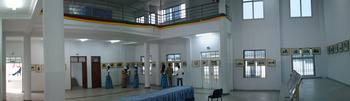
The digitization and conservation project happened in 2014 when Buea, the former capital of Southern Cameroons and later West Cameroon, was preparing for the celebration of the Reunification of the former French and Anglophone Trusteeships fifty years before. Roads were paved, street lighting was installed or repaired and a huge monument erected in the historical centre of Buea and the buildings along the route to be taken by President Biya were repainted. The last to be renovated was the archive building, although its roof was repainted only on the street side! At that time there was huge interest in historical photographs from the Press Photo Archives as the government published a number of publications celebrating the event. In the same week, while president Biya was visiting Buea, the exhibition “The Path towards Unity” opened in Buea’s new Town Hall. On show were more than fifty recently digitized photographs from the Press Photo Archives (see Figure 1).Footnote 40
The exhibition “The Path towards Unity” in Buea’s Town Hall, 2014. Photographer: Rosario Mazuela

Dealing with photographs and bringing them to a wider public’s attention in Cameroon goes hand in hand with reflections on what it is possible to show and what not, even though there is no overt censorship in the country. Furthermore, what can be put on display in one place and in a certain situation can work quite differently in another context. For example, in government publications for the reunification ceremonies in 2014, John N. Foncha was mentioned among the architects of postcolonial Cameroon. Foncha had a varied political career and enjoyed varying official recognition over the decades. He was Prime Minister of West Cameroon until 1965 and Vice President until 1970. However, when on the occasion of a photographic exhibition African Photography Initiatives placed a large portrait of Foncha at the entrance of the Community Hall of Limbe, a small coastal city south of Buea, the City Council demanded its immediate removal – without providing reasons.Footnote 41
Weighing the loss through digitization of material existence and corresponding loss of historical entity against the gain in publicity and accessibility, everything is in favor of digitization and the creation of a digital archive. After all, the reproduction takes on a life of its own and the “ontological transformation” that happened from the analogue surrogate – the negative in this case – to the print was never significant, at least not with regard to the veracity of the image since it remained connected to the Press Photo Archives and the documentary guarantee that institution grants. For the contact sheets, however, the situation is different, for the sorting by hand and laying out of chronologically ordered photographs is possible only after the contact sheets have been printed.
The bigger question remains the limitation of access to the digitized material for political reasons – or perhaps simple administrative hurdles. Although the British Library which funded a good part of the project offers its website and services to place the material online and thus accessible globally, the Ministry of Communication is still waiting for the Presidency’s and Ministry of Culture’s appraisal of the matter and therefore is not ready to give its approval. Thus, as before with the negatives and contact sheets in the Archives, access to digitized images and contact sheets remains restricted to those who know where the material is stored and are authorized to give permission to use it. A call on the government and other stakeholders in Cameroon to protect and make accessible for public use the country’s photographic and cinematographic heritage has been launched by African Photography Initiatives and is open for signature.Footnote 42
As well as the matter of preservation, one of the main arguments for digitising press photographs in Buea is to enable access to the widest possible audience, which could be secured if the Cameroonian government approved their publication on the British Library’s website. That solution would simultaneously relieve the government of the demanding work of continuous technical updating of the site and backup of the digital archive. It might seem that the question of the hosting of the digital archive, which is one of the most important in the whole matter, could be answered easily in the case of the Cameroon Press Photo Archives. However, perhaps we cannot take for granted that it would be acceptable for this official documentation to be hosted on the servers of an institution of the former colonial power. In a postcolonial context we find ourselves once more at the centre of obvious tension between what is considered national heritage and what can be claimed to be world heritage.
What is more, the legal and moral questions that arise in the case of publication or public use of the press photographs are very different for photographs taken by a studio photographer. Then again, how digitization and dematerialization affects the social life of photographs from the Press Photo Archives or a photographic studio differs considerably because the field in which the photographs were circulated covers an entire society in one case, and in the other essentially concerns families, usually a much smaller and more intimate circle who were also in direct contractual relationships with particular photographers.
Studio and Vernacular Archives
Relatively recent scholarship and research on African photography and photography within and from Africa both challenges assumptions that African representation has been dominated by outsiders and adds dynamic modes of understanding the continent and its history. The contribution of vernacular photography, placing the studio and portraits by Africans themselves in the foreground, underpins the important value of photographs to, “sustain powerful durable narratives, which we count on as individuals, families, communities or nations.”Footnote 43
- The Other Camera Project, Special Collections, University of Cape Town (UCT) Libraries
Despite expectations that a democratic South Africa would deliver new energy and enthusiasm for archives and in particular digitization programmes, in fact very little has been done to support that aspect of the heritage sector in South Africa. It is true that a white paper was produced in the early 2000s but it was never ratified in parliament. At the time of the conception of The Other Camera project, in about 2008, the work of Malick Sidibé, Seydou Keïta, and other studio photographers, predominantly from West Africa, had been widely exposed throughout the world. The projects explored and celebrated the studio, the black and white portrait and Africa’s visual modernity, as a cross-cutting theme. Many visual scholars have noted that portraiture is at the core of African photography suggesting, as John Peffer has, that “photographic portraiture in Africa has not stood still as simple memorial illustration of historic persons, but has been repeatedly and continually (into the present) a site for performative interventions, reinscriptions of meaning, and the layering of other, non-photographic media.”Footnote 44 Peffer further contends that “portrait photography encompasses not only discrete images of individuals but also the wider range of circumstances and environmental factors leading to their production, that is, the social interactions and the larger cultural legacies that surround, inform, and are transformed by such images.”Footnote 45 The portrait brings with it a strong sense of agency, as noted by Laura Serani who stated that “[i]n Africa there has been a greater persistence in the practice of the portrait (…) desire for control of one’s image, and (…) the desire to reduce distances with the family far away.”Footnote 46
The fact that the focus on vernacular photography in Africa was centred predominantly in West and Central Africa with very little attention paid to South African styles and traditions was what prompted The Other Camera project.Footnote 47 Santu Mofokeng had produced ground-breaking work formed from a collection of studio portraits from 1890–1950. It was called “The Black Photo Album” and reinforced the notion that photography was deeply inscribed in the emerging urban life of black South Africans. However, The Other Camera showed that the collections of many of the former studios and the work of “street photographers” in South Africa had been lost, primarily because of the shift to digital photography. The Other Camera project therefore set out to show a style of photography that explored the world “from the standpoint of participatory and community photographers.” It poses important questions: how do photographers from communities in Africa and specifically South Africa photograph their own people, environment, cultures and events? More importantly, it asks how vernacular photography has developed and how it has reframed itself in relation to modernity, transformation, and globalization.”Footnote 48
Research into photographic collections looked at past and contemporary collections. The curatorial process considered different styles and photographic traditions to reflect a diversity of work over time and nearly 10,000 scans were archived from the following photographers and collections.
- The Ronald Ngilima Collection
Mostly medium format black and white negatives, photographed in the 1950’s and 60’s, borrowed from the Ngilima family. Ngilima worked on the East Rand of Johannesburg. He ran a studio from his home but also developed a reputation and a career photographing people on location.
- The Daniel Morolong collection
Small black and white prints, held by Forth Hare Institute of Social and Economic Research (FHISER). Morolong was a street photographer who covered cultural events for the community in and around East London from 1950’s–1970’s.
- The Angus Gibson collection
One hundred black and white prints from an unknown studio photographer from Pretoria. This is a rare and beautiful collection of the work of a former studio photographer who operated near Pretoria. At his death his heirs threw away his entire archive, so that all that remains are the photographs in Angus Gibson’s collection.
- Ruth Sack/Yettie Saunderson collection
Hand-colored prints; these are part of a much larger collection inherited by Ruth Sack from her aunt Yettie Saunderson who ran and operated a studio in Johannesburg called Aqua Portrait Studio. It comprises uncollected prints made by her aunt, an airbrush artist who took orders from township photographers and frame shops in Johannesburg. The airbrush technique was popular from the 1930’s onwards but had become less fashionable by the 1990’s.
- The Bobby Bobson (Sukdeo Mohanlall) collection
Medium format color negatives managed by Axis Gallery in New York. This is a remarkable collection of work by one of the foremost studio photographers in Grey Street, Durban. Mohanlall attracted mainly Zulu-speaking clients from the greater Durban area and beyond.
- The William Matlala collection
Color negatives; this is a rare collection of portraits of workers. Matlala, once a trade union shop steward, began documenting working lives by taking portraits of workers in the ‘street photographer’ idiom. He later progressed to photojournalism for COSATU, the largest trade union federation.
- The Sipho Lucky Khoza collection
An album bought by collector Garth Walker. The album reflects the work of one of the most enterprising street photographers of his time who lived in the Durban area.
- The Isoliswe collection
Digital photographs from a street photography collective based around the city of Bloemfontein. The collective would meet regularly to share skills, ideas and marketing strategies.
- The Lindeka Qampi collection
Digital photographs from the Cape flats area of Cape Town. Qampi, who started out as a street photographer has found multiple ways to document street culture in South Africa.
The Other Camera project performed an important function of preservation. In the case of the Ronald Ngilima collection more than 5,000 negatives that were in poor condition were scanned as were a hundred rare color negatives in the Bobson Sukhdeo Mohanlall collection. A great deal of post-production was required as many of the images were damaged and in desperate need of conservation.Footnote 49 The subsequent curating of the images developed into an exhibition and book called The Other Camera, which raised the profile of South African vernacular photography and generated research articles by John Peffer on the hand-colored genre and by Michael Godby on the double exposure street photography style.Footnote 50
As well as a comprehensive digital archive, a travelling exhibition and a book, the intervention of The Other Camera project has served an important role in archiving a vulnerable, endangered and misunderstood genre in a period when digital photography has eclipsed the practice of preservation of objects and pushed it to the margins. One of the last owners of a portrait studio in Durban was a man called Prem Mistry. As he observed, during the project, “When I die, the profession will die with me.”Footnote 51
- The Photo Studio George, Douala, Cameroon
One of the earliest photographic studios in Douala if not in all Cameroon was called “George.” The studio was founded in 1931 by George Goethe who had been born in 1897 in Freetown. There had been other African photographers in Cameroon before Goethe, such as William Mundisa Bell, A.T. Monor Lawson, or Jemedi Mukuri, but Goethe’s studio enjoyed the longest uninterrupted history. When George Goethe died in 1977 his son Cyrille Douala Goethe kept the studio going with a number of employees until early 2000. For almost seventy years generations of Douala’s residents posed in front of the canvas backdrop which became the studio’s trademark from the 1940s onwards. Photo George’s activities were not restricted to the studio, for its photographers went out to cover marriages, funerals and other important moments in individuals’ and families’ lives; they took photographs for local enterprises too and documented public events such as the celebrations for 1st May. In the early days of his career George Goethe took photographs in Cameroon’s hinterland and published a great number of the resulting images as postcards. Not least, a very important line of business for the studio was the re-photographing of old and faded images, uniting couples onto one photograph from two previously separate ones in family albums, and enlarging passport photographs sufficiently to be displayed in living rooms.
In June 2014 when strong winds blew the roof off the studio building leaving the photographs exposed to the elements, African Photography Initiatives joined forces with the Prince Claus Fund’s Cultural Emergency Response (CER) programme to prevent the destruction of the studio’s significant archive.Footnote 52 With the West African monsoon season approaching, the project came just in time to prevent the destruction of the entire collection. In total approximately 50,000 negatives and 1,300 prints could be saved and 6,000 of those negatives and prints were digitized. Material that had been damaged beyond repair was disposed of and what could be rescued was cleaned, with dust and metal clips removed from the photographs. The material was then placed in new storage units and moved to cupboards in a room next to the Goethe family house. The digitized material is now safely stored on a number of hard disks, although no database exists documenting the collection. The purely technical question of how to make the material accessible online has not yet been resolved.
We planned an exhibition in spring 2016 in honor of George and Cyrille Goethe at Douala’s prominent art space doual’art. Cyrille was approaching his eightieth birthday and already quite frail. However, exhibiting the photographs in public became problematic, for at first Cyrille’s brother refused to give his approval. He pointed out that the photographs had been commissioned by individuals and families for their own private use and so had never been intended for public display. “What will those people say when they see their relatives or themselves exhibited in public?” he asked. He was of course quite right on the point; indeed, he was addressing a topic that has never been seriously discussed in connection with any of the different exhibitions and publications of studio photographs from Africa held during the last decades. How can we justify the public display and insertion into a global art market of private photographs, many of which are of people still living? Indeed, as Candace Keller argues, “the publication of these images in Western contexts raises questions of ownership” – although we would point out not only in Western contexts. While “professional proprietors are the rightful owners of the negatives created in their establishments (…) the commissioner owns the rights to the printed images.” As Malick Sidibé confirmed in an interview with Keller, in general the publication of private photographs is problem-free since “most clients are honored to find their images reproduced in catalogues and exhibitions.” However, there are others who have “suffered humiliation and vehemently criticize the practice.”Footnote 53
After some discussion and weighing the opportunity of honoring his father’s and brother’s lifetime achievements against the possible risk of causing embarrassment, Cyrille’s brother eventually gave his blessing to the plans for an exhibition in their hometown. The exhibition was a great success and attracted a large crowdFootnote 54 and nobody complained. In fact, on the contrary those who recognized themselves in the exhibited photographs stood proudly in front of their portraits, joking happily about how old they had become and trying to recall when it was the photograph had been taken. The middle-aged and older generations could remember the ancient brown-beige background that had served for decades as the backdrop. The younger generation who had grown up in the digital age had great fun posing in front of the studio backdrop and taking “selfies.”
The great attraction of the studio background and its prompting of remembrance in older people and the staging of the “selfies” and group photos, nicely highlights a flaw in the programmes of digitization of photographic archives. That is that although digitization can prevent an image from disappearing, not only is the image’s material existence as a photograph lost but so is the context in which it was created. Put another way, the digital image becomes completely separated from the photograph as an object, and that is something particularly serious in the case of studio photography for it represents a major problem that impedes all those wishing to study photography as a social practice, a profession and an economic undertaking.
Digital Faultlines
“L’ordre d’aujourd’hui est le désordre de demain”Footnote 55
We cannot think of photographs without thinking of the archive. In fact, it is impossible to disentangle the two, basically “[b]ecause the camera is literally an archiving machine, [and consequently] every photograph, every film is a priori an archival object.”Footnote 56 In fact, the entanglement of the archive and the photograph appears even deeper and more complex when we think of the archive as what Michel Foucault called “the law of what can be said, the system that governs the appearance of statements as unique events.”Footnote 57 Every photographic image is endowed with a “principle of uniqueness”Footnote 58 although that principle has always been overshadowed if not jeopardized, by the multiplicability of photographic images – to say nothing of their sheer mass. Then of course, there is the matter of what the archive does not include.
Digitizing photographic archives affects their ontological and epistemological status enormously. A most significant element in the process is the obvious effect on the material existence of the archive and the photographs it keeps. There is too the issue of location, in that digitization in its dematerialization delocalizes the archive so that it becomes separated from the larger context of photographic production and associated scenes of social interaction. Delocalization through dematerialization leads to multiplication both of the archive’s physical locations – to hard disks, servers and so on where images are stored only as digital forms – and the interface, where it is seen and consulted. Not only that, but digitization similarly creates new locations from where documents speak. As an analogy with what the German art historian Hans Belting says about images, the history of the archive has always been a history of the archive’s medium.Footnote 59 However, the reappearance – or “re-materialization” – of digitized photographs reproduced in books and the like “touch on fundamental features of photographs as a medium (…) [since] scanning and reproducing photographs necessarily involves technical decisions and various forms of digital manipulations, such as framing, cutting details out of larger layouts, and the determination of contrast, brightness, color, or focus to mention just a few.”Footnote 60
As much as there is a close connection between object and image that involves all the senses, there is a close connection between order and meaning. As Ernst Gombrich reminds us, these “basic categories (…) play their part throughout the range of the visual arts.”Footnote 61 However, even if for the sake of closer analysis we do distinguish between the two categories of perception – order and meaning – as Gombrich did in The Sense of Order, we see that they are reunited in our understanding of the order of archives as the starting point to derive meaning for the photographs. Both the archive order and, consequently, the meaning it asserts for the photographs will be changed in the digitizing process insofar as the process affects the photograph as an image object. The process cannot therefore be seen as “merely changing the physical state of a photograph [and the archive’s ordering system] from the material to the pixel.”Footnote 62 In fact, as Joanna Sassoon argues, it is through the translation from the material to the digital that the act of digitization “becomes a cultural, rather than simply a technological, process.”Footnote 63 There are, indeed, serious consequences to the loss of the evidence of materiality and we can justifiably ask ourselves what the repercussions are on the “social life of things” if the thing – the photograph and the archive – becomes digital and the material environment of production becomes disconnected from both.Footnote 64 Such acts of translation perhaps began even before digitization itself since, as James Opp reminds us, as photographs move “through different hands and archival grids, the meanings attached to the photographs were reworked and renegotiated, and remnants of these earlier interventions continue to haunt the digital data-bases that now bear the cultural weight of these photographs.”Footnote 65 In order fully to grasp these legacies “we need to be able to reconnect the material history of the photographs more overtly to their virtual surrogates.”Footnote 66 Stabilizing the “dubitative image,”Footnote 67 as Peter Lunenfeld terms it, through an overtly acknowledged and traceable relationship of the material and virtual image – and not least the recognition of the autonomy of the digital image – might deliver argumentative building material to resolve digital dilemmas.Footnote 68
The Digital Future – Unfixed
The “Alexandrine Dream” has come true.Footnote 69 In principle, everybody with access to the internet can consult and store all digitally available images on his or her computer. In that sense, information technology has strengthened Africa’s presence globally and embedded Africa’s photographic heritage in “multiple elsewheres.” Many photographers in Africa and the African diaspora upload their images to the internet, participate in global art competitions, and make their work available to a wider audience thereby overcoming barriers of space and time. There is conscious disruption and rebellion against protection and inaccessibility of archives. A form of anarchic reclamation, if you like. While that is encouraging, the reality is that Africa’s photographic heritage is still predominantly under the tutelage of the Global North, through digitizing projects resourced by well-funded museums, libraries, and archives, compared to the situation in Africa. Hence, the caveat that “[d]igitalization projects necessitate constant reacting and acting, because what is digital does not rest, just as overall technological development does not rest,” weighs even more heavily on Africa’s institutions.Footnote 70
Digitally born repositories, too, have caused us to question how we think about archives. The sense of the archive as a repository of memory has been transformed so that it is now seen as a vehicle for instant gratification, a source of multiple “messages” and part of the currency of social media.
With all this there emerge new ways of conceiving the replica – or the surrogacy. The original image once considered in hallowed terms has been replaced by the proliferation of what Hito Steyerl calls “the poor image.” It is as if an orthodox religion had given way to populist evangelism. In her view, “The poor image is no longer about the real thing – the originary original. Instead, it is about its own real conditions of existence: about swarm circulation, digital dispersion, fractured and flexible temporalities. It is about defiance and appropriation just as it is about conformism and exploitation. In short: it is about reality.”Footnote 71 The impact on archives is significant. That in itself is a prevalent practice of modern-day photographers and artists like Hank Thomas and others who use historical material to reframe and question the past.Footnote 72 The religiosity and attention to detail and accuracy through meticulous gathering of metadata and adherence to standards of quality have been traded for accessibility and communication. The implications are obvious – power over the archive has passed to the masses.
The fetish of materiality is still idolized by a circle of believers but there are many outside that circle who would argue that access to the African image world and the survival of the images in the virtual world, all technological challenges notwithstanding, outweighs the loss of the analogue photograph’s auratic material presence. After all, “[w]hile the best way to slow down the physico-chemical process of the decay of photographs is to protect them from being accessed (…), digital photos are only preserved through their use – if one ignores them, the information stored on them will also be lost for future generations.”Footnote 73 Furthermore, if “loss of materiality has been offered as an argument against photographic digitization; this thinking fails [if we] acknowledge that digitization is in fact another mode of material presentation – a re-presentation – that merits further study as an experience.”Footnote 74
Conway and Punzalan point to Andrea Witcomb’s characterization of the “cultural heritage sector’s dilemma” regarding digitization and surrogacy, as a choice between confronting digital technology as a threat to established culture and embracing new technologies as an opportunity for the field to reinvent itself. In Witcomb’s view, individuals who see digitization as a threat are worried about the “loss of aura and institutional authority, the loss of the ability to distinguish between the real and the copy, the death of the object, and a reduction of knowledge to information.”Footnote 75
On the other hand, Witcomb argues that individuals who interpret digital surrogacy as a net gain see “these same losses in materiality as a step toward achieving equity in access and meaning construction;” (…) “loss of institutional authority could mean being facilitators rather than figures of authority, an openness to popular culture, the recognition of multiple meanings, among others.”Footnote 76
If the idea that archives as gospel has been challenged by a popular evangelism, what then are the implications for African photographic archives? How does it affect the contradictions – unanswered and unaddressed – that pertain to the African archives? What about the burning question of repatriation? Or social justice? Both must still be addressed.
Conclusion
The digital world has brought into sharp relief and popularized many of the complexities that continue to accompany “African photographic archives” both on the continent and beyond. Our collective experience shows that government bureaucracy is not always willing to participate in projects that attempt to share regional or national memory and heritage. While working with private collections is far easier, that too is not without its challenges. Important matters remain, such as copyright, accurate metadata, and continual migration of the digital content.
First world institutions and individuals who drive the digital train presume that making material available is the panacea for resolving existing contradictions. They believe it will break down walls previously restricting access to heritage, turning material assets into the property of the masses.Footnote 77 However, the accessibility that is critical to the consumption of these archives, is directly linked to the extent of availability of the internet throughout Africa. As long as that access is limited, true democratization of images will remain elusive. Recent research reflects that while approximately 80% of the population in North America and Europe have internet access, in Africa that figure is considerably lower. Recent studies show that “internet penetration in Africa is 18%, which is significantly lower than the global average of 30%. Only one in ten African households is connected to the internet.”Footnote 78
While many questions are still asked about the impact of digitization and its practice in the world, it is clear that the digital continues to push analogue collections out of their comfort zone and into the hands of the global citizen. Power is thereby transferred from the archival expert into the hands of the citizen archivist. The power of the image has dramatically changed – and for ever, for there is no way back!