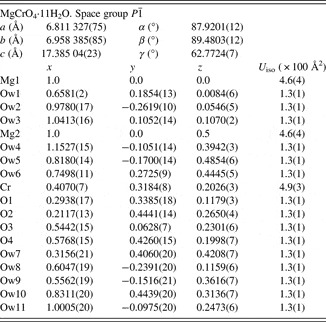
, Z = 2, with unit-cell parameters a = 6.811 33(8) Å, b = 6.958 39(9) Å, c = 17.3850(2) Å, α = 87.920(1)°, β = 89.480(1)°, γ = 62.772(1)°, and V = 732.17(1) Å
I. INTRODUCTION
Crystalline hydrates with the formula M 2+XO4·nH2O occur with a range of compositions, including isomorphous or isodimorphous series with M 2+ = Mg, V, Cr, Mn, Fe, Co, Ni, Cu, Zn, and Cd, X = S, Se, Cr, Mo, and W, and n varying from 0 to 11 (e.g., Cotton et al., Reference Cotton, Wilkinson, Marillo and Bochman1999). Hitherto, the only known compound with n = 11 was the cryohydrate MgSO4·11H2O, which occurs naturally in periglacial environments on Earth and perhaps globally on Mars as the mineral meridianiite (Peterson et al., Reference Peterson, Nelson, Madu and Shurvell2007). This compound has a narrow range of stability in contact with aqueous solution, between a eutectic in the MgSO4–H2O system at −3.9 °C and an incongruent melting point at +2 °C. Although discovered 175 years ago (Fritzsche, Reference Fritzsche1837), this substance has received scant attention until recently, when its structure and anisotropic thermal expansion have been determined (Peterson and Wang, Reference Peterson and Wang2006; Fortes et al., Reference Fortes, Wood and Knight2008). Given the extensive range of substitution, involving both the divalent metal cations and divalent oxyanions, observed in all lower hydrates, it is interesting from a chemical crystallographic perspective to establish whether analogues of meridianiite exist with different compositions. In a pair of companion papers, Fortes et al. (Reference Fortes, Browning and Wood2012a, Reference Fortes, Browning and Wood2012b) reported a systematic study of cation doping, involving replacement of Mg2+ with Mn2+, Fe2+, Co2+, Ni2+, Cu2+, and Zn2+, in which no end-member analogues of meridianiite were observed. However, the study determined the substitution limits of these ions in the meridianiite structure, characterized the chemically induced elastic strain, and discovered two new hydrates. The objective of this paper is to report a parallel study of oxyanion doping, starting with the investigation of a possible MgCrO4 end member.
The MgCrO4–H2O system has been characterized from 0 to 75 °C (Hill et al., Reference Hill, Soth and Ricci1940), exhibiting solubility curves for a pentahydrate and a heptahydrate. No investigations are known at lower temperature, which might reveal the existence of another hydrate. The pentahydrate was first characterized by Wyrouboff (Reference Wyrouboff1890) and found to be isomorphous with CuSO4·5H2O; later analysis by X-ray single-crystal diffraction methods showed that it is isostructural with the CuSO4 and MgSO4 pentahydrates (Bertrand et al., Reference Bertrand, Dusausoy, Protas and Watelle-Marion1971; Baur and Rolin, Reference Baur and Rolin1972). The heptahydrate was described by Kopp (Reference Kopp1842) as being isomorphous with orthorhombic MgSO4·7H2O. X-ray crystallographic analysis confirmed that the two compounds share the same space group, P212121 (Westenbrink, Reference Westenbrink1926), and it is likely that they are isostructural, although there appears to be no refinement of the MgCrO4·7H2O structure in the literature. Fock (Reference Fock1880) reported refractive indices as a function of composition across the series MgSO4·7H2O–MgCrO4·7H2O.
In previous studies, we produced MgSO4·11H2O in one of two ways. As the solubility is known, we were able to grow large single crystals from saturated aqueous solutions kept below 0 °C for several days. However, we also produced polycrystalline mixtures of MgSO4·11H2O + ice by flash freezing concentrated solutions in liquid nitrogen. In the absence of solubility data for the MgCrO4–H2O system below 0 °C, the most effective method of making an initial survey is to use the quenching technique. As information is obtained in this fashion, it will allow us to progress in the future to equilibrium crystal growth experiments.
II. EXPERIMENTAL
A. Sample preparation
Magnesium chromate hydrate (Alfa Aesar 40503, MgCrO4·xH2O, 99.8% metals basis, CAS 16569-85-0) was dissolved in ACS reagent grade water (Sigma Aldrich 320072, CAS 7732-18-5). A substantial quantity of insoluble material was filtered, and the remaining liquid, with a concentration later determined to be ~18 wt% MgCrO4, was evaporated to a concentration of ~30 wt% MgCrO4 at 60 °C using a magnetic stirrer hot-plate; higher temperatures lead to decomposition of the chromate. A pipette filled with this aqueous MgCrO4 solution was taken into the UCL Department of Earth Sciences cold room facility (at an air temperature of −10 to −12 °C) and added drop-wise to liquid nitrogen held in a steel cryomortar. Once frozen, the 2–6-mm-diameter spherules were ground to a powder using a nitrogen-cooled steel pestle.
B. X-ray powder diffraction
X-ray powder diffraction data were collected on a PANanalytical X'Pert Pro multipurpose powder diffractometer (using germanium monochromated Co Kα 1 radiation, λ = 1.788 996 Å, and an X'Celerator multi-strip detector) equipped with a thermoelectrically cooled cold stage (Wood et al., Reference Wood, Hughes, Browning and Fortes2012). This portable cold stage was stored in a chest freezer at −30 °C while the powder specimen was prepared, and then placed on a bed of dry-ice pellets during loading. The bright yellow powder was transferred to the cold stage with a nitrogen-cooled spoon and the surface was flattened with the spoon handle, forming a top-loaded pressed powder specimen. The cover and fan assembly of the cold stage were screwed into place, with the body of the stage still embedded in dry ice, and then the apparatus was moved quickly from the cold room to the X-ray diffraction laboratory. The power supply to the Peltier element and cooling fans was connected and the stage was screwed onto the diffractometer mounting bracket. With loadings at dry-ice temperature, the duralumin body of the cold stage typically becomes heavily frosted, but this melts over ~30 mins as waste heat from the Peltier element is dumped into the heat-sink fins. Once the specimen temperature has stabilized, and the measurement has begun, the stage is entirely free of ice and moisture.
Diffraction patterns were integrated in steps of 0.0167° in the 2θ range 5–90°; the active length of the X'Celerator detector (2.122°) means that the chosen dwell time of 175 s per step translated into an overall measurement time of 1 h 57 min. Four scans of this length were collected (total time = 7 h 47 min) and subsequently summed. This long integration time was used to overcome the high background resulting from fluorescence of Cr when illuminated by Co X-rays. Between each scan, the doors of the instrument housing were opened and cool air was blown in using a desk fan. Data were collected with variable divergence and receiving slits, converted to fixed-slit geometry with the proprietary X'Pert Pro HighScore Plus software package, and exported in an appropriate format for analysis in the GSAS/Expgui package (Larsen and Von Dreele, Reference Larson and Von Dreele2000; Toby, Reference Toby2001).
III. RESULTS
Inspection of the first diffraction scan revealed Bragg reflections from water ice (phase Ih) and a set of additional peaks that strongly resembled the diffraction pattern of MgSO4·11H2O (see, e.g., Figure 2 in Wood et al., 2012). The first 15 peaks of the non-ice phase were indexed using DICVOL06 (Boultif and Louër, Reference Boultif and Louër2004), yielding a triclinic solution with unit-cell dimensions a = 6.8120 Å, b = 6.9566 Å, c = 17.3961 Å, α = 87.929°, β = 89.500°, γ = 62.771°, and V = 732.51 Å3, and the figures of merit M(15) = 119.0 (de Wolff, Reference de Wolff1968) and F(15) = 245.4 (0.0024, 25) (Smith and Snyder, Reference Smith and Snyder1979). This unit cell is similar to that of MgSO4·11H2O (see Table II), and we therefore hypothesized that the non-ice component was the chromate-analogue, MgCrO4·11H2O, the first example of an 11-hydrate isostructural with the mineral meridianiite that contains an alternative cation or anion species.
Atomic coordinates (x, y, and z) and isotropic thermal displacement parameters (U iso) for the heavy atoms in MgCrO4·11H2O.a

a See also the supplementary CIF data.
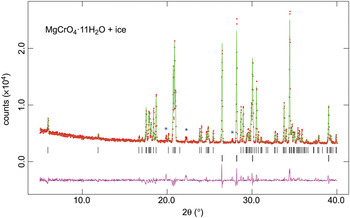
We tested the hypothesis by carrying out Rietveld refinement of a CrO4-substituted meridianiite model against the complete 7.79-h integrated dataset. The sample temperature of −15 °C was used to obtain appropriate unit-cell parameters for the ice component in the specimen, from a linear interpolation of the values tabulated for H2O ice Ih by Röttger et al. (Reference Röttger, Endriss, Ihringer, Doyle and Kuhs1994). With the ice unit-cell parameters fixed, the specimen height and transparency (SHFT and TRNS parameters in GSAS peak shape function 3) were refined, these quantities being constrained to undergo equal shifts for both phases in the refinement. Sample scale, phase fraction, and 10 background coefficients were also refined, followed by the specimen unit-cell parameters and the Lorentzian “microstrain” peak profile parameter, LY. At this point, it was clear that a simple substitution of Cr for S in the meridianiite structure gave a good fit to the observations.Footnote 1 Given the complexity of the structure, atomic coordinates were only refined after a series of bond distance and bond angle restraints were entered; the values used were intended to produce regular CrO4 tetrahedra with Cr–O bond lengths of 1.64 Å and regular MgO6 octahedra with Mg–O bond lengths of 2.09 Å. These values are typical of other MgCrO4-bearing crystals (e.g., Bertrand et al., Reference Bertrand, Dusausoy, Protas and Watelle-Marion1971). After refinement of all atomic coordinates (except Mg1 and Mg2, which are on special positions) and of isotropic thermal displacement parameters, the χ 2 value for the fit was 4.924, with weighted and unweighted profile R-factors (including the background) of 0.0359 and 0.0246, respectively. Table I reports the final structural parameters of the title substance: further details of this refinement are contained in a Crystallographic Information File included in the electronic supplement to this article; the reader may inspect the diffraction data using the freely available pdCIFplot software (Toby, Reference Toby2003). The fit to the diffraction data is shown in Figure 1. Several additional very weak peaks, the strongest of which are indicated in Figure 1 with asterisks, were attributed to the orthorhombic heptahydrate, MgCrO4·7H2O. The refined phase fraction of MgCrO4·11H2O was found to be 68.4(2) wt%, which corresponds to a bulk composition of 28.35(7) wt% MgCrO4, in good agreement with the composition of the starting liquid.
(Color online) Diffraction pattern of the quenched hydrate + ice specimen measured at −15 °C. Filled circular symbols (red) are the measured data and the solid line (green) represents the calculated intensity. Tick marks beneath the pattern are for MgCrO4·11H2O (upper set) and ice Ih (lower set). The difference profile is the solid line (purple) below the tick marks. Asterisks (in blue) indicate the locations of the strongest contaminant peaks attributable to MgCrO4·7H2O.

IV. DISCUSSION
The increases in unit-cell dimensions on substitution of SO42− by CrO42− in both the pentahydrate and the undecahydrate are relatively large (Table II). In work on substitution of the divalent metal cation in MgSO4·11H2O, Fortes et al. (Reference Fortes, Browning and Wood2012a, Reference Fortes, Browning and Wood2012b) observed a range of effects, from substantial unit-cell inflation on doping with Mn2+ to a large unit-cell deflation on doping with Ni2+. Westenbrink (Reference Westenbrink1926) reported only a very small difference in unit-cell parameters between MgSO4·7H2O and MgCrO4·7H2O; in contrast, however, the molar volume of MgCrO4·7H2O as computed from the specific gravities measured by Kopp (Reference Kopp1842) is 2.8% larger than that of MgSO4·7H2O. Hence, the volumetric strains caused by replacement of SO42− by CrO42− are roughly similar (~3–5%) for the pentahydrates, heptahydrates, and undecahydrates. As observed in earlier work on cation substitution, the chemically induced strain caused by anion exchange in the undecahydrate is highly anisotropic—much more so than in the pentahydrate—and the most strained direction is along the b-axis. This direction is perpendicular to the corrugated sheets in the MgSO4·11H2O structure, which are connected by a mixture of single and bifurcated hydrogen bonds (Fortes et al., Reference Fortes, Wood and Knight2008).
Unit-cell parameter of MgSO4- and MgCrO4-bearing pentahydrates and undecahydrates, and the relative change produced by replacing S with Cr.

aBaur and Rolin (Reference Baur and Rolin1972).
bBertrand et al. (Reference Bertrand, Dusausoy, Protas and Watelle-Marion1971)—uncertainties not given in original work.
cFortes et al. (Reference Fortes, Browning and Wood2012b).
dThis work.
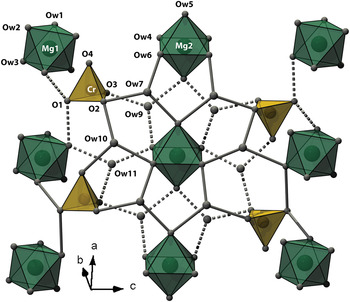
Although the volume of the chromate tetrahedron (V = 2.25 Å3) is 38% greater than the volume of the sulfate tetrahedron (V = 1.63 Å3), this ΔV contributes only 2.482 Å3 to the 25.167 Å3 difference in unit-cell volume between MgSO4·11H2O and MgCrO4·11H2O reported in Table II (i.e., ~9.5% of the total). Evidently, the chromate ion has a much greater effect on its environment than its intrinsic volumetric contribution. We believe that changes in electron density around the chromate ion act to weaken the interpolyhedral hydrogen-bond network (Figure 2), and thereby cause an additional inflation of the MgCrO4·11H2O unit cell. Ab initio calculations reveal differences in the ability of various tetrahedral anions, including CrO42− and SO42−, to influence the structure of surrounding aqueous networks (Hinteregger et al., Reference Hinteregger, Pribil, Hofer, Randolf, Weiss and Rode2010), and the measurement of neutron single-crystal diffraction data from both MgCrO4 heptahydrate and undecahydrate is desirable to characterize the details of any structural changes, particularly in the hydrogen-bond network.
(Color online) The structure of MgCrO4·11H2O, illustrating the interpolyhedral network of hydrogen-bonded water molecules. Mg(H2O)6 octahedra are colored green and the CrO4 tetrahedra are colored yellow. The O–O connections are shown as solid or dashed gray rods merely for ease of viewing. Note the prevalence of pentagonal rings in the network of hydrogen-bonded water molecules surrounding the metal ions.

V. CONCLUSION
We have discovered the first new hydrate of magnesium chromate to be reported for over a century, an undecahydrate that is isostructural with the sulfate analogue, MgSO4·11H2O. The chromate has a substantially larger unit cell than the sulfate; less than 10% of this volume difference can be attributed directly to the greater volume of the CrO42− tetrahedron, and it is likely that the ionic substitution also leads to a change in the relative strength of some or all of the hydrogen bonds linking the coordination polyhedra. We have recently established that a selenate analogue of meridianiite, MgSeO4·11H2O, can also be formed in the same fashion as the chromate analogue reported in this work, despite the apparent lack of a stability in the solubility data of Meyer and Aulich (Reference Meyer and Aulich1928). However, this result might be expected given the similarity in dimensions of these tetrahedral oxyanions (Se–O average = 1.639 Å, Kolitsch, Reference Kolitsch2002). It remains to be seen whether the molybdate ion (MoO42−, Mo–O average = 1.756 Å, Bars et al., Reference Bars, Le Marouille and Grandjean1977) can also form analogues of the MgSO4·11H2O structure.
ACKNOWLEDGMENT
ADF acknowledges financial support from the Science and Technology Facilities Council, Fellowship number PP/E006515/1.
SUPPLEMENTARY MATERIALS AND METHODS
The supplementary material refered to in this paper can be found online at journals.cambridge.org/pdj.