Fredrick Arthur Hornibrook's best-selling The Culture of the Abdomen: The Cure of Obesity and Constipation, published in 1924, contrasts the bad posture and protruding abdomen of “civilized man” with the “splendid physique” of native men (see fig. 1).Footnote 1 Emphasizing the curative power of physical culture, Hornibrook's system was designed to combat middle-aged spread by daily practice of rhythmic abdominal exercises based on native dances cultivating “those parts of the body that, owing to man's posture and to his civilized habits, are the most neglected … viz., the muscles of the abdomen and the organs of digestion and excretion.”Footnote 2The Culture of the Abdomen, which went through eighteen editions and remained in print until the early 1960s, was the most successful popular reducing manual published in Britain in the first half of the twentieth century.Footnote 3 Widely endorsed in the medical press and recommended by physicians, Hornibrook was celebrated as the “man who has lost ten thousand pounds of fat”
—Hornibrook demonstrating the faulty attitude of civilized man. F. A. Hornibrook, The Culture of the Abdomen: The Cure of Obesity and Constipation (London, 1924), facing 17.

and “deflated innumerable waistcoats.”Footnote 4 At the height of his fame, Hornibrook was satirized in Punch by A. P. Herbert, whose Mr. Mafferty kept fit sitting quietly
an’ healthy rotatin’ me fine abdominal wall an’ readin’ The Culture of the Abdomen, by Mr. F. A. Hornibrook, God bless him! … it's glad and grateful I am to be findin’ a new secret of health, an’ it infallible like the rest of them, but restful, which the rest is not. Sure it's a hard struggle for a sedentary fellow … to keep himself a fit man among the snares an’ poisons of civilization. … Sure you might be savin’ your life this livin’ instant, Mister … with … your great abdomen protrudin’ like a bowler-hat … an’ all your interior organs saggin’ … The savage races do well enough, for they … exercise the stomach an’ the diaphragm in the dances. But civilised Man, Mister, has an abdominal wall like a … burst balloon … But that's of no consequence, says Mr. Hornibrook, God bless him! for anny man can exercise his abdominal wall at anny time, whatever else he's doin’. He can rotate it in his bath, he can roll it in his bed, he can retract it at the office, an’ no man's the wiser. There's a few simple exercises besides, five minutes a day, no more … An’ the rest of the day I can sit quiet at me readin’. … Rotatin’ or retractin’ or maybe rollin’ the wall. There's no moment of the day, Mister, when you can point at meself an’ say, “The fellow's idle.”Footnote 5
This article analyzes the rise of obesity and reducing culture in Britain from the late nineteenth century until the Second World War, against the background of dominant codes of manliness and a wider debate about the physical fitness of the British race.
Hornibrook, born in Ireland in 1878, became a physical culture instructor inspired by Eugen Sandow, the father of Britain's physical culture movement in the late nineteenth century.Footnote 6 Hornibrook emigrated to New Zealand where he was Sandow's representative and ran a physical culture institute in Christchurch in the early years of the twentieth century. Following service on a hospital ship in the First World War, he settled in London and established himself as a massage therapist. Made fashionable by clients such as H. G. Wells and Arnold Bennett, Hornibrook and his wife, Ettie Rout, hosted native dance evenings attended by members of London Society in the early 1930s.Footnote 7 With the success of The Culture of the Abdomen and income from his practice, Hornibrook could afford a luxurious apartment in South Street, Park Lane, and employed a staff of five in the mid-1930s.Footnote 8 Hornibrook published his system with the encouragement of Sir William Arbuthnot Lane, consultant surgeon at Guy's Hospital. Arbuthnot Lane was president of the New Health Society, inaugurated in 1925, to “convert what is a rapidly degenerating community … a C3 nation, into an A1 nation composed of healthy, vigorous members, whose bodies will be able to avoid and combat disease.”Footnote 9 These military categories of physical fitness, based on army medical inspections during the Great War, became a recurring metaphor in discussions about the fitness of the British race until the eve of the Second World War.Footnote 10
From the 1880s onward, the medical profession and policy makers became concerned about perceived physical degeneration due to the corrupting influence of modern urban lifestyles in general and an unhealthy diet in particular.Footnote 11 The relationship between poor health in the working class and poverty in early twentieth-century Britain is well known.Footnote 12 Degeneration was also attributed to excess consumption resulting in obesity that was most prevalent among middle-class men. Indeed, lower middle-class men's domesticated lifestyles in the suburbs had been linked to “widespread anxieties about physical and cultural degeneration” since the start of the century.Footnote 13 It is not argued here that obesity eclipsed the dominant “hungry England” debate but rather that reducing culture provided an important and neglected undercurrent. The phenomenon dramatizes class divisions, poignantly illustrated by the paradox of Britain's first slimming craze arising in the midst of economic depression and record unemployment in the early 1930s.
Lifestyle-related diseases such as obesity have come to prominence in the recent past, but the advocacy of regimen to promote health and longevity dates back centuries, if not millennia.Footnote 14 In the second half of the nineteenth century optimistic assumptions about the health benefits of material progress were challenged by medical practitioners who noted a rise in obesity among their middle-class patients due to the combination of an ever more abundant diet and an increasingly sedentary lifestyle.Footnote 15 This development highlights the inherent ambiguities of modernity exemplified by the endeavor to reduce effort and produce abundance through technological progress that conflicted with the aesthetic vision of a muscular, fit, and healthy body.Footnote 16 George Orwell, commenting on Huxley's Brave New World, deplored the “ever more rapid march of mechanical progress” with its tendency to make the “environment safe and soft” because strength and courage could have no meaningful purpose in this “paradise of little fat men.”Footnote 17
Doctors claimed unique expertise in the treatment of obesity, but William Banting's Letter on Corpulence published in 1863, was the first popular reducing manual written by a formerly obese man reporting on his weight loss.Footnote 18 American businessman Horace Fletcher's so-called “chew-chew” fad or supermastication as a system of reducing was popular on both sides of the Atlantic at the turn of the century.Footnote 19 The vilification of obesity and the desire to reduce were stimulated by the emergence of new bodily norms and ideals in anthropometric surveys that were endorsed by the medical profession and promoted in popular culture.Footnote 20 Reducing was part of a wider physical culture, food-reform, and open-air movement that was not unique to Britain but a transnational phenomenon in response to the rise of modern, urban industrial society.Footnote 21 The growing interest in health cultivation and practices of bodily discipline is illustrated by increased attention among doctors, a flourishing mass market of popular self-help guides and press coverage of fitness and physical culture, culminating in a government-sponsored health and fitness campaign in the late 1930s.
Obesity, a major risk factor of heart disease, became a leading public health problem in Britain and Western countries generally in the final decades of the twentieth century. In the course of the century, degenerative diseases replaced infectious diseases as the primary cause of death, and in the 1980s coronary heart disease was identified as the “number one killer” in England and Wales, accounting for nearly one-third of deaths among men.Footnote 22 Nonetheless, obesity has not received the attention it deserves from historians of modern Britain. An important exception is Offer's analysis of body weight in postwar Britain which provides a useful comparison with the United States.Footnote 23
The American literature on obesity and reducing focuses on new techniques of labeling and categorizing bodies that helped to define norms and ideals within a context of rising mass consumerism, sedentary lifestyles, and the decline of religion.Footnote 24 Calorie counting was central to reducing with very low calorie diets popular in the 1920s. Scholars portray slimming in America as a predominantly feminine, essentially private practice, part of an expanding, increasingly commercialized and repressive beauty culture. While Seid suggests that the slimming craze subsided following the depression of the early 1930s, Stearns notes a misogynist frenzy of diet materials aimed at women from the 1920s to the 1960s. There are, of course, parallels between Britain and the United States, but the differences are more significant. Most importantly, British reducing manuals until the Second World War were aimed above all at middle-aged men whose sagging abdomens needed to be cultivated for the sake of health, aesthetics, and national efficiency. These manuals were essentially conduct literature advocating moderation, and they portrayed a well-managed body as integral to civic virtue. Many manuals did not even mention calories, instead, they highlighted the importance of physical culture or exercise. Reducing culture disappeared during the years of austerity following the outbreak of the Second World War and an increasingly commercial American-style reducing culture aimed at women took off in Britain in the 1960s.
Martin Francis, reviewing the literature on masculinity in modern Britain, has called attention to the “pressing need” for more studies of men in relation to consumption, modernity and popular culture in the twentieth century.Footnote 25 An analysis of reducing culture addresses these lacunae, and this article argues that the male waistline represented a site of conflict between different types of masculinity. Normative codes of manliness valued a “neo-Spartan virility as exemplified by stoicism, hardiness and endurance,”Footnote 26 self-discipline and restraint, and celebrated the soldier-hero or imperial explorer.Footnote 27 Hegemonic or normative masculinity was encoded on the male body, and the obese man represented deviance or a “countertype.”Footnote 28 These ideals survived the onslaught of the First World War and in Britain, as elsewhere, the fit male body became a powerful national symbol during the 1920s and 1930s.Footnote 29 As Sonya Rose has argued, a physically fit, muscular male body was imperative to hegemonic masculinity which combined elements of the soldier-hero with an emotionally reticent, distinctly British “tempered” masculinity of the “good citizen” during the Second World War.Footnote 30 Alison Light has suggested that middle-class men embraced domestication in the interwar years, but male domestication remained contested and left men vulnerable to ridicule.Footnote 31 It could be portrayed as suffocating, symbolized by middle-age spread that was blamed on women who overfed their husbands. Popular reducing manuals addressed men's anxieties and their desire for a normative body against a background of competing and shifting masculine ideals. The fight against obesity was represented as more than a personal, private endeavor. At a time of widespread concern about physical deterioration and racial health, the male body became subject to intense scrutiny, and men were urged to adopt a range of practices to cultivate a fit and healthy body as part of a wider obligation of citizenship. The specter of obesity did not amount to a moral panic that was a recurrent phenomenon in debates about the construction and regulation of sexuality.Footnote 32 Nevertheless, body shape was a pertinent issue for many middle-aged middle-class men who became Britain's quintessential slimmers in the early decades of the twentieth century.
Modern Urban Lifestyles and Degeneration
Modern urban and suburban lifestyles emerged in Britain between the 1870s and 1930s as a result of the combined effect of rapid rates of urbanization, the development of suburbs, a rise of sedentary occupations, and the expansion of rail, urban, and motor transport.Footnote 33 Living standards increased dramatically with rising real incomes and abundant food supplies. Growing access to cheaper food coincided with shorter working hours, less demanding work due to mechanization, and more sedentary jobs. According to Offer, eating habits failed to adjust to the lighter workloads and, indeed, households shifted toward a richer diet.Footnote 34 Opportunity to exercise was frequently limited as walking and physical exertion at work declined, and many followed sport primarily as spectators. Apart from a brief downturn during and immediately after the First World War, consumer expenditure in real terms continued to grow until the end of the 1930s despite the depression and massive unemployment.Footnote 35 For the middle classes the 1930s represented a “dawn of affluence” characterized by the emergence of a lifestyle more commonly associated with the postwar consumer boom of the 1950s.Footnote 36
These developments were not an unqualified success story. Income inequality, persistent poverty, and the wretched conditions of the poorer sections of the working class were highlighted by contemporary commentators.Footnote 37 Nevertheless, the 1904 report of the Inter-Departmental Committee on Physical Deterioration concluded that suggestions of a trend toward degeneration or “progressive deterioration” were based on “insufficient grounds.”Footnote 38 The committee highlighted environmental factors as fundamental causes of the poor health of the working class and drew attention to “the effects of improper or insufficient food in determining physique.” This was largely attributed to poverty and deficient energy and protein foods, but also to ignorance and a lack of “proper food” due to “incurable laziness” among housewives.Footnote 39 According to Sir George Newman, chief medical officer at the Board of Education and later the Ministry of Health, the unsatisfactory diet of “the great mass of the workers” was “partly due to man's neglect of rational physiological feeding, … partly to the vicious custom of the sedentary worker of combining excessive consumption of carbohydrate food with an entire lack of daily exercise; partly to ignorance and bad habit.”Footnote 40
In view of the carnage of the First World War and the high rejection rates among recruits, the debate about racial fitness and the corrupting influence of modern urban lifestyles acquired a new sense of urgency.Footnote 41 Anxiety about degeneration continued to be associated with persistent poverty, but commentators also drew attention to the dangers of excessive consumption of unhealthy, highly refined diets especially in combination with sedentary lifestyles. Concern with the size of the working-class chest—too narrow—was now accompanied by growing awareness of an expanding middle-class waist, for example, in Newman's annual reports. The 1921 report singled out “our faulty habits and customs in respect of dietary,” which led to a range of ailments amounting to “a substantial degree of impairment of physique—sometimes over-feeding and sometimes under-nutrition—which results in incapacity and invalidity.” The 1926 report highlighted “excessive and unsuitable food combined with lack of fresh air and exercise which sow[ed] the seeds of degeneration.” In 1931, Newman accepted that “some persons no doubt are under-fed, but many are over-fed—giving their poor bodies little rest, clogging them with yet more food, and disregarding the imperative necessity to health and appetite of a thoroughly cleansed alimentary tract.”Footnote 42
This reference to a clean alimentary tract was probably due to the influence of Arbuthnot Lane's New Health Society, 1925–37, which was part of a wider social hygiene movement in the interwar years.Footnote 43 The launch of the society forced a breach with the British Medical Association (BMA) when Lane resigned his membership in the face of BMA disapproval of extensive publicity given to his at times idiosyncratic medical opinions. Despite this rift, the New Health Society was extremely well connected with many titled patrons including two former Liberal prime ministers, H. H. Asquith and David Lloyd George, leading Labour politicians Ramsay Macdonald and Philip Snowden, as well as industrialists such as Henry Wellcome and Alfred Mond. Among medical doctors, the society's council members included the eugenicist and male-dress reformer Caleb Williams Saleeby and the obesity expert Leonard Williams.Footnote 44 The New Health Society saw the bowels as central to health and considered “chronic intestinal stasis” or constipation the root cause of many ills of civilization.Footnote 45 As Arbuthnot Lane put it, “The diet and habits of civilization are essentially bad, and are producing an enormous amount of ill-health and disease. … The physical degeneration of our race is progressive and very conspicuous,” as evinced by the “Lilliputian race that swarms on the pavements of large cities like beetles on the floor of a cellar.”Footnote 46 The society aimed to remedy this situation with an education campaign on nutrition and healthy living that involved public lectures, summer schools, articles in the Daily Mail, displays at the Ideal Home Exhibition, and the publication of cookery books such as Ettie Rout's Native Diet and Whole-Meal.Footnote 47 Lane was an active public speaker, edited the society's journal, New Health, and published more than half a dozen books as well as numerous pamphlets and newspaper articles.Footnote 48 The aims of the society included increased consumption of fruit and vegetables and putting people back upon the land.Footnote 49 Resettlement addressed the New Health Society's eugenic and environmental concerns by favoring hardy independence and providing access to a more natural diet, thereby ridding society of the “discontents and unemployables who clog the wheels of progress, create disharmony and foster revolution.”Footnote 50
Arbuthnot Lane's critique of modern lifestyles was endorsed by Jean Frumusan who argued that obesity was due to civilization that each day “creates fresh machinery to save us from making the slightest muscular … exertion. … And lording over the nervous disturbances and sedentarism, is our most dangerous enemy, super-alimentation, accelerating the organic turmoil and giving the final impetus to an organism already trembling on the verge of the abyss.”Footnote 51 Leonard Williams condemned “gluttony, begotten of an arrogant assumption of superiority” as a “crime of this civilization,” and argued that, “If modern man were to apply to any of his domestic animals the dietetic principles to which he himself clings with such disastrous determination, he would not be long in realising the appalling results of his stupidity.”Footnote 52 Writers of popular advice manuals concurred with the physicians’ exegesis of modern urban life and its negative consequences for health. Jorgen Peter Muller's My System: 15 Minutes Work a Day for Health's Sake (1905), the most successful physical culture book published in Britain in the first half of the twentieth century, was aimed at the “town office type” who was “often a sad phenomenon” with a general appearance that was either “sunken and shrivelled, or else fat, flabby, and pallid.”Footnote 53 Muller, celebrated as the “best developed man in Denmark” in Sandow's Magazine, came to fame in Britain when he demonstrated his system in 1906.Footnote 54 Following successful tours in subsequent years, he settled in London where he opened a physical culture institute in 1912. Widely advertised in Health and Strength and New Health, Muller's books received the patronage of the Prince of Wales in 1925.Footnote 55 Muller reminded his readers that they could not “live in caves. … We cannot get away from civilization.” He advocated a regimen of exercise, fresh air, and a wholesome diet as imperative to keep pace with civilization and avoid the “danger” of becoming a “flabby race” cosseted by too “many conveniences.”Footnote 56
Hornibrook imagined the Zulus, Polynesians, or Fijians, “untrammelled by the geegaws and trappings of civilization,” as “magnificent men” who held “their bodies superbly” in stark contrast with “the town dweller, the man of sedentary habits, whose business has little or nothing to do with the welfare of his body.”Footnote 57 This was due to the fact that “civilized nations failed to ensure that the majority of adults [were] physically fit, whereas among the uncivilized nations there [were] hardly any adults who [were] physically unfit.” This was not preordained. The “physically perfect native man did not grow: he was made” by a system of physical culture based on native dances and a regime of physical hygiene that amounted to an “ordered plan of race-culture.”Footnote 58 Hornibrook's perspective was not unique in physical culture literature.Footnote 59 Even with its occasional valorizing of nonwhite races, the discourse of “civilization” representing a higher stage of human evolution than “savagery” or the “primitive” legitimated white male hegemony on both sides of the Atlantic.Footnote 60
Sir Arthur MacNalty, the new chief medical officer of health following Newman's retirement in 1935, rejected Hornibrook's idealized portrayal of superior native culture because “primitive existence, although doubtless rich in many potentialities for health … was also subject to plague, pestilence and famine.” Malnutrition, high levels of mortality, and deficiency disease were relatively common in the colonies, and the “good physique and health of primitive peoples” was frequently due to “survival of the fittest.” Nevertheless, MacNalty acknowledged that “progress [was] a two-edged weapon,” particularly in the relationship of “modern civilisation to the national health” and concluded that, “Mankind is like Alice in the grip of the Red Queen moving faster and faster, but often getting nowhere.”Footnote 61
The Inter-Departmental Committee on Physical Deterioration “strongly advised methodical physical training as a remedy to improve the health and physique of the people.”Footnote 62 The development of a Syllabus of Physical Exercise in 1905, recommended for use in all elementary schools, went some way toward addressing this recommendation with regard to school children.Footnote 63 Baden-Powell launched the Boy Scouts in 1908 to counter “preventable deterioration” that was “largely owing to ignorance” by teaching boys to become “personally responsible for their own Strength [and] Health,” forging Britain's most successful youth organization whose membership increased from 107,986 in 1910 to 440,209 in 1934.Footnote 64 The Boy Scouts built on the precedent of late nineteenth-century Christian boys organizations such as the Boys’ Brigade and Church Lads’ Brigade that claimed 64,472 and 70,000 members, respectively, in 1908. In the face of competition from the Boy Scouts, the Anglican Church Lads’ Brigade declined but the nonconformist Boys’ Brigade expanded to 163,177 members in 1934.Footnote 65 These organizations, which appealed mainly to lower middle-class and respectable working-class boys, aimed to instill manliness, self-discipline and physical fitness, building on the ideal of “muscular Christianity” promoted in elite public schools.Footnote 66
It was much more difficult to motivate the adult population to adopt healthy lifestyles. In the 1920s Newman advocated the cultivation of “a health conscience” that depended on the “enlightened goodwill of the individual citizen.”Footnote 67 Arguing that “never before in the history of this country has so much been attempted by the State on behalf of the health of the people,” he maintained “the State cannot alone secure the results desired” because health “must be a matter of individual achievement, though the individual may be helped and taught by the State.”Footnote 68 Newman was even more emphatic in his report of 1929 when he declared that since the late nineteenth century, “to build a healthy race became one of the primary objects of government.” Health, “can only be achieved by the people themselves. … A nation becomes physically strong and healthy if each individual so cultivates his own body and mind as to live at the top of his physical, mental and moral capacity. This means an ordered way of life … every adult must discipline and train himself, or be trained, … to understand and practice this art of Living—much of the essence of which is contained in the Greek aphorism, `know thyself and be moderate in all things.'”Footnote 69
Newman stressed the importance of education and publicity to spread the gospel of health and fitness. This endeavor acquired new urgency in the context of growing international tension in the 1930s when the Ministry of Health and Board of Education joined forces to promote health and fitness in a propaganda campaign aimed at the general public.Footnote 70 The idea was promoted by the BMA whose Report of the Physical Education Committee highlighted the “necessity of raising the national standard of physical efficiency.”Footnote 71 Neville Chamberlain, addressing the Conservative and Unionist Associations annual conference, accepted that for Britain to become a “really healthy nation we shall have to raise the general standard of fitness and physical development.”Footnote 72 Muller enthused about “government plans for increasing physical training facilities” because this “move towards the acquisition of an A.1 nation could not have come at a more appropriate time.”Footnote 73 These plans culminated in the Physical Training and Recreation Act of 1937, which provided capital grants to local authorities and voluntary organizations for improved recreational facilities and funding for the training of instructors totaling £4 million for the period up to March 1940.Footnote 74 With slogans such as “get fit, keep fit” and “England expects every man and woman to be healthy and fit” on posters illustrated with a variety of sporting and outdoor activities, the fitness campaign was aimed at the “man in the street” whose “first task is to conquer his own apathy and increase his effort to be fit.” The aim of “a healthy mind and human happiness,” was not merely beneficial to the individual but an obligation of citizenship because to “be fit … is to make a very real contribution to the National well-being.”Footnote 75 To mark the occasion a special health issue was published by The Times that also covered the campaign extensively.Footnote 76 King George VI endorsed the campaign as a “duty to ourselves and our generation … for nothing adds more to the pleasure of life … than physical fitness.”Footnote 77 This high profile and significant financial support illustrates official concern about national fitness. Nevertheless, the campaign was suspended immediately following the outbreak of war despite the fact that “in wartime it may be presumed that fitness becomes particularly important as a National Duty.”Footnote 78
Obesity—a Disease of Modern Civilization
Medical commentary on obesity or corpulency can be traced to ancient times and the condition received attention in the wake of Banting's Letter in the 1860s, but according to an article in the British Medical Journal, Britain experienced its first “‘slimming’ craze” in 1929.Footnote 79 Obesity was rarely mentioned in the medical journals until 1929, but it was widely discussed in the 1930s. Doctors linked obesity with coronary heart disease, which emerged as a leading cause of death among men in the interwar years. Despite increased life expectancy among all social groups, and particularly the wealthiest, excessive mortality due to degenerative diseases was first observed in Britain in the 1930s when Social Class I experienced disproportionately high mortality from heart disease.Footnote 80 This unprecedented interest in diseases of affluence coexisted somewhat awkwardly with a fierce controversy about the relationship between ill-health and hunger, poverty, and unemployment among physicians, nutritionists, and policy makers during the interwar years.Footnote 81
Medical experts lacked a precise definition of obesity and disagreed on the causes of the disease.Footnote 82 In the mid-nineteenth century, Thomas King Chambers was appalled that the condition was associated with a “certain air of ridicule. … I cannot understand how any human infirmity which involves pain and discomfort can ever be a fit object of ridicule, or how that which certainly shortens the term of life can be considered of trivial importance.” While fat served an important function in retaining warmth, as protection, and as a “treasure house,” “excess” fat was “equally injurious with deficiency.” The amount of fat required for health depended on the “mode of life,” and King Chambers found it “very difficult to draw the boundary line” between a normal and obese body. King Chambers was one of the first physicians to present clearly defined norms in a height for weight table based on five thousand healthy men.Footnote 83 This table was reproduced by Dutton who denied that excessive weight was “evidence of good health” but provided no precise definition. Obesity, which “engaged the attention of the physician much more than formerly,” was a “real disease requiring to be treated on sound principles depending on the causes.”Footnote 84 Leonard Williams rejected a traditional distinction of three stages of obesity from enviable to comical and pitiable, maintaining that “no case of obesity is enviable, most of them are in a sense comical, and all are pitiable,” but yet again did not define obesity.Footnote 85 For W. F. Christie the ideal figure was subject to the vagaries of fashion, and mostly a person's weight in their late twenties was ideal. Although there was “no natural line of demarcation,” Christie suggested that obesity “threatened” when ideal weight was exceeded by 10–15 percent; was established at 15 percent above the ideal; 30 percent and over constituted a “marked degree”; and 50 percent above an “extreme grade.”Footnote 86 Christie's categories were not accepted universally. Herbert Coombes rejected a “rigid definition,” drew attention to differences between weight tables, and argued that assessment of “optimum weights … should really be an individual matter.”Footnote 87
At the turn of the century, the common classification of obesity distinguished between exogenous or alimentary, that is, obesity due to excessive food consumption and endogenous or endocrine obesity due to glandular, particularly thyroid or pituitary, malfunctioning. Dutton differentiated between hereditary and acquired obesity. Whereas the former was “not a common disease” and “very difficult to cure,” the latter was “by far the commoner” and “easily cured by scientific dietetic treatment, combined with judicious exercise, massage, and baths.” Acquired obesity was due to excess consumption, and Dutton argued that if it is possible to bring a race horse or greyhound to racing condition with exercise and nitrogenous food, “why cannot we by similar means cure obesity in mankind?”Footnote 88 Williams was rather more vehement in his moral condemnation of alimentary obesity as “contemptible and disgusting” denoting “self-indulgence, greed … [and] an unsightly distortion of the human form divine.”Footnote 89 By the 1930s this classification was thought to be “not very satisfactory” because it was “often difficult to place an individual case strictly within one group or the other.”Footnote 90 Despite a growing acceptance of the crucial role of diet and lifestyle, commentators drew attention to a variety of contributing factors ranging from heredity, race, and climate to temperament and morality. “Oriental races, enervated by climate, customs and a super-alimentation” were considered more prone to obesity than “sober races, living in bleak climates,” and the condition was associated with profiteering, embezzlement, and homosexuality.Footnote 91 Christie spurned the “bogey of inheritance” but acknowledged that climate, occupation, and temperament were significant. His analysis of 184 cases showed that in nine out of ten cases obesity was due to exogenous factors.Footnote 92The Lancet remained critical of a purely mechanical approach since doctors had to deal with “individual patients and not with mere bodily machines” and differences in metabolism resulted in great variations in people's capacity to store fat.Footnote 93 Similarly, Sir George Newman noted that “upon the same diet one man ‘will lay on flesh’ and another will remain thin.”Footnote 94
The cure of obesity focused on regimen of dietary control and exercise, discussed below, as doctors began to question the efficacy of drug therapy. The dangers of thyroid extract, widely prescribed in the early twentieth century, were highlighted in 1925, and by the 1930s it was thought to be unnecessary.Footnote 95 New metabolic drugs such as dinitrophenol were briefly popular but discredited following the death of a female slimmer.Footnote 96 In the late 1930s the medical profession was increasingly critical of drugs, deplored the haphazard use of thyroid extract, and endorsed MacNalty's strong condemnation of dinitrophenol.Footnote 97 In view of several fatalities, “grave disabilities and impairment of health,” MacNalty advised that dinitrophenol “should not be taken in any circumstances.” Under new poison rules the drug was only available on prescription, but a “heavy responsibility” was placed on the physician in view of the drug's unpredictable toxicity and the fact that there was “no known antidote.”Footnote 98 Christie denounced dinitrophenol, saw no justification for the health risks of drugs when the “cure of obesity by correct dieting is safe and certain,” and warned that the “short-cut to slimness is usually fraught with perils.”Footnote 99
Who Were the Obese?
Obesity occurred among both men and women, but medical debate on obesity and popular manuals generally assumed a male norm. Written by and in many ways for men, reducing literature depicted middle-class middle-aged men as the principal sufferers of obesity. This applies not only to medical journals and books by Dutton or Williams, but also to popular manuals and physical culture magazines such as Sandow's Magazine and Health and Strength. If women were mentioned at all, they were constructed as the “other”; for example, Williams's Obesity includes a chapter entitled “Eve,” in Cecil Webb-Johnson's Why be Fat? a chapter on women is entitled “Beauty and Obesity,” and Thomas Inch's Inch on Fitness includes a chapter entitled, “Ladies and Children.”Footnote 100 Hornibrook's Culture of the Abdomen only mentions women in passing, although Ettie Rout adapted Hornibrook's system to women. By contrast, Muller's My System of 1905 was followed by My System for Ladies in 1911, which also became a best-seller.Footnote 101 Another important exception to the focus on the male body are the books by Christie, particularly the 1937 Practical Handbook, an analysis of 172 cases (45 men and 127 women), which considers the distinctive problems and concerns of both sexes.Footnote 102
There was, of course, a popular female reducing culture that was part of a wider promotion of beauty, health, and fitness aimed at women in early twentieth century Britain.Footnote 103 Before and after the First World War Annette Kellermann and Helena Gent preached the message of health and beauty, an essential prerequisite of a happy marriage, which could be achieved by means of rational diet and exercise.Footnote 104 Ettie Rout presented a eugenicist maternalist case for women to be healthy, fit, and slim in Sex and Exercise (1925), reissued in 1934 as Stand Up and Slim Down: Being Restoration Exercises for Women with a Chapter on Food Selection in Constipation and Obesity.Footnote 105 The book adapted Hornibrook's system to women, combined with Rout's interests in sexual hygiene, native culture, and wholemeal diet. Rout emphasized the pelvic area with regard to sexual intercourse, pregnancy, and labor and the link with digestive organs. A healthy pelvic and abdominal area benefited women by promoting health and happy marriage. Women's quest for a fit, slim body was not motivated by vanity but was important because women's improved health raised the standard of racial health. The most famous female physical culture organization was the Women's League of Health and Beauty, launched by Mary Bagot Stack in 1930, which boasted 166,000 members, produced a magazine, and ran over two thousand weekly classes in the late 1930s. The league, which saw women as the “natural Race Builders,” advocated a system of rhythmic gymnastic exercises focused on the abdominal and pelvic area and aimed at a slim, healthy, and beautiful female body.Footnote 106
The sedentary worker and particularly the fat businessman figured prominently in popular reducing manuals.Footnote 107 Obesity was not perceived to be a serious problem among upper-class men whose lifestyle included the pursuit of vigorous outdoor activities. Williams argued that large eaters who did not gain weight represented a “higher stage of evolution” and contrasted the leanness of the typical aristocrat “whose ancestors through the ages have had no necessity for hoarding fat” with “the profiteer, and the nouveau riche … always depicted as bull-necked and pot-bellied—which he generally is.”Footnote 108
Most early twentieth century dietary surveys, driven by concern about malnutrition among the poorer sections of the working class, focused on low-income groups. A handful of surveys that covered the entire social spectrum show a positive correlation between social class or income, expenditure on food, and daily calorie consumption. This evidence suggests that many middle-class men consumed more than their recommended daily requirement, which for an average male was assumed to be 3,000 to 3,500 calories, ranging from 2,700 for a sedentary worker to 4,500 for a man engaged in heavy manual labor.Footnote 109 Rowntree's servant-keeping class, professional or business families described as “comfortably off” but living “simply,” consumed on average 4,181 calories per man per day, whereas among the poorest consumption stood at only 2,901 calories. Rowntree, assuming a standard requirement of 3,500 calories for a man engaged on moderate work, noted an excess of 681 calories among the servant-keeping class in stark contrast with the low paid whose calorie consumption stood at “17 per cent below standard requirements.”Footnote 110 Similar patterns were observed in the 1930s. A Medical Research Council survey, aimed to establish quantitative knowledge of the “normal diets” of families, noted great disparities in food expenditure and consumption. Calorie consumption per man per day ranged from 3,638 to 2,776 and 2,089 among professionals, unskilled workers and the unemployed, respectively.Footnote 111 John Boyd Orr's influential Food, Health and Income yet again showed differentials of food expenditure and calorie consumption with 3,326 and 2,317 calories per day, respectively, among the top and bottom 10 percent in terms of income.Footnote 112 A survey by Crawford and Broadley in the late 1930s noted a differential in daily calorie consumption from 3,536 among the very rich to 2,335 among the poorer sections of the working class.Footnote 113 Despite variations in the figures and small samples in the highest income groups, there is little doubt that middle-class sedentary workers consumed, on average, significantly more calories than many manual workers and particularly the poorest sections of the working class.
In 1932 the Medical Research Council held that abundant choice and nutritional adequacy rendered continued investigation of the diet of the well-to-do unnecessary.Footnote 114 The St. Andrews study, which acknowledged that the sedentary worker was “probably overfed,” found it difficult to explain why obesity was “relatively rare even among the excessively well-to-do.” Possible explanations included so-called luxury consumption, which suggested that increased food and particularly protein consumption would raise metabolism and thereby avoid weight gain. First proposed by German nutritionists at the turn of the century, the theory remained under discussion, but was rejected in the present study. The report concluded that sedentary workers, who were “of better physique” than many manual workers, maintained their weight despite high calorie intake due to a higher metabolism and generally active lifestyle.Footnote 115 There is of course another explanation, namely, that obesity among the higher income groups was rather more common in view of excess calorie consumption and disproportionately high mortality from heart disease among Social Class I. Popular advice manuals portrayed the middle classes as principal sufferers, an image that was reinforced by contemporary cartoons.Footnote 116
Obesity could develop among all age groups, including children, but the most vulnerable period was middle age, assumed to begin between the mid-thirties and mid-forties, when “‘middle-aged-spread’ coincide[d] with the acquirement of wealth and luxury; alluring meals, daintily served, unduly prolonged, washed down by alcoholic drinks of considerable nutritive value.”Footnote 117 John Benson's study of middle age in Britain suggests that in contrast with the nineteenth-century when middle-age spread had been seen as a sign of status, in the twentieth-century it became synonymous with “complacency and self-indulgence.”Footnote 118 This was already the case at the turn of the century as illustrated by Sandow's Magazine, which depicted the typical sufferer from obesity as a middle-aged middle-class man who had played sport and been “healthy and vigorous” in his youth, but was forced to abandon these activities given the demands of work and particularly after marriage, when the “process of degeneracy sets in.” Professional advancements brought growing comforts, each new waistcoat had to be made “a trifle larger
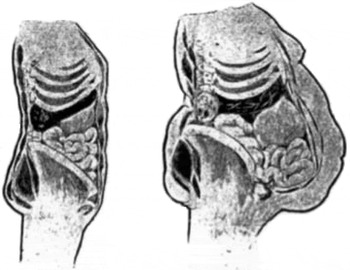
—Sandow's Magazine, November 1900, 365.

round,” and middle-age spread set in owing to “civilization and its customs.”Footnote 119 Accompanied by graphic illustrations of a middle-aged man's protruding abdomen and sagging internal organs, “In the Doctor's Sanctum” portrayed fat as a “parasite … preying upon the internal organs,” hanging “like a millstone, if not round the neck, at all events round the waist” (see fig. 2).Footnote 120 The cure was exercise, coupled with moderation in diet. Sandow compiled a chart of exercises aimed specifically at the obese and pleaded that “if men were to pay only a tithe of the attention to their bodies which they devote to the attainment of wealth and position, countless numbers … might enjoy the boundless blessing of physical health … until long past the period of middle life.”Footnote 121 After the First World War Health and Strength described the “increase in weight of advancing years” as “pathological” and claimed that a “comparatively young” man who acquired “an unseemly rotundity of outline … should feel the keenest distress at such a development, and should positively refuse to let his waist-band disappear in billows of fat.”Footnote 122
According to Benson the meaning of middle age differed between classes; whereas middle age among the working class was associated with “steadiness, reliability and respectability,” for the middle class it came to be identified with a “combination of complacency and anxiety.”Footnote 123 George Orwell, commenting on the stark contrast between youthful sex appeal and shapeless middle age in Donald McGill's comic postcards, noted that the end of youth, adventure, and youthful looks with marriage and middle age was taken for granted by the working class. This was one of “the few authentic class-differences … still existing.” The aspiration of a youthful appearance among middle-class middle-aged people illustrated an important shift in attitudes because “to look young after, say, thirty is largely a matter of wanting to do so. … The impulse to cling to youth at all costs, to attempt to preserve your sexual attraction, to see even in middle age a future for yourself and not merely for your children, is a thing of recent growth.”Footnote 124
For Orwell, class identity was inscribed on the body in a more complex fashion than could be accommodated by a simple three-class model. The youthful appearance of older middle- and upper-class men registering for military service, “who look, on average, ten years younger than the others”Footnote 125 stood in stark contrast with the decaying body of George Bowling, hero of Coming Up for Air, a quintessential lower middle-class suburban married man of the late 1930s. Weighing 14 stone (196 lbs.) with a 49 inch waist at the age of 45 Bowling, about to collect his new false teeth at the beginning of the novel, did not see himself as “`disgustingly’ fat … like something in a side-show at a fair … [but] a little broad in the beam, … the active, hearty kind of fat man.” Bowling had been thin in his youth and got fat a few years after marriage, a process that “happened so suddenly that it was as if a cannon ball had hit me and got stuck inside. … One night you go to bed, still feeling more or less young … and next morning you wake up in the full consciousness that you’re just a poor old fatty with nothing ahead of you this side of the grave except sweating your guts out to buy boots for the kids.”Footnote 126 Similarly, the grotesque “short, pink and chubby” bodies of the socialist cranks in Road to Wigan Pier, with their prim narrow-mindedness were juxtaposed with the heroic body of the coal miner who claimed Orwell's boundless admiration. The miners looked
as though they were made of iron … hammered iron statues—under the smooth coat of coal dust. … It is only when you see miners down the mine and naked that you realise what splendid men they are … [with their] most noble bodies, wide shoulders tapering to slender supple waists, and small pronounced buttocks … with not an ounce of waste flesh anywhere. … You can hardly tell by the look of them whether they are young or old. … No one could do their work who had not a young man's body, and a figure fit for a guardsman at that; just a few pounds extra flesh on the waist-line, and the constant bending would be impossible.Footnote 127
The middle-aged body, prone to obesity, hair loss, and a range of age-related ailments, thus provided a site of competing representations and in many cases thwarted aspirations raising questions about health, self-esteem, and masculine identity. “Forty and Fat,” an article published in Men Only, a magazine aimed at middle-aged, middle-class men, claimed that “Gentlemen prefer blondes, but blondes do not have much time for those guileless males in the early forties” who developed “that condition known to the common herd as ‘the middle-age spread,’” and who “after the usual satisfying evening meal” wanted “nothing better than the thrill of a comfortable easy-chair.”Footnote 128 George Bowling concluded his self-description with the caustic comment, “No woman … will ever look twice at me again, unless she's paid to.”Footnote 129
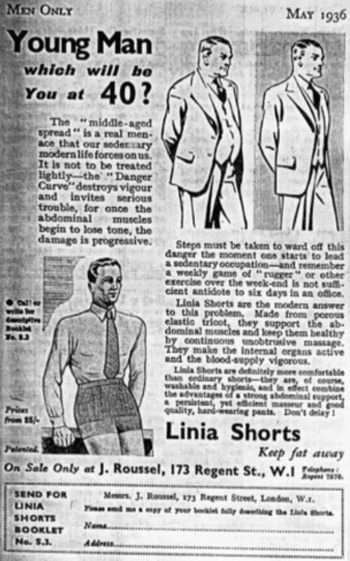
It would certainly be wrong to assume that men did not care about their appearance, and Chris Breward demonstrates that men's fashion shifted from the patriarchal frock coat of the 1860s to a slimmer, leaner look exemplified by the modern lounge suit worn by athletic bachelor types in early twentieth century fashion plates.Footnote 130 In the interwar years male consumerism and fashionability reached new heights, promoted in magazines such as Men Only, which idealized a metropolitan middle-class English masculinity, particularly in “The Well Dressed Man” column. The magazine devoted one-fifth of its articles and over a third of its advertising space to appearance and “the body,” mainly fashion, grooming, and remedial products.Footnote 131 Men's insecurities were exploited by products such as body belts advertised in Men Only and Picture Post.Footnote 132 One advert depicting a thin man and another with a protruding abdomen asked, “Young Man which will be you at 40? The ‘middle-aged spread’ is a real menace that our sedentary modern life forces on us. … The ‘Danger Curve’ destroys vigour and invites serious trouble. … Linia Shorts are the modern answer … they support the abdominal muscles and keep them healthy by continuous unobtrusive massage.” In another example, the reader was urged to “Get ahead of the ‘Danger Curve,’” which was a “handicap” and a “danger to health” by wearing Linia shorts, and which “brace the figure to athletic lines … tone up slack muscles, ward off superfluous fat and keep the whole abdominal region healthy and youthful” (see fig. 3).Footnote 133 A different company featured a Mr. G. Brooks, who reduced his waist eight inches with the help of a body belt. He was transformed “From a ‘Paunchy’ man to a Fine Figure” and “felt twenty years younger.”Footnote 134
Worry about middle-age spread helps explain the success of many reducing
—Men Only, May 1936, 145.

systems which were frequently based on the author's personal experience. Fletcher lost fifty pounds, greatly improved his health, and “felt rejuvenated” in his late forties as a result of his discovery of supermastication.Footnote 135 Hornibrook, deprived of regular exercise after the war, gained weight in his early forties. He claimed that his system enabled him to lose 27 pounds and reduce his abdomen when other methods had failed.Footnote 136 Muller's system was promoted as a cure of obesity and constipation among the middle-aged in an advert that pictured a “before and after” example of a middle-aged man's reduced abdomen.Footnote 137 Williams's Middle Age and Old Age focused on lifestyle-related “maladies of middle age” and urged “reforming the present habits, dietetic and otherwise” to avoid “needless disease … and premature death.”Footnote 138 He argued that the “ordinary man begins to ‘rot’ at 30 years of age, and when he reaches 50 the sinister process is in full swing.” For Williams the “physical signs” of excess consumption were “writ large on the abdominal contour of the all-too-numerous victims” and constituted an “enormous” and “unnecessary” strain on the body.Footnote 139 These concerns attracted Newman's attention in the late 1920s; “after middle life greater care, discrimination and forethought are necessary if degenerative processes are to be avoided and the body be maintained in a full measure of health.”Footnote 140
Why Reduce? What Were the Incentives?
Obese men were confronted with a barrage of exhortations urging them to reduce. As Christie put it, “Surplus fat should neither be tolerated with resignation, nor left for concealment to the tailoring craft. The social unhappiness, physical inefficiency and shortened tenure of life which an excessive burden entails, are sufficient reasons.”Footnote 141 Excessive girth transgressed growing pressures toward bodily norms and the celebration of a muscular but slim male ideal body. Fat was denounced as unhealthy and even lethal, as ugly and morally corrupting. Finally, by inviting ridicule, obesity conflicted with hegemonic masculinity.
Health and longevity were prime incentives for reducing. Dutton highlighted the link between obesity and heart disease, an enfeebled state, lack of vigor, and bad nerves.Footnote 142 Williams saw fat as a “malignant and merciless” “true parasite” that “insinuat[ed] itself into the tissues of vital organs which it gradually succeeds in replacing.” He stressed the “direct causal relationship between obesity and serious cardio-vascular and renal disease,” along with many other illnesses including diabetes, arthritis, gastrointestinal, and nervous diseases, concluding that obesity constituted a “serious menace to the health and efficiency of the individual.”Footnote 143 In another book, Williams described “collops” or excessive flesh as representing “both robbery and slavery. Robbery of energy in their creation, and slavery of other organs in their maintenance.”Footnote 144 Indeed, the “hygienic sin” of excessive food and drink did not merely ruin health but was “deadly” according to Muller who was one of several writers to claim that there were “more people who slowly eat themselves to death than … die of hunger.”Footnote 145 Williams maintained that “more people [were] floated into their coffins on a flood of beef-tea and milk than ever arrive[d] there by the ravages of disease.”Footnote 146 These arguments were buttressed by statistics of the high mortality risk of obesity compiled by American life insurance companies and publicized, for example, by Irving Fisher and Eugene Fisk's best-selling How to Live, published in 1915. This data showed excess mortality with rising weight in the over-thirty-five age group. By contrast, underweight was linked with excess mortality among younger policy holders.Footnote 147 These statistics, based primarily on white middle-class males, were in many ways flawed but the general conclusions were accepted by actuaries and doctors on both sides of the Atlantic.Footnote 148 A discussion in the British Medical Journal of an American actuarial table predicting excess mortality with rising weight, especially among the over-forties, concluded that “should the national overweight continue to grow unchecked, the mortality from the degenerative, non-bacterial diseases will diminish the average expectation of life.”Footnote 149
Obesity conflicted with masculine beauty ideals based on a Greek aesthetic.Footnote 150 Spearheaded by inspirational icons such as Eugen Sandow and Jorgen Peter Muller, these ideals were promoted in popular culture and fashion in the late nineteenth century. Sandow the “magnificent” was celebrated as a “perfect man” whose striking beauty appeared as a sculpture come to life and who successfully blended classical aesthetics and modern technology into a heroic masculinity that struck a chord among men coming to terms with modern urban lifestyles.Footnote 151 Whereas Sandow was represented as a modern Hercules, Muller was christened the “Danish Apollo” by Health and Strength when he demonstrated his system in England in 1906.Footnote 152 Described as a “splendid bronze-coloured man, tall and straight as a Grecian statue” in Sandow's Magazine, Muller with his slimmer frame and emphasis on the abdominal “muscular corset” was more in tune with the modernist aesthetic of the early twentieth century.Footnote 153 T. A. Lowe lamented the absence of “great health personalities” in Men Only in 1937; “Sandow and Muller were the pioneers of my younger days. … Sandow … a magnificent specimen of muscular manhood … caused thousands to view their puny bodies with … contempt—and to really do something about altering them. Then Muller appeared from Denmark like a meteor, with yet another ‘system’ … I saw Muller demonstrating … When stripped, he was the most perfectly proportioned individual I have ever seen … [with] skin that shone like satin.”Footnote 154 Hornibrook, repelled by “fat, ugly, clumsy bodies,” invoked the heritage of ancient Greece that shaped “our conceptions of physical beauty.” There was “not one solitary instance of a beautiful form fashioned in fatness,” and it was impossible to “hide the protuberant belly or the ponderous buttocks which handicap fat people in their cumbrous waddle through life.”Footnote 155 A doctor writing in the late 1930s held that the “pathetic figure” of the obese represented nothing less than “stark human tragedies.”Footnote 156
The association of obesity and fat with humiliation, ridicule, or pity was perhaps an even greater incentive to reduce. Dutton admitted to being a “victim of obesity which was … restricting most of the pleasures of life” until he reduced successfully.Footnote 157 Donald Hunter rejected a connection between obesity and lethargy or financial crime, but maintained that the “victims of obesity are nevertheless to be pitied,” and “not being a cause of laughter in others” was gratifying for one doctor reporting on his weight loss in the British Medical Journal.Footnote 158 Beginning with the quotation, “Nobody loves a fat man,” Webb-Johnson vividly detailed the “misery,” “humiliation,” and “sorrows” of the obese who were “debarred from many of the social pleasures and pastimes.”Footnote 159 In the late 1930s a range of physical abnormalities were no longer considered an acceptable object of humor, and “laughter at the expense of the unfortunate victims [was] now confined only to the obese.”Footnote 160 Addressed as “Tubby” by a stranger, George Bowling confessed being hurt by “insulting comment on [his] personal appearance. Suppose a chap was a hunch-back or had a squint or a hare-lip—would you give him a nickname to remind him of it? But every fat man's labelled as a matter of course.”Footnote 161
Christopher Howard, writing in The Lancet, was a rare critic of the valorization of the slim body and reducing culture. Howard protested the “pseudo-scientific pontifical pronouncements” pitying and denigrating the obese and maintained that,
if, from foolish fear of the mirth which our jolly and rotund appearance often provokes in animated skeletons who lecture us, we are constrained to deny ourselves, we either deservedly fall victims to some intercurrent disease or develop duodenal ulcers—or remain fat. … We glory in our fat, our laughter, our good temper, our sociability, our appreciation of food and drink, and company. … We would rather die in full possession of our faculties in our middle age than totter about in scrawny-legged misery for a few extra years, lean and lonely lepers, suspicious and suspected. We will not be pitied … nor condemned, either as financial criminals … or lazy loungers.Footnote 162
The letter sparked a lively correspondence with Donald Hunter, whose article of October 1933 had inspired Howard's letter. Hunter had “no quarrel with the obese who carr[ied] their load … as airily” as Howard did, but insisted that “to some the burden of obesity … [was] a real tragedy.”Footnote 163 Howard, in reply, argued that the “two factors which operate most successfully in spreading the belief that fatness [was] both aesthetically repulsive and vitally dangerous” were fashion and life assurance companies. Since fashion was fickle, the assurance companies as “high priests of Mammon” were “much more dangerous.” He acknowledged the health problems of obesity but argued that thin people suffered from other ailments such as “neurasthenia and lack of emotional balance.” Howard concluded that being fat he could “face the blows of fortune with comparative equanimity.”Footnote 164 Howard's arguments were unique in the 1930s and predate the critique of the slender ideal proposed by second-wave feminist critics of reducing culture.Footnote 165
The obese man, pitied or ridiculed for his middle-age spread signified male domestication. Gender conflict was acute in the early twentieth century, a period that has been described as a “crisis of masculinity.” The dynamic consumer culture and new employment opportunities for women and girls of the interwar years threatened particularly working-class men faced with high unemployment. Increasingly comfortable middle-class lifestyles were associated with a feminization of many aspects of middle-class life, and “male responses to domesticity remained complex and ambivalent.”Footnote 166 Masculine “vitality was being dissipated … [by] smothering men in comfort” according to Men Only, which imagined its readers as a “`seething mass of revolt’ under the ‘apparent domestic ease.’”Footnote 167 The magazine provided relief, at least in the imagination, in the form heroic tales of travel and adventure. Indeed, the male waistline was a battleground in the conflict between the sexes. Women were widely held responsible for men's obesity because they were “obsessed by an instinctive desire to ‘feed the brute.’”Footnote 168 Williams speculated that women overfed their husbands “not spasmodically or intermittently, but regularly. … It may perhaps be, that she takes the same simple pride in his embonpoint as a farmer takes in his well-fed animals, but the real cause probably lies deeper. She urges him to eat more than he needs for reasons mental rather than physical. She realises … that a fat man is easy-going, yielding, uncritical; stupid in fact.”Footnote 169Men Only similarly recognized that overeating was a habit “very difficult to get out of … when we are watched like a hawk by a wife at the head of the table, who screws up her brows and generally worries her head off if we are off our feed, we gobble up the stuff for the sake of domestic peace.”Footnote 170 Herbert's Mr. Mafferty disliked strict diets because they led to “disputation an’ trouble in the home.”Footnote 171 A late 1930s book yet again claimed that women overfed their husbands not because the breadwinner needed the extra energy but because “fat men [were] slow-moving, not given to adventure and often a trifle dense, and … therefore regarded as ‘safer’ husbands than the lean.”Footnote 172 In order to resist domestication, men were offered techniques of bodily discipline to transform soft, flabby flesh into a hard, muscular male body. These gender conflicts point towards an alternative interpretation of reducing culture in contrast with the well-known argument that the slender ideal was promoted by patriarchy to undermine women at a time when they claimed increased independence and a higher status.Footnote 173
Reducing advocates argued that a normative male body was an asset in the public world of work. Men were urged to be healthy to fulfil their duty as breadwinners, and a fit male body was represented as a symbol of national efficiency. As Christie put it, the “maintenance of one's body in its most agreeable and effective form [was] the obvious duty of every member of a civilised community.”Footnote 174 Premature death of the breadwinner was a disaster, the obese were discriminated against, and the “lean” were “preferred to the fat” in “all kinds of occupations” because they “look, and in fact are, more alert, fitter, better prepared for providing the quick results which are demanded of us to-day, both physically and mentally.”Footnote 175 Comparing a man's body to his business, Hornibrook maintained that “when a bank account is steady and sound … a man knows that his business is in a safe and healthy condition. … He should feel exactly the same about his own body. Either it is developing—that is, improving, or it is deteriorating—that is, decaying.”Footnote 176 Similarly, Inch, in a chapter entitled, “What Physical Culture Means to the Business Man,” declared that daily cultivation of health will result in “better returns in the way of general efficiency, freedom from illness with its attendant absence from business, and better work performed with pleasure instead of it being a trial.” The businessman had insurance policies against fire or burglary as well as a policy on his life. He should adopt a “health insurance policy” or regimen of fitness, because “Health means wealth,” particularly in view of his “unnatural mode of living” and the “stress and strain” of business life. The young man needed a good physique to make “the better impression” in an interview and the middle-aged man could not escape the fact that “Nature keeps a balance sheet of which she is a strict auditor, and any overdraft on the Bank of Health will sooner or later be presented for settlement … in the shape of painful afflictions and general ill-health.”Footnote 177 By the late 1930s men were not unresponsive to this message as illustrated by “Over-Forty” fitness classes run by the YMCA. Picture Post reported in 1939 that “business men, company directors and members of the various professions” attended the YMCA on two evenings a week, in part because of “a sudden concern about the way their figures are developing. Many more are getting fit as a national duty. They realise the effect physical fitness has on a man's capacity for efficient work.”Footnote 178
How to Reduce? Techniques Advocated
Moderation was central to reducing manuals that prescribed what Foucault called the “arts of existence” or “techniques of the self” as a wider obligation of citizenship.Footnote 179 These books were conduct manuals based on the belief that the body was an instrument of will that could be reformed by means of self-control.Footnote 180 The advocacy of individual responsibility and bodily discipline as essential to personal hygiene and civic virtue tapped into a wider discourse on the cultivation of manliness. Baden-Powell's Scouting for Boys, one of the most successful popular books of the first half of the twentieth century, saw “Physical Health” as one of the four aims of the Boy Scouts.Footnote 181 A chapter entitled, “Endurance for Scouts or, How to Be Strong,” details a daily exercise routine and suggests a range of athletic games and outdoor activities. Over and above condemning smoking and drinking and advocating personal cleanliness and continence, a section on food maintains that a “good many illnesses come from over-eating or eating the wrong kind of food. A scout must know how to take care of himself, else he is of no use.” Moderation was essential; “If you have lots of fresh air you do not want much food; if, on the other hand, you are sitting indoors all day, much food makes you fat and sleepy, so that in either case you are better for taking a little; still, growing boys should not starve themselves.”Footnote 182 Although scouting ideology evolved as the movement matured, the health message received even greater emphasis after the First World War as illustrated by the introduction of a “Healthy Man” badge in 1918. Earning the badge required not only an understanding of how to keep healthy and of the “dangers of alcohol, tobacco and unclean thoughts,” but also evidence of at least twelve months following the prescribed health rules.Footnote 183 Reducing manuals similarly recommended a modified diet, physical culture, moderation with regard to alcohol and tobacco consumption, thorough mastication, and regular evacuation of the bowels. This focus on manly conduct and civic virtue stood in stark contrast with the second half of the twentieth century when reducing was portrayed as little more than simply counting calories and primarily aimed at women.
The excesses of Fletcherism soon lost their appeal, but thorough mastication continued to be emphasized and “bolting” food or insufficient chewing was widely condemned.Footnote 184 Dutton advocated slow, gradual weight loss based on a combination of dietetic regime and physical exercise. He recommended a diet of lean meat, white fish, and vegetables, and “forbidden” foods included fat meat and fish, white bread, sugar, pastries and sweets, cream, potatoes, and heavy wines and beers as well as nuts or chocolate.Footnote 185 In contrast with the American focus on calories and the popularity of very low calorie diets (600–750 per day) in the 1920s, neither Williams nor Frumusan even mentioned calories, and, indeed, the latter rejected the significance of calories because “the organism is not a retort.”Footnote 186 These experts advised short periods of fasting at the beginning of a reducing diet to detoxify and reeducate the “digestive-assimilative function,” followed by a restrained diet of lean meat, fish, vegetables and fruit, little or no bread, and the elimination of fatty foods and sugar. Portions were not necessarily defined precisely and physical culture, albeit practiced cautiously by the very obese, was a crucial element of treatment. Williams emphasized the importance of abdominal exercise and recommended Hornibrook's system. Neither paid much attention to the problem of keeping to a diet and urged leaving the table “feeling hungry” and the “less eaten the better.”Footnote 187 By contrast, a late 1930s manual acknowledged the desire for “forbidden fruit” that was “apt to taste sweeter than any other,” but maintained that “right though life we are constantly having to exercise self-control for worthwhile ends” and urged dieters to “make it a matter of self-respect, then, to refuse to be a slave to the old diet habits which have encased you in excess body-fat.”Footnote 188
Calories were not entirely absent from British reducing manuals. Christie, who advocated a gradual weight loss of between one and two pounds per week, suggested consuming between five hundred and one thousand calories less than required in a maintenance diet. Menus were to be planned using a skeleton diet of lean meat, fruit and vegetables, and skimmed milk. Additional food accounting for the remaining calories up to twelve hundred per day, should accord with the “patient's desires,” including a possible allocation of alcohol, allowing for one-eighth of daily calories. In order to make reducing less traumatic, Christie suggested a gradual reduction in consumption, and proposed a “slowly reducing diet” of 1,325 calories per day because the “enthusiastic co-operation of the patient is essential if success is to be achieved.” Exercise was again an important part of reducing, and Christie recommended Hornibrook's system as well as pedestrianism, a walking cure based on increasingly lengthy and arduous walks.Footnote 189 Claxton's Weight Reduction, the most calorie-conscious British manual, included diets ranging from starvation to qualitative restriction and suggested substitution of foods to keep bulk but reduce calories. Positively reviewed in The Lancet, the book's main attraction was a large number of recipes which showed that a “slimming diet” need not be “monotonous and unpalatable.”Footnote 190 American manuals published in Britain such as Hawk, Streamline for Health (1935), or Wolberg, Psychology of Eating (1937), were criticized in the British medical press for their very low calorie diets, a style that was not considered appealing to English readers and because many foods recommended were not generally available in Britain.Footnote 191
Manuals written by physical culturalists included dietary advice such as consumption of wholemeal bread, fruit, and vegetables, but the key to reducing was the adoption of a system of physical culture.Footnote 192 Muller maintained that “those parts of the human body which in the majority of cases are farthest removed from ideal health and perfection of form are the lungs, the skin and the middle of the trunk, for which reason deep breathing, skin gymnastics and exercise of the muscles about the waist are what nine people out of every ten stand most in need of.”Footnote 193
Muller's system involved a fifteen minute a day all-round exercising routine performed without equipment and care of the skin by means of a daily bath and self-massage. Muller was a great enthusiast of sun- and air-bathing and endorsed any form of athletic or outdoor activity that helped develop a vigorous constitution. Hornibrook's system, again performed without equipment, required only seven minutes per day, coupled with regular retraction of the abdomen that could be practiced anywhere anytime. The focus was on good posture and strengthening of the abdominal muscles by means of rhythmic exercises and deep breathing.Footnote 194 Inch suggested gymnastic exercises without equipment as well as the use of dumb-bells, chest expanders, or sculling machines. Muscle-building equipment and particularly Sandow's famous combined developer and dumbbells were promoted by Sandow who aimed at muscular development as well as fitness.Footnote 195 These books beyond prescribing a daily routine of exercise and bathing, included advice on general conduct. For Inch “moderation” was “the health seeker's watchword” and “Instructions for the Busy Man” included regular exercise, restraint with regard to food, alcohol, and tobacco, and the cultivation of hobbies and companionship.Footnote 196 The way to health depended further on rest and relaxation, because “mental disturbances” according to Hornibrook were “in many cases manifestations of … chronic intestinal stasis.”Footnote 197
Influenced by the work of Arbuthnot Lane, fear of constipation or “chronic intestinal stasis,” which bloated the abdomen and resulted in “auto-intoxication” or self-poisoning from uneliminated waste, was a prominent theme in reducing manuals.Footnote 198 The theory was largely discredited by the medical profession in the early 1920s but retained support among popular writers and Whorton argues that at “the level of popular belief and behavior, constipation phobia was entering its golden age” resulting “in a remarkable assortment of anti-constipation measures” ranging from laxatives and water cures to dietary prevention, physical therapies, and, at its most drastic, surgery.Footnote 199 Lane thought of the digestive system as a form of plumbing and practiced colectomy, that is, removal of the colon, as the ultimate remedy of constipation. Lane performed hundreds of colectomies after 1901, but the operation remained controversial and was generally rejected by the First World War.Footnote 200 In the early 1920s even Lane abandoned surgery and turned his attention to other methods of emptying the bowel.Footnote 201 The issue was a primary concern of the New Health Society and was highlighted by writers of reducing manuals connected with the society such as Hornibrook, Williams, and Ettie Rout.
Discussing Arbuthnot Lane's analogy “between the sewage system of a town and the gastro-intestinal system of the body,” Hornibrook argued that constipation amounted to “interference with the outflow of the individual's sewage.” The “White Man's Burden” of an overloaded colon provided “conditions favouring evil … heat, moisture, nitrogenous refuse, darkness and micro-organisms.” This “slow poison factory” or “cesspit” undermined health and was the fundamental cause of a wide range of diseases including cancer, high blood pressure, rheumatism, and nervous disorders.Footnote 202 Williams blamed refined foods “deprived of ballast” and containing “paralysing putrefactive toxins” for “intestinal stasis with all its sinister attendants.”Footnote 203 Bolstered by extensive advertising, purgative drugs to stimulate bowel movements remained popular despite condemnation among physicians, although Arbuthnot Lane advocated liquid paraffin as a laxative.Footnote 204 Nevertheless, the leading cure of constipation was the combination of abdominal exercise and a diet high in fiber such as the wholemeal diets published by Rout.Footnote 205 These ideas reached beyond reducing manuals and the New Health Society as illustrated by Newman who drew attention to the importance of a clean alimentary tract and maintained that an “all round excess in food intake would overtax the organs of digestion, excretion and assimilation and, if continued, pathological changes would be likely to develop.”Footnote 206 Likewise, Baden-Powell condemned constipation and recommended that in order “to get the blood into good order” it was necessary to “make the bowels active to remove the remains of food and dirt from the body.”Footnote 207
It is impossible to say how effective these regimen were in the treatment of obesity. The condition appears to have been as prominent at the end of the 1930s as a decade earlier, and there is no fully representative survey of the prevalence of obesity until 1980.Footnote 208 Anecdotal evidence points toward high success rates in curing individual cases, and Fletcher and Hornibrook claimed personal weight reductions of fifty and twenty-seven pounds, respectively. Indeed, a plausible narrative of weight reduction by the author had been the prerequisite of success in promoting a reducing regimen since Banting, who reported a loss of forty-six pounds.Footnote 209 Sandow, Muller, and Hornibrook cited cases of weight loss achieved by allegedly factual clients.Footnote 210 The huge success of these authors at the very least indicates the widespread desire for a slim, fit body—even if this aspiration was not necessarily or easily realized. Doctors’ accounts of their own weight reduction or case notes are more reliable. Several examples of doctors following a reducing diet published in the medical journals reported successful weight loss and improved health, but in one case the diet was abandoned. “M.D.” experienced lethargy, sleeping problems, and concentration became difficult. He was “obsessed … with the constant thought of food” and finally abandoned the diet because “it was better to be fat and laugh than to diet and be miserable.”Footnote 211 Christie reported that among 172 cases, 56 percent of patients were “completely successful in reducing weight to normal,” a quarter lost some weight, but one in five “fell by the wayside.”Footnote 212 Christie's success rate among patients who were under close medical supervision was high compared with recent evidence that suggests that most diets fail despite a massive commercial slimming industry.Footnote 213
Reducing was certainly no easy task as illustrated by an article in Men Only based on Peter Dale's daily weight chart, which initially showed “stubborn mountains rising stoutly towards the heavens!” Appalled by “that last climb upwards, higher than ever before” culminating in an “even tableland at an altitude of fifteen stones,” (210 pounds) Dale determined to lose weight and marveled as the tableland, “begins to slope away … destroying in a brief space that steadily accumulated mass. What a victory that represents! To the uninitiated it is just a few marks of a pencil on a graph. But to me each of those marks was triumph and torture. … Each downward stroke tells its heroic tale of aching limbs, of sweat-sodden clothes, of all the self-conscious agony of a stout man at exercise. It tells of denials and hardships; of kippers rejected and mixed grills turned away. No expedition ever struggled so manfully to reach Mount Everest as I did to descend it!” Dale, having been “tested in the fire and come out pure,” was rewarded for his efforts by an end to “fear and dread, blushing, even in my solitude, for shame” when he weighed himself. Instead, Dale jumped “briskly on the weighing machine” and savored “leisurely and fondly its praise. Then, whistling triumphantly, I mark it on my graph.”Footnote 214 Reducing represented a heroic personal transformation resulting in the reassertion of a virile masculinity.
Reducing culture expanded continuously until the 1930s but disappeared following the outbreak of war and the introduction of extensive food rationing. Concern about obesity and slimming products vanished during the era of austerity until the early 1950s when policy makers, nutritionists, and housewives struggled to eke out meager rations to maintain civilian health and morale during the war and the difficult years of postwar reconstruction.Footnote 215 Doctors lost interest in obesity, and no popular reducing manuals were published in Britain between 1940 and the early 1950s. This evidence draws attention to the limits of personal responsibility in reducing and highlights the significance of a heavily regulated, restrictive food regime combined with more active lifestyles during the 1940s. Postwar reducing culture aimed primarily at women flourished from the 1960s onward. In subsequent decades, Britain, like the United States, witnessed the paradox of an ever-expanding commercial slimming culture coinciding with substantial weight gains and rising obesity.Footnote 216
Conclusion
Masculine identity was central to the battle against obesity. Reducing culture in the early decades of the twentieth century foregrounded men whose bodies became a site of gender conflict. The rise of obesity was caused by increased living standards, abundant food, and sedentary lifestyles that emerged in the late nineteenth century. The middle classes above all benefited from these developments and were, not surprisingly, the first social group to experience the negative implications of abundance illustrated by increased obesity and disproportional mortality from heart disease. The imperative of restraint in the context of abundance explains the rise of reducing culture that was part of a wider campaign to raise the standards of health and fitness. Given the massive inequalities in Edwardian Britain and during the interwar years, excess consumption and obesity coincided with widespread poverty and unemployment and hunger.
Reducing culture provided a space in which to air wider anxieties about modern civilization that appeared to cause physical degeneration and racial decline. Fat and, to a lesser degree, constipation symbolized the danger of pollution and corruption of modern urban life in contrast with an imagined superior past or alternative world of native culture. Cures of obesity emphasized conduct rather than calories. Moderation and self-discipline were the key to reducing in popular manuals that advocated dietary restraint, physical culture, thorough mastication, and frequent evacuation of the bowels. The practice of “techniques of the self” was presented as a public duty of citizenship, and a tightly controlled fit male body symbolized the well-managed life of a virtuous citizen.
The virulent condemnation of obesity suggests that reducing was promoted not just to improve personal health or fitness. Rather, the obese man embodied a “countertype” whose fat represented greed and self-indulgence that threatened dominant codes of manliness based on restraint and self-control. Obesity was frequently linked with inferior racial or social groups and associated with crime or moral transgression. Reducing culture was an expression of a wider crisis of masculinity in the early decades of the twentieth century. Men's unfitness as soldiers and defenders of the Empire raised concern following the Boer War, and around the same time life insurance companies observed a relationship between weight and premature mortality among their largely male, middle-class policy holders. The shape of the male body spoke to insecurities, particularly among middle-class men whose domestication exemplified by middle-age spread signified a soft, feminized masculinity. Popular reducing manuals addressed these anxieties and presented techniques for men to reestablish a vigorous, assertive masculinity. Reducing culture was thus central to a wider quest to control the male body in the name of health, appearance, and national efficiency.