Arabic is a Semitic language, ranked as the fifth most widely used language in the world. It is an official language in more than 20 states in the Middle East and North Africa, with an estimated population of 185 million native speakers (Holes, Reference Holes2004). Because of immigration, Arabic-speaking communities are also currently found in Europe and North America. In Israel, Arabic is the mother tongue of 20% of the population, and is an official language along with Hebrew (Statistical Central Bureau, 2005).
Despite these demographic figures and an estimated illiterate population in the Arab States of over 70 million adults (15+; Hammoud, Reference Hammoud2005), internationally published studies on reading and spelling acquisition in Arabic are scarce (but see Abu-Rabia, Reference Abu-Rabia2000; Abu-Rabia & Siegel, Reference Abu-Rabia and Siegel1995; Abu-Rabia & Taha, Reference Abu Rabia, Taha, Aaron and Joshi2006; al Mannai & Everatt, Reference al Mannai and Everatt2005; Elbehiri & Everatt, Reference Elbeheri and Everatt2007; Saiegh-Haddad, Reference Saiegh-Haddad2003b, Reference Saiegh-Haddad2005, Reference Saiegh-Haddad2007; Saiegh-Haddad & Geva, in press). Studies on early literacy in Arabic, prior to formal schooling, are even fewer (but see Saiegh-Haddad, Reference Saiegh-Haddad2003a, Reference Saiegh-Haddad2004, in press-a) and focus mainly on phonological skills.
The aim of the present study is to enrich our knowledge of preschool literacy acquisition in Arabic, with a particular focus on the acquisition of letter knowledge. Preschool literacy acquisition was studied here within the framework of an intervention design. Preschool teachers were trained in promoting emergent literacy in low socioeconomic status (SES) Arabic-speaking children. Training consisted of an elucidation of the unique characteristics of the Arabic letter system and its phonology as well as the pedagogical implications of these characteristics. Over a period of 7 months teachers were provided with clear guidelines and online guidance regarding the implementation of literacy-related activities and their administration in small groups. The impact of the intervention was assessed by comparing early literacy skills (letter knowledge, alphabetic awareness, and phonological awareness) of children who participated in the intervention versus children who belonged to a comparison group, both at the beginning and at the end of the intervention period.
THE DIGLOSSIC LETTER NAME SYSTEM OF ARABIC
Arabic is a diglossic language, which refers to a situation where two varieties of the same language are used for socially distinct functions (Ferguson, Reference Ferguson1959). The “high” variety, Modern Standard Arabic (MSA), called alfusha (meaning “the eloquent”), a modern descendent of Classical Arabic (the language of the Qur?an) is used for writing and for formal speech functions, like religious sermons or news broadcasts. It is a prestigious variety and conceived of as an elegant language shared by literate speakers throughout the Arabic speaking world. The “low,” colloquial variety, called al?ammiyya (meaning “the common”), comprises a multitude of local and ethnic vernaculars that are used for everyday conversation (Almusa, Reference Almusa2003). Between the two poles, it is possible to identify a third intermediary variety in the everyday colloquial style of learned people. This is a quasistandard variety used in quasiformal oral linguistic interactions. It is a simplified form of MSA, and parallels the Educated Spoken Arabic variety proposed by Ennaji and Sadiqi (Reference Ennaji and Sadiqi1994, p. 86).
The use of a spoken versus standard variety of Arabic for mutually exclusive sets of functions has distanced the two forms from each other. The distance is apparent in all linguistic domains, including lexicon, syntax, morphology, and phonology. Two factors have contributed to preserving the linguistic distance between the two varieties, and in turn, to maintaining a fair degree of linguistic stability within this diglossic context. The first factor is the fact that spoken vernaculars are acquired informally, like any other mother tongue, whereas MSA is acquired primarily formally when children are read to and mainly when taught to read in the first grade (Hudson, Reference Hudson2002). The second factor is the rigid sociofunctional complementarity of the two linguistic codes: spoken vernacular for informal daily conversation, which makes it open for ongoing change and evolution, as opposed to standard Arabic, which is used for writing and is bound by the prescriptive rules of written Arabic. Research has shown that the linguistic distance between standard Arabic, the language of print, and spoken Arabic vernacular, the oral language of children, challenges the acquisition of reading in Arabic (Abu-Rabia, Reference Abu-Rabia2000; Saiegh-Haddad, Reference Saiegh-Haddad2003a, Reference Saiegh-Haddad2004, Reference Saiegh-Haddad2005, Reference Saiegh-Haddad2007).
The linguistic distance characterizing the diglossic context of Arabic manifests itself in the letter name system. Each letter has two names: standard and colloquial. This is a unique feature of Arabic vis-à-vis other alphabets studied thus far in young children. The Arabic alphabet consists of 28 letters that represent the 28 consonantal phonemes of standard Arabic.Footnote 1 Three of these letters also represent the three long vowels of standard Arabic, whereas short vowels are represented through an optional system of superscripted diacritics. It is noteworthy that some spoken Arabic vernaculars include nonstandard phonemes that are not represented in the letter system. At the same time, some standard phonemes, which have correspondent letters, may be absent from certain spoken vernaculars (for a discussion, see Saiegh-Haddad, Reference Saiegh-Haddad2004).
The standard names of letters are triphonemic (except for the first letter /aleph/) and they are all also acrophonic. That is, they all begin with the sound that the letter typically stands for in writing.Footnote 2 For instance, the letters named /bia?/, /daol/, and /sion/ map onto the phonemes /b/, /d/ and /s/, respectively. Eleven letters have standard names that end with a glottal stop /u/. These letters have quasistandard names as well, which is a simplified form that omits the final glottal stop. For example, the standard names /baː?/ and /faː?/ have a quasistandard form /baː/ and /fa:/, respectively. Omission of word-final glottal stop has become common in transforming standard to quasistandard or colloquial Arabic words, from the 6th century on (Besher, Reference Besher1972).
The colloquial letter names, used by speakers of Palestinian Arabic in Israel, share a common phonological structure. All names are triphonemic, they all start with /?ɛ/, and all end with the sound that the letter represents. For instance, the letters named /?ɛb/, /?ɛd/, and /?ɛs/ in Palestinian spoken Arabic vernacular stand for /b/, /d/, and /s/, respectively. These names are believed to have originally been proposed by early Arab linguists, like Ibn-Jana (9th century), who advocated referring to letters by the sounds that they stood for rather than by their standard names to elucidate the letters' function, as well as adding the prefix /?ɛ/ to the sounds to help discriminate among them. These labels have become ever since the names of the letters in some spoken Arabic vernaculars (Besher, Reference Besher1972).
Despite the differences between standard and colloquial letter names, both names are iconic: they both comprise the relevant sound, as is the case in other alphabetic systems (Ehri, Reference Ehri, Gentile, Kamil and Blanchard1983; Treiman & Kessler, Reference Treiman, Kessler and Kail2003). Moreover, the link between the name and the sound is always transparent: the letter sound appears at the beginning of the standard name and at the end of the colloquial name.
To our knowledge, no study has investigated Arabic native-speaking children's preschool knowledge of letters. Research on other languages has revealed, however, substantial levels of letter knowledge among preschool children. For instance, English and Brazilian–Portuguese prekindergarten (mean age around 5 years) were able to name about 65% of the letters (Treiman, Kessler, & Pollo, Reference Treiman, Kessler and Pollo2006). Hebrew-speaking children were able to name 47% of the letters at that age and about 75% in kindergarten (Levin, Patel, Margalit, & Barad, Reference Levin, Patel, Margalit and Barad2002; Treiman, Levin, & Kessler, Reference Treiman, Kessler and Pollo2006).
Because children participating in the current study all came from a low SES background, and because emergent literacy instruction was not a component in the kindergarten educational curriculum at the time of testing, we expected children to reveal limited knowledge of the Arabic letters at the beginning of the intervention. As instruction in reading in the first grade makes use of the standard names of letter, it was decided that the intervention will involve training in standard names. Therefore, a second expectation was that a substantial increase in knowledge of the standard names of letters will be observed in the intervention group following the intervention. In contrast, a weaker growth was expected in the comparison group.
ALPHABETIC AWARENESS
The contribution of knowledge of letter names in helping children discover the link between speech and print has been demonstrated in studies of several languages. Treiman, Tincoff, and Richmond-Welty (Reference Treiman, Tincoff and Richmond-Welty1996) found that English-speaking children identified the initial letter of a word they listened to more easily when the word began with the sounds of the name of this letter. For instance, when asked to identify the initial letter of beach and of bone, more children succeeded in beach because the name of the initial letter /bi/ is heard when the word is pronounced. Likewise, children were better in identifying the last letter of deaf than of loaf because /ɛf/ can be heard only in the former. The same phenomenon was found among Hebrew-speaking children (Levin, Reference Levin2007; Levin et al., Reference Levin, Patel, Margalit and Barad2002). Note that alphabetic awareness as measured in these tasks does not require children to associate letter names with letter shapes. Rather, they require familiarity with letter names per se and the ability to link the sounds of letter names with the sounds in the target word. This is why it is easier for children to name a letter within a word when the sounds of the letter name are embedded within the word.
In line with earlier evidence, we expected that both the intervention and comparison groups will find letter names easier to report when the names are embedded within the target words than in control words that only begin with the sound that the letter represents. For instance, children should find the letter sin easier to report in the word /sinaː?/ (Sinai, a geographical region) than in the word /safiːna/ (ship), because the name of the letter is embedded within the former but not within the latter.
PHONOLOGICAL AWARENESS
Ample research has demonstrated that phonological awareness contributes to initial reading and spelling acquisition (e.g., Adams, Reference Adams1990; Bus & van Ijzendoorn, Reference Bus and van Ijzendoorn1999; Ehri, Nunes, Stahl, & Willows, Reference Ehri, Nunes, Willows, Schuster, Yaghoub-Zadeh and Shanahan2001; Goswami & Bryant, Reference Goswami and Bryant1990; Snow, Burns, & Griffin, Reference Snow, Burns and Griffin1998). This has been shown to apply to all languages so far studied (Goswami, Reference Goswami, Harris and Hatano1999), including Arabic (al Manai & Everatt, Reference al Mannai and Everatt2005; Eleheiri & Everatt, Reference Elbeheri and Everatt2007; Saiegh-Haddad, Reference Saiegh-Haddad2003a, Reference Saiegh-Haddad2005). Yet, the size of the phonological unit that is considered most relevant to literacy acquisition appears to vary among languages, depending both on the phonological structure of the language and on its orthography (Ziegler & Goswami, Reference Ziegler and Goswami2005). In Semitic languages, unlike Indo-European languages, the consonant–vowel (CV) subsyllabic unit appears to be more accessible to children than the phoneme or any other subsyllabic unit (Ben-Dror, Frost, & Bentin, Reference Ben-Dror, Frost and Bentin1995; Levin, Reference Levin2007; Saiegh-Haddad, Reference Saiegh-Haddad2007b, Reference Saiegh-Haddad2008; Share & Blum, Reference Share and Blum2005; Treiman, Levin, et al., Reference Treiman, Levin and Kessler2006). In the current study, because of children's sociocultural background and educational policy, which refrains from teaching alphabetic and phonological skills, we expected low level of phonological awareness, measured by initial CV isolation, in both intervention and comparison groups, and greater increase following the intervention period in the intervention group.
LETTER NAME CONFUSABILITY
Research has shown that two factors have a major effect on the acquisition of letter knowledge, and specifically on letter confusability: visual similarity and adjacency. In the process of becoming familiar with the names of letters, children may be confused by visual similarity and may name a printed letter by the name of a visually similar letter. Indeed, preschoolers and kindergartners more often name printed letters by names of similar than dissimilar letters, in English, Brazilian–Portuguese, and Hebrew alphabets (Treiman, Kessler, et al., Reference Treiman, Levin and Kessler2006; Treiman, Levin, et al., Reference Treiman, Kessler and Pollo2006). In the same vein, lower-case letters that are similar to many letters were more often misnamed than visually unique letters (Treiman & Kessler, Reference Treiman, Kessler and Kail2003). Likewise, pairs of lower-case letters that are the mirror image of each other (e.g., b/d) were particularly hard to name (Evans, Bell, Shaw, Moretti, & Page, Reference Evans, Bell, Shaw, Moretti and Page2006).
Concerning adjacency, children are often taught to name printed letters by mapping names of letters onto printed shapes according to the order of letters in the alphabet. Consequently, adjacent letters, like F and G, can get confused. Indeed, letters that follow each other in the alphabet were found to be confused with each other more often than letters that are nonadjacent, in English, Brazilian-Portuguese, and Hebrew (Treiman, Kessler, et al., Reference Treiman, Kessler and Pollo2006; Treiman, Levin, et al., Reference Treiman, Kessler and Pollo2006).
Because of a unique feature of the Arabic alphabet, the acquisition of letter knowledge in Arabic provides a natural setting to examine the independent and interactive effect of visual similarity and adjacency. The Arabic alphabet consists of sets of dyads or triads of letters that are highly visually similar and also follow each other in the alphabet. Letters in the same set share a basic shape and differ only in the number of dots and their position. For instance, note the visual similarity of the three successive letters  (see Appendix A). It was expected that letters would be named by the names of other letters most often if the confused letters are both similar and adjacent, less often if they are adjacent but dissimilar, and least often if they are neither similar nor adjacent. For instance, the letter
 will be most often named by the name of
 , which is both similar and adjacent, less often by the name of
 , which is adjacent but dissimilar, and least often, if at all, by
 , which is neither similar nor adjacent.
LITERACY-BASED INTERVENTION PROGRAMS
The current program aimed to promote early literacy of kindergarten children by integrating teachers' instruction of letter knowledge, phonological awareness, and early writing. Although intervention programs, which target some or all of these skills, were successful (for reviews, see Bus & van Ijzendoorn, Reference Bus and van Ijzendoorn1999; Ehri et al., Reference Ehri, Nunes, Stahl and Willows2001; Snow et al., Reference Snow, Burns and Griffin1998), very few of them were implemented by the classes' homeroom teacher. Implementation by research personnel has been preferred for reasons of control of uniformity and fidelity. As such, implementation by teachers can be mitigated by their ongoing competing duties as well as by unexpected events that normally occur in schools. Yet, some of the studies that did use teacher implementation proved to be successful in achieving the goal of promoting literacy skills, even among low SES preschoolers, or children at risk (Aram, Reference Aram2006; Byrne & Fielding-Barnsley, Reference Byrne and Fielding-Barnsley1995; Fuchs et al., Reference Fuchs, Fuchs, Thompson, Otaiba, Yen and Yang2001; Levin, Schleifer, Levin, & Freund, Reference Levin, Schleifer, Levin, Freund, Bus and Neuman2007; Schneider, Roth, & Ennemoser, Reference Schneider, Roth and Ennemoser2000). The frequent employment of research personnel is unfortunate, however, as it constrains the extent to which the intervention outcomes may be generalized to regular classrooms (Fuchs et al., Reference Fuchs, Fuchs, Thompson, Otaiba, Yen and Yang2001).
Intensive training of teachers in disciplinary knowledge and pedagogical procedures was considered essential in the present work. This is because Arabic presents unique challenges for teachers in promoting early literacy, and because little attention to this domain was apparent in the schools. A description of the intervention program including teachers' training appears in the Method section.
Two low SES Israeli Palestinian groups of children were compared: an intervention group and a comparison group. Participants were tested twice: in the beginning and at the end of the intervention period. We expected greater improvement in the intervention group in letter knowledge, alphabetic awareness, and phonological awareness. The facilitative effect on alphabetic awareness of the sound of letter names embedded in words was studied. In addition, the effect of visual similarity and adjacency on letter confusability was analyzed to determine their possible interaction, as well as cross-linguistic external validity.
METHOD
Participants
Sixty Israeli Palestinian kindergartners from low SES Arab neighborhoods, speaking a local dialect of the Northern Palestinian vernacular were tested. Thirty children, sampled from those classrooms participating in the intervention program, composed the intervention group. Another 30 children, recruited from classrooms educated according to the regular curriculum, composed the control group. All children were randomly selected by the experimenters, who had no prior knowledge about their literacy skills or their personal attributes. According to the teachers' reports, parental support of literacy was generally severely limited in these populations. However, home literacy was not assessed empirically.
The intervention group included 13 boys and 17 girls, selected from the six classrooms that participated in the intervention, five children per classroom. The mean age was 5 years and 5 months (range = 55–71 months). The comparison group included 15 boys and 15 girls selected from two classrooms in another city. Their mean age was 5 years and 5 months (range = 58–72 months). No child in either group was reported to have special needs.
Tasks
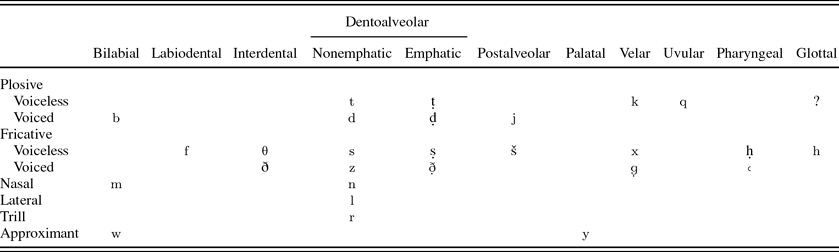
The study employed three tasks that measured three skills: letter naming, alphabetic awareness, and phonological awareness. In each task, items were randomly ordered in a fixed sequence across participants. Appendices A, B, and C present the items of these three tests, respectively. Appendix D presents features of consonantal sounds in Arabic. Because we were concerned that most children would fail on most items in the pretest, to ensure some success and decrease frustration, each test item was followed by a picture card with a drawing of a familiar object, like an ice cream. Children were instructed to label the objects and any response was accepted as correct. Following is a description of the three test tasks.
Letter naming. Each child was presented with 28 Arabic letters, that is, the entire alphabet, excluding one letter. The letter excluded, labeled hamza, is frequently annexed above another letter, and it is debated whether it should be considered a separate letter (Holes, Reference Holes2004).
Arabic script is cursive, and most letters undergo shape transformation when they appear at the initial, middle, or final positions in the word. In addition, some letters may obtain an additional shape when preceded by a letter to which they may connect. For example, the signs  , and
 mark the letter /xaː?/ at the initial, middle, and final (unconnected) positions. The letters presented in the test were in their final unconnected shape, which is the shape used in printing the letters of the alphabet.
The letters (4 × 5 cm) were printed on separate cards, and the child was asked to name each letter. Despite random ordering, testing started with a short training session. In this training session, we employed the first three letters of the alphabet, considered most familiar. A wrong answer or no answer on each of these three letters was corrected by providing the standard Arabic name. If a child replied by the colloquial Arabic name s/he was told that the response was correct, but that the letter had an additional name, and the standard name was provided. No feedback, apart from occasional encouragement, was provided on the subsequent letters.
Scored was the number of letters named correctly. Separate scores were assigned for correct standard and colloquial names. Cronbach alpha internal reliability combined across the two name varieties was .95.
Alphabetic awareness. Alphabetic awareness was measured by asking children to report the initial letters of 24 spoken words. To test the effect of the letter-name clue at the beginning of the target word on children's letter reporting, two types of words were used. The first type consisted of words beginning with a CVC sequence that coincided with the standard name of the initial letter (e.g., the word la:mi' [brilliant' begins with /laːm/, which is the standard name of its initial letter), or with a CV sequence that overlapped with the quasistandard name of the initial letter (e.g., the word /faːr/ [mouse], which begins with /faː/, the quasistandard letter name). The second type consisted of words matched with the first type on the initial letter but which began only with the phoneme that the letter represented, rather than its name (e.g., the word lu'ba [game] matches with la:mi' on the initial letter but does not incorporate the letter name /laːm /.
Familiar words were selected. In 9 out of 12 pairs, the letter name word and the control initial phoneme word were matched on number of syllables. In three pairs we could not find well-matched items composed of familiar words. Children's responses to the first four words were corrected by providing the standard letter name. No feedback was provided on subsequent items. Scored was the number of words that children reported the initial letter by either its standard or colloquial name. Cronbach alpha internal reliability was .94. See items in Appendix B.
Phonological awareness. Phonological awareness was tested by asking children to isolate the initial CV unit of 24 spoken words. These items presented three types of relations between the target CV unit and the syllabic structure of the word. In 12 words, the CV unit was the first syllable of a bisyllabic word (as in the word /kitaːb/, meaning “book”). In six words, the CV unit was a subsyllable of a monosyllabic CVC word (as in /tiːn/, meaning “figs”). In six words, the CV unit was a subsyllabic unit within the first syllable of a bisyllabic word (as in /kursiː/, meaning “chair”). Two factors were expected to have an effect on CV isolation: the overlap between the CV unit and the syllabic structure of the stimulus words as well as the syllabic length of the word (mono- vs. bisyllabic). Syllabic CV units were expected to be easier to isolate than subsyllabic CV units, and monosyllabic words were expected to be easier to segment than bisyllabic. Therefore, the third type of words, bisyllabic words with an initial CV unit that is subsyllabic, was expected to yield the lowest scores.
Half of the words were the same control words as in the previous task, and half were new words, matched with the former on the initial letter. No word included a letter name sequence in the initial CV unit, because otherwise the initial CV sound would become indistinguishable from the initial letter name.
Responses on the first four words were corrected, and no feedback was provided later on. Scored was the number of words responded to with their initial CV sounds. Phonemic responses occurred rarely and were accepted as correct. Cronbach alpha internal reliability was .95. See items in Appendix C.
Procedure
The intervention program. A total of 145 children, attending six kindergarten classrooms, took part in the intervention, out of which 30 were tested and composed the intervention test group, as explained earlier. The intervention program was conducted over a period of 7 months. Children in each classroom were divided by the homeroom teachers into groups of 4–5 children each, homogeneous in the level of literacy skills. In addition, an attempt was made to create well-functioning groups by allocating close friends to the same group, or by assigning children potentially raising disciplinary problems to separate groups. Note, however, that group members were frequently exchanged by teachers to preserve group homogeneity or well functioning.
Each group participated in literacy-related activities once a week for 25 min. The activities included linking letter shapes with their standard names, training in phonological awareness, particularly in rhyming words or segmenting initial/final subsyllables (CV), and in inventing word spelling mediated by the teacher through phonological segmentation and letter-sound mapping. All sessions started by naming letters of the alphabet printed on a personal board. Sessions ended with invented spelling activities.
Activities often took the form of a game. For instance, children were trained in letter naming through a memory game that made use of letter cards: upside down cards were dispersed on the table, and by taking turns, children turned over pairs of cards and named the letters on the cards. The aim was to identify those pairs of cards with identical letters. Children were trained to isolate initial sounds by selecting from a pile of cards those that presented objects whose labels started with the same sound. Scaffolding and corrective feedback, as well as encouraging comments, were provided by the teacher.
The activities were adapted to the group's level, with more support provided in weaker groups. Group meetings were documented by the teachers with regard to children participating, activities performed, and difficulties encountered.
The kindergarten teachers participating in the program formed a study group that met with four experts (the authors) once a month for 2 hr during the whole period of the intervention. Experts took turns in leading the lectures. However, they all participated in the general discussions and contributed their own unique perspective on the issues discussed. The meetings addressed an array of topics: the significance of early literacy to reading and spelling acquisition and academic success, with emphasis on alphabetic skills and phonological awareness; the unique characteristics of Arabic letters, phonology, and orthography; diglossia and its effect on literacy acquisition in Arabic; and role of the teachers' self-efficacy and accountability in promoting literacy. In addition, pedagogical issues were elucidated, such as the advantage of the small group setting in promoting early literacy instruction, the significance of enhancing children's security, self-efficacy, and self-expression, as well as discipline management. In addition, discussions were held on the enrichment of classroom environment with literacy-related games and activities. The teachers were provided with printed guidelines for new activities and games to be carried out in small groups at the end of each meeting. In addition to group training, each teacher was provided with individual support, twice a month, by an expert who observed and helped her in implementing the small-group activities.
Assessment of the impact of the intervention involved two testing phases: pretest and posttest. Pretest testing started simultaneously with the intervention and continued for about 1.5 months. Consequently, children in the intervention group were already involved in the initial phases of the intervention when they were tested and hence may have benefited slightly from the intervention in the pretest. This procedure was decided upon so as not to postpone the beginning of the intervention for the children's sake. Posttest took place during the last 1.5 months of the intervention period.
The children were tested individually in a separate room annexed to the classroom, in a quiet atmosphere. The interviewers were two female graduate students in education, who spoke the same Arabic vernacular as the children. Testing was carried out in three sessions, several days apart. In the first session, children were tested on phonological awareness and on naming letters, and in the second session on alphabetic awareness. The second half of the second session and the third session were devoted to testing other linguistic skills that are not reported in this study.
RESULTS
Outcomes of intervention
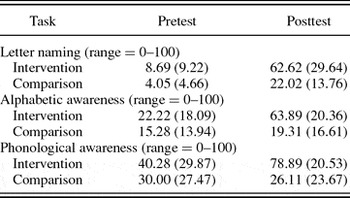
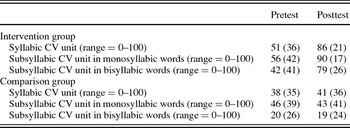
To assess the impact of the intervention on literacy skills, mean percentages of correct responses in the intervention and the comparison groups on pretest and posttest were calculated for each task. Correct responses on letter naming and alphabetic awareness included correct letter names in any variety: standard, quasistandard, or colloquial. Correct responses on phonological awareness consisted of a CV unit, or in few cases of a single phoneme. Table 1 summarizes the mean performance of children on each task by group and time of testing. On pretest, performance was slightly higher in the intervention than in the comparison group. This may have been so because assessment started concomitantly with the intervention. Therefore, some children in the intervention group might have gained from the intervention that had already started. To control for the slight gap between groups in the pretest, the effect of the intervention was analyzed using one-way analysis of variance (ANOVA) on the discrepancy scores of posttest minus pretest, with pretest scores serving as a covariate. Performance increased from pretest to posttest to a greater extent in the intervention than in the control group on all measures: letter naming, M = 53.93 versus M = 17.98, F (1, 57) = 38.05, p < .001; alphabetic awareness, M = 41.67 versus M = 4.03, F (1, 57) = 80.02, p < .001; and phonological awareness, M = 38.61 versus M = −3.89, F (1, 57) = 84.61, p < .001. In fact, on the last two measures, the increase from pre- to posttest practically appeared only in the intervention group. In conclusion, the intervention was effective in improving performance on all literacy skills measured.
Mean percentages (SD) of correct responses on three tasks pretest and posttest in intervention and comparison groups (n = 60)

Naming letters by different varieties
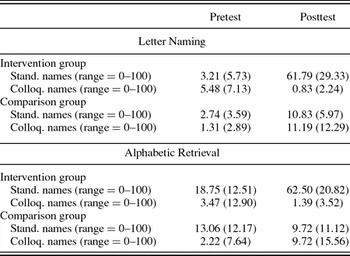
As explained earlier, Arabic letters have multiple names: standard/quasistandard and colloquial. As the intervention provided exposure to the standard names of letters, we expected an increase in the intervention group in children's knowledge of standard names, rather than colloquial. Mean percentages of correct letter naming, by time, group and variety, appear in the upper part of Table 2.
Mean percentages (SD) of correct letter naming by variety on letter naming and initial letter reporting (n = 60)
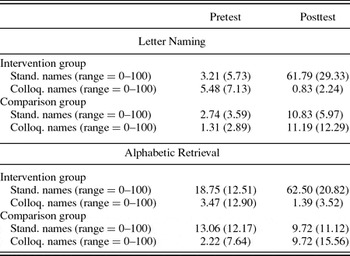
A three-way ANOVA of 2 (Time) × 2 (Group) × 2 (Variety: Standard and Colloquial Names) indicated that overall, standard names were more prevalent than colloquial names, F (1, 58) = 111.66, p < .001. Variety interacted significantly with time, F (1, 58) = 85.80, p < .001, as well as with group, F (1, 58) = 103.80, p < .001, and a three-way interaction emerged of variety, time, and group, F (1, 58) = 96.07, p < .001.
These findings reflect a simple picture. In the pretest, letters were rarely named correctly, either by standard or by colloquial names, both in the intervention and in the comparison groups. Bonferroni comparisons showed no significant differences between the two groups on each variety or between the two varieties in each group.
On posttest, however, in the intervention group, colloquial names were practically wiped out, though the decrease was insignificant, whereas standard names significantly and substantially increased. In the comparison group, letter names were low in both varieties; no difference in knowledge of standard versus colloquial names emerged in the posttest. Neither was there an increase in either type of knowledge from pretest to posttest. These findings indicate that the intervention was effective in promoting children's knowledge of the standard names of Arabic letters.
Similar findings regarding children's preference for standard rather than colloquial letter names surfaced in alphabetic awareness. Table 2 provides mean performance on initial letter reporting by time, group, and variety. A three-way ANOVA of 2 (Time) × 2 (Group) × 2 (Variety) revealed that overall, standard letter names were retrieved more frequently than colloquial, F (1, 58) = 182.50, p < .001, and variety of letter name interacted significantly with time, F (1, 58) = 21.98, p < .001, with group, F (1, 58) = 102.33, p < .001, as well as with both time and group, F (1, 58) = 56.88, p < .001.
These findings reflect the following trends. On pretest, colloquial and standard letter names were rarely reported, both in the intervention and in the comparison groups. Bonferroni comparisons showed no significant differences between the two groups on each variety or between the two varieties in each group. On posttest, in the intervention group colloquial names were hardly reported, whereas standard names were often provided. In the comparison group, colloquial and standard letter names were still rarely produced. Hence, on posttest standard letter names were used to a significantly greater extent by the intervention group than by the comparison group. These findings indicate that exposure to the standard names of letters enhanced alphabetic awareness using these names.
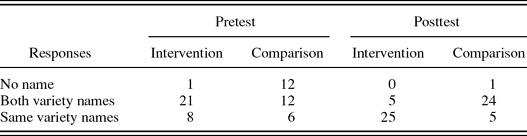
An interesting question was whether children used consistently the same variety or mixed standard and colloquial names. Assuming that children were exposed to names in the two varieties in different contexts, initially not being aware of the distinction between them, children were expected to shift from a phase of naming no letter, to a phase of naming letters by the two varieties and finally to using one variety only: that of standard names. Children were divided into three categories according to their response pattern: not naming any letter correctly, naming letters correctly by different varieties, and naming by one variety. Table 3 presents the distribution of children according to this categorization in the intervention and the comparison group, first in pretest, and then in posttest.
Distribution of children according to variety of names in letter naming (n = 60)
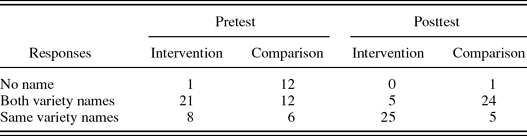
Results show that in pretest, the comparison group was mostly composed of children who named no letter correctly and children who used mixed varieties, whereas children in the intervention group predominantly used mixed varieties. These differences were significant by chi-square analysis, χ2 (2) = 12.05, p < .002. It should be noted that the pretest data were collected while the intervention had already begun, and children were categorized to a certain type of response based on very few correct names that they produced. The co-occurrence of pretest and beginning of intervention may explain the better performance of the intervention group. In the posttest, the comparison group used predominantly mixed varieties while the intervention group used mainly one variety: the standard variety (including quasi-standard). To allow analysis, the no-name cate-gory, that included a single child from the control group, was deleted, χ 2 (1) = 25.77, p < .001. The findings are consistent with the pattern described above.
Facilitation of initial letter retrieval by letter names
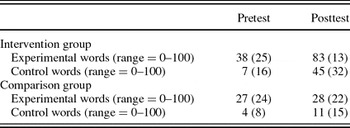
The alphabetic awareness test required children to name the initial letter of orally presented words. Two groups of words were included: experimental words that started with the sounds of the standard (or quasi-standard) letter name, and control words that started with the phoneme that the letter represented but continued differently, like /sionaː?/ (Sinai, geographical region) versus /safiːna/ (ship) that start with the letter named /sion/ or fa:r (mouse) versus fi:l (elephant) that start with the letter /faː/. Letter retrieval was expected to be higher in experimental than control words. Table 4 presents percents of initial letter retrieval by word type, group and time.
Mean percentages (SD) of correct initial letter retrievals of experimental and control words (n = 60)

A three-way ANOVA of 2 (Time) × 2 (Group) × 2 (Word Type: experimental and control) revealed that in experimental words, letter retrieval was higher, F (1, 58) = 162.73, p < .001. Performance was higher on posttest than pretest, F (1, 58) = 75.01, p < .001, and in the intervention group versus the comparison group, F (1, 58) = 50.12, p < .001. Two-way interactions emerged of Time × Group, F (1, 58) = 50.89, p < .001, and Word Type × Group, F (1, 58) = 11.50, p < .001. These interactions indicated that although both groups performed better on experimental words, the discrepancy between performance on these words and on control words was higher in the intervention than in the comparison group.
Initial CV isolation
Children were asked to isolate the initial CV sound of 24 words that presented three types of relations between the target CV unit and the syllabic structure of the word: the CV unit is the first syllable of a bisyllabic word, is a subsyllable of a monosyllabic CVC word, or is a subsyllabic unit within the first syllable of a bisyllabic word. Syllabic CV units were expected to be easier to isolate than subsyllabic CV units, and monosyllabic words were expected to be easier to segment than bisyllabic. Hence, bisyllabic words with an initial CV unit that is subsyllabic, was expected to be hardest. Table 5 presents correct CV isolation on the three types of words by time and by group.
Mean percentages (SD) of correct CV initial sound isolation on syllabic, subsyllabic in mono- and bisyllabic words (n = 60)
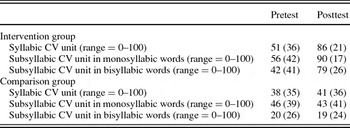
Three-way ANOVA of 2 (Time) × 2 (Group) × 3 (CV Unit Type: syllabic, subsyllabic in monosyllabic word, subsyllabic in bisyllabic word) revealed that CV unit type had an effect, F (1, 58) = 32.02, p < .001. Subsyllabic CV in bisyllabic words was significantly harder to isolate than syllabic CV or subsyllabic CV in monosyllabic words, which did not differ from each other. In addition, performance was higher on posttest, F (1, 58) = 18.40, p < .001 and in the intervention group, F (1, 58) = 24.68, p < .001. Two-way interactions were found of Time × Group, F (1, 58) = 18.79, p < .001, and of Group × CV unit type, F (1, 58) = 4.19, p < .05, indicating that CV unit type had a greater effect in pretest than on posttest and in the control group versus the intervention group. In other words, the intervention improved CV isolation across the board and wiped out the effect of CV unit type.
Letter confusability
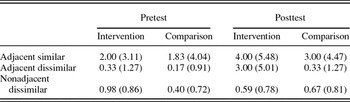
To test the effects of visual similarity and adjacency on children's letter naming, 20 letters were selected. Each letter had 1 adjacent letter that was visually similar and 1 adjacent letter that was visually dissimilar. In addition, all letters that were neither visually similar nor adjacent to each letter were considered. Three error categories were compared: misnaming a letter by the name of an adjacent-similar (AS) letter name, misnaming a letter by an adjacent-dissimilar (AD) letter name, and misnaming by a nonadjacent-dissimilar (NAD) letter name, averaged across all letters included in this category. Mean number of misnamed letters by erroneous letter names, out of 20, are displayed in Table 6.
Mean number (SD) of letters (out of 20) erroneously named by letters that are adjacent and similar, adjacent and dissimilar, or nonadjacent and dissimilar (n = 60)

A three-way ANOVA of 2 (Time) × 2 (Group) × 3 (Error Type: AS, AD, NAD) revealed that letter misnaming increased from pretest to posttest, F (1, 58) = 6.69, p < .02, probably as a by-product of learning to name letters and of growing familiarity with letter names. Error type had an effect, F (2, 116) = 18.34, p < .001, as children erred significantly most often by naming the target letter by the name of an AS letter. The two other types of errors, AD and NAD, were overall statistically indistinguishable from each other.
The interaction of Time × Error Type, F (2, 116) = 4.12, p < .02, and the three-way interaction, F (2, 116) = 3.16, p < 0.05, revealed the following picture: at pretest the three types of errors were statistically indistinguishable. In the intervention group, AD error (naming the target letter by adjacent dissimilar letter) increased from pretest to posttest, probably because these children learned the letters in their alphabetic order, causing some confusion between adjacent letters. No such increase appeared in the comparison group. At posttest, AS errors were significantly higher than NAD errors in both the intervention and the comparison groups, and AS errors were significantly higher than AD errors in the comparison group.
In conclusion, similarity between letters is the major factor affecting confusion between letter names. Adjacency contributed to confusability only in the intervention group following the intervention.
DISCUSSION
A 7-month intervention in low SES Israeli Palestinian kindergartens succeeded in substantially promoting children's letter knowledge, alphabetic awareness, and phonological awareness. This outcome may be attributed to several features of the current intervention program. First, the teachers, who implemented the intervention program, were professionally empowered by enrolling in ongoing study group and by receiving individual tutoring that aimed to increase their disciplinary and pedagogical knowledge. Intervention programs integrating collective workshops with teacher's individual tutoring were found to be successful in promoting early literacy (e.g., Levin, Aram, Biron, & Shemesh, Reference Levin and Bus2003). Second, training was carried out in small homogeneous groups (e.g., Aram & Biron, Reference Aram and Biron2004; Lauren & Allen, Reference Lauren and Allen1999). Third, the training of children was semistructured. Teachers were provided with printed guidelines for activities to be held in the groups, but were encouraged to deviate from instructions whenever they felt activities were excessively demanding, too easy, or not sufficiently engaging (Levin et al., Reference Levin, Aram, Biron and Shemesh2003). Fourth, training focused on a limited and well-defined set of literacy-related skills, ignoring broader aspects of language, cognition, or socioemotional development (e.g., Ehri et al., Reference Ehri, Nunes, Stahl and Willows2001; Foulin, Reference Foulin2005; Hammill, Reference Hammill2004). Of importance, the intervention's impact emerged so clearly because performance in the comparison group hardly improved during the school year. This is because of the children's low SES background and the state's educational policy at the time of testing that did not encourage teachers to teach kindergarten children literacy skills.
Particular attention should be devoted to the performance of the comparison group, as an example of early literacy among low SES Israeli Palestinian kindergartners. Forty percent of the children, of a mean age of 5 years and 5 months, could not name any letter in the pretest, and on average, this group succeeded in naming less than a single letter at that point in time. This performance level is considerably low when compared with middle-class children reared in other countries. For instance, US and Brazilian–Portuguese preschoolers, a few months younger than the present cohort, named an average of 64% of the letters in their alphabets (Treiman, Kessler, et al., Reference Treiman, Kessler and Pollo2006). Hebrew-speaking preschoolers and kindergartens, in a low to middle SES sample, although not taught about letters at school, succeeded in naming 61% of the letters (Treiman, Levin, et al., Reference Treiman, Kessler and Pollo2006). The poor letter knowledge of the comparison group, relative to English or Hebrew speakers, was also reflected in children's alphabetic awareness, as measured by retrieval of initial letters from spoken words (Levin et al., Reference Levin, Patel, Margalit and Barad2002; Trieman et al., Reference Treiman, Tincoff and Richmond-Welty1996). The letter knowledge of the comparison group remained low throughout the school year, as reflected in the posttest. This may be attributed to low family literacy, as well as the curriculum in Israeli Palestinian kindergartens, at the time of data collection. Teaching in kindergartens mainly referred to cultural values, based on narratives and customs connected to Islamic, Christian, and Druze traditions, with special attention given to the religion of the majority of children in the class. Code-related mediation, promoting letter knowledge, word segmentation, invented spelling, or word recognition, was scarce in Arabic-speaking kindergartens. The curriculum in Arabic-speaking preschools and kindergartens is currently being reformed to include teaching of Arabic language and literacy skills.
In contrast, the intervention program succeeded in raising the performance of children to a level comparable to that of their English- and Hebrew-speaking counterparts. On average, children managed to name 63% of the letters in their standard names, and correctly retrieved 83% of initial letters from spoken words. These levels of performance are impressive given the diglossic nature of the Arabic letter system and the sociocultural context of the low SES home.
Like letter knowledge, phonological awareness improved substantially following the intervention. On the pretest, the level of phonological awareness was moderate in both groups, and relatively more advanced than any of the other skills tested. It is noteworthy that phonological awareness was measured in this study using an initial CV unit isolation task that on half of the items overlapped with the initial syllable, and on the other half constituted a subsyllabic unit. The observed moderate levels of phonological awareness on this particular task are consistent with earlier studies showing that sensitivity to syllables and subsyllabic units that are larger than phonemes may be demonstrated by young children, as well as by illiterate adults, unfamiliar with letters and the written code (e.g., Morais, Reference Morais, Brady and Shankweiler1991; Treiman & Zukowski, Reference Treiman, Zukowski, Brady and Shankweiler1991).
The moderate levels of phonological awareness on the pretest, and the remarkably high improvement in this skill because of the intervention may also be attributed to the unique intrasyllabic structure of the syllable in Arabic. Although the intermediary level between the syllable and the phoneme that has been the target of earlier research was the onset rime (e.g., Goswami, Reference Goswami, Harris and Hatano1999; McBride-Chang, Reference McBride-Chang2004; Treiman & Zukowski, Reference Treiman, Zukowski, Brady and Shankweiler1991), an alternative level of representation has been proposed for Semitic Arabic and Hebrew. This level is the body coda (Ben-Dror et al., Reference Ben-Dror, Frost and Bentin1995; Levin, Shatil-Carmon, & Asif-Rave, Reference Levin, Shatil-Carmon and Asif-Rave2005; Saiegh-Haddad, Reference Saiegh-Haddad2003a, Reference Saiegh-Haddad2004, Reference Saiegh-Haddad2007b, Reference Saiegh-Haddad2008; Share & Blum, Reference Share and Blum2005). Our findings are in accordance with the argument that in Semitic languages the subsyllabic body (CV) is the most accessible unit for children and probably more natural than any other subsyllabic unit.
Children's alphabetic awareness, measured by retrieving initial letters from spoken words, requires some degree of phonological processing. Specifically, it requires the ability to link the name of the letter with the sounds embedded in words. Alphabetic awareness was shown to be quite low on pretest, but was significantly higher than the ability to name letters. This indicates that some children were able to aurally detect names of letters in spoken words but were unable to map these names on printed letters.
Previous analyses of learning letter names concerned letters with single names. Excluded are few cases of dialectic variations, like Zed and Zi in English, or register variations like Jud and Jod in Hebrew (Treiman, Levin, et al., Reference Treiman, Kessler and Pollo2006). In contrast, the current study pertains to the Arabic letter name system, which is diglossic with each letter having two names: a standard/quasistandard name and a colloquial name. The current findings suggest that young Arabic speaking children do not distinguish between the two name varieties and provide standard names for some of the letters and colloquial names for others. When taught standard names (as in the current intervention) children make a substantial shift to standard names. It is unclear whether and when such a shift occurs with children who are not involved in focused learning of standard letter names. However, the distinction between letter name varieties can be expected to grow in line with the growing distinction among younger children between notational systems, like numbers, and letters (Klein, Teubal, & Ninio, submitted; Levin & Bus, 2002; Treiman, Kessler, et al., Reference Treiman, Kessler and Pollo2006; Treiman, Levin, et al., Reference Treiman, Kessler and Pollo2006).
In addition to investigating factors that uniquely affect acquisition of code-related skills in Arabic, the current study also investigated whether sources of the difficulties that children have in learning letter names in other language are also valid for Arabic. Treiman and colleagues (Treiman, Kessler et al., Reference Treiman, Kessler and Pollo2006; Treiman, Levin et al., Reference Treiman, Kessler and Pollo2006) found among children who speak English, Brazilian–Portuguese, and Hebrew, that they tend to confuse the names of two letters more often when the letters are visually similar. In fact, visual similarity was the major factor in the confusion of letters. This finding was taken to mean that names of letters are learned in the same way as other lexical items, as young children also tend to confuse labels of visually similar referents in the process of lexical acquisition (e.g., Clark, Reference Clark1993). In addition, letter adjacency was found in these studies to affect letter confusability, probably because children learn to name letters in the way they are ordered in their alphabet.
In Arabic, and unlike the languages studied thus far, the letter system includes sets of letters that are visually similar and also follow each other in the alphabet. This feature provides a natural setting for testing the concurrent effect of the two factors on letter naming. The current study showed that throughout the school year children tended to confuse letters that were both adjacent and visually similar. Following the intervention that taught them to name letters in the alphabetic order, a slight tendency emerged for confusing adjacent letters that are not necessarily similar. These findings support the generality of visual similarity and adjacency as underlying factors in letter learning across alphabets.
The current findings have important educational implications. It is well acknowledged that level of early literacy in preschool and kindergarten predicts reading and spelling acquisition later on in school (e.g., Aram, Reference Aram2005; Bruck, Genesee, & Caravolas, Reference Bruck, Genesee, Caravolas and Blachman1997; Caravolas, Hulme, & Snowling, Reference Caravolas, Hulme and Snowling2001; de Jong & van der Leij, Reference de Jong and van der Leij1999; Foulin, Reference Foulin2005). The sustained low level of literacy throughout the school year among kindergartners in the comparison group suggests that these children were deprived of the education that might have prepared them for learning to read and write in school, a deprivation increasing their risk for academic failure.
It is important to recognize that learning to read Arabic involves introducing children, via the print, to MSA, which is linguistically different from the children's spoken vernacular (Abu-Rabia, Reference Abu-Rabia2000; Saiegh-Haddad, Reference Saiegh-Haddad2003a, Reference Saiegh-Haddad2004, in press-a). Indeed, in the international survey on reading literacy among fourth graders in 35 countries, carried out by PIRL (2001), reading comprehension was relatively low in all Arabic-speaking countries participating in the survey (Olshtain & Zuzovsky, Reference Olshtain and Zuzovsky2004). In Israel, Hebrew readers were substantially more advanced than Arabic readers, although the latter outperformed their counterparts in Arabic-speaking countries. The substantial gains in code-related skills of Arabic-speaking kindergartners because of intervention in the current study indicates that more attention should be devoted to this domain, and that education in these skills can be, and should be, profoundly improved. Evidence-supported improvement calls for increasing international research on early literacy in diglossic languages in general, and in Arabic in particular.
APPENDIX A

APPENDIX B
Words in the task of alphabetic awareness

APPENDIX C WORDS IN THE TASK OF PHONOLOGICAL AWARENESS
/ḥimar/(a donkey); /ḥuːt/ (a whale); /rumman/ (pomegranate); /riːḥ/ (wind); /biːda/ (egg); /buːða/ ice-cream); /tiːn/ (figs); /tuffaːḥ/ (apple); /diːk/ (cock); /dukkaːn/ (store); /sukkaːr/ (sugar); /safiːna/ (ship); /ṣuːra/ (picture); /ṣiyaːḥ/ (shouting); /ṭuːl/ (length); /ṭifil/ (baby); /fuːṭa/ (towel); /fiːl/ (elephant); /kursiː/ (chair); /kitaːb/ (book); /luába/ (game); /lisaːn/ (tongue); /hilaːl/ (moon); /hudaː/ (name, Fm).
APPENDIX D
Features of consonantal sounds in Arabic
ACKNOWLEDGEMENT
Thanks are extended to Price Brodi and Tel Aviv University Initiative, which supported this study, and especially to its Director, Yehudit Shvili. We are grateful to the teachers and headmasters of the schools participating in this study.