Introduction
Conyza species have high fecundity, high potential for dispersion by seed, staggered emergence, adaptation to no-till farming systems, and resistance to different site-of-action herbicides, which gives these species high invasive potential worldwide (Savage et al. Reference Savage, Borger and Renton2014; Wu et al. Reference Wu, Walker, Rollin, Tan, Robinson and Werth2007). Currently, the management of Conyza spp. has become more difficult due to the increase in herbicide-resistant biotypes (Heap Reference Heap2021). There are 106 cases of Conyza spp. resistant to herbicides globally (Heap Reference Heap2021). In Brazil, the first report of herbicide-resistant Conyza spp. occurred in 2005, when failures were observed after glyphosate application (Moreira et al. Reference Moreira, Nicolai, Carvalho and Christoffoleti2007).
In 2017, Sumatran fleabane [Conyza sumatrensis (Retz.) E. Walker; syn.: Erigeron sumatrensis Retz.] was first reported with multiple resistance to five herbicide (paraquat, saflufenacil, diuron, 2,4-D, and glyphosate) sites of action (Pinho et al. Reference Pinho, Leal, Dos Santos, de Oliveira, de Oliveira, Langaro, Machado, Christoffoleti and Zobiole2019) and subsequently to diquat (Leal et al. Reference Leal, Souza, Borella, Araujo, Langaro, Chapeta, Amorim, Silva, Morran, Zobiole, Gaines and Pinho2021). The resistant biotype shows different responses to each herbicide application, and in this report, we demonstrate a rapid resistance responses to 2,4-D herbicide in this biotype that is not seen when the other five herbicides (or site of action) are applied. This was the first case in the world reported for Conyza with an extremely complex and atypical response to 2,4-D. This resistant biotype exhibits a differential response to 2,4-D application compared with the susceptible biotype, with a symptom of necrotic in leaves within 30 to 60 min following 2,4-D application and normal growth resuming within 1 to 2 wk after 2,4-D treatment, resulting in failed control. A rapid response as part of an evolved resistance mechanism to herbicide treatment was also reported by Moretti et al. (Reference Moretti, Van Horn, Robertson, Segobye, Weller, Young, d’Avignon, Gaines, Westra, Green, Jeffery, Lesperance, Tardif, Sikkema and Hall2018) in giant ragweed (Ambrosia trifida L.), with the resistant biotype surviving glyphosate application by using rapid necrosis as an adaptation strategy to survive herbicide application. In addition, Harre et al. (Reference Harre, Nie, Robertson, Johnson, Weller and Young2017), documented the involvement of H2O2 (hydrogen peroxide) in the rapid response of A. trifida resistant to glyphosate, similar to the rapid response of C. sumatrensis.
Necrotic symptoms may be a result of an oxidative burst mediated by increased reactive oxygen species (ROS) (Gill and Tuteja Reference Gill and Tuteja2010; Peer et al. Reference Peer, Cheng and Murphy2013; Song Reference Song2014). Along with ROS production, changes in antioxidant enzymatic systems and photosynthetic capacity can also occur to support the rapid response as a survival strategy (Harre et al. Reference Harre, Nie, Jiang and Young2018). Photosynthetic traits, such as chlorophyll (Chl) a fluorescence could be used to monitor cases of resistance involving physiological changes in 2,4-D–resistant plants. The use of Chl a fluorescence to monitor resistance has been reported in C. sumatrensis upon paraquat application, with resistant biotypes surviving and showing recovery of the dynamic electron transport chain energy fluxes within a day, while susceptible plants rapidly show great disorder in the photosynthetic apparatus and die within hours after paraquat application (Leal et al. Reference Leal, Souza, Borella, Araujo, Langaro, Chapeta, Amorim, Silva, Morran, Zobiole, Gaines and Pinho2021). As well, Brunharo and Hanson (Reference Brunharo and Hanson2017) reported that in tall windmill grass (Chloris elata Desv.) resistant biotypes, the herbicide affects photosynthetic performance until the molecules are trapped by the mechanism of action operating in plant cells. Here, we propose an opposite response to 2,4-D application compared with paraquat. Photosynthetic performance declines more rapidly in the resistant than in the susceptible biotype during a period of rapid necrosis induction that occurs within a few days. In contrast, the decline in Chl a fluorescence takes longer in susceptible biotypes, until the plant dies. Chl a fluorescence technique can show these differences in photosynthetic performance between the biotypes to rapidly detect herbicide stress (Dayan and Zaccaro Reference Dayan and Zaccaro2012; Hassannejad et al. Reference Hassannejad, Lotfi, Ghafarbi, Oukarroum, Abbasi, Kalaji and Rastogi2020). Moreover, plants treated with paraquat start to show photosynthetic recovery after 24 h, while with 2,4-D it may happen in about 40 d, after plant regrowth.
The conditions of herbicide application, such as suboptimal and light conditions, can also influence plant metabolism, growth, or development by altering homeostatic balance (Kranner et al. Reference Kranner, Minibayeva, Beckett and Seal2010). These factors cause changes in chlorophyll fluorescence induction and responses in the defense system. The herbicide stress affects the stability of the photosynthetic apparatus and indirectly affects chlorophyll fluorescence induction (Dayan and Zaccaro Reference Dayan and Zaccaro2012; Kalaji et al. Reference Kalaji, Schansker, Ladle, Goltsev, Bosa, Allakhverdiev, Brestic, Bussotti, Calatayud, Dąbrowski, Elsheery, Ferroni, Guidi, Hogewoning and Jajoo2014). Metabolic perturbation induced by herbicides, even herbicides not directly associated with photosynthetic metabolism, can be detected from changes in fluorescence parameters, even before any visual effects appear (Barbagallo et al. Reference Barbagallo, Oxborough, Pallett and Baker2003; Caverzan et al. Reference Caverzan, Piasecki, Chavarria, Stewart and Vargas2019; Oukarroum et al. Reference Oukarroum, EL Madidi, Schansker and Strasser2007). Thus, fluorescence is a promising technique to describe the differential photosynthetic response due to any source of stress (Dayan and Zaccaro Reference Dayan and Zaccaro2012; Guidi et al. Reference Guidi, Lo Piccolo and Landi2019; Stirbet and Govindjee Reference Govindjee2011).
The exposure of plants to herbicides may cause oxidative stress, leading to the generation of ROS, such as superoxide radicals (O2 .−), hydrogen peroxide (H2O2), and hydroxyl radicals (·OH) (Caverzan et al. Reference Caverzan, Piasecki, Chavarria, Stewart and Vargas2019). In response to the damage caused by ROS, the antioxidative enzyme system (including superoxide dismutase [SOD], catalase [CAT], peroxidases, ascorbate peroxidase [APX], and glutathione reductase) (Gill and Tuteja Reference Gill and Tuteja2010) may be differentially expressed/activated in resistant and susceptible biotypes (Benedetti et al. Reference Benedetti, Rangani, Ebeling Viana, Carvalho-Moore, Merotto, Rabaioli Camargo, Antonio de Avila and Roma-Burgos2020). The herbicide can also differentially modulate the induction of enzymatic antioxidant systems in resistant and susceptible biotypes (Caverzan et al. Reference Caverzan, Piasecki, Chavarria, Stewart and Vargas2019).
We hypothesize that 2,4-D–resistant C. sumatrensis induces rapid response (rapid necrosis), possibly as a mechanism to avoid 2,4-D translocation. The rapid response may be associated with a higher production of H2O2 and differential antioxidative enzymes. The rapid response can be affected by temperature and light and dark conditions as well. In this work, we evaluated the short time-induced oxidative stress–mediated rapid metabolic and physiological responses of C. sumatrensis biotypes resistant and susceptible to 2,4-D under fixed (simulated natural growth conditions) and variable (temperature and light) conditions.
Materials and Methods
Plant Material
Seeds of a 2,4-D–susceptible biotype and a 2,4-D–resistant C. sumatrensis with multiple resistance to six herbicides (paraquat, diquat, saflufenacil, diuron, 2,4-D, and glyphosate) (Leal et al. Reference Leal, Souza, Borella, Araujo, Langaro, Chapeta, Amorim, Silva, Morran, Zobiole, Gaines and Pinho2021; Pinho et al. Reference Pinho, Leal, Dos Santos, de Oliveira, de Oliveira, Langaro, Machado, Christoffoleti and Zobiole2019) of C. sumatrensis were originally collected from a site at Assis Chateaubriand-Paraná, Brazil. Two experimental approaches (fixed: simulated natural growth conditions; and variable: temperature and light conditions) were conducted to evaluate the rapid metabolic and physiological responses of these plants to 2,4-D application. All the experiments described were independently conducted twice.
Experimental Setup under Fixed Conditions
The first trial was conducted in a greenhouse with temperature conditions of 25 ± 5 C and 65 ± 5% relative humidity. Seeds from both 2,4-D–resistant and 2,4-D–susceptible biotypes were sown in 2.5-dm−3 pots filled with potting mix soil. After germination, the seedlings were thinned to one plant per pot. To promote active growth and avoid nutritional deficiencies, the soil was fertilized with N, P, and K (5-20-20) weekly and irrigated daily. Experimental units were arranged as a randomized complete block design with four replications. The treatments were 2,4-D–resistant biotype and 2,4-D–susceptible biotype with and without application of 2,4-D-amine herbicide (DMA® 806 BR SL, Corteva Agrisciences, São Paulo, SP, Brazil), without adjuvants. When plants reached 10-cm height, the 2,4-D herbicide was sprayed at 1,005 g ae ha−1 using a CO2-pressurized backpack sprayer with four XR-110015 flat-fan nozzles (TeeJet® Technologies, Wheaton, IL, USA), delivering 150 L ha−1 at 240 kPa.
After herbicide application, the injury symptoms were assessed as a percentage of visual injury using a scale from 0% to 100%, with 0% indicating no symptoms and 100% indicating plant death (Frans et al. Reference Frans, Talbert, Marx, Crowley and Camper1986). The injury was recorded at 1, 4, 8, and 24 h after application (HAA) and 2, 3, 7, 14, 21, 35, and 42 d after application (DAA). Chl a fluorescence transients were also measured at 1, 4, and 48 HAA and 42 DAA. Subsequently, at 1, 4, and 8 HAA, the fully expanded first leaf was harvested from a different plant each time. Leaves were removed by clipping the base of the leaf at the end of the petiole and were immediately frozen in liquid nitrogen and temporarily stored at −80 C until an analysis of enzymatic activity. After removal of leaves, plants were discarded to avoid influencing other analyses. In addition, the analysis performed at 42 DAA was only done for resistant plants upon regrowth.
Enzymatic Activity Measurements
To measure the enzymatic activities, the fully expanded first leaf (last mature leaf) was collected (±0.2 g) and crushed to a powder using liquid N2 in porcelain mortars, containing 5% polyvinyl polypyrrolidone and homogenized in 100 mM potassium phosphate buffer, pH 7.8, containing 0.1 mM ethylenediaminetetraacetic acid (EDTA), 20 mM ascorbic acid, 5 mM dithiothreitol, 5 mM β-mercaptoethanol, and 0.01% Triton X-100. The homogenate was centrifuged at 12,000 × g for 20 min at 4 C, and the supernatant was used as crude enzyme extract. An aliquot of the extract was used to determine protein content as described by Bradford (Reference Bradford1976), using bovine serum albumin as standard. The supernatant was then used as an enzyme extract to assay SOD (EC 1.15.1.1), CAT (EC 1.11.1.6), and APX (EC 1.11.1.11).
Total SOD activity was measured as described by Giannopolitis and Ries (Reference Giannopolitis and Ries1977). SOD activity was measured in a 200-µl reaction mixture containing 75 μM p-nitro blue tetrazolium chloride (NBT), 2 μM riboflavin, 14 mM methionine, 0.1 mM EDTA, 50 mM potassium phosphate buffer (pH 7.8), and 5 µl of enzyme extract. The samples were placed under fluorescent lamps at 4,000 lx for 5 min, and absorbance at 560 nm was recorded. One unit of SOD activity was equal to the amount of enzyme necessary to cause 50% inhibition of NBT reduction at 560 nm.
The catalase activity was determined according to Azevedo Neto et al. (Reference Azevedo Neto, Prisco, Enéas-Filho, de Abreu and Gomes-Filho2006). CAT activity was assayed in a 200-µl reaction mixture containing 100 mM potassium phosphate buffer (pH7.0), 12.5 mM H2O2, and 10 µl of enzyme extract. The reaction was initiated by adding H2O2 last. Catalase activity was determined by monitoring H2O2 consumption and measuring a decline in the absorbance at 240 nm and calculated using a molar extinction coefficient of 39.4 M−1 cm−1.
APX activity was determined by the method of Nakano and Asada (Reference Nakano and Asada1981). The activity was assayed in a 200-µl reaction mixture containing 100 mM potassium phosphate buffer (pH 7.0), 0.5 mM ascorbic acid, 0.1 mM H2O2, and 10 µl of enzyme extract. The reaction was initiated by adding H2O2 last. The activity of APX was observed at 290 nm and calculated using a molar extinction coefficient of 2.8 mM−1 cm−1.
Chl a Fluorescence Transients Analysis
Chl a fluorescence transients were measured in dark-adapted leaves using a Handy-PEA fluorimeter (Plant Efficiency Analyzer, Hansatech Instruments, King’s Lynn, Norfolk, UK). The last fully expanded leaves were kept in the dark for 20 min in specially provided clips to conduct measurements. The polyphasic fluorescence rise, OJIP, was induced by one saturating red-light flash (peak at 650 nm) with 3,000 μmol photons m−2 s−1 and measured during the first second of illumination (10 µs to 1 s). The OJIP fluorescence transients are based on the polyphasic fast fluorescence rise from the lowest intensity FO (minimum fluorescence, the O level) to the highest intensity FM (maximum fluorescence, the P level) with two intermediate steps labeled J and I (Strasser et al. Reference Strasser, Tsimilli-Michael, Srivastava and Papageorgiou2004). The fluorescence intensities were determined at 50, 100, and 300 μs (F50μs, F100μs and F300μs, respectively), 2 and 30 ms (F2ms- FJ and F30ms -FI), and at FM using the JIP test parameters (for analysis of chlorophyll a fluorescence, see Strasser et al. [Reference Strasser, Tsimilli-Michael, Srivastava and Papageorgiou2004] and Tsimilli-Michael and Strasser [Reference Tsimilli-Michael, Strasser and Varma2008]). The intensity measured at 50 μs was considered the initial fluorescence (F0). The plotted fluorescence values were the average of eight measurements of each treatment. The JIP test was also applied to analyze and compare the OJIP transients using the untreated treatment (normalizations) as the reference and subtraction of values to compare the samples for the events reflected in the OP (Wt), OI (WOI), and IP (WIP) phases. The transients were normalized as relative variable fluorescence: Wt = (Ft − F0)/(FJ − F0), WOI = (Ft − F0)/(FI − F0) and WIP = (Ft − FI)/(FP − FI).
Experimental Setup under Variable Conditions: 15 C versus 25 C
The C. sumatrensis resistant and susceptible biotypes were germinated in commercial soil potting media in a greenhouse. Environmental conditions inside the greenhouse were set up for 25 C, 65 ± 5% relative humidity, and 12 h light d−1. The experiments were conducted using 10-cm plants. The plants were acclimated to each environmental condition (15 C or 25 C) for 3 d before the herbicide application. Treatments included no herbicide treatment and 2,4-D application at 1,005 g ae ha−1 with six biological replicates per treatment.
Both biotypes were placed in a chamber with a constant temperature of 25 or 15 C for 3 d before herbicide treatment and were kept at this temperature until the end of the experiment. The plants were watered as scheduled, light intensity was 520 μmol photons m−2 s−1 (photosynthetically active radiation [PAR]) of 12 h d−1, and relative humidity was 60% in both chambers. The H2O2 production was evaluated at 0.5, 1.5, and 3 HAA.
Experimental Setup under Variable Conditions: Light versus Dark Conditions
Plants were placed in and acclimated to a chamber under low light (PAR = 330 μmol photons m−2 s−1) conditions for 3 d before the herbicide treatment. Afterward, both biotypes were sprayed with 2,4-D at 1,005 g ha−1 and maintained in the chamber in complete darkness for 24 HAA or light intensity (PAR-520 μmol photons m−2 s−1) of 12 h d−1. Both chambers were maintained at 60% relative humidity and 25 C temperature.
The H 2 O 2 Content
After 24 h under light or dark acclimation, the H2O2 content was evaluated at 0.5, 1.5, and 3 HAA. The production of H2O2 was indirectly measured by staining leaf disks in solutions containing 3,3′-diaminobendizine (DAB) (Queiroz et al. Reference Queiroz, Delatorre, Lucio, Rossi, Zobiole and Merotto2020; Takano et al. Reference Takano, Ovejero, Belchior, Maymone and Dayan2020; Thordal-Christensen et al. Reference Thordal-Christensen, Zhang, Wei and Collinge1997). The DAB solution contained 0.1 g DAB solubilized in 200 ml of water with pH 3.8. Twenty-four leaf disks from control and treated leaves in each condition were placed in 20-ml glass tubes containing staining solution. The samples were then shaken under 20-Hg vacuum for 1 h. Leaf disks were washed in distilled water and boiled in 70% (v/v) ethanol solution with solution replaced every 20 min, repeated four times. Leaf disks were then stored in 70% (v/v) ethanol solution for 12 h and scanned. The levels of H2O2 were quantified using Photoshop software (Adobe Systems) to measure the color intensity in each leaf disk, removing background levels. The data were represented as relative intensity of treated samples compared with control samples (treated intensity − control intensity).
Statistical Analysis
For analysis of enzymatic activity and ROS measurement, the data were submitted to ANOVA (P ≤ 0.05), and when statistical significance was identified, means were separated and adjusted using Fisher’s protected LSD, P ≤ 0.05. Statistical analyses were performed using SAS v. 9.0 Statistical Software Program (SAS Institute, Cary, NC, USA).
Results and Discussion
Injury Symptoms
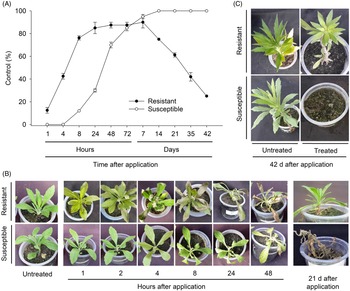
The 2,4-D–resistant biotype showed a rapid necrotic response following 2,4-D treatment, as all leaves (young and old) developed necrotic spots that spread across the leaf within 30 to 60 min after application (Figure 1; Supplementary Material S1). At 8 HAA, visible necrosis occurred in all leaves that received herbicide. However, the meristems were not affected by 2,4-D, and the resistant biotype survived through continued growth from the apical and axillary meristems after 1 to 2 wk of growth following application (Figure 1). In contrast, the 2,4-D–susceptible biotype developed typical symptoms of auxin herbicide exposure after 6 to 24 h, such as epinasty and stem-thickening symptoms. The susceptible biotype showed control above 80% within 72 HAA and death of all plants within 7 to 14 DAA (Figure 1).
Visual control (A) and injury symptoms (B and C) of Conyza sumatrensis 2,4-D–resistant and 2,4-D–susceptible biotypes treated with 2,4-D (1.0 kg ha−1).

Rapid physiological responses of C. sumatrensis to 2,4-D were also reported by Queiroz et al. (Reference Queiroz, Delatorre, Lucio, Rossi, Zobiole and Merotto2020) in a 2,4-D–resistant biotype. However, the results showed differences in relation to the times symptoms appeared and plant regrowth. Queiroz et al. (Reference Queiroz, Delatorre, Lucio, Rossi, Zobiole and Merotto2020) showed rapid necrosis symptoms within 2 h after 2,4-D application, and total necrosis of leaves after 1 d, which may have been modulated by light and temperature conditions during the experiment. The symptoms were observed in the mature leaves; the meristems and young leaves had no rapid necrosis. In addition, at 21 DAA, plants reestablished growth from only the axillary meristems and not the apical meristem.
The herbicide 2,4-D kills plants by altering the plasticity of the cell walls, influencing the amount of protein production, and increasing ethylene hormone concentration in the tissues (Grossmann Reference Grossmann2000; Sandalio et al. Reference Sandalio, Rodríguez-Serrano and Romero-Puertas2016). It can be absorbed through roots, stems, and leaves and is translocated to the meristems of the plants, which leads to plant death (Grossmann Reference Grossmann2000). However, the resistant biotypes showed a rapid cell death that might limit the translocation of herbicide to other parts of the plant to ensure the resistant biotype’s survival. A rapid response as part of evolved resistance to herbicide treatment, with resistant A. trifida plants having decreased glyphosate translocation, was also reported by Moretti et al. (Reference Moretti, Van Horn, Robertson, Segobye, Weller, Young, d’Avignon, Gaines, Westra, Green, Jeffery, Lesperance, Tardif, Sikkema and Hall2018). This mechanism was reported as rapid necrosis and is an adaptation strategy to survive herbicide application. In addition, Harre et al. (Reference Harre, Nie, Robertson, Johnson, Weller and Young2017) documented the involvement of H2O2 in the rapid response of A. trifida resistant to glyphosate. The production of H2O2 increases more rapidly during the first hours, which leads to leaf tissue necrosis in the resistant compared with the late response of the susceptible biotype. Thus, the resistant biotype is not inherently more tolerant to oxidative stress (Harre et al. Reference Harre, Nie, Jiang and Young2018).
Here, the 2,4-D–resistant biotypes displayed symptoms similar to those identified in A. trifida resistant to glyphosate, defined as apoptosis-like programmed cell death (PCD) or hypersensitive response (Harre et al. Reference Harre, Nie, Jiang and Young2018; Lespérance Reference Lespérance2015; Moretti et al. Reference Moretti, Van Horn, Robertson, Segobye, Weller, Young, d’Avignon, Gaines, Westra, Green, Jeffery, Lesperance, Tardif, Sikkema and Hall2018; Van Horn et al. Reference Van Horn, Moretti, Robertson, Segobye, Weller, Young, Johnson, Schulz, Green, Jeffery, Lespérance, Tardif, Sikkema, Hall and Mclean2017).
Chl a Fluorescence Transients Analysis
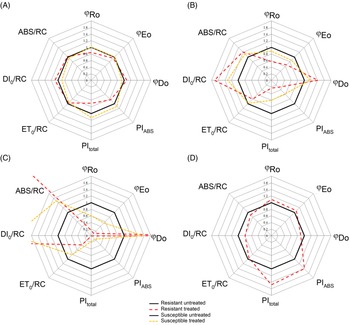
Chl a fluorescence analysis, normalized as the relative variable fluorescence curve (Wt) and the calculation of the parameters of the JIP test, provides detailed information on the structure and function of the photosynthetic apparatus (Strasser and Strasser Reference Strasser, Strasser and Mathis1995). The photosynthetic performance is related to energy conservation from excitation captured to the reduction of the electron acceptor of intersystem (PIABS) and photosystem I (PSI; PItotal). At 1 HAA, the 2,4-D–resistant biotype showed a decline of 20% in photosynthetic performance (performance index PIABS and PItotal) (Figure 2A), indicating a loss of photochemical efficiency by the plants (Trebst Reference Trebst2007). At this time point, no variations in photosynthetic parameters were observed in relation to the 2,4-D–susceptible biotype (Figure 2A), indicating that the first physiological symptoms can be rapidly detected by Chl a fluorescence in the resistant biotype.
Chlorophyll a fluorescence transients of dark-adapted leaves of 2,4-D–susceptible and 2,4-D–resistant biotypes of Conyza sumatrensis at 1 h after application (HAA) (A), 4 HAA (B), 48 HAA (C), and 42 d after application (D). Among the parameters selected by the highlighted JIP test: ϕRo, quantum yield for reduction of end electron acceptors at the photosystem I (PSI) acceptor side); ϕEo, quantum yield for electron transport (ET); ϕDo, maximum quantum yield of non-photochemical de-excitation; PIABS, performance index (potential) for energy conservation from exciton to the reduction of intersystem electron acceptors; PItotal, performance index (potential) for energy conservation from exciton to the reduction of PSI end acceptors; DI0/RC (reaction center), dissipation of an active RC; ABS/RC, a measure of the apparent size of the antenna system; TR0/RC, maximum trapping rate per RC.

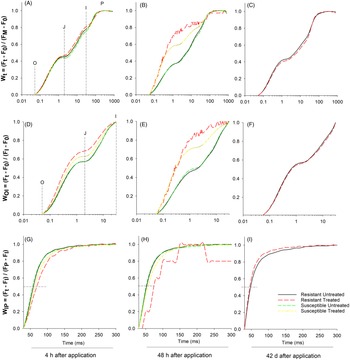
At 4 HAA, the 2,4-D–resistant biotype and the 2,4-D–susceptible biotype showed a slight variation in the relative variable fluorescence (Wt) (Figure 3A). There was an increase in the excitation captured by the reaction centers (RCs) until the reduction of plastoquinone (PQ) as observed in the OI phase (Figure 3D) in both biotypes. However, there was a reduction of the electron transfer from PQ to the final electron acceptor of the PSI, as highlighted in the IP phase (Figure 3G) for the 2,4-D–resistant biotype. Furthermore, the 2,4-D–resistant biotype presented a decrease of 20% in QA − reoxidation per RC (ET0/RC) and a decrease of 30% in the quantum yield of electron transport from QA − to the electron acceptor intersystem (ϕE0 parameter) and 40% electron transport quantum yield of QA − for the final electron acceptor of the PSI (ϕR0 parameter) (Figure 2B). In addition, a decline of 80% in the photosynthetic performance and an increase of 70% in energy dissipation as heat per active RC (DI0/RC and ϕD0) were observed (Figure 2B). However, the 2,4-D–susceptible biotype showed a subtle variation in these parameters. Photosynthetic damage was rapidly observed in the resistant biotype compared with the susceptible biotype due to the differential physiological response of the 2,4-D–resistant biotype.
Chlorophyll a fluorescence transients of dark-adapted leaves of 2,4-D–susceptible and 2,4-D–resistant Conyza sumatrensis biotypes at 4 h after application (A, D, G), 48 h after application (B, E, H), and 42 d after application (C, F, I). Data correspond to the relative variable fluorescence between steps O and P (Wt) (A, B, C); between steps O and I (WOI) (D, E, F), and between steps I and P (WIP) (H, I, J) on a logarithmic timescale. Data correspond to the photosynthetic parameters deduced by the JIP test analysis of the fluorescence transients normalized using the untreated treatment as the reference (n = 8).

At 48 HAA, both biotypes showed an increase in the relative variable fluorescence (Figure 3B) and energy dissipation as heat (Figure 2C). PIABS and PItotal declined 100% and 80% for 2,4-D–resistant and2,4-D–susceptible biotypes, respectively (Figure 2C). The ϕE0 declined 40% for the 2,4-D–susceptible biotype and 80% for the 2,4-D–resistant biotype (Figure 2C). In addition, there was a reduction of electron transfer from PQ to the final electron acceptor of the PSI, as highlighted in the IP phase (Figure 3H) and ϕR0 parameter (Figure 2C), for both biotypes, which was more pronounced in the resistant biotype.
The resistant biotype survived the 2,4-D application through regrowth from the apical meristem with 1 to 2 wk after application, and by 42 DAA, this biotype showed normal photochemical activity in new leaves (upon regrowth) when compared with untreated resistant plants (Figures 2 and 3).
Antioxidant Enzyme Activities
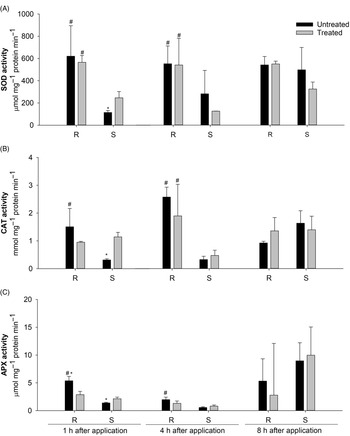
The basal activity levels of 2,4-D–resistant and 2,4-D–susceptible biotype leaves of untreated plants were different for all antioxidant enzymes (Figure 4). The resistant biotype constitutively expressed greater antioxidant enzyme activities for SOD, CAT, and APX in untreated leaves compared with the susceptible biotype. This finding is quite intriguing and needs to be elucidated by molecular analysis. However, so far, the resistant biotype shows resistance to six herbicides with different sites of action; this adaptation is to be expected as the genes coding for antioxidant enzymes are constitutively expressed as induced by the herbicide. This finding may also be supported by reports of antioxidative enzymes operating as a response mechanism in resistant biotypes to herbicides, such as paraquat (Harre et al. Reference Harre, Nie, Jiang and Young2018; Ye and Gressel Reference Ye and Gressel2000). Studies reported that hairy fleabane [Conyza bonariensis (L.) Cronquist; syn. Erigeron canadensis L.] resistant to paraquat constitutively showed more SOD and APX activities before paraquat treatment compared with a susceptible biotype (Shaaltiel and Gressel Reference Shaaltiel and Gressel1986; Ye and Gressel Reference Ye and Gressel2000). Although the differences in basal enzymes between the resistant and susceptible biotypes have not been elucidated, we suggest that these differences may be constitutively incorporated upon the development of a mechanism of resistance to maintain the normal growth of plants.
Change in superoxide dismutase (SOD) (A), catalase (CAT) (B), and ascorbate peroxidase (APX) (C) enzymatic activities in 2,4-D–resistant and 2,4-D–susceptible Conyza sumatrensis biotypes at 1, 4, and 8 h after application of 2,4-D herbicide (1,005 g ae ha−1). The treatment effects were separated at P ≤ 0.05 and adjusted using Fisher’s protected LSD. Symbols above error bars: *compared between treatment (untreated and treated); #compared between biotype (resistant and susceptible). Values represent the means ± SD.

In addition, it is not necessarily an increase in the activity of the enzymes upon herbicide application compared with basal ones. This can be observed in our study and can be related to the resistance mechanism of action operating in the biotype to counteract the herbicide in the tissues. Antioxidant enzyme activities were also reported to be similar between the rapid responses of glyphosate-susceptible and glyphosate-resistant A. trifida biotypes following glyphosate treatment (Harre et al. Reference Harre, Nie, Jiang and Young2018). There is also a difference in tissue damage between juvenile and mature leaves of the resistant biotype, which has a differential and transiently increases in antioxidant enzyme expression in juvenile leaves. However, considering the overall induction of antioxidative enzymes, juvenile leaves induced lower expression than mature leaves (Harre et al. Reference Harre, Nie, Jiang and Young2018). Constitutively, levels of antioxidant enzymes can be also a response to the resistant and susceptible biotypes of Conyza.
The activities of all enzymes did not differ between untreated and treated 2,4-D–resistant biotypes at 1, 4, and 8 HAA (Figure 4). However, at 1 HAA, the antioxidant enzyme activities were significantly higher in the treated 2,4-D–susceptible biotype than in the untreated (Figure 4). SOD is one of the most important enzymes used against oxidative stress in plant defense systems (Giannopolitis and Ries Reference Giannopolitis and Ries1977). The increase in SOD activity might be due to increased production of the superoxide radical, since this is the first enzyme to act on the antioxidant system, initiating the dismutation of the superoxide radical into H2O2 (Azevedo Neto et al. Reference Azevedo Neto, Prisco, Enéas-Filho, de Abreu and Gomes-Filho2006). The increases in CAT and APX activity in the leaves might be related to high levels of H2O2 originating from the conversion of the superoxide radical through SOD-mediated reactions, as CAT and APX enzymes help to overcome the damage to tissue metabolism by reducing toxic levels of H2O2 (Apel and Hirt Reference Apel and Hirt2004; Mittler Reference Mittler2002).
The enzymatic activity may influence the photosynthetic behavior of the susceptible biotype, as the enzymes were able to detoxify the ROS and no damage was found at 1 HAA in the photosynthetic apparatus. Otherwise, at 1 HAA, the resistant biotype showed a decline in photosynthetic activity and did not show enzymatic changes between treated and untreated. The increase in enzymatic activity at the first hours in the susceptible biotype may be related to an attempt to cope with the increase in ROS production over time, which fails and leads to plant death. On the other hand, the resistant biotype rapidly induces ROS production itself to trigger PCD and avoid herbicide translocation with no need to induce antioxidant enzymes. It is also noteworthy that there are other enzymatic and non-enzymatic compounds not measured here that may be involved in this mechanism of detoxification: enzymes such as glutathione peroxidase, glutathione reductase, guaiacol peroxidase, glutathione-S-transferase, peroxiredoxin, monodehydroascorbate reductase, and dehydroascorbate reductase and non-enzymatic molecules such as ascorbate, glutathione, tocopherol, phenolics, proline, and others (Gill and Tuteja Reference Gill and Tuteja2010; Irato and Santovito Reference Irato and Santovito2021). It is also worth mentioning that quantifying the dynamic expression of antioxidant genes as well as changes in enzymatic activity and compounds as a means of coping with ROS is also important to elucidate basal and herbicide responses of resistant and susceptible biotypes.
15 C versus 25 C
The temperature becomes a relevant factor in Brazil; this biotype is widespread in the country, and when present in the south (a colder region), visual symptoms are observed only at 2 to 3 HAA, while in hotter regions, such as the midwestern part of the country, the symptoms are often observed at 30 min after application. This information is very relevant, considering the widespread dissemination of this plant worldwide.
The interaction between both temperature treatment and biotypes was significant (P < 0.05) (Figure 5). The accumulation of H2O2 in the resistant biotype was higher at all time points compared with the susceptible biotype. Higher H2O2 accumulation was associated with the rapid physiological response observed in this biotype, as higher H2O2 levels lead to oxidative damage of cells (Figure 5) (Gill and Tuteja Reference Gill and Tuteja2010) as a mechanism to induce PCD to avoid herbicide translocation. H2O2 is one of the main ROS compounds generated outside and within the cell in response to stresses, and it is also induced on the application of exogenous auxins in plants (Peer et al. Reference Peer, Cheng and Murphy2013; Peterson et al. Reference Peterson, McMaster, Riechers, Skelton and Stahlman2016; Song Reference Song2014). Auxin is involved in the regulation of several processes, such as cell viability, cell cycle progression, and PCD, which depend on ROS signaling (Xia et al. Reference Xia, Zhang, Nie and Guo2005). The accumulation of H2O2 before tissue death is a response to an induced oxidative burst involved in the signaling of apoptosis-like PCD (Lam et al. Reference Lam, Kato and Lawton2001; Reape and McCabe Reference Reape and McCabe2008). The symptoms observed in C. sumatrensis were similar to those reported in the rapid response of glyphosate-resistant A. trifida, defined as apoptosis-like PCD (Lespérance Reference Lespérance2015).
Changes in hydrogen peroxide (H2O2) in 2,4-D–resistant and 2,4-D–susceptible Conyza sumatrensis biotypes following treatment with 2,4-D herbicide (1,005 g ae ha −1) at 0.5, 1.5, and 3 h after application at 15 and 25 C. The treatment effects were separated at P ≤ 0.05 and adjusted using Fisher’s protected LSD. Symbols above error bars: *compared between temperature (15 and 25 C); #compared between biotype (resistant and susceptible). Values represent the means ± SD.

Although there was no increase in the activity of antioxidant enzymes between the treated and untreated 2,4-D–resistant biotypes (Figure 4), there was an accumulation of H2O2 in the cell induced by herbicide spray (Figure 5). The overproduction of ROS leads to oxidative damage (Gill and Tuteja Reference Gill and Tuteja2010), and maintaining antioxidant enzymes at basal levels or even at a reduction is crucial for a plant to sustain ROS accumulation and induce PCD, a mechanism to avoid herbicide translocation. The temperature effect appears to modulate the velocity of the beginning of the necrosis, as a higher concentration of H2O2 was detected at 0.5 HAA in the 2,4-D–resistant biotype compared with the susceptible biotype at both 15 and 25 C (Figure 5). However, within 30 min and 1.5 HAA, the resistant biotype showed higher H2O2 concentrations at 25 C compared with 15 C, while no differences were observed at 3 HAA (Figure 5).
These results reflect those of Derr and Serensits (Reference Derr and Serensits2016), who also found that herbicide applications at warm temperatures generally cause faster injury symptom development than at cold temperatures. The lower temperature reduces metabolism rates, absorption, and translocation, leading to a delay in initial weed injury (Derr and Serensits Reference Derr and Serensits2016; Ganie et al. Reference Ganie, Jugulam and Jhala2017).
H2O2 is produced in plant cells under normal conditions associated with stress signaling (Apel and Hirt Reference Apel and Hirt2004; Caverzan et al. Reference Caverzan, Piasecki, Chavarria, Stewart and Vargas2019) and in repsonse to herbicides, as shown in this study. Accumulation of H2O2 has been reported in an A. trifida rapid-response biotype at 0.5 h after glyphosate treatment under 25 C conditions (Harre et al. Reference Harre, Nie, Jiang and Young2018). ROS accumulation occurred before tissue death in A. trifida, and this rapid response had not been previously associated with glyphosate application in plants. The rapid response in C. sumatrensis following 2,4-D treatment in this study induced the generation of H2O2 that may be associated with stress signaling and rapid cell death in the 2,4-D–resistant biotype (Figure 5).
Light versus Dark Conditions
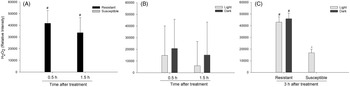
The interaction between light treatment and biotypes was not significant (P < 0.05) at 0.5 and 1.5 HAA. For this reason, the results are shown separately, with one graph for biotypes (susceptible and resistant) and another for light and dark conditions. The 2,4-D–resistant biotype showed higher production of H2O2 than the susceptible biotype at 0.5 and 1.5 h after light treatment (Figure 6A). Under light and dark conditions, there was higher variation in the results when data was plotted together, showing no differences (Figure 6B).
Changes in hydrogen peroxide (H2O2) in 2,4-D–resistant and 2,4-D–susceptible Conyza sumatrensis biotypes following treatment with 2,4-D herbicide (1,005 g ae ha −1) at 0.5, 1.5, and 3 h after application under light and dark conditions. The treatment effects were separated at P ≤ 0.05 and adjusted using Fisher’s protected LSD. Symbols above error bars: *compared between light and darkness; #compared between biotype (resistant and susceptible). Values represent the pool of means ± SD.

Interaction between light treatment and biotypes was significant at 3 HAA. The 2,4-D–resistant biotype produced similar levels of H2O2 under dark and light conditions. Higher H2O2 levels were observed in the 2,4–D resistant biotype than in the susceptible biotype under both dark and light conditions (Figure 6C).
The phytotoxicity of 2,4-D in part involves oxidative stress caused by the overproduction of ROS (Grossmann Reference Grossmann2000; Pazmino et al. Reference Pazmino, Rodríguez-Serrano, Romero-Puertas, Archilla-Ruiz, Del Rio and Sandalio2011). Queiroz et al. (Reference Queiroz, Delatorre, Lucio, Rossi, Zobiole and Merotto2020) reported that the 2,4-D–resistant C. sumatrensis biotype Marpr9-rn had rapid necrotic symptoms that began at approximately 2 h after herbicide application, while the evolution of H2O2 started at 15 min after application. Rapid necrosis in response to to 2,4-D at higher light intensities was observed. However, after 60 min, there were no differences between the low and high light conditions (29 and 848 µmol m−2 s−1, respectively) (Queiroz et al. Reference Queiroz, Delatorre, Lucio, Rossi, Zobiole and Merotto2020). Harre et al. (Reference Harre, Nie, Jiang and Young2018) observed that light was necessary to induce the rapid response in A. trifida following glyphosate treatment. In this study, the rapid metabolic and physiological response of C. sumatrensis resistant to 2,4-D did not show light dependence for the production of ROS (Figure 6).
The C. sumatrensis 2,4-D–resistant biotype showed rapid photosynthetic damage after 2,4-D treatment compared with the susceptible biotype. The antioxidant enzyme activities were higher in the resistant biotype. Temperature effects appeared to modulate the speed of initiation of the rapid necrosis process. The symptoms occurred faster in the 2,4-D–resistant biotype under higher temperatures. Production of H2O2 in the 2,4-D–resistant biotype was not light dependent. 2,4-D may induce a rapid response by interrupting auxin translocation, including 2,4-D, to the whole plant, as both auxins and 2,4-D are transported via polar mechanisms through the same transporters. Auxin accumulation may lead to induction of ethylene and ROS production that induce PCD of tissues affected by herbicide application, avoiding plant death and allowing regrowth after a few days from lateral meristems not affected directly or indirectly (translocation) by the herbicide. In addition, the rapid response seems to be a mechanism operating only in response to systemic herbicides, as is the case in 2,4-D translocation being blocked in Conyza. Although we suggest the actual mechanism of the plant’s response to 2,4-D remains to be elucidated in the resistant biotype, and molecular approaches may be a useful tool to understand the metabolic mechanism(s). Our understanding of the basal antioxidant responses of resistant and susceptible biotypes also needs to be improved
Acknowledgments
This study was financed in part by the Coordenação de Aperfeiçoamento de Pessoal de Nível Superior- Brasil (CAPES), finance code 001; Fundação Carlos Chagas Filho de Amparo à Pesquisa do Estado do Rio de Janeiro (FAPERJ); and Corteva Agriscience Industrial LTDA. No conflicts of interest have been declared.
Supplementary material
To view supplementary material for this article, please visit https://doi.org/10.1017/wsc.2022.10