Introduction
Many different models of successful aging (SA) exist in the absence of an overarching consensus definition (Cosco et al., Reference Cosco, Prina, Perales, Stephan and Brayne2014a). Since the initial coining of the phrase more than half a century ago (Havighurst, Reference Havighurst1961), the operationalization and practical application of the phrase has been contentious (Depp and Jeste, Reference Depp and Jeste2006). Researchers from a variety of fields have developed an immense breadth of different definitions of SA, ranging from strictly biomedical conceptualizations capturing only physical and cognitive function, to single-item self-report measures of how an individual feels they have successfully aged (Cosco et al., Reference Cosco, Prina, Perales, Stephan and Brayne2014a). As a testament to the proliferation and heterogeneity of SA definitions, a 2006 review revealed 29 definitions whilst a review in 2014 revealed 105 definitions of SA (Depp and Jeste, Reference Depp and Jeste2006; Cosco et al., Reference Cosco, Prina, Perales, Stephan and Brayne2014a).
Further complicating this issue is the discrepancy between researchers’ operationalizations of SA and laypersons’ perspectives on SA; recent systematic reviews have revealed that researchers generally posit unidimensional biomedically focused models of SA whilst laypersons have a multidimensional, psychosocially focused conceptualization of SA (Cosco et al., Reference Cosco, Prina, Perales, Stephan and Brayne2014b). The inclusion of lay perspectives into research has important implications for increasing the relevance of research outcomes and in complementing scientific theory (Jopp et al., Reference Jopp, Wozniak, Damarin, De Feo, Jung and Jeswani2015). Further, SA theorists have advocated for the inclusion of both subjective and objective components in models of SA (Bowling and Iliffe, Reference Bowling and Iliffe2006; Pruchno et al., Reference Pruchno, Wilson-Genderson and Cartwright2010). If a construct researchers are examining does not have relevance to the demographic they are targeting, the potential impact of this research will be impeded.
Although interest in positive states of aging and the heterogeneity of aging trajectories is on the rise, these theoretical developments have progressed at a much faster pace than practical applications of SA. Research into the theoretical underpinnings of SA has provided insight into the complexity of the construct (Cosco et al., Reference Cosco, Prina, Perales, Stephan and Brayne2014b), but examples where SA models have been applied in the framework of tangible health-related outcomes are limited (Young et al., Reference Young, Fan, Parrish and Frick2009).
The use of services in later life – both professional and informal – is on the rise (Kehusmaa et al., Reference Kehusmaa, Autti-Ramo, Helenius, Hinkka, Valaste and Rissanen2012), increasing the temporal and monetary value of their provision. Therefore, being able to identify individuals at greater prospective risk of the need for services is an important issue for policy makers, stakeholders, researchers, and clinicians to address. One such way may be to examine the degree to which individuals are aging “successfully.”
SA models to date have been largely theoretical, e.g. Rowe and Kahn (Reference Rowe and Kahn1987), with few studies examining practical applications of the concept, e.g. Young, et al. (Reference Young, Fan, Parrish and Frick2009). The current study addresses the gap between theoretical and practical models of SA, and expands upon existing studies, by using a theoretically-driven, a priori model of SA to assess the predictive ability, with respect to service utilization, of a model of SA.
Methods
Study characteristics
The MRC CFAS is a population-based study of community dwelling individuals (n = 13,004) aged 65 years and over, conducted in five centers with identical methodology in England and Wales (Newcastle, Nottingham, Oxford, Cambridgeshire, and Gwynedd) (Brayne, Reference Brayne2006). Baseline interviewing began in 1991. A 20% (n = 2,640) stratified sample, selected based on cognitive ability, age, and center completed a more detailed assessment interview, with re-interviewing approximately every two years. Trained interviewers conducted face-to-face interviews in participants’ place of residence. Questions concerning demographics, cognition (Mini-Mental State Exam: MMSE (Folstein et al., Reference Folstein, Robins and Helzer1983)), activities of daily living (ADLs), instrumental activities of daily living (IADLs) (Townsend and Ryan, Reference Townsend and Ryan1991), and psychosocial well-being were included in the interview. Data in the current study was taken from the MRC CFAS first combined screen and assessment (referred to here as the baseline interview) and the second combined screen and assessment conducted two years later (referred to here as the two-year follow-up; data version v9.0). Further details of the sampling methods and interview are available at www.cfas.ac.uk (Brayne, Reference Brayne2006). All study centers obtained ethical approval from local research committees.
Successful aging index
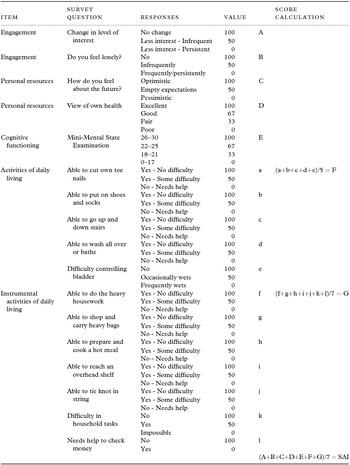
Based on the results of recent systematic reviews of operational definitions (Cosco et al., Reference Cosco, Stephan and Brayne2014c) and lay perspectives of SA (Cosco et al., Reference Cosco, Prina, Perales, Stephan and Brayne2013) an a priori model of SA was constructed. Physical functioning (modified Katz ADLs (1970) and modified Lawton IADLs (1969)), and cognitive functioning (MMSE (Folstein et al., Reference Folstein, Robins and Helzer1983)) were the two most commonly identified components of SA in the operational definitions of SA review and were, consequently, included in the model. In the lay perspectives review, the three most commonly identified components of SA were included in the model: personal resources (optimism: measured on a three-point Likert scale ranging from optimistic to pessimistic view of the future), engagement (interest: measured on a three-point Likert scale ranging from no loss of interest to persistent lower interest; loneliness: measured on a three-point Likert scale ranging from no feelings of loneliness to frequent/persistent feelings of loneliness) and self-awareness (self-rated health measured on a four-point Likert scale ranging from excellent to poor rating of one's own health) (model previously described in Cosco et al. (Reference Cosco, Stephan and Brayne2014c)). Through the inclusion of three components of the operational definitions review and the lay perspectives review, both perspectives were equally represented in the model. Due to shortcomings of the components expressed in a binary framework (as highlighted in Cosco et al. (Reference Cosco, Stephan and Brayne2014c) a continuum-based index was developed to allow for higher resolution and greater granularity, i.e. the SAI. The SAI was created using a similar protocol used to create the frailty index (Searle et al., Reference Searle, Mitnitski, Gahbauer, Gill and Rockwood2008), insofar that ordinal items were assigned values and the scores from each of the items used to create a continuous value (Table 1). Depending on the number of possible answers, fraction values were assigned accordingly, e.g. for a four-item Likert question, the answer corresponding to the highest level of functioning would receive 100, the next highest 67, 33, and finally 0 for the lowest possible level of functioning. For continuous variables, e.g. MMSE scores, previously used cut-off scores, i.e. ≥26, 25–22, 21–18, 17–0 (Yip et al., Reference Yip, Brayne, Easton and Rubinsztein2002; Xie et al., Reference Xie, Brayne and Matthews2008; Cluett et al., Reference Cluett2010), were used to assigned fractional values, as per the protocol used in Searle et al. (Reference Searle, Mitnitski, Gahbauer, Gill and Rockwood2008). Diverging from the frailty index procedures, each ADL (dressing oneself, putting on shoes, going up stairs, continence, cutting toenails) and IADL (doing heavy housework, shopping, preparing meals, reaching overhead shelf, tying a knot, housekeeping, getting on a bus, managing finances) item (measured on a three-point Likert scale ranging from able to perform task without difficulty to unable to perform task alone) was made into an index of its own, averaged, and entered into the full model as a single item. The physical functioning components were made into indexes of their own to allow for the equal representation of biomedical and psychosocial components. Inclusion of each constituent ADL or IADL into the integrated index would result in there being many more biomedical components than lay components. Items were averaged creating a value between 0 and 100, with higher values indicating higher functioning.
Successful aging index (SAI) items, values and calculation

Outcomes
The predictive validity of the SAI was investigated by examining the relationship between the SAI score and study participants’ self-reported service use at two years follow-up. Three categories of self-reported day-to-day service provision were investigated: (1) health services, i.e. home help, care worker, community worker, community nurse; (2) functional services, i.e. meals on wheels, warden, paid help; and, (3) informal care, i.e. help provided by friends or relatives.
Statistical procedures
All analyses were conducted in STATA 12. Descriptive statistics were calculated to examine differences in the SAI by study demographics. Missingness at random was assessed via a χ2 test, examining the association between missingness and service use. Differences between service and non-service users were tested using χ2 tests for sex and socio-economic status and t-tests for age. Logistic regression was performed examining the association between the SAI and service use at two-years follow-up, in unadjusted models and models adjusted for sex, socio-economic status, education, and age. ROC curves were plotted for each logistic model and the area under the curve (AUC) was calculated to determine the predictive accuracy of each model. Logistic regression analyses were conducted unweighted and weighted for study design (i.e. backweighted to adjust for over sampling of individuals aged 75 years or older and sampling to the diagnostic interview). Score calibration was assessed for goodness of fit via Hosmer–Lemeshow test using deciles of SAI scores and service use. It is not possible to weight calculation of the AUC for study and therefore only unweighted estimates are presented.
Results
Sample characteristics
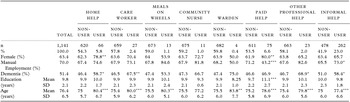
In the full MRC CFAS sample, 1,651 individuals were captured at baseline, of whom 511 were excluded in the current study due to incomplete components of the SAI or the use of informant data rather than respondent data. At the two-year follow-up, 740 individuals with SAI scores at baseline remained in the sample, 684 of whom had completed surveys on service use. The sample consisted of primarily women (64.2%), from manual occupations (68.1%) with an average age of 75.9 years (SD 6.2) and 9.9 (SD 2.1) years spent in full-time education. Informal help (23.0%), paid help (6.6%), and home help (5.8%) were the most commonly used services. As shown in Table 1 there were significant sex differences between service users and non-users in home help (X2 = 7.06, p = 0.008) and paid help (X2 = 9.51, p = 0.002) and there were significant age differences in use of home help (t(684) = −7.13, p < 0.001), care worker (t(684) = −3.95, p < 0.001), Meals-on-Wheels (t(684) = −2.89, p = 0.004), warden (t(684) = −2.74, p = 0.006), paid help warden (t(684) = −4.71, p < 0.001), other professional help (t(684) = −3.45, p < 0.001), and informal help (t(684) = −5.07, p < 0.001). Differences in paid help use were observed in manual employment (X2 = 23.64, p < 0.001) and education (t(681) = −5.15, p < 0.001). Individuals in the highest cognitive impairment category, i.e. (MMSE < 26), differed in their use of home help (X2 = 4.11, p = 0.04), a care worker (X2 = 60.73, p = 0.009), other professional services (X2 = 5.54, p = 0.02) and informal services (X2 = 4.37, p = 0.04).
Missing data
Save for care workers (X2 = 14.25, p < 0.001), and community nurse (X2 = 6.37 p = 0.01) and other paid help (X2 = 5.17, p = 0.02) there were no significant associations between service use and missingness, suggesting that missing values were missing at random.
Predictive validity
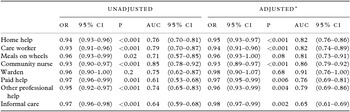
Values for the weighted data and unweighted data were nearly identical, saved for paid help which did not reach significance in the weighted regressions. Therefore only results from the unweighted analysis are presented here in Table 2 (see Appendix A for weighted results, available as supplementary material attached to the electronic version of this paper at www.journals.cambridge.org/jid_IPG). Significant negative associations were observed between the provision of home help, care worker, community nurse, paid help, other professional help and informal care, and SAI score in the unadjusted and adjusted models. The Hosmer–Lemeshow test suggest good-fit for all service services reaching significance in the adjusted models, save for informal care (X2 = 26.55, p < 0.001). The AUC for each model is shown in Table 3 and ranged from strong for predicting community nurse use (AUC = 0.86, 95% CI: 0.79 to 0.92) to weak for informal care (AUC = 0.65, 95% CI: 0.61 to 0.69).
Sample characteristics, by service users and non-users

*p < 0.05; **p < 0.01; ***p < 0.0001.
SAI score and service use

*Adjusted for age, sex, education and socio-economic status; OR: Odds ratio – odds of using a service at follow-up, per one SAI unit increase; CI: Confidence interval AUC: Area under the curve.
Discussion
The current study has taken a model of SA that is based on the literature and demonstrated a strong association between the SAI and a tangible, external outcome, i.e. prospective service use, providing preliminary evidence for the predictive validity of the SAI. The results suggest that the SAI, which incorporates both objective physiological measures and subjective psychosocial measures of SA, is an independent marker of aspects of all three categories of service use: health services, functional services, and informal help in older aged adults. Significant negative associations were demonstrated between SAI score and service use.
There are however, limitations that must be taken into account in the interpretation of these results. The construction of the SAI was done using secondary data, matching variables informed by systematic reviews to proxy measures captured in CFAS. Although the most commonly identified components identified in the review were captured in CFAS, perhaps if there were more components within each of these categories, a greater level of granularity could be teased out. Data regarding the use of each service was collected via self-report. As with all longitudinal studies of older adults, attrition was a factor, resulting in missing values. The SAI is an average of all the constituent components; therefore if an item was missing their total score would not be comparable to other who had complete scores. Only respondent data was used to capture individuals’ subjective experiences, rather than an informant’s. Consequently, individuals who were unable to complete all of the SAI components themselves, for example, if they had severe dementia, were excluded, which may have resulted in a bias towards healthier individuals in the sample. Due to the level of missing data (30%) complete-case analysis was conducted rather than multiple imputations. As a result of attrition due to the exclusion of informant data, individuals included in the study were selected from a pool that may have been healthier than the general population. The SAI demonstrated a significant negative association with service use in a sample that may have been biased towards healthier individuals, perhaps if the lower end of the health continuum was better represented in the sample this relationship might have been strengthened; this is an area for future research.
The model used in the current study is informed by the results from two systematic reviews including one of layperson perspectives (Cosco et al., Reference Cosco, Prina, Perales, Stephan and Brayne2013) of SA and one review of operational definitions (Cosco et al., Reference Cosco, Prina, Perales, Stephan and Brayne2014a) of SA. Previous SA theorists have advocated the inclusion of both subjective and objective components (Bowling and Iliffe, Reference Bowling and Iliffe2006; Pruchno et al., Reference Pruchno, Wilson-Genderson and Cartwright2010; Cosco et al., Reference Cosco, Prina, Perales, Stephan and Brayne2014b) in SA models. The current model is firmly rooted in the literature including components that have been deemed to be important to older adults and researchers. Through the inclusion of these components individuals are able to age to varying degrees of success even in the presence of disease and disability. The presence of disease is not included in the model, therefore the SAI can accommodate and articulate the ways in which people with varying levels of disability are able to age successfully. Models that posit explicitly biomedical components, e.g. frailty, have demonstrated associations with health services utilization (emergency department visits, after-hours GP visit, nursing home admission (Drubbel et al., Reference Drubbel, de Wit, Bleijenberg, Eijkemans, Schuurmans and Numans2013)); however, models that include both psychosocial and biomedical models, e.g. SA, have not received the same level of analysis. The current study is intended to assess the validity of a theoretically-driven, a priori model of SA. Consequently, the SAI was validated as an omnibus metric rather than examining the psychometric soundness of its constituent components, with the aim to provide a practical application of a theoretical model. Additionally, the index approach provides a level of granularity in analysis that has not been possible with previously posited binary (Cosco et al., Reference Cosco, Stephan and Brayne2014c) and ordinal models (Young et al., Reference Young, Fan, Parrish and Frick2009) of SA.
The current study provides a forward in the practical application and relevance of a SA model in the general population. These results are important as they highlight the association between SA and outcomes that are temporally and monetarily burdensome. The AUC is a measure of the accuracy of a model to predict the presence versus absence of a disease. The AUC values for the SAI ranged from 0.65 to 0.86, highlighting the predictive utility of the SAI, suggesting that it may be a useful tool to assess the probability of individuals’ prospective need for service use. This has important implications for policy makers, clinicians, and researchers. For policy-makers, having the ability to anticipate need can be a useful tool in the allocation of funds towards care and in the implementing of relevant interventions. For clinicians, being able to monitor individuals’ SAI score may be useful in the longitudinal tracking of health. Finally, for researchers it is advantageous to capture an outcome that has strong theoretical underpinnings and demonstrated links with tangible public health outcomes. Through the increased application of SA models in practical contexts, future modeling of SA will have increased relevance to researchers, clinicians, and to older adults themselves; however, there is still much work to be conducted on the utility of the SAI and of SA models in these settings.
Through the identification and mapping of SA variables identified in systematic reviews of SA, an a priori model of SA was created. The current study provides evidence as to the predictive validity of this model with respect to service utilization, moving this theory-driven conceptualization of SA towards the practical realm.
Conflict of interest
None.
Author contributions
TDC conducted the analysis and interpretation of the data and wrote the first draft of the manuscript. BS and CB contributed to the data interpretation and draft revisions.
Sponsor's role
Sponsors had no role in the design, analysis or preparation of this manuscript.
Acknowledgments
The authors acknowledge study funders: The Medical Research Council and Department of Health [Grant No: G9901400].
Supplementary material
To view supplementary material for this article, please visit http://dx.doi.org/10.1017/S1041610215000708