Implications
Minimizing the risk of heat stress of cattle during summer is important from both production and animal welfare standpoints. The provision of artificial shade with 35% or 80% blockage of solar radiation increased the time cattle spent under the shade during the hottest hours, although shade did not affect overall animal performance and tympanic temperature. Thus, in extensive beef cattle operations in temperate regions, the main effect of shade would be in animal comfort rather than in productivity or body temperature considering the whole summer period.
Introduction
Environmental conditions during the summer can have a negative impact on beef cattle performance and behaviour (i.e. reduction in dry matter (DM) intake; Davis et al., Reference Davis, Mader, Holt and Parkhurst2003; Brown-Brandl et al., Reference Brown-Brandl, Eigenberg and Nienaber2006). High temperature coupled with high relative humidity, solar radiation and low wind speed can cause heat stress (Mader and Davis, Reference Mader and Davis2004). A shade structure is one way of reducing the impact of heat stress (Armstrong, Reference Armstrong1994; Muller et al., Reference Muller, Botha and Smith1994a). Research has addressed the issue of type of shade mainly on confined cattle (Ittner and Kelly, Reference Ittner and Kelly1951; Eigenberg et al., Reference Eigenberg, Brown-Brandl and Nienaber2009) and on high-producing dairy cattle (Valtorta et al., Reference Valtorta, Leva and Gallardo1997; Gaughan et al., Reference Gaughan, Goodwin, Schoorl, Young, Imbeah, Mader and Hall1998; Tucker et al., Reference Tucker, Rogers and Schütz2008; Schütz et al., Reference Schütz, Rogers, Cox and Tucker2009, Reference Schütz, Rogers, Poulouin, Cox and Tucker2010). However, little is known about the effect of the type of shade on grazing beef cattle in a low-to-medium plane of nutrition. As animal productivity decreases, metabolic heat production also decreases with the metabolism of less amount of nutrients, which makes the low-producing animal less vulnerable to heat stress than animals that are more active metabolically (Kadzere et al., Reference Kadzere, Murphy, Silanikove and Maltz2002). In addition, pastured cattle have the ability to seek shade (when available), water and air movement to cool themselves, whereas radiant heat from dirt or concrete surface is increased for feedlot cattle (Renaudeau et al., Reference Renaudeau, Collin, Yahav, de Basilio, Gourdine and Collier2012).
In a preliminary study, Rovira and Velazco (Reference Rovira and Velazco2010) reported that the provision of artificial (cloth) or natural (trees) shade was successful as a method of reducing respiration rate of grazing steers without affecting grazing time or animal performance. Although trees are the most effective shade producers (Armstrong, Reference Armstrong1994), shade cloths (polypropylene) are the easiest way of getting shade when trees are not available. The most popular design in South America’s temperate region (Uruguay, south of Brazil and Mesopotamia Argentina) is a cloth providing 80% shade, although other configurations with less blockage of solar radiation (i.e. 35%) can be cheaper and most cost-effective in such temperate regions where the impact of heat stress on animal performance would be milder compared with tropical regions.
In this experiment, the objective was to understand how different artificial shades varying in protection from solar radiation influenced the physiological, behavioural and productive responses of beef cattle grazing native pastures in a temperate region.
Material and methods
This study was carried out from 21 December 2012 to 22 February 2013 (63 days) at the INIA-Treinta y Tres Research Station (latitude: 33°14'S, longitude: 54°15'W) in Uruguay. All procedures involving animals were approved by the INIA Animal Ethics Committee. Twenty-four growing 15-month-old Aberdeen Angus×Hereford steers (average initial weight±standard error (s.e.): 268±4 kg) were randomly assigned to three treatments of four animals each with two replications: (1) without shade (control group), (2) free access to artificial shade with 80% blockage of solar radiation (80% shade) and (3) free access to artificial shade with 35% blockage of solar radiation (35% shade). Each treatment group was tested simultaneously and kept separately in 2.5 ha (1.6 steers/ha) of natural pastures (mainly composed of perennial species such as Cynodon dactylon, Paspalum notatum and Axonopus affinis) in a continuous grazing system without additional supplements. In all cases, artificial shade structures consisted of a black woven polypropylene cloth mounted on 4.0-m-high wooden posts with the long axis north/south located 100 m from the water trough supplied by underground well water. The length and width of the cloth were 4.0 and 4.0 m (16 m2) corresponding an average of 4.0 m2 of shade per animal.
Dry bulb air temperature (ºC) and relative humidity (%) were recorded hourly during 24 h of each day placing automatic data loggers (HOBO® Model Temp/RH – 08-032-08; Onset® Computer Corporation, Cape Cod, MA, USA) exposed to sun. A Temperature–Humidity Index (THI) was calculated hourly to characterize the climatic heat load experienced by the animals based on the equation developed by Thorn (Reference Thorn1959): [(0.8×air temperature)+(relative humidity/100)×(air temperature−14.4)+46.4]. Periods were deemed thermoneutral when average THI<70, mild heat stress when 70⩽THI<74, heat stress when 74⩽THI<77 and severe heat stress when THI⩾77 (Davis et al., Reference Davis, Mader, Holt and Parkhurst2003). Black globe temperature (BGT, ºC) was measured at 1000, 1200, 1400 and 1600 h by visual observation of a black globe thermometer (Globe Thermometer Model 210–4417, NovaLynx Corporation, Auburn, CA, USA) during 6 days randomly selected during the period of the study (3, 10, 18 and 22 January; 7 and 14 February). Black globe thermometers consist of a conventional thermometer inserted through a rubber stopper into a hollow, 6-inch diameter copper ball coated with a flat black paint and are used to measure radiant temperature integrating the effects of solar radiation and wind. The globe thermometer was placed exposed to sun and under both types of artificial shade at a height of 1 m above ground level trying to represent the centre of mass of standing animals. Temperature (ºC) of the ground surface was also measured at the same time than the BGT was registered using an infrared thermometer (Raytek MT4 MiniTemp, Raytex Corporation, Santa Cruz, CA, USA). When black globe and soil temperatures were registered behaviour activities were not recorded as the process of taking the temperature can affect normal animal behaviour.
Tympanic temperature (TT) of steers was taken simultaneously for all treatments in 12 different days during three periods at 1-h intervals (Period I: from 12 to 16 January; Period II: from 29 to 31 January and Period III: from 24 to 27 February). Periods were randomly selected and in each period two steers per treatment were selected within one replicate and were fitted with an automatic TT-recording device (iButton® Model DS1921H/DS1921-Z, Maxim Integrated, San Jose, CA, USA) placed near the tympanic membrane in one ear. During Period I, there were selected animals from replicate 1, whereas during Periods II and III there were selected animals from replicate 2. Each thermometer was wrapped in gauze and secured to the ear using self-adhesive bandages and tape according to procedures outlined by Mader et al. (Reference Mader, Holt, Hahn, Davis and Spiers2002) and Arias et al. (Reference Arias, Mader and Parkhurst2011) measuring temperature in 0.125ºC increments with ±1ºC accuracy. Steers were weighed on days 0, 21, 42 and 63 and average daily gain (ADG) was calculated for the entire 63-day study. Animal behaviours were measured by one observer by live observations of all individual animals within one replicate for all treatments on the same days (15, 16, 30 and 31 January; 26 and 27 February). All treatments were observed simultaneously and on days where the tympanic thermometers were placed on the animals. The observer was the same in the 6 days to avoid inter-observer reliability and each animal had a number from 1 to 4 painted in both flanks to be identified by the observer. The activities recorded every 15 min from 1100 to 1600 h on the selected days were: grazing (head in the sward), standing (shade or not) and lying (shade or not). Standing was considered to be an inactive upright posture (no locomotion) and lying was defined as body contact with the ground. Use of shade was defined when the animal was standing or lying under the shade casted by the black woven propylene cloth. Pasture height (cm) and availability (kg DM/ha) were registered for each treatment at the beginning, medium and end of the experiment by clipping six random 0.1 m2 quadrants in each repetition at ground level.
Statistical analyses were performed using the SAS System v. 6.12 (SAS Institute. Inc., Cary, NC, USA). The effect of treatment on animal performance, TT and behaviour was analysed using the PROC GLM command. The experimental unit was the group of animals (two observations per treatment) for ADG and animal live weight (error degree of freedom=3). For TT and behaviour activities, there were 12 and 6 days of observation, respectively, corresponding half the days to replicate 1 and the other half of the days to replicate 2. In these cases, the experimental unit was each replicate (n=2) as we considered replicates independent of experimental units (error degree of freedom=3). The effect of treatment on TT was analysed averaged over the whole period, for each hour (0000, 0100, 0200, …, 2300 h) and within each heat stress category according to the THI value. Time spent under the shade by individual steers between 1100 and 1600 h was averaged per treatment and regressed on average THI at the same time for each day of behaviour observation (n=6). Then the dependent variable time spent on shade was regressed on the independent variable THI using the PROC REG procedure of SAS. The effect of treatment on BGT and surface soil temperature (SST) was analysed using the PROC GLM procedure including the main effect of treatment taking days of recording as repetitions. ADG was calculated through a linear regression of liveweight on days of experiment and analysed using the PROC GLM procedure with the main effect of treatment. In all the variables where the F-test was significant (P<0.05), the differences between treatments were determined using Tukey’s test.
Results
Climate
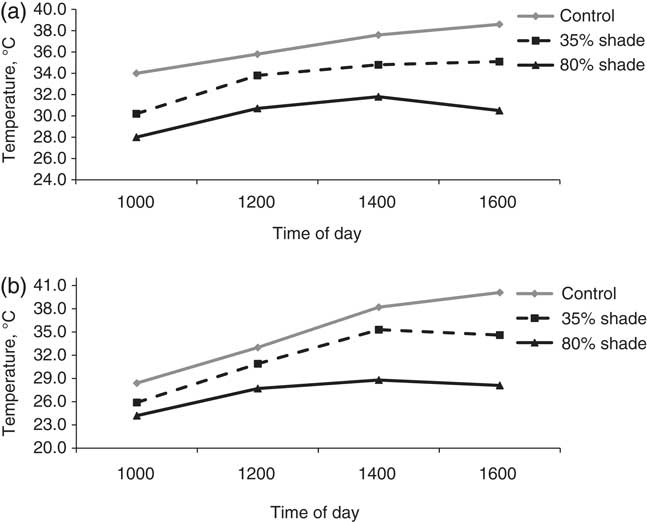
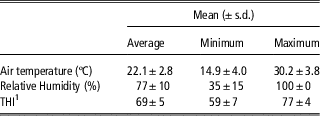
Mean THI was in the thermoneutral category according to the categorization used by Davis et al. (Reference Davis, Mader, Holt and Parkhurst2003) (Table 1). However, in the 63 days evaluated (1536 h), cattle were exposed to mild heat stress (70⩽THI<74), heat stress (74⩽THI<77) and severe heat stress (THI⩾77) during 21%, 14% and 15% of the time, respectively. The remaining 50% of the time corresponded to the absence of predisposing heat stress conditions (THI<70). The type of shade significantly (P<0.05) affected both BGT and SST. Means (±s.e.) for BGT during the assessment period (1000 to 1600 h) were 36.5±1.1ºC (control), 33.4±0.9ºC (35% shade) and 30.2±0.6ºC (80% shade), whereas SST averaged 34.9±1.9ºC, 31.7±1.2ºC and 27.2±0.8ºC, respectively (Figure 1).
Evolution of black globe temperature (a) and surface soil temperature (b) of control (exposed to sun) and under different shaded treatments from 1000 to 1600 h.

Climatic conditions registered during the 63-day experimental period (mean±s.d.)

1 THI=Temperature–Humidity Index.
THI=[(0.8×air temperature)+(relative humidity/100)×(air temperature−14.4)+46.4]
Tympanic temperature
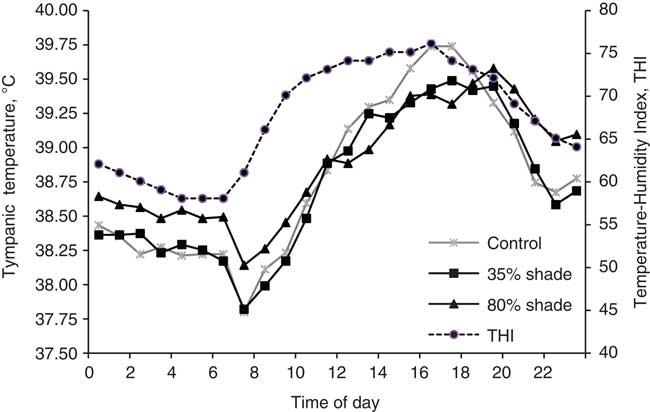
Overall mean (±s.e.) TT (ºC) did not differ among treatments (P>0.05) averaging 38.77±0.03 (control), 38.71±0.09 (35% shade) and 38.88±0.03 (80% shade). Minimum TT was registered at 0700 h for all treatments (37.92±0.08ºC), whereas maximum TT was reached at 1700 h for both control group (39.73±0.18ºC) and 35% shade (39.48±0.12ºC) and at 1900 h for 80% shade (39.57±0.15ºC). Significant differences (P<0.05) in average TT were observed between 2200 and 0400 h where animals in the 80% shade group showed higher TT (38.70±0.02) compared with animals in the control and 35% shade groups (38.41±0.01). The 24-h rhythm of TT for the different treatments during the 12 days where TT was measured in relation to daily changes in THI is shown in Figure 2. According to THI, cattle were exposed to some degree of heat stress 43% of the time during the 12 days where TT was recorded (125 out of 288 h) corresponding 17% of the time to mild heat stress (mean THI: 72), 16% heat stress (mean THI: 75) and 10% severe heat stress (mean THI: 80). No differences (P>0.05) were detected among treatments for TT within mild, severe and heat stress categories (Table 2). However, 80% shaded steers had 0.26ºC higher (P<0.05) TT than the average of unshaded and 35% shaded steers during absence of heat stress conditions.
Mean daily tympanic temperature rhythms of grazing steers with access to shade (35% or 80% shade) or no shade and daily evolution in the Temperature–Humidity Index.

Effect of type of shade on mean tympanic temperature of steers exposed to different heat stress categories

1 Row means with different superscripts differ significantly at P<0.05.
2 THI=Temperature–Humidity Index=[(0.8×air temperature)+(relative humidity/100)×(air temperature−14.4)+46.4].
Behaviour
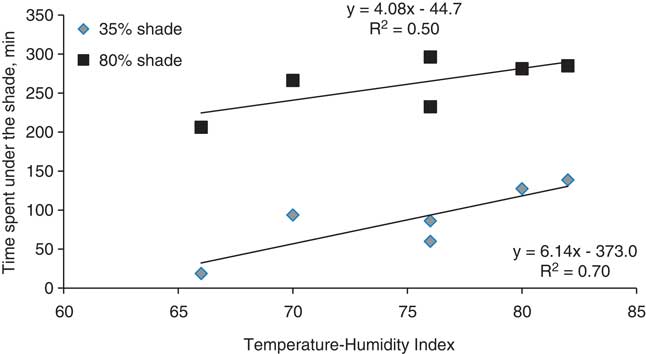
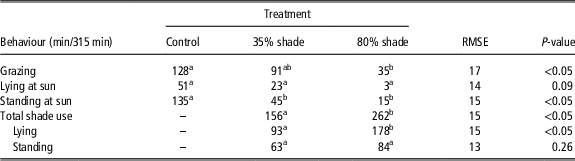
Time lying at the sun and time standing under the shade were the only variables that were not affected by treatment (P>0.05; Table 3). Time spent grazing and standing without grazing in the sun during the observation period decreased (P<0.05) as shade increased from 0% (control) to 80% occlusion of incoming radiation. When shade was provided, the use of shade was the main activity registered during the observation period, corresponding 49% (35% shade) and 83% (80% shade) of the total time (151 and 261 min, respectively; P<0.05). Steers with 35% spent more time in shade on days with higher THI (P<0.05). This pattern was also apparent for 80% shade steers (P=0.11; Figure 3).
Total shade use (min/315 min of observation) by steers between 1100 and 1600 h on days with different Temperature–Humidity Index. Each point is an average of four animals per day.

Effect of type of shade on animal behaviour between 1100 and 1600 h

a,bRow means with different superscripts differ significantly at P<0.05.
Animal performance
Mean (±s.e.) pasture allowance and sward height during the experiment was 2131±190 kg DM/ha and 5.3±0.3 cm, respectively. Sixty-two percent of the herbage mass was composed of green forage (DM basis), the rest being dead (dry) material. Overall, the 63-day period of evaluation, animal performance was not affected by treatment (P>0.05). Overall mean ADG and final liveweight (±s.e.) was 0.622±0.060 kg/a per day and 308±4 kg, respectively, averaged over treatments. Treatment means ADG were 0.657 kg/a per day (control), 0.504 kg/a per day (35% shade) and 0.705 kg/a per day (80% shade). ADG tended to increase from the beginning to the end of the experiment averaging 0.458 kg/a per day (13 December to 11 January), 0.580 kg/a per day (11 January to 1 February) and 0.869 kg/a per day (1 February to 22 February).
Discussion
Mean THI=69 was in the thermoneutral category according to the categorization used by Davis et al. (Reference Davis, Mader, Holt and Parkhurst2003). Although recent evidence suggests a THI threshold of 68 for high-producing dairy cows from which milk production is affected (Zimbelman et al., Reference Zimbelman, Rhoads, Rhoads, Duff, Baumgard and Collier2009), in the present study the traditional threshold of 72 was used under the hypothesis that steers would be less affected by heat stress than high-producing dairy cows.
Shade structure modified the microenvironment of the steers through the BGT, which integrates effects of net radiation, dry-bulb temperature and wind speed. In agreement, Roman-Ponce et al. (Reference Roman-Ponce, Thatcher, Buffington, Wilcox and Van Horn1977) showed the big difference between the shaded and unshaded environments is expressed through BGT. It is known that shade is effective in protecting animals from solar radiation, but does not alter air temperature or relative humidity around the animals (Armstrong, Reference Armstrong1994; West, Reference West2003; Renaudeau et al., Reference Renaudeau, Collin, Yahav, de Basilio, Gourdine and Collier2012). In the present study, BGT decreased as solar protection increased from 35% to 80% of shade cover. As percentage of shade increases, it reduces the estimated stress level (based on BGT reduction) so that cattle are exposed for a less time to the heat stress categories (Eigenberg et al., Reference Eigenberg, Brown-Brandl and Nienaber2009). The results of the present experiment also indicated the same pattern was followed by SST confirming environmental differences not only between shaded and unshaded treatments but also between shaded treatments. If the temperature of the ground on which the animal is lying is closer or greater than skin temperature, then the risk of heat stress is higher as the animal can gain heat by conduction, adding to the metabolic heat load (Silanikove, Reference Silanikove2000).
Body temperature is an excellent indicator of an animal’s susceptibility to heat load (Mader et al., Reference Mader, Davis and Brown-Brandl2006). In the current study, TT was measured, which has been found to be very similar to rectal temperature (Mader et al., Reference Mader, Gaughan and Young1999a, Reference Mader, Holt, Hahn, Davis and Spiers2002; Davis et al., Reference Davis, Mader, Holt and Parkhurst2003). There was no difference in the overall mean TT among treatments (38.77ºC for the unshaded treatment and 38.79ºC averaged over shaded treatments). Similar values in the range of 38.4ºC to 38.7ºC were reported by Kendall et al. (Reference Kendall, Nielsen, Webster, Verkerk, Littlejohn and Matthews2006), Tucker et al. (Reference Tucker, Rogers and Schütz2008) and Schütz et al. (Reference Schütz, Rogers, Cox and Tucker2009) in grazing cows with or without shade. Lefcourt and Schmidtmann (Reference Lefcourt and Schmidtmann1989) also found that body temperature of grazing cows was similar with (38.84ºC) or without (38.87ºC) access to shade under climatic conditions corresponding to severe heat stress risk (ITH 75 to 77). On the other hand, Muller et al. (Reference Muller, Botha, Coetzer and Smith1994b) reported that cows without access to shade had a higher rectal temperature than shaded cows between 1100 and 1500 h, and that the non-shaded cows were more susceptible to increases in ambient temperature. Similarly, Brown-Brandl et al. (Reference Brown-Brandl, Eigenberg, Nienaber and Hahn2005) reported a difference of 0.4ºC between shaded and unshaded cattle when maximum THI⩾84 (38.5ºC and 38.9ºC, respectively). In a different study, Gaughan et al. (Reference Gaughan, Bonner, Loxton, Mader, Lisle and Lawrence2010) reported a maximum TT difference of 0.76ºC between shaded and unshaded cattle during a heat wave (cattle exposed to a mean ambient temperature >30ºC for 8 h per day for more than 2 consecutive days). In the present study, the absence of extreme environmental conditions could explain the lack of effect of shade on TT even during the hottest hours of the day and/or the power of the experiment was not strong enough to detect statistical differences among treatments. It should also be noted that the present data are based on the average of a group of animals, which tends to smooth the body temperature curve. Individual animals may display a more erratic TT profile pattern (Mader and Johnson, Reference Mader and Johnson2010).
Under similar climate, animal and pasture conditions in the same experimental site, Rovira and Velazco (Reference Rovira and Velazco2010, Reference Rovira and Velazco2011) found that grazing steers with access to shade had significantly lower respiration rate (breath per minute, bpm) than the unshaded steers during daylight hours during two consecutive summers (64 v. 74 bpm in 2010 and 57 v. 69 bpm in 2011). First of all, it may imply that the variation in respiration rate would be a more sensitive physiological indicator of animal response to the provision of shade than the fluctuation in body temperature as reported by Gaughan et al. (Reference Gaughan, Holt, Hahn, Mader and Eigenberg2000). Second, the success of such an increase in respiration rate of animals as a mechanism to dissipate excessive heat load in temperate regions can prevent the potential rise in TT even in unshaded animals.
The reduced TT of steers without access to shade (38.41ºC) compared with those with access to 80% shade (38.70ºC) between 2200 and 0400 h is in agreement with numerous studies (Gaughan et al., Reference Gaughan, Tait, Eigenberg and Bryden2004, Reference Gaughan, Bonner, Loxton, Mader, Lisle and Lawrence2010; Brown-Brandl et al., Reference Brown-Brandl, Eigenberg, Nienaber and Hahn2005; Mader et al., Reference Mader, Gaughan, Johnson and Hahn2009). Gaughan et al. (Reference Gaughan, Bonner, Loxton, Mader, Lisle and Lawrence2010) suggested that the reason for this may be a result of the cattle without shade trying to overcorrect TT at night in an attempt to reach homeothermy. Average air temperature and THI at night (2200 to 0600 h) was 16.0ºC and 61ºC, respectively, during the 12 days where TT was recorded. Under these climatic conditions heat flow may reverse direction, with stored heat being dissipated from the animal back to the environment and the body temperature may fall (Kadzere et al., Reference Kadzere, Murphy, Silanikove and Maltz2002). Mader et al. (Reference Mader, Gaughan, Johnson and Hahn2009) reported that cattle that had the greatest maximum TT during the day also had the least TT at night. In the present study, unshaded cattle showed the greatest daily TT amplitude (1.92ºC) followed by steers in the 35% and 80% groups (1.66ºC and 1.43ºC, respectively). In addition, animals in the 80% shade group could graze more at night, thereby causing higher TT between 2200 and 0400 h. It has been shown that cattle prefer to use shade if available when THI is high, compensating for a lower grazing frequency during the day by grazing more at night (Kendall et al., Reference Kendall, Nielsen, Webster, Verkerk, Littlejohn and Matthews2006; Andersson, Reference Andersson2009). Steers with access to 35% shade had similar TT fluctuation as unshaded animals.
Overall, the minimum TT was observed early in the morning (0700 h) and then increased and reached the maximum between 1700 (control and 35% shade) and 1900 h (80% shade), which is the same pattern reported by Arias and Mader (Reference Arias and Mader2009) for feedlot cattle. TT in all groups exhibited a lag of ∼2 h behind changes in THI. This estimate is in general agreement with other studies, which have reported lags between 2 and 5 h between body temperature and ambient temperature (Al Haidary and Al Hassan, Reference Al Haidary and Al Hassan2003; Brown-Brandl et al., Reference Brown-Brandl, Nienaber, Eigenberg, Hahn and Freetly2003; Kendall et al., Reference Kendall, Nielsen, Webster, Verkerk, Littlejohn and Matthews2006). Unshaded steers and those with access to 35% shade exhibited a maximum TT 2 h earlier than steers with 80% shaded probably because they grazed more at noon and early in the afternoon, as shown by behavioural data, causing a rapid increase in TT.
Steers spent more time under shade cloth that blocked 80% of solar radiation over shade cloth that blocked only 35% of solar radiation between 1100 and 1600 h. Because there were statistical differences in BGT beneath the types of shade, it may suggest that cattle can distinguish between shades differing in solar radiation and/or BGT, although cattle were not given options (35% or 80% shade) to choose from at the same time. This finding is in accordance with Bennett et al. (Reference Bennett, Finch and Holmes1985), Tucker et al. (Reference Tucker, Rogers and Schütz2008) and Schütz et al. (Reference Schütz, Rogers, Cox and Tucker2009) who demonstrated that cattle preferred shade that blocked more solar radiation. Under both types of shade, steers spent more time lying than standing. This observation is consistent with results reported by Muller et al. (Reference Muller, Botha, Coetzer and Smith1994c) and Rovira and Velazco (Reference Rovira and Velazco2010, Reference Rovira and Velazco2011) but contrary to other observations (Mitlöhner et al., Reference Mitlöhner, Morrow, Dailey, Wilson, Galyean, Miller and McGlone2001; Kendall et al., Reference Kendall, Nielsen, Webster, Verkerk, Littlejohn and Matthews2006). When increased standing behaviour is observed during summer, it is likely an effort to maximize the animal surface area exposed to the environment to regulate body temperature (Kendall et al., Reference Kendall, Nielsen, Webster, Verkerk, Littlejohn and Matthews2006). Steers spent more time in shade on days with higher values of THI as cattle seek shade in response to increase heat load. Total time in the 80% shade was significantly higher than time spent in the 35% shade at any given THI in the range of 66 to 82. However, comparative values of the linear regression of use of shade on THI showed that 35% shade had a higher rise in cattle shade use because of each unit increase in THI (6.1 min per 1 unit increase in THI compared with 4.1 min for 80% shade treatment).
Access to shade was not associated with a significantly higher ADG in cattle. The results support earlier findings of Rovira and Velazco (Reference Rovira and Velazco2010, Reference Rovira and Velazco2011) for grazing steers in similar environmental conditions where shaded and unshaded steers showed similar ADG. The moderate rate of growth of animals (0.622 kg/a per day) could decrease the sensitivity to heat stress as the comfort line depends on the level of production being more sensitive animals presenting higher level of production as dairy cows and feedlot cattle (Berman, Reference Berman2005). In addition, the effect of the absence of shade on animal performance can be attributed to acclimatization of unshaded cattle (McDaniel and Roark, Reference McDaniel and Roark1956; Nienaber and Hahn, Reference Nienaber and Hahn2007; Renaudeau et al., Reference Renaudeau, Anais, Tel and Gourdine2010), compensatory growth after periods of heat stress offsetting initial benefits of providing shade (Mader et al., Reference Mader, Dahlquist, Hahn and Gaughan1999b; Mitlöhner et al., Reference Mitlöhner, Morrow, Dailey, Wilson, Galyean, Miller and McGlone2001) and/or a sufficient cooling period at night to prevent any further decline in animal production (Igono et al., Reference Igono, Bjotvedt and Sanford-Crane1992). In general for temperate climates, animal response varies according to the intensity and duration of the thermal challenge (Renaudeau et al., Reference Renaudeau, Collin, Yahav, de Basilio, Gourdine and Collier2012). A summary of results from several studies concluded that shaded cattle in areas with more than 750 h per year of temperatures above 29.5°C generally show a performance improvement compared with unshaded cattle, whereas additional gains of shaded cattle in areas that receive 500 to 750 h per year of temperatures above 29.5°C are less conclusive (Brown-Brandl et al., Reference Brown-Brandl, Eigenberg, Nienaber and Hahn2005). During the summer 2012 to 2013 (92 days), there were only 210 h of temperatures above 29.5°C in the site where the present experiment was carried out. If cattle would have been weighed immediately before and after a heat wave, probably shaded cattle would have shown a higher ADG than the unshaded cattle; however, in the long term (whole summer), any potential effect of hot weather in animal performance would be diluted under the conditions of the present experiment.
In conclusion, 35% and 80% shade cloths were evaluated using environmental and animal measures as an alternative to reduce the risk of heat stress in cattle grazing native pastures in a temperate region. Both materials were effective improving environmental comfort of animals by reducing black globe and SSTs under the shade structure. For that reason, use of shade was the main activity during the hottest part of the day, especially for 80% shade cattle. However, the use of shade had no impact on overall animal performance and TT suggesting the ability of cattle to acclimatize (i.e. increase in respiration rate) and/or compensate (i.e. spent more time grazing at night) for eventually short-term severe heat stress events in temperate regions. In terms of research needs, additional studies are required with more exigent experimental designs and protocols trying to detect productive and/or physiological differences owing to the provision of shade during short heat stress events in temperate regions.
Acknowledgements
The author gratefully acknowledges the financial assistance and support of the National Institute of Agricultural Research (INIA) of Uruguay.