Introduction
One consequence of globalization is that plants and plant-eating insects from across the globe are interacting in novel geographic locations (Roy et al., Reference Roy, Alexander, Davidson, Campbell, Burdon, Sniezko and Brasier2014; Wild, Reference Wild2017), sometimes with dramatic detrimental consequences for native ecosystems and local economies (Aukema et al., Reference Aukema, Leung, Kovacs, Chivers, Britton, Englin, Frankel, Haight, Holmes, Liebhold, McCullough and von Holle2011). A leading cause has been the accidental introductions of non-native, plant-eating insects (Liebhold et al., Reference Liebhold, MacDonald, Bergdahl and Mastro1995; Lovett et al., Reference Lovett, Weiss, Liebhold, Holmes, Leung, Lambert, Orwig, Campbell, Rosenthal, McCullough, Wildova, Ayres, Canham, Foster, LaDeau and Weldy2016). However, there has also been a burgeoning and deliberate propagation of monocultures of non-native plants for the production of food, fiber, and other plant products (Wingfield et al., Reference Wingfield, Brockerhoff, Wingfield and Slippers2015), and there are now increasing cases of non-native insects becoming pests in the plantations of non-native trees (Paine, Reference Paine2008; Ayres & Lombardero, Reference Ayres and Lombardero2017). In Argentina, for example, the government has funded the planting of Pinus contorta Douglas and Pinus ponderosa Douglas, both native to North America, to encourage woodlot timber production, to boost the economy, and to limit deforestation of native trees (Leal & de Camara, Reference Leal and de Camara2003; de Renolfi & Ortuno Perez, Reference de Renolfi and Ortuño Pérez2005). Sirex noctilio Fabricius (Hymenoptera: Siricidae), a woodwasp native to Europe, was first discovered in Argentina in 1985, and soon appeared in pine plantations across Patagonia (Espinoza et al., Reference Espinoza, Lavanderos and Lobos1986; Villacide & Corley, Reference Villacide and Corley2012).
Sirex noctilio females attack living pines with an ovipositor that drills through the outer bark and probes into the phloem, where she may do one or more of the following: inject a phytotoxin, lay an egg, and inoculate the area with a mutualistic fungi. This attack further stresses the tree, making it more attractive to other S. noctilio females in the immediate area, which also attack that tree. Resin defenses featuring terpenes are ubiquitous in pine species, and act as chemical and physical defenses against insects and pathogens (Berryman, Reference Berryman1972; Langenheim, Reference Langenheim2003). Madden & Coutts (Reference Madden, Coutts and Batra1979) found that trees with high oleoresin pressure were rejected by S. noctilio for oviposition. Ryan & Hurley (Reference Ryan, Hurley, Slippers, de Groot and Wingfield2012) hypothesized that S. noctilio can sense the oleoresin defenses of a potential host tree with their ovipositor and lay eggs or not depending upon tree defense levels. In North America and Europe, S. noctilio attacks are normally concentrated within stands of high basal area, and more specifically in trees that are smaller than their neighbors (Neumann et al., Reference Neumann, Morey and McKimm1987; Ayres et al., Reference Ayres, Pena, Lombardo and Lombardero2014; Dodds et al., Reference Dodds, Cooke and Hanavan2014). While S. noctilio is capable of attacking and killing many species of pines, woodwasp populations in our study region in Argentina were recently shown to preferentially attack and kill P. contorta (24% of available trees) over P. ponderosa (4% of available trees) (Lantschner & Corley, Reference Lantschner and Corley2015).
It might be that in Patagonia, P. contorta are more susceptible than P. ponderosa to woodwasps because they have lower resin defenses. Resin defenses of pines growing in Argentina have not been previously studied, but in North America, P. contorta produces less resin than many other pines (West et al., Reference West, Bernklau, Bjostad and Jacobi2016). Pine tree resin production can be affected by genotype, environment, and ontogeny (Lorio, Reference Lorio1986; Roberds et al., Reference Roberds, Strom, Hain, Gwaze, McKeand and Lott2003; Ott et al., Reference Ott, Yanchuk, Huber and Wallin2011). There could be relatively low resin defenses in Patagonia due to the selection of particularly fast-growing genotypes for propagation, which also tend to have low defenses (resource availability hypothesis; Coley et al., Reference Coley, Bryant and Chapin1985), or because pines in Patagonia were planted on good sites that permit especially rapid growth, which can detract from carbohydrates available for secondary metabolism (growth-differentiation balance hypothesis, Herms & Mattson, Reference Herms and Mattson1992). As in other parts of the southern hemisphere such as New Zealand, Australia, and South Africa (Madden, Reference Madden and Berryman1988; Hurley et al., Reference Hurley, Slippers and Wingfield2007), pines were planted at very high densities in Patagonia, which could lead to depressed defenses due to low overall carbon budgets (Bryant et al., Reference Bryant, Chapin and Klein1983; Lombardero et al., Reference Lombardero, Ayres, Lorio and Ruel2000; Rodríguez-García et al., Reference Rodríguez-García, López, Martín, Pinillos and Gil2014). On the other hand, resin defenses might have little impact on the susceptibility of pines to woodwasps. For example, pine propagation in Patagonia likely favored genetic varieties with high intrinsic growth, and there can be positive genetic correlations between growth and defenses in the presence of sufficient resources (Roberds et al., Reference Roberds, Strom, Hain, Gwaze, McKeand and Lott2003; Villari et al., Reference Villari, Faccoli, Battisti, Bonello and Marini2014). Furthermore, site characteristics that favor rapid tree growth sometimes favor high defenses (e.g., plant stress hypothesis; White Reference White1974; Larsson Reference Larsson1989). To help distinguish among these alternative patterns in tree defenses, we measured the resin production of P. contorta and P. ponderosa in Patagonia and evaluated attack patterns by woodwasps in relation to resin defenses.
Methods
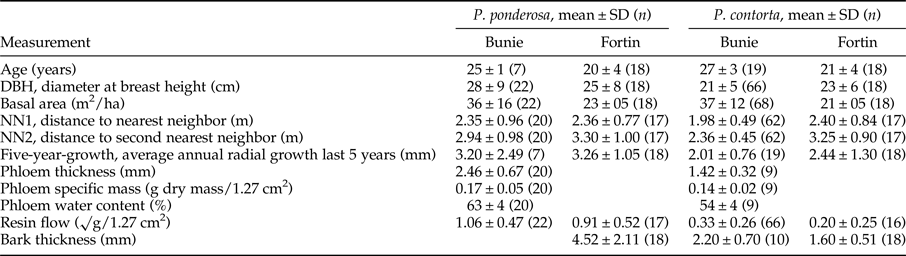
The study was conducted in two pine plantations of 10–14 ha in size, located in the northern Argentine Patagonian province of Río Negro, near San Carlos de Bariloche (‘Bunie’, El Mallin Chacay: 41.21°S, 71.22°W; and ‘Fortín’, El Fortín Chacabuco: 41.00°S, 71.16°W). Plantations consisted of P. contorta and P. ponderosa of similar age (20–27 years), height (13–16 m tall), and diameter (20–30 cm; table 1). Our studies were conducted in March and April (late summer) of 2013, 2014, and 2015. Like most pine stands in this region, these were planted around the time when the government started the forestation incentive programs during the early 1990s.
Means, standard deviations, and sample sizes of tree-specific measurements of Pinus ponderosa and Pinus contorta at Bunie and Fortín study sites. See table 2 for correlation matrices among traits.

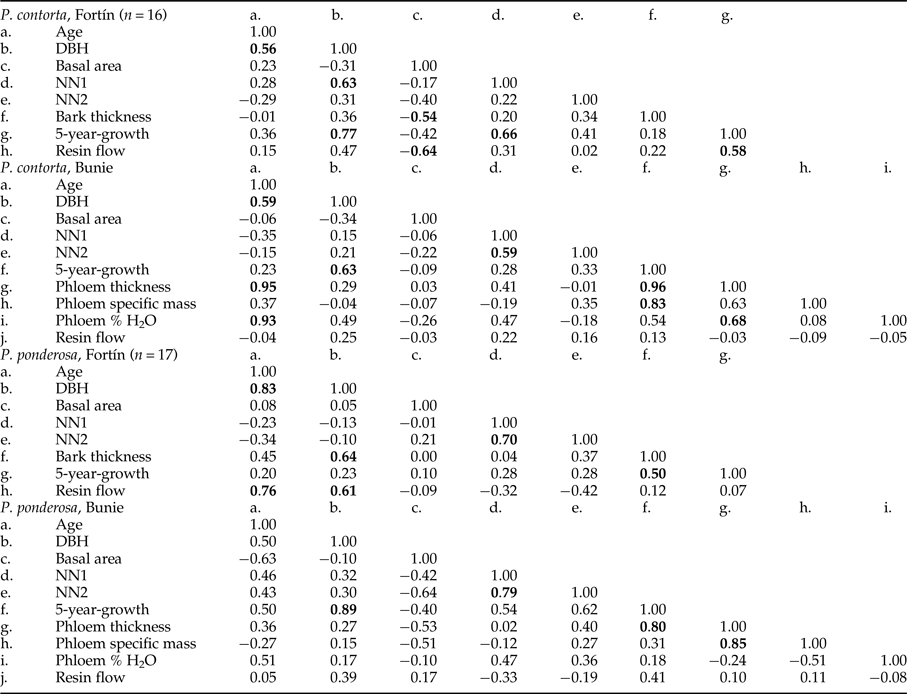
Pairwise Pearson correlations among tree traits for Pinus contorta and Pinus ponderosa at Fortín and Bunie. Bold type indicates significance at P < 0.05. See table 1 for means, standard deviations, sample sizes, and units. Lateral letters (a–g or i) correspond to named vertical traits.

The two study sites differed in the configuration of the forest and the abundance of S. noctilio. At Bunie, the plantation was divided into monospecific plots of either P. ponderosa or P. contorta (separated by a 10 m strip of cleared land). At Fortín, the two pine species were intermixed. Throughout Patagonia, pine plantations have stand structures that are similar to ours, varying from planted rows, to mixed, naturally spaced trees. Conversations with the plantation owners suggest that S. noctilio had been present in these stands for at least 10 years. At the start of the study, S. noctilio were more abundant at Bunie than Fortín (2.6× more trap captures in 2013; Martínez et al., Reference Martínez, Villacide, Fernández Ajó, Martinson and Corley2014).
Patterns of resin defense
To assess the levels of tree resin defenses, we sampled constitutive resin from trees of both species at both sites. Our measurement protocol followed previous studies of resin defenses in pine (e.g., Lorio Reference Lorio, Mattson, Levieux and Bernard-Dagan1988; Lombardero et al., Reference Lombardero, Ayres, Lorio and Ruel2000; Strom et al., Reference Strom, Goyer, Ingram, Boyd and Lott2002, and Martinson et al., Reference Martinson, Hofstetter and Ayres2007). A metal punch (0.5 inch diameter) was used to remove the outer bark and phloem without scoring the xylem, creating a measurement wound with a surface area of 1.27 cm2. Resin that flowed from these wounds during the next 24 h was collected and weighed. No wounds were still producing resin when samples were collected at 24 h. On each sampling occasion, we collected two samples from each tree near breast height with maximum separation to minimize interference between samples (Martinson et al., Reference Martinson, Hofstetter and Ayres2007). Resin flow was measured as g oleoresin/wound; for comparison with other studies that report resin flow as ml/wound, 1 ml of oleoresin corresponds to about 1.1 g (Zinkel & Russell, Reference Zinkel and Russell1989).
At Bunie, we measured resin flow from 100 trees (22 P. ponderosa, and 78 P. contorta); at Fortín, we measured 36 trees (18 of each species). Trees at Bunie were measured in both March and April during the summers of 2013 and 2014; trees at Fortín were measured in April of 2013. At Bunie, individual trees were selected at random within each row. At Fortín, we selected 16 randomly located plots of 5 m radius that contained both species, and sampled the nearest one or two trees of each species within the plot, closest to the center of the plot and of the same height and diameter. At both sites, for each measurement tree, we recorded location, DBH (diameter at breast height ≈1.4 m), basal area (BA, with a BAF −10× prism), the distance in meters to the nearest and second nearest neighboring trees (NN1 and NN2), S. noctilio status (attacked or not, as determined by resin drips on the bark), and crown stature relative to adjacent trees (suppressed, co-dominant, dominant). At Fortín, we measured total bark thickness (mm from outer bark to cambium) on all trees. We quantified recent radial growth from every tree at Fortín, and every third tree at Bunie, by extracting one core from each tree (at 1.4 m) and measuring mm of radial growth in the previous 5 years. For a small subset of trees, we also measured phloem thickness (as specific mass, g dry mass/1.27 cm2) and phloem water content (%).
Patterns of S. noctilio attack
In March–April of 2014 and 2015, we visited each tree we had sampled in 2013 and scored all trees as attacked or not by S. noctilio, as indicated by resin drips on the outer bark and oviposition drills in the phloem. Of the study trees that had been attacked as of 2014, we felled 18 to allow for measurements of woodwasp attacks: ten trees at Bunie (all P. contorta) and eight trees at Fortín (five P. contorta and three P. ponderosa). Then we debarked 25% of each tree's circumference from the butt to the top of the crown, and cut each tree into sections, 1–2 m in length. From the exposed surface of each section, we counted the number of woodwasp attacks and recorded the number of drills per attack (Lombardero et al., Reference Lombardero, Ayres, Krivak-Tetley and Fitza2016); drills are observable as multiple small holes created within about a 1 cm2 area of the peripheral xylem. We calculated an attack density (attacks/m2) for each section from each tree based on the surface area. To compare attack density and drills/attack among trees with differing heights, we binned each bole into deciles representing relative position from the base of the tree.
Statistical analyses
Patterns in resin flow at Bunie were evaluated with a general linear model that included species (P. contorta and P. ponderosa), sampling occasion (two dates in 2013 and two dates in 2014), species × occasion, tree nested within species as a random effect, and tree × occasion as a random effect. Resin flow was only measured on one occasion at Fortín, so the statistical model only included species, and tree nested within species. Trees that had been attacked prior to measurements were excluded from resin analyses for both sites. Resin flow data were square-root transformed prior to analyses to improve normality and reduce heteroscedasticity (Roberds et al., Reference Roberds, Strom, Hain, Gwaze, McKeand and Lott2003). We tested whether the incidence of subsequent attack (in 2014 or 2015) by S. noctilio was greater on trees with low resin flow (measured in 2013) by evaluating a generalized linear model (binomial distribution with a logit link function) of attack (0 or 1) as a function of resin flow in 2013 (one average of the four square-root transformed measurements from each tree). For each pine species, we tested for relations between resin flow and tree growth with a statistical model that included mean resin flow, average mm radial growth during the previous 5 years, and site (Bunie and Fortín); we allowed for the possibility of different relations at the two sites by also evaluating the model that allowed for different slopes at the two sites (site × growth interaction). Using the ten P. contorta at Bunie that were felled and dissected, we employed a simple linear regression to test for the effects of resin flow on attacks/m2 and drills/attack. We also estimated the average number of drills/attack in these trees as the slope of a regression with intercept = zero of total drills/tree vs. total attacks/tree (Cochran, Reference Cochran1977; Lombardero et al., Reference Lombardero, Ayres, Krivak-Tetley and Fitza2016). Statistical analyses were performed with JMP, version Pro 13.0, SAS Institute, Cary, NC, USA.
Results
Patterns of resin defense
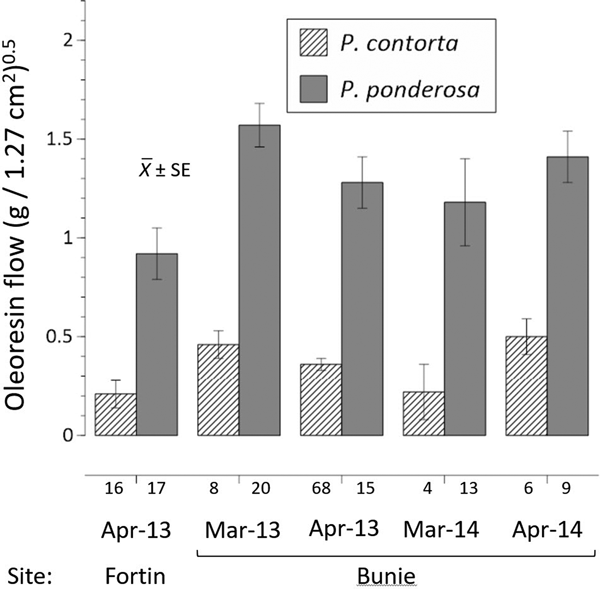
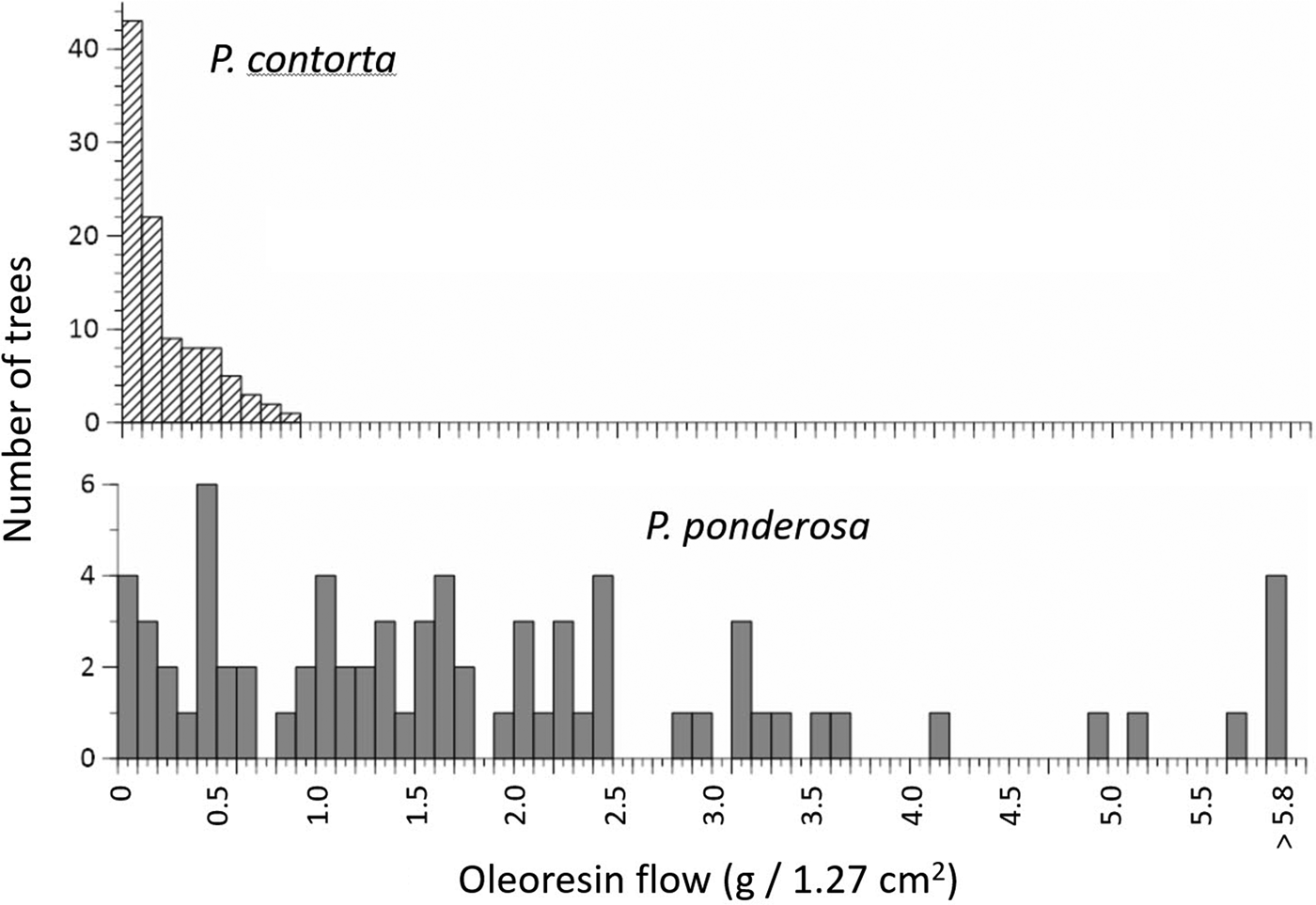
On every sampling occasion, average resin flow was markedly higher (2.8–5.3 times) in P. ponderosa than in P. contorta (fig. 1). Pinus contorta frequently produced <0.1 g resin/day (63% at Fortín and 38% at Bunie), compared with P. ponderosa (13% at Fortín and 4% at Bunie; fig. 2). At Bunie, where trees were measured on four occasions in 2 years, resin flow varied among dates (F 3, 30.9 = 14.2, P < 0.001), and there was a significant date × species interaction (F 3, 30.9 = 12.8, P < 0.001), but on every date, average resin flow in P. ponderosa was at least double that of P. contorta. Replicate measures of resin from within trees were quite consistent (r 2 = 0.69, n = 187 paired measurements). Even within species, trees varied in their resin flow; 36% of the total random variance was attributable to variation among trees within species. Further, the resin flow of individual trees was quite consistent across dates (Pearson correlation coefficients among trees across dates = 0.80–0.94). At Fortín, where sampling was blocked by clusters, there was no detectable variation among clusters.
Oleoresin flow from standardized wounds of Pinus contorta vs. Pinus ponderosa in Argentina at two locations on one to four occasions. Values below bars indicate number of trees per sample.

Frequency distributions of oleoresin flow from individual trees of Pinus contorta vs. Pinus ponderosa (84 and 37 trees, respectively; histograms show means of two measurements per tree on 1–4 sampling occasions, binning at 0.1 g resin/day increments).

Patterns of S. noctilio attack
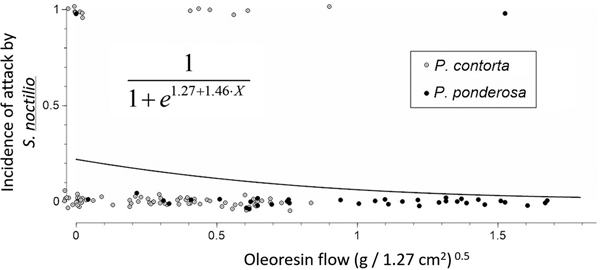
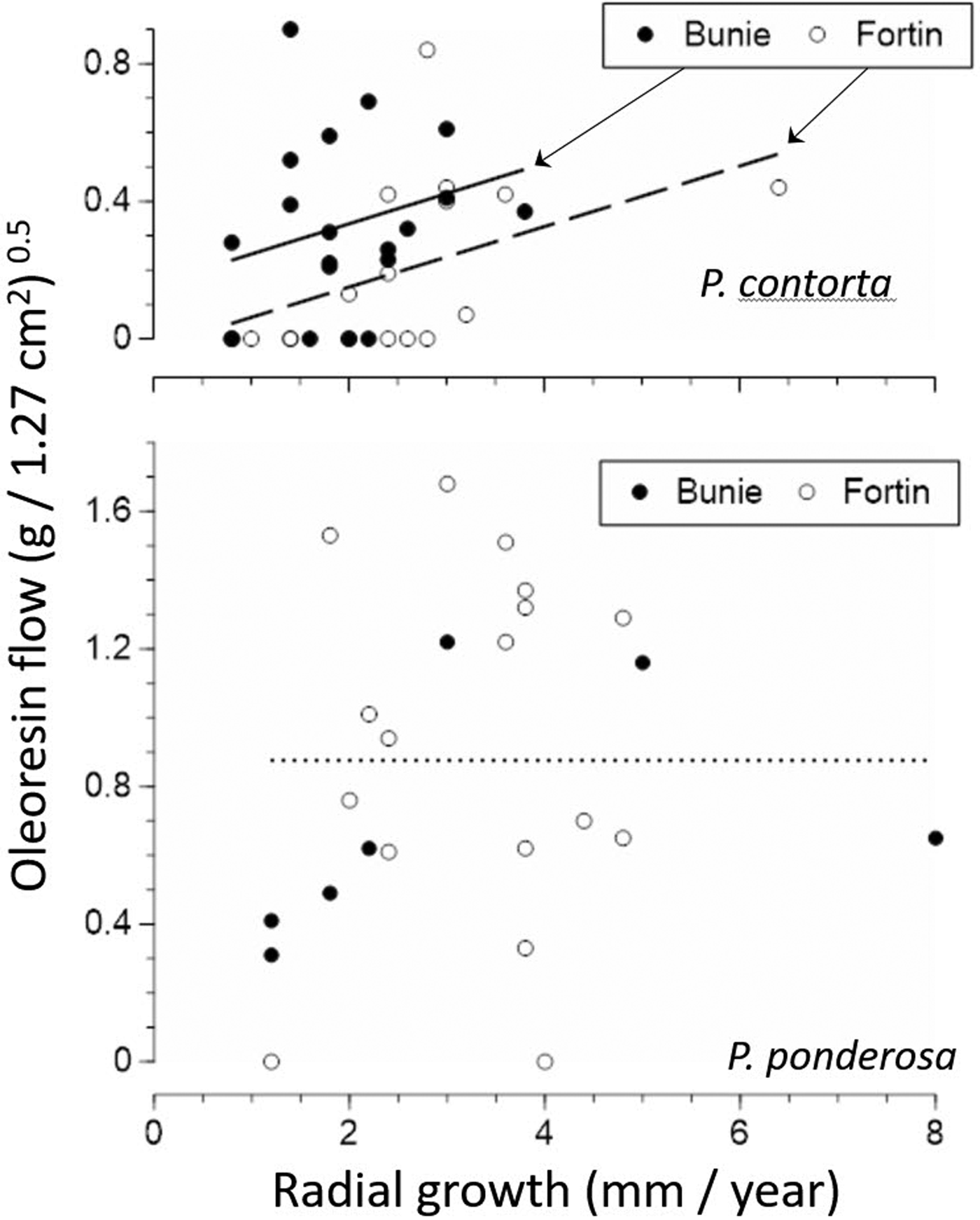
Of our study trees, 15% of P. contorta were attacked vs. only 2% of P. ponderosa. Sirex noctilio were more likely to attack trees with low resin flow compared with other trees at the site (fig. 3; mean ± SE resin flow of attacked vs. non-attacked P. contorta was 0.21 ± 0.07 vs. 0.37 ± 0.07 g/wound, respectively; only two P. ponderosa were attacked). In contrast, there was no relationship between attack probability and diameter at breast height (χ 2 for logistic model = 0.02, P = 0.89, n = 122; diameters standardized to a mean of 0 and standard deviation of 1 within each stand). Numerous tree attributes were correlated in typical ways (tables 1 and 2). One pattern in the correlation structure relevant to interactions with S. noctilio was that the resin flow of P. contorta (but not P. ponderosa) tended to be higher for trees that were relatively less crowded (lower basal area; table 2) and had higher growth rates (as measured by the average width of the last 5 years of annual rings; fig. 4).
The incidence of subsequent attack by S irex noctilio as a function of oleoresin flow in 83 Pinus contorta and 39 Pinus ponderosa. The probability of attack ranged from 21 to 2% at low vs. high resin flow (P = 0.032). Measurements were jittered on the Y-axis to increase clarity.

Oleoresin flow in Pinus contorta, but not Pinus ponderosa, was significantly lower in trees with relatively low radial growth (P = 0.025 and P = 0.43, respectively). Furthermore, the resin flow of P. contorta at Bunie was significantly greater than at Fortín after controlling for effects of radial growth (P = 0.026).

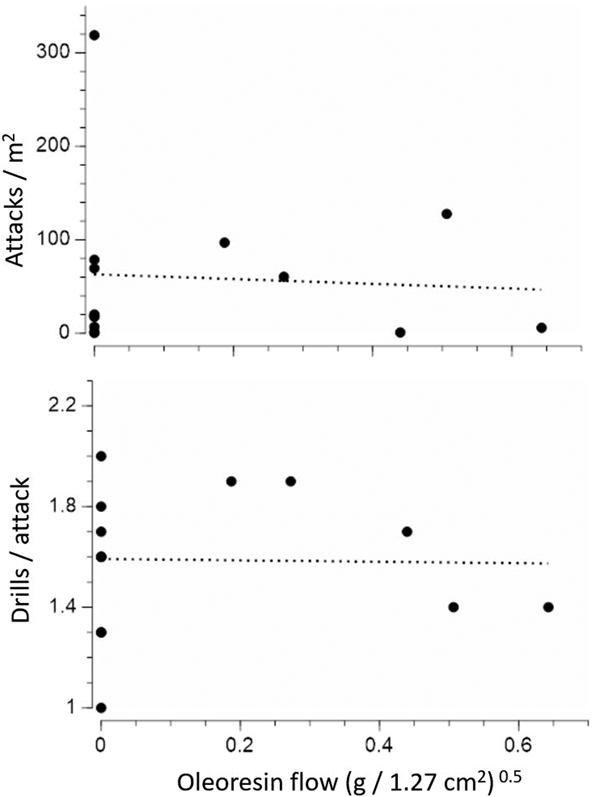
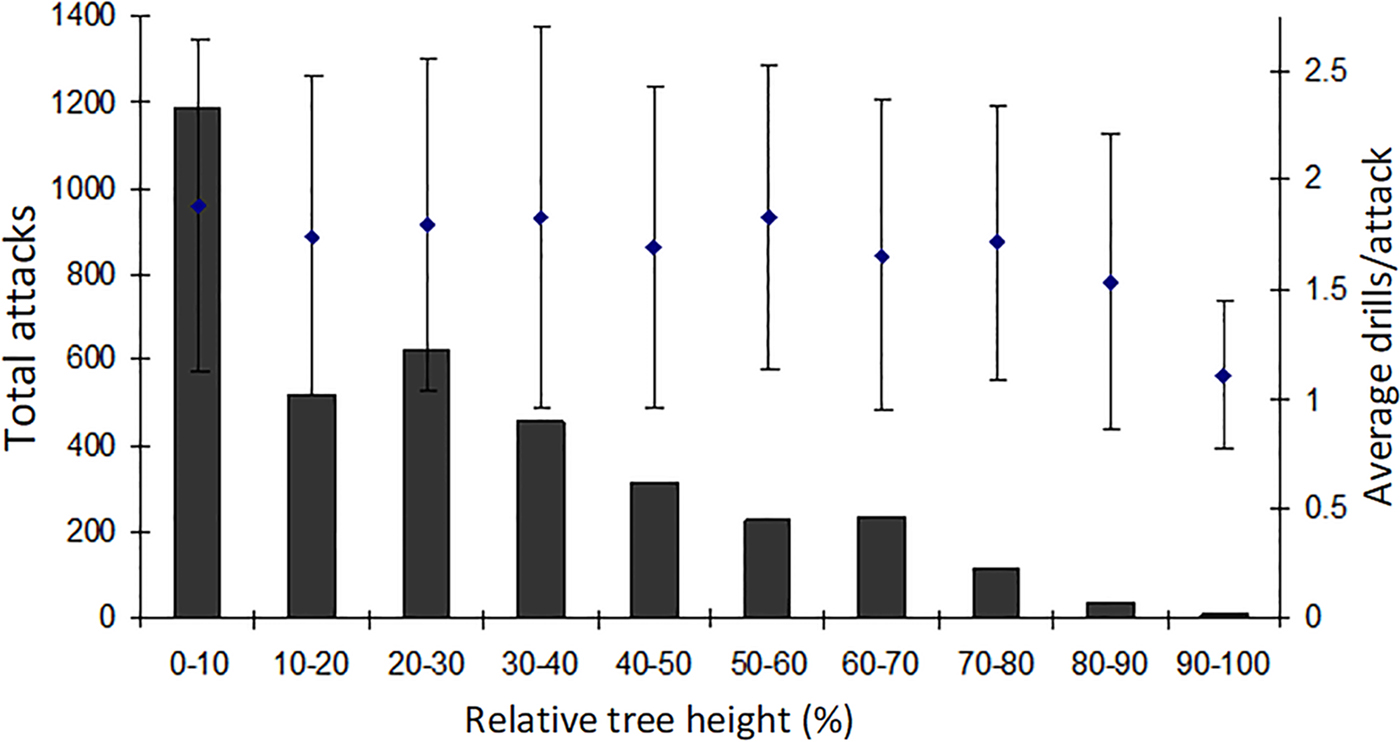
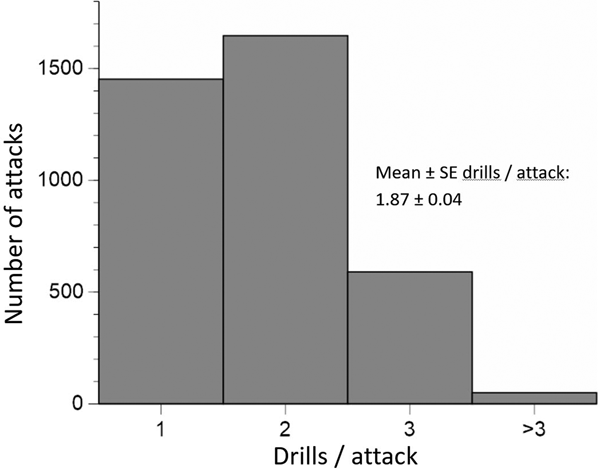
On trees that were attacked by S. noctilio and subsequently felled, we measured a total of 3739 attacks. There was no relationship between resin flow and the density of attacks or the number of drills per attack (fig. 5). Attack density decreased with tree height, with the bottom 10% having nearly twice the attack density of the middle, and there being few attacks in the top 20% of the bole (fig. 6). The number of drills per attack, however, was consistent throughout the length of the trunk (fig. 6, overall mean ± SE = 1.87 ± 0.04 drills/attack).
There was no relationship between oleoresin flow and the density of attacks by Sirex noctilio or the drills per attack (n = 13 Pinus contorta and one Pinus ponderosa) for trees that came under attack after our resin measurements were taken in 2013.

Total number of attacks (solid bars) and average number of drills/attack as a function of standardised tree height. Attacks were greatest in the lowest 10 % of the tree and rare towards the top of the bole. In contrast, the number of drills/attack was relatively constant with tree height.

The density of attacks was over ten times higher at Bunie than Fortín: attacks/m2 ± SE = 495 ± 151 vs. 47 ± 33, respectively (F 1, 13 = 4.18, P = 0.06). However, the number of drills/attack was similar, so the density of drills was also about tenfold higher at Bunie than Fortín: drills/m2 = 891 ± 281 vs. 72 ± 52, respectively (F 1, 13 = 4.07, P = 0.06). Attacks of P. ponderosa were rare, so we were only able to measure attack patterns on a single tree. This tree had a slightly lower overall attack density than our samples from P. contorta (39 vs. 47 ± 3.3 attacks/m2), and fewer drills per attack than P. contorta (1.50 vs. 1.87 ± 0.04, respectively). The other two P. ponderosa we cut down at Fortín had zero and four attacks, with no sign of successful oviposition.
Discussion
In Argentina, P. contorta produced less resin than P. ponderosa, and were more likely to be attacked and killed by S. noctilio (figs 1–3). Studies in North America, where both pines are native, also consistently found that P. ponderosa produced dramatically more resin than P. contorta, typically 5–8 g/wound vs. <1 g/wound, respectively (synthesizing these studies which used a similar protocol: Rocchini et al., Reference Rocchini, Lindgren and Bennett2000; Gaylord et al., Reference Gaylord, Kolb, Wallin and Wagner2007; McDowell et al., Reference McDowell, Adams, Bailey and Kolb2007; Davis & Hofstetter Reference Davis and Hofstetter2014; Hood & Sala Reference Hood and Sala2015; West et al., Reference West, Bernklau, Bjostad and Jacobi2016; Aoki Reference Aoki2017; Fischer et al., 2017). Many P. contorta at our sites produced almost no resin, meaning they were virtually undefended. This provides a mechanism to explain previous observations of higher mortality in P. contorta compared with P. ponderosa in Patagonia (Lantschner & Corley, Reference Lantschner and Corley2015). Our data clearly indicate that oleoresin flow is at least a correlate of tree susceptibility to S. noctilio attack. We hypothesize that low resin flow is causally related to higher attacks and mortality.
There are reasons to expect silvicultural practices to influence resin production. For example, forests with a high tree density may have a high proportion of slow-growing trees with limited resources to allocate to resin defenses (Tuomi et al., Reference Tuomi, Niemela, Chapin, Bryant, Siren, Mattson, Levieux and Bernard-Dagan1988). Kolb et al. (Reference Kolb, Holmberg, Wagner and Stone1998) reported lower resin flow from P. ponderosa in unthinned vs. thinned stands. Brown et al. (Reference Brown, Nebeker and Honea1987) reported similarly for loblolly pine. Conversely, other studies with P. taeda have shown no effect of thinning on constitutive resin defenses (Wilkens et al., Reference Wilkens, Ayres, Lorio, Hodges, Mickler and Fox1997; Ruel et al., Reference Ruel, Ayres and Lorio1998; Lombardero et al., Reference Lombardero, Ayres, Lorio and Ruel2000). There is a long-standing idea that overstocked stands (i.e., high basal area) are susceptible to pests and disease (Graham & Knight, Reference Graham and Knight1965), and indeed, tree density tends to correlate with the incidence of insect-mediated mortality for many tree-killing insects (e.g., Mitchell et al., Reference Mitchell, Waring and Pitman1983; Olsen et al., Reference Olsen, Schmid and Mata1996; Anderegg et al., Reference Anderegg, Hicke, Fisher, Allen, Aukema, Bentz, Hood, Lichstein, Macalady, McDowell, Pan, Raffa, Sala, Shaw, Stephenson, Tague and Zeppel2015), including S. noctilio (Neumann et al., Reference Neumann, Morey and McKimm1987; Ayres et al., Reference Ayres, Pena, Lombardo and Lombardero2014; Dodds et al., Reference Dodds, Cooke and Hanavan2014). At Bunie, where the two species were growing in adjacent plots, the basal area of each plot was similar, but the P. contorta plot contained densely planted, small-diameter trees (table 1). We observed high incidence of S. noctilio attacks on P. contorta at Bunie, and no cases of attacks on P. ponderosa. Surprisingly, resin flow of P. contorta at Bunie and Fortín was similar, even though basal area was nearly double at Bunie (intercept of two lines, top graph, fig. 4). Slow-growing P. contorta did have reduced resin defenses compared with faster growing conspecifics (slope of two lines, top graph, fig. 4). So, differences in planting density, tree size, and thinning history may have contributed to the differences between pine species in resin flow and mortality at Bunie, but we also observed lower resin flow and greater mortality in P. contorta vs. P. ponderosa at Fortín, where the species were growing intermixed at the same basal area and planting density. While silvicultural practices can impact tree defenses, there is apparently a genetic basis for the differences in defenses and susceptibility between these two species of pine.
It could be that resin flow is not a direct defense against S. noctilio, but that the mutualist fungi grows poorly in high resin trees, and that those trees are more likely to successfully fend off attacking wasps. We did occasionally see trees with resin drips on the outer bark, indicative of early attacks, but these trees remained healthy and did not sustain or die from mass attacks (e.g., this may have been what we observed in two P. ponderosa at Fortín, which had resin drips on the outer bark, but no sign of attack within the xylem). In such cases, the early attacks may cause induced resin production, and that protects the tree and allows it to survive. Often, but not always, the levels of constitutive defense are well correlated with the levels of inducible defenses. In this case, constitutive resin flow is still a reasonable metric for assessing tree susceptibility to attack (Haukioja, Reference Haukioja1991; Lombardero et al., Reference Lombardero, Ayres, Lorio and Ruel2000). Physical defenses, like bark thickness, may be part of tree susceptibility, and other attributes like phloem thickness and primary nutrition may make some trees more suitable for larval development or fungal growth than others. It is possible that differences in the resin chemistry of these species (qualitative resin chemistry described by Ferrenberg et al. (Reference Ferrenberg, Langenhan, Loskot, Rozal and Mitton2017) and West et al. (Reference West, Bernklau, Bjostad and Jacobi2016) in the pine's native ranges) may be involved in initial attraction or host suitability, as was suggested for a bark beetle by Fischer et al. (Reference Fischer, Waring, Hofstetter and Kolb2008), and this could be an avenue for further study. But research with other phloem-rearing pests has found that the differences in the chemistry of the resin have limited effect on fecundity or host attractiveness (Raffa & Berryman, Reference Raffa and Berryman1983; Tisdale et al., Reference Tisdale, Nebeker and Hodges2003; Davis & Hofstetter, Reference Davis and Hofstetter2011; Coulson & Klepzig, Reference Coulson and Klepzig2012).
Resin defenses may influence oviposition behavior of woodwasps. The release of volatile monoterpene resin constituents by stressed pines acts as an initial attractant for S. noctilio females (Böröczky et al., Reference Böröczky, Zylstra, McCartney, Mastro and Tumlinson2012). High osmotic pressure within the phloem upon insertion of the ovipositor can act as an oviposition deterrent (Madden & Coutts, Reference Madden, Coutts and Batra1979) and S. noctilio rarely lay eggs in attack sites that are rejected after the first drill. The number of eggs per attack increases with the number of drills per attack (Madden, Reference Madden1974; Spradbery, Reference Spradbery1977; Haavik et al., Reference Haavik, Dodds and Allison2015). We observed no relationship between oleoresin flow and the attack density, or number of drills per attack (fig. 5). Our sample consisted of trees showing subsequent signs of decline, and most S. noctilio attacks contained one or two drills (fig. 7). This suggests that S. noctilio females accurately assessed the high susceptibility of these trees and oviposited multiple times on selected hosts.
Frequency distribution of number of drills/attack; most attacks consisted of one or two drills (n = 3,739).

Another trait that could theoretically influence host selection by S. noctilio is tree size. It could be that host-seeking female woodwasps are attracted to small diameter trees as they fly through a pine stand. If so, relative tree size, rather than resin defenses per se, could be the proximate cue by which woodwasps choose their host trees. This could be favored by selection because relatively small diameter trees tend to be suppressed trees which tend to have reduced defenses. However, there was no relationship in our study between the probability of attack and relative diameter, even though there was a significant relationship between resin flow and probability of attack (fig. 3).
For both species of pines, our study trees in Patagonia were growing much faster than their counterparts in North America: height in feet at age 100 years ≈140 vs. 50–80, respectively (site index calculated from Alexander (Reference Alexander1966); Barrett (Reference Barrett1978), and Minor (Reference Minor1964)). At the same time, our trees in Patagonia yielded only 20–50% as much resin from wounds as the same species in North America (Rocchini et al., Reference Rocchini, Lindgren and Bennett2000; Gaylord et al., Reference Gaylord, Kolb, Wallin and Wagner2007; McDowell et al., Reference McDowell, Adams, Bailey and Kolb2007; Davis & Hofstetter, Reference Davis and Hofstetter2014; Hood & Sala, Reference Hood and Sala2015; Aoki Reference Aoki2017). These studies from North America used a protocol comparable to the one that we used for measuring oleoresin flow, were conducted on trees of similar size to those in our study, and included locations from Arizona, Colorado, Montana, and British Columbia. Presumably, the rapid growth of these pine species in Patagonia matched the hopes of those who selected them for planting in production forests. They perhaps did not anticipate that rapid tree growth would be associated with reduced defenses, which would later make these trees more susceptible to a novel pest, accidentally introduced from another continent. However, this is consistent with the growth-differentiation balance hypothesis (Herms & Mattson, Reference Herms and Mattson1992), which predicts a general tendency for environmental conditions that favor rapid plant growth to also lead to the downregulation of secondary metabolism (e.g., resin in pine trees). Further study will be required to determine if there is a general pattern of reduced defenses in pines that are propagated under highly productive environmental conditions (e.g., most of the extensive pine plantings in the southern hemisphere). If so, this could help explain the apparent susceptibility to pests of pines in production forests of the southern hemisphere.
As forest pests continue to be introduced in new locations, there will be greater damage to forest ecosystems and increasing undesirable consequences for people (Wingfield et al., Reference Wingfield, Brockerhoff, Wingfield and Slippers2015). It is inevitable that there will be growing numbers of cases of plant–herbivore interactions where both players are non-native and interacting for the first time. This elevates the value of developing and testing theories of plant–herbivore interactions that are general enough to yield predictions even about novel interactions between plants and herbivores. One tactic for expanding our understanding is to do research that directly compares plant defenses and plant–insect interactions across the native and introduced ranges of plants and their potential pests.
Acknowledgements
Support was provided by USDA Forest Service International Programs (USA) and PICT 0557 (MINCyT, Argentina). The authors thank Stephie and Bunie for permitting us to conduct research in their pine stands and for help with the studies. The manuscript benefitted from insightful comments by an anonymous reviewer.