I have a great desire to come over to Sweden one of these days … In your next letter, you should thoroughly describe in which season and in which month it would be best for me to travel to Sweden, what sort of musical things there are to hear and do there, whether it would be possible to take a trip to the Norwegian Highlands without too much difficulty … How I look forward to your new pieces and to showing you mine, and to the endless things we have been wanting to talk about.
Felix Mendelssohn Bartholdy to Adolf Fredrik Lindblad (23 March 1833)Footnote 1
An inveterate traveller, Felix Mendelssohn Bartholdy journeyed 800 miles southwards from Berlin to Naples and 800 miles to Oban to the north and west, yet despite his oft-expressed desire to visit Sweden, the excursion of 500 miles northward to Stockholm remained an unfulfilled dream. A constellation of forces – family ties, friendship and royal patronage – lay claim to Mendelssohn at varying stages of his career, calling him to pay a visit to the largest Scandinavian kingdom. Although he ultimately never set foot in that country, knowledge of his works gradually spread and his reputation grew, a process set largely in motion through the efforts of the Swedish composer Adolf Fredrik Lindblad (1801–1878), who befriended Mendelssohn in Berlin in 1825 and became the focal point through which the majority of Mendelssohn’s Swedish connections, familial and professional alike, converged.Footnote 2
Mendelssohn’s vast correspondence, including a little-known set of 22 letters from Lindblad, reveals the depth of his connections with Sweden. Lindblad’s letters not only provide a detailed view of musical life in a region largely overlooked in music history studies, they also convey information about critical reviews of Swedish premieres and performances of works by Mendelssohn and other prominent figures. Most importantly, this epistolary relationship also prompted Mendelssohn himself to reflect upon his compositional processes and his relationship with Beethoven in a time when the late works of that composer were widely dismissed as eccentric.
Mendelssohn’s earliest link with Sweden, his first cousin Josephine (‘Peppi’) Benedicks, who took up residence in Stockholm in the 1810s, is traced primarily through his mother’s correspondence and Peppi’s friendship album containing entries by young Fanny and Felix. The greater Mendelssohn family shared the prevailing continental perceptions of Sweden as a locus of negligible musical importance, a situation that Lindblad partly affirms; yet his own letters to Felix provide a fuller first-hand account, reporting higher levels of musical activity than his German friend would otherwise have realized (including a candid review of the Swedish premiere of the Sommernachtstraum Overture), while also confiding his own struggles to establish himself as a composer of international prominence.
After examining the origins of their friendship and initial stages of extant correspondence, I turn to two recurring themes. First, Mendelssohn’s self-referential commentary on his own pieces gives voice to his development as a composer. Conversations about Mendelssohn’s compositions carry on, in written form, long after Lindblad leaves Berlin, giving Mendelssohn the opportunity to formulate his thoughts on paper; of special interest are his notes on the formal structure of his latest compositions and his visions for ideal interpretations in performance. Second, Beethoven – whom Lindblad terms the ‘God of Composition’ – surfaces repeatedly as an influence on both of his younger contemporaries, each of whom identifies with a different portion of the recently deceased composer’s oeuvre. Over time, the correspondents declare and defend their disparate affinities, with Mendelssohn respecting Lindblad’s preference for the accessible style of the early symphonies even while advocating effusively for the baffling yet rewarding late string quartets with their novel approaches to unity of thematic material and their unprecedented relationships between key areas. These two overarching themes of the correspondence come to a head with Mendelssohn’s borrowing of aspects of Beethoven’s quartet in F major, op. 135, in his own quartet in A minor, op. 13. The present analysis expands the pairing of the quartet and the song that inspired it (‘Frage’) to include two further songs, one each by Lindblad (‘Für ewig’) and Mendelssohn (‘Tröstung’), forming a cluster of interrelated compositions spanning a 20-year period.
Mendelssohn’s contact with Sweden reached the highest levels of society. In addition to befriending the country’s most celebrated singer, the soprano Jenny Lind, he dedicated his op. 44 string quartets to Crown Prince Oscar (later Oscar I), with Lindblad serving as intermediary securing the customary permission. Ultimately, the wealth of Mendelssohn’s documented interest in Sweden and its junior partner in union, Norway, also raises the question of which Nordic-inspired pieces might have emerged had he actually made the journey and experienced first-hand this region that so captivated his imagination.
Blood Relations: Mendelssohn’s First Cousin in Stockholm
If Lea Mendelssohn Bartholdy’s opinion is any indication, Felix’s initial impressions of Sweden may have been less than promising; yet his awareness of the country was raised early on, as musical and cultural conditions in Stockholm became a recurring topic of family conversation thanks to the marriage of Josephine (‘Peppi’) Benedicks née Seligmann (1797?–1834), the elder daughter of Lea’s sister Rebecka Seligmann née Salomon (1776–1810), to the merchant Wilhelm Benedicks (1783–1851), who lived much of his life in the Swedish capital.Footnote 3 Peppi’s reports and occasional visits familiarized the Mendelssohn family with life in the northern kingdom.
Very little is known about Peppi; not even the precise year of her birth has been determined. Certainly by 1819, and probably at some point before the birth of their first child in 1816, the couple had settled permanently in Stockholm, where Wilhelm had first immigrated no later than 1805.Footnote 4 Peppi kept in touch with her Berlin relatives through letters and occasional visits, which became all the dearer to both parties after Lea assumed the role of a mother figure after Rebecka’s death.Footnote 5 Between 1819 and 1834, Peppi appears prominently in Lea’s correspondence with Lea’s cousin Henriette von Pereira-Arnstein of Vienna.Footnote 6 Peppi likely knew young Felix early on, as his family fled Hamburg for her native Berlin in 1811, when she was probably in her early teens; however, he would have had few, if any, direct memories of her from this time, as she moved via London to Stockholm within the next few years.
To Lea, who was accustomed to the rich musical life of Berlin, it seemed that Peppi endured a deprived existence in provincial Stockholm, confined to the cultural as well as geographical outer periphery of Europe. In 1821, for example, Lea reports to von Pereira-Arnstein that the virtuoso French-Dutch flautist Louis Drouet, who performed two concerts in Stockholm, had ‘defrosted the stubborn citizens of Stockholm; at least my dear Peppi can enjoy it, for she has so few opportunities for interesting things of that sort’.Footnote 7
Lea’s observation coincides with a relatively subdued period in Swedish music in the first four decades of the nineteenth century.Footnote 8 In the 1770s and 1780s, Gustav III had turned Stockholm into a major operatic centre with a special focus on the production of new vernacular operas on historical Swedish themes, but his efforts came to an abrupt end when he was mortally wounded at a masked ball in his own opera house in 1792.Footnote 9 Although the Royal Opera gradually recovered and even surpassed previous production levels by the early 1800s, it never again commanded such prominent attention as an innovator of repertoire.Footnote 10 Looking ahead to the early 1840s, the Opera’s fortunes began to turn with the distinguished career of the soprano Jenny Lind (1820–1887), the first in a string of notable singers who have kept Sweden back firmly on the international opera map, from Christina Nilsson and Jussi Björling to Birgit Nilsson and, more recently, Anne Sofie von Otter, Nina Stemme and Peter Mattei. Also in the 1840s, the lifting of the royal theatre monopoly in Stockholm led to the founding of several private theatres with their own freelance musical ensembles, greatly increasing entertainment opportunities in the city.Footnote 11
Geography also exerted a defining force upon musical life in Stockholm. Felix was hardly alone in not visiting the city; most of Europe’s leading musicians who travelled around the Continent did not set their sights as far north as Sweden, severely limiting opportunities for musical exchange and performance in that country. Stockholm did receive a minor flow of traffic thanks to its position on the sea route between western Europe and the art-rich court of St Petersburg, but any comparison with musical opportunities in Berlin falls decidedly in Prussia’s favour. Peppi’s Stockholm of the 1810s and 1820s offered performances of operas and comic operas at the Royal Opera House and the Arsenal Theatre, alongside concerts in various venues – in addition to Drouet, at least 28 other visiting foreign instrumentalists played in the city during those two decades, a palette of performances far more meagre than that to which Lea and young Felix were privy in Berlin during that same period.Footnote 12 Even by mid-century, though, concerts were nowhere near as plentiful as in central European musical capitals such as Leipzig, which, according to Felix, suffered from a miserable ‘throng of musicians and music’ and was positively ‘teeming with pianists’ during the winter of 1846–47.Footnote 13
The most enduring trace of contact between the cousins is the étude-like Prestissimo in F minor for solo piano that Felix inscribed into Peppi’s stambok (friendship album) with the dedication ‘For his cousin, composed by Felix Mendelssohn Bartholdy, Berlin 23 August 1824’.Footnote 14 Full of nimble triplets and passagework, this lively (peppig) work – reminiscent in style of Peppi’s very name – remained unpublished in Felix’s lifetime, and while he did keep a manuscript copy (dated 19 August 1824), the primary function of the piece remained as a personal gift for Peppi; when she returned to Sweden a few weeks later, it became his first musical export to that country.Footnote 15
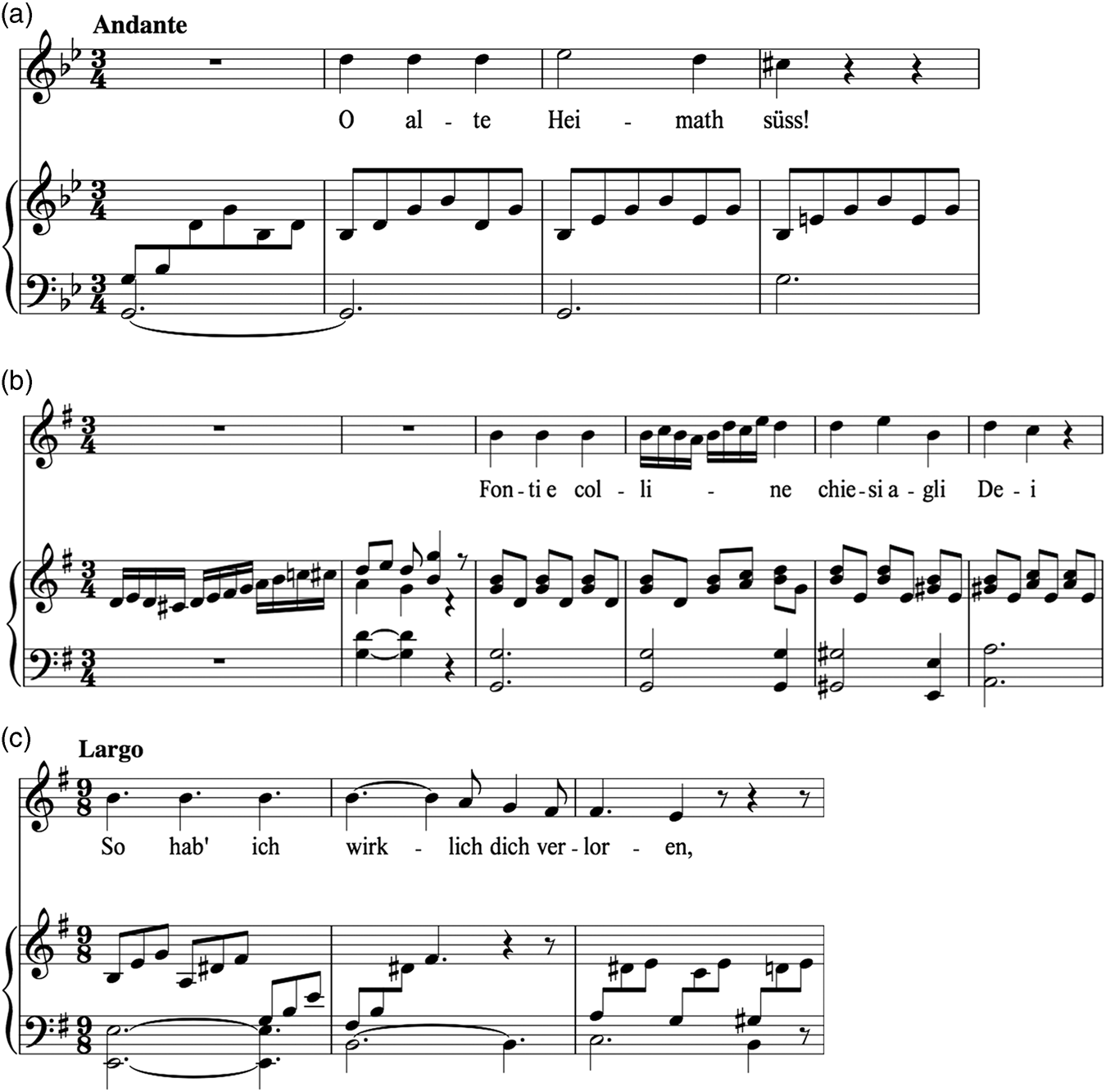
Further musical linkages exist in the half dozen songs that Fanny Mendelssohn wrote for Peppi around this time, including an entry inscribed in the same stambok just two weeks before Felix’s Prestissimo. All of Fanny’s songs to her cousin, with the exception of the copy of ‘Frühlingsnähe’ written into Peppi’s album, survive solely as autographs in her composition album, where brief marginal references such as ‘To Peppi’ (‘An Peppi’) indicate the intended recipient; because no letters survive in either direction, Peppi’s responses – or even whether she actually received any of the Lieder besides ‘Frühlingsnähe’ – remain unknown.Footnote 16 By coincidence, the first three songs open in the same manner, with three repeated crotchets (in 3/4) or dotted crotchets (in 9/8) on a single pitch (see Ex. 1).Footnote 17
Fanny Hensel, three songs displaying ‘Peppi head-motif’

While the ‘Peppi head-motif’ does not continue through the remaining Lieder that Fanny wrote to her cousin, common themes of absence and distance run through nearly all of the pieces in this group.
A sad tale unfolds in Lea’s correspondence with von Pereira-Arnstein, as Lea’s concern for Peppi’s cultural well-being soon gives way to larger worries about her niece’s physical well-being. After the 1824 visit to Berlin, Lea laments that Peppi is determined to return to the ‘sad, cold country’ of Sweden against the better judgment of family and doctors alike.Footnote 18 So dire are Lea’s misgivings that she writes of Peppi’s departure from the city in a sentence that reads like a eulogy: ‘On September 16, our dearly beloved Peppi departed from us, to the sorrow of all who knew the angelic creature.’Footnote 19 Almost exactly a decade later, Lea’s fears proved to be well founded.Footnote 20 Upon Peppi’s death in 1834, Mendelssohn’s direct familial connection with Stockholm weakened significantly.Footnote 21
Although Sweden is situated on the geographical fringe of Europe, the country was known to both Felix and Fanny from an early age through first-hand reports from their emigrant cousin, Peppi, who maintained regular correspondence with Lea and even returned to visit Berlin on a few occasions. When Felix first met the composer Adolf Fredrik Lindblad the year after Peppi’s visit of 1824, he was already familiar with Lindblad’s country, giving their friendship a broader cultural base than music alone.
‘I am your friend for life – Felix Mendelssohn Bartholdy’: The Correspondence with Adolf Fredrik Lindblad
In October 1825, as 16-year-old Mendelssohn was finishing his masterful Octet, he struck up a close friendship with Adolf Fredrik Lindblad (then 24), who had recently arrived in Berlin to study and expand his musical horizons.Footnote 22 The two crossed paths again when Lindblad visited Frankfurt in 1836 and Berlin and Düsseldorf in 1842.Footnote 23 Twenty-six extant letters exchanged over a period of 20 years chronicle this long-lasting friendship that broke off only upon Mendelssohn’s death in 1847. In scholarship, this conversation has been presented largely as a one-sided affair ever since the first publication of Mendelssohn’s letters over a century ago.Footnote 24 An examination of unpublished archival letters now restores Lindblad’s missing voice to the conversation, fleshes out a lively dialogue and reveals new insight into Mendelssohn’s influence, both critical and compositional, on his Swedish contemporary.Footnote 25 The earliest surviving exchanges show how Mendelssohn helped Lindblad understand the need to develop a capacity for self-critical evaluation of his compositions (vis-à-vis an argument about Lindblad’s Swedish folksong arrangements), a skill that Lindblad would find to be essential upon returning to Stockholm, which had a much smaller community of musicians than the circles to which he had been privy in Berlin. Lindblad’s newfound confidence in his ability to judge his work more critically was a significant step in his quest to establish himself as a prominent composer.
Lindblad, whose prolific songwriting earned him the nickname ‘the Swedish Schubert’, worked his way from illegitimate beginnings (he was immediately adopted by his mother’s aunt and uncle) to become a well-respected music teacher in Stockholm, numbering among his pupils such illustrious figures as the soprano Jenny Lind, the composer Ludvig Norman, and Crown Prince Oscar and his musically inclined son, Prince Gustaf.Footnote 26 Lindblad began to express real interest in music as a teenager. Much to the chagrin of his adoptive father, the boy proved poorly suited to various positions in trade, and at age 17 he was sent to Hamburg in hopes that his Swedish connections and the German he had learned in school could be of some use.Footnote 27 During this year abroad, Lindblad greatly expanded his horizons, but not with respect to the merchant trade; rather, he fell raptly under the spell of authors such as Goethe, Jean Paul, Novalis and Tieck. Lindblad later recalled his introduction to German romantic literature as follows:
With enthusiasm, the only artistic means I have ever owned, I gave myself over to reading [German literature]. Not just during the days, but even at night, and even though I have always been somewhat disorganized, I still have notes and critical opinions from this time, which made an impression of the sort that can only be effaced with difficulty.Footnote 28
Crucially, while in Hamburg, Lindblad also encountered the music of Beethoven, who became his life-long ideal, as letters and compositions alike attest. After studying music briefly under Johann Christian Friedrich Hæffner at Uppsala University, Lindblad travelled to Berlin in 1825, where he studied counterpoint with Zelter and met Mendelssohn.
Just three days after arriving in Berlin on 9 September, Lindblad was introduced to Zelter, and by 3 October he was studying daily with the leader of the Sing-Akademie, according to his patron and traveling companion, Malla Montgomery-Silfverstolpe. A week later, she reported in her famous diary,
On the ninth, Adolf [Lindblad] and Zelter were at the Mendelssohn’s and listened to music that delighted him, especially by the young 18-year-old [sic] Felix Mendelssohn, a pupil of Goethe and Zelter.Footnote 29 – It was a very good acquaintanceship, that sincerely pleased me.Footnote 30
At the beginning, Lindblad was impressed with Mendelssohn’s compositional skills, though somewhat guarded in his response; of a performance of the Symphony No. 1 in C minor (MWV N13, op. 11), he recorded in his travel diary,
Symphony by Felix Mendelssohn. There is much to say about it, first in praise and then in criticism. And yet I believe that the proper response is neither the one nor the other, but rather simply to admire. For it is admirable that a 17-year-old [sic] boy can write such a symphony. – It would be necessary to hear it many times in a row in order to figure out everything that is going on, for it was not at all ‘hollow’ – on the contrary!Footnote 31
Four days after the entry quoted above, Lindblad stopped keeping his travel journal, but Malla continued her own entries, chronicling a number of occasions on which the two composers spent time together; in late April 1826, Lindblad even told her of his plans to rent a room from the Mendelssohn family.Footnote 32 Lea confirms in early July that Lindblad had a key to the house, but just a few weeks after that letter, he departed for several months in Paris.Footnote 33
The surviving correspondence begins in the middle of a heated argument stemming from Lindblad’s arrangements of Swedish folksongs early the following February (1827), after Lindblad’s return to Berlin, with Mendelssohn’s declaration: ‘If You [Sie] are capable of listening to a seriously even-tempered word in a seriously even-tempered manner, then I will tell *You [*Ihnen] the following’.Footnote 34 Mendelssohn presents himself as the more level-headed of the two, but his word choice reveals that he was swept up in strong feelings that overwhelmed his rational thought: in the first two paragraphs of this letter, he mistakenly uses the formal pronouns Sie and Ihnen, even though he had already on a previous occasion initiated the use of the informal Du. An asterisk leads to the correction: ‘Should be the informal you’ (soll alles Du heißen), and from paragraph three onwards the correct pronouns are used consistently.Footnote 35 This innocent slip-up did not pass unnoticed, although Lindblad’s response, which does not survive, can only be inferred. Mendelssohn counters in his following letter: ‘What you write about my mix-up with Du and Sie is a breach of etiquette since I was the one who first offered to be on first-name terms with you’.Footnote 36 Evidently, Lindblad did not shy away from speaking his mind.
At the heart of the larger quarrel lies a collection of Swedish folksong arrangements that Lindblad had dedicated to Mendelssohn, or more precisely, Mendelssohn’s apparently lukewarm reaction to the same.Footnote 37 Capitalizing on the widespread Herderian passion for folksong, and building upon simple piano-vocal arrangements of folksong published in Sweden in the previous decade, Lindblad devised more active accompaniments for his settings, bridging the folk/classical divide and bringing the songs closer to the tradition of the north German strophic Lied.Footnote 38 While others in Lindblad’s circle in Berlin praised the songs,Footnote 39 Mendelssohn blames his own indifferent reaction one evening on an unfortunate headache, rather than any fault of the songs themselves, which he professes to have enjoyed. Playing devil’s advocate, he asks Lindblad: ‘Let us suppose that I had not liked the songs at all; does this make them one iota worse – does my personal opinion in any way reduce their value?’Footnote 40 There follows a lecture from the younger to the elder on the importance of confidence in one’s own aesthetic judgment, as 18-year-old Felix chides 26-year-old Adolf for failing to form his own opinions and for relying excessively on the judgment of others: ‘What does my declaration matter to you? Yours should be of the highest importance to you, and thus you will be driven to and fro by the opinion of every person, vacillating, until you stand firmly within yourself’.
Lindblad’s impassioned response does not survive, but in a second note, dated the following day, Felix expresses a wish to forget portions of Adolf’s letter entirely – ‘I efface the rest of the letter from my heart, and wish that my memory did not have to remind me that you wrote it’.Footnote 41 Yet he ultimately interprets Lindblad’s heartfelt lines as a positive sign: ‘finally, our relationship has become clear, and that is good’.Footnote 42
Mendelssohn’s critical advice proved to be especially fitting for Lindblad’s compositional career, though not quite in the way the giver intended. The frame of reference in this note from 1827 is Berlin, a city notorious for musical opinion thanks in part to the likes of the outspoken critic Adolf Bernhard Marx.Footnote 43 Early into Lindblad’s stay in Berlin, Mendelssohn was ‘completely under Marx’s sway’ as he wrote his overture to A Midsummer Night’s Dream.Footnote 44 During much of that same period, Lindblad met with Mendelssohn daily, according to Malla Montgomery-Silfverstolpe, which means that he, too, would have been immersed in active communities of musical discourse.Footnote 45 Back in Stockholm, Lindblad suffered from an acute lack of musical community, which forced him to develop his capacity for self-criticism. After a year, he rather arrogantly complained in a letter to Mendelssohn: ‘Since I was in Berlin, I haven’t heard a sensible word about music spoken by anyone other than myself’.Footnote 46 Nevertheless, he took Mendelssohn’s admonition from 1827 to heart and prided himself upon his newfound ability to cast a critical eye upon his work:
I am now composing more eagerly than ever before, and unselfconsciously. I do miss having a circle around me that is interested in such things, but because of this I am able to cultivate this practice inwardly, and I am more than ever my own advisor and judge in matters of taste.Footnote 47
In all likelihood, Mendelssohn’s sharp comments about the necessity of cultivating one’s own judgment directly prepared Lindblad for the reality he would face as he negotiated his professional life in Stockholm.
The letters pick up the thread of self-criticism a second time in late 1833, as Mendelssohn makes the transition into professional musical life in Düsseldorf. At this new stage of responsibility, he revisits the topic of critical opinion with respect to Lindblad. In a letter to his parents in December, he reverses course and admits the great value of Lindblad’s critical opinion in his own musical life:
Since those jolly days of summer, I know very few people whose opinion I value more highly than his … and when I have finished a piece, whether successfully or in failure, he is, together with you [Abraham and Lea Mendelssohn Bartholdy], among the first whose impression of the piece I like to imagine.Footnote 48
No trace of his earlier impassioned argument for the supremacy of self-judgment remains; rather, Lindblad’s opinion has gained a rare place in Mendelssohn’s inner circle of critics.
Mendelssohn’s choice of the verb ‘to imagine’ (sich denken) appropriately describes the way in which he usually approached Lindblad’s opinion; unfortunately for posterity, the Swedish composer tends to write general praise rather than specific details about Mendelssohn’s works. In person, Lindblad was apparently more forthcoming with critical opinion. Shortly after his visit to Frankfurt of 1836, he begged pardon for verbal comments he had made about the overture to Das Märchen von der schönen Melusine (MWV P12, op. 32); but Mendelssohn must have found the comments to be of some use, for he urged Lindblad: ‘[W]rite to me … and pour out your heart over musical matters, as you did that time about Melusine, for which I am still thankful to this day’.Footnote 49 Lindblad’s comments came at least half a year too late to have affected Mendelssohn’s substantial revision of the overture in late 1835, but the tantalizing prospect remains that Lindblad may yet have left an invisible impression on one or more individual pieces in 1826 or 1827.
‘Tell me about the performance of my Midsummer Night’s Dream’: Mendelssohn’s Music in the SpotlightFootnote 50
Alongside The Fair Melusine, some 18 compositions by Mendelssohn appear in the correspondence. Often, Mendelssohn updates Lindblad about his most recent pieces; in October 1838, for example, these include the Cello Sonata No. 1 in B-flat major (MWV Q27, op. 45); a few unnamed piano pieces; Psalms 42 and 95 (MWV A15, A16); and a symphony-in-progress.Footnote 51 As an interested but far-away party, Lindblad provides Mendelssohn with the opportunity to reflect on and explain more unusual features of his music in writing; the resulting commentary, such as Mendelssohn’s animated directions for studying his string quartet in A minor, proves as relevant to analysts and performers today as it was to its intended reader nearly two centuries earlier. On other occasions, Lindblad provides little-known details of reception history for individual works. Well aware of Fanny’s skill as a composer, he attempts to praise her for one of the songs in the Zwölf Lieder, op. 9, only to be gently corrected by Felix, who claims the song as one of his own. Through Lindblad, Felix learns that in preparation for its Swedish premiere (1827), the overture to A Midsummer Night’s Dream was taken seriously with no fewer than eight rehearsals, and it won, on musical grounds, the approval of an audience with little to no knowledge of the underlying play. Even the First Piano Concerto (which Mendelssohn had dismissed to Lindblad as one of a few ‘bad things’ he had recently published) deeply impressed critics in Stockholm, according to Lindblad, who was inspired to report the concerto’s success in a letter to Lea Mendelssohn. The richness of the Lindblad–Mendelssohn correspondence as a resource for discovering Mendelssohn’s thoughts on his own music, as well as critical responses elicited by Swedish performances of several works, will be explored below.
Early on in the correspondence, Mendelssohn gives instructions about how to study his string quartet in A minor two years before it was published as op. 13 (MWV R22), providing various options for Lindblad to consider in the event he is not immediately taken with the piece. To begin with, Mendelssohn references an inside joke: ‘If it doesn’t please you the first time (which might happen) then play it a second time, and if you notice anything minuet-like, then think of your stiff and formal Felix with his collar and servant’.Footnote 52
Humour aside, he gives more concrete advice for the learning process, which begins with thorough study of the score before convening a group of musicians to turn the notes into sounding music. Detailed instructions for interpretation include the following:
Play the introduction very calmly and warmly … If you’ve paused after the first movement, which must end in ff and con fuoco, then begin the Adagio immediately … One more thing, the Adagio is played in one crescendo until the end, and then you play the Intermezzo in a leisurely manner, keeping the A major effortless. At the end, pull out all the raging stops [lass alle Register der Wuth los] up through the Fantasy at the end, and then the calm Lied … By the way, when you play it [the quartet] at the piano, you must sing the first violin part. I always do this with my scratchy voice [Eulenstimme], and it sounds good to me. Now write and tell me about this soon.Footnote 53
From these comments, Lindblad learns the pacing with which to connect movements (which is not directly indicated in the published score), as well as the long-range dynamic trajectory of the Adagio, which is not immediately clear from the individual dynamics of its component sections, which fluctuate wildly between pp and f before eventually reaching a sustained f to ff level (bars 61–90) immediately prior to the return of the more subdued and dynamically expressive opening section. Near the end of the passage quoted above, Mendelssohn stretches the boundaries of the string quartet beyond the foundation of its origins in song (discussed below) to the addition of an actual voice to the texture during the learning process. Furthermore, he adds the full weight of the organ to his metaphorical conception of the texture.
Less than three months after Mendelssohn posted the letter with a copy of the quartet, Lindblad writes back with a glowing review of the piece. Inspired by the vivid set of instructions, he professes to have studied the quartet so diligently that he knows it better than he knows his own works: ‘I have read and played through it so often (if my attempt at playing deserves to be called as much) that I almost have it completely memorized, which is saying a lot for me since I don’t even know my own pieces with such precision.’Footnote 54
On one occasion, Lindblad unwittingly inverts the typical pattern of attribution of works by the Mendelssohn siblings. Fully aware that some of Fanny’s Lieder were published under Felix’s name, he praises a song in E-flat major that he assumes to be by her, which he ‘liked exceedingly well because of the very warm expression that lies within’.Footnote 55 While Lindblad’s attribution is plausible – three of the Zwölf Lieder, op. 9, are indeed hers – Felix quickly corrects the error and claims Lindblad’s praise for himself, stating that the song in question, In weite Ferne (MWV K53), was his ‘own property’.Footnote 56
This confusion notwithstanding, each composer speaks warmly of the influence of the other’s music in his own personal life. A copy of Mendelssohn’s Drei Phantasien oder Capricen, op. 16 (MWV U70–72) stands upon Lindblad’s piano, ready to help ease the lonely nights of an insomniac.Footnote 57 In turn, Mendelssohn reflects upon the stability of their relationship in his last letter, dated 20 January 1847:
Your daughter plays my pieces for you, and I listen to your songs being sung (just recently, another set translated by Dohrn arrived, and it brought me great joy), but even if you never heard [another] note of mine, nor I of yours, I know that we would not forget each other.Footnote 58
As a concertgoer, Lindblad also provides his friend with first-hand accounts of performances of Mendelssohn’s major instrumental and choral works in Stockholm. Through Lindblad, we learn of the semi-successful Swedish premiere (‘went badly, but under the circumstances it went well’) of the Sommernachtstraum Overture, which had been liberally rehearsed and had managed to make a good impression on the audience (‘it was very pleasing in general’) despite an insufficient violin section and the audience’s near-complete lack of familiarity with the play.Footnote 59 Lindblad half worried that his endless praise of Mendelssohn in the months since his return from Berlin had managed to turn his friends against the German composer (‘Many of my friends admired it, although I had incited them to opposition against you with my lengthy speeches – thus do friends invariably nearly cause more harm to an artist than his enemies do’), but the performance by the Harmoniska sällskapet (Philharmonic Society), an amateur orchestra led by kapellmästare Johan Fredrik Berwald, easily won them over.Footnote 60
Later reviews confirm the positive reception of the programmatic overture; in April 1833, one reviewer writes of ‘the young and promising Felix Mendelssohn-Bartholdy’s [concert overture] to Shakespeare’s Midsummer Night’s Dream, an entirely brilliant and original composition that reveals its composer’s rich fantasy and keen understanding of the subject, all of which are abilities of a great composer’.Footnote 61 Some years later, a review in the same paper laments that the excellent (förträffliga) overtures to A Midsummer Night’s Dream and Egmont were replaced by ‘less significant’ (mindre betydande) overtures by Weber and Rossini.Footnote 62
Some pieces Lindblad already knew; for example, shortly after arriving in Berlin, he was treated to a performance of the Sommernachtstraum overture with Felix and Fanny at the piano.Footnote 63 Others were entirely new to him, such as the First Piano Concerto, in G minor (MWV O7), which Mendelssohn introduced to Lindblad with a few self-deprecating lines: ‘I’ve published a few bad things lately: a Capriccio [in B minor, MWV O8, op. 22] and a Concerto. If you see them, don’t be miffed with me; I wrote them to impress a beautiful girl, and she may excuse me, for nobody else can.’Footnote 64 Lindblad never gave a direct response; rather, the conversation continued indirectly several years later, when he told Lea Mendelssohn Bartholdy about recent performances of this concerto ‘written by the one who was born for happiness (Felix)’ that ‘brought unspeakable joy to me and all friends of true and good music, in which our small capital is not lacking in relationship to its size’.Footnote 65 Passing through Stockholm on the way to St Petersburg, the pianist Louise Dulcken (1811–1850)Footnote 66 caused quite a sensation with her performances; even several years later, a reviewer of another concert remarked that he ‘had not heard the piano handled so musically’ since Dulcken performed.Footnote 67 To Lindblad, however, her choice of repertoire revived ghosts of earlier times that ‘compressed a beautiful past and a beautiful present in one picture, about which I would like to speak with someone from that unforgettable time’.Footnote 68
Why did Lindblad choose Lea, rather than writing directly to Felix? He seems to have been in the habit of writing to her at least occasionally; the letter opens with the explanation that he is once more feeling the urge to write to her, but not to atone for any guilt (as if to say he had not written in a long time, as he continually apologizes to Felix); rather, he wishes ‘to relieve himself … of the burden of a great joy’.Footnote 69 In addition, Felix’s travel schedule made it difficult to address a letter to a moving target; in his most recent letter to Felix from late the previous year, Lindblad partially excuses his tardiness in responding (after an interval of two and a half years) by saying that Felix was away on his travels, although he admits that Abraham and Lea could well have made sure that a letter got through.Footnote 70 This is exactly what happens with Lindblad’s note to Lea about the piano concerto, which has an extraordinary effect upon its composer. After thanking his mother for forwarding Lindblad’s letter, Felix tells her that his positive judgement ‘made him like the concerto much more’ than he previously had.Footnote 71
In an age prior to mechanical recording, these epistolary comments convey important details about the composer’s intentions and performance practice. Mendelssohn describes how he conceives of some of his works in language that is accessible and useful to modern performers seeking to approach the ‘ideal’ interpretation, while Lindblad shares facts and opinions on the state of music performance in Stockholm, an under-studied locale in English-language scholarship.Footnote 72 However, in addition to discussing their own scores, both letter-writers also regularly comment on works by other composers, giving insight into their own stylistic development.
Echoes of Beethoven
More than any other composer, Beethoven is a pillar to which both parties continually return in their correspondence, the beginnings of which predate Beethoven’s death by just six weeks, although each correspondent resonates with a different side of the eminent composer. Their discussion plays out directly through concrete statements justifying their affinities as well as analytical comparisons of works by all three composers. In time, Mendelssohn comes to understand Lindblad’s preference for early Beethoven, even as he introduces Lindblad to details of his preferred late quartets, pieces which as yet had very little traction in Sweden. Indeed, Mendelssohn identifies traits of Beethovenian cyclical unity on a small scale in Lindblad’s song ‘Saknad’ (‘Missing’), and he models direct influence in his A minor string quartet, op. 13, itself based on the song ‘Frage’ much as Beethoven constructed the final movement of his ‘Muss es sein?’ quartet, op. 135, on texted melodic phrases. Finally, the correspondence expands the paired song-quartet to include two other songs exchanged in response, including a little-known song written as a wedding present for Mendelssohn that is analysed here for the first time.
In general, Lindblad finds himself most at home in the more straightforward logic of Beethoven’s early period, at least as far as his own compositions are concerned. He readily admits of his First Symphony in C major (1831–32) that the piece ‘is not written in a brand-new Beethovenian style, but rather along the lines of his Symphonies in C major and D major, which I know that you [Felix] – before, anyway – didn’t think much of’.Footnote 73 Lindblad continues: ‘But for me, a beginner, it was necessary to choose a more defined and not unpopular form.’Footnote 74 In addition, Lindblad ascribes this choice to the practical consequences of his career as an educator: ‘Also, because of giving so many lessons, I’ve become somewhat drier – or old-fashioned (orthodox).’Footnote 75 Hardly an old man as far as years are concerned, Lindblad wrote this symphony at the age of 30, closely following Beethoven, who completed his first two essays in this genre shortly before and after completing the third decade of his life.Footnote 76
If Lindblad gives the half-picture that Mendelssohn did not care as much for early Beethoven, Mendelssohn himself provides us with another piece of the puzzle, his complete infatuation with the late string quartets, a repertoire that was only rarely performed in German-speaking regions for much of the nineteenth century (and even less often in Sweden).Footnote 77 Like so many early critics, whose only access to the pieces came in the form of reading the score or playing through piano arrangements, Mendelssohn directed his famous commentary on the Opp. 130 and 131 string quartets to Lindblad, urging him to immerse himself in the details:
Do you know his new quartet in B-flat minor? the one in C-sharp minor? Get to know them, I implore you. The piece in B♭ has a cavatina in E♭ where the first violin sings the whole time, and the world sings along with it, and the second violin always echoes the phrase-endings, and then comes a part in C-flat major, with a lot of sighing, and after that continues for a little while, the E-flat major returns with such a heavenly turn, that I don’t know anything more heartfelt. I used to dislike that transition because it goes from E-flat major to E-flat major, but – O God! Get to know it and think of me!Footnote 78
Lindblad likely never had the opportunity to hear a performance of the C-sharp minor quartet (op. 130), which premiered in Stockholm as late as 1871, several years after he had retired and moved to the countryside in the province of his birth.Footnote 79 The B-flat minor quartet (op. 131) so effusively described by Mendelssohn in the passage above, which received its first public performance in that city as late as 1874, may have been only slightly more accessible through a series of private chamber-music gatherings at which Lindblad was occasionally present.Footnote 80
By far the most active chamber music society in Stockholm during the early years of the Mendelssohn–Lindblad correspondence was run by the wholesale trader and capable amateur cellist Johan Mazer (1790–1847), who regularly invited professional and amateur musicians to his summer home outside Stockholm for private readings of chamber music; Lindblad’s presence is recorded on occasion for readings of his own works. According to the journal of repertoire played at 342 meetings between 1823 and 1832, quartets by Haydn, Beethoven and Mozart topped the list of favourites.Footnote 81 The first ten Beethoven quartets were read between four and 13 times each, indicating a high level of interest among the performers, who played informally for their own pleasure rather than for an external audience.Footnote 82 The last six quartets (op. 133 receives its own entry) were acquired together at a later date; only op. 130 received any sustained attention (three readings), while Opp. 133 and 135 were each read just once, then set aside for good. If the ledger is complete, Opp. 127 and 131 were never attempted. In short, Lindblad – who was not even a regular participant in Mazer’s gatherings – had very limited chances to hear the late quartets, which makes Mendelssohn’s listening guide all the more valuable for Lindblad’s understanding of this difficult repertoire.
With his ear attuned to the daring moves of late Beethoven, Mendelssohn detects in Lindblad, a disciple of early Beethoven, a certain tendency toward Beethoven’s later experiments with unity, where individual sonata movements are joined by common relationships, such that one can already know the ‘secret’ of a piece from its very beginning:
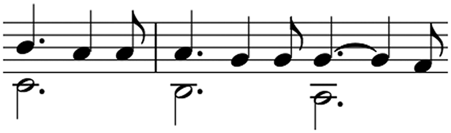
that has to go into the music. Help me put it in there! Now I see how much farther along you were back then than I was, for you could write [see Ex. 2] and I could not understand it, but believe me now, I am composing differently than I used to, and much more seriously.Footnote 83
Felix Mendelssohn, excerpt quoted in letter to Lindblad, 19? February 1828

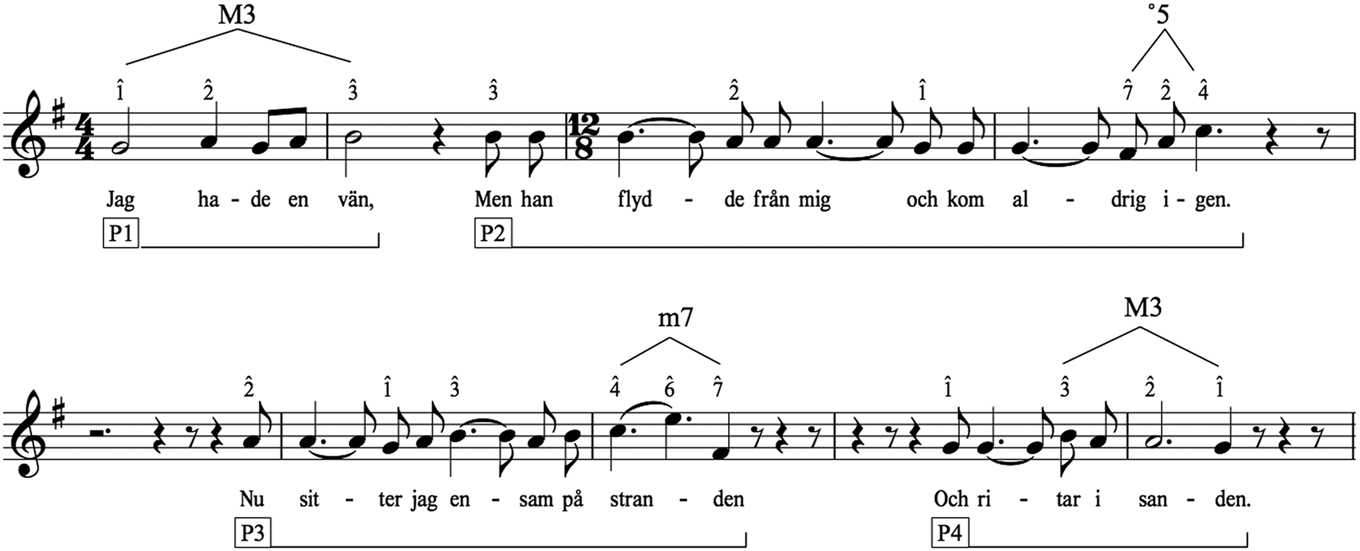
The quoted passage comes from the second phrase of Lindblad’s song ‘Saknad’ (‘Missing’, in the sense of ‘to miss something’), a song that displays a high degree of melodic unity in which each phrase grows directly out of the opening motive.Footnote 84 Just as Mendelssohn hears the ‘secret’ of the op. 131 quartet in the two notes of the rising D major octave at the beginning of the second movement, Lindblad plants the core melodic idea of his song in its opening phrase (P1), a five-note rising figure that spans a major third (Ex. 3).Footnote 85
Adolf Fredrik Lindblad, ‘Saknad’, melody, strophe 1

I had a friend, but he fled from me and never returned. / Now I sit alone at the shoreline, drawing in the sand.
Subsequent phrases unfold within the space of those same three scale degrees until the last three notes open to permit increasingly more space: the second phrase (P2) widens by a semitone in either direction to encompass a diminished fifth, while the end of the third phrase (P3) expands all the way to a minor seventh before the fourth and final phrase (P4), a near mirror reversal of the opening phrase (P1), narrows the range to the original three pitches. In hindsight, Mendelssohn sees in Lindblad’s song an attempt at the sort of unity he is now putting into his own compositions, such as the quartet in A minor, op. 13.
Although Mendelssohn and Lindblad reach toward Beethoven from opposing ends of his output, they find some common ground in the middle period. Mendelssohn relates to Lindblad his experience of walking along a street one night bellowing a few notes from the second movement of Beethoven’s quartet in E minor, op. 74 – which he calls ‘your’ Beethoven Adagio – so loudly as to attract the attention of people nearby. Ordinarily, Felix is not particularly drawn to the piece, but on this occasion, he is won over and feels the need to write to Lindblad that very evening:
Truly, Lindblad, I understand you and your Swedish songs and your A-flat major Adagio by Beethoven [he quotes another phrase from Beethoven op. 74 here] somewhat better now than I usually do. It is damned sentimental … It is the simplicity in the singing … it is an impression that speaks through the Beethovenian tones and often brings me to tears (inwardly).Footnote 86
Perhaps this same singing quality prompted Mendelssohn to out-Beethoven Beethoven, who had recently constructed a quartet movement around the motto-like question ‘Muss es sein?’ and its response: ‘Es muss sein’. Mendelssohn’s innovation is to use a complete Lied as the backbone of his string quartet in A minor, thereby spawning the most complete paper trail about specific compositions in the Lindblad correspondence: a decades-long journey that unfolds from song to quartet and back again to song, revealing a complex interplay between elements of two distinct genres. This group of related compositions – one quartet and three Lieder in all – also demonstrates how works from each composer reverberate in the life of the other.
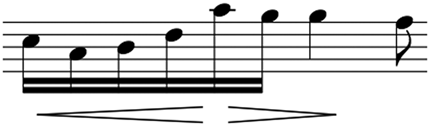
The exchange begins with a false start in 1827, when Mendelssohn announces that he is about to finish a violin quartet that is ‘sentimental enough to make you weep’.Footnote 87 A brief musical quotation (Ex. 4) inserted into the text of the letter, however, does not appear anywhere in the quartet itself, leaving poor Lindblad with a misleading first impression of the piece.Footnote 88
Mendelssohn, fragmentary quotation purportedly from string quartet in progress

Lindblad responds in short order – ‘How I long for your violin quartet!’Footnote 89 The A minor quartet, Mendelssohn’s first serious essay in the genre after an early quartet from 1823, came into being during the heady period of the publication of Beethoven’s final quartets; in particular, he completed the piece the month after SchlesingerFootnote 90 in Berlin published Beethoven’s quartet in F major, op. 135, to which Mendelssohn’s quartet is thoroughly indebted.Footnote 91 Mendelssohn’s approach is experimental in itself, in that the theme comes from a song he had written the previous year; as he tells Lindblad: ‘You will hear its notes speak in the first and last movements, and its sentiments in all four movements’.Footnote 92 The cyclical form of this quartet has been discussed at great length; according to Benedict Taylor, it is ‘the most thorough-going essay in cyclic form, both by Mendelssohn and by any composer to that time, until the late works of Franck at the very least’.Footnote 93 The song in question is titled ‘Frage’ (MWV K39, op. 9/1); the opening passage of the quartet incorporates the initial motive corresponding to the question ‘Is it true?’, while the finale ends with a near-verbatim statement of the second half of the song, wordlessly evoking the answer: ‘What I feel can only be understood by the one who feels it, too, and who remains true to me forever’ (Was ich fühle, das begreift nur, die es mitfühlt, und die treu mir ewig bleibt).Footnote 94
Lindblad immediately recognizes the quartet as being ‘taken from the mouth of Beethoven, or spoken from his soul, as the German puts it more beautifully’.Footnote 95 Going farther, he characterizes the quartet as ‘damned Beethovenesque’ (verflucht Beethovenesk), which to him is high praise; he observes that ‘musicians circle around the God of Composition and tickle him from all sides, but for how few of them of them does he open his eyes?’Footnote 96 Presumably, Mendelssohn is one of few who would be able to rouse the attention of the great god himself, through the depths of feeling in this quartet; yet these same elements of Beethovenian strangeness challenge Lindblad’s small circle of chamber music aficionados.Footnote 97 Without naming names, he reports that
the people understand [the quartet], as you can imagine, only partly, and partly they want more melody here and there … they speak of dissonances that are all too glaring, Beethoven-like noise, they are astonished over the development, they praise it highly and play it five times in a row.Footnote 98
The cry for more melody maps clearly onto the finale, where Beethoven’s technique of jagged instrumental recitative is superimposed upon a menacing tremolo on a fully diminished seventh, heightening the tension. Beethoven’s reputation as a noise-maker looms large, and not necessarily to his advantage, but Mendelssohn’s standing in Stockholm is already positive enough that his reputation can survive the progressive aspects of this quartet.
The second chapter in the chronicle of the song-quartet opens in 1836 with Lindblad’s seemingly unrelated account of stopping by the Mendelssohn family home in Berlin after visiting Felix in Frankfurt:
Your relatives in Berlin were somewhat worried about you because you had not written anything in four weeks. But while I was there, a letter came, and so they became reconciled with you again. The letter said something about a certain … what was her name?’Footnote 99
The family interrogates Lindblad about a mysterious woman in Frankfurt who had caught Felix’s attention.Footnote 100 Mendelssohn’s calendar-diary shows that he and Lindblad spent an evening together at the family home of Cécile Jeanrenaud two months before her engagement to Felix and long before any of his family had had the chance to meet her.Footnote 101 The connection between Lindblad’s anecdote and the quartet becomes clear the following summer when Lindblad congratulates Mendelssohn on his recent wedding: ‘Right around the time of my own wedding, I received a song in A major [‘Frage’] from you, which interwove itself so closely with that time, that I can never recall that time without thinking of the song, nor think of the song without remembering that time. And so I decided to write a song for you, too’.Footnote 102
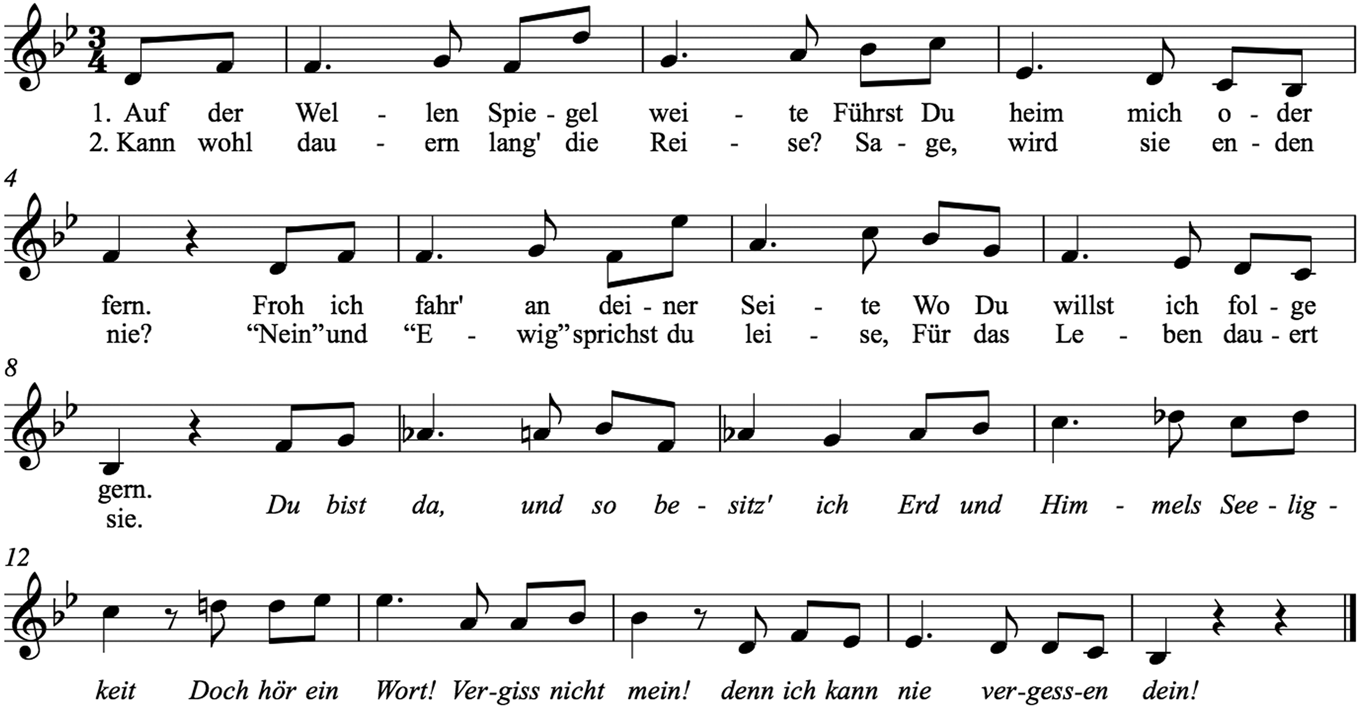
The song itself, which Lindblad encloses, has thus far largely escaped the attention of Mendelssohn and Lindblad scholars (see Ex. 5). In its published form in the first volume of Hirsch’s edition of Lindblad’s collected songs, the text is in Swedish, rather than the German version he sent to Mendelssohn, and no mention is made of any connection with the more famous composer.Footnote 103 Lindblad wrote the texts for a third of his 215 known songs, as he does here in ‘Für Ewig’.Footnote 104
Lindblad, ‘Für Ewig’, melody

On the mirror of the waves, Will the journey last a long time?,
whether you carry me home or to distant places, Tell me, will it never end?,
happily I travel at your side ‘No’ and ‘forever’, you say softly,
gladly following wherever you go. It will last a lifetime.
You are there, and so I possess,
the bliss of earth and heaven.
But hear one word! Forget me not!,
For I can never forget you.
Mendelssohn confirms the presence of Lindblad’s voice in the song, as a specific musical gesture conjures up a vision of the composer himself:
It is so entirely like you, and it is as if I could hear you singing. I even know the look on your face in a few spots, when it goes down to E♭, and then I wish twice as much that I could see and hear you with my own eyes and ears.Footnote 105
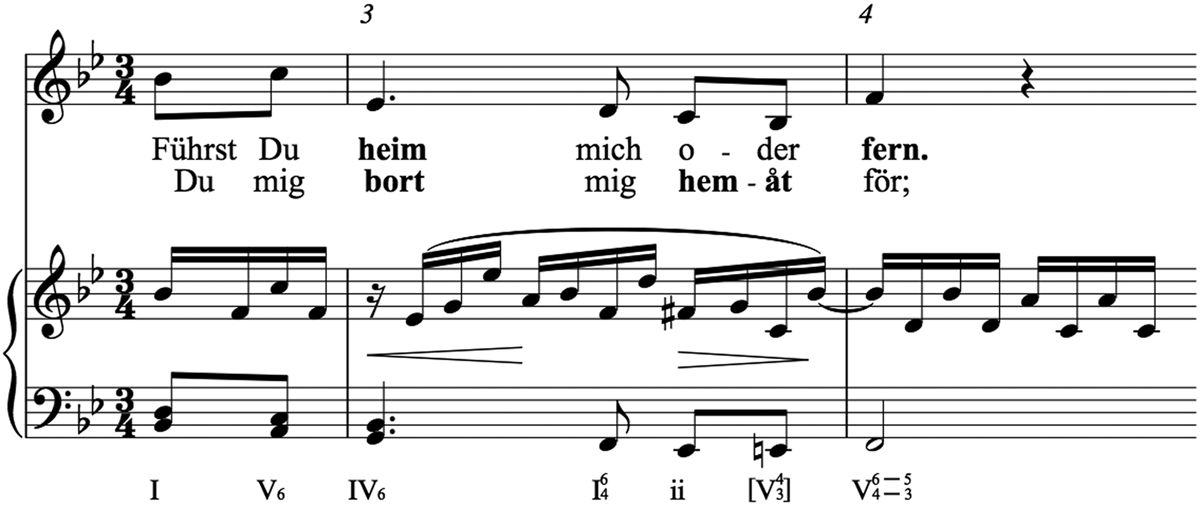
Assuming Lindblad wrote the Lied specifically for Felix, as he claims, the linguistic provenance of the text is an open question. Did he originally craft the text in his native tongue and then fashion a German translation, or did he first conceive of the poem auf Deutsch and only later translate it into Swedish for publication? In this line singled out by Mendelssohn as characteristically Lindblad, the Swedish text makes more effective use of the E♭ (Ex. 6, bar 3), notable both for its sizable melodic leap downwards as well as its harmonic retrogression from the dominant at the end of the previous bar to the subdominant on the downbeat of bar 3.
Lindblad, ‘Für Ewig’ / ‘För evigt’, bars 3–4, German and Swedish text underlay

In the German, the word heim (‘home’) lands precariously on the subdominant in first inversion, in stark contrast to the relative stability of fern (‘distant, afar’) on the dominant suspension at the end of the phrase. In the Swedish, however, the unexpected E♭ falls on the word bort (‘away’), while hemåt (‘homewards’) leads, if not directly to stability, at least briefly to the tonic with its stepwise descent to the first scale degree.
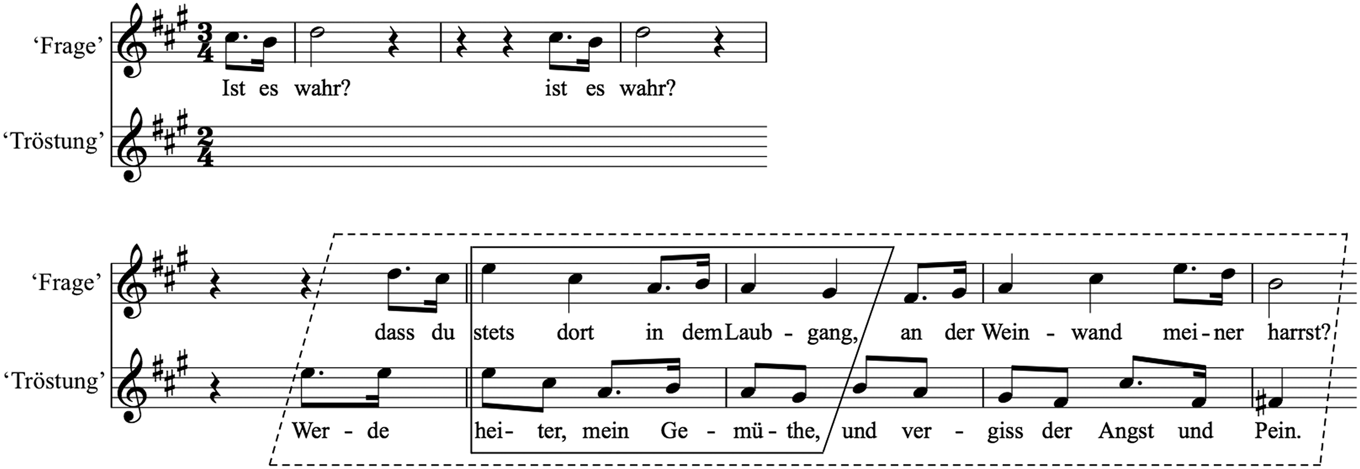
Ten years later, Mendelssohn has the last word in this remarkable correspondence. In January of 1847, he asks if Lindblad has any new compositions to send, in anticipation for which he encloses his own song ‘Tröstung’ (MWV K120). The first eight notes bear an uncanny resemblance to the first extended phrase in his earlier song ‘Frage’, as shown in Ex. 7.Footnote 106 When transposed up a tone, the pitch levels of the third through eighth notes in ‘Tröstung’ are identical to those of a corresponding passage in ‘Frage’ (see notes inside the solid line); in addition, the rhythms are remarkably similar despite the different metres and consist predominantly of two even notes at the beginning of each bar, followed by a dotted figure (notes inside the dotted line).
Mendelssohn, ‘Frage’, bars 1–8 and ‘Tröstung’, bars 1–4, comparison

Surely this brief correlation is a matter of coincidence; yet it is fitting that, two decades after the first song was shared through the mail, it again echoes in the opening contour of the last song shared. In hindsight, the closing lines of this letter are a moving testament to the end of an era. Felix writes: ‘My family here [in Leipzig] and my siblings in Berlin are well, thank heavens! Remain good to me, my dear, dear friend. I am, my whole life long, your friend, Felix Mendelssohn Bartholdy’.Footnote 107 Within a few months, Fanny would be gone, and Felix would follow soon after.
Mendelssohn’s early quartet on the song ‘Frage’ echoes the spirit of Beethoven’s late ‘Muss es sein?’ quartet. While Lindblad tells Mendelssohn that he wrote ‘Für Ewig’ in response to ‘Frage’ as a wedding present to Felix and Cécile, the song was never published with its German text, and no public dedication ever appeared. In contrast, Mendelssohn officially dedicated three of his works to a different Swede, who was both Lindblad’s musical inferior and social superior: his composition pupil, Crown Prince Oscar.
‘Making myself noble’: A Royal Dedication
Lindblad’s letters fill in a missing link in the process through which Mendelssohn’s op. 44 string quartets came to be dedicated to the Crown Prince of Sweden, thanks to a potentially serious social faux pas on Lindblad’s part. Mendelssohn first met Prince Oscar while visiting an art collection in Frankfurt; while entries in his Schreibkalender are disappointingly spare during this time period – not surprising, perhaps, for a newlywed on his honeymoon – Cécile records briefly in their honeymoon diary that on 4 June 1837, ‘Felix met the Crown Prince of Sweden in the Städel Institute’.Footnote 108 Two days later, they conversed again. After the fact, Mendelssohn shared a few details with Lindblad:
I spoke with your Crown Prince last summer in Frankfurt, where he addressed me and shared your greetings; I liked him very much, and he seemed to take an interest in you. Does he do so actively? and are you content and in harmony with your life in Stockholm? I wish you would write to me about all this’.Footnote 109
Mendelssohn knew that Lindblad gave regular instruction in composition to the prince – even helping him complete an opera left unfinished upon the death of composer Eduard Brendler in 1831 – and that Oscar had responded favourably to the Swedish premiere of the Sommernachtstraum overture in 1828.
When Mendelssohn hatched the idea of dedicating the set of three string quartets eventually published as op. 44 to Prince Oscar, the decision was far from simple.Footnote 110 As he had once explained to Ignaz Moscheles: ‘I usually do not think much of dedications, and I have rarely made any’, though he did not abstain from the practice altogether.Footnote 111 In this particular case, two potential candidates vied for prominence in his mind: Prince Oscar and Ferdinand David. Lea weighed in firmly on the side of the violinist: ‘A King David with his harp is worth more than all the Oscars after Ossian’; more pragmatically, however, she adds that if the latter were chosen, Wilhelm Benedicks (her late niece’s husband) could earn diamond rings from the affair – and that one could go to Cécile.Footnote 112 Ultimately, Mendelssohn sided with the royal option; as he joked to his brother Paul: ‘I’m becoming noble, as you can see’.Footnote 113 This dedication was neither his first nor his last association with royalty; Friedrich Wilhelm IV had already received the dedication for three overtures published in full score in 1835 (Sommernachtstraum, Die Hebriden, and Meeresstille und glückliche Fahrt), and similar honours were later bestowed upon Friedrich August II of Sachsen for the ‘Lobgesang’ Symphony in B-flat major (1840/1841) and Queen Victoria for the Symphony No. 3 in A minor (1842/1843).
A public dedication implies a relationship between the author and dedicatee.Footnote 114 Social codes demanded that Mendelssohn first secure the approval of his intended honouree, which was sometimes easier said than done, as he explains to Lindblad:
I would like to dedicate a piece to your Swedish Crown Prince, whom I met in Frankfurt last year and whose character pleased me well, if it does not require as formal an inquiry as it does here in Germany. If that is necessary in Sweden as well, and if I (for example) first must write a letter and beg for permission, then I would rather leave the whole thing alone.Footnote 115
Lindblad successfully served as intermediary in this potentially delicate negotiation, though not without causing himself a certain anxiety. Prince Oscar readily gave his permission with no mention of formalities (‘he bid me tell you that a dedication from such a distinguished composer would always flatter him’), which inadvertently put Lindblad into an embarrassing position:
This is how the matter stands now, and it just occurred to me, that I might have done something stupid and perhaps gone against your wishes by speaking with him about this; now it will be necessary for you to dedicate something to him, even though you might have preferred not to follow through with this.Footnote 116
Fortunately for Lindblad, Mendelssohn willingly followed through with his plan, and the quartets bear a dedication a son altesse royale Monsigneur le Prince Royal de Suede.Footnote 117 The year after this exchange, a newspaper advertisement for the quartets included the above phrase as part of the full title, making the dedication a matter of public record.Footnote 118 Two weeks after the composer’s death, an arrangement for piano, four hands was among some 20 such arrangements of various pieces by Mendelssohn advertised by an enterprising publisher and shopkeeper eager to promote his works for domestic consumption.Footnote 119
The first documented performance of an op. 44 string quartet in Sweden took place not in the capital, but rather in Gothenburg. While Lindblad and others were quick to champion Mendelssohn in Stockholm, residents of Sweden’s second city – a small commercial centre of c. 37,000 in 1860, compared to 112,000 in the capital – were slower to appreciate Mendelssohn’s breadth as a composer, according to Smetana, who lived and worked there for much of the period between 1856 and 1861.Footnote 120 In a letter to Liszt in 1857, he noted,
People are here continually firmly trapped in antediluvian artistic opinions. Mozart for them is the subject of unbounded admiration but at the same time they don’t understand him. They are frightened of Beethoven, they proclaim Mendelssohn as indigestible and they are unaware of any more recent composers … Here I have a splendid opportunity to work for progress and to cultivate the taste of the people and there is an impact which I could never have achieved in Prague.Footnote 121
Earlier that year, Smetana had already initiated a chamber music series (together with the violinist Josef Czapek and the cellist August Meissner) in which Mendelssohnian works figured prominently; audiences heard a cello sonata, both published piano trios and two piano quartets before the first known performance of an op. 44 quartet in Sweden, the quartet in E minor (MWV R28, op. 44/2), which took place in 1860.Footnote 122 Long after Smetana’s return to Prague, a performance of the third quartet from this set (E-flat major, MWV R30) in 1883 provides further evidence of attempts to raise levels of musical awareness in Gothenburg by elevating music from mere entertainment material to the status of inviolable works: an anonymous reviewer criticizes the omission of the final movement, invoking the ‘principle that a work of art of this type should not be split up’.Footnote 123
In Stockholm, the first member of the set (D major, MWV R26) triggered a more extensive review in 1875 by the renowned critic Adolf Lindgren.Footnote 124 In a retrospective account of the season’s chamber music series, Lindgren finds Mendelssohn to be somewhat less original than Schubert, Schumann and Chopin, but more technically capable and, thanks to his talent as well as his personality, an immeasurable influence on his musical era (musikaliska samtid). Lindgren discerns greater originality in the overtures, while the chamber music, including the D major quartet, shows off the composer’s ability to develop motives and construct harmonically balanced forms.
Mendelssohn’s joke to his brother, Paul, on the act of dedicating the quartets to Prince Oscar came true in a certain sense: he ascended to the musical nobility. In 1845, Mendelssohn was elected to the Royal Swedish Academy of Music; his orchestral, chamber and, above all, choral works were programmed increasingly often through the century; and he even posthumously returned to the general news in 1877, in the form of an announcement stating that the statutory period of copyright on his works had elapsed, thereby opening his catalogue to interested publishers.Footnote 125 The foundation for this widespread admiration of Mendelssohn in the second half of the century was laid by Adolf Fredrik Lindblad’s early advocacy in the 1830s and 1840s.
Reflections on Dreams Unfulfilled
Mendelssohn’s surviving letters to and from Adolf Fredrik Lindblad occupy only a small portion of the 5,855 outgoing and 7,000 incoming letters in his overall correspondence.Footnote 126 In comparison, for example, he maintained a much more robust exchange with the diplomat and poet Carl Klingemann, whose first letter to Felix was dated within a few months of Lindblad’s first letter; over the same 20 years, Mendelssohn sent 158 letters to and received 155 from Klingemann, more than ten times the volume of the Lindblad correspondence.Footnote 127 Numbers notwithstanding, the letters between Lindblad and Mendelssohn testify to a friendship that flourished in spite of – or, dare we speculate, because of – the thousand kilometres between them. Had Lindblad remained indefinitely in Berlin, they may well have drifted apart.
If Lindblad had never met Mendelssohn, the Swedish composer’s output would have been diminished, and the letters have shown how Mendelssohn’s reproach spurred Lindblad to learn to listen to his own critical voice. If Mendelssohn had never met Lindblad, the repercussions would have extended far beyond his merely having had one fewer friend. Without Lindblad’s imagined voice across the distance, Mendelssohn would have had one fewer trusted critic guiding his thoughts. Without the letter to Lindblad from early 1828, posterity would be deprived of his own detailed explanation of how the A minor string quartet was born of his infatuation with the late Beethoven quartets and his precise instructions regarding how his quartet is to be studied and performed.Footnote 128 Without Lindblad’s initiative, this quartet would never have realized its potential to return full circle to its origins by inspiring a new song.
What could Mendelssohn have achieved had he followed through on his intention to visit Sweden? On a personal level, he could have strengthened an old friendship with Lindblad, meeting his family as Lindblad had met his and making obsolete his typical closing phrase: ‘Give my regards to your wife, although we haven’t met.’ He could have provided a link to the old country for his late cousin’s Stockholm-born children. His reputation and career would surely have benefitted from a personal appearance, as major musical events in the musically isolated northern capital tended to be talked about for years to come. Perhaps his fantasy would have been inspired by the Norwegian highlands, which he ‘all too gladly longed to see’, and the orchestral repertory would have been blessed with a Norwegian Symphony or a Saga Overture even before Wagner’s infusion of Germanic epic poetry with Nordic legends appeared onstage at Bayreuth.Footnote 129
The greatest what-if of all involves the nature of Mendelssohn’s relationship with one of the most famous Swedes of the century, Jenny Lind. George Biddlecombe’s thorough investigation into this relationship concludes that evidence suggests Jenny Lind likely did possess secret love letters from Mendelssohn, which were discovered and burned upon her death.Footnote 130 While this research raises compelling questions about their personal lives and what might have happened had Mendelssohn lived longer, one cannot also help but wonder how Lind might have inspired Mendelssohn to engage with Swedish culture. Having heard her sing the folksongs she so famously promoted, what settings of his own might he have produced? Long before they met, he did set one text purportedly of Swedish origin (published as ‘Winterlied’, MWV K72, op. 19a/3 in 1833), although no original Swedish text has yet been identified as a source for the German poem. After writing the soprano part of Elijah specifically for the ‘Swedish Nightingale’, which Swedish poem or dramatic saga might have caught his attention? In the end, Mendelssohn’s plans of visiting Sweden proved, like the subject matter of his overture that became so popular in Stockholm, to be ‘No more yielding but a dream’. Today, however, through the voices of archival documents emerging from silence, his vision of journeying to the north lives once more in the imagination.
Appendix: Quotations from primary sources
‘[Med] en enthusiasm, det enda konstnärliga vehikel jag nånsin egt, hängaf jag mig åt denna läsning [Tyska skönlitteraturen]. – Ej dagarna blott, men äfven nätterna användes och, hur omethodisk jag altid varit, eger jag likväl ännu quar anteckningar och omdömen från denna tid, hvars intryck ha den egenskapen, att endast med svårighet kunna utplånas’ (note 28).
‘Den 9. Adolf var med Zelter hos Mendelsohns och hörde där musik, som förtjuste honom; isynnerhet af den unge adertonårige Felix Mendelsohn, Goethes och Zelters elev. – Det var då en rätt god bekantskap, som innerligt fägnade mig’ (note 30).
‘Sinfonie af Felix Mendelson. Häröver vore mycket att säga först till beröm och så till Tadel. Ändoch tror jag den gör rätthaft som hvarken gör det ena eller andra utan blott beundrar. Ty beundrans wärdt är det att en 17 års gosse skrifver en sådan Symfonie. – Det behöfdes att höra den många gånger efter hvartannat för att få reda på allt ty den var på intet vis “hohl” – tvärtom’ (note 31).
‘[Ich] seitdem ich in Berlin war über Musik kein gescheidteres Wort als mein eigenes gehört habe’ (note 46).
‘Componiren thue ich eifriger wie je und unbefangen. Einen Kreis der sich dafür interessiert, das vermisse ich noch, aber darum übe ich mich im Stillen und bin mehr wie jemals mein eigener Geschmacksrath und Richter’ (note 47).
‘Ich habe es so oft durchgelesen und durchgespielt (wenn nähmlich meine Art zu spielen diessen Nahmen verdienen kann) dass ich es fast ganz auswendig weiss, welches bey mir viel ist, denn so genau kann ich selbst meine eigene Sachen nicht’ (note 54).
‘welches mir ganz ausserordentlich gefällt wegen den sehr warmen Ausdruck der darin liegt’ (note 55).
‘ging schlecht, nach den Umständen aber gut’ and ‘Gefallen hat sie, im Allgemeinen, sehr’ (note 59).
‘[Die Ouverture] fand mehrere Enthusiasten unter meinen Freunden, die ich mit langen Vorreden zur Opposition gegen Dich geweckt hatten [sic], (so schaden immer die Freunden dem Künstler fast mehr, als die Feinden)’ (note 60).
‘[D]en unge lofvande Felix Mendelson Bartholdys [Ouverture] till Shakespeares Midsommer-night’s dream, en högst genialisk och originell komposition och som hos sin författare röjer både en rik fantasi och en förståndig uppfattning af ämnet, således alla anlag till en stor tonsättare’ (note 61).
‘Der Composition von dem zum Glücke Gebohrenen (Felix) hat mir und alle Feunde wahrer und guter Musik, die unsere kleine Hauptstadt verhältnißmäßig nicht weniger zählt als andere grössere, eine unaussprechliche Freude gewährt’ (note 65).
‘Vi tillstå, att vi, sedan fru Dulcken här lät höra sig, aldrig hört pianot behandlas mera musikaliskt’ (note 67).
‘Die wieder aufgefrischten Geister … [haben] eine schöne Vergang[en]heit mit einer schönen Gegenwart in einem Bilde zusammengedrängt wovon ich mit jemanden aus jener unvergesslichen Zeit reden möchte’ (note 68).
‘[M]ir selbst die Last einer übergrossen Freude … zu entladen’ (note 69).
‘Sie ist nicht in einem nagelneuen Beethovenschen Stil geschrieben sondern ungefähr von der Art wie seine C dur oder D dur Sinphonien von welchen ich weiss daß du, früher wenigstens, nicht viel hieltest’ (note 73).
‘Mir war es aber, als Anfänger, nöthig eine bestimtere und nicht unpopuläre form zu wählen’ (note 74).
‘Auch bin ich durch viele Stunden geben etwas trockener geworden – oder altväterisch (orthodox)’ (note 75).
‘Wie sehne ich mich nach deinen violin Quartett!’ (note 89).
‘[D]as Ganze ist dem Beethoven aus dem Munde genommen oder aus der Seele gesprochen, wie der Deutsche schöner sagt’ (note 95).
‘[V]erflucht Beethovenesk’. ‘Die Musiker gehen um den Goth der Tonkunst herum und kitzeln ihn von allen Seiten. Wie wenigen aber thut er die Augen auf?’ (note 96).
‘Die Leute verstehen dies, wie Du es denken kannst nur halb und halb wollen hie und da mehr Melodie … sprechen von gar zu grellen Dissonanzen, Beethovensche Lärm, staunen insgesamt über die Durchführung, loben es sehr und spielen es fünf Mal nach einander’ (note 98).
‘Deine Verwandten in Berlin waren etwas besorgt über Dich da Du in 4 Wochen nichts geschrieben. Während ich da war kam aber einen Brief an und so wurden sie wieder ausgesöhnt mit Dir. In jenem Briefe steht geschrieben von einer gewissen … wie hat sie geheißen?’ (note 99).
‘[Es] kam gerade zur Zeit meiner eigene Heirath ein Lied um Dir aus A dur [quotes incipit here] an, welches sich mit jener Zeit so einwebte dass ich jene Zeit niemals ohne den Lied und das Lied niemals ohne jene Zeit mir denken kann. So bin ich darauf gekommen auch für Dich ein Lied zu schreiben’ (note 102).
‘So steht diesse Sache jetzt und eben fällt mir ein, ich habe es dennoch dumm gemacht, und vielleicht gegen deinem Wunsche da ich ihm über diesse Sache gesprochen; denn nun wird es nöthig seyn dass Du Ihm etwas didicerest was Du vielleicht lieber wolltest noch wäre in der Wahl stehen geblieben’ (note 116).
‘principen att ett konstverk af denna art ej bör delas’ (note 123).