Inevitably, when writing about Cold War musical diplomacy, scholars have focused on the Superpowers: the United States and the Soviet Union.Footnote 1 Yet within these more traditional frameworks of exchange, a wider application of what cultural diplomacy might mean has emerged in recent years. Danielle Fosler-Lussier explains traditional forms of musical diplomacy (such as tours and artistic exchanges meant to foster goodwill and a not-always-friendly spirit of competition) involved both imperialist efforts of extending power abroad and globalizing tendencies of changing cultural economies.Footnote 2 British efforts in this regard actually focused on two spheres of influence: the Soviet bloc was one, but the other was the Commonwealth.Footnote 3 In this article, I explore the ways in which Britain, through the medium of the British Broadcasting Corporation (BBC) and the programme Commonwealth of Song, exported an idea of ‘Britishness’ across the Commonwealth in the post-war era while simultaneously projecting a narrow understanding of the Commonwealth to the British public. I argue that, notwithstanding the fact that this enactment of cultural identity was transmitted within a friendly network of nations, the BBC strongly engaged in cultural diplomacy through this programme. I also contend that, though the BBC's intentions probably seemed benign, even enlightened, at the time of broadcast, many of their assumptions and decisions now seem clearly shaped by colonial attitudes which, moreover, were apparent to their Commonwealth listeners, but whose protests were ignored.
Above tours and exchanges, Britain prioritized radio and broadcast media as a diplomatic tool to teach the public – globally and domestically – the nation's specific brand of internationalist values, particularly regarding the Commonwealth, the voluntary collective of current and former colonial holdings. Media scholars Simon J. Potter, Alban Webb, and Thomas Hajkowski have demonstrated how BBC radio shaped Britain's global image across the twentieth century, though this scholarship draws almost exclusively on news programming.Footnote 4 Similarly, musicologists Christina L. Baade and Jenny Doctor maintain that early twentieth-century BBC music broadcasting served a related function, delineating proper British taste for classical and popular music alike.Footnote 5 As Hajkowski writes, drawing on Benedict Anderson's ideas, ‘The BBC reinforced British national identity in the United Kingdom merely by creating a community of “British listeners” from Land's End to Londonderry.’Footnote 6 This was particularly important for more nebulous concepts, such as the Commonwealth, which had ill-defined values and aims in the early 1950s. As Adrienne Munich argues in reference to Queen Elizabeth II's imperial radio addresses, ‘The concept of “Commonwealth” depends in part on the will of people to believe in it and follows few coherent paradigms as a whole; the queen's voiceover creates a disjunctive fantasy that is no less effective for its illogicality in answering a culturally constructed desire.’Footnote 7 This ‘disjunctive fantasy’ extended beyond the sovereign's voice, with all radio broadcasting encouraging listeners to take part in an exercise of performing Britishness – and, to an extent, Commonwealth-ness.
The BBC had a long history of including educational and entertaining content about Britain's global reach on the airwaves. Early examples, such as the 1929 Empire Vaudeville or Brush Up Your Empire of the 1940s, invited listeners to compare various local cultures with that of metropolitan Britain.Footnote 8 Others, such as the literary programme Caribbean Voices (1943–58), highlighted for British citizens the cultural achievements of a particular geographic area while simultaneously giving the formerly colonized a voice and validation by an established global institution.Footnote 9 The BBC even transmitted Commonwealth-themed concerts by venerable institutions, such as the London Symphony Orchestra's Commonwealth Day Concert in 1959.Footnote 10 There is also a long history of non-radio propaganda produced by governmental and extra-governmental bodies designed to bolster Britain's geopolitical agenda. Domestic propaganda, such as that described in Sir Stephen Tallents's The Projection of England, asserted the supremacy of British values.Footnote 11 On the global side, the British Council's Empire Division director described their aim as being ‘to project or interpret abroad British life and thought, the history and traditions of Britain and its modern progress and achievements, British political institutions and social services, our arts, our sciences, our industries, and even our sports – in short, the British way of life’.Footnote 12 The British government stressed the Commonwealth's value because British citizens were reluctant to form cultural bonds within the collective, with the Commonwealth Relations Office concluding in 1958 that many citizens ‘take the Commonwealth for granted’.Footnote 13 This charge of looking beyond Britain's shores was difficult because of the cultural ‘inward turn’ taking place in the early to mid-twentieth century; Jed Esty describes how many authors – from Virginia Woolf to J. R. R. Tolkien – turned to local history and culture for inspiration, in part to shield against the shame of imperial decline.Footnote 14 Heather Wiebe has further demonstrated the ‘inward turn’ narrative's applicability to British music studies through her analysis of Britten's post-war music.Footnote 15
Music broadcasting served as an important tool in attempting to shape how British citizens thought of the Commonwealth, with the most influential programme being Commonwealth of Song, running from 1953 to 1961. The series featured musicians from across the British world – from the self-governing white Dominions (e.g., Canada and Australia) to the African colonies (e.g., Nigeria and the Gold Coast, now Ghana) performing light classical fare and occasionally music from the performers’ homelands, all while engaging in playful dialogue under the watchful eye of a (usually British) musical moderator. The series was recorded in the style of a live concert but was subsequently transmitted with minimal editing to clean up pauses and dialogue rather than censor musical content.Footnote 16 Throughout the series’ nine-year run, BBC administrators and government officers alike considered the programme instrumental in reinforcing ideas of the Commonwealth as a friendlier successor to the Empire. This was possible due to the series's wide reach, being broadcast on the Light Programme and the English-language General Overseas Service (GOS). The Light Programme, founded in 1945, primarily broadcasted popular, established entertainment for the masses in Britain and was the lowest level in the BBC's hierarchal strategy intended to promote cultural uplift.Footnote 17 The BBC described the Light Programme as ‘more “easy listening” in general, designed to appeal not so much to a certain class of listener but to all listeners when they are in certain moods’.Footnote 18 Including Commonwealth content on the Light Programme was important for raising awareness of Britain's geopolitical commitments in the mid-century; by including Commonwealth information on the lowest rung of the BBC structure, the corporation could meet the listening public even when they were looking to relax. On the other hand, the GOS, which succeeded the Empire Service in 1939, highlighted the British perspective on global news and cultural developments for the world at large, though its target audience in the 1950s was Commonwealth nations.Footnote 19 By broadcasting Commonwealth of Song on separate services, the BBC sought multiple diplomatic aims. For British citizens listening on the Light Programme, the series was to teach them about how Commonwealth citizens outside Britain were just like them. For Commonwealth citizens outside the metropole, the programme aimed to prove that the United Kingdom valued Commonwealth citizens as cultural actors in the British world. These goals were based on the deceptive notion that the Commonwealth was a community of equals, when in fact the Commonwealth of the 1950s was moulded and dominated by British concerns, acting as an extension of the Victorian ideal of Greater Britain.Footnote 20 As historian Philip Murphy notes, in the early 1950s, many politicians and administrators saw the Commonwealth as a ‘Family’ united by British values (notably freedom and cooperation), with the monarch as ‘Head of the Commonwealth’.Footnote 21 Thus, Commonwealth of Song's intentions often contradicted each other, muddling the messages for both audiences. If anything, the programme's musical content, which drew almost exclusively from British light entertainment taste, reinforced a British projection of the Commonwealth as a body venerating metropolitan culture.
Commonwealth of Song stands apart from its precursors and contemporaries due to its comparative approach when it was increasingly unpopular for British institutions to lump current and former imperial holdings under a single banner. This was possible because nearly every performer on Commonwealth of Song shared a citizenship marker: Citizen of the United Kingdom and Colonies, a designation that individuals held in addition to a citizenship based on birth nation and created by the 1948 British Nationality Act.Footnote 22 Rather than stress that Britain had the best musicians or composers, Commonwealth of Song insisted that British taste aligned with the values Commonwealth citizens should strive towards.
In this article, I document Commonwealth of Song's history to highlight changing and competing forms of Britishness during the fall of the British Empire. Drawing on written records from the BBC Written Archives Centre and the National Archives, Kew, I reconstruct the series to demonstrate how it reflected institutional views on the Commonwealth and supported a particular diplomatic mission, one focused on a simultaneously national and global identity – a domestic diplomacy unique to Britain's Cold War concerns. In doing so, I call attention to two associated points of tension: between performers and their repertoire (the programme's content), and between domestic and global audiences (the programme's listenership). The former, I contend, created questions about what the BBC should emphasize: a performer's nationality or the music one performed. These questions centred on race, class, and the looming threat of Americanization. The latter tension made it difficult to answer content questions as the domestic and global listenership each fostered unique diplomatic aims.
The history I present reveals how British citizens’ views of the Commonwealth and its musical simulacra formed, as well as how programmers believed music could palliate Britain's geopolitical turmoil. I argue that Commonwealth of Song became a site for testing new sonic constructions of globally minded Britishness in the 1950s, yet conflicting messaging fostered uneven programming and a lukewarm response. In documenting these disputes, I highlight the distinctive ways in which the BBC tried teaching a new version of British geopolitical identity at the Empire's twilight; in doing so, I present a new way of thinking through problems of musical diplomacy and representation, especially in cases of overlapping identities, such as the Commonwealth.
Nothing ventured, nothing gained
From the start, the BBC saw Commonwealth of Song serving a political purpose. In April 1953, J. H. Davidson, the BBC assistant head of variety music programmes, wrote to Donald MacLean, an Australian music producer working for the BBC, suggesting an ensemble from the Gilbert and Ellice Islands (now Kiribati and Tuvalu, respectively) for a programme MacLean was assembling.Footnote 23 Nine months earlier, the Overseas Talks Department urged Davidson to use these Gilbertese musicians to make artistic programmes for South Pacific broadcasting.Footnote 24 This idea became Commonwealth of Song, which from the beginning brought musicians from one of the most remote British holdings into dialogue with metropolitan performers to foster community. The BBC allocated £200 per episode (equivalent to approximately £5,950 in 2022) for the series, which was to last six weeks. This amount was high, but not unusually so, allowing the BBC to book emerging talent and the occasional big name. With its eclectic mix of middle-of-the-road music, Commonwealth of Song fitted neatly into the Light Programme docket. In this conception, there was a host and musical soloist who was the primary draw, changing each week, and always from one of the white-settler Dominions. This structure mirrored the Commonwealth's make-up, where all nations were supposedly equal, yet certain nations had more autonomy. The series would also feature the Johnston Singers, a small orchestra, a Māori quartet, and potentially one other vocalist each week. MacLean suggested numerous hosts, all proven white male performers.Footnote 25 Using established musicians (especially white men) created a credible air and reinforced existing Commonwealth power structures. Furthermore, by simultaneously highlighting new talent, the producers followed the series's mandate of showcasing emerging Commonwealth performers.
Quickly, however, producers reorganized the series. Instead of a new host each week, British singer Robert Easton served as permanent figurehead, with other Commonwealth guests joining to round out the programme.Footnote 26 MacLean did not record a reason for this change, which could have been driven by several practical factors; at the very least, having a stable and popular host would lead to a better sense of identity for the series. In the new layout, the host would sing fewer songs, but would serve as an interlocutor, discussing music with many Commonwealth musicians, rather than just one or two other performers each week. Perhaps inadvertently, this change represented a massive shift in geopolitical intention within Commonwealth of Song. Rather than presenting the Commonwealth as a community of equals by rotating host duties between Commonwealth representatives, the BBC chose a white, native-born British citizen as moderator, asserting a cultural paternalism over the assembly. Not only would a British musician receive top billing, but so would a British voice.
With Commonwealth of Song's global focus, the BBC decided to record the programme for subsequent GOS broadcast as it assumed audiences outside of Britain would enjoy the same content as listeners at home. The BBC further stressed the programme's global relevance in promotional materials, with the BBC magazine the Radio Times printing the following in preparation for the first broadcast: ‘The programme Commonwealth of Song (Light, Sunday) is the first of a Coronation Series designed to reflect the music of Commonwealth countries. The host and representative of Britain will be Robert Easton; Australia will be represented by Patricia Baird; Canada by Edmund Hockridge; South Africa by Eve Boswell; and the West Indies by George Browne.’Footnote 27 The Coronation connection is not surprising: as Wendy Webster and Jan Morris have claimed, the event was an important moment for the Commonwealth, highlighting the young monarch's role in exerting British influence in global affairs.Footnote 28
The BBC relied on audience research to ensure programme quality and listener enjoyment, with administrators eager for feedback.Footnote 29 Listener reports following the premiere were strong: the head of audience research reported an Appreciation Index of 66 (out of 100), with a listening figure of 7 per cent of the Light Programme's total listenership – solid numbers for a new programme.Footnote 30 Audience Research used a listener panel survey to arrive at these numbers; the survey included a required grade for the programme (on an A+ to C- scale), plus specific questions about the host and musical selections.Footnote 31 Unfortunately for modern researchers, the collected surveys were not kept, replaced with periodic summaries from Audience Research. As such, the data are primarily quantitative, focusing on listenership and general enjoyment, omitting detailed information from listeners noting what they enjoyed about the programme. There is no record of listener demographics either, making it difficult to determine the BBC's imagined audience. As Thomas Hajkowski notes, this lacuna makes studying programmes from a listener perspective difficult, meaning one must consider audience reports in tandem with producer notes and commentary.Footnote 32
With favourable reviews, administrators continually moulded the programme to portray a friendly musical Commonwealth emphasizing British culture. After the first broadcast, Davidson wrote to MacLean outlining eight primary ways that future Commonwealth of Song broadcasts could improve. Davidson stressed that in future programmes MacLean should ‘seek the emergence of the personalities of the performers over and above their singing performance’.Footnote 33 Focusing on personalities would strengthen connections between the Commonwealth performer and his or her British audience, with listeners hopefully hearing a potential friend from across the Commonwealth. Other points concerned repertoire. Davidson wanted to insert a vocal number representing Britain, as well as additional duets and trios so performers of different nations could sing together to model Commonwealth cooperation. Davidson suggested Gilbert and Sullivan operettas as ideal, likely for their bountiful numbers for multiple performers and potentially their implicit Englishness. Davidson's final concern was ‘intelligibility of dialogue’. This issue could refer to audio levels, as another listed concern was maintaining clarity from the control booth.Footnote 34 More likely, however, is that this comment related to including a diverse range of accents from across the British world. The BBC has a long history of dictating radio presenters’ proper accent (‘received pronunciation’), so it would not be surprising if including speakers from across the world proved concerning for producers, particularly for a Light Programme series.Footnote 35 In addition to Davidson's recommendations, MacLean suggested that the musical guests introduce each other, promoting a ‘family feel’, perhaps a reference to the ‘Commonwealth family’.Footnote 36 The changes worked on some level, as the series's listening figures and Appreciation Index rose. What is unknown is whether these increases related to audiences appreciating any political ideals in the programme. A ‘Listener Research Report’ from 1953 showed that most listeners enjoyed the musical selections.Footnote 37 Evidently the BBC believed they could retain their audience, as the network extended the series's run for an additional thirteen weeks.
This initial series also brought about the first concerns regarding musical representation, as musicians apparently strove for performance authenticity on Commonwealth of Song, though what counted as ‘authentic’ varied from person to person. The Light Programme controller, H. Rooney Pelletier, wrote to Davidson noting that the orchestra insisted on giving an ‘authentic’ performance of a Gilbertese folk song for an upcoming broadcast, though what that may have meant in practice is impossible to determine. Pelletier disagreed with the orchestra as he believed the piece would work better as ‘the raw material for a novelty contribution’ and urged producers to have a staff arranger adapt the tune.Footnote 38 MacLean would have sided with Pelletier as ‘For [Commonwealth of Song's] purpose it would matter not at all that the result was far removed from the original.’ Ultimately the piece was cut as MacLean held that ‘it's not [interesting] – and there's no entertainment value in the most evocative and colourful background story if the tune doesn't appeal’.Footnote 39 This comment raises the question: appeal to whom? The Light Programme broadcasted a mix of musical styles with a goal of reaching a British audience when looking to relax. Thus, as part of the Light Programme docket, Commonwealth of Song had to fit a certain aesthetic and appeal to the imagined listenership.
Perhaps surprisingly, promoting a geographic range of performers was not an immediate concern. While programmers asserted that Commonwealth of Song featured music from ‘four corners of our Commonwealth of Nations’, for much of this first run, the BBC consistently represented the same four corners: Australia, Canada, the West Indies, and South Africa, using only white performers. The Dominions were the Commonwealth locales most important in representing the British world, though the BBC featured a generic ‘West Indies’ across the broadcasts. Furthermore, when the series featured Black, Asian, and Minority Ethnic (BAME) performers, the BBC was prone to a studied oversight in description and representation. In late July 1953, South Africa's white representative, Eve Boswell, left, creating a need for another female singer, preferably one to represent an African Commonwealth state.Footnote 40 Jazz singer Marion Williams (not to be confused with the American gospel singer of the same name) eventually took that spot. Initial memos describe Williams as representing the West Indies; Williams, however, was born in London and had mixed Nigerian and Irish heritage.Footnote 41 The BBC corrected her billing in the Radio Times, listing her as representing Nigeria.Footnote 42 One cannot be sure of the reason for this billing confusion, though until Williams joined the line-up, the only BAME performers on Commonwealth of Song represented the West Indies and all African representatives were white South Africans; perhaps the mix up was caused by an assumption that this trend would continue. This descriptive error, as well as the BBC's continual blunder of reducing individuals with heritages that resist single markers down to simple national labels, highlights a noticeable level of fungibility among BAME performers on the series.
By so heavily featuring white performers from the Dominions - locales with large populations with British heritage – the BBC promoted the idea of a Britain-forward Commonwealth.Footnote 43 Even so, producers occasionally augmented the line-up with indigenous Dominion performers. For example, in both the 9 August and the 16 August broadcasts, a group of Māori musicians, The N.Z.-ers, represented New Zealand. The group performed traditional Māori songs and were scheduled to perform a piece by an officer-cum-ethnomusicologist, a Colonel Laxton of Auckland, though this piece was dropped due to poor recording quality.Footnote 44 Even when highlighting the range of musical styles present in the Dominions, the spectre of Empire hovered in the background – in this case via the colonialist underpinnings of song collecting.
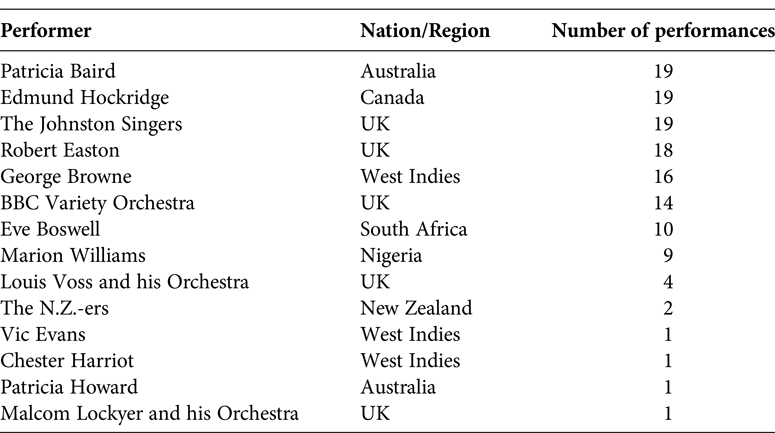
In total, Commonwealth of Song featured fourteen performers or ensembles from seven nations/regions in this initial run. The locale most featured was unsurprisingly Britain, with the Radio Times describing 41.4 per cent of performers as British (see Table 1 for a breakdown of performers on the first series). While there were more foreign performers than British ones, British performers were the dominant group. This command is clearer when one considers that Robert Easton hosted for all but one broadcast and the backing orchestra was always a British ensemble. These statistics, coupled with the fact that most non-British performers hailed from the Dominions and thus had a seemingly stronger connection with Britain, demonstrate that producers shaped Commonwealth of Song's version of Commonwealth music with Britain in mind. Yet when one considers the BBC's original concept for Commonwealth of Song as a Light Programme series introducing British citizens to their Commonwealth brethren through music, this is hardly surprising. If anything, it likely was the best way to complete the diplomatic mission of getting listeners in Britain interested in the larger world by letting them hear Commonwealth citizens who looked like them, performed music they liked, and just happened to live on the other side of the globe.
Performers on the first series of Commonwealth of Song, 17 May–20 September 1953. Data from Radio Times

Why would a Commonwealth musician want to appear on this new, untested programme? One could not get rich from a string of performances on the series; most guest soloists received around £7 for each appearance (approximately £208 in 2022).Footnote 45 This was not a small sum, but certainly not enough to support oneself for an extended period. As Peter J. Kalliney notes regarding Commonwealth writers, many accepted entry-level positions well below their skill level at well-respected organizations – including the BBC – because the job represented some form of establishment recognition.Footnote 46 Nobel Prize winner V. S. Naipaul recounts that he began working on his first book, Miguel Street, on BBC letterhead as it felt ‘less likely to attract failure’.Footnote 47 Cultural capital, of course, will not keep food on the table. The BAME writers Kalliney discusses faced a much higher bar to receive cultural recognition than white Dominion singers featured on Commonwealth of Song. Prestige was attached to representing one's nation on the world's largest radio network.
Commonwealth of Song was a regular presence on the Light Programme and the GOS throughout the summer of 1953 until the spring of 1954.Footnote 48 It was serving a diplomatic mission, using light music to communicate British values such as cooperation to the Commonwealth while humanizing the collective to British citizens who remained largely indifferent. Commonwealth of Song thus fits neatly with other cultural programming of the Coronation era, where British citizens experienced a surge in national culture alongside flattened representations of imperial siblings. A Britain-led Commonwealth signalled British culture's importance in certain places around the globe. While Commonwealth of Song reflected the Coronation ethos, the BBC quickly found it relevant to the changing political landscape of the mid-1950s.
Finding a niche
Before returning to regularly scheduled programming, Commonwealth of Song appeared in an experimental form for four weeks, again testing the Commonwealth's sonic identity. In December 1954, this new version ran on the GOS with simultaneous broadcast on the Light Programme, a shift in intended audience from the original series. Rather than targeting audiences in Britain, producers envisioned this Commonwealth of Song season for audiences across the Commonwealth. The BBC's presumed GOS audience was even more homogenized than the Light Programme, with the network targeting English speakers from across the globe, particularly those in former and current British colonial holdings. With such a massive target, it is not surprising that nuanced presentation became lost at times. In addition to a new primary audience, the new Commonwealth of Song series highlighted a new set of musicians; rather than established singers, producers turned their microphones to student groups from universities around the world. These students showcased the future of music across the Commonwealth, while also emphasizing the Commonwealth's humanity, putting a face (or rather, a voice) to its potential. These ensembles embodied a broader geographic range of the Commonwealth, featuring groups from the Dominions, as well as locations such as Ceylon (now Sri Lanka), Nigeria, India, and the Gold Coast (now Ghana). The BBC's goal was to prompt comparisons across nations and genres; producer David Jones stressed the seeming universality of the student experience (plus the universal nature of musical pleasure), asserting ‘there is one thing that the students have in common without a doubt – an obvious enjoyment in singing’.Footnote 49
There was also a return of the initial Commonwealth of Song concept. In early 1955, the GOS began planning a run for the second quarter, with the network booking many of the same performers from previous years. Yet there was a key difference: unlike the initial version, this iteration originated on the GOS and ran exclusively without subsequent Light Programme broadcasts. This decision demonstrates how administrators saw Commonwealth of Song as more than light entertainment, it was also a series of geopolitical importance. Listeners in Britain could tune in, yet the series's primary intended audience was the broader Commonwealth. As the intended audience shifted away from British citizens, the format and musical make-up remained the same. The programme's raison d’être became one of demonstrating musical talent, as well as boasting British cultural openness, proving to the world that listeners in Britain could turn their ears towards the Commonwealth, even if the music resembled that heard on British airwaves. The BBC did not alter the format to feature a broader range of musical styles, emphasizing that the Corporation believed the programme's limited repertoire spoke to local and global audiences alike.
Quickly, global audiences complained about the BBC's representational bias. The network's Delhi representative, Derek J. G. Holroyde, wrote an impassioned letter to the GOS head, asking that Commonwealth of Song feature musicians who epitomized India's artistic heritage:
I see that India is represented by a Tony Brent who is described as a ‘swing-singer’ … [Y]ou will hardly need me to tell you, after your experiences out here, that this is about as un-Indian an item as you can possibly find. It is little things like this that make people in India feel that Britain is only really able to conceive of a Commonwealth along Western lines and prefers to ignore all the indigenous artistic expression and talent that is truly representative of these Asian members of the Commonwealth. Mr. Brent is relatively unimportant, but I shall have completely failed in everything I believe to be right if I don't continue to urge that, whenever possible, genuine Indian contributions should be sought for programmes like this instead of dragging in the name of India by attaching it to an item that is so unrepresentative. It is no compliment to India – indeed it is almost an insult – and is a gross and distorted use of the word ‘Commonwealth’. Please accept this point in the spirit in which it is made. I know you will be well aware now of the complete misrepresentation which this kind of thing typifies.Footnote 50
For Holroyde, having a musician perform swing under the banner of ‘India’ misrepresented one of the Commonwealth's most important members. To have Brent, a white performer, heard across the British world representing India obfuscated the nation's ancient musical traditions. One must, at the very least, question the ability of a single musician to represent India, considering the range of styles emanating from the subcontinent. The homogenizing gesture of having one artist represent an entire nation – an identifying feature of Commonwealth of Song – is central to modern critiques of tokenism. Authenticity and nuanced representation were not principal concerns for Light Programme officials, but Holroyde's letter demonstrates their importance for those whose cultures the Light Programme had erased.
The representational situation was further compounded by India's importance to Britain's Cold War strategy. The idea of India crafting alliances beyond Britain became increasingly likely following India participating at the Bandung Conference in April 1955, a precursor to the Non-Aligned Movement forming in 1961.Footnote 51 It became essential for the United Kingdom to maintain strong ties with what had been the crown jewel of the Empire, now a growing independent power. Holroyde indicates that Brent himself was not the issue, nor was Commonwealth of Song as a concept. Rather it was the general feeling of malcontent due to British media organizations ignoring the ‘indigenous artistic expression and talent’ from Asian Commonwealth nations. Of course, Western popular music, including jazz, has a long history in India.Footnote 52 Born in Bombay during the Raj, Brent was of British descent and moved to London in 1947 to pursue a career as a pop singer. So for Holroyde, while Brent was of India, he was not Indian. These distinctions were important for Commonwealth states across the world. With the Cold War and the Non-Aligned Movement continually threatening Britain's alliances, it was essential for the nation to fight the perception of being a power-hungry state driven to maintain its realms at any cost.
Holroyde understood that ‘Britain … conceiv[ing] of a Commonwealth along western lines’ was insulting to the people of India and other Asian Commonwealth states, yet monocultural suppositions were essential to Commonwealth of Song.Footnote 53 The series arose from the BBC assuming a shared taste for music popular in Britain performed by talent from across the Commonwealth, to be appreciated by a presumed compliant audience. While earlier runs of the show certainly highlighted singers from around the British world, the musical content derived almost entirely from Western traditions, particularly light classical and popular musics. On Commonwealth of Song, the BBC emphasized a British understanding of the Commonwealth: a body venerating metropolitan culture and its spread across the globe. Holroyde's letter, however, indicates some Commonwealth citizens desired a Commonwealth celebrating diasporic cultures from the former colonies.
Upon Commonwealth of Song's return in summer 1956, the Radio Times listed a Commonwealth nation or region alongside each performer's name. The BBC's groupings of singers were reductive, diluting musicians and their art to a national label, with that label's purpose shifting with the BBC's whims or with the availability of singers themselves. Furthermore, the BBC would typically only accept a musician as representing the Commonwealth if he or she performed standard Light Programme musical offerings, thus ruling out vast swathes of national musical cultures under the assumption that only the ‘British’ idioms would transcend national borders. A tension thus arose between ‘diverse’ musicians and mainstream music in the sonic make-up of Commonwealth of Song.Footnote 54 In short, it was people, not music, who were chosen to represent nations of the Commonwealth, as showcasing diverse styles would have undermined the claim of the Commonwealth as a unified cultural collective. When Brent reappeared on the 26 August 1956 Commonwealth of Song broadcast, the Radio Times accompanied his name with ‘(India)’.Footnote 55 Just two days after Brent's set, C. J. Mahoney, the assistant head of variety (general), wrote to producer Glyn Jones stressing the importance of proper national identifiers: ‘we might overcome our difficulties by omitting any precise form of nationality alongside an artist's name but simply to state “… from India”. This short descriptive note to be applied to all artists featured in the billings, both in London Calling and Radio Times, not just their country of origin which has given rise to some overseas criticism.’Footnote 56 Administrators noted another issue with copy. In the first transmissions from this run, the Radio Times described Commonwealth of Song as ‘Artists from the Commonwealth of Nations gather[ing] in London to send greetings in song to their folks at home and to listeners in the Motherland.’ The GOS head asked Mahoney to change the wording in two small ways. First, ‘Commonwealth of Nations’ changed to ‘Commonwealth’, giving the BBC more leeway in billing, allowing it to book performers from anywhere in the former Empire (the informal Commonwealth) instead of just member states of the formal Commonwealth of Nations. Second, ‘the Motherland’ became ‘Britain’ to remove extreme imperial baggage.Footnote 57 The Radio Times implemented these changes the following week by eliminating the copy entirely.
Billing changed, but programming did not. Aside from jazz, most music on Commonwealth of Song derived from white Western musical traditions, reinforcing the Britain-led Commonwealth. Rather than crafting a programme showcasing the diversity of musical taste across the British world, in choosing performers and repertoire, the BBC asserted that the musical Commonwealth was built on Britain's terms and British taste. Unlike other performance domains, such as ballet or symphonic music where certain national traditions were held up as representing the pinnacle of achievement (Russian and German, respectively), for music on the Light Programme – and Commonwealth of Song particularly – it was not about achieving in a particular national genre, but instead fitting in to broadly British taste for light entertainment (as conceived by the BBC). Even as certain national traditions such as Italian opera occasionally appeared on Commonwealth of Song, they were not explicitly nationalized, but instead positioned as light-hearted fare without a particular geographic association. This is another example of the homogenizing forces and assimilationist models of diversity fostered by the BBC.
Commonwealth of Song found its niche. On top of appearing in the first quarter of 1957, runs occurred in autumn 1957, winter 1957–58, and throughout 1959. Even as most British listeners encountered Commonwealth of Song through the Light Programme, during the later 1950s, the show originated on the GOS. The BBC saw the show's value in projecting their understanding of the Commonwealth back to member states. With the move to GOS funding in 1955, the BBC indicated a shift in the programme's primary intention from showcasing Commonwealth talent to listeners in Britain to demonstrating Britain's commitment to the Commonwealth; yet the network shaped the series with a presumed listener seeking relaxation via a narrow range of light entertainment. By prioritizing this version of British taste around the world, the BBC reinforced notions of the Britain-first Commonwealth. Concerns over representation and authority indicate that the BBC's plan to reach a general global audience, well intentioned as it was, was ill-defined. Simultaneously, the national government began doubling-down on programmes to reinforce to citizens the Commonwealth's importance in daily life.
On parade
In the late 1950s, the British government decided there was a need to bolster the public's views and knowledge of the Commonwealth. Thus, the Commonwealth Relations Office (CRO) began the Commonwealth Projection Project, a multipronged appeal to highlight how the Commonwealth influenced the lives of British citizens in the metropole. Many of the pitches involved making up-to-date Commonwealth information easily accessible; examples range from providing Commonwealth lesson plans to teachers to reducing license fees so theatres could show Commonwealth-themed films. There were, however, two ambitious proposals: a travelling exhibition of Commonwealth goods, and a series of ‘Commonwealth Weeks’ targeting provincial cities. The government believed that for £80,000 a year (around £1.98 million in 2022), they would see a ‘considerable impact on the problem of projecting the Commonwealth at home’.Footnote 58 What followed was an exercise in multisensory education; by supporting encounters with the sights, sounds, scents, and flavours of the Commonwealth, the government encouraged support for the diplomatic partnership.Footnote 59
The Commonwealth Weeks and Exhibition series worked as follows. In major British cities, the government set aside at least a week for the celebration.Footnote 60 The main draw was the touring Commonwealth Exhibition, designed by various offices of the British government, including the Colonial Office (CO), the Central Office of Information (COI), and the CRO. The ministries decided that ‘Commonwealth Governments [would] not be invited to contribute anything to the exhibition’ but could collaborate with local officials in organizing events focusing on their nations. Other notable elements (drawn from Commonwealth Projection Project principles) included booklets on the Commonwealth available for purchase, plus reference materials and lectures.Footnote 61 The organizing committee also believed in stressing the Crown's centrality to Commonwealth relations.Footnote 62 To open the first Commonwealth Week, the committee sought a high-ranking royal to represent Queen Elizabeth II's role as head of the Commonwealth. The committee hoped for Prince Philip or the Queen Mother, though eventually Princess Margaret, the Queen's younger sister, took the post. The secretary of state for Commonwealth relations, Alec Douglas-Home, also spoke at the ceremony.
The programme's goal was to saturate British citizens young and old with positive messages about the Commonwealth, though these messages tended to focus on political and economic policy due to the importance of the Commonwealth in Britain's Cold War strategy.Footnote 63 Commonwealth culture was a trickier business. Planners needed to interest the public without relying on exoticizing principles of nineteenth-century international exhibitions or the isolationist tendencies of the 1951 Festival of Britain.Footnote 64 To stress British culture as the unifying aspect of the Commonwealth would continue the whitewashing and homogenizing trend that nations such as India were becoming increasingly irritated by.
Organizers realized that to encourage more media coverage, there needed to be some sort of cultural component.Footnote 65 Thus, the BBC stepped up in organizing what it hoped would be a live Commonwealth of Song broadcast at the opening Liverpool event. Neither the British government nor the BBC kept records detailing how the idea arose, with the first mention occurring in a BBC memo from late August about needing to rearrange the GOS schedule to accommodate the special event.Footnote 66 At this point, many questions needed answers: what orchestra would accompany the performance? Who would attend the event? Was there enough time to book an adequate venue with all the hullabaloo surrounding the Commonwealth Weeks? The closest BBC-contracted ensemble was the Northern Dance Orchestra (based in Manchester); they required transportation and lodging in Liverpool if the broadcast went ahead. This posed a serious financial burden that no party seemed willing to bear for a half-hour broadcast.Footnote 67 Eventually, with rental fee waivers and booking lesser-known artists, the BBC produced the concert for approximately £400 (around £9,900 in 2022).Footnote 68
Neither the BBC nor the supervising governmental factions were concerned with musical content due to the regular style of Commonwealth of Song's programming: by agreeing to a live concert for the Commonwealth Weeks, the government knew what to expect and how it could fit into the celebration. The final programme included Estelle Valery, an operatic soprano from New Zealand, Libby Morris, a Canadian comedic singer, the West Indian cabaret act Chester Harriott and Victor Evans, and the Raymond Woodhead Singers of Britain, all accompanied by the BBC Northern Dance Orchestra. Replacing usual host Robert Easton was Ed Deveraux of Australia.Footnote 69 This line-up conformed to the CRO's dictum that the entertainment should not highlight any Commonwealth nation over others.Footnote 70 Yet, there were multiple representational oversights. First, the programme drew mostly on performers from the Dominions rather than colonies. The one exception was the West Indian act; Harriott and Evans were the only BAME performers featured that night. Second, the genres conformed with typical BBC light entertainment programming. In short, the concert limited for listeners what it meant to be a talented Commonwealth musician. With the narrow definition of music imposed and a narrow representation of the Commonwealth itself (mostly the white Dominions), power structures leaned back towards Britain, projecting a Commonwealth overwhelmingly formed in Britain's image. No matter how much the BBC insisted this GOS production reflected the range of talent across the Commonwealth, it mirrored British tastes, simply because producers devised the series for the Light Programme, intended as ‘popular entertainment’ for British citizens. The programme functioned like the Commonwealth Weeks and Exhibition series, connecting everything Commonwealth back to Britain, all while furthering the prejudices begun during the first runs of Commonwealth of Song.
The Liverpool Commonwealth of Song concert occurred on 30 November 1959. The BBC could not coordinate a live broadcast, moving instead to a later broadcast slot on the GOS and Light Programme on 4 December. Reports note that the recording went well, the live audience enjoyed the programme, and the producers believed the subsequent broadcast was ‘a well worthwhile job’.Footnote 71 The reach and broadcast reception is harder to determine. The BBC failed to market the broadcast, with no special write-up in the Radio Times. There were also no articles or reviews in the regional press. The Liverpool Echo mentioned the concert just twice: once in their write-up of the Exhibition opening, and again in a brief profile of Libby Morris, which focused more on her acting career than the concert.Footnote 72 Additionally, no audience reports survive indicating listenership or reactions.
Following the events in Liverpool, the Exhibition spent the winter and early spring travelling to Leeds, Birmingham, and Norwich. The Exhibition space remained the same at each locale, but the cultural elements differed in each city; notably there were no Commonwealth of Song concerts in Leeds, Birmingham, or Norwich, though other musical activities took place. In Birmingham, ‘a programme of West Indian music and a solo performance … by a Commonwealth violinist’ transpired ‘[and] the Indian Community [performed] a concert’.Footnote 73 The violin recital featured the Australian musician Wilfred Lehmann, accompanied by his wife, the pianist Bernice Lehmann, which the BBC broadcast on the Midlands service.Footnote 74 Some conversation about Commonwealth of Song becoming part of every Commonwealth Week and Exhibition took place, though it is not clear which side dismissed that idea.Footnote 75
Commonwealth of Song next appeared at the Cardiff Commonwealth Weeks and Exhibition on 3 May 1960. As this was the first of the Weeks outside of England, the British government was set on featuring high-profile guests and special events. This dedication was to ensure that the public saw the Commonwealth helping all British citizens, not just the English.Footnote 76 For their part, the British government insisted on a member of the Royal family opening the Exhibition, eventually securing Louis Mountbatten, the 1st Earl Mountbatten of Burma, as opening speaker. Mountbatten spoke of the Commonwealth as a ‘community of views’ kept alive through a ‘system of free and continuous exchanges’ developing over the previous decade as the Commonwealth emerged from the Empire's ashes.Footnote 77 These remarks sit uneasily with Mountbatten's legacy as a staunch imperialist set on maintaining British supremacy in geopolitical negotiations.Footnote 78 Yet many members of the ruling class believed that the Commonwealth offered a path forward where the United Kingdom could maintain some semblance of power in the new Cold War order.
By January 1960, the BBC's Light Entertainment division felt certain that the government would call for a Commonwealth of Song programme in Cardiff. By inviting a live performance of the Commonwealth of Song for the Cardiff Exhibition, the CRO demonstrated that the Commonwealth was not just for the English, but also for citizens of the provincial nations. The government scheduled the Cardiff Exhibition during a period when the BBC was not airing a Commonwealth of Song series, posing a small yet not insurmountable concern for the corporation.Footnote 79 As the producers could build upon the Liverpool model, planning was a relatively light touch, though senior BBC executive C. J. Mahoney insisted on keeping costs ‘below that of the Liverpool operation’.Footnote 80
For performers, producer Glyn Jones (himself a Welshman) wanted Welsh representation at the concert. The first act booked, suggested by BBC Wales Head of Music Mansel Thomas, was the celebrated Treorchy Royal Male Choir. After coordinating with the group's director, Jones settled on three numbers for the choir to perform: the Soldiers’ Chorus from Gounod's Faust, the African American spiritual ‘Steal Away to Jesus’, and the patriotic song ‘Cymru'n Un’ (‘One Wales’) by Welsh composer Idris Lewis, all already in the choir's repertoire.Footnote 81 To modern observers, including an African American spiritual stands out due to its unique cultural and racial history, seemingly separate from Commonwealth concerns.Footnote 82 The Fisk Jubilee Singers popularized ‘Steal Away’ during their late nineteenth- and early twentieth-century tours of Europe and the United States, plus their later recording projects.Footnote 83 Furthermore, composer Michael Tippett had arranged the spiritual in his 1944 oratorio A Child of Our Time, feeling that the song spoke to the desire to break free from oppression.Footnote 84 Yet these European connections were not strong enough to uncouple ‘Steal Away’ from its spiritual roots. There is no documentation as to why Jones chose this piece, but one possible explanation is Paul Robeson's popularity in Wales. Robeson recorded ‘Steal Away’ in 1925, and in the 1930s the singer became active in various Workers’ Rights initiatives in Wales; this led to his music becoming extremely popular among the Welsh working class.Footnote 85 Including the piece could have been a reference to Robeson and his support for the Welsh people. Or perhaps this was musical exoticism at work, with a choir of mostly white Welshmen singing a piece tied to a racial minority; or maybe Jones assumed the song's theme of oppression would resonate with the ideals of Welsh nationalism.
Also noteworthy is the Lewis part-song, a setting of a lyric poem by David Lloyd George. In the verses, Lloyd George describes the Welsh countryside's rugged beauty and how, in turn, geography influenced the Welsh people's proud spirit. In the penultimate stanza, the lyrics take an even stronger nationalist turn:
In setting this verse for solo tenor, Lewis made the lyrics easy to comprehend for those who understood Welsh.Footnote 87 Including this piece on the programme shows the lengths Jones went to to ensure Welsh representation; not only did he book a celebrated choir, but also he had them sing a nationalistic song calling for Welsh independence. This piece was the most political ever performed on Commonwealth of Song, though considering the language barrier in understanding the message, the piece's political essence had limited reach outside of Wales.
In addition to the Treorchy Royal Male Choir, the Cardiff Commonwealth of Song programme featured Patricia Baird of Australia, Libby Morris of Canada (who performed in Liverpool), operatic bass-baritone Donald McIntyre of New Zealand, and Wales's Ivor Emmanuel served as host.Footnote 88 Attending the concert were around 500 people, mostly local leaders and government officials who helped organize the Cardiff Commonwealth Weeks and Exhibition.Footnote 89 BBC administrators were delighted with the Commonwealth of Song concert; Glyn Jones told the head of music for the Welsh Service that he felt ‘more than pleased with the whole affair’.Footnote 90 Yet no matter how fruitful the BBC found the programme, the broadcast's narrow reach limited their triumph. The Light Programme dropped the transmission as planners could not find a way to fit it into the schedule without violating the Welsh orchestra's contract.Footnote 91 Producers moved the subsequent airing to 6 May on both the GOS and the Welsh Home Service.Footnote 92 As one goal of the Cardiff Commonwealth Weeks was demonstrating the importance of the Commonwealth to Wales (and Wales to the Commonwealth), this broadcast to the Welsh people certainly furthered that objective. Eliminating the broadcast from the Light Programme schedule, however, meant that citizens across Britain would not strengthen this mental connection between Wales and the Commonwealth. The Light Programme had a greater reach within Britain than either the Welsh Home Service or the GOS, and as such, this iteration of Commonwealth of Song had limited sway.
To CRO officials, the Commonwealth Weeks and Exhibition series was a tremendous success. When summarizing the project for the prime minister, the CRO estimated that almost 890,000 persons attended the exhibition across fifteen cities between 1959 and 1961, with about 16 per cent of each location's populace attending the spectacle. While unable to quantify the effect of featured programmes such as Commonwealth of Song, the CRO concluded that ‘it seems reasonable that it was not inconsiderable’ considering the BBC's ‘continuous and favourable’ support.Footnote 93 Yet room for improvement remained. The CRO report noted that Commonwealth nations felt wary in funding the Commonwealth Weeks and Exhibition series unless the overall message aligned with their policies. The Dominions were free in crafting their global policy agendas since the 1926 Balfour Declaration, and for supporting the Commonwealth Weeks, they demanded Britain uphold their end of the bargain. More importantly, the CRO noted that among the public, the idea of the British Empire, more so than that of the Commonwealth, loomed larger. Imperial understandings, though, varied depending on age: ‘Older age groups find the Commonwealth at times a rather bewildering successor to the Empire’, while ‘the younger generation, brought up in an era of international organisations … and an ever decreasing “imperial” responsibility approach the subject in a receptive but more critical attitude looking for more concrete evidence of the benefits of the association and Britain's part in it’.Footnote 94 This younger generation – schoolchildren born during and immediately after the Second World War – were raised in the shadow of nationalist conflict and only knew the declining version of the Empire. It seems reasonable that they would want to know how the Commonwealth would directly benefit them.
The collaboration between the British government and the BBC in concerts and broadcasts of Commonwealth of Song at the Liverpool and Cardiff Commonwealth Weeks marked an important milestone for both the programme and the Commonwealth Projection Project. The British government considered music, on some level, useful in building Commonwealth unity, and the BBC could – and would – support this musical diplomacy. Of course, questions remain as to whom this diplomacy targeted, as well as its effectiveness. For the Commonwealth Weeks and Exhibition, British citizens were the audience, assumed to know little about the Commonwealth and whose support for it might be waning. Yet when one considers the limited publicity for these special broadcasts, it is doubtful that this domestic diplomacy influenced many beyond the scope of the original series or the work of the Commonwealth Weeks. While efficacious on paper, the Commonwealth Weeks broadcasts’ effect is difficult to know, regardless of the platform's grandeur.
Sputtering out
Following the Cardiff concert, the Light Entertainment Department returned to business as usual, even as BBC Music underwent major changes that influenced Commonwealth of Song's future. In autumn 1959, the BBC promoted William Glock to the position of controller of music. A staunch supporter of modernism, Glock previously served as founding editor of The Score and music critic at the New Statesman, plus a two-year term on the BBC's music advisory council. Neil Edmunds and David Addison have positioned Glock as the leading figure in shifting the BBC's attitude towards a progressive view of programming.Footnote 95 Additionally, a new BBC director-general, Sir Hugh Greene, came to power in January 1960; Greene began a modernizing campaign for the BBC to compete with ITV.Footnote 96 These changes happened at the same time as youth audiences turned to new forms of popular music, such as American rock ’n’ roll.Footnote 97
Yet, when the BBC contracted Michael North as producer for the autumn 1960 Commonwealth of Song season, his orders were to stick to the status quo.Footnote 98 The series ran from early October through the holiday season, including a special broadcast on Boxing Day where Cy Grant performed his ‘London Calling’ calypso, written for the GOS.Footnote 99 In what listeners today would understand as a move towards corporate synergy, Grant's performance promoted himself and the BBC simultaneously. Grant, however, had begun distancing himself from his calypso identity, branching into acting and crooning-style singing. Starting in 1959, Grant sought performance opportunities apart from the BBC, though he retained one-off contracts to keep his name in the public's mind.Footnote 100 Grant's performance on Commonwealth of Song stands out as a notable exception to the series's tendency to highlight styles associated with white performers. Here the BBC used a prominent Black artist in promoting BBC programming, employing a branded song to further the corporation's promotional goals. In the process of editing the song's lyrics to ensure accuracy, however, GOS producer Peter Titheradge commented that ‘calypsos aren't very polished things’, betraying a bias against the style.Footnote 101 Yet the Light Entertainment Department wanted to ‘strengthen the bill … to give [Commonwealth of Song] a strong cast for Boxing Day’.Footnote 102 So while the BBC did occasionally book popular BAME performers to diversify programming, producers nonetheless continued to voice some bias against styles outside the Light Programme domain.
After years of steady audience ratings and listener figures, by autumn 1960, the numbers had begun to fall. Audience Research reported an audience figure of 2.5 per cent of the potential listenership for the first broadcast of autumn, with an Appreciation Index of 64, two points lower than the Commonwealth of Song average.Footnote 103 The BBC also experienced trouble attracting a live audience; the network began appending tags to broadcasts explaining how to obtain tickets.Footnote 104 Even with a new host (an Anglo-Australian, Wilfrid Thomas), numbers continued falling.Footnote 105 For the first Light Programme broadcast of spring 1961, Audience Research reported an audience figure of less than 1 per cent of potential listenership – the lowest recorded for the series – with only a modest dip in the Appreciation Index (down to 62 from the series average of 64).Footnote 106 In other words, although dedicated listeners found the show enjoyable, fewer people were tuning in. As the British government projected the Commonwealth's importance to British citizens through events such as the Commonwealth Weeks tour, its sister programme Commonwealth of Song was no longer completing its diplomatic mission, connecting with audiences and promoting Commonwealth ideals.
In the end, two British representation issues struck the death knell for Commonwealth of Song. First came a reprise of concerns over artist billings. In October 1961, Tom Ronald, the programme's newest producer, received a memo noting the GOS head's alarm that the programme was falling into old habits; the administrator saw some musical acts were ‘from’ locales they held little claim over. He indicated that ‘artists taking part in [Commonwealth of Song] should be identified in the billing with their country of origin if they are national subjects of the country concerned’.Footnote 107 While the GOS head failed to indicate any problematic acts, C. J. Mahoney sent a follow-up outlining specific examples. He pointed to The Belltones, a group performing on the 8 October broadcast representing India. Mahoney noted that ‘just one man in the group of the four was born in the country concerned’. He did not want The Belltones removed from Commonwealth of Song but argued producers should bill the ensemble under Britain's banner as most of the performers (those born in Britain) were ‘quite apart from the artists who have legitimate claims to commonwealth [sic] nationality’.Footnote 108 Mahoney's analysis indicates that, in his understanding, one either held Commonwealth or British nationality. His views contradicted legal understandings under the 1948 British Nationality Act, where individuals across Commonwealth nations (including the United Kingdom) fell under the same identity rubric – that of ‘Citizen of the United Kingdom and Colonies’ – while also having a national citizenship from one's birthplace. Nevertheless, while all members of The Belltones could claim to be Citizens of the United Kingdom and Colonies, only one (at most) was an Indian national subject. In earlier Commonwealth of Song series, the BBC found it acceptable to bill performers under a national banner they had little claim over; Eve Boswell, Marion Williams, and Tony Brent (to name just a few) were all billed in dubious ways to highlight their ties to Commonwealth states beyond Britain. These representational practices were becoming increasingly frowned upon by administrators considering changing political norms.
The second issue concerned repertoire choice and how a new Superpower – and former colonial holding – might overshadow the Commonwealth. In November 1961, a member of parliament, Captain G. R. Chetwynd, wrote to the BBC's director-general raising concerns about the surge of American music in BBC light music programmes. Chetwynd, the Labour MP for Stockton-on-Tees, singled out Commonwealth of Song as one place where listeners should expect British, or at least Commonwealth, content. Instead, Chetwynd found that ‘in five programmes which were subjected to detailed scrutiny there was Commonwealth content of only 24% against 67% American, the crowning absurdity being that the signature tune is an American item called WEST POINT’.Footnote 109 In Chetwynd's estimation, asserting British and Commonwealth music to BBC listeners in Britain was important for promoting British culture, thus holding off Americanization. British traditionalists worried that American immigrants and cultural imports would ‘dumb down’ mass culture, while some members of the intellectualist Left saw American influence as a form of imperialism that Britain was, ironically, not prepared for.Footnote 110
The BBC began affirming Chetwynd's claims about British representation in Commonwealth of Song. The network cast a wider net, surveying twenty-three Light Programme broadcasts, and found that of the 312 pieces performed, only eighty-six (27.6%) were by British and/or Commonwealth composers. In comparison, there were 226 American pieces (72.4%) on Commonwealth of Song in the same period.Footnote 111 The numbers were more dire than Chetwynd's report suggested. The more pressing issue, however, concerned claims over the theme tune's nationality. Ronald reported that Sigmund Romberg composed ‘West Point Song’, which was part of the series since the first broadcast in May 1953.Footnote 112 The song originated in the 1928 Broadway operetta Rosalie, featuring music by Romberg and George Gershwin, with lyrics by Ira Gershwin and P. G. Wodehouse. In the song, Romberg employs a martial topos, and the lyrics by Wodehouse describe the power of sound, particularly bugle calls, in summoning nostalgia within West Point Military Academy graduates. Ronald also noted that the series's original producer chose the number because of the last line of the chorus – ‘Across the World to You’ – which he felt embodied the series's general sentiment. Ronald described how the number worked within Commonwealth of Song's sonic branding, specifically a spoken introduction. As the programme began, the orchestra would play ‘West Point Song’ while singers hummed the tune. On top of this, the announcer would give his opening introduction about how ‘music-makers from the four corners of the British world, friends of yours who are now friends of ours, welcome you to share their common wealth of song’. After the last line, the vocalists would sing the tagline ‘Across the world to you’. Ronald concluded by noting the composition was not British, but the series was not meant to feature only Commonwealth compositions, focusing explicitly on Commonwealth performers and implicitly on British taste.Footnote 113
The theme song's nationality was of great concern, and yet at no point did Chetwynd, Commonwealth of Song producers, or BBC officials give any method of determining a song's nationality. Romberg, the song's composer, was born in Hungary, so if the BBC labelled songs according to the location of the composer's birth, then ‘West Point Song’ is not American, but Hungarian.Footnote 114 Instead, it seems labelling related to where genres originated and became popular. The problem was that ‘West Point Song’ – and much of Commonwealth of Song's repertoire in the early 1960s – originated in the United States, even though it represented British taste. It did not matter that Romberg's style of composition drew heavily on Viennese operetta; the fact that he wrote ‘West Point Song’ for an American audience caused Chetwynd and others to label the tune ‘American’, making it ineligible as the series's theme.Footnote 115 So while the BBC ignored the unique musical identities of Commonwealth nations, believing that light fare popular in Britain represented everywhere from Australia to the West Indies, outside influential observers were insistent that programmers should highlight music by Commonwealth composers, rather than the new Superpower on the block.
Indeed, for Chetwynd, the only music acceptable for representing the Commonwealth was music of the Commonwealth (in many ways, relying on the more conventional modes of musical diplomacy focused on music by composers of a certain nationality), and the only Commonwealth music the BBC considered featuring conformed with British taste. This doubling-down on British music, clearly important to some, did the programme no favours in attracting a larger segment of the youth audience, which was turning increasingly to American musicians and styles. Chetwynd's concerns could have been primarily financial, as the parliamentary record notes his alarm about the BBC paying extensive royalties to American publishers with ‘no encouragement to British composers and song writers’.Footnote 116 Even as Britain's post-war politics were influenced by the nation's ‘special relationship’ with the United States, Chetwynd remained sceptical of American musical influence in part due to financial ramifications.
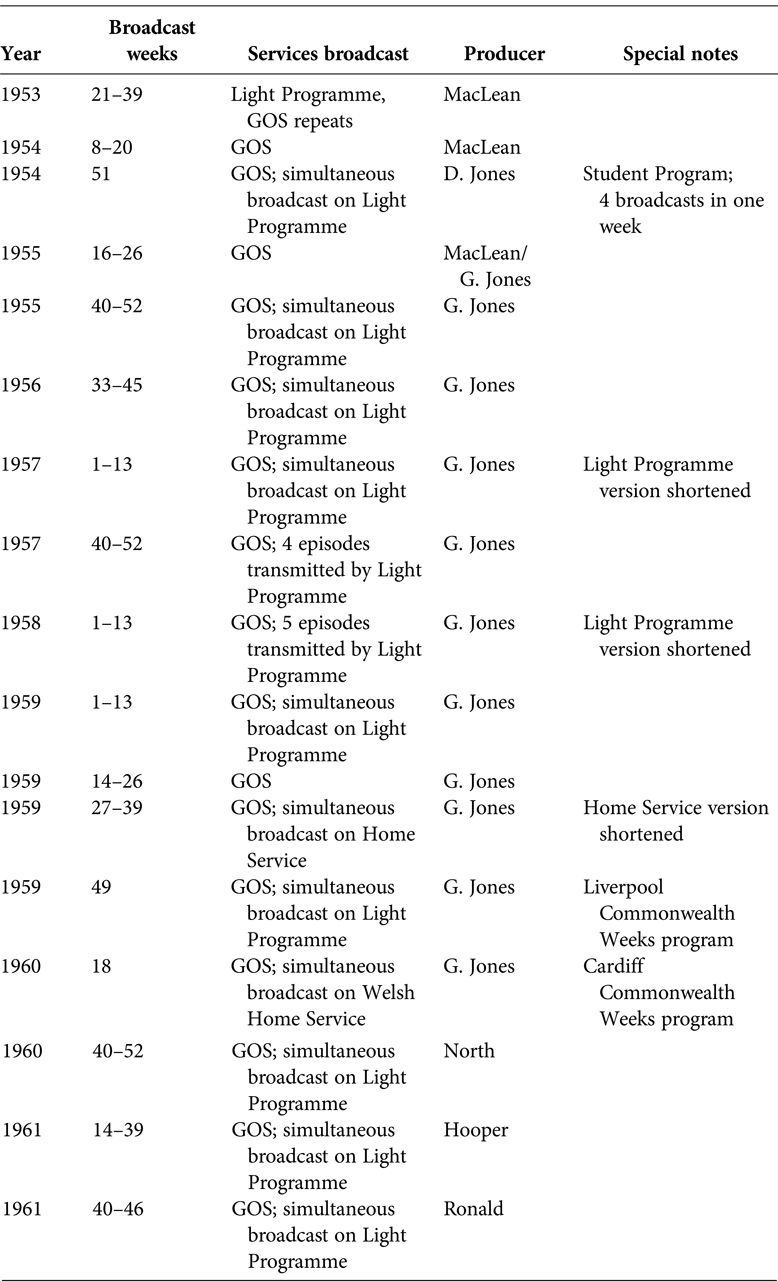
Some administrators tried to explain the programming policy and history to those with more institutional power, but it was not enough.Footnote 117 On 13 November, Commonwealth of Song finished its autumn 1961 series, and the BBC chose to not renew the programme, most likely due to the combination of dwindling numbers and the Chetwynd inquiry. The series was a Light Programme and GOS staple for nine years, airing 233 broadcasts on at least one service (though typically more), including the programmes in Liverpool and Cardiff. (For a summary of the broadcast history, see Table 2.) Without fanfare, the curtain fell on Commonwealth of Song.
Summary of Commonwealth of Song series. Adapted from ‘Commonwealth of Song’, Memo from A. M. E. Lange to J. H. Davidson, 22 November 1961. BBC WAC R19/1, 603/1

Conclusion
Across the nine years Commonwealth of Song appeared on BBC airwaves, producers tried many tactics to communicate the Commonwealth's value to British citizens. Yet, as this study demonstrates, the mixed messaging about the Commonwealth's goals, ideals, and musical identity meant this projection of a new globally minded Britishness was far from successful. This was mostly due to the difficulty in reaching two distinct audiences simultaneously in a time when the Commonwealth was still ill-defined. What is notable about Commonwealth of Song is the series's longevity and how closely it follows broader discourse surrounding representation among Commonwealth member states. While later Commonwealth artistic celebrations, such as the 1965 Commonwealth Arts Festival, receive more scholarly attention, Commonwealth of Song documents early concerns about the Commonwealth as a post-Empire cultural and political organization.Footnote 118
The Commonwealth projected by Commonwealth of Song was one with Britain in charge. From musical selection to the racial make-up of the performers, the BBC stressed ties to the United Kingdom. Yet by the end of the programme's run, the Commonwealth was undergoing changes. In the early 1960s, Commonwealth members argued that organizational control should move from British hands to a formal body; this became the Commonwealth Secretariat, the intergovernmental unit tasked with all Commonwealth business.Footnote 119 Since the Secretariat's founding in 1965, Commonwealth representation has taken a more egalitarian approach, dispelling the idea that Britain still runs all things Commonwealth.Footnote 120
With Commonwealth of Song, one witnesses the BBC experimenting with Commonwealth representation as a way of teaching the British public – especially the presumed majority white, British audience likely to listen to the Light Programme – about the Commonwealth. Through programming and repertoire featured, historians can observe struggles over Commonwealth identity, providing explanations as to why the Commonwealth, an early attempt at forging a post-imperial identity, failed to take hold as a meaningful aspect of Britishness. Competing diplomatic aims prevented the domestic goals from being fully accomplished. For programmers in the 1950s, representation was more about people than musical styles. Rather than respond to critiques over inappropriate representation by expanding the musical palette, it was easier for the BBC to limit the show to tried (or even tired) forms of light entertainment.
Ultimately Commonwealth of Song's diplomatic mission went astray. With its dual foci of teaching British citizens about the Commonwealth and communicating to Commonwealth citizens the favourable views in Britain of the organization, Commonwealth of Song fell short of both goals. In relying on light music styles, the series could only teach British listeners about the range of performers from across the British world in a narrow vein of music making, and thus did not present a well-rounded picture of Commonwealth culture. In stressing similarity of persons and musics across the Commonwealth, nothing new emerged for the public to grasp, nothing to distinguish it from its imperial forebear. While Commonwealth of Song was of its time, it also displayed, with all its contradictions, the fallacies of the early Commonwealth. It was, to borrow Philip Murphy's phrase, just the Empire's new clothes.Footnote 121
Nevertheless, this global engagement remains important for our understanding of British musical history, as well as the history of the cultural Cold War. With their desire to rely on imperial models of global engagement, the BBC, the CRO, and other government ministries laid the groundwork for what Paul Gilroy termed ‘postcolonial melancholia’, or Britain's repressed state caused by failing to adequately mourn imperial loss.Footnote 122 The Commonwealth would not have ‘fixed’ race relations in Britain, but might have become a new space for dialogues about the Empire's legacy – both in the metropole and in the former colonies – and would have gone a long way in forging a post-imperial Britain. In the end, Commonwealth of Song's diplomatic mission provides great insight into the importance of geopolitical thinking in Cold War domestic policy, reminding scholars that the domestic is never far from the global.