Many children languish in the context of marital and parent–child conflict, but negative psychological consequences of family conflict are not apparent in other children. In this paper, we advance a conceptual model that focuses on indices of children's autonomic nervous system (ANS) functioning that increase vulnerability or provide protection against psychological maladjustment in the context of family conflict. Our focus on the ANS is based on (a) the compelling history of research on ANS functioning and psychological maladjustment (Beauchaine, Reference Beauchaine2001), within which conceptual propositions and findings can be contextualized; (b) that ANS parameters can be assessed easily and noninvasively (e.g., see Beauchaine, Reference Beauchaine2009; Gottesman & Gould, Reference Gottesman and Gould2003), such as during lab tasks designed to simulate or reflect certain environmental conditions or to evoke certain physiological responses; (c) the evidence that ANS functioning may be responsive to psychosocial intervention (e.g., Raine et al., Reference Raine, Venables, Dalais, Mellingen, Reynolds and Mednick2001) and used as a mechanism for change (e.g., biofeedback; Karavidas et al., Reference Karavidas, Lehrer, Vaschillo, Vaschillo, Marin and Buyske2007); (d) the critical role of the ANS as a channel through which information travels to and from the central nervous system; and (e) the considerable body of empirical research demonstrating the moderating role of ANS functioning in the context of family conflict (e.g., El-Sheikh et al., Reference El-Sheikh, Kouros, Erath, Cummings, Keller and Staton2009; Katz & Gottman, Reference Katz and Gottman1995, Reference Katz and Gottman1997), from which we can generate new understanding and hypotheses about sources and sequelae of ANS functioning that moderate the negative effects of family conflict on children.
We discuss the conceptual and empirical foundations of our model that reflect the state of the science regarding links between family conflict, ANS activity, and child adaptation, provide examples of current research, and propose directions for future research. We focus on research directions that are developmentally focused and that promote an integrated conceptualization of psychophysiological functioning in the context of family conflict, with an emphasis on interactions across family conflict and the two branches of the ANS: sympathetic (SNS) and parasympathetic (PNS). By doing so, we hope to accelerate understanding and promote further inquiry into ANS variables that moderate the effects of family conflict on children's psychological adjustment.
Overarching Conceptual Model
Our biopsychosocial conceptual model is situated within a general developmental psychopathology framework that views child maladjustment as an outcome of interactions and transactions among multiple individual and environmental risk factors (Cicchetti, Reference Cicchetti, Cicchetti and Cohen2006). The model draws from influential perspectives on family conflict (e.g., Cummings & Davies, Reference Cummings and Davies1996; Patterson, Reid, & Dishion, Reference Patterson, Reid and Dishion1992), psychophysiology (e.g., Beauchaine, Reference Beauchaine2001; Berntson, Cacioppo, Quigley, 1991; Porges, Reference Porges2007), and Biological × Environmental interactions (e.g., Beauchaine, Gatzke-Kopp, & Mead, Reference Beauchaine, Gatzke-Kopp and Mead2007; Belsky & Pluess, Reference Belsky and Pluess2009; Boyce & Ellis, Reference Boyce and Ellis2005).
Our premise is that child psychological outcomes are shaped partly by interactions between family and ANS functioning, such that certain child physiological profiles incur vulnerability or offer protection against family risk. We emphasize that relatively stable individual differences, reflected in ANS measures, can render children more or less susceptible to the negative psychological effects of family conflict. As such, our model is related to and more topic specific than biological sensitivity to context (Boyce & Ellis, Reference Boyce and Ellis2005) and differential susceptibility to environmental influences (Belsky & Pluess, Reference Belsky and Pluess2009). Our discussion may be more consistent with differential susceptibility than biological sensitivity because we focus on ANS functioning as a relatively stable individual difference that may moderate the effects of family conflict across a range of severity and chronicity, like the Belsky model, but we certainly recognize that ANS functioning is under some degree of environmental control, as Boyce and Ellis propose. Our model is also distinguished in focus from conceptual frameworks that either link psychophysiological profiles directly with child psychopathology (e.g., Beauchaine, Katkin, Strassberg, & Snarr, Reference Beauchaine, Katkin, Strassberg and Snarr2001), or that emphasize how negative family processes influence emotion and psychophysiology, which in turn contribute to psychological outcomes (e.g., Beauchaine et al., Reference Beauchaine, Gatzke-Kopp and Mead2007; Katz, Reference Katz, Grych and Finchman2001). That is, we focus specifically on ANS parameters as moderators of the association between family conflict and child psychological adjustment. Other conceptualizations are either more general in their approach to environmental stress and biological parameters or have implied or specified other types of models (e.g., mediation) linking the familial environment, child biological markers, and psychopathology (e.g., Beauchaine et al., Reference Beauchaine, Gatzke-Kopp and Mead2007; Belsky & Pluess, Reference Belsky and Pluess2009; Boyce & Ellis, Reference Boyce and Ellis2005).
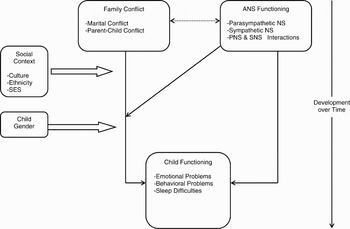
The conceptual model is depicted in Figure 1. Briefly, family conflict is linked with children's physiological and psychological development. ANS functioning may operate as a pathway, or mediator, through which family conflict influences children's psychological adjustment (e.g., Beauchaine et al., Reference Beauchaine, Gatzke-Kopp and Mead2007; Katz, Reference Katz, Grych and Finchman2001). More germane to our focus, however, ANS functioning may vary independent of family conflict, and exacerbate or attenuate the impact of family conflict on children's psychological adjustment. In particular, we propose that the moderating influence of the ANS may involve interactions between the SNS and PNS. Biological characteristics (e.g., sex) and social–ecological conditions (e.g., ethnicity, socioeconomic status) are also conceptualized as correlates and moderators of family conflict. It is important to acknowledge that our model focuses on family conflict and the SNS and PNS branches of the ANS, but we also extend discussion to other physiological systems (e.g., hypothalamic–pituitary–adrenal [HPA] axis) as they pertain to interactions with the ANS. We do not specifically address other sources of influence on children's psychological adjustment (e.g., genetic or peer-group factors); as such, the model presented here attempts to explain only part of the variance in children's psychological adjustment.
The conceptual model. ANS, autonomic nervous system; NS, nervous system; PNS, parasympathetic nervous system; SNS, sympathetic nervous system; SES, socioeconomic status.

Throughout the paper, we raise five potential ways in which ANS functioning may increase risk or provide protection in the context of family conflict. First, baseline levels of ANS activity may affect children's readiness to respond adaptively to experiences of family conflict. For example, moderate baseline levels may facilitate appropriate awareness and active cognitive or behavioral responses, compared to baseline levels that are under- or overactive. Second, ANS activity may affect or reflect children's sensitivity to experiences of family conflict. SNS and PNS levels have actually been linked with sensitivity to aversive and rewarding conditions (Beauchaine, Reference Beauchaine2001) as well as biological sensitivity to context or differential susceptibility to environmental influence (Belsky & Pluess, Reference Belsky and Pluess2009; Boyce & Ellis, Reference Boyce and Ellis2005).
Third, ANS reactivity may influence children's concurrent psychological responses to family conflict, including their emotions (e.g., form, intensity, duration, regulation), cognitions (e.g., attention or encoding, attributions, response evaluations), and behaviors (e.g., social communication, passive hovering, escape–avoidance, aggression); together, these ANS and short-term responses to conflict may exacerbate or attenuate long-term adjustment difficulties. Because children may be aware of their levels of ANS activity (e.g., sweating, increased heart rate), there may be substantial promise in investigating ANS responses as they relate to concurrent psychological responses.
Fourth, each ANS system may influence (e.g., mediate, moderate) the activity of other stress response systems during or following exposure to family conflict. For example, PNS withdrawal may stimulate SNS or HPA activity, or a strong SNS response may override the PNS response and stimulate the HPA axis. Finally, ANS responses to stress may recalibrate the (co)operation of bioregulatory systems (e.g., HPA, immune system, sleep system) over time. For example, repeated activation of one system may contribute to dysfunctions in other systems due to excessive allostatic load, or wear and tear on physiological systems (McEwen, Reference McEwen1998).
Definitional issues
Respiratory sinus arrhythmia (RSA), skin conductance level (SCL), and cardiac preejection period (PEP) are the indices of ANS functioning most commonly studied in the context of family conflict. We focus on these ANS parameters and define them below.
RSA can be used as an estimate of vagal tone or PNS influence on the heart, and change in RSA from baseline to stress can be used to index vagal reactivity. In this paper, we use the terms vagal tone and vagal reactivity when referring to the constructs at a conceptual level; we use the term RSA when reporting study findings. RSA is the rhythmic fluctuation of heart rate during spontaneous breathing and is governed by the myelinated vagus nerve (Porges, Reference Porges1995). Vagal tone (indexed by resting RSA) reflects the activity of the PNS at rest and perhaps the ability to sustain attention, regulate emotion, and engage in social communication (Porges, Reference Porges2007; Thayer & Lane, Reference Thayer and Lane2009). Vagal reactivity refers to changes in RSA from baseline to challenging conditions, and may be characterized as vagal withdrawal (decreased RSA) or vagal augmentation (increased RSA). Vagal withdrawal accelerates heart rate and increases metabolic output rapidly and incrementally, and may reflect awareness of environmental challenge and mobilization of physiological resources to mount an active coping response (Fox & Calkins, Reference Fox and Calkins2003; Porges, Reference Porges2007). Conversely, vagal augmentation decelerates heart rate in response to challenge and may reflect failure to engage with environmental demands or immobilization responses (Calkins, Reference Calkins1997; Calkins & Dedmon, Reference Calkins and Dedmon2000). Of importance, vagal withdrawal and vagal augmentation occur along a continuum such that greater or lesser degrees of change from baseline conditions occur. RSA has been well validated as a marker of the vagus nerve's influence on the heart; and within a broad range of normal physiological functioning, it is considered a valid measure of vagal tone (Grossman & Taylor, Reference Grossman and Taylor2007). Pharmacological blockade studies demonstrate that the vagus nerve influences the attenuation or elimination of RSA (Berntson et al., Reference Berntson, Bigger, Eckberg, Grossman, Kaufmann and Malik1997; Hayano et al., Reference Hayano, Sakakibara, Yamada, Yamada, Mukai and Fujinami1991; Sherwood, Allen, Obrist, & Langer, Reference Sherwood, Allen, Obrist and Langer1986).
Evidence for sex differences in RSA is inconclusive. Girls exhibited higher RSA than boys in some studies (Fabes, Eisenberg, Karbon, Troyer, & Switzer, Reference Fabes, Eisenberg, Karbon, Troyer and Switzer1994), but findings were reversed in other studies (El-Sheikh, Reference El-Sheikh2005a; Hinnant, Staton, & El-Sheikh, Reference Hinnant, Staton and El-Sheikh2010; Salomon, Reference Salomon2005). Furthermore, some studies revealed no sex differences in RSA (Alkon et al., Reference Alkon, Goldstein, Smider, Essex, Kupfer and Boyce2003; Calkins, Graziano, & Keane, Reference Calkins, Graziano and Keane2007; Gazelle & Druhen, Reference Gazelle and Druhen2009; Graziano, Keane, & Calkins, Reference Graziano, Keane and Calkins2007; Hessler & Fainsilber Katz, Reference Hessler and Fainsilber Katz2007; Suess, Porges, & Plude, Reference Suess, Porges and Plude1994). Few studies have examined race differences, although at least one recent study reported higher RSA among African American children compared to European American children (Hinnant et al., Reference Hinnant, Staton and El-Sheikh2010).
SCL and SCL reactivity (SCL-R) refer to electrodermal activity and reactivity, respectively. SCL and SCL-R are governed by the activity of sweat glands, which are innervated by the SNS component of the ANS. It is well established that SCL and SCL-R are influenced by SNS activity (Boucein, 1992; Siepmann et al., Reference Siepmann, Heine, Kluge, Ziemssen, Muck-Weymann and Kirch2007; Venables & Christie, Reference Venables, Christie, Martin and Venables1980). The SNS is activated in response to perceived stress or threat, equipping the body for a fight/flight/freeze response. Individuals with heightened SCL and SCL-R may experience high anxiety or fearfulness and exhibit inhibited behavior when faced with perceived threat, often resulting in avoidant (flight) responses (Beauchaine, Reference Beauchaine2001; Fowles, Kochanska, & Murray, Reference Fowles, Kochanska and Murray2000). Note that SCL and RSA tend to be uncorrelated (El-Sheikh et al., Reference El-Sheikh, Kouros, Erath, Cummings, Keller and Staton2009). Girls may have higher SCL than boys (e.g., Boucsein, Reference Boucsein1992; El-Sheikh, Reference El-Sheikh2007), although findings are relatively mixed (e.g., Venables & Mitchell, Reference Venables and Mitchell1996). Race differences are more consistent, such that European American children tend to exhibit higher SCL than African American children (e.g., Boucsein, Reference Boucsein1992; El-Sheikh, Keiley, & Hinnant, Reference El-Sheikh, Keiley and Hinnant2010); this finding may be explained by the inverse relation between number of sweat glands and darker skin pigmentation (Boucsein, Reference Boucsein1992).
Many of the studies to date on child risk in the context of family conflict have examined skin conductance. Another index of SNS functioning is PEP, which is also termed ventricular ejection time. PEP is the time between when the heart fills with blood and when the blood is ejected out of the heart, and it can be assessed using impedence cardiography (Andreassi, Reference Andreassi2007). Lower PEP indicates higher SNS activity and heart rate acceleration (Quigley & Stifter, Reference Quigley and Stifter2006). PEP is an established measure of SNS activity (Berntson, Cacioppo, & Fieldstone, Reference Berntson, Cacioppo and Fieldstone1994; Quigley & Stifter, Reference Quigley and Stifter2006), and the cardiac sympathetic nerves effects on the myocardium are reflected in the shortening or lengthening of preejection period (Imrich et al., Reference Imrich, Eldadah, Bentho, Pechnik, Sharabi and Holmes2008; Larkin & Kasprowicz, Reference Larkin and Kasprowicz1986). Despite the relatively small number of studies that have examined children's PEP, it may be an important index of SNS functioning that reflects trait impulsivity or approach motivation under conditions of reward (Brenner, Beauchaine, & Sylvers, Reference Brenner, Beauchaine and Sylvers2005; Richter & Gendolla, Reference Richter and Gendolla2009), whereas SCL may more specifically reflect inhibition or anxiety (e.g., Beauchaine, Hong, & Marsh, Reference Beauchaine, Hong and Marsh2008).
Alpha-amylase has recently begun to be considered as a possible marker of the SNS (Bishop, Walker, Scanlon, Richards, & Rogers, Reference Bishop, Walker, Scanlon, Richards and Rogers2006; Chatterton, Vogelsong, Lu, Ellman, & Hudgens, Reference Chatterton, Vogelsong, Lu, Ellman and Hudgens1996; Granger, Kivlighan, El-Sheikh, Gordis, & Stroud, Reference Granger, Kivlighan, El-Sheikh, Gordis and Stroud2007). However, this is still a point of debate among scholars (Nater et al., Reference Nater, Rohleder, Gaab, Berger, Jud and Kirschbaum2005, Reference Nater, La Marca, Florin, Moses and Koller2006; Rohleder, Nater, Wolf, Ehlert, & Kirschbaum, Reference Rohleder, Nater, Wolf, Ehlert and Kirschbaum2004).
Conceptual issues
Polyvagal theory is exceptionally informative as a conceptual framework for understanding the role of ANS in the context of both stress exposure and psychopathology. Below, we provide a brief overview of polyvagal theory, followed by consideration of Beauchaine's important integration of Gray's motivational theory with Porges' polyvagal theory.
As a general principle, polyvagal theory (Porges, Reference Porges2007) posits that vestiges of earlier, less complex stress response systems are available in humans and activated when more contemporary systems fail or become overwhelmed. The first response system to evolve was the dorsal vagal complex, or vegetative vagus, which is distinguished by nonmyelinated vagal motor fibers that originate in the dorsal motor nucleus of the brain. It is proposed that dorsal motor nucleus fibers become active only when innervation from the nucleus ambiguus (NA) branch of the vagus, a more recent evolutionary adaptation (discussed below), is withdrawn. In response to threat, the vegetative vagus minimizes oxygen usage and energy demand by slowing heart rate and reallocating energy throughout the body. Thus, vegetative vagus activity results in subsequent behavioral responses such as freezing in the service of avoidance.
The next evolutionary development is the SNS, which fosters mobilization. To prepare the body for action, the SNS increases cardiac output and sweat gland secretion while simultaneously inhibiting gastrointestinal tract activity. Thus, the body shifts energy from normal homeostatic functions to allow an active behavioral response. The most recent evolutionary development involves the ventral vagal complex, or smart vagus. This complex includes the myelinated vagus and portions of other cranial nerves originating in the NA, which project to various organs in the body. The trigeminal and facial nerves are also commonly considered part of this complex. Collectively, this system influences facial expression, sucking, swallowing, listening, and vocalization, and thus has been described as a social engagement system (Porges, Reference Porges2007).
In addition, activity of the ventral vagal complex exerts an inhibitory influence on the heart, and its withdrawal stimulates a heart rate increase, independent of sympathetic activity. The myelination of vagal fibers originating in the NA allows for firm control and speed in responding to the environment. Thus, the “vagal brake” can be withdrawn or instated to produce rapid changes in cardiovascular output to meet environmental demands. Furthermore, the ventral vagal complex allows for a metabolically conservative response to the environment by promoting incremental changes in heart rate to support regulated emotional responses (Porges, Reference Porges2007).
According to the polyvagal theory (Porges, Reference Porges2007), when confronted with a challenge, mammals automatically respond by first orienting then disengaging the vagal brake, inhibiting parasympathetic influence. This response results in a rapid increase in heart rate that allows the individual to engage attention in the environment, gather information, and/or use appropriate social strategies (such as enlisting complex emotions) to ameliorate the threat. If the challenge diminishes, the vagal brake can quickly reengage to reduce arousal and minimize metabolic expenditure. This ability to transiently engage and disengage with the environment allows for temporary shifts in energy, such as those required for the listening and communication phases of social interaction (Porges, Reference Porges1998). However, if the stressor is intense or chronic, then the SNS may be activated. SNS activation enables fight/flight/freeze behaviors, but is consequently more metabolically demanding than the initial vagal response. Likewise, if the sympathetic response is not sufficient to meet external challenge, then the dorsal vagal complex may engage, resulting in an immobilization response such as freezing. Although this framework is helpful as a general guideline, the progression does not occur in simple discrete steps; instead, it is characterized by “transitional blends” among systems (Porges, Reference Porges1998, p. 844). Thus, even when the PNS is adaptively regulating arousal, one or both of the other systems may be activated. Research has firmly established that stress-induced changes in heart rate can be caused by parasympathetic withdrawal, sympathetic engagement, or a combined action of the systems (Cacioppo, Uchino, & Berntson, Reference Cacioppo, Uchino and Berntson1994).
The ANS and its neural substrates serve both regulatory and social engagement functions, according to the polyvagal theory. The regulatory or calming function is explained by the inhibitory influence of the myelinated vagus on the cardiac pacemaker, and the social engagement function stems from the neuroanatomical integration of neural networks that control the vagus and neural networks that control muscles of the face and head, which regulate facial orienting and expression, speaking, and listening (Porges, Reference Porges2007). The calming and social engagement functions of the ANS may support adaptive responding in the context of family conflict and protect against the development of psychopathology.
Drawing on ideas from polyvagal theory and Gray's motivational theory (Gray, Reference Gray1987), Beauchaine (Reference Beauchaine2001) explained that regulational functions of the ANS are under PNS control, whereas motivational functions of the ANS are under SNS control. The SNS can be further divided into dimensions that stem from the neural network that governs either behavioral inhibition (BIS) and sensitivity to threat or behavioral activation (BAS) and sensitivity to appetitive stimuli (Gray, Reference Gray1987). Beauchaine's integrated conceptualization of the PNS, BIS, and BAS draws distinctions between forms of psychopathology associated with different psychophysiological profiles that cannot be drawn based on single physiological systems. For example, he indicated that most forms of psychopathology are characterized by low vagal tone, which may be considered a nonspecific marker of emotion dysregulation. To draw distinctions between different forms of psychopathology (e.g., externalizing, anxiety, depression), markers of the PNS (e.g., RSA), BIS (e.g., SCL), and BAS (e.g., PEP) should be considered. This model has been useful, for example, in distinguishing between adolescents with conduct disorder plus attention-deficit/hyperactivity disorder, who exhibited reduced electrodermal responding and reduced SNS-linked cardiac activity (i.e., lengthened PEP; see also Crowell et al., Reference Crowell, Beauchaine, Gatzke-Kopp, Sylvers, Mead and Chipman-Chacon2006), and adolescents with attention-deficit/hyperactivity disorder only, who exhibited reduced electrodermal responding but not lengthened PEP (Beauchaine et al., Reference Beauchaine, Katkin, Strassberg and Snarr2001). Research to elucidate the connection between neurophysiological motivational constructs (e.g., BIS, BAS) and peripheral autonomic measures (e.g., SCL, PEP) continues to evolve (e.g., Brenner et al., Reference Brenner, Beauchaine and Sylvers2005).
Beauchaine and colleagues (e.g., Beauchaine Reference Beauchaine2001; Beauchaine et al., Reference Beauchaine, Gatzke-Kopp and Mead2007; Beauchaine, Klein, Crowell, Derbidge, & Gatzke-Kopp, Reference Beauchaine, Klein, Crowell, Derbidge and Gatzke-Kopp2009) have described a developmental model in which inherited impulsivity, marked by low SNS activity and reactivity, may or may not develop into severe conduct problems, depending upon emotion socialization in the family. Early childhood behavior problems may lead to poor PNS (i.e., vagal) and emotion regulation, as well as severe conduct problems in middle childhood, via coercive family processes, in which negative affect and aggressive behavior are negatively reinforced (Patterson et al., Reference Patterson, Reid and Dishion1992). Alternatively, a protective family environment, characterized by consistent positive reinforcement of appropriate behavior and controlled consequences for aggressive behavior, may foster PNS and emotion regulation abilities that buffer impulsive children from developing angry and aggressive behavioral patterns (Beauchaine et al., Reference Beauchaine, Gatzke-Kopp and Mead2007).
The conceptual frameworks described above demonstrate the value of contemporaneous consideration of the SNS and PNS to fully understand psychological adjustment in the context of family conflict. Next, we review the literature on family conflict and both child adjustment and ANS activity, followed by the literature linking ANS activity with children's maladjustment, and we conclude with research documenting interactions among family conflict and indices of ANS activity, which is the focus of our paper and the subject of most attention.
Literature Review
In the sections that follow, we provide a selective review of research related to the pathways presented in Figure 1. To provide a segue to our main focus, we begin with brief discussions of literature linking family conflict with child adaptation, as well as associations among family conflict, ANS functioning, and child adaptation. Next, we provide more extensive discussion of the newer literature regarding interactions among family conflict and indices of ANS functioning, including multisystem interactions, which is the main focus of this paper.
Family conflict and child adaptation
In this review, we focus on marital conflict and parent–child conflict, broadly construed; other important forms of family conflict, such as sibling conflict, have yet to be investigated in combination with ANS functioning. Because abusive parent–child interactions are different in form and severity from normative forms of family conflict, and may have different associations with either our focal variables (e.g., ANS activity) or different psychopathology processes (e.g., posttraumatic disorders), we do not focus on child abuse. We refer to destructive forms of marital conflict that involve physical aggression, nonverbal or verbal hostility, or threat to the intactness of the family (Cummings, Goeke-Morey, & Papp, Reference Cummings, Goeke-Morey and Papp2004). Associations between marital conflict and various dimensions of children's internalizing and externalizing problems have been documented thoroughly, and explained in terms of emotional insecurity (Davies, Harold, Goeke-Morey, & Cummings, Reference Davies, Harold, Goeke-Morey and Cummings2002), cognitive representations of threat and self-blame (Grych & Fincham, Reference Grych and Fincham1990), social learning of aggressive behavior (Bandura, Reference Bandura1977), specific emotions (Crockenberg & Langrock, Reference Crockenberg and Langrock2001), and negative spillover into the parent–child relationship (Erel & Burman, Reference Erel and Burman1995). Recent studies have investigated a broader range of health outcomes, finding that children's exposure to marital conflict also increases their risk for sleep disturbances (El-Sheikh, Buckhalt, Mize, & Acebo, Reference El Sheikh, Buckhalt, Mize and Acebo2006) and physical health problems (El-Sheikh, Cummings, Kouros, Elmore-Staton, & Buckhalt, Reference El-Sheikh, Cummings, Kouros, Elmore-Staton and Buckhalt2008; Troxel & Matthews, Reference Troxel and Matthews2004).
In addition, numerous studies have linked parent–child conflict with children's externalizing and internalizing problems, and the association appears to be reciprocal (Burt, McGue, Krueger, & Iacono, Reference Burt, McGue, Krueger and Iacono2005; Pettit & Arsiwalla, Reference Pettit and Arsiwalla2008). For example, harsh parenting refers to coercive acts and negative emotional expressions that parents direct toward children, including verbal and physical aggression; the association between harsh parent–child interactions and externalizing behaviors is robust (Gershoff, Reference Gershoff2002). Psychological control in the parent–child relationship (e.g., inducing guilt, withdrawing love, invalidating the child's perspective), in contrast, is linked especially with child internalizing symptoms (for a review, see Barber & Harmon, Reference Barber, Harmon and Barber2002). Despite some evidence for specificity, however, marital conflict and various forms of parent–child conflict have been linked with both internalizing and externalizing problems. Some investigators have suggested that environmental stressors, such as family conflict, operate as nonspecific risk factors in the elicitation of child maladjustment, with physiological arousal and regulation shaping the specific form of maladjustment that emerges (Steinberg & Avenevoli, Reference Steinberg and Avenevoli2000).
Family conflict and ANS functioning
Several studies offer important evidence for associations linking negative parent–child interactions and marital conflict with patterns of ANS functioning that are generally considered maladaptive. For example, mothers' negative and controlling parenting behaviors have been linked with lower RSA (Kennedy, Rubin, Hastings, & Maisel, Reference Kennedy, Rubin, Hastings and Maisel2004) and lower task-related reductions in RSA (Calkins, Smith, Gill, & Johnson Reference Calkins, Smith, Gill and Johnson1998) in young children. Marital conflict also has been linked with lower RSA in infants (Porter, Wouden-Miller, Silva, & Porter, Reference Porter, Wouden-Miller, Silva and Porter2003) and lower reductions in RSA during a peer provocation task in middle childhood (Katz, Reference Katz2007). A recent study reported that adolescents with a history of mental health problems and lower levels of secure-base support from their parent exhibited weaker RSA reductions and RSA recovery during a stress task and reunion with the parent (Willemen, Schuengel, & Koot, Reference Willemen, Schuengel and Koot2009).
In addition, El-Sheikh (Reference El-Sheikh2005b) reported that aggressive marital conflict was associated with higher baseline SCL (girls and boys) and higher SCL-R reactivity (boys only). These findings are consistent with the allostatic load model, which contends that unremitting exposure to intense stress, failure to habituate to moderate stress, or unchecked activation of stress responses incurs wear and tear on physiological systems (McEwen, Reference McEwen1998). Over time, these physiological systems may become dysregulated and uncoordinated, increasing risk for psychological problems as well as cardiovascular problems and physical illnesses (Gunnar & Vazquez, Reference Gunnar, Vazquez, Cicchetti and Cohen2006; McEwen & Lasley, Reference McEwen and Lasley2002; Repetti, Taylor, & Seeman, Reference Repetti, Taylor and Seeman2002).
Employing another measure of SNS activity, Salomon, Matthews, and Allen (Reference Salomon, Matthews and Allen2000) reported that higher child- and parent-reported family conflict were associated with a combination of increased PEP and decreased RSA during reactivity tasks in the lab (reaction time, mirror-tracing, social competence interview). It is interesting to note that, across two studies, some form of family conflict has been linked with elevations in SCL responses (El-Sheikh, Reference El-Sheikh2005b) and increases in PEP (Salomon et al., Reference Salomon, Matthews and Allen2000). This pattern of responding across SCL and PEP, representing high activation of the BIS and low activation of the BAS, has been tied to depression in children (Beauchaine, Reference Beauchaine2001), and the combination of exposure to marital conflict and higher skin conductance reactivity has been linked to internalizing symptoms among girls (El-Sheikh, Reference El-Sheikh2005b). These findings highlight the advantages of investigating multiple physiological markers and distinguishing their roles in emotional and behavioral regulation. Of course, further research is necessary before conclusions can be drawn about specific links between family conflict and different dimensions of the SNS; efforts to discern the role of lab task in physiological responses will be especially important.
ANS functioning and child adaptation
Internalizing problems
A substantial body of literature has linked ANS functioning with children's internalizing problems, such as symptoms of depression and anxiety, shyness, and low self-esteem. For example, Boyce and colleagues (2001) found that lower vagal tone distinguished children with internalizing symptoms from both children with externalizing symptoms and children with neither internalizing nor externalizing symptoms (see also Dietrich et al., Reference Dietrich, Riese, Sondeijker, Greaves-Lord, van Roon and Ormel2007), and El-Sheikh and Whitson (Reference El-Sheikh and Whitson2006) reported that lower vagal withdrawal predicted internalizing behaviors among boys. Kagan, Reznick, and Snidman (Reference Kagan, Reznick and Snidman1988) found that measurements of inhibited children's peripheral physiology implied greater sympathetic arousal (e.g., cardiac accelerations) in comparison to uninhibited children. Inhibited children with the highest heart rates were most likely to remain inhibited over time. Likewise, Schmidt, Fox, Schulkin, and Gold (Reference Schmidt, Fox, Schulkin and Gold1999) found that 7-year-old children who were high in temperamental shyness exhibited a greater increase in heart rate during a self-presentation task compared to children low in shyness. Changes in heart rate were probably driven by SNS activity because no differences in PNS activity (i.e., RSA) were observed; note that heart rate is influenced by both the SNS and the PNS. Higher SCLR in response to mildly frightening stimuli also has been linked with self-reported anxiety among adolescents (Weems, Zakem, Costa, Cannon, & Watts, Reference Weems, Zakem, Costa, Cannon and Watts2005). Thus, the available research has been particularly consistent in demonstrating a positive association between higher SNS activity and children's anxiety symptoms.
Externalizing problems
Numerous studies have tested the association between SNS activity and children's externalizing behavior problems. For example, children with disruptive behavior disorder have lower baseline SCL than controls (van Goozen, Matthys, Cohen-Kettenis, Buitelaar, & van Engeland, Reference van Goozen, Matthys, Cohen-Kettenis, Buitelaar and van Engeland2000), and this association persists into adolescence (van Bokhoven, Matthys, van Goozen, & van Engeland, Reference van Bokhoven, Matthys, van Goozen and van Engeland2005). Some childhood studies report that higher SCLR is associated with children's reactive aggression (Hubbard et al., Reference Hubbard, Smithmyer, Ramsden, Parker, Flanagan and Dearing2002) and externalizing problems (El-Sheikh, Reference El-Sheikh2005b), but more studies have found that lower SCLR is associated with child externalizing problems (Fung et al., Reference Fung, Raine, Loeber, Lynam, Steinhauer and Venables2005; Herpertz et al., Reference Herpertz, Mueller, Qunaibi, Lichterfeld, Konrad and Herpertz-Dahlmann2005; McBurnett, Reference McBurnett1992; Snoek, van Goozen, Matthys, Buitelaar, & van Engeland, Reference Snoek, van Goozen, Matthys, Buitelaar and van Engeland2004; van Goozen, Matthys, Cohen-Kettenis, Gispen-de Wied, & van Engeland, Reference van Goozen, Matthys, Cohen-Kettenis, Gispen-de Wied and van Engeland1998).
According to the results of a recent meta-analysis (Lorber, Reference Lorber2004), individuals with (nonaggressive) conduct problems exhibit lower resting SCL and lower SCL-R to lab tasks, compared to individuals without conduct problems. Longitudinal research is also supportive of the association between SNS underarousal and conduct problems. For example, adult criminals showed significantly lower SCL during middle adolescence compared to adults without a criminal record (Raine, Venables, & Williams, Reference Raine, Venables and Williams1990). In addition, in clinical research, Beauchaine and colleagues have shown that preschoolers, elementary-age children, and adolescents with conduct problems exhibit relatively high PEP (or attenuated SNS-linked cardiac activity) at baseline and during reward conditions (Beauchaine et al., Reference Beauchaine, Gatzke-Kopp and Mead2007; Crowell et al, Reference Crowell, Beauchaine, Gatzke-Kopp, Sylvers, Mead and Chipman-Chacon2006). In another study, aggressive 8- to 12-year-old boys exhibited no PEP reactivity to reward conditions (see also Hinnant et al., Reference Hinnant, Staton and El-Sheikh2010) and lower baseline vagal tone compared to nonaggressive boys, whereas aggressive girls demonstrated greater electrodermal responding than nonaggressive girls (Beauchaine et al., Reference Beauchaine, Hong and Marsh2008), suggesting a potentially important sex difference in the autonomic correlates of aggression.
Calkins and colleagues (2007) have examined the link between PNS activity and child externalizing behavior. Calkins et al. (2007) found that children with less pronounced reductions in RSA in response to a lab task designed to elicit positive emotion and focused attention also had higher externalizing symptoms at age 5 (see also Calkins et al., Reference Calkins, Smith, Gill and Johnson1998). Children with lower baseline RSA at age 2 exhibited a greater decline in externalizing behaviors over time, and these children had lower externalizing behaviors at age 5 compared to children with higher baseline RSA. Of interest, Beauchaine et al. (Reference Beauchaine, Gatzke-Kopp and Mead2007) have also reported that the low RSA among children and adolescents with aggressive forms of disruptive behavior disorders (e.g., oppositional defiant disorder) is not evident during early childhood, suggesting that lower RSA may emerge sometime between early and middle childhood among children with clinical behavior problems. In another longitudinal study, however, the typical declines in child negativity from age 4 to 7 were more pronounced for children with higher baseline RSA, whereas the typical increases in emotion regulation abilities were more pronounced for children with greater reductions in RSA in response to an attention task (Blandon, Calkins, Keane, & O'Brien, Reference Blandon, Calkins, Keane and O'Brien2008).
Thus, an association between increased vagal withdrawal and reduced externalizing behaviors has been documented consistently in nonclinical samples. However, increased vagal withdrawal has also been documented in children with clinically significant levels of externalizing behaviors (e.g., oppositional defiant disorder; conduct disorder) (Beauchaine et al., Reference Beauchaine, Gatzke-Kopp and Mead2007). Thus, as Beauchaine (Reference Beauchaine2009) suggested, the function of vagal withdrawal may differ in children with and without psychopathology. Another possibility that we have raised is that the risk for psychopathology is particularly high among children who exhibit both increased vagal withdrawal in conjunction with low resting levels of vagal tone (Hinnant & El-Sheikh, Reference Hinnant and El-Sheikh2009). Conversely, children with higher vagal tone or moderate vagal withdrawal may not be at risk for physiological arousal and may actually be well positioned for engagement with the environment and active coping responses (Porges, Reference Porges2007). Furthermore, the consistent link between lower vagal tone and externalizing behavior in children and adolescents is less clear among infants and toddlers. Higher vagal tone may promote engagement with the social environment (Porges, Reference Porges2007). Thus, among infants, who are less able to regulate their own emotions, higher vagal tone may illicit emotion socialization from caregivers, thereby reducing behavior problems in the long term, even if early externalizing behaviors are observed (Beauchaine, Reference Beauchaine2001).
Interactions between family conflict and ANS functioning
Indices of PNS functioning have been examined relatively thoroughly as moderators of marital conflict. In almost all of these studies, higher vagal tone and vagal withdrawal have operated as protective factors in the context of family conflict; that is, the association between marital conflict and child maladjustment is less pronounced among children with higher vagal tone or vagal withdrawal, compared to children with lower vagal tone or vagal augmentation (for an exception, see Obradovic, Bush, Stamperdahl, Adler, & Boyce, Reference Obradovic, Bush, Stamperdahl, Adler and Boyce2010). The protective function of higher RSA or greater reductions in RSA during stress or challenge has been evident across cross-sectional (El-Sheikh, Harger, & Whitson, Reference El-Sheikh, Harger and Whitson2001; Katz & Gottman, Reference Katz and Gottman1995) and longitudinal studies (El-Sheikh & Whitson, Reference El-Sheikh and Whitson2006; Katz & Gottman, Reference Katz and Gottman1997; Leary & Katz, Reference Leary and Katz2004); across multi-informant (El-Sheikh et al., Reference El-Sheikh, Harger and Whitson2001; El-Sheikh & Whitson, Reference El-Sheikh and Whitson2006; Katz & Gottman, Reference Katz and Gottman1995) and observational (Katz & Gottman, Reference Katz and Gottman1995; Leary & Katz, Reference Leary and Katz2004) sources; and across externalizing, internalizing (El-Sheikh et al., Reference El-Sheikh, Harger and Whitson2001; El-Sheikh & Whitson, Reference El-Sheikh and Whitson2006; Katz & Gottman, Reference Katz and Gottman1995, Reference Katz and Gottman1997), social (Leary & Katz, Reference Leary and Katz2004), and physical health (El-Sheikh et al., Reference El-Sheikh, Harger and Whitson2001; Whitson & El-Sheikh, Reference Whitson and El-Sheikh2003) outcomes. Similarly, the protective effects of higher RSA have been documented in the context of parent–child conflict (Whitson & El-Sheikh, Reference Whitson and El-Sheikh2003) and child maltreatment (Gordis, Feres, Olezeski, Rabkin, & Trickett, Reference Gordis, Feres, Olezeski, Rabkin and Trickett2010). The purported protective effect of higher vagal tone and vagal withdrawal in the context of marital conflict has been attributed to the ways in which these PNS processes may reflect or support emotion regulation and social engagement (Porges, Reference Porges2007).
Despite the overall evidence for the protective functions of higher vagal tone and increased vagal withdrawal in the context of family conflict, evidence for gender differences is somewhat mixed. For example, in cross-sectional analyses, greater reductions in RSA protected only boys against externalizing and health problems associated with verbal and physical marital conflict, respectively (El-Sheikh et al., Reference El-Sheikh, Harger and Whitson2001). In contrast, in longitudinal analyses, greater reductions in RSA protected only girls against internalizing problems associated with marital conflict (El-Sheikh & Whitson, Reference El-Sheikh and Whitson2006). Although some sex differences exist across particular studies with particular outcomes, the protective functions of higher vagal tone and increased vagal withdrawal have been replicated among boys and girls.
Several studies have investigated interactions between family conflict and SNS functioning. For example, El-Sheikh (Reference El-Sheikh2005b) found a stronger association between marital conflict and both internalizing and externalizing behavior among girls with higher SCL-R, compared to girls with lower SCLR. In longitudinal analyses with the same sample, El-Sheikh, Keller, and Erath (Reference El-Sheikh, Keller and Erath2007) reported that marital conflict predicted increased externalizing problems among boys with lower SCLR and among girls with either lower or higher SCLR (but especially among girls with higher SCLR). Thus, in the context of marital conflict, some existing evidence suggests that higher SCLR may be a stronger vulnerability factor among girls compared to boys (El-Sheikh, Reference El-Sheikh2005b; El-Sheikh et al., Reference El-Sheikh, Keller and Erath2007), which is consistent with evidence that aggressive girls exhibit higher electrodermal activity than nonaggressive girls (Beauchaine et al., Reference Beauchaine, Hong and Marsh2008).
Two recent studies provided evidence that externalizing behavior may be high and stable from middle to late childhood among boys with relatively harsh parents and lower SCLR, compared to boys with relatively harsh parents and higher SCLR, whose externalizing behavior may increase during later childhood (age 8 to age 10; Erath, El-Sheikh, & Cummings, Reference Erath, El-Sheikh and Cummings2009; Erath, El-Sheikh, Hinnant, & Cummings, Reference Erath, El-Sheikh, Hinnant and Cummings2010). In these studies, girls and boys with less harsh parents exhibited relatively lower externalizing behavior throughout late childhood irrespective of their SCLR.
Collectively, these studies are relatively consistent in showing that boys with lower SCLR exhibit elevated levels of externalizing problems, particularly in the context of either marital conflict (El-Sheikh et al., Reference El-Sheikh, Keller and Erath2007) or harsh parenting (Erath et al., Reference Erath, El-Sheikh and Cummings2009, Reference Erath, El-Sheikh, Hinnant and Cummings2010). These findings may be interpreted by integrating learning theories with models of psychophysiology and antisocial behavior. Reduced SCLR may reflect a predisposition toward behavioral disinhibition or punishment insensitivity (Beauchaine, Reference Beauchaine2001), which may be more common among boys compared to girls. This temperamental characteristic may set the stage for coercive parent–child exchanges, and perhaps increase the likelihood that children will learn aggression from harsh parenting (e.g., observational learning, negative reinforcement) rather than feel punished by it (Dadds & Salmon, Reference Dadds and Salmon2003; Patterson et al., Reference Patterson, Reid and Dishion1992; Reid, Patterson, & Snyder, Reference Reid, Patterson and Snyder2002).
Evidence has been less consistent regarding the risk for psychological maladjustment among children with higher SCLR in the context of family conflict. In El-Sheikh (Reference El-Sheikh2005b) and El-Sheikh et al (Reference El-Sheikh, Keller and Erath2007), higher SCLR was a vulnerability factor for externalizing and internalizing problems in the context of marital conflict among girls. In Erath et al. (Reference Erath, El-Sheikh, Hinnant and Cummings2010), however, only boys with higher SCLR and relatively harsh parents exhibited increases in externalizing behavior from middle childhood to late childhood. It is possible that family conflict predicts externalizing behavior over time among children with higher SCLR because their behavior is particularly responsive to environmental stress and contingencies, potentially reflecting susceptibility to environmental influences (Belsky & Pluess, Reference Belsky and Pluess2009) or biological sensitivity to context (Boyce & Ellis, Reference Boyce and Ellis2005). Wootton, Frick, Shelton, and Silverthorn (Reference Wootton, Frick, Shelton and Silverthorn1997) reported that children without callous-unemotional traits, consistent with normal or high SCLR, exhibited elevated conduct problems only in the context of ineffective parenting (see also, Shannon, Beauchaine, Brenner, Neuhaus, and Gatzke-Kopp, Reference Shannon, Beauchaine, Brenner, Neuhaus and Gatzke-Kopp2007). Children who exhibit higher SCLR, who may be more sensitive to aversive circumstances than children with lower SCLR, may be especially likely to react negatively to family conflict or harsh parenting during a developmental period characterized by increasing needs for autonomy from parents. Thus, existing research suggests that the risk associated with SCLR may depend on age, gender, and type of family conflict.
Interactions between the SNS and PNS
Investigations of interactions between family conflict and single indices of autonomic activity (i.e., either SNS or PNS) have provided important insights about risk and resilience in children. However, similar to environmental factors that moderate the influence of one another (e.g., Lindsey, Caldera, & Tankersley, Reference Lindsey, Caldera and Tankersley2009; Pettit, Bates, Dodge, & Meece, Reference Pettit, Bates, Dodge and Meece1999), single physiological systems do not operate in isolation. Multiple physiological systems cooperate to serve homeostatic functions under ideal circumstances and to meet individual or environmental demands under challenging conditions (Bauer, Quas, & Boyce, Reference Bauer, Quas and Boyce2002). Because of innate biological vulnerabilities or experiences of intense or chronic stress, however, physiological systems may become uncoordinated or dysregulated, potentially exacerbating the toll of exposure to family stress (Bauer et al., Reference Bauer, Quas and Boyce2002).
Investigators have begun to consider the joint action of the two branches of the ANS, the SNS and PNS, and we expect that further research along these lines will help clarify inconsistencies in the literature on family stress and psychophysiological processes. For example, Beauchaine (Reference Beauchaine2001) explained that low vagal tone is linked with a range of negative child outcomes, including internalizing and externalizing problems; to predict whether low vagal tone will manifest as an externalizing or internalizing problem, the SNS must be considered as well.
Another model, the doctrine of autonomic space, concerns the simultaneous action of the SNS and PNS on target organs that are innervated by both branches of the ANS (e.g., heart; Berntson et al., Reference Berntson, Cacioppo and Quigley1991; Berntson & Cacioppo, Reference Berntson, Cacioppo, Malik and Camm2004). It is important to note that the autonomic space literature refers specifically to SNS-linked cardiac reactivity (e.g., cardiac PEP), which is discussed in further detail below. The autonomic space model does not refer to electrodermal measures of the SNS (i.e., SCL). However, given the much larger body of research linking electrodermal measures (compared to PEP) with family conflict and children's psychological functioning, and the opportunity to test interactions between PNS measures and electrodermal measures in many existing data sets, we believe it is worthwhile to consider whether the effects of SNS activation or inhibition, reflected in electrodermal measures, may be conditional upon PNS activation or inhibition, reflected in measures of RSA. Thus, we consider the synergistic action of the PNS and SNS, like the autonomic space model (El-Sheikh et al., Reference El-Sheikh, Kouros, Erath, Cummings, Keller and Staton2009), but acknowledge that our focus on SCL as a marker of SNS activity diverges from the autonomic space model.
According to the autonomic space model (Berntson et al., Reference Berntson, Cacioppo and Quigley1991; Berntson & Cacioppo, Reference Berntson, Cacioppo, Malik and Camm2004), reciprocal activation refers to conditions under which both branches of the ANS promote the same directional response in a target organ or system (e.g., see Table 1). Reciprocal sympathetic activation involves sympathetic activation and parasympathetic inhibition, both of which upregulate physiological processes such as heart rate and cardiovascular output. By comparison, reciprocal parasympathetic activation is characterized by sympathetic inhibition and parasympathetic activation, both of which downregulate similar physiological processes, serving homeostatic and calming functions. Nonreciprocal activation refers to conditions under which branches of the ANS promote opposing responses in target systems. Specifically, coactivation refers to increased sympathetic and parasympathetic action, and coinhibition refers to decreased action of both branches. Because sympathetic and parasympathetic actions serve opposing physiological functions, such parallel, or nonreciprocal, activation may promote opposing physiological outcomes.
Autonomic nervous system profiles

Note: SNS, sympathetic nervous system; PNS, parasympathetic nervous system; SCL, skin conductance level; RSA, respiratory sinus arrhythmia.
Berntson et al. (Reference Berntson, Cacioppo and Quigley1991) explain that modes of reciprocal activation can produce strong, unidirectional changes in the system under autonomic influence. Thus, reciprocal sympathetic activation may be well-suited for adjustments to challenge or stress, particularly when the necessary coping response is well defined, whereas reciprocal parasympathetic activation may be most appropriate for situations in which a calm physiological state is beneficial. Modes of nonreciprocal activation, in contrast, yield a more ambivalent physiological response because the action of ANS branches is in opposition. In the case of coactivation or coinhibition, it is actually possible that little or no change in the state of the target system would occur if the relative activation of sympathetic and parasympathetic branches was equivalent. Thus, nonreciprocal modes may operate to preserve the baseline functional state of an organ or system in situations without challenge or stress. It is also possible that nonreciprocal activation occurs when the optimal behavioral response in a novel or challenging situation is unclear to the individual (Berntson et al., Reference Berntson, Cacioppo and Quigley1991).
Studies that have utilized the autonomic space framework have found that reciprocal sympathetic activation is a normative response to stress among children and adolescents (Salomon et al., Reference Salomon, Matthews and Allen2000). However, the most common response profile may vary developmentally (Alkon et al., Reference Alkon, Goldstein, Smider, Essex, Kupfer and Boyce2003), and children with externalizing behavior problems often exhibit coinhibition in response to laboratory challenges (Beauchaine et al., Reference Beauchaine, Gatzke-Kopp and Mead2007; Boyce et al, Reference Boyce, Quas, Alkon, Smider, Essex and Kupfer2001). In a series of studies informed by Berntson and colleagues (1991), as well as models reviewed above (Beauchaine, Reference Beauchaine2001; Porges, Reference Porges2007), SNS × PNS interactions were examined in the context of marital conflict as predictors of children's externalizing behaviors, as described below (El-Sheikh et al., Reference El-Sheikh, Kouros, Erath, Cummings, Keller and Staton2009).
Interactions among the SNS, PNS, and family conflict
A core principle of developmental psychopathology is that child outcomes are best understood in terms of transactions among multiple individual and environmental variables (Masten, Reference Masten2006). Likewise, a critical next step is to apply integrated conceptualizations of SNS and PNS responses to stressful environmental contexts that evoke ANS reactivity. As such, interactions between SCL and RSA were investigated as moderators of the relation between marital conflict and child externalizing behavior (El-Sheikh et al., Reference El-Sheikh, Kouros, Erath, Cummings, Keller and Staton2009).
Analyses revealed that opposing action of the PNS and SNS (i.e., coactivation and coinhibition in autonomic space terms) operated as a vulnerability factor for externalizing behavior in the context of marital conflict, whereas reciprocal action of the PNS and SNS (i.e., reciprocal sympathetic activation and reciprocal parasympathetic activation in autonomic space terms) operated as a protective factor (El-Sheikh et al., Reference El-Sheikh, Kouros, Erath, Cummings, Keller and Staton2009). This pattern of findings emerged consistently in three studies with multimethod and multi-informant designs, including mother, father, and child reports of marital conflict; mother, father, and teacher reports of various child externalizing problems, and physiological data on child responses to different laboratory stress tasks. Of note, Gordis et al. (Reference Gordis, Feres, Olezeski, Rabkin and Trickett2010) also reported that coinhibition, reflected in low levels of both basal RSA and SCL reactivity, and coactivation, reflected in high levels of both basal RSA and SCL reactivity, exacerbated the association between child maltreatment and aggressive behavior among girls. On the basis of these results, we offered the following tentative assertions about the functions of autonomic profiles in the context of marital conflict (El-Sheikh et al., Reference El-Sheikh, Kouros, Erath, Cummings, Keller and Staton2009).
Coactivation may indicate that the PNS response is insufficient for managing a stressor (as reflected in vagal augmentation rather than vagal withdrawal), prompting activation of a significant SNS response. As such, coactivation may reflect physiological overarousal, given the potential SNS “override” of the PNS response (Porges, Reference Porges1995, Reference Porges2001), and thus it is possible that coactivation enables dysregulated, fight/flight/freeze responses to conflict as well as child involvement in marital conflict. Such high emotional reactivity may set the stage for coercive exchanges between parents and their children, in which children are negatively reinforced for aggressive attempts to end conflict (Patterson, Reference Patterson, Reid, Patterson and Snyder2002). High emotional reactivity may also contribute to increased child involvement and exposure to conflict, and thereby enhance sensitization to conflict (Cummings & Davies, Reference Cummings and Davies1994).
Coinhibition may reflect an ambivalent physiological response in which the PNS equips the child for action by withdrawing its inhibitory influence, whereas the sympathetic system, conversely, fails to produce the metabolic output needed for an active behavioral or emotional response. Potentially, such a physiological response may promote passive vigilance, which could result in increased exposure to marital conflict and limited efforts to reduce exposure, such as by communicating upset feelings to parents. It is possible that coinhibition of ANS branches is more characteristic of children with underaroused antisocial behavior (Raine, Reference Raine2002), or callous–unemotional traits (Frick & Ellis, Reference Frick and Ellis1999). For example, low vagal tone may reflect poor emotion regulation, and diminished SNS arousal may suggest fearlessness, failure of avoidance learning, or punishment insensitivity (Raine, Reference Raine2002).
Reciprocal sympathetic activation may reflect an efficient parasympathetic response to stress (as reflected in vagal withdrawal) and a corresponding (moderate) sympathetic response to meet metabolic demands. In the context of marital conflict, reciprocal sympathetic activation may indicate appropriate concern or anger, yet also promotes constructive attempts to address worries with adults or attempts to reduce exposure to conflict. In contrast, reciprocal parasympathetic activation and sympathetic inhibition may occur when marital conflict is not interpreted as especially threatening, and is managed efficiently and effectively through vagal withdrawal, without resorting to SNS activation. This type of ANS response pattern may reflect effective self-soothing in the context of marital conflict.
Although our work diverges from the autonomic space model (Berntson et al., Reference Berntson, Cacioppo and Quigley1991) in that we examined SCL versus cardiac measures of SNS activity, our findings and those of Gordis et al. (Reference Gordis, Feres, Olezeski, Rabkin and Trickett2010) are consistent with this body of work in that SCL appeared to operate like PEP in conjunction with PNS activity to predict child behavior. Although both SCL and PEP are influenced by the SNS, it is important for future research to further support the application of electrodermal measures to the autonomic space model. In addition, although the autonomic space literature focuses on physiological reactivity, we examined all combinations of SCL and RSA at baseline and in response to laboratory tasks and demonstrated their effects (see also Gordis et al., Reference Gordis, Feres, Olezeski, Rabkin and Trickett2010).
Likewise, our findings can be interpreted in the context of our expansion on polyvagal theory propositions (Porges, Reference Porges2007). Specifically, although Porges did not focus on interactions among the PNS, SNS, and dorsal vagal systems per se, he proposed that responses across these systems in the face of stress do not proceed in a linear fashion and are often characterized by blending of physiological activity across these systems. Findings (El-Sheikh et al., Reference El-Sheikh, Kouros, Erath, Cummings, Keller and Staton2009; Gordis et al., Reference Gordis, Feres, Olezeski, Rabkin and Trickett2010) suggest that reciprocal modes of ANS responding may indicate that more evolutionarily advanced response strategies have been effective and sufficient, whereas coactivation and coinhibition may suggest a breakdown in regulation, in which either the PNS or SNS system fails to perform its adaptive function in response to stress.
Our findings are also consistent with Beauchaine's and colleagues' (2001, 2007) research, which suggests that children with clinical levels of externalizing problems are likely characterized by coinhibition, or reduced activity of both the parasympathetic and sympathetic branches. Findings reported in the Monograph (El-Sheikh et al., Reference El-Sheikh, Kouros, Erath, Cummings, Keller and Staton2009) build on Beauchaine's work and extend it, particularly by showing that certain patterns of SNS and PNS activity can operate as vulnerability or protective factors in the context of marital conflict. It is important to note that neither the polyvagal theory nor autonomic space model deal specifically with exposure to family stress. Our model is most similar to that of Beauchaine and colleagues in its integration of family stress, autonomic activity, and psychopathology, although we focus more on interactions between family risk and the two branches of the ANS in the prediction of psychopathology.
Future Directions
In this section we highlight future research directions that would accelerate understanding of ANS variables that transmit, moderate, or reflect the effects of family conflict on children. The types of studies discussed below would significantly advance basic knowledge and applied efforts, by testing novel hypotheses, and by clarifying hypotheses that have been tested in numerous studies with results that are not entirely consistent. For example, whereas several studies have provided evidence that vagal withdrawal operates as a protective factor in the context of marital conflict (El-Sheikh et al., Reference El-Sheikh, Harger and Whitson2001; El-Sheikh & Whitson, Reference El-Sheikh and Whitson2006; Katz & Gottman, Reference Katz and Gottman1997; Leary & Katz, Reference Leary and Katz2004) or parental problem drinking (El-Sheikh, Reference El-Sheikh2001, Reference El-Sheikh2005c), some theory (biological sensitivity to context; Boyce & Ellis, Reference Boyce and Ellis2005) and empirical work (Obradović, Bush, & Boyce, Reference Obradović, Bush and Boyce2009) suggest that vagal withdrawal may contribute to particularly negative outcomes in the context of family adversity. We anticipate that such inconsistencies, which are not uncommon in the psychophysiological literature, may be resolved at least in part by further investigation of developmental differences in ANS effects, nonlinear effects of ANS functioning, interactions among multiple physiological systems, and differential effects of ANS functioning depending on specific environmental risks, specific laboratory tasks, and specific child outcomes. Each of these propositions will be discussed next.
Developmental progressions
The vast majority of research on children's ANS functioning and psychological adaptation in the context of family conflict has employed cross-sectional or short-term longitudinal designs with two data collection points. Multiyear studies that cross developmental periods and transitions (e.g., transition to elementary school, puberty) are necessary to illuminate the direction of associations, the malleability of ANS functioning, and the potential of developmental change in the intervening role of ANS functioning (e.g., mediation, moderation). To this point, investigators have put forth several intriguing developmental models that warrant further empirical examination.
For example, according to the biological sensitivity to context model (e.g., Boyce & Ellis, Reference Boyce and Ellis2005; Ellis & Boyce, Reference Ellis and Boyce2006), children may develop heightened sensitivity to their family context, reflected in high ANS reactivity, under conditions of nurturance and support or under conditions of stress and adversity (for a complementary theory, see differential susceptibility to environmental influence; Belsky, Reference Belsky, Ellis and Bjorklund2005). In the former case, high ANS reactivity is an evolutionarily adaptive response that maximizes exposure to enriching qualities of the environment, whereas in the latter case, high reactivity is an adaptive response (at least in the short term) that promotes vigilance to environmental hazards. In addition, as reviewed above, Beauchaine and colleagues (e.g., Beauchaine, Reference Beauchaine2001; Beauchaine et al., Reference Beauchaine, Gatzke-Kopp and Mead2007) have discussed a developmental model in which inherited impulsivity, marked by low SNS activity and reactivity, may or may not develop into severe conduct problems depending upon family processes (e.g., coercive parent–child interactions) that either support or undermine emotional and physiological regulation.
Although the specific hypotheses of the developmental models discussed above require further longitudinal investigation, some empirical support exists for the proposition that ANS activity is responsive to early environmental influence. For example, Gottman, Katz, and Hooven (Reference Gottman, Katz and Hooven1996) reported that parental emotion coaching predicted higher baseline RSA during middle childhood. A growing body of studies has linked responsive and synchronous parenting with infants' higher RSA (for a review, see Propper & Moore, Reference Propper and Moore2006), and concordance between mothers' and children's vagal withdrawal to environmental challenges appears to increase from infancy through early childhood (Bornstein & Suess, Reference Bornstein and Suess2000). Prevention and intervention studies also support the malleability of ANS functioning. For instance, educational, social–emotional, and health enrichment in early childhood has been linked with adaptive SNS arousal in response to laboratory tasks (i.e., increased amplitude and speed of electrodermal responding) during preadolescence in a controlled, experimental trial (Raine et al., Reference Raine, Venables, Dalais, Mellingen, Reynolds and Mednick2001). Habitual exercise and other lifestyle factors have also been linked with changes in vagal tone over time in adults (Rennie et al., Reference Rennie, Hemingway, Kumari, Brunner, Malik and Marmot2003; Thayer & Lane, Reference Thayer and Lane2007). Preliminary evidence also supports the utility of acupuncture to increase vagal tone in depressed women, which in turn results in decreased depression (Chambers & Allen, Reference Chambers and Allen2002). In addition, RSA may be alterable using biofeedback (Hatch, Borcherding, & German, Reference Hatch, Borcherding and German1992) or medication (Porges, Reference Porges and Reese1976).
Psychophysiological response patterns probably retain some malleability throughout the lifespan, as suggested by the studies described above, but research suggests that ANS responses become more stable over time. In particular, evidence has emerged for moderate stability in baseline and reactivity levels of SNS and PNS activity in middle to late childhood (Bornstein & Suess, Reference Bornstein and Suess2000; Calkins & Keane, Reference Calkins and Keane2004; Doussard-Roosevelt, Montgomery, & Porges, Reference Doussard-Roosevelt, Montgomery and Porges2003; El-Sheikh, Reference El-Sheikh2005a, Reference El-Sheikh2007); lower levels of stability are observed for reactivity than resting SNS and PNS measures. As such, one possibility is that, following a period of greater susceptibility to family and general environmental influence, ANS reactivity to stressors becomes relatively stable around late childhood or early adolescence, at which time it can be considered an individual difference variable that exacerbates or ameliorates the risk for adjustment problems in the context of family conflict (El-Sheikh, Reference El-Sheikh2001; El-Sheikh et al., Reference El-Sheikh, Keller and Erath2007). Our proposition that family factors may exert influences on children's ANS reactivity more strongly in infancy and early childhood, and then primarily function to interact with physiological patterns in late childhood and adolescence, requires further empirical investigation. This hypothesis is similar to Barlow's (Reference Barlow2000) conceptualization of the development of internalizing disorders in which individual vulnerabilities associated with internalizing symptoms are fostered by environmental stressors early in life (i.e., mediation model), yet go on to amplify environmental stressors later in life (i.e., moderation model).
To understand developmental changes in the intervening role (e.g., mediation or moderation) of ANS activity, we must also understand its normative developmental course. Few studies have examined the developmental course of ANS activity, but existing research suggests some important directions for future research. There is evidence that baseline RSA increases from infancy through middle childhood (Propper & Moore, Reference Propper and Moore2006). However, Salomon (Reference Salomon2005) found that greater reductions in RSA during lab stress protocols in prepubertal 8- to 10-year-olds predicted lower resting RSA approximately 3 years later, controlling for earlier resting RSA. Salomon suggested that repeated vagal withdrawal to stress may alter the set point for resting vagal tone, as the PNS adapts to anticipate continued homeostatic disturbances in the future. As such, under conditions of chronic stress in which children repeatedly withdraw vagal tone to increase vigilance and active coping, resting vagal tone may become conditioned to anticipate circumstances that require vigilance and coping, and thus decline over time.
The implications are intriguing. Several studies have shown that vagal withdrawal in the context of stress or challenge is associated positively with social and emotional regulation, and also operates as a protective factor in the context of family stress. One tentative possibility, however, is that despite the apparently adaptive function of vagal withdrawal in the short term, it could operate as a risk factor for lower resting vagal tone and the associated mental and physical health problems in the long term in the context of high stress exposure.
The altered operation of the HPA axis in the context of chronic stress (e.g., Miller, Chen, & Zhou, Reference Miller, Chen and Zhou2007) is an interesting parallel to the declining basal levels of PNS activity among children who exhibit vagal withdrawal earlier in development. According to the hypercortisolism hypothesis, chronic stress sensitizes the HPA axis to subsequent stress, such that the HPA axis increasingly generates physiological resources to cope with perceived threat. In turn, sustained elevations in HPA activity produce allostatic load and damage the development and functioning of neural and cognitive systems, resulting in child health problems and psychological maladjustment (Gunnar & Vazquez, Reference Gunnar, Vazquez, Cicchetti and Cohen2006; McEwen, Reference McEwen1998; McEwen & Lasley, Reference McEwen and Lasley2002; Repetti et al., Reference Repetti, Taylor and Seeman2002). In contrast, the hypocortisolism hypothesis (Miller et al., Reference Miller, Chen and Zhou2007) suggests that chronic HPA activation can result in blunting of responses over time, which is also associated with negative psychological outcomes. Likewise, children may become psychologically sensitized to intense marital conflict, such that they begin to interpret even mild stressors in the family as precursors of serious threat, inducing heightened distress and impeding effective coping (Davies & Cummings, Reference Davies, Cummings, Cicchetti and Cohen2006). Thus, initially adaptive physiological and psychological responses may become maladaptive over time due to intense and frequent exposure to environmental stress.
These findings (e.g., Salomon, Reference Salomon2005) may be interpreted within the biological sensitivity to context framework (Boyce & Ellis, Reference Boyce and Ellis2005), which proposes that highly reactive children, who are presumably most susceptible to environmental influence, should demonstrate the best outcomes under positive conditions and the worst outcomes under negative conditions (for a complementary theory, see differential susceptibility to environmental influence; Belsky, Reference Belsky, Ellis and Bjorklund2005). Highly reactive children (e.g., very high vagal withdrawal) may experience particularly negative outcomes under adverse conditions, at least in part, because repeated incidents of stress exposure may contribute to a state of increased reactivity to stressors over time. Clearly, this is an area of research in which many important questions remain unanswered. Further investigation may yield critical information about when in development adjustment problems are most likely to emerge among children who experience chronic or intense family conflict, depending on their ANS profile.
Further examination of individual systems
Nonlinear associations
It may be important to consider the potential difference between high (i.e., extreme) and optimal levels of arousal and reactivity (Eisenberg, Fabes, Guthrie, & Reiser, Reference Eisenberg, Fabes, Guthrie and Reiser2000), or levels of arousal that are best matched with contextual demands. For instance, as noted above, although a growing body of evidence suggests that vagal withdrawal in response to challenge is generally adaptive (e.g., El-Sheikh, Reference El-Sheikh2005c; El-Sheikh et al., Reference El-Sheikh, Harger and Whitson2001, Reference El-Sheikh, Keller and Erath2007; Graziano et al., Reference Graziano, Keane and Calkins2007; Katz, Reference Katz2007), there may be a point at which excessive vagal withdrawal contributes to overarousal or dysregulation and impedes effective coping (Beauchaine, Reference Beauchaine2001). Consistent with this possibility, Ashman, Dawson, and Panagiotides (Reference Ashman, Dawson and Panagiotides2008) found the highest levels of vagal withdrawal among children of chronically depressed mothers, intermediate levels of vagal withdrawal among children of nondepressed mothers, and the lowest levels of vagal withdrawal among children of mothers with stable, mild depression. Other studies examining nonlinear associations have found that optimal behavioral and cognitive functioning are linked with moderate (rather than high or low) physiological responses, including cortisol (e.g., Abercrombie, Speck, & Monticelli, Reference Abercrombie, Speck and Monticelli2006; McBurnett, Lahey, Rathouz, & Loeber, Reference McBurnett, Lahey, Rathouz and Loeber2000), heart rate, and skin conductance (e.g., Gilbert, Reference Gilbert1998). More recently, Keller and El-Sheikh (Reference Keller and El-Sheikh2009) documented a nonlinear association between salivary α-amylase (sAA), a possible marker of SNS activity, and children's externalizing behavior. Moderate levels of sAA were predictive of lower externalizing behaviors 2 years later. Thus, emerging evidence suggests that optimal environments may predict moderate ANS arousal, which in turn predicts optimal behavioral and psychological outcomes. An important direction for future research is to specify the degrees of SNS and PNS activation that promote positive and negative developmental outcomes.
Physiological recovery
Baseline ANS levels and ANS reactivity to stress or challenge have been examined in numerous studies. However, although recognized as an important parameter of vagal functioning (Porges, Reference Porges2007), ANS recovery (i.e., return to baseline) following stress exposure is surprisingly understudied. Adult studies have linked slower vagal recovery to an increase in cardiovascular disease (Mezzacappa, Kelsey, Katkin, & Sloan, Reference Mezzacappa, Kelsey, Katkin and Sloan2001). Gottman and Katz (Reference Gottman and Katz2002) found that children with higher baseline RSA exhibited faster heart rate recovery from physiological arousal following stressful parent–child interactions. In middle childhood, lower vagal recovery has been linked with maladaptive emotion regulation responses to frustration (Santucci, Silk, Shaw, Gentzler, Fox, & Kovacs, Reference Santucci, Silk, Shaw, Gentzler, Fox and Kovacs2008). To our knowledge, however, no additional studies have examined the association between vagal recovery and child or family functioning. Physiological recovery may be an important parameter that moderates the extent to which family conflict exposure produces allostatic load and spills over into other settings and relationships.
Interactions among baseline, reactivity, and recovery
Individual differences in ANS state during resting conditions and changes in ANS levels during and following environmental stimuli are all part of an integrated system of ANS functioning (Porges, Reference Porges2007). Whereas these dimensions of ANS functioning (i.e., baseline, reactivity, recovery) have typically been examined independently, their effects may be conditional on one another. In other words, it may not be only the starting point (i.e., basal levels) or change (e.g., during stress) in ANS functioning that is important for understanding adaptive ANS function, but a combination of both. For example, vagal withdrawal appears to reflect active environmental engagement and coping, and higher baseline vagal tone may allow a wider dynamic range for vagal withdrawal to occur adaptively (Beauchaine, Reference Beauchaine2001; Berntson et al., Reference Berntson, Cacioppo and Quigley1991; Porges, Reference Porges2007). However, large decreases in vagal tone in response to stress may be maladaptive when resting vagal tone is already quite low. Hinnant and El-Sheikh (Reference Hinnant and El-Sheikh2009) found that lower levels of RSA in conjunction with greater reductions in RSA during lab challenge predicted elevated child internalizing symptoms 2 years later. The highest levels of externalizing symptoms were predicted for children who demonstrated lower basal RSA in conjunction with RSA augmentation; this finding was replicated in El-Sheikh, Hinnant, and Erath (2011). Further research on the role of at least one physiological parameter—given at least one other parameter—would yield results that better reflect the complexity of the ANS in the context of stress.
Multisystem interactions
In the sections above, we described recent research on SNS × PNS interactions, including ANS interactions contextualized by family conflict. Although our focus in this paper is on interactions between ANS indices and conflict, HPA axis activity is a major component of the stress response system, and the ANS and HPA systems are linked anatomically and functionally (see Benarroch, Reference Benarroch1993; Thayer & Lane, 2006, Reference Thayer and Lane2009). Thus, HPA activity may modulate the functioning of the ANS and further interact with family conflict in the prediction of psychopathology (Gordis, Granger, Susman, & Trickett, 2008). In this section, we discuss the emerging literature on two-way interactions between the ANS and HPA activity, and call for investigations of ANS × HPA interactions in the family context.
PNS × HPA
The interdependence of the ANS and HPA axis motivates investigation of their interactive effects. The HPA axis, PNS, and SNS are coordinated via the central autonomic network (CAN), which includes hypothalamic, amygdala, and prefrontal components (Benarroch, Reference Benarroch1993; Thayer & Lane, Reference Thayer and Lane2009). The CAN regulates both PNS activity (directly) and HPA activity (via the amygdala; Thayer, Hall, Sollers, & Fischer, Reference Thayer, Hall, Sollers and Fischer2006; for more detail regarding the HPA system and its neurological underpinnings, see Gunnar and Vazquez, Reference Gunnar, Vazquez, Cicchetti and Cohen2006). Furthermore, PNS activation may inhibit pervasive stress responses, including cortisol excretion, through a negative feedback mechanism (Bueno et al., Reference Bueno, Gue, Fargeas, Alvinerie, Junien and Fioramonti1989; Thayer et al., Reference Thayer, Hall, Sollers and Fischer2006); it is important to note that there are multiple pathways linking the ANS and HPA systems. Higher resting heart rate variability has been linked with lower HPA activity in adults (Thayer & Sternberg, Reference Thayer and Sternberg2006). Likewise, Gunnar, Porter, Wolf, Rigatuso, and Larson (Reference Gunnar, Porter, Wolf, Rigatuso and Larson1995) reported an inverse association between vagal tone and cortisol in infants and Blair, Peters, and Granger (Reference Blair, Peters and Granger2004) and El-Sheikh, Arsiwalla, Hinnant, and Erath (in press) found that children with higher vagal tone had lower basal cortisol. Conversely, PNS (i.e., vagal) withdrawal is typically associated with increased HPA activity, fostering metabolic activity and mobilization behaviors (Porges, Reference Porges2001, Reference Porges2003). For example, kindergarten children who exhibited greater vagal withdrawal in response to a negative affect task also showed an increase in cortisol (Doussard-Roosevelt et al., Reference Doussard-Roosevelt, Montgomery and Porges2003). Thus, consistent evidence has emerged for coordination between PNS and HPA activity, reflected by the inverse association between the activities of these systems. Despite evidence for PNS–HPA coordination via the CAN under normal circumstances, a breakdown in their “functional connectivity” may occur because of individual-level vulnerabilities or adverse circumstances (Thayer & Steinberg, 2006).
In a recent study, we investigated interactions between resting levels of cortisol and vagal tone as predictors of children's anxiety and depression symptoms across two independent samples (El-Sheikh et al., in press; see also Erath & El-Sheikh, Reference Erath and El-Sheikh2009). Prior research has linked either higher cortisol or lower vagal tone with children's internalizing symptoms, but to our knowledge, no prior studies have investigated the interaction between these two markers of the stress response system. The interaction between cortisol and RSA consistently predicted children's internalizing symptoms. In most cases, greater variability in internalizing symptoms was evident at higher versus lower levels of cortisol; whether internalizing symptoms were higher or lower depended on level of RSA. As hypothesized, the highest levels of internalizing symptoms were generally evident among children with elevated cortisol and lower RSA, whereas higher RSA was generally protective against internalizing symptoms among children with elevated cortisol.
Higher cortisol and lower vagal tone should reflect the highest levels of general physiological arousal, a common symptom of internalizing symptoms, especially anxiety (e.g., Weems et al., Reference Weems, Zakem, Costa, Cannon and Watts2005). Physiological arousal (e.g., elevated heart rate, which usually occurs with lower vagal tone) may operate as an internal cue of threat that draws attention inward and exacerbates self-focused fears among anxious children or diminishes perceived control among depressed children (Vasey & Daleiden, Reference Vasey, Daleiden, Sarason, Pierce and Sarason1996). Elevated baseline levels of physiological arousal (e.g., lower vagal tone, higher cortisol) may also affect readiness to respond to stress or challenge. For example, low resting vagal tone may set the stage for extremely low vagal tone (or physiological overarousal) following vagal withdrawal in the context of a stressor; children with low baseline RSA and reductions in RSA during lab challenges reported elevated internalizing symptoms (Hinnant & El-Sheikh, Reference Hinnant and El-Sheikh2009).
Along with its implications for physiological arousal (e.g., heart rate deceleration), vagal tone is a well-documented physiological index of emotion regulation (Beauchaine, Reference Beauchaine2001; Porges, Reference Porges2007). Thus, lower vagal tone may impede adaptive emotion regulation and exacerbate internalizing symptoms in the context of elevated baseline cortisol. Results of our study seemed to parallel Blair et al's. (2004), finding that the combination of higher cortisol levels and lower RSA levels is found among preschool children with both high approach and high avoidance motivations, which itself is consistent with the anxious–solitary profile often associated with psychosocial maladjustment in childhood and early adolescence (Gazelle & Rudolph, Reference Gazelle and Rudolph2004; Rubin & Mills, Reference Rubin and Mills1988). This physiological or motivational pattern may reflect a mismatch between arousal and the ability to regulate the arousal that comes with social or environmental engagement. Of course, these potential explanations are obviously tentative and assessments of children's affective responses and coping strategies in conjunction with physiological responses are critical for explicating relations between physiological responses and child adjustment.
SNS × HPA
Although it is clear that the HPA and SNS work concurrently to generate physiological changes associated with stress, their optimal coordination in the context of family conflict is not well understood. The degree of coordination, or symmetry, between HPA and SNS activity may be shaped by exposure to environmental stress. Gordis et al. (Reference Gordis, Granger, Susman and Trickett2008), for example, reported symmetry between cortisol and sAA reactivity to social stressors among comparison youth but not among maltreated youth. Likewise, Schommer, Hellhammer, and Kirschbaum (Reference Schommer, Hellhammer and Kirschbaum2003) reported dissociation between adults' HPA reactivity and SNS reactivity in the context of repeated psychosocial stress. HPA–SNS asymmetry in the context of environmental adversity may be the result of different rates of habituation to stress across the HPA and SNS (Gordis et al., Reference Gordis, Granger, Susman and Trickett2008; Schommer et al., Reference Schommer, Hellhammer and Kirschbaum2003). A challenge for future research is to reconcile findings linking HPA–SNS asymmetry with both environmental adversity (e.g., Gordis et al., Reference Gordis, Granger, Susman and Trickett2008; Schommer et al., Reference Schommer, Hellhammer and Kirschbaum2003) and reduced behavioral maladjustment (discussed below; El-Sheikh, Erath, Buckhalt, Granger, & Mize, Reference El-Sheikh, Erath, Buckhalt, Granger and Mize2008; Gordis, Granger, Susman, & Trickett, Reference Gordis, Granger, Susman and Trickett2006).
Bauer and colleagues (2002) proposed that the influences of the HPA and SNS on child behavioral adjustment may be conditional upon one another, and put forth two testable models. First, the “additive” model assumes that the HPA primarily augments (i.e., is redundant with) the SNS, such that symmetrical activity across these systems could result in hypoarousal (low SNS and low HPA activity) or hyperarousal (high SNS and high HPA activity), and thereby leave children susceptible to adjustment problems. Conversely, children would be at the least risk for adjustment problems when both systems are moderately active, or when the activity of the SNS and HPA is asymmetrical (i.e., one is high and the other is low). Second, the “interactive” model rests on the possibility that the HPA functions primarily to suppress (or counteract) SNS activity, such that symmetrical responses would result in medium levels of arousal (e.g., high HPA modulates high SNS activity). Both models assume that a medium level of arousal is optimal, and moderate levels of arousal have been associated with optimal performance or behavioral adjustment in numerous studies, consistent with the inverted “U” model of arousal and performance (e.g., Kagan, Snidman, Arcus, & Reznick, Reference Kagan, Snidman, Arcus and Reznick1994).
At least two recent studies have examined interactions between HPA and SNS systems as predictors of child adjustment. El-Sheikh, Erath, et al. (Reference El-Sheikh, Cummings, Kouros, Elmore-Staton and Buckhalt2008) found that the interaction between baseline HPA (indexed by cortisol level) and SNS activity (indexed by both SCL and sAA) was associated with both externalizing and internalizing problems. The highest levels of externalizing and internalizing problems were found among children with symmetrical HPA and SNS activity, particularly among children with high baseline levels in both domains. Gordis et al. (Reference Gordis, Granger, Susman and Trickett2006) also found the highest levels of parent-reported aggression among early adolescents with symmetrical HPA and SNS reactivity, yet participants with low SNS reactivity and low cortisol reactivity were most aggressive. The lowest levels of aggression were observed among early adolescents with asymmetrical HPA and SNS reactivity (i.e., high cortisol activity and low SNS activity). Findings from both studies are consistent with the proposition of Bauer et al. (Reference Bauer, Quas and Boyce2002), which suggested that redundant actions of the HPA and SNS could result in hyperarousal when both systems are high in activity or hypoarousal when both systems are low in activity.
Differential effects depending on source of stress, lab stimuli, and child outcomes
Source of stress
We have focused on marital and parent–child conflict, in part because there is a relatively well-developed literature on interactions between these sources of family stress and ANS functioning. One important direction for future research, however, is to systematically test potential differences in the effects of marital conflict and parent–child conflict on ANS functioning as well as stressor-specific interactions with ANS functioning. It also will be necessary to extend tests of the current conceptual framework to other sources of significant stress that children experience in the family context.
Such research is underway. For example, Shannon et al. (Reference Shannon, Beauchaine, Brenner, Neuhaus and Gatzke-Kopp2007) found that higher RSA conferred partial protection against child depression in the context of maternal melancholic depression. In the context of parental problem drinking, higher RSA (El-Sheikh, Reference El-Sheikh2001) and greater reductions in RSA during lab tasks (El-Sheikh, Reference El-Sheikh2005c) protected children against internalizing, externalizing, and social maladjustment. Greater reductions in RSA during lab tasks protected 3-year-old children against maladaptive behavior associated with prenatal cocaine exposure (Sheinkopf et al., Reference Sheinkopf, Lagasse, Lester, Liu, Seifer and Bauer2007). In addition, Hastings et al. (Reference Hastings, Sullivan, McShane, Coplan, Utendale and Vyncke2008) reported that paternal protective–overcontrol and low support were associated with preschoolers' internalizing symptoms among children with less pronounced RSA reductions during lab challenges but not among children with greater RSA reductions.
SNS functioning also has been examined as a moderator of other sources of family stress. For example, Shannon et al. (Reference Shannon, Beauchaine, Brenner, Neuhaus and Gatzke-Kopp2007) reported that higher SCL-R, an index of SNS activity, conferred partial protection against conduct problems in the context of paternal antisocial behavior; children with lower SCL-R exhibited higher conduct problems at all levels of paternal antisocial behavior. In addition, Cummings, El-Sheikh, Kouros, and Keller (Reference Cummings, El-Sheikh, Kouros and Keller2007) found that higher SCL-R operated as a vulnerability factor for externalizing problems in the context of fathers' depressive symptoms for girls and boys.
It also will be important to advance understanding of the broader social ecology within which family stress interacts with children's ANS functioning. Accumulation of risk factors contributes to psychological distress, allostatic load, and self-regulatory difficulties (Evans, Reference Evans2003). Further, according to a multiplicative risk model, risk factors not only add to the impact of other risk factors, but exacerbate the impact of one another (Rutter, Reference Rutter, Rolf, Masten, Cicchetti, Nuechterlein and Weintraub1990).
Lab stimuli
It is possible that the type of laboratory task or stimulus governs whether certain ANS responses will be evoked or moderate child outcomes in the context of family conflict (Hastings et al., Reference Hastings, Sullivan, McShane, Coplan, Utendale and Vyncke2008). For example, PEP responses may index approach motivation only under conditions of reward (Brenner et al., Reference Brenner, Beauchaine and Sylvers2005; Richter & Gendolla, Reference Richter and Gendolla2009). Children's lab-based responses to simulated family conflict, general interpersonal stressors (e.g., social stress tasks), cognitive challenges (e.g., reaction time tasks), or physical stressors (e.g., cold pressor tasks) may differentially translate into adaptive responses to family conflict in the home. In the context of a cognitive challenge in the lab, Obradović et al. (Reference Obradović, Bush and Boyce2009) found a stronger association between marital conflict and externalizing behaviors among children who exhibited greater reductions in RSA; however, in the context of an interpersonal stressor in the lab, there was a stronger association between marital conflict and externalizing behavior among girls who exhibited lower reductions in RSA and lower PEP reactivity. We have also found that children's vagal responding to different lab tasks differentially predict children's externalizing and internalizing symptoms (Hinnant & El-Sheikh, Reference Hinnant and El-Sheikh2009). Systematic comparisons of results across various lab stimuli may generate important insights and clarify inconsistencies in the literature.
Child outcomes
It will be important for future research to further investigate physical health outcomes predicted by family conflict and ANS functioning. Generally, deficiencies in vagal inhibition of sympathetic activation can result in unimpeded energy mobilization and corresponding wear and tear on physiological systems that support mental and physical health, including cardiovascular problems and lower illness resistance (McEwen, Reference McEwen1998; McEwen & Lasley, Reference McEwen and Lasley2002; Thayer & Lane, Reference Thayer and Lane2007). In addition, higher vagal tone and moderate vagal withdrawal in response to stress have been linked with lower body mass index (Masi, Hawkley, Rickett, & Cacioppo, Reference Masi, Hawkley, Rickett and Cacioppo2007), fewer physical health problems (El-Sheikh et al., Reference El-Sheikh, Harger and Whitson2001; Thayer & Lane, Reference Thayer and Lane2007), and less risk for cardiovascular disease (Thayer & Lane, Reference Thayer and Lane2007). Physical health has rarely been examined as an outcome of both family and psychophysiological processes (for an exception, see El-Sheikh et al., Reference El-Sheikh, Harger and Whitson2001).
Investigators also have begun to consider associations among ANS functioning and children's sleep. For example, children diagnosed with sleep apnea exhibit greater increases in SNS activity in response to sigh and cold pressor tasks, in comparison to control children; these children also take longer to return to baseline SNS activity following the cold pressor task than control children (O'Brien & Gozal, Reference O'Brien and Gozal2005). El-Sheikh and Buckhalt (Reference El Sheikh and Buckhalt2005) found that reduced vagal withdrawal in response to a reaction-time task was correlated with children's greater subjective sleep problems, lower percentage of time in bed asleep, and increased physical activity during the night. Taken together, these findings suggest that children who exhibit less adaptive patterns of ANS functioning are at risk for sleep disruptions; family conflict may moderate these effects.
Conclusions
A substantial and growing body of research supports the following conclusion: the main effects of family conflict on children's psychological problems are often qualified by children's ANS functioning. Some moderation findings have been particularly robust (e.g., higher vagal tone and increased vagal withdrawal as protective factors in the context of marital conflict). Research focused on clarifying the types and intensities of ANS responses that increase or decrease susceptibility to different forms of family conflict would advance multidomain models of child risk and resilience, and help generate new hypotheses about why children are more or less affected by family conflict. This research also may inform prevention and intervention efforts in innovative directions.
Testing such interactive models requires complex data analyses, particularly when developmental changes and interactions among multiple physiological systems and subsystems are considered. A critical challenge for investigators is to manage complex, higher order interactions among family conflict and physiological variables—to test complicated models while maintaining scientific rigor. It is more feasible to examine multiway interactions with large samples and nonredundant physiological parameters; and, careful conceptual rationales and replication across studies can build confidence in moderation findings. Of course, assessments of higher order interactions require increased power for reliable detection of significant effects (Aiken & West, Reference Aiken and West1991). As such, it may be important to make use of advanced statistical procedures (e.g., latent profile analysis) that account for multiple family and physiological parameters without sacrificing significant statistical power. As investigators overcome methodological challenges and test integrative models, children's psychological adjustment in the context of family conflict will be better understood and perhaps improved as a result of intervention applications.