Introduction
Approximately 45% of firefighter deaths in the line-of-duty are due to coronary artery disease. Seventy-five percent of deaths occur during suppression operations, responding/returning from alarms, or in training.Reference Risavi and Staszko 1 This is significantly higher than for police (22%), for Emergency Medical Services (EMS) personnel (11%), and for all deaths occurring at work (15%).Reference Kales, Soteriades, Christophi and Christiani 2 In 2006, an estimated 1,000 firefighters suffered an on-duty cardiovascular event not resulting in sudden death.Reference Donovan, Nelson, Peel, Lipsey, Voyles and Israel 3 Some studies have shown a high prevalence of risk factors for coronary artery disease among firefighters, as well as lower than expected exercise tolerance, although data have been somewhat conflicting.Reference Risavi and Staszko 1 , Reference Karter and Molis 4 , Reference Glueck, Kelley, Wang, Gartside, Black and Tracy 5 Approximately 8.5% of all white males in the United States have coronary artery disease.Reference Elsner and Kolkhorst 6
The high mortality associated with acute coronary syndromes among firefighters highlights of the need for education and identification of risks among this group. It is widely known that cardiovascular risks increase with age. 7 , Reference Byczek, Walton, Conrad, Reichelt and Samo 8 Yang et al reported that sudden cardiac death among firefighters less than 45 years of age was associated with lifestyle factors. These included left ventricular hypertrophy, cardiomegaly, and obesity. Many were smokers and hypertensive.Reference Soteriades, Smith, Tsismenakis, Baur and Kales 9 Geibe et al reviewed on-duty cardiovascular events in firefighters and concluded that predictors of death were prior history of coronary artery disease (18 (4%) in this sample; evidenced by abnormal stress test, history of coronary artery bypass grafting or angioplasty, myocardial infarction, or angina), current smoking, and hypertension (HTN; blood pressure at rest greater than 140/90).Reference Yang, Teehan, Farioli, Baur, Smith and Kales 10 Fifty-six percent of autopsies had evidence of left ventricular hypertrophy, increasing the likelihood of arrhythmia. In fact, HTN increased the odds ratio of a fatal cardiovascular event to 4.15.Reference Yang, Teehan, Farioli, Baur, Smith and Kales 10
Volunteer firefighters comprise 75% of the nations’ firefighters.Reference Geibe, Holder, Peeples, Kinney, Burress and Kales 11 Yoo et al examined the cardiovascular disease risk factors in 230 volunteer firefighters, finding 35% to be overweight or obese, 30% smokers, and 47% did not know their blood pressure. It is clear that medical screening may identify the cardiovascular risk factors which are subject to modification.Reference Geibe, Holder, Peeples, Kinney, Burress and Kales 11 Moore-Merrell reviewed contributing factors in line-of-duty deaths in the US, determining that 53.8% of deaths were related to health/fitness/wellness.Reference Yoo and Franke 12 National Fire Protection Standard 1500/1582 (National Fire Protection Association; Quincy, Massachusetts USA) provide consensus guidelines for fire department wellness/fitness and medical screening; however, these are only guidelines.Reference Moore-Merrell, Zhou, McDonald, Fisher and Moore 13 Kales reported that 75% of firefighters who died had no recent medical evaluation. Moreover, age greater than 45 had a six-fold increase risk of death, while HTN, prior arterial-occlusive disease, and smoking remained significant risk factors for on-duty death. 14 The purpose of this study was to assess the knowledge of risk factors for coronary artery disease and to describe the prevalence of those risk factors in a convenience sample of Pennsylvania (USA) firefighters. The researchers also sought to understand whether this knowledge was being implemented (eg, whether firefighters who knew the risks were those who had lowered theirs).
Methods
Institutional review board approval was obtained from the University of Pittsburgh Medical Center-Hamot (Erie, Pennsylvania USA) for the study using a survey of Pennsylvania firefighters in northwestern Pennsylvania who consented. Participants were both career and volunteer firefighters. There were 37 fire departments participating in this study. Call volumes ranged from less than 100 annually to greater than 5,000. This included fire, rescue, and medical calls. A convenience sample of firefighters who were in attendance at scheduled training/meetings was utilized. All data were devoid of Health Insurance Portability Accountability Act identifiers. Inclusion criteria included all firefighters greater than 18 years of age present at the scheduled meetings. Exclusion criteria included those firefighters less than age 18 (of which there were 16).
After consenting, participants had anthropomorphic and blood pressure measurements taken by study investigators including height, weight, and waist circumference. Standard medical/physician scales with stadiometers were used to measure height and weight. Inelastic cloth tape measures were used for waist measurements. Bodyweight was assessed with clothing but without shoes, coats, radios, or other equipment. Blood pressure was measured via auscultation using either a standard size adult cuff or a large cuff. The same blood pressure cuffs were used throughout the study. Classification of HTN was based on Department of Health and Human Services (Washington, DC USA)/Federal Occupational Health guidelines.Reference Kales, Soteriades, Christoudias and Christiani 15 Body mass index (BMI) was derived from height and weight data. Relevance of waist circumference to risk of pathologic states (metabolic syndrome or heart disease) was based on a value in excess of 102 cm for BMI values from 25-35. 16
The survey asked for background demographics and then posed questions about risk factors for heart disease. Demographics included the fire department affiliation, age, gender, years of service, marital status, and race. The survey form asked participants to identify the recognized risk factors for coronary artery disease as well as information about the frequency of routine exercise in their daily life (Appendix 1; available online only). As the majority of departments are volunteers, there are generally no formal fitness requirements. Data were summarized as means or rates (percentages). For subgroup analyses, t-Tests, Chi-square Tests, McNemar’s Tests, or logistic regression were used, as appropriate. The researchers used a forward conditional approach to variable entry into the logistic model of P=.05 and removal from the model of .10. By convention, .05 was used as the threshold for significance.
Results
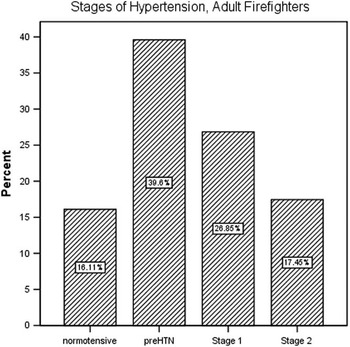
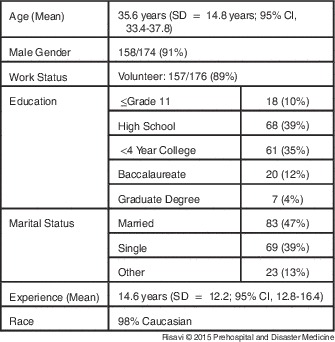
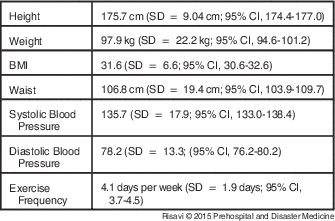
One hundred sixty firefighters participated in the study representing 37 local departments. There was a total of approximately 50,000 firefighters in the Commonwealth of Pennsylvania, of which this sample represented 0.32% of the total firefighters. 17 Most were Caucasian, married, male volunteers approximately 36 years of age with 14 years of experience (Table 1). The average BMI was approximately 31, average waist circumference was 107 cm, and average systolic/diastolic pressures were 136/78. Study respondents averaged approximately four days per week of exercise (Table 2) with 102 (58%) overall who reported exercising regularly. A number were smokers (25; 14.2%). Based on HTN classification, 39% were pre-hypertensive (95% CI, 31%-45%) and approximately 45% combined were Stage I and Stage II hypertensive (95% CI, 33%-47%; Figure 1). Six firefighters (4%) reported a history of coronary artery disease, eight (5%) had had coronary artery bypass surgery, and four (2%) had stents placed. Eleven percent was reported with a history of a heart condition (95% CI, 6%-16%).
Hypertension, Adult Firefighters.a Abbreviation: HTN, hypertension. aFirefighters over the age of 18.

Demographics

Adult Anthropomorphic Data
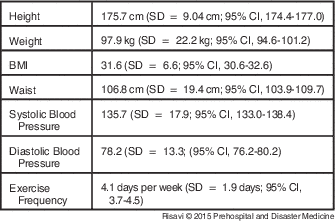
Abbreviation: BMI, body mass index.
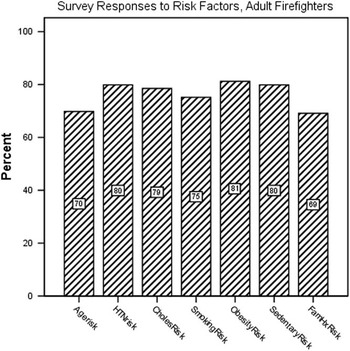
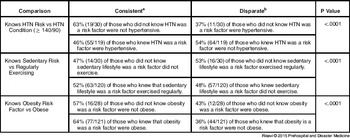
Most firefighters recognized the risks for cardiovascular disease (Figure 2) with family history representing the least-recognized (69%) and obesity and HTN the most (82%). For those who knew that HTN or sedentary lifestyles are risks for heart disease, 52% to 54% were neither hypertensive nor sedentary (Table 3). However, 46% to 64% of those who knew the risks for cardiovascular disease were obese, sedentary, or had HTN. These associations were not spurious (P<.0001). Of the 40% who were found to be hypertensive (Stage I or Stage II), only 18/69 (26%) were being treated for HTN. Overall, 61 (35%) firefighters reported a medical evaluation requirement in their departments.
Survey Responses to Risk Factors. Abbreviation: HTN, hypertension.

Consistency between Knowledge of Risk and Personal Health Risks, Adult Firefighters (95% CI: ± 9%)

Abbreviation: HTN, hypertension.
a Knows risk and is at-risk; does not know risk and is not at-risk.
b Knows risk and is not at-risk; does not know risk and is at-risk.
In this cohort, HTN was associated with age and BMI, but not exercise. Thirty-four percent of those respondents under the age of 40 were hypertensive versus 50% for those over 40. When modeling the effects of age and BMI on HTN, the resultant odds ratios were 1.035 (95% CI, 1.008-1.057) and 1.162 (95% CI, 1.097-1.237), respectively, suggesting that incremental increases in age and BMI increase the risk of HTN by 4% and 16% (P ≤.005). These results show that BMI exerted the greatest risk of becoming hypertensive.
Discussion
Eighteen subjects (4%) had known coronary artery disease. The results indicate a lack of understanding of risk factors for coronary artery disease as well as the presence of these risk factors in the majority of firefighters in this study. Firefighting is a dangerous and demanding profession. The stress of job performance might increase risks of cardiovascular events in firefighters. Soteriades et al reported that these stressors include: inadequate physical activity, poor dietary habits, and shift work. Additionally, smoke exposure, noise (and its effect on blood pressure), and psychological stress also contribute. Sympathetic activation from the initial alarm, physical workload, heat exposure, and dehydration remain important stressors.Reference Byczek, Walton, Conrad, Reichelt and Samo 8 Smith et al reported that for every duty-related sudden cardiac death, there are nearly 17 non-fatal events, namely myocardial infarction or stroke. 18 In this study, 38% were pre-hypertensive, while 40% were hypertensive. Consistent with this data, Kales et al reported that 75% of EMS responders have either pre-HTN or HTN. Also, 75% of those with HTN and being treated are not adequately controlled.Reference Smith, Barr and Kales 19
Physical exertion increases cardiovascular demand during firefighting activity.Reference Kales, Tsismenakis, Zhang and Soteriades 20 Leiba et al reported on the inverse relationship between cardiorespiratory fitness and cardiovascular morbidity and mortality. Specifically, exercise-induced HTN appears to be correlated with higher risk of subsequent HTN and cardiovascular morbidity and mortality.Reference Smith, Manning and Petruzzello 21 Several studies have examined the role of heavy physical exertion in triggering sudden cardiac death. Mittlemen et al reviewed 1,228 patients suffering myocardial infarctions and noted 54 (4.4%) engaged in heavy physical exertion one hour prior to acute myocardial infarction.Reference Leiba, Baur and Kales 22 There was a trend toward increased risk at age 70. Regular exercise is associated with a decrease in long-term risk of coronary events and decreased relative risk that infarction will be triggered by heavy physical exertion.Reference Leiba, Baur and Kales 22 In this study, only 58% reported exercising regularly. Albert et al studied sudden death (although not in firefighters) during 12 years of follow-up and reported that the relative risk of sudden death during, and up to, 30 minutes post-exertion was 16.9 in males between the ages of 40 and 84.
Willich et al studied 1,194 patients experiencing a myocardial infarction during physical exertion. The authors demonstrated that the relative risk for exercise induced myocardial infarction among patients who exercised regularly was reduced; they also reported that patients whose frequency of regular exercise was less than four times per week had relative risks of 6.9, while those exercising greater than four times per week had relative risks of 1.3 (P<.001).Reference Mittleman, Maclure, Tofler, Sherwood, Goldberg and Muller 23 In 7.1% of patients, infarctions occurred during moderate or marked physical activity. In this study, participants who exercised did so an average of four times per week. Habitual vigorous exercise (two to four times per week) decreased the risk of sudden death during vigorous exertion.Reference Willich, Lewis, Löwel, Arntz, Schubert and Schröder 24
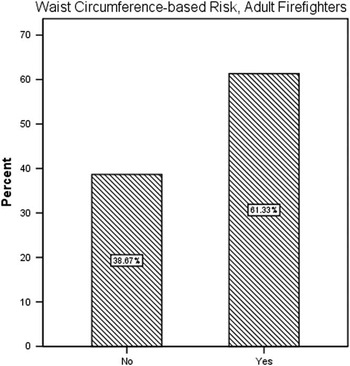
National Institutes of Health (Bethesda, Maryland USA) defines overweight as a BMI of 25-29.9 kg/m2, and obesity as BMI of 30 kg/m2 or greater. 16 Jahnke et al reported increasing rates of musculoskeletal injury as BMI increased. Moreover, increasing BMI was predictive of musculoskeletal injury and subsequent disability risk.Reference Albert, Mittleman, Chae, Lee, Hennekens and Manson 25 Poston et al reported that obesity was also a risk factor for HTN.Reference Jahnke, Poston, Haddock and Jitnarin 26 Scanlon et al surveyed 730 volunteer firefighters in New York (USA). The authors found that 56.7% were over age 40, 41.2% were overweight, and 35.3% were obese. Other cardiovascular risk factors were noted to be present in a number of firefighters as well.Reference Poston, Haddock, Jahnke, Jitnarin, Tuley and Kales 27 Byszek et al assessed the prevalence of cardiovascular risk factors and the relationship to BMI. 7 , Reference Scanlon and Ablah 28 The prevalence of obesity in firefighters (30%) was 2.5 times the Healthy People 2010 target (15%) and nearly twice the prevalence found in US men.Reference Soteriades, Hauser, Kawachi, Liarokapis, Christiani and Kales 29 Clark et al evaluated BMI and its use as a screening tool for fitness and health status of firefighters. Based on waist circumference, about 60% of those with a BMI between 25 and 35 were at-risk of pathologic disease (Figure 3). In this study, 80.7% of subjects were overweight, (body mass indices greater than 25). 30 It was also noted that systolic blood pressure also increased with increased BMI. While the majority of firefighters in this sample were aware of established cardiovascular risk factors, a substantial number were not. Awareness ranged from 69% to 82%. Many did not identify age and family history as risk factors and one in five subjects failed to recognize HTN, hypercholesterolemia, smoking, and obesity as risk factors. Haddock et al reported that almost 14% of career firefighters and 17% of volunteers smoked.Reference Clark, Rene, Theurer and Marshall 31 Many of the firefighters in this study identified themselves as having cardiovascular risk factors including HTN, hypercholesterolemia, and a sedentary lifestyle nearly 38%, 13.5%, and 42%, respectively.
Waist Circumference-based Risk, Adult Firefighters.a Abbreviation: BMI, body mass index. aRisk of Metabolic Syndrome for firefighters over the age of 18 with BMI 25-35.

Donavan et al identified 15% of firefighters as having metabolic syndrome in their study of 214 firefighters.Reference Kales, Soteriades, Christophi and Christiani 2 Superko et al reported the importance of metabolic syndrome and insulin resistance as contributing to the development of coronary heart disease.Reference Haddock, Jitnarin, Poston, Tuley and Jahnke 32 Wilson et al demonstrated an association between blood pressure, low-density lipoprotein (LDL) cholesterol, and coronary artery disease. The progression of atherosclerosis is closely related to the degree of long-term reduction in LDL cholesterol.Reference Superko, Momary and Pendyala 33 , Reference Wilson, D’Agostino, Levy, Belanger, Silbershatz and Kannel 34 According to the Framingham data, as cited in Wilson et al, the average risk of heart disease in males ranged from 3% in the 30-34 age group up to 30% in the 70-74 age group.Reference Superko, Momary and Pendyala 33 Additionally, regular exercise substantially reduces the risk of cardiovascular disease, stroke, and HTN.
Given the significant number of those in this study who did not exercise, it is clear that wellness programs are beneficial. Physical activity reduces many cardiovascular risk factors – with frequency, duration, and intensity being important.Reference Libby and Theroux 35 - Reference Poston, Haddock, Jahnke, Jitnarin and Day 41
National efforts to identify these issues have been initiated; however, given the fact that approximately 75% of the nations’ firefighters are volunteers, it is difficult to provide clear and consistent leadership in addressing these issues.Reference Geibe, Holder, Peeples, Kinney, Burress and Kales 11 Jahnke et al reported on health concerns raised by (career) firefighters. Cancer, heart disease, fitness, nutrition, sleep, mental health, and injury were all significant concerns. Surprisingly, 76% of fire departments had no formal fitness programs.Reference Durand, Tsismenakis, Jahnke, Baur, Christophi and Kales 42 Aggressive medical monitoring appears to be inconsistent at best and is clearly a foundation for promoting fitness/wellness. 14 , Reference Jahnke, Poston, Jitnarin and Haddock 43 Thus, focused education of firefighters regarding heart disease and reduction of risk factors is needed, given the results of the study. Although National Fire Protection Association standards exist regarding firefighter wellness/fitness, more aggressive enforcement is necessary to produce favorable outcomes and decrease the incidence of coronary artery disease and sudden death related to the performance of stressful firefighting tasks.Reference Yoo and Franke 12 , Reference Moore-Merrell, Zhou, McDonald, Fisher and Moore 13
Limitations
The limitations of this study included self-reporting of some aspects of data (ie, exercise and frequency). Selection bias associated with a convenience sample was a possibility. The measurement of blood pressure and calculation of BMI were subject to operator variability; however, all measurements were collected by experienced personnel using a standardized method. Additionally, participant bias was a possibility due to voluntary participation by firefighters in a convenience sample. The researchers employed anonymous data collection to limit the biases associated with self-reporting. The healthy worker effect may have also played a role as well in that ill or injured firefighters would not have been present at the training events. 7
Conclusion
While a majority of firefighters were able to identify risk factors for coronary artery disease, many could not. Eighteen (4%) had a history of coronary artery disease, including interventions. Many had several of the risk factors indicated, which highlights the need for an organized national approach to address the medical screening/evaluation, nutrition, and exercise components of firefighter fitness.
Acknowledgement
The authors would like to thank Tim Cooney, MS, for statistical analysis.
Supplementary Material
To view supplementary material for this article, please visit http://dx.doi.org/10.1017/S1049023X15005415.