INTRODUCTION
African savannas harbour a high diversity of herbivore species of different sizes. Despite the establishment of protected areas, savannas are still subject to multiple threats. Increasing human populations, changing land-use practices and the implementation of land claims in natural areas often result in ecosystem fragmentation, habitat loss and thus in species extinction (Prins & Olff Reference PRINS, OLFF, Newbery, Prins and Brown1997). To better understand the functioning of African savanna ecosystems, insight into the determinants of species coexistence is necessary. Niche partitioning based on body size differences has been suggested to facilitate the coexistence of savanna herbivore species (Olff et al. Reference OLFF, RITCHIE and PRINS2002, Owen-Smith Reference OWEN-SMITH1988, Prins & Olff Reference PRINS, OLFF, Newbery, Prins and Brown1997). However, up to now research on community interactions in savannas has focused mostly on large ungulates, such as buffalo (Syncerus caffer) and elephant (Loxodonta africana) (Owen-Smith Reference OWEN-SMITH1988, Prins & Douglas-Hamilton Reference PRINS and DOUGLAS-HAMILTON1990). We present some of the first experimentally based results on the interplay of murid rodents with larger herbivores in African savannas. Few studies have reported the impact of large herbivore exclusion on rodent abundance and community composition (Keesing Reference KEESING1997, Reference KEESING1998a, Reference KEESING2000). Keesing (Reference KEESING1998a) found that the exclusion of native ungulates and cattle resulted in an overall increase in rodent abundance, suggesting that rodents and large herbivores in these ecosystems compete for food resources and that habitat quality was higher for rodents when ungulates were absent. However, the way in which indigenous herbivores of different sizes affect savanna rodents has not been explored.
In the present study we experimentally excluded different size-classes of large herbivores (body sizes ranging from large: white rhino, Ceratotherium simum; to small: hares) from plots of savanna vegetation and monitored murid rodent abundance and species composition; and vegetation characteristics to explore their interplay. We hypothesise that the exclusion of different size-classes of herbivores has both positive and negative effects on rodents due to several possible mechanisms. For instance, intense grazing by large herbivores (e.g. white rhino, buffalo and zebra, Equus burchelli) improves the vegetation structure for smaller herbivores (Arsenault & Owen-Smith Reference ARSENAULT and OWEN-SMITH2002, Farnsworth et al. Reference FARNSWORTH, FOCARDI and BEECHAM2002, Vesey-FitzGerald Reference VESEY-FITZGERALD1969) as it leads to the development of patchy vegetation with short grazing lawns. The establishment of short grazing lawns has positive long-term effects on rodents by improving the food quality as grazing lawns consist of high-quality plant species. On the other hand, selective medium-sized herbivores (e.g. impala, Aepyceros melampus) decrease the number of high-quality plant species available for smaller herbivore species and thus negatively influence rodents through competition for food (Keesing Reference KEESING1998a). Additionally, vegetation modifications by larger herbivores restrict the habitat available to rodents as grazing and trampling reduces the vegetation cover (Bock et al. Reference BOCK, BOCK, KENNEY and HAWTHORNE1984, Goheen et al. Reference GOHEEN, KEESING, ALLAN, OGADA and OSTFELD2004, Grant et al. Reference GRANT, BIRNEY, FRENCH and SWIFT1982, Roques et al. Reference ROQUES, O'CONNOR and WATKINSON2001). A decrease of vegetation cover leads to higher exposure of rodents to their predators and therefore increases their predation risk (Birney et al. Reference BIRNEY, GRANT and BAIRD1976, Edge et al. Reference EDGE, WOLFF and CAREY1995, Peles & Barrett Reference PELES and BARRETT1996).
METHODS
Study area
This study was conducted between July 2002 and December 2004 in the Hluhluwe-iMfolozi Park (HiP) in KwaZulu-Natal, South Africa (28°13′S, 32°00′E). HiP is a 90 000-ha fenced, protected area and consists of the Hluhluwe Game Reserve in the North and the iMfolozi Game Reserve in the South. The vegetation types in the Park range from open grasslands to closed Acacia and broadleaved woodlands with a high variation in grass quality and quantity at different scales (Owen-Smith Reference OWEN-SMITH2004). Rainfall averages 985 mm y−1 in the high-altitude regions (Hluhluwe) but 650 mm y−1 in the lower areas (iMfolozi; average 1980–2004), with a dry season from April to September. Daily maximum temperatures range from 13 °C to 35 °C. The fire management regime involves simulating natural fires in the park, where different areas are burnt with different frequencies. The park is inhabited by a large set of indigenous large herbivores and carnivores (Brooks & McDonald Reference BROOKS, MCDONALD and Owen-Smith1983). Important snakes and raptors in HiP potentially feeding on rodents are Mozambique spitting cobra (Naja mossambica) and puff adder (Bitis arietans) (Branch Reference BRANCH1998) as well as black-shouldered kite (Elanus caerulus) and spotted eagle owl (Bubo africanus) (Maclean Reference MACLEAN1985).
Experimental design
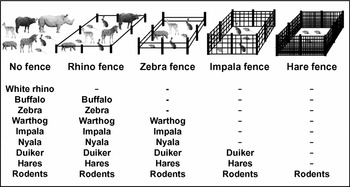
Herbivore exclosures. Our experiment was established in early 2000 (Bond & Olff, unpubl. data). Large herbivore species of varying body sizes were permanently excluded in turn from sixteen 40 × 40-m plots of savanna vegetation by using fences with different height and mesh width (Figure 1). Two study sites were located in Hluhluwe (situated 5 km apart from each other) and two study sites were located in iMfolozi (situated 5 km apart from each other). The distance between the study sites in Hluhluwe and iMfolozi was approximately 30 km. Each of the replicates had four herbivore exclosure treatments and an unfenced control (only dominant herbivore species listed): (1) no fence: all mammalian herbivores potentially present, allowed (species list is provided as an appendix); (2) rhino fence: a thick cable slung at a height of c. 0.7 m above the ground (excludes both species of rhinos, elephant and giraffe but allows access to smaller grazers); (3) zebra fence: two thick cables slung at 0.7 m and 1 m height (additionally excludes animals the size of zebra and larger); (4) impala fence: a 2-m-high upside-down game fence (Bonnox) with variable mesh size, the larger holes were at ground level (allowing access to small antelope and hares but excluding impala-size antelopes and larger animals; (5) hare fence: a 2-m-high game fence with a lower strip of chicken-mesh steel-wire (chicken mesh height: 1.3 m, mesh size 1.3 cm; excludes all animals the size of a hare and larger)
Design of the exclosure experiment in the Hluhluwe-iMfolozi Park, South Africa. Herbivore species of different size classes are stepwise permanently excluded from 40 m × 40-m blocks of savanna vegetation by using fences with different height and mesh width. Exclosure treatments include (from left to right) unfenced control, rhino fence, zebra fence, impala fence and hare fence. Herbivore species that are able to feed within the different exclosure treatments are listed below each. Animal pictures are copyright of O. Bonnet and A.M. Shrader.

The study sites in Hluhluwe included all four exclosure treatments and the unfenced control, whereas the study sites in iMfolozi contain only two exclosure treatments (rhino fence and hare fence) plus the unfenced control. The distance between the control and the exclosure treatments was not more than 10 m. Dung counts conducted in the control and the exclosure treatments indicated that the fences successfully excluded the target groups. The study sites were burned once every 2 y as part of the fire management regime in the park. During the period of this study, they were burned in August 2002 and August 2004.
Vegetation characterization. Vegetation characteristics were recorded in March 2003 in one-half of the control and each exclosure treatment in a grid with measuring points spaced 2 m apart from each other (200 points). To measure vegetation height the drop disc method (46 cm diameter, mass: 460 g) was used (Stewart et al. Reference STEWART, BOURN and THOMAS2001). The most dominant grass species (basal area cover) was determined and the height at which the disc was resting on the vegetation was measured. To determine the quality of rodent food sources, we collected 112 samples of green leaves of the dominant grass species from all exclosures and control plots. We gathered the number of samples of each species roughly in proportion to their abundance within these plots. We analysed each sample for its N, P, Ca, Mg and Na concentration and then calculated the average concentration of each nutrient per grass species in order to avoid any treatment effects. We discriminated the grass species by their growth forms and placed them into two categories (1) bunch grasses and (2) lawn grasses. We then calculated the average concentrations of the nutrients in the samples and classified them in two nutritional quality categories: (1) high-quality grasses and (2) low-quality grasses.
Rodent surveys. We established a permanent small-mammal trapping grid inside the control and the exclosure treatments. Each 40 × 40-m plot contained a trapping grid of twenty-five 5 × 5-m traps located approximately 7 m apart from each other. Traps were not placed closer than 3 m to a fence. We conducted nine trapping sessions of 4–5 consecutive nights each. Trapping sessions were conducted approximately every 3 months over the course of the study. PVC live-traps were placed on flat ground using one trap per station. Traps were baited with a mixture of oatmeal, raisins, water, oil and salt and checked in the morning and evening, re-baited and reset if necessary. Captured animals were weighed, identified to species (Skinner & Chimimba Reference SKINNER and CHIMIMBA2005), and permanently individually marked with glass fibre transponders (Telinject®, ID 100, Römerberg, Germany). In July and August 2002, dung pellets of the most frequently captured rodent species were collected from the traps for micro-histological faecal analysis. Epidermis fragments of grasses in the faeces were compared to photomicrographs of epidermis fragments of the most dominant grass species occurring at the study sites on reference slides (De Jong et al. Reference DE JONG, GILL, VAN WIEREN and BURLTON1995). For the reference slides, pieces of leaf blades were cleaned in household bleach overnight, washed in water, fragments of epidermis were then stripped off and mounted in glycerol before photomicrographs were taken. The faecal samples were mixed on an individual basis; mixed samples were stored in a formalin–acetic acid–alcohol mixture (Anthony & Smith Reference ANTHONY and SMITH1974) and softened by autoclaving with some water at 125 °C. Samples were then washed in a Waring Blender, strained over a 0.1-mm plankton sieve and stored in 70% ethanol. From every mixed sample, ten random samples were examined by light microscopy. At least 100 fragments of epidermis were identified by comparison with the photomicrographs and measured by using a grid of 0.01-mm2 squares in the microscope eyepiece (De Jong et al. Reference DE JONG, GILL, VAN WIEREN and BURLTON1995). The abundance of each species was calculated as a percentage of the total area of the fragments measured (Alipayo et al. Reference ALIPAYO, VALDEZ, HOLECHECK and CARDENAS1992, Cid & Brizuela Reference CID and BRIZUELA1990, Homolka & Heroldová Reference HOMOLKA and HEROLDOVÁ1992, Sparks & Malechek Reference SPARKS and MALECHEK1968, Stewart Reference STEWART1967). Because rodents were able to move between exclosures within a site, we restricted our diet analysis to differences between Hluhluwe and iMfolozi (and not exclosure treatments). Captured animals were released at their trapping location after measurements were taken.
Data analyses
The effects of large herbivores on vegetation were tested statistically in two different ways. To highlight the impact of the different herbivore size classes on the grass species composition and vegetation structure, we firstly analysed the Hluhluwe and iMfolozi areas separately. This analysis included all exclosure treatments (four in Hluhluwe vs. two in iMfolozi), plus the unfenced controls. However, to facilitate four similar replicates throughout the experiment, we also pooled the data from Hluhluwe and iMfolozi, including only the two replicated exclosure treatments (rhino fence and hare fence), plus the unfenced control. We then used the pooled data for the remaining analyses.
We calculated the mean vegetation height (using 200 measuring points per plot) for each exclosure treatment (four in Hluhluwe vs. two in iMfolozi), plus the unfenced controls. This resulted in 10 values for Hluhluwe (four exclosure treatments + one control × two study sites) and six for iMfolozi (two exclosure treatments + one control × two study sites). We used these values to analyse the effect of large herbivores on the vegetation height in the two separate study areas with a one-way ANOVA followed by Tukey HSD tests. Then, we tested the influence of large herbivores on the mean vegetation height using a two-way ANOVA. In this analysis, exclosure treatment (hare fence, rhino fence, control) and study area (Hluhluwe, iMfolozi) were the independent factors; vegetation height was the dependent factor. We used a Pearson's Chi-square test to examine the impact of large herbivores on grass species composition in the two separate study areas (including all exclosure treatments plus control). To test for differences in both grass and rodent species composition between exclosure treatment (hare fence, rhino fence, control) and study area (Hluhluwe, iMfolozi), we used a three-way ANOVA. Seven dominant grass species were included in the analysis for the grass species composition, whereas the analysis for the rodent species composition included six different rodent species. We used a repeated-measures ANOVA followed by Tukey HSD tests to investigate the impact of large herbivores on rodent numbers and trapping success (percentage of traps that were occupied by rodents) over the course of the study. In these analyses, exclosure treatment (hare fence, rhino fence, control) and study area (Hluhluwe, iMfolozi) were the independent factors, and rodent numbers or trapping success per trapping session were the dependent factors. Relations between trapping success and vegetation height were analysed with logistic regression with rodent presence/absence as the dependent variable and vegetation height as a predictor. Due to the unbalanced number of grass species, we first tested the data on nutrient concentrations of bunch and lawn grasses for equality of sample variances. Each nutrient was then tested separately for differences between bunch and lawn grass species using a t-test (the sample variances for N, Mg, P and Na concentrations which were found to be unequal were estimated separately for each group). Differences in the overall diet composition of rodents and the grass components of their diet between study areas were analysed with a Pearson's Chi-square test.
RESULTS
Vegetation analysis
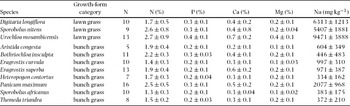
Grass species quality. Lawn grass species had significantly higher average N (t40.4 = −2.7, P = 0.01), P (t42.0 = −3.5, P < 0.001), Ca (t110 = −3.6, P < 0.001), Mg (t41.5 = −4.2, P < 0.001) and Na concentrations (t32.6 = −11.1, P < 0.001) than bunch grass species (Table 1) and are therefore determined as high-quality grass species. However, some bunch grasses are high-quality as well (such as Panicum maximum).
Leaf nutrient concentrations (mean ± SD), number of samples taken and growth-form category of each dominant grass species in the Hluhluwe-iMfolozi Park, South Africa. We found that lawn grass species had significantly higher nutrient concentrations than bunch grass species (t-test, P < 0.05). However, the nutrient concentrations in the bunch grass Panicum maximum were also high. Bothriochloa insculpta is expected to be neglected by herbivores due to its bitter taste (van Oudtshoorn Reference VAN OUDTSHOORN1992).

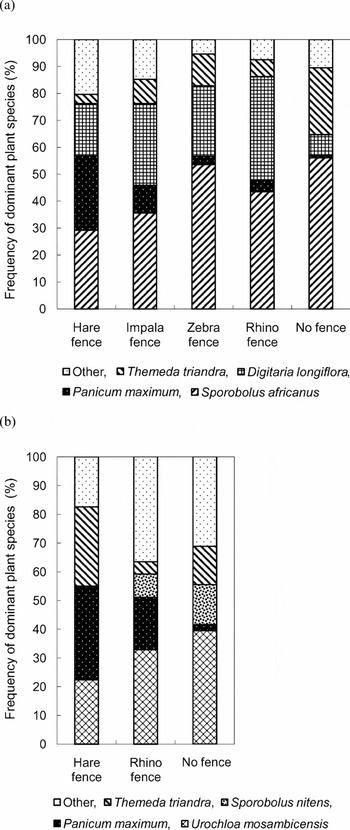
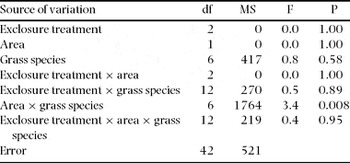
Grass species composition. The stepwise exclusion of different size-classes of herbivores resulted in significant changes in the grass species composition in Hluhluwe (χ216 = 432, P < 0.001, Figure 2a) and iMfolozi (χ28 = 228, P < 0.001, Figure 2b). The dominant grass species in Hluhluwe were Sporobolus africanus and Digitaria longiflora, representing 67% of the recorded species. Other frequently recorded grass species included Panicum maximum and Themeda triandra. In iMfolozi, the dominant grass species were P. maximum and Urochloa mosambicensis, recorded at 49% of the measurement points. However, Sporobolus nitens and T. triandra were also recorded frequently. In both study areas, Hluhluwe and iMfolozi, we found a considerable increase in the abundance of the high-quality grass species P. maximum after the exclusion of all large herbivore species. Moreover, the grass species composition in the hare fence, rhino fence and unfenced control was significantly different between Hluhluwe and iMfolozi (Table 2).
Frequency of occurrence of dominant grass species for the different exclosure treatments in (a) Hluhluwe and (b) iMfolozi measured in March 2003 in the Hluhluwe-iMfolozi Park, South Africa. The grass species composition was significantly different between the exclosure treatments in both Hluhluwe (n = 200, χ216 = 432, P < 0.001) and iMfolozi (n = 200, χ28 = 228, P < 0.001). In both study areas, Hluhluwe and iMfolozi, the abundance of the high-quality grass species P. maximum increased considerably in the absence of large herbivores (i.e. hare fence).

Results of a three-way ANOVA of the effects of exclosure treatment, area and different grass species on the grass species composition in the Hluhluwe-iMfolozi Park, South Africa. ‘Area’ refers to the pooled data of the two study sites in each of the Hluhluwe and iMfolozi areas. The grass species composition differed significantly between Hluhluwe and iMfolozi.

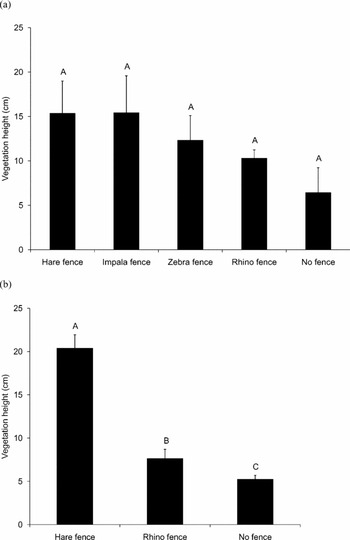
Vegetation structure. The exclusion of all herbivore species the size of zebra and larger resulted in a stepwise increase of the vegetation height in Hluhluwe (Figure 3a). However, this increase was not significant (F4, 5 = 1.5, P = 0.31), but followed the same trend as in iMfolozi. In iMfolozi, we found a significant increase of the vegetation height after the exclusion of white rhino (F2, 3 = 53.4, P = 0.005; Figure 3b).
Mean vegetation height for the different exclosure treatments in (a) Hluhluwe and (b) iMfolozi measured in March 2003 in the Hluhluwe-iMfolozi Park, South Africa. Error bars represent 1 SE. Different upper-case letters show significant differences in vegetation height between exclosure treatments (n = 200, one-way ANOVA, F2, 3 = 53.4, P = 0.005).

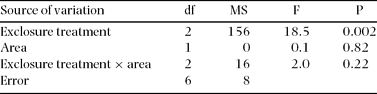
Furthermore, the vegetation heights in the hare fence, rhino fence and unfenced control were significantly different for the pooled data of Hluhluwe and iMfolozi (Table 3).
Results of a two-way ANOVA of the effects of exclosure treatment and area in vegetation height in the Hluhluwe-iMfolozi Park, South Africa. ‘Area’ refers to the pooled data of the two study sites in each of the Hluhluwe and iMfolozi areas. The vegetation heights differed significantly between the exclosure treatments when considering only the hare fence, rhino fence and unfenced control for both study areas, Hluhluwe and iMfolozi.
Rodent analysis
Between July 2002 and December 2004, we captured 387 murid rodents, comprising four species. The most frequently captured species was the single-striped mouse (Lemniscomys rosalia), a murid rodent that is common in bushveld habitats in Kwazulu-Natal (Taylor Reference TAYLOR1998). In HiP, the single-striped mouse represented about 75% of all captures. Other murid rodent species captured and identified included the Natal multimammate mouse (Mastomys natalensis), the pouched mouse (Saccostomus campestris) and bush-rats (Aethomys spp). However, several captured rodents could not be identified to species level.
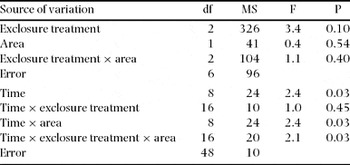
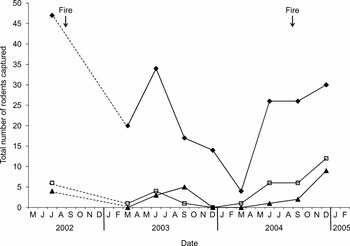
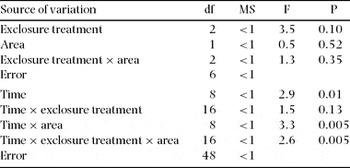
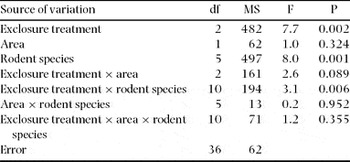
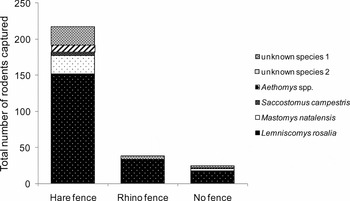
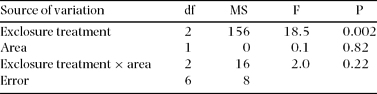
From the three-way interaction, it was clear that the number of murid rodents was significantly higher in the absence of all larger herbivores throughout the course of the study (Table 4, Figure 4). The trapping success was significantly higher when all large herbivore species were absent over the course of the study (Table 5). Furthermore, the trapping success significantly increased with increasing vegetation height (Wald = 51.7, P < 0.001). The rodent species composition was significantly different between the three exclosure treatments (Table 6, Figure 5). Firstly, the absence of all large herbivores resulted in a higher number of rodent species. Secondly, while Lemniscomys rosalia and the unknown species 1 were present in all exclosure treatments, Saccostomus campestris, Aethomys spp., and the unknown species 2 were captured only in the absence of large herbivores.
Results of a repeated-measures ANOVA of the effects of exclosure treatment, area and time on the abundance of murid rodents in the Hluhluwe-iMfolozi Park, South Africa. ‘Area’ refers to the pooled data of the two study sites in each of the Hluhluwe and iMfolozi areas. The three-way interaction indicates that murid rodent numbers were significantly higher in the absence of large herbivores throughout the course of the study.

Total number of murid rodents captured in the different exclosure treatments from July 2002 to December 2004 in the Hluhluwe-iMfolozi Park, South Africa. The different exclosure treatments are presented as: solid diamonds = hare fence; open squares = rhino fence; solid triangles = unfenced control. The dashed lines indicate a hypothesized trend in the number of murid rodents due to a missing trapping session. Murid rodent numbers were significantly higher in the absence of all larger herbivores throughout the course of the study (n = 9, repeated-measures ANOVA, F16, 48 = 2.1, P = 0.03).

Results of a repeated-measures ANOVA of the effects exclosure treatment, area and time on the trapping success of murid rodents in the Hluhluwe-iMfolozi Park, South Africa. ‘Area’ refers to the pooled data of the two study sites in each of the Hluhluwe and iMfolozi areas. The three-way interaction shows that the absence of large herbivores significantly increased the trapping success of murid rodents over the course of the study.

Results of a three-way ANOVA of the effects of exclosure treatment, area and different rodent species on the rodent species composition in the Hluhluwe-iMfolozi Park, South Africa. ‘Area’ refers to the pooled data of the two study sites in each of the Hluhluwe and iMfolozi areas. The rodent species composition differed significantly between the exclosure treatments.

Total number of murid rodent species captured in the different exclosure treatments from July 2002 to December 2004 in the Hluhluwe-iMfolozi Park, South Africa. The exclusion of large herbivores resulted in a higher number of rodent species in the hare fence. In addition, the composition of the rodent species assemblage differed significantly between the exclosure treatments (n = 9, three-way ANOVA, F10, 36 = 3.1, P = 0.006).

The diet of L. rosalia consists mainly of grass leaves and stems (65%) but also seeds (25%) and arthropods (3%), with a significantly higher grass and arthropod proportion in its diet in iMfolozi than in Hluhluwe (χ24 = 20.7, P = 0.001). Considering only the grass diet components, L. rosalia consumed significantly different proportions of grass species in Hluhluwe than in iMfolozi (χ29 = 708, P < 0.001). In Hluhluwe, it mostly fed on two low-quality bunch grass species, Sporobolus africanus (69%), and Eragrostis curvula (21%). In iMfolozi, it predominantly fed on the high-quality lawn grass species U. mosambicensis (77%); however, T. triandra, a lower-quality bunch grass species, was also detected in its diet (13%).
DISCUSSION
Herbivore species of different body sizes had different effects on murid rodents. Medium-sized herbivores such as warthog, impala and nyala altered mainly the abundance of high-quality grasses and thus plant species composition. Large bulk feeders such as zebra, buffalo and white rhino changed primarily the vegetation height. This in turn, had a strong impact on rodent abundance and both rodent species diversity and species composition.
Effects of large herbivores on murid rodents
Herbivore species of different body sizes select different diets due to their foraging selectivity and food quality requirements. Medium-sized herbivores (e.g. warthog, impala and nyala) can feed on individual plants or even plant parts (Ritchie & Olff Reference RITCHIE and OLFF1999) and selectively feed on high-quality food resources. Large herbivore species (e.g. white rhino, buffalo and zebra), on the other hand, can only graze on multiple plants at their lowest level of selection and tolerate lower-quality food (Demment & van Soest Reference DEMMENT and VAN SOEST1985, van Soest Reference VAN SOEST1994). As a consequence, herbivore species of different body sizes play various roles in creating mosaic patches of short and long vegetation (Cromsigt & Olff Reference CROMSIGT and OLFF2006, Vesey-FitzGerald Reference VESEY-FITZGERALD1969, Reference VESEY-FITZGERALD1972) that differ in quality and quantity.
In the present study, we hypothesized that the absence of medium-sized herbivores would lead to changes in the quantity and quality of food available to rodents. Our results showed that the exclusion of medium-sized herbivores led to changes in both food quantity and grass species composition, increasing the abundance of high-quality food resources available to rodents. Furthermore, the dominant rodent species captured in the study area, Lemniscomys rosalia, is mostly herbivorous and thus potentially competing with larger herbivores for food resources. However, L. rosalia showed a strong preference for the most abundant grass species occurring in their habitat, rather than for high-quality grass species. Moreover, the diet analysis revealed that L. rosalia includes arthropod components in its diet, which may be of greater importance nutritionally than the protein concentration in grass leaves. This may indicate that food is unlikely to be a limiting factor for rodents in this habitat.
We hypothesized that the absence of large herbivore species would result in increased vegetation height and thus protective cover available to rodents. Our study revealed that the exclosure of large herbivores led to a significant increase in the vegetation height. Furthermore, the abundance of rodents was strongly correlated with the vegetation height. Smit et al. (Reference SMIT, BOKDAM, DEN OUDEN, OLFF, SCHOT-OPSCHOOR and SCHRIJVERS2001) also found taller vegetation and higher rodent density after the exclusion of large herbivores. Taller vegetation may imply a better habitat for rodents as they benefit from closed vegetation cover through a lower predation risk (Bowland & Perrin Reference BOWLAND and PERRIN1989, Kotler Reference KOTLER1984, Kotler & Blaustein Reference KOTLER and BLAUSTEIN1995). Several studies have shown that the amount of vegetation cover is important for protecting rodents from predators (Birney et al. Reference BIRNEY, GRANT and BAIRD1976, Cook Reference COOK1959, Edge et al. Reference EDGE, WOLFF and CAREY1995, Peles & Barrett Reference PELES and BARRETT1996). In some habitats, however, rodent numbers increase in the absence of larger herbivores despite undetectable differences in vegetation cover (Heske & Campbell Reference HESKE and CAMPBELL1991, Keesing Reference KEESING1998a, Reference KEESING1998b, Reference KEESING2000). Nevertheless, we conclude that the abundance of rodents in this habitat is most likely influenced by large-herbivore-induced changes of the vegetation cover and the subsequent increase in their exposure to predators, especially raptors, which are abundant in HiP.
Our study indicated that the absence of large herbivores results in a higher number of rodent species. We also found that some rodent species were captured regardless of the presence of large herbivores (e.g. Lemniscomys rosalia, Mastomys natalensis), whereas others were only captured in the absence of large herbivores (e.g. Saccostomus campestris). Lemniscomys rosalia is known to occupy herbivore niches, as it tends to be herbivorous (Monadjem Reference MONADJEM1997a). Its most important requirement seems to be the presence of dense ground cover of long grass (Monadjem Reference MONADJEM1997b, Taylor Reference TAYLOR1998), as it appears to breed in surface grass nests (Taylor Reference TAYLOR1998). Although Mastomys natalensis is known to be a pioneer species in the colonization of heavily overgrazed areas (Meester et al. Reference MEESTER, LLOYD and ROWE-ROWE1979), it was also found mainly in tall vegetation. Saccostomus campestris, on the other hand, is a slow-moving animal that often falls prey to carnivores (Taylor Reference TAYLOR1998). It is particularly vulnerable to avian predators, which mainly use vision in hunting. Therefore, it is likely that this species prefers tall vegetation rather than areas with heavily grazed vegetation. Overall, we suggest that murid rodent abundance and both species diversity and species composition in South African savannas are driven primarily by large-herbivore-induced changes of their predation risk.
ACKNOWLEDGEMENTS
Ezemvelo KZN Wildlife gave permission to conduct research in the Hluhluwe-iMfolozi Park and is gratefully acknowledged. We thank the management and research staff of the Hluhluwe-iMfolozi Park to allow us to work in the Park and for their logistic support; D. Balfour, S. van Rensburg, S. Nxumalo, P. Hartley, C. Reid, D. Robertson, E. Smidt and R. and O. Howison. We are very grateful for the help of many people collecting the data for this study; especially N. Mbatha, K. Mpanza, S. Mhlongo, X. Mthiyane, J. Ngobese, T. Shelembe, A. Kramer, M. Beijen, S. Khumalo, X. de Lugt and R. Xaba. We also would like to thank W. J. Bond and the Zululand Grass Project (ZLGP) for fruitful collaboration. N. Pillay is gratefully acknowledged for the assistance with the rodent species identification. Comments from H. Lutermann, A. M. Shrader and two anonymous reviewers greatly improved the manuscript. We thank O. Bonnet and A. M. Shrader for the permission to use their animal pictures. The study was financially supported by the Robert Bosch Foundation, Germany (grant number: 32.5.8040.0013.0). Small mammal trapping and marking in HiP was approved by Ezemvelo KZN Wildlife and by the Animal Ethics Committee of Wageningen University and Research Centre.
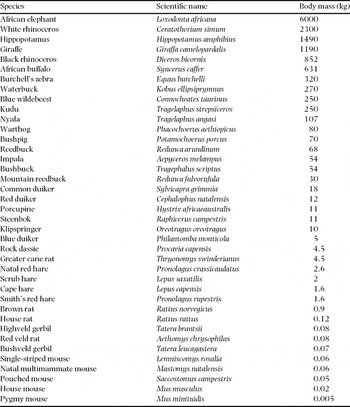
Mammalian herbivore species potentially present in the Hluhluwe-iMfolozi Park, South Africa (nomenclature follows Skinner & Chimimba Reference SKINNER and CHIMIMBA2005). Body mass represents maximum male mass.