Healthcare-associated infections (HAIs) cause significant patient morbidity and mortality.Reference Klevens, Edwards and Richards 1 Methicillin-resistant Staphylococcus aureus (MRSA) is the most common antibiotic-resistant bacteria causing HAIs and is more difficult to treat than methicillin-susceptible S. aureus.Reference Cosgrove, Sakoulas and Perencevich 2 Trials of MRSA prevention have generally not evaluated more than one intervention. Trials evaluating active surveillance culturing have not found MRSA reduction.Reference Huskins, Huckabee and O’Grady 3 , Reference Derde, Cooper and Goossens 4 Trials of chlorhexidine (CHG) patient bathing found variable impact on overall infections, skin contaminants, MRSA, and vancomycin-resistant Enterococcus.Reference Milstone, Elward and Song 5 , Reference Huang, Septimus and Kleinman 6 The Benefits of Universal Glove and Gown (BUGG) trial, a single trial of universal gloving and gowning, found a reduction in MRSA transmission but not vancomycin-resistant Enterococcus transmission.Reference Harris, Pineles and Belton 7
To determine the interaction between universal gloving and gowning with CHG bathing and other infection control interventions, we conducted a subgroup analysis of the BUGG trial.
METHODS
The study was a subgroup analysis of the BUGG cluster-randomized ICU trial. From September 1, 2011, through December 31, 2011, intensive care units (ICUs) collected baseline data on the primary outcome of MRSA acquisition. For randomization and analysis, ICUs were pair-matched on baseline rates of MRSA and vancomycin-resistant Enterococcus acquisition. Within each pair, one ICU was randomized to the intervention and the other to the control group.Reference Harris, Pineles and Belton 7 The intervention period was from January 1 through October 31, 2012.
We recruited medical, surgical, or combined medical-surgical ICUs for adult patients from academic and community hospitals in the United States through the Society for Healthcare Epidemiology of America Research Network, excluding those performing active surveillance culturing for MRSA or vancomycin-resistant Enterococcus during the study. Information on infection control practices from infection control staff was obtained during site visits at each ICU.Reference Harris, Pineles and Belton 7
The intervention occurred at the cluster level of ICU. During the study period, all healthcare workers (eg, nurses, physicians, respiratory therapists) in the 10 ICUs assigned to the intervention group were required to wear gloves and gowns when entering any patient room. The 10 ICUs in the control group followed usual standard of care, which consists of healthcare workers following Centers for Disease Control and Prevention contact precaution guidelines (gloves and gowns) for patients known to have infection or colonization with antibiotic-resistant bacteria. ICUs were stratified according to whether or not they performed CHG patient bathing, were classified as academic hospitals based on affiliation with a medical school, and had performed active surveillance for MRSA before entering the study.
All patients had ICU admission and ICU discharge surveillance culture specimens collected for MRSA (nasal swab). For each patient, MRSA acquisition was defined as having a surveillance culture on ICU admission that was negative for MRSA, with a subsequent surveillance culture on ICU discharge for the same hospitalization that was positive for MRSA. Poisson mixed effects models were used to perform all subgroup analyses. The models included fixed effects for time period (baseline period versus study period), random group assignment (control versus intervention), subgroup category, 2-way interaction terms between these variables, and a 3-way interaction term. A random intercept was included to account for heterogeneity among ICUs. A separate model was fit for each subgroup variable. We tested the coefficient of the 3-way interaction term to determine whether the effect of the intervention differed by subgroup category. All tests were 2-sided with the threshold for statistical significance being P<.05. The University of Maryland School of Medicine Institutional Review Board served as the central institutional review board. All participating ICUs received approval from their local institutional review boards.
RESULTS
Twenty ICUs participated in the study and none withdrew. There were 26,180 ICU admissions and 92,241 swabs for detection of MRSA. During the study period, compliance with obtaining nasal cultures was 95.73% at admission and 84.44% at discharge. Compliance with wearing gloves in the intervention ICUs was 86.18% (2787/3234), and compliance with wearing gowns was 85.14% (2750/3230). In the control group, 10.52% of patients were on contact precautions.
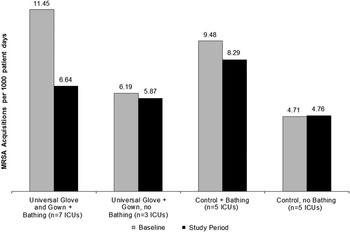
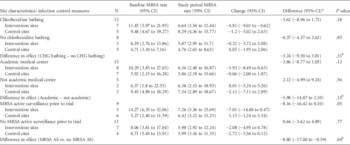
Figure 1 and Table 1 demonstrate the results of the intervention stratified by infection control practices including CHG bathing, academic versus nonacademic setting, and presence of MRSA surveillance before study initiation. No units began new infection prevention practices during the study period. Five units in the control arm practiced CHG bathing (3 used wipes, 2 CHG soap) whereas 7 units in the intervention arm practiced CHG bathing (4 used wipes, 3 CHG soap). We found no statistically significant differences in units that practiced CHG bathing versus units that did not practice CHG bathing on the effect of universal gloving and gowning to reduce acquisition of MRSA. However, among units that practiced CHG bathing, the reduction in MRSA was greater in intervention ICUs than in control ICUs (rate difference, −3.62; 95% CI, −8.96 to 1.73, P=.18). Among units that did not practice CHG bathing, the change in MRSA acquisition was similar in intervention ICUs and control ICUs (rate difference, −0.37; 95% CI, −4.37 to 3.62, P=.85).
Frequency of methicillin-resistant Staphylococcus aureus (MRSA) acquisition in intensive care unit (ICU) patients during baseline and study periods representing the effect of universal glove and gown on patients in ICUs that did or did not use chlorhexidine bathing.

Baseline and Study Period Rates of MRSA Acquisition per 1,000 Patient-Days in Those Sites Randomized to the Intervention of Universal Glove and Gown Use Compared With Control Sites as Subanalyzed by Other Infection Control Methods Used at Sites During the Baseline and Study Periods

NOTE. AS, active surveillance; CHG, chlorhexidine; MRSA, methicillin-resistant Staphylococcus aureus.
a Negative number reflects greater reduction in the intervention group than in the control group from the baseline period to the study period.
b P for interaction.
Among units that performed MRSA active surveillance before the start of the study, the reduction in MRSA acquisition was greater in intervention ICUs than in control ICUs (rate difference, −8.16; 95% CI, −16.42 to 0.10, P=.05). In contrast, among units that did not practice active MRSA surveillance before the start of the study, the change in MRSA acquisition was similar in intervention ICUs and control ICUs (rate difference, 0.64, 95% CI, −3.62 to 4.89, P=.77). This resulted in a significant difference in effects of −8.80 (95% CI, −17.00 to −0.59, P for interaction=.04). We did not find a significant interaction when comparing the intervention effect between academic and nonacademic ICUs (P=.15).
DISCUSSION
In a subgroup analysis of the BUGG trial, we found that the effect of universal gloving and gowning on MRSA acquisition was not modified by whether a unit was already using CHG bathing or was an academic medical center. Those units that were using CHG bathing during the study period had larger, although not statistically significant, decreases in MRSA acquisition than did units not using CHG bathing. Facilities that had been performing active surveillance culturing immediately before the BUGG study had a significantly greater reduction in MRSA acquisition with universal gloving and gowning than did their counterparts.
Although there was limited power for subanalysis of a 20 ICU cluster study, the estimated effect of universal gloving and gowning was greater in units using CHG bathing. This may suggest that there are additional benefits to performing both CHG bathing and universal gloving and gowning in the reduction of MRSA acquisition.Reference Huang, Septimus and Kleinman 6 , Reference Harris, Pineles and Belton 7 The reason for the increased benefit from universal gloving and gowning as a change from active surveillance culturing for MRSA is unclear. Units employing MRSA active surveillance may have had higher rates of MRSA or, as some have argued, ineffective active surveillance for MRSA may distract staff from general horizontal infection prevention practices.Reference Edmond and Wenzel 8 These results suggest that the benefits of CHG bathing and universal gloving and gowning may be additive. The decision to implement a method of infection prevention should depend on frequency of HAIs and multidrug-resistant organisms at an individual hospital or ICU. Units with low rates of both HAIs and multidrug-resistant organisms using baseline prevention methods may choose not to implement any additional interventions, whereas units with high rates of HAIs and multidrug-resistant organisms may wish to implement one or both of CHG bathing and universal gloving and gowning. This study was limited by statistical power and a non-random adoption of infection prevention practices.
In conclusion, in a subanalysis of the BUGG study, we found that there are additive benefits to performing both CHG bathing and universal gloving and gowning to reduce MRSA in some ICUs.
BUGG STUDY PRIMARY INVESTIGATORS
The primary investigators of the BUGG Study are Syed K. Shahryar, MD, St. Luke’s Medical Center, Phoenix, Arizona; Tamara Rasner, RN, BS, CIC, St. Luke’s Medical Center, Phoenix, Arizona; Connie S. Price, MD, Denver Medical Center, Denver, Colorado; Joseph J. Gadbaw, MD, Lawrence and Memorial Hospital, New London, Connecticut; Marci L. Drees, MD, MS, Christiana Hospital, Newark, Delaware; L. Silvia Muñoz-Price, Jackson Memorial Hospital, Miami, Florida; Dave Calfee, MD, New York-Presbyterian/Weill Cornell Medical Center, New York, New York; Jesse T. Jacob, MD, Emory University Hospital Midtown, Atlanta, Georgia; Loreen A. Herwaldt, MD, University of Iowa Hospitals and Clinics, Iowa City, Iowa; Deborah S. Yokoe, MD, MPH, Brigham and Women’s Hospital, Boston, Massachusetts; Lisa Maragakis, MD, MPH, Johns Hopkins Hospital, Baltimore, Maryland; Nasia Safdar, MD, PhD, University of Wisconsin Hospitals and Clinics, Madison, Wisconsin; Matthew E. Lissauer, MD, University of Maryland Medical Center, Baltimore, Maryland; David K. Warren, MD, Barnes Jewish Hospital, St. Louis, Missouri; Robin L. Carver, RN, BSN, CIC, WakeMed Hospital, Raleigh, North Carolina; Stephanie Levine, MD, University Health System, San Antonio, Texas; and Deverick J. Anderson, MD, MPH, Duke University, Durham, North Carolina.
Acknowledgments
Financial support. Agency for Healthcare Research and Quality (HHSA290200600015 Task Order no. 5; and 1K08HS18111-01 to D.J.M.) and the National Institutes of Health (5K25AG034216-03 to M.S. and 5K24AI079040-05 to A.D.H.).
Potential conflicts of interest. A.D.H. reports that he has been a consultant for Premier, Cubist, and Sanogiene and is an editor for UpToDate Online. D.J.M. reports that he has served as a consultant for Welch Allyn and Sanogiene. D.H.K. reports that he serves as a consultant for Pfizer and Astellas; has received honoraria or speaking fees from Pfizer, Astellas, and GlaxoSmithKline; and has received research support from Pfizer and Akers Bioscience. D.K.W. reports that he has received research support from Cubist and BioMérieux as well as payment for a lecture from 3M Healthcare and serves as a consultant for Centene and Sagentia. All other authors report no conflicts of interest relevant to this article.
Role of the sponsors. The sponsors had no role in the design and conduct of the study; in the collection, management, analysis and interpretation of the data; or in the preparation of the manuscript.
Disclaimer. The content is solely the responsibility of the authors and does not necessarily represent the official views of the Agency for Healthcare Research and Quality or the National Institutes of Health.