Introduction
There is increasing interest and concern regarding the health of people conceived by assisted reproductive technologies. Studies have shown that in vitro fertilisation (IVF) singleton neonates are statistically more likely to suffer a range of adverse perinatal outcomes compared to spontaneously conceived neonates, including low birth weight (LBW = < 2500 g), very LBW (VLBW = < 1500 g), small for gestational age (SGA = < 10th percentile for weight), preterm delivery (PD = < 37 weeks), very PD (VPD = < 32 weeks), and have higher incidences of congenital abnormalities (including heart defects) and perinatal mortality. Reference Chen, Yang, Zheng, Yu, Wang and Qin1–Reference McDonald, Han and Mulla8 The developmental origins of health and disease (DOHaD) theory Reference Barker9 posits that poor perinatal outcomes of PD, LBW and SGA are associated with poorer health outcomes in adulthood. Reference Simeoni, Armengaud, Siddeek and Tolsa10–Reference Calkins and Devaskar14 Subsequently, the increased incidences of poor perinatal outcomes have become a cause for concern for the long-term health of people conceived with IVF and other assisted reproductive technologies. Reference Chen and Heilbronn15–Reference Wen, Jiang and Ding19
A subset IVF treatment modality, donated oocytes, has been shown in systematic reviews to be associated with LBW, VLBW, PD, SGA and of lower gestational age, when compared to neonates conceived with autologous oocytes. Reference Moreno-Sepulveda and Checa20–Reference Adams, Clark, Davies and de Lacey24 While oocyte donation, perinatal outcomes appear from those reviews to be conclusively poorer than their autologous oocyte IVF counterparts, the perinatal outcomes from sperm donation are less clear with very few systematic reviews or meta-analysis investigating these outcomes. One recent meta-analysis showed that sperm donation neonates were significantly more likely to be born of LBW and with more birth defects than those conceived spontaneously. Reference Adams, Clark, Davies and de Lacey25 However, an earlier review (non-systematic and without meta-analysis) suggested that the perinatal outcomes were comparable to those spontaneously conceived. Reference Lansac and Royere26 Uncertainty remains due to the lack of systematic reviews and meta-analysis, as well as the low number of studies that met the inclusion criteria and were then able to be included in the meta-analysis of donor sperm perinatal outcomes. Reference Adams, Clark, Davies and de Lacey25 The long-term health of donor-conceived people continues to be of concern and therefore warrants further investigation.
Only one oocyte donation systematic review investigated longitudinal physical health outcomes into childhood or adulthood in addition to perinatal outcomes; however, the included studies only reported perinatal outcomes, not longitudinal outcomes. Reference Adams, Clark, Davies and de Lacey24 The sperm donation systematic review found three studies investigating outcomes into childhood and no studies investigating adulthood outcomes. Reference Adams, Clark, Davies and de Lacey27 Since the sperm donation review, another study that investigated the health outcomes for school-aged children conceived with donor sperm found that the healthcare outcomes did not differ from spontaneously conceived children except for a small healthcare needs increase. Reference Amor, Lewis and Kennedy28 To date, there are still no studies investigating adulthood outcomes. Consequently, donor-conceived adults represent a population that has not been studied in terms of their physical health outcomes.
This paper presents the first study investigating the self-reported health outcomes of donor sperm-conceived adults compared to spontaneously conceived adults to determine if mode of conception has affected their long-term health through the DOHaD phenomenon. Furthermore, this study focuses only on the physical health outcomes reported in the survey, while mental health outcomes will be presented in a subsequent publication.
Methods
Participants
Adults (individuals aged 18 years and over) who were either donor conceived or spontaneously conceived from around the world and who could understand English and had access to the internet were eligible to participate.
Problematically, low disclosure rates from parents to the donor conceived, described hereafter, make the recruitment of subjects for an unbiased analysis of their health in a laboratory/clinic difficult. While donor conception practice has seen more openness and an increasing disclosure rate (informing the child of their mode of conception), a 2016 systematic review found that most donor-conceived children are still not aware of their donor conception status. Reference Tallandini, Zanchettin, Gronchi and Morsan29 More recent data still show that most parents are not disclosing to children, Reference Lassalzede, Paci and Rouzier30 except for solo mothers by choice. Reference Freeman, Zadeh, Smith and Golombok31 Furthermore, there is a dearth of data on disclosure rates amongst adult donor-conceived people. Nonetheless, a small study from Australia found that only 11% were aware of their donor conception status. Reference Bourne, Johnson, Anderson and Hunter32 While recruitment of a true cross section of the donor-conceived community is not possible, opportunities exist to recruit donor-conceived participants through internet groups of self-identified donor-conceived people. These groups are typically in the form of support and networking groups that use social media platforms and are subsequently recruited through those platforms. In the absence of population sampling frames, innovative use of these platforms provides early, and potentially valuable data, for future investigation.
Respondents were recruited from a variety of sources. Donor-conceived adults were primarily recruited through advertisements placed on social media. Specifically, groups that only contained donor-conceived people were targeted on Facebook (Worldwide Donor Conceived People Network; We Are Donor Conceived; RUDC), and email lists (PCVAI – People Conceived Via Artificial Insemination); while groups that contained donor-conceived people as well as other people such as recipient parents and donors were also targeted on Facebook [Donor Conceived Offspring, Siblings, Parents (sperm or egg); DNA for the Donor Conceived; TangledWebs]. Advertisements were placed on behalf of the researchers by group administrators. Organisations involved in donor conception placed the survey advertisement on their websites, newsletters and social media pages (VARTA – Victorian Assisted Reproductive Treatment Authority; Donor Children online registry; Donor Conception Network – United Kingdom; Donor Conception Support Group – Australia; FIOM – Netherlands; VANISH – Victorian Adoption Network for Information and Self Help). The advertisement was also placed on the Flinders University Facebook page, as well as the Flinders University research studies webpage (https://www.flinders.edu.au/research/research-study). Finally, respondents were also recruited via the survey recruitment website Prolific (https://prolific.ac/).
The advertisement requested that respondents pass on the survey link to others they knew who may be interested in completing the questionnaire (snowball sampling); and specifically, in the case of donor-conceived participants, that, if possible, they forward on the survey to a spontaneously conceived adult who was similar in age and location.
Measures
The questionnaire was completed anonymously on the SurveyMonkey website and was live for four months between the start of December 2017 and the end of March 2018. Questions were developed based on known DOHaD adult health outcomes associated with the perinatal outcomes of donor conception, Reference Mascarenhas, Sunkara, Antonisamy and Kamath21–Reference Adams, Clark, Davies and de Lacey25 as well as other questions developed by the authors using their experience to cover a wide range of physical and mental health outcomes. The questions covered the following categories: demographics, information regarding birth (such as whether participants were donor conceived), general health [including outcomes such as body mass index (BMI), exercise levels and alcohol usage], cardiovascular, chromosomal and genetic, dermatological, EENT (ears/eyes/nose/throat), endocrinological, gastrointestinal, immunological, musculoskeletal, neurological, oncological, reproductive, respiratory, urogenital and mental health questions (mental health outcomes are described in the companion article). Only questions concerning the respondents’ age, sex, birth status (donor or spontaneously conceived) and whether they had received fertility treatment themselves were compulsory. All other questions were voluntary. Health outcomes that were not continuous variables (e.g., weight, height, age, etc.) or descriptive (e.g., free text input),were binary and required a ‘yes’ or ‘no’ response. Participants were asked to only report ‘yes’ to health conditions for which they had been diagnosed by a health professional such as a general practitioner or specialist. Those unsure were advised to answer ‘no’. For each health outcome category listed above, respondents were given the option of responding in a free text box to describe any other condition or illness that they may have been diagnosed with to cover conditions or illnesses that may have been inadvertently omitted.
Statistical analyses
While all donor-conceived people regardless of the treatment modality used in their conception, whether they were conceived with donor sperm, oocyte, embryo or surrogacy using donated gametes were able to participate in the survey, this was restricted to the analysis of donor sperm outcomes in comparison to those conceived spontaneously due to the low sample size of each of the other groups. Statistical analysis was conducted using SPSS V25. (IBM Corporation, New York, USA). All analysis was comparisons between the donor sperm-conceived group and those spontaneously conceived. Further stratification of the cohorts was performed to analyse the effect of sex, maternal complications and country of birth (Australia), on outcomes. Australia was implemented as a country of birth stratification as Australians represented the largest cohort in both donor sperm and spontaneously conceived individuals. Continuous variables were summarised using mean values and standard deviation, and then subjected to two-tailed, Student’s t-test to determine significance. Binomial outcomes are presented with the number of ‘yes’ responses as a function and percentage of the total number of responses received for each question and are analysed using two-tailed Pearson’s chi-squared analysis. When cross tabulation resulted in > 20% of cells having an expected count less than 5 in a 2 × 2 table, two-tailed Fisher’s exact test was used to test significance, and for cross tabulation larger than 2 × 2, likelihood ratios were implemented. If free text input outcomes had 20 responses or greater for the donor-conceived adults, then these outcomes were subjected to quantitative content analysis. The free text responses were coded and grouped into categories according to themes. These were then combined where appropriate to reduce the groups down to three or four main categories which were then subjected to a right-tailed chi-squared distribution analysis.
In large health studies that implement multiple comparisons, it is inevitable that some analysis will be statistically significant (P < 0.05), due to sampling variability. To correct for false positives associated with multiple comparisons, the Benjamini–Hochberg procedure was implemented on the health outcome responses using a false discovery rate at alpha 0.05 level. Reference Benjamini and Hochberg33 The Benjamini–Hochberg procedure has been used widely as a false discovery rate adjustment when analysing multiple comparisons. Reference Glickman, Rao and Schultz34 False discovery rate has been recommended in the literature over other commonly used multiple comparison controls such as the Bonferroni adjustment for health studies. Reference Glueck, Muller, Karimpour-Fard and Hunter35 Quantitative content analysis data were not subjected to Benjamini–Hochberg correction as these results were grouped by the authors post hoc rather than a specific question that the respondents answered. Results were deemed to be significant if P < 0.05.
The spontaneously conceived group provides the basis for comparison to those who were conceived with donated sperm. Subsequently, it was important to verify how representative of the general population this group was in terms of condition frequencies. The spontaneously conceived group was stratified and restricted to Australia for country of birth as they represented the largest cohort of spontaneously conceived adults. These were compared to comparable data obtained from the Australian Bureau of Statistics, National Health Survey (ABS NHS), dated 2017–2018 as this corresponds to the date of our survey. Furthermore, as the worldwide spontaneous group contains a wide variety of cultures and ethnicities, the worldwide spontaneous group was also compared to comparable data from the Centres for Disease Control and Prevention, National Health and Nutrition Examination Survey (CDC NHANES), from the same period (2017–2018).
Results
The final sample consisted of 1149 respondents. By mode of conception, the number of respondents was as follows: spontaneous (n = 877) and donor sperm conceived (n = 272).
The average time spent completing the questionnaire was 10 min, 17 s, with a completion rate of 78%. Response rates cannot be calculated as the number of people viewing the advertisement is unknown, nor is the number of donor-conceived people worldwide known.
Characteristics of respondents
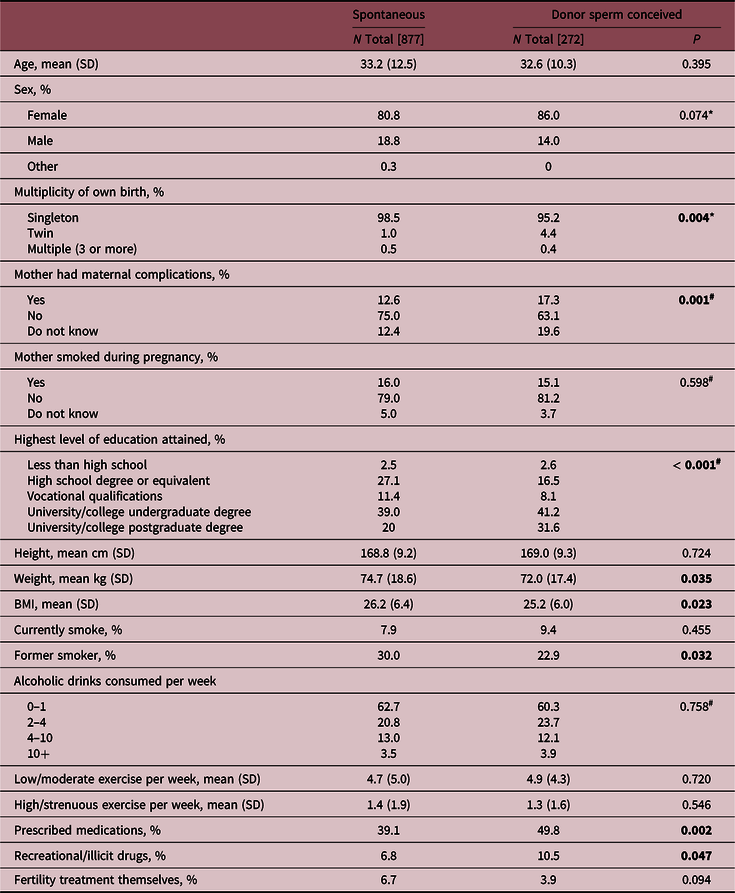
The characteristics of the two respondent groups are shown in Table 1. No significant differences were observed between the donor sperm-conceived group and those conceived spontaneously in terms of mean age (years), sex (female/male/other as designated by the respondent), mean height, current smoking status, alcohol consumption, amount and level of exercise per week [both low/moderate (example was walking), and high/strenuous (example was running)] and whether they had received fertility treatment themselves. However, donor sperm adults had a lower current mean weight (P = 0.035) and lower BMI (P = 0.023). Furthermore, donor sperm-conceived adults had significant differences in educational outcomes with higher levels of education (P < 0.001), more specifically post-graduate degrees, than spontaneously conceived adults. Donor sperm adults reported lower incidences of being a former smoker (sperm P = 0.032) and were more likely to be currently using prescribed medications (P = 0.002) and be using recreational/illicit drugs (P = 0.047).
Characteristics of respondents

[ ], total respondents.
P value using Students two tailed TTEST versus spontaneously conceived unless specified by alternative test below.
# Pearson’s chi-squared (two-tailed) P value versus spontaneously conceived. Chi-squared results are based on total chi-squared table results of all outcomes and not individual outcome groupings (i.e., all of the all donor conceived outcomes versus all spontaneously conceived outcomes).
* Likelihood ratio P value versus spontaneously conceived people used instead of Fisher’s exact test for when > 20% of cells in chi-squared table have expected values less than 5 in tables larger than 2 × 2.
Note, percentages may not equal 100% due to rounding.
In terms of their birth and gestational characteristics, donor sperm-conceived adults reported significantly higher incidences of being born as a twin (P = 0.004), and whose mothers had higher incidences of maternal complications (P = 0.001). However, no significant differences were reported in the incidences of maternal smoking during pregnancy.
The top five countries of birth and countries of current residence by the number of respondents are shown in Table 2. All other countries had N < 10 for country of birth or residence (Supplementary Table S1). There is considerable variation in percentage of respondents between spontaneous and donor sperm-conceived groups in both countries of birth and residence for those countries represented with larger numbers of respondents (Australia, Belgium, the Netherlands, the United Kingdom and the United States of America). Australia and the United Kingdom had higher proportions of spontaneously conceived respondents than donor sperm-conceived respondents, while Belgium, the Netherlands and the United States of America had higher proportions of donor sperm-conceived respondents than those spontaneously conceived.
Country of birth and residency (top 5 countries by number of participants)

Descriptive table of countries of birth and current residence.
Cardiovascular outcomes
Donor sperm-conceived adults did not report any significantly different incidences of diagnosed cardiovascular outcomes of congenital heart disease, cardiovascular disease (including heart attack, stroke, angina, cardiomyopathy, cerebrovascular disease, arteriosclerosis, atherosclerosis, rheumatic heart disease, peripheral arterial disease, aneurysm and deep vein thrombosis), bleeding disorders (such as haemophilia), heart murmur, palpitations, high blood pressure [over 140/90, either or both reading(s) could be higher], low blood pressure [below 90/60, either or both reading(s) could be lower], anaemia, poor peripheral circulation [leading to white/blue fingers and or toes (such as Raynaud’s syndrome)], high cholesterol, aneurysms, phlebitis, varicose veins, heart defects requiring surgery or other conditions as reported by the respondent when compared to spontaneously conceived adults (Supplementary Table S2).
Chromosomal and genetic outcomes
No significant differences were observed between the self-reported incidences of chromosomal or genetic abnormalities of the donor sperm-conceived group and their spontaneously conceived peers (Supplementary Table S3).
Dermatological outcomes
Donor sperm-conceived adults did not report significant differences in the incidences of the diagnosed skin conditions of eczema, psoriasis, urticaria (hives) or other conditions not covered by those classifications in comparison to spontaneously conceived adults (Supplementary Table S4). However, as the ‘other’ category had greater than 20 respondents for the donor sperm-conceived group, the free text inputs were subjected to quantitative content analysis using the following four categories: acne, colouring, infections and ungrouped conditions. Acne included other conditions such as hormonal cysts, hidradenitis suppurativa and eccrine hidrocystoma. Colouring included conditions that change the colour of the skin such as rosacea, dermatitis, pityriasis rosea, Henoch–Schonlein purpura and vitiligo. Infections included conditions involving bacterial, viral or fungal infections of the skin such as impetigo, cellulitis, shingles and tinea versicolour. Ungrouped conditions included all other responses that could not be grouped into the previous three categories. Quantitative content analysis revealed no differences between sperm donor conceived to those conceived spontaneously on any of the skin conditions.
EENT outcomes
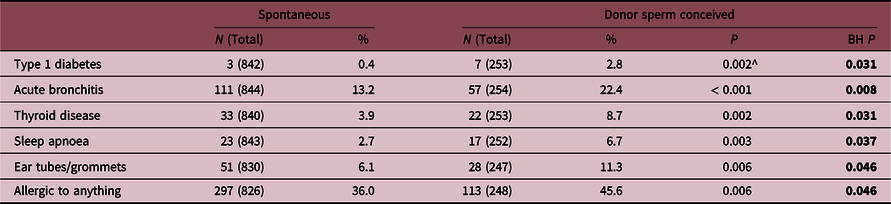
Donor sperm-conceived adults, when compared to those conceived spontaneously, reported significantly higher incidences of having ear tubes/grommets surgically implanted (11.3% v 6.1%, P = 0.046) (Table 3). However, they did not report significant differences in terms of being diagnosed with eye disorders, hearing loss, total deafness, nasal allergies/hay fever, tinnitus, Meniere’s disease or other non-classified conditions. Furthermore, they also did not report significant differences in having corrective glasses/lenses, eye surgery or their tonsils or adenoids surgically removed (Supplementary Table S5).
Significant physical health outcomes

Pearson’s chi-squared (two-tailed) P value versus spontaneously conceived people.
BH, Benjamini–Hochberg procedure adjusted P value versus spontaneously conceived people.
^Fisher’s exact test (two-tailed) P value versus spontaneously conceived people used instead of Pearson’s chi-squared for when > 20% of cells in chi-squared table have expected values less than 5.
Endocrinological outcomes
The donor sperm-conceived group when compared to those conceived spontaneously reported significantly higher incidences of type 1 diabetes (2.8% v 0.4%, P = 0.031) and thyroid disease diagnoses (8.7% v 3.9%, P = 0.031) (Table 3). No significant differences were observed for the reported diagnoses of type 2 diabetes, pancreatitis, adrenal disorders, pituitary disorders or other non-classified disorders (Supplementary Table S6).
Gastrointestinal outcomes
Donor sperm-conceived adults did not report significant differences in the incidences of being diagnosed with liver disease, irritable bowel syndrome (IBS), inflammatory bowel disease (IBD), ulcers, coeliac disease, appendicitis, gall bladder problems, gastroesophageal reflux disease or other non-classified disorders in comparison to spontaneously conceived adults (Supplementary Table S7).
Immunological outcomes
There was a significant increase in the reported incidence of being allergic to anything (45.6% v 36.0%, P = 0.046), for donor sperm-conceived adults in comparison to spontaneously conceived adults (Table 3). Respondents were able to input text on specific allergies. These responses were categorised into four categories for quantitative content analysis: environmental allergies, ingested allergies, medication allergies and ungrouped allergies. Environmental allergies included contact allergies such as animals, plants, pollen, cosmetics, mould and latex. Ingested allergies included food type allergies (medication excluded). Medication allergies incorporated all types of medications such as antibiotics (can be ingested, topical or intravenous). Ungrouped allergies were all other allergies not covered by the above categories such as insect bites and stings. Donor sperm-conceived adults were significantly more likely to be allergic to environmental allergens (29.4% v 16.7%, P < 0.001), but not to ingested, medication or ungrouped allergens (Supplementary Table S8). There were no significant differences observed between groups for the diagnosed immunological outcomes of arthritis, rheumatoid arthritis, spleen problems, gout, lupus, ankylosing spondylitis, connective tissue disorders, chronic infectious disease or other non-classified immunological disorders (Supplementary Table S8).
Musculoskeletal outcomes
The donor sperm-conceived group did not report significant differences for the diagnosed musculoskeletal outcomes of joint problems, osteoporosis, scoliosis, growth disorder, muscular dystrophy or other non-classified musculoskeletal disorders when compared to those spontaneously conceived (Supplementary Table S9).
Neurological outcomes
No significant differences were observed between the self-reported incidences of the diagnosed neurological outcomes of epilepsy/seizures, tremors, migraines, multiple sclerosis, vertigo, cerebral palsy, fibromyalgia, Parkinson’s disease or other non-classified neurological outcomes of the donor sperm-conceived group and those spontaneously conceived (Supplementary Table S10).
Oncological outcomes
Donor sperm-conceived adults were not statistically more or less likely than those conceived spontaneously to have had various forms of cancer. They reported no differences in terms of diagnosed blood, skin, bowel, breast (female only and all sexes combined), prostate (males only), bone, brain, lung/tracheal, pancreatic or other malignancies (Supplementary Table S11).
Reproductive outcomes
Female donor sperm-conceived adults in comparison to females conceived spontaneously did not report significant differences in the diagnosed incidences of ovarian cysts, endometriosis, menstrual problems, polycystic ovary syndrome, infertility or other non-classified reproductive disorders. They also reported no significant difference in pregnancy rates and parity (Supplementary Table S12).
Male donor sperm-conceived adults in comparison to males conceived spontaneously also reported no significant differences in their reproductive outcomes of testicular problems, prostate problems, low sperm count/quality, infertility or other non-classified reproductive disorders (Supplementary Table S13).
Respiratory outcomes
The donor sperm-conceived groups in comparison to spontaneously conceived adults were significantly more likely to report incidences of acute bronchitis (22.4% v 13.2%, P = 0.008) and sleep apnoea (6.7% v 2.7%, P = 0.037) (Table 3). There were no significant differences observed between the donor-conceived groups and spontaneously conceived adults for the outcomes of asthma, chronic obstructive pulmonary disease (COPD), pneumonia or other non-classified respiratory disorders (Supplementary Table S14).
Urogenital outcomes
Donor sperm-conceived adults were not statistically more or less likely than those conceived spontaneously to report incidences of diagnosed kidney disease, kidney stones, bladder disease, urogenital defects or other non-classified urogenital disorders (Supplementary Table S15).
Effect of sex
With both cohorts having a greater than 80% proportion of females in the sample, the rates of reported diagnoses were analysed by sex to determine if there were significant differences between the sexes. Females and males in both donor sperm and spontaneously conceived groups were well matched in terms of mean age, multiplicity, maternal complications, maternal smoking, education levels and smoking (both currently and formerly) (Supplementary Table S16). Males were significantly heavier (P < 0.001), and taller (P < 0.001), than their female counterparts, as is typical for male versus female populations. However, no significant difference was observed in their BMI. Both donor sperm and spontaneously conceived males were more likely to report higher levels of alcohol consumption (sperm P = 0.016; spontaneous P < 0.001), but lower levels of prescribed medication use (sperm P = 0.001; spontaneous P < 0.001). Spontaneously conceived males, but not donor sperm-conceived males, reported higher amounts of exercise (low/moderate P = 0.009; high/strenuous P = 0.012), recreational/illicit drug use (P = 0.013) and lower incidences of receiving fertility treatment themselves (P = 0.001) than their spontaneously conceived female counterparts.
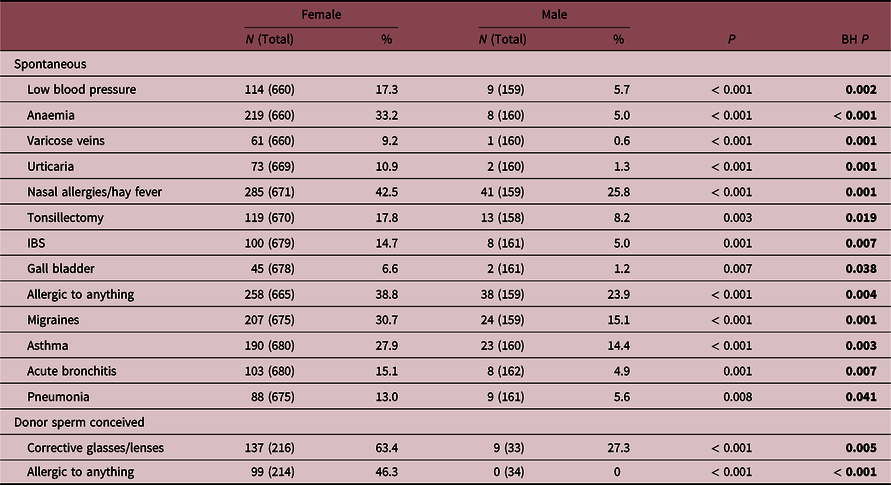
In terms of the physical health outcomes, spontaneously conceived males reported significantly reduced incidences of being diagnosed with low blood pressure (P = 0.002), anaemia (P < 0.001), varicose veins (P = 0.001), urticaria (P = 0.001), nasal allergies/hay fever (P = 0.001), tonsillectomy (P = 0.019), irritable bowel syndrome (IBS) (P = 0.007), gall bladder problems (P = 0.038), migraines (P = 0.001), asthma (P = 0.003), acute bronchitis (P = 0.007) and pneumonia (P = 0.041) than spontaneously conceived females (Table 4). Both donor sperm and spontaneously conceived males reported lower diagnoses than females in terms of being allergic to anything (sperm P < 0.001; spontaneous P = 0.004); however, content analysis of type of allergy showed only spontaneously conceived males reported a significantly reduced diagnosis of medication allergies (P < 0.001) (data not shown). Donor sperm-conceived females were also significantly more likely to report having corrective glasses/lenses (P = 0.005) than male donor sperm-conceived adults.
Significant physical health outcomes by sex

Pearson’s chi-squared (two-tailed) P value females versus males.
BH, Benjamini–Hochberg procedure adjusted P value females versus males.
Effect of maternal complications
Maternal complications are a well-known confounder of neonatal outcomes and have been linked to long-term health trajectories. Subsequently, it was pertinent to stratify data based on maternal complications to determine if these had an effect on health outcomes in the cohorts. Those respondents who reported that they did not know if their mother experienced maternal complications were excluded from the analysis. In terms of respondent characteristics, mean age was lower in both cohorts for those respondents whose mother experienced maternal complications (sperm P = 0.020; spontaneous P < 0.001) than those whose mother did not experience maternal complications (Supplementary Table S17). Donor sperm-conceived adults whose mother had maternal complications were more likely to be a former smoker (P = 0.017), while spontaneously conceived adults whose mother experienced maternal complications were more likely to be female (P < 0.003), and to be shorter in mean height (P < 0.001). All other respondent characteristics were not statistically different.
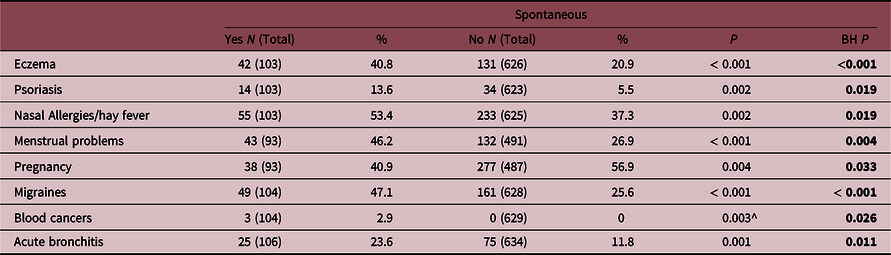
Spontaneously conceived adults whose mother experienced maternal complications were significantly more likely than those whose mother did not experience maternal complications to report being diagnosed with eczema (P < 0.001), psoriasis (P = 0.019), nasal allergies/hay fever (P = 0.019), migraines (P < 0.001), blood cancers (P = 0.026) and acute bronchitis (P = 0.011) (Table 5). While female spontaneously conceived adults resulting from a pregnancy involving maternal complications were more likely to report being diagnosed with menstrual problems (P = 0.004) but were less likely to have been pregnant themselves (P = 0.033). No significant differences were observed in the donor sperm-conceived cohort.
Significant physical health outcomes by maternal complications

Pearson’s chi-squared (two-tailed) P value versus spontaneously conceived people.
BH, Benjamini–Hochberg procedure adjusted P value versus spontaneously conceived people.
^Fisher’s exact test (two-tailed) P value versus spontaneously conceived people used instead of Pearson’s chi-squared for when > 20% of cells in chi-squared table have expected values less than 5.
Effect of country of birth
The criteria for diagnosis of various health conditions and the ability to access medical health care can vary between countries. Restricting outcomes to a subset of respondents based on their country of birth allows us to determine whether there is bias in the comparison cohort and whether there is an effect on outcomes based on country of birth. The largest proportions of spontaneously conceived adults were born in Australia (42.4%) as well as the largest proportion of donor sperm conceived (28.6%) and therefore Australians were used for analysis.
Donor sperm-conceived Australians differed significantly from their spontaneously conceived compatriots in terms of having a lower mean age (P < 0.001) and whose mother had experienced maternal complications (P = 0.002) (Supplementary Table S18). They were, however, not significantly different in all other characteristics. Furthermore, Australian donor sperm-conceived adults were statistically not different to Australian spontaneously conceived adults for all physical health outcomes surveyed (data not shown).
Validation of comparison group
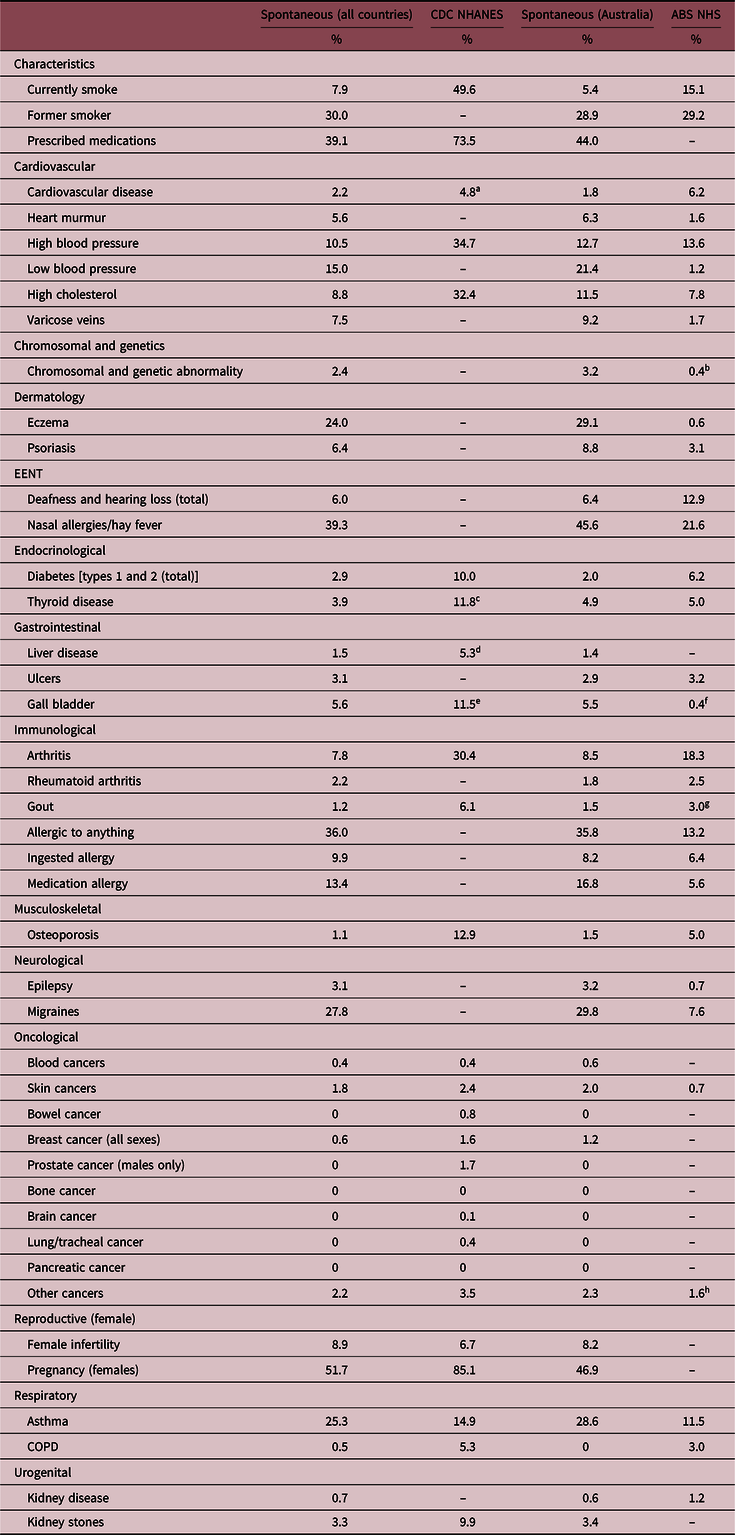
Frequencies of comparable reference data, ABS NHS and CDC NHANES, against spontaneously conceived Australian and worldwide cohorts respectively are shown in Table 6. Australian born spontaneously conceived adults represent 42.4% of all spontaneously conceived respondents and were largely representative in terms of frequencies of conditions to the whole worldwide spontaneously conceived frequencies with exceptions of low blood pressure, eczema and nasal allergies/hay fever.
Spontaneous cohort comparisons

CDC NHANES, Centres for Disease Control and Prevention, National Health and Nutrition Examination Survey, 2017–2018 data (USA), all ages; ABS NHS, Australian Bureau of Statistics, National Health Survey, 2017–2018, ages 18 and over.
aCoronary heart disease as designated by CDC.
bChromosomal abnormalities but also includes congenital malformations and deformations.
cThyroid disease but also includes other thyroid problems.
dLiver condition including disease.
eGall bladder surgery.
fGallstones.
gIncludes gout and other soft tissue disorders.
hAustralian cancers other than skin and benign neoplasms or neoplasms of unknown nature.
Comparison of condition frequencies included those who were comparable, but also that in numerous instances, the survey respondents had either lower or higher frequencies than those of the reference data. Worldwide spontaneously conceived respondents reported lower frequencies of currently smoking and taking prescribed medications, and lower or same frequencies of conditions than the CDC NHANES reference data in 24 of 27 categories. Higher frequencies of female infertility and asthma were reported by the worldwide spontaneously conceived adults than observed in the CDC NHANES data. Australian spontaneously conceived respondents self-reported lower frequencies in 2 of 2 characteristics and 12 of 29 conditions than those observed in the ABS NHS data. They also reported higher frequencies in 17 of 29 conditions.
Discussion
This study is the first of its kind to compare the self-reported health outcomes of adult donor sperm-conceived people and spontaneously conceived people. Results revealed that, for most health outcomes, there was no statistically significant difference between donor sperm conceived and spontaneously conceived groups. However, donor sperm-conceived adults self-reported higher incidences of being diagnosed by a medical health professional with the following conditions: type 1 diabetes, thyroid disease, environmental allergies, acute bronchitis, sleep apnoea and having ear tubes/grommets surgically implanted.
Demographically, spontaneously conceived and donor sperm-conceived groups were not significantly different in terms of mean age, sex, mean height, current smoking status, alcohol consumption, exercise regimes, whether their mother had smoked during pregnancy and whether they had received fertility treatment themselves. Donor sperm-conceived adults were more likely, however, to have been born as a twin, and their mothers were more likely to have experienced complications during pregnancy. They were also more likely to have a lower BMI and had completed a higher level of education but were also more likely to be using prescribed medications and recreational/illicit drugs. Donor sperm adults had a lower current mean weight and were less likely to have been a former smoker. Many of these findings are supported by previous studies.
Higher reported incidences of twins observed have been associated previously with both donor sperm Reference Adams, Fernandez and Moore36,Reference Huang, Song and Liao37 and donor oocyte treatments. 38–42 Similarly, higher maternal complications during pregnancy have also been previously associated with the use of donor sperm, Reference Adams, Fernandez and Moore36,Reference González-Comadran, Urresta Avila and Saavedra Tascón43 donor oocytes Reference Jeve, Potdar, Opoku and Khare23,Reference Rodriguez-Wallberg, Berger and Fagerberg44,Reference Elenis, Svanberg, Lampic, Skalkidou, Åkerud and Sydsjö45 and pregnancies involving twins/multiples. Reference Luke46,Reference Okun and Sierra47 Fertility treatment is typically associated with higher socioeconomic status of parents also and related factors, Reference Hammoud, Gibson, Stanford, White, Carrell and Peterson48 even in jurisdictions where fertility treatment is covered through the public medical system with no self-payment, Reference Schmidt49 or jurisdictions that have mandated insurance coverage. Reference Jain and Hornstein50 This higher socioeconomic status of families seeking fertility treatment may potentially be associated with the higher education outcomes, lower BMI, weight and lower incidences of smoking observed in the donor sperm-conceived cohort. The increased incidences of taking prescribed medications may be linked with the increased incidences of self-reported medically diagnosed conditions observed.
With a high proportion of female respondents, the data were stratified to analyse the effect of sex on outcomes. In all instances of significant differences between the sexes in terms of physical health outcomes, females reported significantly higher incidences of being diagnosed with a range of conditions including low blood pressure, anaemia, varicose veins, urticaria, nasal allergies/hay fever, tonsillectomy, IBS, gall bladder problems, migraines, asthma, acute bronchitis, pneumonia, being allergic to anything and wearing corrective glasses/lenses. However, the majority of those differences were observed in the spontaneously conceived cohort. Considering that the donor sperm-conceived males’ sample size was N = 38, the analysis lost power to detect many of the differences even though there was variation in the frequencies reported. Those differences that were initially observed between donor sperm-conceived females and males were no longer significant after controlling for false-discovery utilising the Benjamini–Hochberg procedure. Nonetheless, the increased incidence of various conditions that were observed in females appears to be supported by the significant increase in the use of prescribed medications by both spontaneously and donor sperm-conceived females.
The DOHaD theory typically associates poor perinatal outcomes such as LBW, PD and SGA with cardiovascular disease, Reference Chehade, Simeoni, Guignard and Boubred51,Reference Chu and De Beritto52 hypertension, Reference Bertagnolli, Luu, Lewandowski, Leeson and Nuyt12,Reference Arima, Nishiyama, Izumiya, Kaikita, Hokimoto and Tsujita53 type 2 diabetes Reference Eriksson54,Reference Nightingale, Rudnicka and Owen55 and obesity. Reference Hoffman, Reynolds and Hardy56,Reference Oken and Gillman57 Evidence shows that donor-conceived neonates also experience similar poor perinatal outcomes. Reference Moreno-Sepulveda and Checa20–Reference Adams, Clark, Davies and de Lacey25 However, those common adult outcomes of cardiovascular disease (including hypertension and other cardiovascular outcomes) and type 2 diabetes were not observed in the responses of the donor-conceived adults in this study. Furthermore, not only did the donor sperm-conceived group not have a significant increase in bodyweight or BMI as suggested through the DOHaD theory but actually reported a significantly lower BMI. Considering that the mean age of the donor sperm-conceived respondents in this survey was 32.6 years of age, which is relatively young from a population study perspective, it is problematic to assume that they will or will not go on to develop age-related illnesses such as cardiovascular disease later in life. Furthermore, outcomes such as lower BMI, weight, incidences of previously smoking and increased post-graduate education levels observed in the donor sperm-conceived cohort may potentially be linked to the socioeconomic status of the individual as fertility treatments have been typically associated with higher socioeconomic status of parents. Reference Hammoud, Gibson, Stanford, White, Carrell and Peterson58 Caution should therefore be taken in extrapolating the findings of this study to age-related conditions in the context of DOHaD as well as those outcomes that could be influenced by socioeconomic factors. Nevertheless, these observations provide a reference point for further investigations.
For those medical conditions observed in the donor sperm-conceived cohort that are not supported by previous studies investigating longitudinal effects of LBW, PD and SGA, these conditions may instead be potentially associated with other pregnancy or birth characteristics that can also be classified under DOHaD. Alternatively, or in addition to, they may be influenced by the fertility treatment methodology itself. For example, preeclampsia is a known maternal complication of donor oocyte, Reference Moreno-Sepulveda and Checa20,Reference Blázquez, García, Rodríguez, Vassena, Figueras and Vernaeve59–Reference Klatsky, Delaney, Caughey, Tran, Schattman and Rosenwaks61 and donor sperm modalities, Reference González-Comadran, Urresta Avila and Saavedra Tascón43,Reference Kyrou, Kolibianakis, Devroey and Fatemi62,Reference Smith, Walker, Tessier and Millar63 and has been associated with a variety of diseases in later life. Reference Bokslag, van Weissenbruch, Mol and de Groot64–Reference Kajantie, Eriksson, Osmond, Thornburg and Barker67 These diseases have included those involving cardiovascular, immune, endocrine, respiratory, nervous, urogenital, digestive and musculoskeletal systems, as well as metabolic, mental, nervous and blood disorders among others. The use of donor sperm, now but not always historically, involves the use of manual handling and cryopreservation which can cause DNA fragmentation, Reference Zribi, Feki Chakroun and El Euch68,Reference Dalzell, McVicar, McClure, Lutton and Lewis69 through oxidative stress, Reference Thomson, Fleming and Aitken70 and can also adversely affect sperm morphology, motility and viability. Reference Di Santo, Tarozzi, Nadalini and Borini71 The long-term health consequences of manual handling and cryopreservation-induced DNA damage on resultant offspring are poorly understood but have been associated with increased incidences of poorer outcomes such as epigenetic disorders, DNA methylation and morbidity in animal studies. Reference Zadmajid, Falahipour, Ghaderi, Sørensen and Butts72–Reference Urrego, Rodriguez-Osorio and Niemann74
As a method to determine if maternal complications such as preeclampsia had an effect on health outcomes in the cohorts, the data were stratified into those who reported that their mother had maternal complications and those whose mother did not. As was the case with analysis of sex differences, the sample size for those reporting maternal complications in the donor sperm-conceived cohort of N = 47 reduced the power to detect differences in the donor sperm cohort. All differences in the donor sperm-conceived cohort were no longer significant after adjusting for false-discovery using the Benjamini–Hochberg procedure. While no inference can be made regarding the impact of maternal complications on the increased incidences of diagnosed health conditions in the donor sperm-conceived cohort, the concept that maternal complications may potentially be associated with poorer long-term health outcomes was supported by data from the spontaneously conceived cohort which showed increased incidences of being diagnosed with eczema, psoriasis, nasal allergies/hay fever, migraines, blood cancers, acute bronchitis and menstrual problems (females). Females were also less likely to have experienced a pregnancy. The survey question of whether the respondents’ mother experienced maternal complications is potentially subject to recall bias on behalf of the respondent. However, for those who did not know for certain, they were instructed to answer that they did not know and were subsequently excluded from the maternal complication analysis. Notwithstanding, the possibility remains for recall bias in this regard and therefore may have affected the outcomes even though the increased incidences of maternal complications in the donor sperm-conceived group are consistent with published studies.
The sample size obtained for this study was larger than several previous studies investigating donor-conceived people, Reference van den Akker, Crawshaw, Blyth and Frith75–Reference Jadva, Freeman, Kramer and Golombok79 but smaller than some others. Reference Nelson, Hertz and Kramer80–Reference Beeson, Jennings and Kramer82 However, unlike the present study, the larger previous studies all involved children and or adolescents in addition to adults, rather than adults alone. Using an online questionnaire, therefore, proved to be an acceptable form of participant recruitment to access a reasonable sample size of adults who were donor conceived from around the world.
While this is the first study to investigate the self-reported health outcomes of adult donor-conceived people, there are limitations. A limitation of the study was sample bias due to the respondents self-reporting health conditions. We attempted to reduce reporting bias by asking that respondents only answer ‘yes’ to those conditions to which they had been diagnosed by a medical health professional. Considering that few physical health significant differences were observed between the groups, this approach appeared to be somewhat successful. Furthermore, statistical procedures were implemented to control for the false discovery rate.
The primary recruitment sources for donor-conceived participants were from social media support groups and online donor conception groups, thereby making them a self-identified sample. Subsequently, it could be postulated that this pool represents a subset of donor-conceived adults who may potentially be having some form of difficulty dealing with their conception status or are perhaps looking for assistance in obtaining information about, and or connecting with their biological (donor) parent. Reference Rodino, Burton and Sanders76,Reference Slutsky, Jadva and Freeman83 The mental health of participants in this survey was also captured as part of the survey. While the results are yet to be published, mental and physical health can be both directly and indirectly associated, Reference Ohrnberger, Fichera and Sutton84 and subsequently, mental health outcomes should be considered when interpreting the physical health outcomes in relation to the support groups that some of the donor sperm-conceived adults were recruited from. Since the majority of donor-conceived adults were not aware of their conception status, Reference Tallandini, Zanchettin, Gronchi and Morsan29 it was not possible to get a representative cross section of this population cohort. The same sample bias problem has been repeatedly reported by other researchers investigating various outcomes in donor-conceived offspring Reference Mahlstedt, LaBounty and Kennedy77,Reference Jadva, Freeman, Kramer and Golombok79,Reference Zadeh, Ilioi, Jadva and Golombok85,Reference Persaud, Freeman and Jadva86 and will continue to be an issue while non-disclosure of a person’s conception status still exists. Nonetheless, caution should be taken in extrapolating the results to all donor sperm-conceived adults and those conceived with other modalities such as donated oocytes, embryos and surrogacy using donated gametes that may also differ.
The countries in which individuals are conceived, raised and live in may affect their ability to access health care and subsequently their long-term health trajectories. Additionally, diagnosis may vary between countries. While the majority of respondents in this survey were conceived in western countries (87.4% of respondents were born in just five countries), with excellent health care availability, an analysis was still conducted by restricting outcomes to the largest country of birth cohort, Australia. Differences initially observed from chi-squared analysis were no longer significant after adjustment using the Benjamini–Hochberg procedure to remove false discoveries. Thereby highlighting that the differences observed in the global analysis is biased by the remaining countries including those with excellent health care such as the United States of America, the United Kingdom, Belgium, the Netherlands, New Zealand, Canada etc. However, as was found in previous stratification analysis, statistical power was reduced primarily due to the smaller sample size in the donor sperm-conceived cohort and subsequently it is difficult to determine if Australian donor sperm-conceived adults are equally healthy as their spontaneously conceived peers.
Validation of the comparison group (spontaneously conceived) is difficult due to the reference data. By and large, the whole (worldwide) spontaneously conceived cohort is healthier than those in the CDC NHANES data. The CDC states that the NHANES data are oversampled for Hispanic, non-Hispanic black and Asians, making it non-representative of the USA population, but it also provides greater multi-ethnicity which is perhaps better in terms of the spontaneously conceived respondents in our survey which had a variety of individuals from all over the world including some Asian countries. However, the CDC also states that they oversampled non-Hispanic whites below 185% poverty guidelines and non-Hispanic whites over 80 years of age. Whereas, there was only 1 respondent in the spontaneously conceived group who was over the age of 80. In effect, the CDC NHANES data are likely to have bias towards age-related conditions as well as poor access to health treatment due to poverty, making the data biased towards poorer health outcomes which is consistent with the healthier frequencies observed in the spontaneously conceived respondents.
Australian validation data from the ABS NHS showed a mix of better and poorer health outcomes in the Australian spontaneously conceived group. The Australians provided roughly 2 out of every 5 worldwide spontaneously conceived respondents and their data were generally consistent with the worldwide cohort. ABS NHS data include a bias towards young people with 28.3% of participants between the ages of 0–19 years, whereas respondents in this survey were all over the age of 18 years. Of those conditions that Australian spontaneously conceived respondents reported of having large differences in frequencies including eczema, nasal allergies/hay fever, allergic to anything, medication allergy, asthma, migraines and low blood pressure, the majority have associations with the immune system. Both reference data sets are representative for the dates that they are collected and that they are both surveys of the population and therefore subject to the same recall bias issues that the respondents in our survey are. Differences between the reference data sets and the spontaneously conceived cohort are not surprising due to age (NHANES and NHS), and poverty (NHANES), biases present in the reference data.
While this study is not without its limitations, it does represent valuable outcomes from a subset of adults conceived with reproductive technologies not previously studied. Moreover, the self-reports are consistent with the increased incidences of birth defects associated with donor sperm treatment. Reference Adams, Clark, Davies and de Lacey25
This study highlights that there is a group of people conceived through reproductive medicine that self-reported worse adulthood health outcomes than their spontaneously conceived peers. Confounding of multiplicity and maternal complications, which can include preeclampsia, can be directly associated with the fertility treatment that their mother received. These confounders are therefore intrinsically linked with the treatment modality, and consequently, dismissal of outcomes simply by appealing to confounding is problematic. Multiplicity is iatrogenically induced through ovulation induction which is sometimes used in donor insemination or also through multiple embryo transfer and therefore preventable. Several of the findings run contrary to those that would be expected from typical DOHaD outcomes associated with LBWs and PD, albeit that these may alter with age due to the relatively young age of the sample, but nonetheless may also be associated with other DOHaD maternal/perinatal characteristics such as preeclampsia and therefore require further investigation.
Supplementary material
To view supplementary material for this article, please visit https://doi.org/10.1017/S204017442000080X
Acknowledgements
The authors would like to thank the following organisations for their support in advertising the survey: VARTA – Victorian Assisted Reproductive Treatment Authority; Donor Children online registry; Donor Conception Network – the United Kingdom; Donor Conception Support Group – Australia; FIOM – the Netherlands and VANISH – Victorian Adoption Network for Information and Self Help. The authors would also like to thank the administrators of the following Facebook groups: Worldwide Donor Conceived People Network; We Are Donor Conceived; RUDC; Donor Conceived Offspring, Siblings, Parents (sperm or egg); DNA for the Donor Conceived; TangledWebs and the email list PCVAI – People Conceived Via Artificial Insemination, for advertising the survey on our behalf.
Author contributions
All authors contributed to the conceptualisation and design of the study. D.A. had correspondence with the administrators and organisations involved in the advertising of the study. D.A. managed the collection of data and provided initial data analysis with input from A.G., M.D. and S.deL. Data were critically assessed and interpreted by all authors. D.A. wrote the first draft of the manuscript. All authors provided critical revision of the paper and approved the final version.
Financial support
D.A. is supported by an Australian Government Research Training Program Scholarship.
Conflicts of interest
None.
Ethical standards
The authors assert that all procedures contributing to this work comply with the Australian ethical standards and guidelines of The National Statement on Ethical Conduct in Human Research (2007) in accordance with the National Health and Medical Research Council Act (1992), and with the Helsinki Declaration of 1975, as revised in 2008. This study has been approved by the Flinders University Social and Behavioural Research Ethics Committee (Approval number: 7827).