Introduction
Minerals of the tourmaline supergroup are (Si6O18)-ring borosilicates with very diversified compositions. They occur as minor to accessory minerals in low-grade to ultrahigh-pressure metamorphic rocks, granites and granitic pegmatites, as chemically resistant phases in sedimentary rocks, and as common gangue minerals in diverse types of hydrothermal deposits (e.g. Ertl et al., Reference Ertl, Marschall, Giester, Henry, Schertl, Ntaflos, Luvizotto, Nasdala and Tillmans2010; Slack and Trumbull, Reference Slack and Trumbull2011; van Hinsberg et al., Reference van Hinsberg, Henry and Dutrow2011; Henry and Dutrow, Reference Henry and Dutrow2012; Biernacka, Reference Biernacka2019). According to Henry et al. (Reference Henry, Novák, Hawthorne, Ertl, Dutrow, Uher and Pezzotta2011), the general chemical formula of the tourmaline supergroup minerals can be written as XY3Z6(T6O18)(BO3)3V3W, where the populations of cations and anions at specific structural sites are indicated in capital letters: IXX = Na+, K+, Ca2+, Pb2+ and □ (□ = vacancy); VIY = Fe2+, Mg2+, Mn2+, Al3+, Li+, Fe3+, Cr3+, V3+, Ti4+, Zn2+, Cu2+ and Ni2+; VIZ = Al3+, Fe3+, Cr3+, V3+, Mg2+ Fe2+ and Ti4+; IVT = Si4+, Al3+ and B3+; IIIB = B3+; III,IVV = OH– and O2–; and III,IVW = OH–, F– and O2–. The dominant occupant at the X site determines the affiliation of a tourmaline to one of the three groups: alkali, calcic and X-vacant, whereas the occupation of the W site determines the fluor-, hydroxyl- and oxy-tourmaline species. Tourmalines are known for their wide P–T stability range up to UHP conditions as well as their complex chemical composition with negligible diffusion of elements. All these aspects make them efficient geological tools for investigating P–T–X conditions during their formation, being excellent petrogenetic indicators (e.g. Henry and Guidotti, Reference Henry and Guidotti1985; Henry and Dutrow, Reference Henry, Dutrow, Anovitz and Grew1996; van Hinsberg et al., Reference van Hinsberg, Henry and Dutrow2011; Berryman et al., Reference Berryman, Wunder, Wirth, Rhede, Schettler, Franz and Heinrich2015, Reference Berryman, Wunder, Rhede, Schettler, Franz and Heinrich2016; Dutrow and Henry, Reference Dutrow and Henry2016).
There are 18 oxy-tourmaline species (Pasero, Reference Pasero2022). One of these oxy-species is magnesio-lucchesiite, originally known from only two occurrences in Canada and Italy (Scribner et al., Reference Scribner, Cempírek, Groat, Evans, Biagioni, Bosi, Dini, Hålenius, Orlandi and Pasero2021). Crystals of magnesio-lucchesiite have subsequently been found within quartz veins cross-cutting an amphibolite body in proximity of the Kowary town, SE Karkonosze-Izera Massif, south-western Poland, ~1 km to west of the oxy-dravite occurrence on Wołowa Góra Mt. (Pieczka et al., Reference Pieczka, Ertl, Sęk, Twardak, Zelek, Szełęg and Giester2018), thus representing the third documented occurrence of magnesio-lucchesiite worldwide. This work addresses the chemical and structural characterisation of this peculiar oxy-tourmaline species. In this study we also provide a brief discussion on the crystallisation environment in which this tourmaline species was formed.
Geological setting
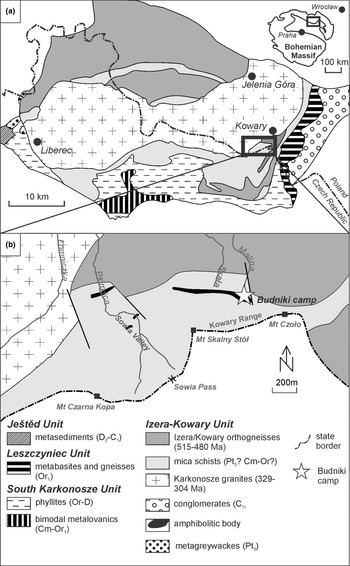
The Kowary area, where the tourmaline samples were collected, belongs to the Izera–Kowary Unit in the southeastern part of the Karkonosze–Izera Massif, Western Sudetes, Poland, in the northeast periphery of the Bohemian Massif (Fig. 1a). The Karkonosze–Izera Massif includes a core intrusion of Variscan granite ~320–315 Ma (Machowiak and Armstrong, Reference Machowiak and Armstrong2007; Kryza et al., Reference Kryza, Pin, Oberc-Dziedzic, Crowley and Larionov2014; Kusiak et al., Reference Kusiak, Williams, Dunkley, Konečný, Słaby and Martin2014) surrounded by a Neoproterozoic–Palaeozoic metamorphic envelope with a sequence of four distinct units: (l) the Izera–Kowary Unit in the north and south-east along with the Velká Upá Group (leucogranites, gneisses, mica schists, mafic and felsic metavolcanics, graphite quartzites, hornfelses and marbles); (2) the Ješted Unit exposed in the south-west (weakly metamorphosed sediments and minor volcanics, marbles, metasandstones, phyllites and metaconglomerates); (3) the South Karkonosze Unit in the south (gneisses, mica schists, phyllites, metasedimentary rocks and basic and felsic metavolcanic rocks); and (4) the Leszczyniec Unit on the east (felsic gneisses, mica schists, amphibolites, phyllites and marbles) (Mazur, Reference Mazur1995; Mazur et al., Reference Mazur, Aleksandrowski, Kryza and Oberc-Dziedzic2006). The units are interpreted as a nappe structure formed from mixed magmatic–sedimentary protoliths connected with pre-Variscan bimodal volcanism related to the development of the continental rift (e.g. Oberc-Dziedzic et al., Reference Oberc-Dziedzic, Kryza, Klimas, Fanning and Madej2005, 2010; Mazur et al., Reference Mazur, Aleksandrowski, Kryza and Oberc-Dziedzic2006; Pin et al., Reference Pin, Kryza, Oberc-Dziedzic, Mazur, Turniak and Waldhausrová2007). Rocks of the Izera–Kowary Unit, the closest to the Karkonosze granite, are represented by Izera, Karkonosze and Kowary orthogneisses with their granitic protoliths dated at 515–480 Ma (Borkowska et al., Reference Borkowska, Hameurt and Vidal1980; Korytowski et al., Reference Korytowski, Dörr and Żelaźniewicz1993; Oliver et al., Reference Oliver, Corfu and Krogh1993; Kröner et al., Reference Kröner, Jaeckel, Hegner and Opletal2001), and the Velká Upá Group schist series considered as the country rocks to the ~500 Ma granite protoliths of the orthogneisses, metamorphosed under upper greenschist- to lower amphibolite-facies conditions. They often contain small intercalations of mafic and felsic meta-igneous rocks representing bimodal volcanic activity (Żaba, Reference Żaba1984; Oberc-Dziedzic, Reference Oberc-Dziedzic1988; Kryza and Mazur, Reference Kryza and Mazur1995; Mazur et al., Reference Mazur, Aleksandrowski, Kryza and Oberc-Dziedzic2006; Mochnacka et al., Reference Mochnacka, Oberc-Dziedzic, Mayer and Pieczka2008; Oberc-Dziedzic et al., Reference Oberc-Dziedzic, Kryza, Mochnacka and Larionov2010; Ilnicki, Reference Ilnicki2011).
Geological sketch map: (a) of the Karkonosze-Izera massif (after Ilnicki, Reference Ilnicki2011); (b) southeastern metamorphic envelope in the Kowary area.

The tourmalines studied originate from quartz veinlets within an amphibolite body hosted by mica schists of Czoło Mt., in the so-called Budniki camp near Kowary town in the Polish part of the Karkonosze Mountains, which were cross-cut by a prospect adit for uranium during searches in the area in the 1950s (Fig. 1b). The remains of the excavated material are still accessible in a small waste dump in the Malina stream along the green tourist route from Karpacz to the Okraj Pass in the Kowary range. The samples of amphibolite with tourmaline–quartz veinlets from the dump contain locally scattered Ti-bearing and Fe–Cu–Ni–Co–Zn–Pb-sulfide–sulfoarsenide mineralisation formed by ilmenite, rutile, titanite, pyrrhotite, pyrite, arsenopyrite, chalcopyrite, sphalerite, galena, cobaltite, gersdorffite, marcasite, pentlandite and traces of scheelite and wolframite (Mochnacka et al., Reference Mochnacka, Oberc-Dziedzic, Mayer and Pieczka2008).
Methods
Electron-probe microanalysis
Quantitative chemical analyses of the tourmalines were done using a JEOL SuperProbe JXA-8230 electron microprobe at the Laboratory of Critical Elements AGH–KGHM, Faculty of Geology, Geophysics and Environmental Protection, AGH University of Science and Technology, Kraków, Poland. The microprobe operated in wavelength-dispersive X-ray spectrometry (WDS) mode with a 15 kV accelerating voltage, 20 nA beam current and 5 μm beam size. Standards, diffracting crystals, analytical lines and detection limits (element wt.%) were as follows: fluorite – F (LDE1, Kα, 0.04), albite – Na (TAP, Kα, 0.02), Si (TAP, Kα, 0.03), Al (TAP, Kα, 0.04); diopside – Mg (TAP, Kα, 0.03) and Ca (PET, Kα, 0.02); fayalite – Fe (LIF, Kα, 0.04); rhodonite – Mn (LIF, Kα, 0.05); synthetic NiO – Ni (LIFL, Kα, 0.04); chromite – Cr (PET, Kα,0.04); V2O3 – V (PET, Kα, 0.01); willemite – Zn (LIF, Kα, 0.05); Sc2O3 – Sc (PET, Kα, 0.01); sanidine – K (PET, Kα, 0.01); and rutile – Ti (PET, Kα, 0.02). Raw data were reduced with the ZAF routine. Due to a small excess of Si in microprobe determinations, the atom contents in the tourmaline formulae were normalised on the basis of (Y + Z) site occupants equal to 9 atoms per formula unit (apfu), and the Si content was accepted as 6 apfu. B2O3 and H2O were calculated based on the tourmaline stoichiometry with the assumption of B = 3 apfu, and H2O occurring as OH groups from charge-balanced formulae. As it was not possible to determine directly the content of FeO and Fe2O3 (e.g. using Mössbauer spectroscopy), as well as the amount of H2O, and considering that the relationship among the constituents Fe2+–Fe3+ and OH–O depends on the coupled substitution Fe2+ + OH– = Fe3+ + O2–, the results of analysis of the difference-Fourier maps and the structure refinement were taken into account. These analyses indicated the presence of H atoms bonded to O(3) oxygen atoms at the V sites of both crystals, and no distinct q-peaks in the immediate vicinity of the W sites that could be related to H at the H1 site (bonded to O(1)) at the tourmaline rim. Thus, for both the tourmaline crystals studied, the Fe3+/Fetotal ratio was matched in order to obtain identical calculated <Y–O> and <Z–O> distances to the values refined in the structural analysis, using site-scattering values optimised on the basis of the results of microprobe determination and structure refinement. The optimisation of the Fe3+/Fetotal ratio on the basis of the comparison of Y and Z site bond-valence sums with average charges of the site occupants (e.g. Scribner et al., Reference Scribner, Cempírek, Groat, Evans, Biagioni, Bosi, Dini, Hålenius, Orlandi and Pasero2021), although initially considered, was not carried out due to insignificant differences among the parameters.
Single-crystal X-ray structural studies and refinement
X-ray diffraction (XRD) data from single crystals were collected using a SuperNova four-circle diffractometer equipped with an HyPix Hybrid Pixel Array Detector (Rigaku Oxford Diffraction). The crystal-to-detector distance was 54.9 mm. CuKα radiation (λ = 1.54184 Å) was used at 50 kV and 0.8 mA. Crystal fragments of sizes 0.055 × 0.026 × 0.011 mm (core tourmaline) and 0.050 × 0.043 × 0.022 mm (rim tourmaline) were mounted on a non-diffracting carbon fibre of 0.01 mm diameter, which was attached to a steel pin support. A frame-width of 0.5° in ω scans and frame times set to 17.79 and 71.16 s for the crystal extracted from the tourmaline rim (magnesio-lucchesiite) and 1.20, 5.00 and 6.00 s for the crystal from the tourmaline core (dravite–oxy-dravite), were used.
Crystal structures were solved with the dual-space iterative phasing algorithm implemented in ShelXT (Sheldrick, Reference Sheldrick2015a) that located all positions of cations (except hydrogen) and O anions. The correct element assignment for cations and anions was based on compositional data obtained by EMPA and crystal-chemical reasoning, comprising site-scattering, coordination and bond lengths. The model was refined with the least squares minimisation using Shelxl (Sheldrick, Reference Sheldrick2015b), within Olex2 (Dolomanov et al., Reference Dolomanov, Bourhis, Gildea, Howard and Puschmann2009) as a graphical interface. When more than one element occupied the same position in the asymmetric unit, constraints for equal atom coordinates and equal anisotropic displacement parameters for these groups of atoms within each unique site were applied. The occupancies of X, Y and Z sites in both analysed crystals were refined. In details, the occupancies of the Y and Z sites were refined as Fe vs. Mg and fractional occupancy of Al, respectively. The latter converged to 1.000(6) and 0.998(7) in core and rim tourmaline, respectively. Thus, in the final refinement values of the parameter were fixed to 1. The W site occupancy was constrained to 1 and refined as F vs. O in the rim tourmaline, and fixed to 1 with the oxygen form factor in the core tourmaline. The X site occupancy was refined as fractional occupancies of Na vs. vacancy for tourmaline forming the core, and Na vs. Ca for the rim tourmaline, respectively. The T- and B-site occupancies were fixed as Si1.00 and B1.00.
Results
Chemical composition
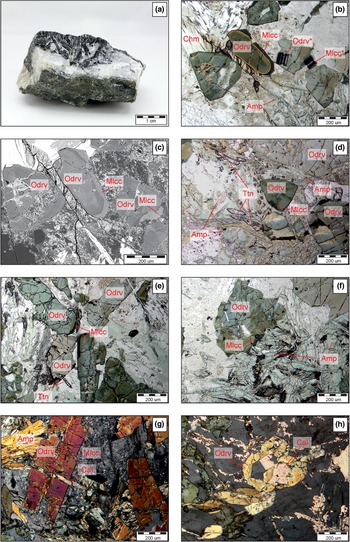
The tourmalines studied are representative of the core and rim regions of crystals characterised by concentric zoning, occurring in quartz veinlets of 1–5 cm in thickness cutting an amphibolite body in the Malina stream valley, Karkonosze Mountains. The crystals are black in hand specimen, reach up to 15 mm in length and 3–4 mm in diameter, locally form massive accumulations in the vein quartz, and sometimes are associated with alkali feldspars, chamosite, titanite, ilmenite and base-metal sulfides (Fig. 2a). In thin section, the tourmaline crystals show concentric zoning with a greenish to brown coloured core, with less frequent complex intersector zoning typical for metamorphic tourmalines described by Van Hinsberg et al. (Reference van Hinsberg, Schumacher, Kearns, Mason and Franz2006) (Fig. 2b–h). The core tourmaline has been partly leached and overgrown by a discontinuous rim of a younger tourmaline with a dark green ω pleochroic colour (Fig. 2b–f). The quartz veinlets are cracked due to tectonic stress, and resealed with calcite and rarely fluorite crystals (Fig. 2g,h).
Internal texture of quartz-tourmaline veins hosted by the Budniki amphibolite. (a) Representative hand specimen of the quartz-tourmaline vein. (b and d–f) Optical images of zoned tourmaline forming intergrowths with amphiboles, titanite and chlorite (transmitted polarised light). Extraction sites of crystals used in single-crystal X-ray diffraction are marked with abbreviations Odrv* and Mlcc* in Fig. 1b. The core / rim border in a crystal of the Budniki tourmaline is marked by an orange dashed line in the same figure. (c) A back-scattered-electron image of the crystals appropriate for the extraction. (g,h) Optical images of the vein tourmalines locally associated with calcite (transmitted light, crossed polars). Mineral name abbreviations: Amp – amphibole, Cal- calcite, Chm – chamosite, Mlcc – magnesio-lucchesiite, Odrv – oxy-dravite, Tnt – titanite (Warr, Reference Warr2021).

Electron probe microanalysis (EPMA) data is given in Table 1, with optimised compositions of both tourmaline crystals, averaged from three spot analyses for each zone. The calculated B2O3, H2O, FeO and Fe2O3 amounts are derived on the basis of the EPMA and structure refinement (SREF) results. According to Henry et al. (Reference Henry, Novák, Hawthorne, Ertl, Dutrow, Uher and Pezzotta2011), the resulting empirical ordered formulae for core tourmaline samples is: X(Na0.82Ca0.07K0.01Sr0.01□0.09)Σ1 Y(Mg1.73Fe2+0.81Fe3+0.41Ti0.04V0.01)Σ3Z(Al5.85Fe3+0.15)Σ6 (Si6O18) (BO3)3(OH)3WOH0.50O0.50)Σ1, and for rim tourmaline is: X(Ca0.49Na0.41K0.04Sr0.02□0.04)Σ1 Y(Mg1.86Fe2+0.94Ti0.15Fe3+0.03V0.02)Σ3Z(Al5.49Fe3+0.51)Σ6(TSi6O18)(BO3)3(OH)3 W(O0.81F0.18OH0.01)Σ1
Representative compositions of dravite–oxy-dravite and magnesio-lucchesiite from Budniki.*

*Notes: Mn, Cr and Zn are below detection limits (b.d.l.), n = number of spot analyses. Data in parentheses are estimated standard deviations.
.
The idealised empirical formula of the core tourmaline, Na(Mg2.5Fe3+0.5)Al6(BO3)3(Si6O18)(OH)3(OH0.5O0.5), corresponds to the mid-member in the solid-solution series between dravite, NaMg3Al6(BO3)3(Si6O18)(OH)3(OH), and a ferric-analogue (Fe3+ replaces YAl) of oxy-dravite, Na(Mg2Fe3+)Al6(BO3)3(Si6O18)(OH)3O. The rim tourmaline is magnesio-lucchesiite, CaMg3Al6(BO3)3(Si6O18)(OH)3O, as it is Ca-dominant at the X position in the general formula of tourmaline, YMg- and ZAl-dominant, and oxy-dominant at W with O2– > (OH + F). It forms a solid solution with dutrowite, Na(Fe2+2.5Ti0.5)Al6(BO3)3(Si6O18)(OH)3O. Both tourmalines differ generally in Ca + Sr contents (0.068 Ca and 0.011 Sr apfu in the core dravite–oxy-dravite vs. 0.490 Ca and 0.021 Sr apfu in the rim magnesio-lucchesiite) at the X-site, and the W-site occupants (O, OH and F) where O2– is the dominant occupant only in magnesio-lucchesiite (0.810 apfu); F is also detected by EPMA in this species (0.184 apfu; Table 1). The Mg/(Mg + Fetotal) ratio of 0.556 in dravite–oxy-dravite and 0.541 in magnesio-lucchesiite, indicates close genetic affinity of the two tourmaline species in the crystals. Overall, the composition of the Budniki tourmalines is formed by three substitutions: (1) XNa+ + WOH– ← XCa2+ +WO2–; (2) isovalent anionic WOH– ← WF; and (3) deprotonation: Y(Mg,Fe)2+ + WOH– ← YFe3+ + WO2– and Y(Mg,Fe)2+ + 2WOH– ← YTi4+ + 2WO2–.
Crystal structure
Crystal, data-collection and refinement details are presented in Table 2. Atomic coordinates, equivalent displacement parameters, and refined occupancy for atomic sites are shown in Table 3. Anisotropic displacement parameters for both the crystals are accessible in the crystallographic information file, which has been deposited with the Principal Editors of Mineralogical Magazine and is available as Supplementary material. Selected bond lengths are collected in Table 4, assigned site populations are reported in Table 5, and calculated bond valences are shown in Table 6.
Crystal information and details of X-ray diffraction data collection and refinement for magnesio-lucchesiite and dravite–oxy-dravite.

*w = 1/[σ2(F o2) + (0.040P)2]; #w = 1/[σ2(F o2) + (0.0295P)2 + 0.6222P], where P = (F o2 + 2F c2)/3.
Atomic coordinates, equivalent displacement parameters, and refined occupancies for atomic sites in the Budniki dravite–oxy-dravite and magnesio-lucchesiite.

Selected mean bond lengths in dravite–oxy-dravite and magnesio-lucchesiite tourmalines from Budniki.

Optimised site populations for the tourmalines studied.

* Scattering for the fixed site population.
Bond-valence analysis for the Budniki tourmalines.

Bond valence sums (BVS) were calculated using the equation S = exp[(R 0–R)/B], where R 0 and B are bond-valence parameters derived by Gagné and Hawthorne (Reference Gagné and Hawthorne2015), and R is the refined bond length.
The crystal structures of the two tourmalines were refined in the space group R3m (Z = 3) to R 1 values of 1.53% (dravite–oxy-dravite) and 1.87% (magnesio-lucchesiite). In the structure of both crystals, the B and T sites are occupied exclusively by B and Si, respectively, as can be deduced from the refined <B–O> and <T–O> mean distances of 1.373(4) and 1.377(4) Å, and 1.620(2) and 1.621(2) Å, respectively (Table 4). The refined X site occupancies: Na0.95(2)Ca0.05(2) in dravite–oxy-dravite and Ca0.56(2)Na0.44(2) in magnesio-lucchesiite (Table 3) correspond to 11.5(2) and 16.0(2) valence units (vu), respectively, versus 11.0 and 15.9 vu, derived from the respective empirical formulae. The sums of bond valences at the site correspond to 0.89 vu in dravite–oxy-dravite and 1.26 vu in magnesio-lucchesiite, which are comparable with averaged valences of the site cations of 0.99 and 1.47 vu (Table 6).
The Y and Z site populations were optimised for six possible occupants: Mg, Fe2+, Al, Fe3+, V3+ and Ti4+, assuming that the Z sites can be filled by Al, Mg and Fe3+, and the Y sites also by Fe2+ and the two remaining trace constituents. The Z-site population was determined from the following relationships:
(1) Al + Mg + Fe3+ = 6 apfu
(2) 13Al + 12Mg + 26Fe3+ = total optimised site-scattering value (78.93 vu for dravite–oxy-dravite, and 78.66 vu for magnesio-lucchesiite)
(3) 0.535Al + 0.72Mg + 0.645Fe3+ = (6 × 1.9333)–(5 × 1.36)–1.38 (dravite–oxy-dravite), or (6 × 1.9349)–(5 × 1.36)–1.38 (magnesio-lucchesiite),
where Al, Mg and Fe3+ denote contents of the cations at the Z sites in the formal units; 13, 12 and 26 = numbers of electrons in the element constituents; 0.535, 0.72 and 0.645 = radii of the respective cations according to Shannon (Reference Shannon1976), 1.36 and 1.38 = radii of (3)O2– and (4)O2– anions bonded to the Z cation (ibidem); 78.93 or 78.66 = the optimised total Z-site scattering; and 1.9333 and 1.9349 = the refined <Z–O> mean distances. The Y-site population was estimated from differences. Because the total scattering for the refined (Y + Z) site populations, Mg1.710(25)Fe1.290(25)Al6.000 equal to 132.06(25) vu for dravite–oxy-dravite, and Mg1.515(34)Fe1.485(34)Al6.000 equal to 134.79(34) vu for magnesio-lucchesiite (Table 3), differ slightly from the calculated numbers of electrons derived from the microprobe-measured raw populations (135.19 and 137.09 vu, respectively), both site-scattering values were optimised to 133.63 and 135.94 vu as averages between the microprobe determined and refined ones. The latter differ from the original refined values by somewhat less than 2 S.D. (Table 3), and the differences in the optimised MgO, FeO, Al2O3 and TiO2 amounts are also in the range of 2–3 S.D. of the microprobe spot analyses (Table 1).
These assumptions allowed the optimisation of the Y- and Z-site populations of the dravite–oxy-dravite crystal of: Y[(Fe2+0.810Mg0.680)Σ1.490(Al1.044Fe3+0.413V0.009)Σ1.465Ti0.045]Σ3Z(Al4.806Mg1.042Fe3+0.152)Σ6 for which the calculated Y- and Z-site scatterings are equal to 54.7 and 78.9 vu, corresponding to the optimised value of 133.6 vu, and the calculated <Y–O> and <Z–O> distances 2.031 and 1.933 Å corresponding to the refined values (Table 5). Analysis of bond-valence sums at the Y and Z sites (Table 6) indicates 2.45 and 2.84 vu, respectively, which are very close to averaged valences of the respective complex cations, 2.52 and 2.83 vu. Differences between the respective values: +0.07 and –0.01 vu, fit well confirming the accuracy of the bond-valence method.
Similar optimisation in case of magnesio-lucchesiite led to the following Y- and Z-site populations: Y[(Fe2+0.945Mg0.750)Σ1.695(Al0.737Fe3+0.404V0.018)Σ1.159Ti0.146]Σ3Z(Al4.749Mg1.115Fe3+0.137)Σ6, for which the calculated Y and Z site scatterings are equal to 57. 3 and 78.7 vu corresponding to the optimised value of 135.9 vu, and the calculated <Y–O> and <Z–O> distances of 2.050 and 1.935 Å correspond to the refined ones (Table 5). Analysis of the bond-valence sums at the Y and Z sites (Table 6) indicated 2.40 and 2.82 vu, respectively, which are again very close to averaged valences of the respective complex cations, 2.48 and 2.81 vu.
The W site occupancy was fixed as O1.00 in dravite–oxy-dravite on the basis of microprobe analysis, and refined as O0.79(13)F0.21(13) in magnesio-lucchesiite. In the case of dravite–oxy-dravite, the occupancy indicates F absence in the crystal whereas for magnesio-lucchesiite, the refined occupancy agrees with microprobe analysis and the optimised F content.
Genetic implications
The discovery of magnesio-lucchesiite at Budniki, in the Polish Karkonosze Mountains, represents the third documented occurrence of this rare Ca-dominant oxy-tourmaline species worldwide. Magnesio-lucchesiite was previously found in two independent geological occurrences: a lamprophyre dyke that cross-cuts tourmaline-rich metapelites within the exocontact of the O'Grady Batholith, Northwest Territories, Canada, and in hydrothermal veins embedded in meta-serpentinites within the contact aureole of the Monte Capanne intrusion at the San Piero in Campo village, Elba Island, Italy (Scribner et al., Reference Scribner, Cempírek, Groat, Evans, Biagioni, Bosi, Dini, Hålenius, Orlandi and Pasero2021). A further finding of this peculiar tourmaline species was mentioned by Krmíček et al. (Reference Krmíček, Novák, Trumbull, Cempírek and Huzar2021) in the locality of Černá, in the Český Krumlov Unit in Moldanubicum, Czech Republic. Both in the type and co-type localities, magnesio-lucchesiite is associated with Ca- and Mg-bearing ultrabasic rocks metasomatised by B-rich fluids, whereas in the Czech locality, the mineral is associated with metacarbonates occurring in mica schists and gneisses of the Český Krumlov unit.
The occurrence at Budniki corresponds well to the magnesio-lucchesiite type and cotype localities. Its genesis relates to the Variscan prograde and early retrograde metamorphism preceding the intrusion of the Karkonosze granite. Pressure–temperature conditions of prograde metamorphism for the Budniki amphibolites were estimated to be ~6 Kb and 600–550°C. During retrogression, pressure decreased to 2–3 Kb, and temperature to 540–510°C at an early stage, increasing to 620–635°C at the contact metamorphism peak, followed by a further retrogression down to 510–470°C (Mochnacka et al., Reference Mochnacka, Oberc-Dziedzic, Mayer and Pieczka2008; Oberc-Dziedzic et al., Reference Oberc-Dziedzic, Kryza, Mochnacka and Larionov2010). At prograde metamorphism stage, boron with other mobile components, e.g. SiO2, could have been released mainly from sedimentary protoliths of the Velká Upá mica schists and migrated as aqueous fluids infiltrating into the surrounding rocks (Dutrow et al., Reference Dutrow, Foster and Henry1999). We suppose that dravite–oxy-dravite core tourmaline was formed by interaction of the fluids with the rocks in which the veins were emplaced. Such metasomatic interaction could have supplied, successively, some amounts of Mg, Fe, Al, Ti, and also Sr, V, Cr, Ni and Co in traces, to the growing tourmaline crystals. Some of the constituents are present in amphibolite in the form of ilmenite–rutile–titanite aggregates, and as disseminated Ni–Co–Fe sulfide and sulfoarsenide ores typical for basic magmas. These B-bearing fluids could have been also sources for other quartz–tourmaline veins and veinlets in the Karkonosze granite metamorphic envelope of the Kowary region, for example, at the Wołowa Góra Mt. near to the Budniki camp, containing oxy-dravite, fluor-dravite and dravite (Lis et al., Reference Lis, Stępniewski and Sylwestrzak1965; Pieczka et al., Reference Pieczka, Ertl, Sęk, Twardak, Zelek, Szełęg and Giester2018).
Similarly to the type occurrence, the magnesio-lucchesiite from Budniki occurs as overgrowths on the partially leached dravite–oxy-dravite core. There is an abrupt increase in Ca and F with only minor changes in other chemical parameters. The occurrence of magnesio-lucchesiite as a thin outer zone may suggest that the only source of boron at this stage is that released by dissolving dravite–oxy-dravite. Some of these features seem to be typical for magnesio-lucchesiite occurrences: the enrichment in TiO2 reaches 1.92 wt.% in the type locality and 1.62 wt.% at Černá, while at Budniki dravite is enriched in TiO2 up to 1.60 wt.%, and magnesio-lucchesiite to 1.30 wt.%. Also, all described crystals are enriched in V and Cr. In all the cases, these features reflect the chemical composition of the host rocks. Finally, the chemistry of the fluids is partly documented by abundant calcite fillings in the latest microtectonic fissures that cut the quartz–tourmaline veinlets, and more rarely by fluorite.
Conclusions
Tourmaline from quartz veinlets that cross-cut amphibolite hosted by the Velká Upá mica schists at the Budniki camp in the eastern envelope of the Karkonosze granite near the Kowary town, SW Poland, evolves from oxy-dravite to magnesio-lucchesiite in prograde Variscan metamorphism and early retrogression stages. The species grown from B-bearing metamorphic fluids derived from the surrounding mica schist protoliths, which interacted with the amphibolite. Evolution of the fluids with the crystallisation progression and temperature decrease led to the replacement of dravite–oxy-dravite core tourmaline by magnesio-lucchesiite, forming crystals with rims richer in Ca and F. The origin of these differences is not clear: Ca and F may originate both from the amphibole or be derived from the surrounding Velká Upá group pelitic protoliths of mica schists interbedded with calcareous sediments.
Acknowledgements
We greatly thank Peter Leverett and two anonymous reviewers for their constructive comments on the manuscript. This study was supported by the National Science Centre (Poland) grant 2017/27/N/ST10/01579 to M.S. and AGH University of Science and Technology grant 16.16.140.315.
Competing interests
The authors declare none.
Supplementary material
To view supplementary material for this article, please visit https://doi.org/10.1180/mgm.2022.114