Introduction
Canada lacks a standardized method to collect information about the quality of community-based palliative care (PC) (Government of Canada, 2018). Unfortunately, the available evidence is inadequate to support clinical practice guidelines and individual/caregiver needs (Ahluwalia et al., Reference Ahluwalia, Chen and Raaen2018). The identification of appropriate and valid quality measures for PC is at a critical stage in the evolution of the assessment of quality in health care in Canada. The need for PC will increase in Canada with population aging. Many Canadians express a preference for dying at home (Canadian Hospice Palliative Care Association, 2013a). It is therefore a critical time to develop quality indicators (QIs) to assist in addressing possible gaps in care and inform where quality improvement efforts are most needed.
PC is intended to provide optimum quality of life for individuals with serious and life-limiting illnesses and to give support to their informal caregivers (World Health Organization, 2016). In some instances, PC initiatives have been shown to improve quality of life (Bakitas et al., Reference Bakitas, Lyons and Hegel2009; Temel et al., Reference Temel, Greer and Muzikansky2010), but the evidence is mixed (Black et al., Reference Black, Johnston and Morrison2012; Curtis et al., Reference Curtis, Back and Ford2013). To understand whether PC quality initiatives are making a difference, operational definitions are needed to identify the dimensions of PC quality and how they can be measured.
QIs are measurable aspects of care that address specific areas of care or a specific outcome. QIs examine the rates of potential issues for a group of individuals to allow for comparisons to be made between health care settings, care providers, or across geographic regions. QIs allow for a better understanding of where improvements might be warranted and whether quality improvement strategies are working (Leemans et al., Reference Leemans, Van den Block and Vander Stichele2015; Bainbridge and Seow, Reference Bainbridge and Seow2016). However, they are not definitive measures of quality, but rather serve as a proxy for the quality of care being provided. QIs are intended to support a variety of applications, including internal continuous quality improvement, comparisons of regions and/or health care settings, external evaluation for accreditation, performance monitoring, and public reporting to enhance transparency for individuals and their families (Hirdes et al., Reference Hirdes, Fries and Morris2004).
Several QIs have been proposed for PC services from a number of countries, including Canada (Barbera et al., Reference Barbera, Paszat and Chartier2006; Grunfeld et al., Reference Grunfeld, Lethbridge and Dewar2006; Gagnon et al., Reference Gagnon, Nadeau and Scott2015), the United States (Dy et al., Reference Dy, Kiley and Ast2015; Wachterman et al., Reference Wachterman, Pilver and Smith2016), Italy (D'Angelo et al., Reference D'Angelo, Mastroianni and Vellone2012), and multiple countries in Europe (Woitha et al., Reference Woitha, Van Beek and Ahmed2012), including two systematic reviews (Pasman et al., Reference Pasman, Brandt and Deliens2009; De Roo et al., Reference De Roo, Leemans and Claessen2013). These QIs tend to use administrative data, focus on the structure/process of care rather than outcomes of care, and are primarily used for individuals with cancer. Consequently, there is a need to assess the applicability of existing QIs for use in community-based PC, and to develop additional measures where necessary to reflect the unique needs of individuals and their informal caregivers. The new QIs would broadly capture all of the key domains that represent what is important to measure when assessing care provided in the home and other community-based settings. Key domains for quality PC have been developed by The National Consensus Project (NCP) for Quality Palliative Care Guidelines in the US. These guidelines are intended to help guide health care organizations on how to improve access to quality PC for all individuals with a serious illness, regardless of prognosis, diagnosis, setting, or age (Ferrell et al., Reference Ferrell, Twaddle and Melnick2018). There are eight domains in total, covering issues such as physical symptoms, spiritual, religious, and existential issues, care for the individual nearing end-of-life, and legal and ethical considerations. The guidelines can be used in the development of new PC programs, to measure the effectiveness of current programs, to improve care and assist with educational and training programs.
To begin to address this gap, we held a one-day workshop to elicit input from experts working in PC in order to better understand what is important to capture when thinking about providing good quality PC services in the community. The workshop was part of a larger 3-year project, funded by the Canadian Institutes of Health Research (CIHR), aimed at developing and testing QIs for community-based PC. The insights gained from this expert consultation were used as the initial step in this project to create these QIs.
Methods
Design
A one-day workshop was held in Toronto in 2018. A workshop was chosen as the primary method of data collection as it is known to be effective for a large PC expert group (Stevinson et al., Reference Stevinson, Preston and Todd2010; Payne et al., Reference Payne, Hughes and Wilkinson2019). This event was designed to have PC experts from diverse backgrounds work collaboratively to identify what should be captured to measure quality PC delivered in the community. The workshop was held in Ontario, recognizing that additional phases of this project would include broad-based consultations with stakeholders from multiple provinces and territories. The general structure of the workshop included opening remarks from members of the research team, three brainstorming sessions where participants first worked in smaller groups to identify important quality measures and were then brought together to share their thoughts with the larger group. Finally, members of the research team and two international researchers gave presentations.
Qualitative validity of this research was established via: (1) an initial audit of the research methods; and (2) through an ongoing peer-review of the research process while planning and executing the workshop. These validity procedures were conducted by an external consultant, allowing for outside feedback into methodological processes from the beginning to the end of the data collection (Creswell, Reference Creswell2018). The consultant, with expertise in facilitating health stakeholder collaborations across Canada (NaW), provided input throughout the planning of the workshop, acted as the event's moderator, and assisted with data analysis.
The workshop involved three brainstorming sessions. Participants were assigned by the research team to one of seven groups, with five to six people per group. This assignment was done in order to ensure that each group included at least one PC researcher and a balance of clinical, technical, and administrative perspectives.
The brainstorming sessions were focused on answering the following questions:
1. What is important to measure to support quality PC, regardless of setting or current feasibility?
2. Of the measures identified in the first brainstorming session, are any of special importance in the care provided in the home? Are there any new measures that are unique to the delivery of PC in the home?
3. What are the challenges, barriers, and potential opportunities for creating these measures?
This study was reviewed and approved by the Research Ethics Board at Wilfrid Laurier University (REB #5683).
Participants
Invitations were emailed to a sample of potential participants with the intent to recruit PC experts from a broad range of stakeholders (e.g., clinical leaders, researchers, front-line staff, health and information system administrators, and decision makers). At the time of the workshop, Ontario was divided geographically into 14 Local Health Integration Networks (LHINs) that were responsible for overseeing the delivery of health services within each region. Invitations were sent to the senior leaders of the 14 LHINs, the Ontario Ministry of Health and Long-Term Care, as well as leaders representing an array of PC and other organizations (e.g., Hospice Palliative Care Ontario, Canadian Institute for Health Information). Senior leaders were invited to delegate an appropriate expert from their organization if they were unable to attend the workshop. Ultimately, invitation emails were sent to 70 individuals and follow-up emails were sent roughly two weeks later if no reply was received.
Of the 70 invitations sent, 30 experts consented to participate, representing 12 of the 14 LHINs, and 11 other organizations. The participants included registered nurses, nurse practitioners, social workers, researchers, and decision makers. Time constraints and travel restrictions were noted as reasons why some individuals could not attend the workshop. Since we were interested in obtaining input from individuals in the PC community, several of the experts invited were members of the research team. Two international researchers also contributed to the workshop, providing information on how PC services and standardized assessments are being utilized in their home countries of Belgium and New Zealand and participated in the brainstorming sessions.
Data collection
In each of the three brainstorming sessions, the moderator introduced the question and clarified the expectations for the group. Individuals initially worked alone to record their ideas on sticky notes and then collaboratively to cluster them into categories on their group's flipchart. Within each small group, a member of the research team was assigned to be a group facilitator to assure clarity of the notes and to encourage participation from all group members. Each group chose one person to present their results to the larger group after each brainstorming session. As each group shared its findings, the moderator clarified the group's notes, solicited and recorded additional comments on a central flipchart, and then presented the information back to the room in the form of a member check (Creswell, Reference Creswell2018). Due to the large number of participants working in close proximity to one another, audio recording was not performed. In between the second and third brainstorming session, the international researchers from Belgium and New Zealand both presented on research being done in PC in their home countries.
Data analysis
Multiple methods of triangulation were used to establish credibility (Creswell, Reference Creswell2018). For all three brainstorming sessions, the flipchart notes from participants and the moderator were transcribed verbatim by NW. Important concepts and similar ideas were identified via content analysis of the two data sources (participant and moderate notes) and grouped together into themes. As mentioned, there are eight domains captured by the NCP guidelines. We used these eight domains as a guide when grouping together the comments from the workshop participants in order to create the key themes. Software was not used in this analysis. Instead, hand coding of the comments was completed by NW and reviewed by DMG. The categorized themes, along with the summary of the day, were sent to all participants. At a later date, a review of all data and material pertaining to the workshop was completed by NB, NaW, and NL as an additional form of research triangulation.
Results
Brainstorming session one
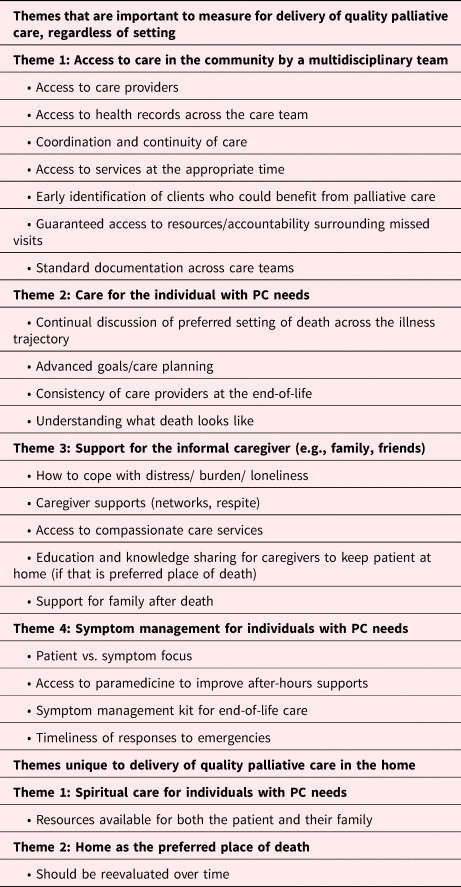
In the first session, participants were asked what they thought was important to measure to capture quality PC services, regardless of where this care was provided (i.e., community, hospital, etc.). Participants identified four key themes.
Theme 1: Access to care in the community by a multidisciplinary team
The access to care theme clearly aligns with the structure and process of the care domain developed by the NCP guidelines. This domain outlines that PC principles and practices can be integrated into any healthcare setting and be delivered by members of a multidisciplinary team. Participants acknowledged that having access to multidisciplinary care providers in the community was a key component of PC, while also ensuring that this access was timely and available when the individual or their caregiver needed it. This also included appropriate and timely referrals, and ensuring continuity of care. Appropriate referrals also pertained to early identification of individuals who could benefit from a palliative approach to care as everyone agreed that only providing PC services in the last few weeks of life was not sufficient for most individuals with a life-limiting illness. Additionally, the participants thought it was important that health care professionals should have access to a standardized documentation system as well as the ability to access health records across the care team. Finally, participants felt it was important that individuals with PC needs had guaranteed access to the resources they needed to ensure the best quality of care was provided.
Theme 2: Care for the individual with PC needs
Participants highlighted that the care for the individual is not just about addressing their physical symptoms, but rather caring for all of the needs the individual may have including physical, spiritual, emotional, and psychosocial aspects. This idea captures two of the domains put forth by the NCP guidelines, namely, the social aspects of care and also care for the individual nearing end-of-life. Continual discussions with the individual around their preferred place of death were identified as important to measure when thinking about providing high-quality palliative care. This included having the conversation early on in the disease trajectory but also throughout the trajectory of the illness as the individual's wishes may change throughout their journey. Similarly, participants also agreed that it is important to have continual conversations surrounding the individual's goals of care and around advance care planning. Finally, participants thought that a measure of quality PC was whether or not the individual was provided with information about death and how this might be unique for each individual.
Theme 3: Support for the informal caregiver (e.g., family, friends)
Participants noted that it was important to also ensure that their informal caregiver was supported, to enable them to continue in that role. This support may help mitigate the caregiver feeling burdened or distressed and therefore allow them to continue to provide support at home. It is imperative that the health care system continues to provide information and access to supportive services such as respite or other informal networks to help caregivers continue in their role. Additionally, the participants also agreed that good quality of care requires that health care professionals educate caregivers on how to best care for loved ones at home. Finally, the experts thought that offering access to bereavement services is important to consider when thinking about providing high-quality PC to the individual and their caregiver. The NCP guidelines do not have a specific domain to capture support for the caregiver; however, this idea is found throughout all eight domains as it is imperative that the caregiver is involved in all aspects of the care being provided to the individual with PC needs.
Theme 4: Symptom management for individuals with PC needs
High-quality PC should view the individual as a whole person and not simply focus on their physical symptoms. The physical aspects of care domain within the NCP guidelines support the idea that it is important to address/relieve symptoms associated with their physical, functional, and emotional well-being in order to improve or maintain functional status and the individual's overall quality of life. The participants stressed that it is not enough to just treat the physical symptoms the individual may be experiencing. It is also important to have a person-centered approach to care and manage both the physical symptoms and any other issues (e.g., emotional, spiritual, cultural, goals of the individual, etc.) the individual may be experiencing, to help to improve the individual's quality of life. The participants also noted that it is imperative for those receiving PC to have access to after-hours supports (e.g., prescriptions, pain, and symptom management), which would include timely responses to emergencies, as well as access to a symptom management kit (includes medications and supplies for urgent medical care needs) that would assist the individual/caregiver for end-of-life emergencies (Table 1).
Results of session 1 and 2: quality care across all settings and those unique to the home

Brainstorming session two
In the second session, participants were asked to discuss which aspects of PC provided in the home were important to measure and whether these differed at all from services being provided in other locations. While everyone agreed that all four of the themes from the first brainstorming session were relevant to capture quality PC in the home, they also identified two themes that are of special importance to care being provided in the home, including spiritual care for individuals with PC needs and home as the preferred place of death.
Theme 5: Spiritual care for individuals with PC needs
Everyone agreed that it was important that the individual with PC needs and their family should be provided resources and have access to spiritual care, as appropriate, at the end-of-life. However, the participants did not specify what spiritual care should encompass, but in a general sense, everyone agreed that it was important when providing high-quality PC. Within the NCP guidelines, spiritual, religious, and existential aspects of care are a fundamental aspect of patient- and family-centered care and should be addressed.
Theme 6: Home as the preferred place of death
The participants thought it was important to capture issues around the home as the preferred place of death. Even though an individual may be receiving PC services in their home, it does not necessarily imply that this is their preferred place of death. The feasibility of the individual with PC needs choosing to die at home should continually be evaluated with additional options being made available. While this theme could potentially fall under the structure and process of care domain within the NCP guidelines, it is important to highlight when the home is the preferred place of death as this may offer additional challenges to those caring for the individual at home. For example, the personal circumstances and the caregiver's ability to care for a dying person, who may have increasingly complex care needs, should be considered carefully in making this decision (Table 1).
Brainstorming session three
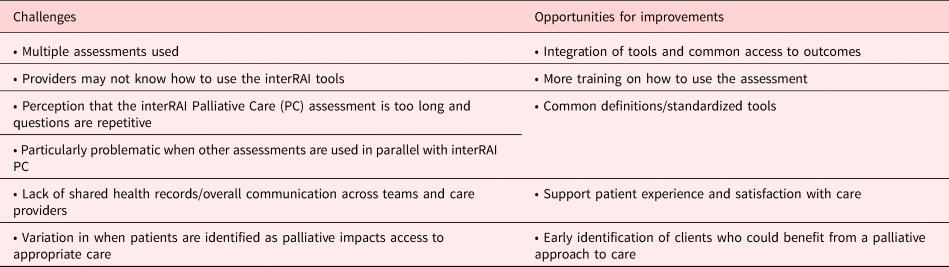
In the final session, the experts identified several challenges and areas of potential improvement associated with the delivery and measurement of quality PC (Table 2). Participants found it challenging to have multiple assessment tools being used simultaneously in PC across several organizations and suggested that integration of tools and having a standardized way of documentation could help mitigate this challenge. Similarly, the lack of shared health records and lack of communication across the PC team was identified as a challenge. However, having an open and collaborative approach established across PC teams could help mitigate this challenge. Finally, participants also acknowledged that everyone using the interRAI PC assessment may not know how to appropriately complete the assessment and could therefore lead to incomplete/inaccurate assessments. The interRAI PC is a comprehensive assessment instrument that was created by interRAI, a not-for-profit consortium of international researchers and clinicians (Smith, et al., Reference Smith, Steel and Fries2010). The assessment is used in Ontario for most individuals receiving palliative home care and identifies person-specific care preferences, symptoms, and needs, which assist health care professionals in the care planning process. In addition, many participants also expressed concern that the interRAI PC assessment is too long and quite repetitive and suggested that more training on how to accurately complete the assessment would be beneficial for health care providers.
Results of session 3: what challenges, and related opportunities, are there for measuring these types of issues?

Discussion
This research represents an important initial step in the creation of QIs for palliative care in the community. The main finding of the workshop was that many of the themes identified by the experts as important to measure to capture the quality of care were relevant for all care settings, while only two (spiritual care for individuals with PC needs and home as the preferred place of death) were of special importance to care provided in the home.
The six themes that were highlighted by our experts clearly align with the eight key domains developed by the National Consensus Project (NCP) for Quality Palliative Care Guidelines in the US (2018). These domains have been used as a benchmark for two systematic reviews from Europe examining the development of QIs for palliative care (Pasman et al., Reference Pasman, Brandt and Deliens2009; De Roo et al., Reference De Roo, Leemans and Claessen2013). Several of the key themes identified in the current study, clearly align with the domains put forth by the NCP such as the structure and process of care, the physical aspects of care, spiritual/religious aspects of care, continued care of the individual as they near the end-of-life and also the social aspects of care. The NCP guidelines also include domains around the cultural aspects of care, the psychological and psychiatric aspects of care, as well as the ethical and legal aspects of care. While our experts did touch on a number of these additional areas of care, they ultimately did not warrant their own theme as they tended to be captured within a larger theme. For example, ideas around the psychological and psychiatric aspects of care were captured in the “support for the informal caregiver (e.g., family, friends)” theme.
The majority of Canadians indicate that they would prefer to receive PC in their own homes and die at home surrounded by loved ones (Canadian Hospice Palliative Care Association, 2013a; Canadian Institute for Health Information, 2018). However, providing PC to individuals with a serious illness in their own homes offers an array of challenges. For example, care provided in the home is mainly delivered by non-paid individuals such as family members and friends who likely do not have any formal training on how to best care for individuals with a serious illness. As a result, informal caregivers have to deal with the physical, financial, and emotional aspects of caring for their dying family member, while still trying to provide and coordinate their care. The additional stressors of caring for a loved one at home may increase the likelihood for a caregiver to experience burden (Hirdes et al., Reference Hirdes, Freeman and Smith2012; Guerriere et al., Reference Guerriere, Husain and Zagorski2016). The experts in the workshop all agreed that it was vital to provide support and resources to the individual as well as their family support system (as captured in Themes 2 and 3). As highlighted in Theme 4 (symptom management for individuals with PC needs), it is essential that caregivers have access to after-hours supports and the necessary information on how to address both the physical symptoms and other issues (e.g., emotional, cultural, spiritual, etc.) the individual may be experiencing. Since a palliative approach to care is both individual- and family-centered, it is important that there are continuous discussions around care planning and the needs and wishes of the individual with PC needs and their family throughout the trajectory of the illness.
Regardless of care setting, the experts indicated in Theme 1 that access to PC in the community by a multidisciplinary team should be offered as early as possible for anyone who could benefit from a palliative approach to care. Currently, in Canada, there are no standardized criteria for determining eligibility for PC and the initiation of PC services. The majority of individuals who receive PC have a cancer diagnosis and a much shorter prognosis (weeks or months) (Paetkau et al., Reference Paetkau, Switzer and Kasperki2011). However, a recent shift in the PC community has been observed in multiple countries, including Canada (Canadian Hospice Palliative Care Association, 2013b), the United States (Ferrell et al., Reference Ferrell, Twaddle and Melnick2018), the United Kingdom (Shaw et al., Reference Shaw, Clifford and Thomas2010), Belgium (Maetens et al., Reference Maetens, Deliens and Van den Block2019), New Zealand (Ministry of Health, 2001), and Australia (Australian Government, 2018), which has focused on providing PC to anyone who would benefit from a palliative approach to their care. Earlier access to PC has been found to be beneficial for individuals with a life-limiting illness as it has the potential to improve the overall quality of life for both the individual and their family (Paetkau et al., Reference Paetkau, Switzer and Kasperki2011), reduce symptom burden, and may lead to reduced hospital admissions (Seow et al., Reference Seow, O'Leary and Perez2018; Qureshi et al., Reference Qureshi, Tanuseputro and Perez2019).
One of the main themes that the experts agreed was of special importance to the home setting was around the preferred place of death (Theme 6). There has been a shift in Canada away from hospital deaths, as discussions around the location of death are becoming more common (Wilson et al., Reference Wilson, Truman and Thomas2009, Reference Wilson, Shen and Birch2017). The choice of where to receive care and where to die is extremely important to consider when providing good quality PC, as most individuals would prefer to remain at home (Skorstengaard et al., Reference Skorstengaard, Neergaard and Andreassen2017). A recent retrospective cohort study of all decedents in Ontario found that increased community supports may lead to less hospital deaths (Tanuseputro et al., Reference Tanuseputro, Beach and Chalifoux2018). While it is not always reasonable for someone to remain at home, it is important to address these concerns as transitions in place of care/death can put an added stress on both the individual and their caregivers (Cohen et al., Reference Cohen, Pivodic and Miccinesi2015; Wilson and Birch, Reference Wilson and Birch2018). Therefore, considerations and discussions around an individual's preferred place of death should be continually assessed and should address the feasibility of the wishes of the individual if they prefer to remain at home. The friend or family member who will take on the caregiver responsibilities at home must be prepared for the role (Garlo et al., Reference Garlo, O'Leary and Van Ness2010; Vellone et al., Reference Vellone, Fida and Cocchieri2011; Miller et al., Reference Miller, Rosenheck and Schneider2012) as there are additional obstacles in providing care at home over other settings (e.g., medication management, monitoring vitals). Our experts agreed that this should be considered in the determination of the preferred place of death.
The importance of access to spiritual care resources for both the individual and their family at the end-of-life has been widely acknowledged in the literature (Wang et al., Reference Wang, Chow and Chan2017; Ahluwalia et al., Reference Ahluwalia, Chen and Raaen2018), which was a key theme (Theme 5) that all experts agreed was important to measure when providing high-quality PC. Despite the overwhelming evidence on the importance of the availability of spiritual care resources, most QI lists have not adequately captured this concern as it can be quite subjective and therefore difficult to measure (D'Angelo et al., Reference D'Angelo, Mastroianni and Vellone2012; Woitha et al., Reference Woitha, Van Beek and Ahmed2012; Barbera et al., Reference Barbera, Seow and Sutradhar2015; Etkind et al., Reference Etkind, Bone and Gomes2017). Furthermore, the non-physical needs of individuals with PC needs and their families should be considerate of individual, cultural, and religious beliefs (Mistry et al., Reference Mistry, Bainbridge and Bryant2015). Although these items may be difficult to measure, it is an important area that should be captured when providing good quality PC.
The NCP has identified how important it is that PC begins with the use of a comprehensive assessment and emphasizes the individual, their family, open communication, and continuity of care across all care settings (Ferrell et al., Reference Ferrell, Twaddle and Melnick2018). One of the main challenges that our experts identified in delivering good quality PC was around communication either between care teams or with the individual/family. The experts expressed how important it is to use a standardized assessment to allow for continual and up-to-date sharing of information among health care teams. While this does not always happen in practice, the experts also expressed that having a standardized format for documentation, used by all health care providers providing PC in the community, could help lessen the assessment burden.
Conclusion
The workshop was the first step in a larger multi-year project aimed at identifying and developing a standardized set of QIs for PC delivered in the community. Following the workshop, the research team conducted individual interviews and/or focus groups with individuals with PC needs, caregivers, and decision makers from various parts of Canada. From these interviews, the research team has begun to create operational definitions (i.e., numerator and denominator) for a preliminary set of QIs, which will be able to be generated from existing interRAI assessment data. Several interRAI assessments are currently implemented in many parts of Canada, the US, multiple European countries, Australia, and New Zealand. Therefore, the QIs that are developed through this work have the potential to be used in many regions around the world. Although this work is still underway, once completed, there will be a standardized set of QIs that are applicable to PC in the community for adults (18+). These indicators will enable health care professionals and decision makers to target areas for improvement, implement interventions to improve the quality of care, and ultimately, optimize the health and well-being of individuals with a serious illness.
Funding
This work was supported by a grant from the Canadian Institutes of Health Research (CIHR) [DG, Grant #: PJT-156359].
Conflict of interest
The last listed author is a Fellow with interRAI. All authors confirm that they have no conflicts of interest to disclose.