Introduction
This study provides a way of understanding how intergenerational exchanges function within refugee families in the United States (US) by illustrating ways in which people adapt types and meanings of intergenerational exchanges to changing life circumstances. This research focused on one community of Cambodian refugee families living along the Gulf of Mexico coast who had adapted to life far from their homeland with transformed and redefined identities. This study uses an expansion of the definition of family to include persons related by marriage, biology or adoption (both through legal actions and through informally including the individual in the day-to-day interactions associated with obligation, affection, and/or dependence) which encompasses the diversity of relationships found in the community (Rothausen Reference Rothausen1999). Community is defined as a group of people linked by social ties who share common perspectives and ideologies, and engage in interactions in specific geographic locations or settings (MacQueen et al. Reference MacQueen, McLellan, Metzger, Kegeles, Strauss, Scotti, Lynn and Trotter2001). Filial piety is defined as showing daily obedience, deference, care and love toward one's elders and ancestors (Ikels Reference Ikels and Ikels2004).
Most members of the community have endured and survived as individuals and communities by working hard to preserve ideological traits and characteristics (Lewis Reference Lewis2001, Reference Lewis2007). They have negotiated extreme circumstances that tore at long-held beliefs of who they were, who they had become and how they interacted with those around them. This article illustrates how various pressures that occurred as a consequence of forced migration, resettlement and the reconstruction of extended family networks have influenced intergenerational exchanges in this particular Cambodian community.
Intergenerational exchanges
Demands created by forced migration can change the structure of intergenerational relationships to create uncertainty and conflict, even where there is considerable intergenerational solidarity (Hareven and Adams Reference Hareven, Adams and Hareven1996; Lüscher and Pillemer Reference Lüscher and Pillemer1998). Such ambivalence may change how intergenerational exchanges function, and change the ways in which time, housing, food, care and financial assets are managed and allocated across the generations, and the meanings of those interactions. For example, the desire to fulfil family obligations may be overshadowed by circumstances associated with social and cultural disruption, such as family separations (Detzner Reference Detzner1996, Reference Detzner2004; Horowitz Reference Horowitz and Loue1998) or the loss of economic power (Boehnlein et al. Reference Boehnlein, Tran, Riley, Vu, Tan and Leung1995; Hareven and Adams Reference Hareven, Adams and Hareven1996). Ambiguity surrounding lost family members (Boss Reference Boss2002), loss of status (Gelfand Reference Gelfand1989; Kim, Kim and Hurh Reference Kim, Kim and Hurh1991), and concerns over loss of cultural traditions (Detzner Reference Detzner1996), and the confusions of a new language can strain intergenerational relations and create tensions. In addition, through deaths or separation, families become fragmented and are unable to fulfil their expected roles (Detzner Reference Detzner1996; Gelfand Reference Gelfand1989; Kim, Kim and Hurh Reference Kim, Kim and Hurh1991) in spite of a strong desire to fulfil intergenerational obligations.
Differences in attitudes towards ‘appropriate’ intergenerational exchanges, including obligations for care, exist within both immigrant and non-immigrant families (Phinney, Ong and Madden Reference Phinney, Ong and Madden2000); however, differences are more disruptive for immigrant families who are struggling with changing life circumstances such as role loss, economic loss or loss of extended social and family networks (Detzner Reference Detzner2004; Phinney, Ong and Madden Reference Phinney, Ong and Madden2000). In spite of the above-mentioned conflicts and disruptions within immigrant families, many ‘fuse together the old and new to create a new kind of family life’ (Foner Reference Foner1997: 961) and modify fulfilment of familial obligations in accordance with changes such as additional time away from family for work or school. Rather than discarding traditional norms and behaviours and assimilating or fully adopting US norms and behaviours, many immigrant families remould their identities through adapted practices that are unlike those found in either culture (Hurh and Kim Reference Hurh and Kim1984).
The experiences of older refugees and immigrants have been shown to be significantly different from those of elders who have not participated in forced or international migration (Ikels Reference Ikels and Loue1998; Villa Reference Villa, Steckenrider and Parrot1998). In particular, most elder Cambodian refugees lived through extremely traumatic experiences associated with wars, refugee camps and impelled resettlement that continue to influence their lives (Lewis Reference Lewis2001). Once in the US, refugees often experience long-term abuses from racism, marginalisation and stigmatisation, as they struggle to reconstruct and redefine their own and other family members' lives (Lewis Reference Lewis2001; Ong Reference Ong1995). Few studies have sought to provide a thorough critique of the implications of adaptation and ambivalence on family exchanges associated with filial piety among refugee families.
The horrors of war, escape experiences, life in crowded refugee camps and family disruption have infused the experiences of many Cambodian refugees and immigrants living in the US (Detzner Reference Detzner1996; Lewis Reference Lewis2001). The most disruptive event for many refugee families involved fleeing the effects of war and civil unrest in their home nations (Szymusiak Reference Szymusiak1999; Ung Reference Ung2000; Yee Reference Yee and Sokolovsky1997). Some elders had experienced role shifts, such as ceasing to be the head of household or denial of the active role of grandparent through the deaths or separations of other family members (Lewis Reference Lewis2001; Yee Reference Yee and Sokolovsky1997). Elders may experience a loss of identity through their multiple losses within ‘the web of family, culture, and history’ (Detzner Reference Detzner1996: 45). Changes in elders' sense of identity can create multiple problems throughout families as each generation struggles to balance traditional forms of intergenerational exchanges based on filial piety with the norms of independence found in US mainstream cultural ideologies (Phinney Reference Phinney, Chun, Organista and Marin2003; Smith-Hefner Reference Smith-Hefner1999). Traditional beliefs and behaviours shape the framework of hierarchically organised relations of obedience and respect younger members show to older people, and mould the ways in which emotions, faithfulness and love within and across generations are interpreted (Domingo and Asis Reference Domingo and Asis1995; Ikels Reference Ikels and Sokolovsky1997; Jenike Reference Jenike, Formanek and Linhart1997a, Reference Jenike and Sokolovsky1997b; Kaplan and Thang Reference Kaplan, Thang, Kaplan, Henkin and Kusano2002; van Willigen and Lewis Reference van Willigen, Lewis, Yoon and Hendricks2006). Traditional concepts of intergenerational exchanges embrace a continual spiral of reciprocal care-giving and care-receiving across generations, yet life in the United States involves multiple adaptations (Lewis Reference Lewis2007).
Theoretical framework
Family-exchange theory, derived from a synthesis of the French school of social-exchange theory (Ekeh Reference Ekeh1974; Rettig Reference Rettig1985), constructionist perspectives on ageing (Gubrium and Holstein Reference Gubrium, Holstein, Bengston and Schaie1999), and an intergenerational ambivalence conceptual framework (Connidis Reference Connidis2001; Lüscher and Pillemer Reference Lüscher and Pillemer1998; Pillemer and Lüscher Reference Lüscher, Pillemer and Lüscher2004), is used in this paper to illuminate the types, meanings, and ambivalence in family exchanges. Family-exchange theory makes visible how and why families create and engage in patterns, beliefs and behaviours that are the texture of intergenerational exchanges. It moves beyond an economic or fiscal model of exchanges and incorporates social and symbolic values, meanings within exchanges, and positive and negatives tensions within those exchanges. It provides a framework for understanding why families interact as they do in a particular cultural milieu.
The French school or collectivist model of social exchange postulates that the degree to which an exchange contributes to the corporate existence of society or a particular group increases the relevance and importance of the exchange (Ekeh Reference Ekeh1974). Under this model, ‘giving’ is more than observable acts and is less dependent on utilitarian or economic assumptions; it may be for the sake of giving rather than to discharge an obligation and be a gift (Mauss 1950/Reference Mauss1990). The relationship between the giver and receiver stays with the gift, taking the collective and the self along with memories and obligations of the giver to the next receiver (Mauss 1950/Reference Mauss1990). The contract between the giver and the receiver endures across generations, across exchanges, and is not solely an economic act. The gift given when one is young, for example, may be transferred many times before being returned, not necessarily to oneself, but perhaps to one's descendants in a continual spiral of exchanges.
Giving, when viewed using the collectivist model of social exchange theory, flows into society (Folbre Reference Folbre2001) and has a spiritual connection (Mauss 1950/Reference Mauss1990). With the giving comes the moral obligation or duty to receive and repay the gift; though not necessarily to the one who initiated the original gift, but to a larger social collective that transcends time. Giving, receiving and repaying, when viewed through a collectivist social exchange model, meet both the psychological and social needs of the groups and the individuals involved (Ekeh Reference Ekeh1974; Malinowski Reference Malinowski1922). Even the sacrifice of one's time, material possessions or self is a gift in need of reciprocation among co-mingled souls.
The gift, however, is also a burden that cannot remain unanswered because everything given must be given back in a continuous nexus of giving, receiving and reciprocation. Gifts given in this life may be reflected in the gifts that are received in the next life or by the next generation. Such gifts are mutually and perpetually enriching. Ceasing the cycle of exchange eliminates the flow of the gift's essence, that is, the spirit of the giver (Mauss 1950/Reference Mauss1990). Although the French exegesists of social-exchange theory explicated the ways in which social exchanges yield a particular morality that is inseparable from society, a morality that provides a template for social conformity (Ekeh Reference Ekeh1974; Mauss 1950/Reference Mauss1990), they failed to inform us of the meanings and definitions actors assign to those exchanges. Constructionist perspectives on ageing therefore add an essential element for understanding meanings within exchanges.
Constructionist perspectives provide a lens for understanding the meanings and actions that surround intergenerational exchanges and relationships (Berger and Luckmann Reference Berger and Luckman1966; Gubrium and Holstein Reference Gubrium, Holstein, Bengston and Schaie1999; Schwandt Reference Schwandt, Denzin and Lincoln1994). Intergenerational exchanges based on a re-storied understanding of ‘appropriate’ care, for example, may reflect the conflicts, constraints, and adaptations associated with the phenomenological and collective realities of refugees' lives in the United States. Applying a constructionist theoretical perspective illuminates a ‘world of meanings’ (Gubrium and Holstein Reference Gubrium, Holstein, Bengston and Schaie1999: 289) for the changing cultural and socio-political milieu within which refugee families redefine intergenerational exchanges. Understanding both individual and social histories also allows an understanding of present-day adaptations (Berger and Luckmann Reference Berger and Luckman1966; Mills Reference Mills1959). Thus, constructionist perspectives provide a way for a retrospective re-telling of narratives that are mutually informed by the past, present and future interpretations.
With culture and society as interpretative tools (Geertz Reference Geertz1983; Kaufman Reference Kaufman1986), human beings construct or make knowledge rather than finding it already constituted. Constructed knowledge is actively achieved and manifest in self-sustaining and self-renewing interpretations of events, and is constructed by personal, historical, and political experiences. As such, knowledge is composed of both individual and collective understandings of those experiences that inform and are informed by a self and collective construction of lived experiences (Geertz Reference Geertz1983; Halbwachs 1952/Reference Halbwachs1992; Kaufman Reference Kaufman1986; Schwandt Reference Schwandt, Denzin and Lincoln1994).
In addition to social-exchange theory and constructionist perspectives, an intergenerational ambivalence conceptual framework helps clarify how both solidarity and conflict are handled within intergenerational relations in everyday life (Pillemer and Lüscher Reference Lüscher, Pillemer and Lüscher2004), including intergenerational exchanges. Lüscher (Reference Lüscher, Pillemer and Lüscher2004) defined intergenerational ambivalence as the existence of ‘simultaneous emotions, thoughts, volitions, actions, social relations, and/or structures that are considered relevant for the constitution of individual or collective identities … [that are or can be] interpreted as temporarily or even permanently irreconcilable’ (Lüscher Reference Lüscher, Pillemer and Lüscher2004: 36). Although opposing characteristics are held at the same time, intergenerational ambivalence is not necessarily a negative factor (Lang Reference Lang, Pillemer and Lüscher2004). In fact, Lüscher's (Reference Lüscher, Pillemer and Lüscher2004) definition points to the dynamic nature of positive and negative aspects of ambivalence in intergenerational relations. That is, the various ways of constituting identities and relationships may fluctuate even within the short span of a single exchange.
Intergenerational ambivalence should not be viewed as an either/or condition of negative or positive interactions (Connidis Reference Connidis2001; Lang Reference Lang, Pillemer and Lüscher2004). Intergenerational ambivalence is distinctly found in those relationships that find that ideals, habits or traditions are inconsistent with or opposed to the actual experiences, attitudes or concerns by which the families function (Connidis Reference Connidis2001; Lettke and Klein Reference Lettke, Klein, Pillemer and Lüscher2004; Pillemer Reference Pillemer, Pillemer and Lüscher2004). Of particular relevance in this study is the tension in family relations surrounding dependency and autonomy, social and cultural norms, and exchanges.
Family-exchange theory provides a more comprehensive lens through which to view collectivist, reinterpreted exchanges in the context of the push and pull of conflicting cultural ideologies through a consideration of types, meanings and ambivalence in exchanges. Self and collective ideologies based on social and cultural norms and behaviours are defined and displayed in the context of intergenerational exchanges (Alba and Nee Reference Alba, Nee, Hirshman, Kasinitz and DeWind1997; Foner Reference Foner1997; Gans Reference Gans1997; Halbwachs 1952/Reference Halbwachs1992). Children's ideologies, for example, may be derived from parents' influences, and parental ideologies may be derived from the actions of their children in a whorl of events and experiences. Individual and collective ideologies influence the types of exchanges and inform their interpretations just as collective and individual histories influence present and future beliefs and behaviours.
Three types of exchanges were considered using family-exchange theory: instrumental, affective and symbolic exchanges. Instrumental exchanges are those task-oriented activities such as shopping, driving, preparing meals, or other actions associated with daily life. Affective exchanges include displays of affection, one's feelings, or other emotional aspects of relationships that are centred on love, care, kindness, advice and other social supports. Symbolic exchanges include ideas, advice, identity and spirituality as well as food, music and clothing that serve as unifying markers of belonging to a particular group – in this case, belonging as a Khmer person within an extended family. Family-exchange theory provides a framework for understanding intergenerational exchanges and for understanding meanings within exchanges that allow each type of exchange to ‘fit’ into changing socio-cultural space. All three types of exchanges are often found in a single account of an event or exchange.
Methods
Ethnographic research methods, which include participant observation, group meetings, informal, unstructured, and semi-structured interviewing and a review of materials prepared by others, form the foundation for this representation of intergenerational exchanges among Cambodian refugee and immigrant families in the United States. A total of 79 people whose ages ranged from 15 to 94 years were interviewed to gather a broad range of information about filial piety and family exchanges. Of the 79 people interviewed, 31 were selected for in-depth interviews that focused on intergenerational relations and exchanges (see Table 1). These 31 individuals, who ranged in age from 15 to 83 years, were all members of one extended family.
Extended family members by age categories, pseudonym and gender
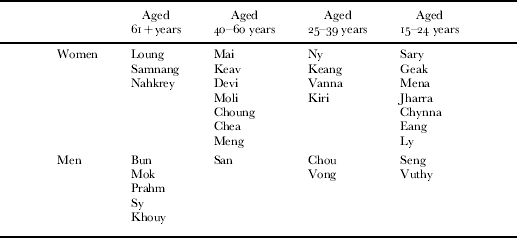
Data from the 31-member family-exchange network were organised across four age categories (61 years and older, 40–60 years, 25–39 years, and 15–24 years). Interviews and interactions with individuals aged 61 and older captured information from those who had reached middle adulthood in Cambodia and were considered elders in the United States KhmerFootnote 1 population. Individuals aged 40–60 years represented those who had reached young adulthood in Cambodia and who were attaining elder status in the United States at the time of this study. Participants aged 25–40 years had been children when they immigrated to the United States. The fourth category included individuals between the ages of 15 and 24 years who had been born in the United States.
The three older age categories provided ways to understand long-term versus short-term enculturation in homeland culture. The youngest age categories also allowed a consideration of those individuals who had experienced Khmer culture in the United States through family and community interaction, had not lived in Cambodia, and had only experienced Cambodian culture through interactions with other Cambodian people in the United States. The family members included in this research tended to interact many times each week through visits, phone calls, temple activities and work. The additional 48 elders were interviewed during interactions at various celebrations, ceremonies and family gatherings.
Informal and unstructured interviews were conducted with each participant in this study (Bernard Reference Bernard1995; Fontana and Frey Reference Fontana, Frey, Denzin and Lincoln1994). Unstructured interviews are very useful in ethnographic studies because they allow long interactions where participants can speak openly and give their own narrative accounts of a particular topic. The early interviews (from 1997–2000) were conducted with the aid of an interpreter or in English when the participant was bilingual. The author studied the Khmer language at the Southeast Asian Summer Studies Institute at the University of Wisconsin in Madison during the summer of 2001. From that time, the interviews with elders were conducted in Khmer by the author. Most interviews with those aged less than 40 years were conducted in English. When a person was bilingual, interviews were conduced in the language chosen by the interviewee. Although the author spoke Khmer, an assistant was present during most interviews for clarification of words or concepts not clearly understood by the author. Consent and assent forms were written in English and Khmer. Documents were read to any participant who was not literate. Assent and parental consent were obtained for participants younger than 18 years old.
Because of the author's long-term relationship with the US Gulf Coast Cambodian community, convenience and snowball samples (Bernard Reference Bernard1995) were used. Previous encounters and introductions by community members to other community members allowed the author to gain access to most families in the community. These techniques provided a way to reach both men and women in the community.
Analysis
Ethnographic research involves a constant analysis of data to uncover trends, patterns, issues and themes as they unfold (Bernard Reference Bernard1995). Data gathered as field notes were recorded with careful attention to detail and context and were matched with semi-structured interviews, unstructured interviews and participant observations (Bernard Reference Bernard1995). Ethnographic analysis is an iterative process of general reading, close reading and writing, followed by general reading that directs the author's attention more deeply into the data. The collected data were analysed line by line to categorise multiple ideas and issues using an ‘open coding’ process (Emerson, Fritz and Shaw Reference Emerson, Fretz and Shaw1995: 143). The identification of ideas and issues led to more focused coding. Field notes and the annotations were read as a whole after coding. This facilitated recognition of significant themes such as different types of intergenerational exchanges, differences in expressions of filial piety, webs of connectivity across families, widespread mutual assistance, family closeness across various distances and ambivalence in fulfilling familial obligations.
The inclusion of wide-ranging topics such as traditional cultural ideologies surrounding respect, obligation and faithfulness, politics, occupations, ancestor worship, social networks and survival strategies was enabled by the in-depth interviews, deep narratives and extensive interaction with people individually and in groups. A consideration of actual behaviours as a group interacted with families, communities and society (Wolcott Reference Wolcott1994) provided a way to recognise beliefs and practices that were influenced by larger political and social institutions. ‘Progressive focusing’ (Wolcott Reference Wolcott1994: 18), or moving from a wide view of political and social ideologies to specific closely-observed individual actions. This enabled extended consideration of particular experiences that showed individual agency within apparently collective actions.
Results
Family relations and intergenerational exchanges
This study found that each of the 79 persons interviewed was connected as family in some way; through experiences in Cambodia and in refugee camps, through resettlement, through affective or instrumental relations or through conscious inclusion of the person or persons in the interdependence associated with multiple generations. To exemplify, during one gathering of the community, a 70-year-old man, MokFootnote 2, described family and family relations that reinforced the collectivity that was so apparent in the observed interactions. Mok stated that all Khmer people are his ‘country’. Another at the gathering, Samnang, a 72-year-old woman, declared that ‘we are all together; one, no difference’. As the discussion of ‘family’ continued, others expanded on the themes. Khouy, aged 63 years, remarked that ‘the Khmer family is not just those people who live with you’. He added, ‘Khmer family is all Khmer. We are all responsible for each other’.
Like the hand-woven, hand-dyed silk found throughout Cambodia and highly prized by Khmers in America, the small nuances, nubs and texture of the ‘family’ discussed in this work must be considered a construct made by the Khmer people who shared their stories and by the author who heard them. The relationships formed an intricately patterned fabric woven by different hands at different times. The fabric may have been smooth or have had broken and knotted threads and patches or holes. Sometimes the family fabric showed repairs and imperfections. Sometimes it gracefully flowed, folded and conformed to its host's body. At other times, it stood crisp and firm. It was very often difficult to see its internal structure, to see behind the folds and below the patches. The repairs and patches were at times practically invisible.
With these caveats in mind, conceptualisation of these family members as separate individuals, cut from different cloths, must be tempered by acknowledging a disjuncture between the ways most members of mainstream US society define family (through biological or legal connections) and the fluidity with which Khmer notions of family were constructed, and how they extended widely across relational bonds. Those in need of assistance, companionship or support, no matter what their age, were incorporated into the family. As needs changed, relationships changed. An elder may have moved from one home to another to assist with child care. A young college graduate may have been ‘adopted’ into a Khmer family near where he or she was attending graduate school. In each case, the Khmer family represented in this study created a strong, broad ‘family’ fabric of exquisite complexity.
Instrumental, affective and symbolic exchanges
Intergenerational exchanges (instrumental, affective, and symbolic) are those actions, beliefs and behaviours that flow throughout family relations. An example of modifications in instrumental, affective and symbolic exchanges was given by an older man, Bun. His description of his family's collective efforts to provide transport and of numerous affective exchanges through personal visits and phone calls is a compelling account.
Bun Even though I am an old man who has lived a long life, I am very happy. I have a big family around me. Ma [his wife] is good to me. My grandson takes me to the temple when he is home from college. My daughter drives me there on weekends when she is not working. My grandchildren all come to visit me, those who live close by stop in everyday. Those families who live away call me on the telephone to ask if I have eaten rice. This is how Khmer live. We keep our family, old people and young people, close in our minds.
All three types of exchanges are shown as Bun and his family members keep each other close in mind and engage in daily interactions, a pattern that follows traditional notions of filial piety. In Cambodia, Bun walked to work, the temple and to other family members' homes. Because he did not learn to drive when he arrived in the US, he relied on his grandchildren and his daughters to drive him. When they were not available, other family members fulfilled his needs. Those family members living nearby visited with him, and those in more distant locations called him on the phone. Yet, he expressed limitations on the times his family members could assist him. Younger family members also echoed Bun's ambivalence in these modifications.
Other exchanges involved less obvious economic value and were more focused on affective exchanges. Elders often spoke of following the ‘middle path’ and teaching their children appropriate behaviours by example, a finding also reported by Hareven and Adams (Reference Hareven, Adams and Hareven1996) and Smith-Hefner (Reference Smith-Hefner1999). San, who provided daily care across generations to his parents-in-law and children, explained how each generation worked together to provide a happy life for the other by considering each others' needs. Older family members strived to teach younger family members. Younger family members strived to provide for the needs of elders through instrumental exchanges and to show proper respect for older family members through affective exchanges, while at the same time, making subtle changes in the patterns of care.
San My daughters take care of everything for me. They cook and clean up the house. They call me to say they love me. They take care of their grandparents too. … I am very happy to see them following the Khmer ways. Khmer family life is peaceful. We learn from our parents and grandparents how to do the right thing. We see our parents taking care of others and we learn that we must take care of others too. We learn what is right and what is wrong. … We then live our lives this way so that our children and grandchildren can see the right way to live. My children always are thinking of mom and dad. They call us and drive to see us from far away.
San's remarks and his actions show how exchanges, such as phone calls, were shifted and moulded to fit present-day circumstances. As his ageing mother- and father-in-law required more assistance, he strived to continue a traditional pattern of filial piety so that his children learned from his example, just as he learned from his own parents and grandparents. Although his actions were not explicitly linked to his family's health, because they are family centred, they served as a building block toward a peaceful and healthy life (Berman, Kendall and Bhattacharyya Reference Berman, Kendall and Bhattacharyya1994). At the same time, his children engaged in both traditional forms and in modified patterns of exchange, reporting mixed feelings over their struggles to conform to expectations of filial piety and to US mainstream ideas of ‘youthful’ behaviours. San's daughter, Eang, struggled to fulfil her obligations associated with instrumental, affective, and symbolic exchanges but was torn in her desire to be ‘more American.’
Eang My family is everything. When I come home from school, I just go to my grandma and grandpa and do my homework … But, sometimes I am not sure how to be a good granddaughter, should I study or should I cook for my grandpa? Should I stay home to visit with them or should I be more American and go with my friends? I don't know … I try to do everything for them and for my future in America.
Remittances as a form of instrumental exchange were often mentioned by family members. Mok, who cared for his wife Nahkrey, was supported by his children, both of whom lived considerable distances away. Monthly payments for his automobile were made automatically by his son while his daughter made routine deposits into his bank account. He expressed pride in the achievements and success in America of his children. Yet, in spite of the financial assistance he and Nahkrey received, he lamented an absence of affective exchanges and categorised ‘taking care’ as involving more than the instrumental exchange he received.
Mok I don't think my children will take care of me when I am old. I will just go to nursing home. My children are always working. Why should I think they will take care of me when I am old? They must take care of their own children before they take care of me. The American way is independence.
One way in which Mok and Nahkrey had compensated for the absence of affective exchanges with their biological children had been to establish strong familial bonds with younger members of the community. For example, Mok and Nahkrey engaged throughout the community in affective exchanges and were included as respected elders in meals, celebrations and ceremonies in the extended family network. Mok engaged in symbolic exchanges by providing Khmer language training and tutoring sessions for school-aged children, by helping arrange marriages with members of the extended network, and by assuming the role of respected elder. One middle-aged woman, Vanna, explained Mok's role as teacher and uncle:
Vanna Bpo [Uncle] Mok teaches us how to treat others, especially our elders and parents, but also teaches us to take care of each other. We learn from our family what is important for our lives. We know that we owe our elders and our parents our love and respect. They know that we will take good care of them when they get too old.
Vuthy, a young man, who routinely engaged in exchanges with Mok, expressed his ambivalence, ‘Sometimes it is hard to do all the things my grandpa and my parents want me to do to be a “good” Khmer boy'. Chynna, a young woman, echoed Vuthy's sentiments and his ambivalence:
Chynna Because I am a girl, I am expected to stay very close to Khmer ways. My grandpa and my parents are too strict. They won't let me go places like the mall unless half-a-dozen of my aunts go with me. I just want to be more like the other [non-Khmer] girls at school. But, my family is my life. They teach me everything I need to know to be happy. I help my mom with whatever she needs – like driving, or language. My grandparents teach me about Cambodian ways. They tell me stories. I like to cook special things for my grandma. She is so happy when I make her Khmer food.
The difficulty younger Khmer felt when attempting to blend both Khmer and American customs and attitudes reached across all generations (Eliason et al. Reference Eliason, Detzner, Cleveland and Xiong2005). Yet, they described the importance of paying respect each day, acquiring good US-oriented educations, and providing instrumental, affective and symbolic exchanges in spite of changing circumstances. A significant aspect of these exchanges was an expansion of the conception and practical meanings of family.
Meanings within exchanges
Reconstructing family was another path for engaging in intergenerational exchanges, especially symbolic exchanges. For example, Meng, a middle-aged woman, lost most of her family during the Pol Pot years. She explained, ‘I was the last child born to my mom. My brothers and sisters were separated from us in Cambodia and we think they are dead, so there were only two of us in the camps and here in the United States’. She and her mother were resettled in the United States in 1982 by the US Catholic Council. Meng talked about her relationship with her mother and the relationship Meng's mother has with her granddaughters.
Meng When I came to the US, I was not very old – around 17 years I think. I stayed very close to my mother when we were in the camps. … Now she is too old to work so I take care of her. It makes me so happy to see her eating and enjoying her talks with my daughters. … My daughters love her and listen to her stories of Cambodian life. That is how old people should live the last of their lives, with family and with love.
Meng's remarks showed how families worked together across the life span to help each other. Because Meng and her family were no longer in Cambodia and immersed daily in Khmer culture, their economic struggles were compounded by refugee status and family losses (Knodel, Saengtienchai and Sittirai Reference Knodel, Saengtienchai and Sittitrai1995). Still, Meng's daughters spent considerable time with their grandmother learning about Khmer traditions. One daughter, Jharra, remarked, ‘When my grandma got so sick, nobody minded even getting up [to take care of her] after they had gone to sleep. Because we all share [responsibility for her care] and my grandma is so wonderful’. As Jharra's comments illustrate, exchanges were often reciprocal and symbolic, such as stories told by grandparents to grandchildren that provided a way to pass on traditions while maintaining close intergenerational exchanges and building social solidarity (Rettig Reference Rettig1985).
A Khmer proverb, In our own homes we each have one mother; in the jungle we all share the same mother, goes some way to explain American Khmers' expansive notions of family and how an inclusive view of family influenced the meanings and conduct of intergenerational exchanges. Each Khmer family interviewed had lost significant numbers of kin in Cambodia during the Pol Pot years (1975–1979) and many more in the following years through the severe deprivations of the refugee camps. Reconstituting ‘family’ by informal adoptions – across all ages – gave the surviving Khmers a way to re-weave and reassemble opportunities to engage with family regardless of biological relatedness, a pattern seen above in San's narrative and below in Chea's connections with her adopted uncle and his extended family.
Having lost nearly all her family in Cambodia, Chea moved nearby 12 years earlier to be near her informally ‘adopted’ Khmer family. She described her experiences fleeing the Khmer Rouge, and recalled how she redefined her own needs when she arrived safely in the United States. Chea and her infant daughter were sponsored by an American family living in Pennsylvania. Alone and without language skills, she was determined to provide a good life for herself and her daughter. As her daughter grew into adulthood, she began to long for an extended family such as she had lost in Cambodia.
Chea When I lost my family in Cambodia, I learned that I could be okay on my own. Now as I get older, it is harder to be alone. So, I have gotten closer to my uncle's family. I go there for dinners and celebrations. They know I wasn't always part of their family but now I am and it is good for me and for them. It has helped me remember my ancestors and gives me peace.
Reuniting with other Khmers provided her with a way to give meaning to the core ethnic values she acquired before leaving Cambodia and the independence she acquired in the United States. Actions surrounding intergenerational exchanges created new meanings of family. Meng, who lost all but her mother in Cambodia, was embraced by one Khmer family soon after her arrival in the US.
Meng My older uncle sponsored my wedding. I came here without my family and he took me to be his family. Now we are one family and my children call him Ta [grandfather], not just because he is old but because we have so much love in our family.
The meanings of family, aptly described by Khouy as including all Khmer, were evident in Meng's, Chea's and others' descriptions. Exchanges across generations allowed many to reconstruct meaningful family relationships. In each case, the family members continued to engage in kindness, love, and respect in reciprocal patterns across generations of all three types of exchanges.
Ambivalence within exchanges
Ambivalence often can be found in intergenerational exchanges (Connidis Reference Connidis2001; Lüscher Reference Lüscher, Pillemer and Lüscher2004; Lüscher and Lettke Reference Lettke, Klein, Pillemer and Lüscher2004) amid the struggles and adaptations across situations and across relationships. No matter what type of intergenerational exchange, whether instrumental, affective or symbolic, each held particular and multiple meanings; moreover, most created some level of ambivalence. Because personal biographies colour the ways that individuals interact and the expectations they have of themselves and others (Gubrium and Holstein Reference Gubrium, Holstein, Bengston and Schaie1999; Halbwachs 1952/Reference Halbwachs1992; Holland et al. Reference Holland, Lachicotte, Skinner and Cain1998), meanings within exchanges shifted and were redefined according to the particular histories, needs and abilities of the members of this diverse assemblage of Khmer families. A ‘looking back’ provided the participants in this study with the opportunity to reconstruct their understandings of the past based on their present-day circumstances. The pull of independence, for example, may have pushed against the desire to fulfil family obligations. The push and pull of family obligations and daily life was seen in statements made by Vong, who frequently moved in and out of the community following employment opportunities.
Vong Life brings lots of changes. Khmer people have had to learn to adapt since we had to leave our country. We can keep our traditions in our home but we have to act American to the outside world. Otherwise, we will always be poor and have nothing.
Each time Vong, his wife and children returned to the community, his family celebrated. Each time they moved away, a farewell dinner was prepared. Perhaps the most stretched and ambivalent of all age groups (25–39 years), Vong and his contemporaries struggled to find a way to ‘fit’ within both cultures, often precariously balancing each day's work and child care with reverence for and respect to older family members. Vong indicated that his ability to find work was how he showed respect to his father. He said, ‘If I don't work, what does that say to my papa?' That he raised a no-good son?' When Vong began to feel that he was letting his father down by holding a low-wage job, he moved his family to another city in hopes of (finally) attaining a ‘good’ job with a good wage. That way, Vong explained, he would begin repaying his father for earlier financial assistance and would show his father that he was a ‘good’ son. Vong's ambivalence was apparent in his desire to fulfil obligations associated with filial piety and his quest for economic success in the US. Both were manifest in his cyclical migrations – back to the community to be near and to assist his father, away again in search of better opportunities.
A similar pattern of ambivalence was found among numerous middle-aged adults; many spoke of strains associated with balancing multiple roles: work, child-care, the temple and tasks associated with elder respect and ancestor veneration. Solidarity was also apparent in intergenerational exchanges. Bun and his family maintained close exchanges through multi-generational living arrangements, frequent visits and phone calls. Another example of solidarity was seen between one 83-year-old grandmother, who provided companionship to her great-grandchildren and her family. She had accepted changes in her role that made her more dependent on her family. Her ambivalence was diminished because of her willingness to adapt to her new identity.
The permanence of intergenerational relations increases the possibility of ambivalence (Grundy and Henretta 2004). Younger adults, especially those who arrived in the US as adolescents or very young adults, described more struggles and were more troubled by their shifting roles. Older Khmer, on the other hand, were more willing to accept changes brought about by cultural dissonance and more readily adapted to changing life circumstances. Older Khmers' attitudes of acceptance also may have been influenced by long-term Buddhist training that taught acceptance of one's plight as a consequence of one's actions in a previous life. Younger family members continued to redefine themselves within the context of life in the US whereas older family members were more comfortable with changes. Ambivalence, then, was felt differently across generations.
Different types of exchanges, meanings and ambivalence within intergenerational exchanges dominated the narratives. Most people who were less than 60-years-old spoke of continued filial piety and continued intergenerational exchanges in spite of the reality of long days working outside the home, often in low-wage jobs. Younger family members acknowledged the debt they owed to parents and grandparents and stated their intentions to repay those debts – not through time, as might be a more traditional approach, but through better multi-generational housing, dedication to their studies or through financial contributions. Most of the elders also spoke of continued filial piety; they seemed more willing to accept younger family members' time limitations associated with economic advancements and the shift of their own status toward living as dependants rather than as the economic heads of extended households. Perhaps their acceptance was an artefact of their observations that a ‘traditional’ pattern was not sustainable. This acceptance, even if somewhat reluctant, has led family members to create new meanings in instrumental, affective and symbolic exchanges across generations. These newly formed meanings invoke significant ambivalence because family members concomitantly express satisfaction in patterns of cultural adhesion that blend Khmer traditions and US cultural ideology while at the same time lamenting the loss of more traditional forms of filial piety, elder respect and family relations.
Conclusion
This study found that family members modified types of intergenerational exchanges for a better fit within US society. They reinterpreted meanings of those exchanges so that behaviours conformed to demands of daily life in the US, while at the same time, fulfilled obligations and expectations associated with filial piety. Yet, they also experienced ambivalence in those modifications and reinterpretations. Families in this study made way for a reworking of the social template that defined appropriate types and methods of exchanges for fulfilling obligations associated with filial piety. Family members brought with them the experiences and histories particular to their own circumstances and particular to the length of time they had spent in Cambodia, in refugee camps and in the US. Individual and collective histories informed ways in which each interacted with the other. A modified social template provided guidance for conforming to present-day intergenerational expectations.
Beliefs and behaviours that followed a traditional ideology of filial piety and intergenerational exchanges were reflected in each of the preceding narratives. Reports of ancestor veneration, elder reverence and obedience and acknowledgement of the debt owed to elders were woven throughout Khmers' remarks. There were no differences in sentiments surrounding traditional filial piety beliefs by age or gender. Observed behaviours also reflected adherence to a tradition of filial piety. It was common to see younger Khmers taking food to older Khmers who were not able to attend some ceremony or celebration. Even very young children momentarily paused to greet elders in a hands-together head-slightly-down greeting before running off to play.
Throughout interactions in this Khmer community, intergenerational exchanges and respect across ages was the norm. Younger Khmers spent considerable time making certain that older Khmers were comfortable – whether that meant providing food, a home, conversation or a loving encirclement. Elders, likewise, acknowledged their responsibilities to teach and nurture younger Khmers so that a traditional Khmer family life was understood, embraced and preserved. Across all ages, family members told similar stories of care, respect and assistance. Subtle shifts in what was considered appropriate relations, however, could also be heard in their narratives.
The fabric of refugees' lives described in this study interwove, frayed, overlapped and held strong. The warp and weft were an intricate assemblage of events, people, places and times that were, all at once, part of past, present and future lives. Physical and symbolic reconstruction of a complex Khmer ‘home place’ in the form of community with its Buddhist temple provided one way for reconnecting, reconstructing and redefining the composition of selves and families. Fitchen (Reference Fitchen1991) describes close-knit communities as repositories and referents for understanding, for constructing identities and for defining ‘who and what we are.’ (1991: 245). The definition has particular relevance for this group of refugees who are living in the context of social disruption, cultural dissonance and changing life circumstances. The families described in this study have responded by constructing an existence, in the village and beyond, that blended multiple aspects of Khmer and US cultures into a complex fabric of intergenerational exchanges.
This research increases our understanding of the ways in which minority immigrant families adapt to life in the US. It shows how US cultural influences can be both beneficial and detrimental to refugee and immigrant family relations and how families create new environments that allow adaptation, adhesion and the continuity of desired culture traits that include intergenerational exchanges. As the narratives of Khmer families in this paper revealed, types of intergenerational exchanges became accepted or rejected according to the particular mix of social, political, historical and cultural patterns, beliefs and behaviours within which families existed. Moreover, varying degrees of ambivalence were experienced as expectations, beliefs and behaviours changed regarding intergenerational exchanges. Changed life circumstances and cultural transitions have shaped attitudes, preferences and behavioural patterns associated with intergenerational exchanges that fulfilled obligations of filial piety among immigrant and refugee populations.
This exploration of the lives of this group of Khmer refugee families has shown how and why families negotiated and modified beliefs and behaviours surrounding intergenerational exchanges in the context of massive social and cultural disruption. The more important component of Khmer families' lives in this report, however, was the ability to hold onto those aspects of Khmer culture that were considered essential, such as continuation of filial piety and elder reverence. At the same time, Khmer families adapted and redefined types and meanings of intergenerational exchanges the better to reflect their current lives in the US. There is little doubt, then, that their stories will continue to be moulded and shaped as they carry on their lives in the US.
Acknowledgements
This research was supported by a Research Challenge Trust Fund Fellowship through the University of Kentucky. I would like to thank Mr Heang Bun Chhun and the entire Khmer community for the kindness shown throughout my long relationship with them.