Implications
Production systems for fattening pigs have been characterized over the last 2 decades by rising farm sizes coupled with increasing group sizes, in order to optimize management and efficiency. Concerns about animal welfare in these systems are under intensive discussion. Lack of scientifically proven studies contributes to the negative image of modern livestock farming. Therefore, the welfare level of 60 fattening pig farms in Germany was assessed and the effect of group size on welfare indicators was evaluated to identify an optimal group size proved to be superior to others in terms of animal welfare. This will be an important contribution for the future discussion as group size is one of the most criticized aspects among the welfare debate.
Introduction
During the last decades, the pig fattening industry has shifted towards larger farm sizes mainly due to limited profits (FAWC, 2012). At the same time, some farmers changed the housing system from small groups of 12 to 15 pigs to large (>50 pigs) (Turner and Edwards, Reference Turner and Edwards2004) and even mega groups (>100 pigs) (Samarakone and Gonyou, Reference Samarakone and Gonyou2008) in order to optimize management and labour efficiency (Schmolke et al., Reference Schmolke, Li and Gonyou2003). Common group sizes for growing pigs in Germany range between 10 and 30 animals, even though groups of 40 to 100 or even more animals were proposed by a few farms as a management strategy to improve overall profitability (Schmolke et al., Reference Schmolke, Li and Gonyou2003). In Germany, pigs under conventional production conditions, are generally fattened indoors and barns are generally characterized by fully slatted floors, forced ventilation and automatic feeding systems (Hoy et al., Reference Hoy, Gauly and Krieter2006). Recently, these production systems, particularly under conditions of large farms and group sizes, have been under serious discussion mainly due to animal welfare concerns (Schröder and McEachern, Reference Schrøder-Petersen and Simonsen2004; Kayser et al., Reference Kayser, Schlieker and Spiller2012; Velarde et al., Reference Velarde and Geers2015). Studies using various welfare-related measures indicate negative impacts when groups sizes exceed those found in the wild, which are usually comprised of two to four sows with their most recent litters and juvenile offspring of previous litters (Gonyou, Reference Gonyou2001). McGlone and Newby (Reference McGlone and Newby1994) found that injury and morbidity rates were greater for pigs in groups of 40 than of 10 or 20 animals. In contrast, Samarakone and Gonyou (Reference Samarakone and Gonyou2008) did not find differences for mortality, morbidity or behavioural vices, such as tail biting, when comparing groups of around 20 and 100 pigs. The meta-analysis of Averós et al. (Reference Averós, Brossard, Dourmad, de Greef, Edge, Edwards and Meunier-Salaün2010) did also not provide any evidence that group size affects the lying behaviour.
Because the welfare status of animals is multi-factorial, a combination of various parameters is necessary for its evaluation. The Welfare Quality® assessment protocol (WQP) for growing pigs (Welfare Quality®, Reference Wolter, Ellis, Curtis, Augspurger, Hamilton, Parr and Webel2009) is an adequate tool to address the effects of group size on farm. As a multidimensional concept, it integrates the absence of thirst, hunger, discomfort, disease, pain and injuries, stress and the expression of normal behaviour. Recent studies on the welfare status of growing pigs raised under intensive conditions reported only minor differences between farms (Temple et al., Reference Temple, Dalmau, Ruiz de la Torre, Manteca and Velarde2011b and Reference Temple, Courboulay, Manteca, Velarde and Dalmau2012). However, group size effects on the animal-based indicators of the protocol were not assessed, yet. Therefore, the aim of this study was to compare different group sizes under conventional fattening conditions in terms of welfare-related indicators of the WQP.
Material and methods
Farm selection and housing systems
A total of 60 conventional pig fattening farms with herd sizes between 250 and 11 000 pigs, located in Northern Germany, were assessed. The assessments were conducted between September 2013 and June 2014 by the same observer, who received intensive training on the correct application of the WQP beforehand. Farms were selected based on farm size and management (intensive production conditions, forced ventilation, ‘all in all out’ management). A total of 80% of the farms only raised growing pigs, while 20% had a closed system raising sows, piglets and growing pigs. Farm-related data (feeding and hygiene management, prevention of diseases, mortality rate, castration and tail docking routines and procedures) were gathered. All barns were insulated and equipped with mechanical ventilation systems. Liquid feeding was used in 62% and dry feeding automats in the other farms.
Animal and pen characteristics
On each farm, 10 randomly selected pens were assessed. In pens with <15 pigs, all pigs were included, while in larger pens 15 animals were randomly selected and assessed for the animal-based measures. Hospital pens were excluded and the sex of each individual was recorded. The total number of 600 pens housed 32 723 pigs, of which 8214 were included in the individual observations. The group size of the selected pens ranged from 10 to 350 animals, which were classified into the following three categories: (1) small: <15 pigs/pen; (2) medium: 15 to 30 pigs/pen and (3) large: >30 pigs/pen.
Animals were crossbreds of various genetic lines from the following breeding companies: DanZucht (Copenhagen, Denmark) (45%), German Federal Hybrid Breeding Program (BHZP, Ellringen, Germany) (15%), Topigs (Senden, Germany) (12.8%), Pig Improvement Company (PIC, Schleswig, Germany) (8.3%), Hypor (Sittensen, Germany) (6.6%) or JSR Hybrid (Ahaus, Germany) (3.3%). Sows were bred by AI either with Pietrain (73%) or Duroc (27%) semen. Tail docking was routinely practiced for all pigs.
The fattening period started at an initial BW of 29.9±2.8 kg and pigs were slaughtered at 120.8±3.5 kg. The age of the pigs at the assessment ranged from 12 to 30 weeks. On the assessment day, the actual BW was calculated based on the initial weight and under the assumption of 800 g daily weight gain. The respective BW was classified into the following groups: (1) <50 kg; (2) 50 to 80 kg; and (3) >80 kg.
The length and width of the individual pens was measured to calculate the space allowance. On average, 0.83 m2 were available per pig (range 0.31 to 2.5 m2). In accordance with the German farm animal welfare regulations (Tierschutz-Nutztierhaltungsverordnung, 2006) the space allowance was defined as (1) legally justified: 30 to 50 kg, >0.5 m2/pig; 51 to 110 kg, >0.75 m2/pig; >111 kg, >1 m2/pig or (2) not legally justified: space allowance below the thresholds stated under (1).
Assessment of animal-based measures
At the individual level, body condition, bursitis, manure, wounds, tail biting, lameness, laboured breathing, scouring, skin condition (inflammation or discoloration), hernias, twisted snouts and rectal prolapse were assessed according to the WQP (Reference Wolter, Ellis, Curtis, Augspurger, Hamilton, Parr and Webel2009), which includes detailed information on the overall assessment methodology. Only one side of the animals was inspected. Individual animal-based measures are either categorized by a three-point scale (0=absent, 1=moderate, 2=severe), such as bursitis, manure on the body, shivering, panting, huddling, lameness, wounds on the body, skin condition and ruptures or else by a two-point scale (0=absent, 2=present), such as body condition score, tail biting, twisted snouts and rectal prolapse. In brief, score 2 for tail lesions describes the presence of any animal with fresh blood visible on the tail and/or evidence of some swelling and infection, and/or part of the tail tissue missing and presence of crust. For pig dirtiness, score 0 is defined as <20%, score 1 as 20% to 50% and score 2 as >50% of the body surface being soiled with faeces. The accordant definitions for bursitis are no evidence of bursa/swelling (score 0), one or several small bursa (1.5 to 2.0 cm) or one large bursa (3.0 to 5.0 cm) (score 1) and several large bursa, or one extremely large bursa (5.0 to 7.0 cm), or any eroded bursa (score 2). Wounds are scored 0 if the different regions of the body (ears, front, middle, hind-quarters and legs) have less than five lesions. Score 1 is given if 5 to 10 lesions are visible and 2 if more than 11 lesions are observed on at least two body regions or if any zone is found with more than 15 lesions.
At pen level, huddling, shivering, panting, the human–animal relationship and the water supply (number of drinkers, functioning and cleanliness) were assessed. Huddling, shivering and panting were the first measures assessed visually from the corridor and only observed in resting animals, just before the animals began to stand up. The human–animal relationship test was performed using score 0 for no panic towards the human present and score 2 for more than 60% of the pigs with panicking behaviour. Panic was defined as animals fleeing, facing away from the observed or huddling in the pen corner. For the human–animal relationship test, the amount of pens with a panic response from the total pens observed per farm expressed in per cent was used for further analysis.
The social and explanatory behaviour was assessed at three different observation points of the farm. At each point 50 to 60 animals from up to four different pens were observed for a total period of 10 min with a scan made every 2 min. After the animals were forced to stand up, if necessary hands were clapped, the observer waited for 5 min before starting with the observations. At first, pigs were scored as active or inactive (resting). Active behaviour was then further differentiated into positive social, negative social, pen investigation, use of enrichment material and other active behaviour. Negative social behaviour is defined as aggressive interaction including any social behaviour with a response from the disturbed animal, whereas positive social behaviour describes sniffing, nosing, licking and moving gently away from the pig without an aggressive or flight reaction from this individual. Investigation of the pen is defined as sniffing, nosing, licking or chewing all features of the pen, whereby the use of enrichment material is described as playing or exploring enrichment materials. Other active behaviour includes eating, drinking and air sniffing.
Statistical analyses
All analyses were conducted using SAS version 9.3 (Statistical Analysis Systems, 2011). Pen was defined as the statistical unit. Results were considered statistically significant at P>0.05. For indicators that were recorded at individual level, the number of animals per pen scored either 1 or 2 was divided by the total number of animals observed in the pen and then transformed into frequencies. Data of the social and exploratory behaviour were expressed as the proportion of animals performing the respective behaviour in relation to the total number of active animals observed per view point. From seven observation points data could not be included, because pens from more than one group size category were observed at these points.
Multiple Generalized Linear Mixed Models were performed separately for moderate bursitis, manure and wounds as well as for the social and exploratory behaviour using the GLIMMIX procedure. A Poisson distribution and a logarithmic link function were assumed. Apart, scores other than 0 were observed at such low rates that group size effects could not be verified. The statistical model included the fixed effects group size (small, medium and large), live weight group (1, 2 and 3), space allowance (legally justified, not legally justified), and feeding system (liquid feeding, dry feeding) were included. The farm served as random effect to account for the possible dependence between observations of pens from the same farm. Space allowance was excluded because it did not have a significant effect on any of the measures.
For human–animal relationship, which was recorded as binomial variable, odds ratios were calculated using the GLIMMIX procedure including group size as fixed and farm as random effect.
Results
Farms and animals
Females and castrates were housed together in mixed pens in >60% of the studied pens, whereas pens with boars and females (6%) and boars only (4%) were exceptions. Sexes were raised separately in all other pens. The vast majority of the pens had a fully and only 8% a partly slatted floor (Table 1). More than 40% of the pens had a space allowance below the German legal requirements independent of the group size (Table 1). The mean and median number of pigs per drinker was 6 and 7, respectively, for liquid feeding (range 2 to 43) and 9 and 10 for dry feeding (range 2 to 23). In 22% of the pens the ratio was >10; and 7% of the pens were only equipped with one drinker. Three farms using liquid feeding even had no additional drinker in the pen or turned them off after a certain period of the fattening period. The mortality rate averaged 2.5% and ranged from 0.9% to 5.2%.
Distribution (in % of pens) of floor type (fully slatted and partly slatted), space allowance (legally justified and not legally justified) and live weight group (1, 2 and 3) in dependence of three different group sizes (small, medium and large) evaluated in 600 pens for growing pigs

1 Group size: Small=<15 pigs/pen; medium = 15 to 30 pigs/pen and large =>30 pigs/pen.
2 Space allowance: legally justified=30 to 50 kg, >0.5 m2/pig; 51 to 110 kg, >0.75 m2/pig; >111 kg, >1 m2/pig; not legally justified=space allowance below the thresholds stated under legally justified.
3 Live weight group: 1=<50 kg; 2=50 to 80 kg and 3=>80 kg.
Animal-based measures
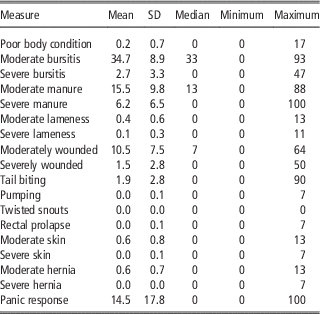
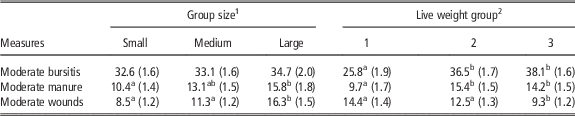
Among the animal-based measures, highest prevalence was determined for moderate bursitis (35%), moderate manure (15.5%) and moderate wounds (10.5%), whereas severe bursitis, manure and wounds were only detected exceptionally (Table 2). For all other indicators recorded at the individual level including tail biting, scores other than 0 were recorded at very low frequencies. In Table 3, rates of the most prevalent measures are presented by group size and live weight class. For moderate bursitis, group sizes did not differ (P>0.05), while the prevalence was higher in the two upper live weight classes when compared with the lowest class (P<0.05). In medium and large groups moderately soiled bodies were found more often than in small groups (P<0.05). Moderate manure was found at higher rates on pigs fed by a liquid (22%) than a dry feeding system (12%) (P<0.05). Pigs in the upper two live weight classes were dirtier than in the lowest class (P<0.05). Moderate wounds increased from <9% in small to almost 16% in large groups (P<0.05). In comparison to pigs in the medium live weight category, moderate wounds were less often observed in pigs of the upper one (P<0.05).
Prevalence (%) of the animal-based measures of the Welfare Quality® assessment protocol for growing pigs evaluated in 600 pens

Prevalence (%) (standard error) of selected animal-based measures of the Welfare Quality® protocol for growing pigs separated by group size (small, medium and large) and live weight group (1, 2 and 3) evaluated in 600 pens

a,b,cDifferent letters within rows indicate significant differences (P<0.05).
1 Group size: Small=<15 pigs/pen; medium=15 to 30 pigs/pen; and large=>30 pigs/pen.
2 Live weight group: 1=<50 kg; 2=50 to 80 kg; and 3=>80 kg.
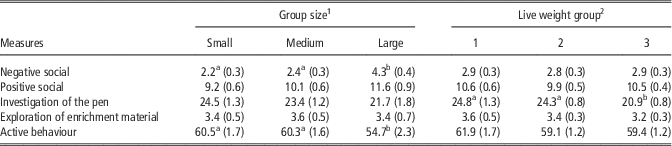
The effects of group size and live weight group on the social and exploratory behaviour are presented in Table 4. At a rate of 4.3%, negative social behaviour was recorded more frequently in large groups (P<0.05) than in small (2.2%) and medium groups (2.4%). Without differences between groups, a positive social behaviour was observed at rates of around 10%. Also not different between groups, rates of 22% to 25% were found for investigation of the pen and 3% to 4% for exploration of enrichment material. Pigs in large groups showed active behaviour less frequent than those in small and medium groups (P<0.05). Regarding live weight groups, differences were only found for investigation of the pen, which was recorded more often in group 1 and 2 than in group 3 (P<0.05).
Prevalence (%) (standard error) of the social and exploratory behaviour separated by group size (small, medium and large) and live weight group (1, 2 and 3) evaluated in 600 pens

a,b,cDifferent letters within rows indicate significant differences (P<0.05).
1 Group size: Small=<15 pigs/pen; medium=15 to 30 pigs/pen; and large=>30 pigs/pen.
2 Live weight group: 1=<50 kg; 2=50 to 80 kg and 3=>80 kg.
The prevalence of a panic response assessed via human–animal relationship was higher in small (20.3%) than in medium (14.0%) and large groups (6.6%; Table 5). Thereby, the odd of having a panic response was 0.329 and 0.497 for pigs in small and medium groups, respectively, when compared to large groups.
Probability of occurrence of a panic response to the observer depending on group size (small, medium and large) evaluated in 600 pens

1 Intercept coefficient=2.9466.
2 Group size: Small=<15 pigs/pen; medium=15 to 30 pigs/pen and large=>30 pigs/pen.
Discussion
Among the various indicators that were assessed using the WQP bursitis, wounds and manure on the pigs showed the highest incidences. In large groups of >30 animals, the presence of both wounded and soiled pigs was higher compared to small- and medium-sized groups. Additionally, negative social behaviour was found more often in large groups, in which, on the contrary, a better human–animal relationship was noted. With increasing live weight, the occurrence of bursitis and manure on the body increased, while the prevalence of wounds and exploration of enrichment material decreased.
Feeding
Under conventional fattening conditions where animals are commonly fed ad libitum, pigs with a poor body condition are the exception. Expectedly, values in our study were similar to those observed by Temple et al. (Reference Temple, Courboulay, Manteca, Velarde and Dalmau2012) who recorded a prevalence of only 0.4% in conventional production systems. Even though previous studies showed that access to feeders and feed intake is impacted by group size (Spoolder et al., Reference Spoolder, Edwards and Corning1999; Wolter et al., 2001), changes are not as pronounced as to translate directly into body condition changes. In general, a poor body condition is the result of deficits in health management and consequently in feed intake (Velarde and Geers, Reference Velarde, Fabrega, Blanco-Penedo and Dalmau2007). However, it has to be mentioned here that hospital pens are not assessed by the WQP, thus the actual prevalence in the studied farms might have been greater.
Contrary to feeding, the water supply was regularly insufficient in terms of animal to drinker ratio and functionality. In accordance with article 28 (2) No. 5 (Tierschutz-Nutztierhaltungsverordnung, 2006) one drinker should be offered per 12 pigs and article 26 (1) No. 2 regulates that every pig should have permanent access to a drinker with water in sufficient quality and quantity and which is separated from the feeding spaces. Nevertheless, the ratio should be adjusted to the group size, as the interaction between group size and drinker ratio on daily time at the drinkers found by Turner et al. (Reference Turner, Sinclair and Edwards2000) indicated. Consequently, the larger the group the more drinkers per pig should be available, although pigs in larger groups (60 pigs) spent less time drinking per day than pigs in smaller groups (<20 pigs). Furthermore, the frequency of visits to the drinkers, drinking bout duration and daily drinking time increased in the mentioned study when the pig to drinker ratio increased (Turner et al., Reference Turner, Sinclair and Edwards2000). However, a sufficient quantity is more often a problem than the water quality (Kamphues and Schulz, Reference Kamphues and Schulz2002).
Bursitis
Bursitis arises as one or more fluid-filled sacs at the fore or hind leg, where normally no swelling is present. The swelling occurs whenever skin covering a bony structure is exposed to pressure and is not related to an infection. As a result, the fluid exudates from traumatized capillaries and lymphatic vessels. Bursitis can persist or vanish after a certain period of time (Mouttotou et al., Reference Mouttotou, Hatchell and Green1999). In the present study moderate bursitis (35%) was found as the most prevalent animal-based measure. As shown in previous studies, this is a sensitive indicator to compare different production systems and differentiate farms, because of high between-farm variability and low within-farm variability (Temple et al., Reference Temple, Courboulay, Manteca, Velarde and Dalmau2012). When bursitis was present on a farm, a large number of animals were affected. The different prevalence of bursitis and the high between-farm variability can be explained by several causal factors such as the environment, especially the floor type. A concrete floor increases pressure on the pigs’ limbs and intensifies the severity of bursitis (Smith, Reference Smith1993; Mouttotou et al., Reference Mouttotou, Hatchell and Green1999). The high bursitis prevalence in the present study can be explained by the vast majority of pens with fully slatted floors. However, differences between fully and partly slatted floors could not be verified. The prevalence of bursitis increased with age during the fattening period, mainly due to the fact that the greater BW exerts additional pressure on the limbs (Mouttotou et al., Reference Mouttotou, Hatchell and Green1999). Although Smith (Reference Smith1993) reported that pigs kept at high stocking densities tended to have an increased prevalence and severity of bursa lesions, the stocking density and group size in our study did not have an effect. Although we observed that >40% of the farms had a space allowance below the German farm animal welfare regulations (Tierschutz-Nutztierhaltungsverordnung, 2006), this did not affect the prevalence of bursitis. Severe bursitis was only recorded exceptionally and at lower rates than under comparable production conditions with concrete flooring in previous studies (Temple et al., Reference Temple, Dalmau, Ruiz de la Torre, Manteca and Velarde2011b).
Pig dirtiness
The prevalence of moderately (15.5%) and severely (6.2%) soiled bodies are similar to the values of 16.6% and 3.7%, respectively, reported by Temple et al. (Reference Temple, Dalmau, Ruiz de la Torre, Manteca and Velarde2011b). This emphasizes that the prevalence of soiled bodies is consistent within the same production system independent of the geographic region. The highest prevalence of moderate dirtiness was registered for pigs kept in large groups (15.8%), compared to the lowest in small groups (10.4%). Comparable values are not available in the literature, yet. Pig dirtiness is influenced by multiple factors (Velarde and Geers, Reference Velarde, Fabrega, Blanco-Penedo and Dalmau2007) with the floor type being one of the most causal factors in conventional housing systems (Temple et al., Reference Temple, Dalmau, Ruiz de la Torre, Manteca and Velarde2011b). Thereby, the risk for manure on the body is higher for partly than for fully slatted floors (Temple et al., Reference Temple, Courboulay, Manteca, Velarde and Dalmau2012). However, this could not be verified in our study. Similar to bursitis, pig dirtiness increased during the fattening period, which can be mainly explained by the fact that the effective stocking density increases. Furthermore, older pigs spend more time lying compared to younger animals in order to dissipate metabolic heat (Aarnink et al., Reference Aarnink, Schrama, Heetkamp, Stefanowska and Huynh2006). This was supported by the current finding that older pigs were found less often investigating the pen compared with younger animals. As another determining factor, the feeding system plays a role. The findings that liquid-fed pigs were dirtier than dry-fed ones was previously described by Hyun (Reference Hyun2001). In summary, the feeding system and floor type seem to have a much larger effect on pig dirtiness than group size.
Wounds
The prevalence of severely wounded pigs (1.5%) was similar to the mean prevalence found by Temple et al. (Reference Temple, Dalmau, Ruiz de la Torre, Manteca and Velarde2011b). The occurrence of moderate wounds was about 10.5%. With increasing group size, the amount of observed moderate wounds rose. It remains questionable whether these wounds are a consequence of social interactions between animals (fights) or deficiencies in the physical environmental (inappropriate design of facilities). Moreover, negative social behaviour occurred more often with increasing group size in the present study. In general, negative social behaviour is a clear indicator of poor welfare, whereas the occurrence in the present study was found at a level as low as reported by Temple et al. (Reference Temple, Manteca, Velarde and Dalmau2011a). The number of possible encounters increases with increasing group size and consequently the risk for agonistic behaviour and injures increases (Velarde and Geers, Reference Velarde, Fabrega, Blanco-Penedo and Dalmau2007). Similar to our findings, McGlone and Newby (Reference McGlone and Newby1994) observed the highest injury and morbidity rate in groups of 40 compared with 20 or 10 pigs.
The decreasing prevalence of wounds with increasing age during the fattening period is probably due to the fact that wounds are usually achieved at the beginning of the fattening period as a result of fights during the establishment of the rank order. These fights can be of differing severity and length depending on the aggressiveness of individual group members (Bryant and Ewbank, Reference Bryant and Ewbank1972). Furthermore, competition for food leads to more wounds (Botermans and Svendsen, Reference Botermans and Svendsen2000). In fact, dry feeding with limited feeding places compared with liquid feeding using communal troughs led to an increase in skin injuries, which was most pronounced when the pigs were fed restrictively. In agreement, pigs fed by a dry feeder with a reduced number of feeding places, showed a higher incidence of moderate wounds in our study. Though the incidence of wounds is highly dependent on whether pigs are fed ad libitum or restricted, lesion patterns on the skin do act as indicators for welfare and reflect the quality of pigs’ social and physical environment. This is particularly valid under the consideration that fattening pigs are most commonly fed ad libitum.
Behaviour
In general, behaviour is an important component of animal welfare because it reflects the animal’s feeling. Therefore, it plays a major role in the WQP. To the author’s knowledge this is the first study, revealing the relationship between group size and social and exploratory behaviour. The fact that large groups showed more negative social behaviour, which is a clear indicator of insufficient welfare, emphasizes the increased number of stressful situations and competition for resources in these groups. Nevertheless, it has to be noted that differences between groups were relatively low and the overall presence of this indicator was lower than observed by other studies under comparable production systems (Temple et al., Reference Temple, Manteca, Velarde and Dalmau2011a). For investigation of the pen, differences between groups sizes were not observed, so the proposed increase in negative social behaviour associated with a decrease of exploratory behaviour by Temple et al. (Reference Temple, Manteca, Velarde and Dalmau2011a) could not be substantiated. The proportion of exploratory behaviour including investigation of the pen and exploration of enrichment material in our as well as previous studies (Temple et al., Reference Temple, Manteca, Velarde and Dalmau2011a) clearly indicates that under intensive fattening conditions the behavioural needs are not fulfilled. This becomes obvious when comparisons to extensive housing conditions where exploratory behaviour is performed at much higher rates (40%) are drawn (Temple et al., Reference Temple, Manteca, Velarde and Dalmau2011a). The decrease of the exploration behaviour during the fattening period is probably due to a lower level of curiosity and higher level of lethargy (Studnitz et al., Reference Studnitz, Jensen and Pedersen2007). In contrast to negative, positive social behaviour was observed at higher frequencies without any difference between group sizes. It reduces the negative effects of stressful events and hence is related to good welfare (Temple et al., Reference Temple, Manteca, Velarde and Dalmau2011a). However, a social interaction may begin as a positive one (i.e. licking) and end up in a negative one (i.e. biting). Therefore, high levels of positive social activity may not necessarily reflect a positive mood of the animal (Boissy et al., Reference Boissy, Manteuffel, Jensen, Moe, Spruijt, Keeling, Winckler, Forkman, Dimitrov, Langbein, Bakken, Veissier and Aubert2007). In consequence, the interpretation of high frequencies of positive social behaviour should be carefully interpreted (Temple et al., Reference Temple, Manteca, Velarde and Dalmau2011a).
The human–animal relationship is largely affected by the way farmers interact with their animals (Hemsworth et al., Reference Hemsworth, Barnett and Coleman1993). With the help of this parameter it is possible to detect the fear response of the pigs towards the stockman. Fear is considered as a major welfare problem and alters not only the well-being, but also the productivity, product quality and profitability of farm animals (Waiblinger et al., Reference Waiblinger, Boivin, Pedersen, Tosi, Janczak, Visser and Jones2006). Without changes in husbandry conditions, human–animal relationship is consistent for a prolonged period on the farm (Temple et al., Reference Temple, Manteca, Velarde and Dalmau2011a). In total, a panic response was observed in 14.5% of the pens in the present study. According to Temple et al. (Reference Temple, Manteca, Velarde and Dalmau2011a), a farm with maximum 30% of the pens showing a panic response can be considered having a good welfare status for the relationship between animal and farmer. Apart from an adequate interaction, there are other important factors influencing the human–animal relationship such as the genetics, growing stage, rearing system (Waiblinger et al., Reference Waiblinger, Boivin, Pedersen, Tosi, Janczak, Visser and Jones2006) or feed supply (Hemsworth et al., Reference Hemsworth, Barnett and Coleman1993). Indeed, results might be biased by the fact that in small pens pigs cannot escape from the observer as easily as in large pens. Another explanation might be that in large pens farmers have to walk through the pens for their routine controls, and thus pigs might receive more frequent human contact.
Tail biting and other indicators
As one of the most common welfare problems in the pig industry (Schrøder-Petersen and Simonsen, Reference Schröder and McEachern2001), tail biting has welfare implications not only for the bitten pigs suffering from pain, but also for the biters being unable to cope with their environment (D’Eath et al., Reference D’Eath, Arnott, Turner, Jensen, Lahrmann, Busch, Niemi, Lawrence and Sandoe2014). Economic losses are caused by reduced weight gain, extra handling and medication costs, whereas determining factors are complex and can vary over time (Taylor et al., Reference Taylor, Main, Mendl and Edwards2010). When pigs are tail-docked and tail biting is occurring as rarely as observed in this as well as the study of Temple et al. (Reference Temple, Dalmau, Ruiz de la Torre, Manteca and Velarde2011b), group size does not seem to be a risk factor. Nevertheless, it has to be emphasized that docked pigs are less bitten than un-docked pigs, even though it does not prevent tail biting behaviour completely (Moinard et al., Reference Moinard, Mendl, Nicol and Green2003).
The low occurrence (<2%) of the indicators lameness, hernia, panting, laboured breathing, shivering, huddling and scouring in growing pigs kept under intensive conditions found here and by Temple et al. (Reference Temple, Dalmau, Ruiz de la Torre, Manteca and Velarde2011b), limited the potential of these measures to differentiate group sizes. Again, it has to be mentioned that hospital pens were not observed and this might have affected the prevalence. However, the prevalence of these indicators not only reflects health problems but also problems in the management of the hospital pens (Temple et al., Reference Temple, Dalmau, Ruiz de la Torre, Manteca and Velarde2011b).
Conclusion
Findings of the present study showed the effects of different group sizes in fattening pigs on several animal-based measures. However, none of the group sizes proved to be superior to others. In pens with >30 animals the presence of wounded and dirty pigs and of negative social behaviour was greater. On the contrary, a better human–animal relationship was noted in these large groups.
Acknowledgements
The study was supported by the PhD-Program ‘Animal Welfare in Intensive Livestock Production Systems’ funded by Lower Saxony, Germany. The authors are grateful to Dr Karl-Heinz Tölle, Dr Conrad Welp, Dr Jörg Bauer, Martin Knees, Georg Freisfeld, Gert Stelling and all the farmers for their cordial collaboration.