

Introduction
“In Indian prisons, mental illness is treated with silence, not therapy.”
In India, prisons are built to lock away the body, but very little attention is given to the mind. Behind the bars and broken walls are people carrying deep emotional pain, old traumas, grief, fear and mental illness that often go unseen. Mental health services within prisons are rarely seen in India (Sarkar and Dutt Reference Sarkar and Dutt2006), and prisoners are one of the most medically neglected groups in society, particularly when it comes to mental healthcare (Dhillon and Sasidharan Reference Dhillon and Sasidharan S.2024). Prisons are no longer solely focused on delivering retribution and deterrence as forms of punishment (Kumar and Pal Reference Kumar and Pal2023). The prison system counts how many people are locked up and how many cells are full, but it rarely notices those suffering from depression, psychosis or suicidal thoughts. The word “therapy” is rarely heard inside jail walls, and mental healthcare remains missing from official records. This paper begins with a simple truth: in India, prisoners are not just locked away; they are mentally and emotionally forgotten.
In prisons, despair has become a serious problem, but there is no clear way or plan to deal with it (Gee, Loewenthal, and Cayne Reference Gee, Loewenthal and Cayne2015). Although the Indian Constitution, through Article 21, promises every person the right to life and dignity, and although the Mental Healthcare Act, 2017 says that mental healthcare should be available to everyone, these rights seem to stop at the gates of our prisons. There is no proper policy, mental health infrastructure, political interest or accountability for this failure. However, what if therapy is not just about treating pain but also about helping people change? Studies and psychological research show that when therapy is given regularly, it can reduce anger, improve self-control and slowly change harmful thinking patterns. When emotional wounds are addressed, violence can be reduced. When someone feels heard and supported, better behaviour can follow, not because of fear but because of emotional healing.
If India calls itself a democracy that believes in reforming its prisoners, how can that reform happen without first helping them heal? This paper argues that the absence of therapy in prisons is not just a gap in the system; it is a serious failure of our constitutional promises. This work shows that therapy should not be considered a special privilege by looking at legal cases, government silence and global standards. It is a basic need, a legal duty and a moral responsibility. When justice chooses only to punish and not to heal, it does not just hurt the prisoner but harms the entire nation’s values.
Methodology
This study employs a qualitative, non-empirical, conceptual research design grounded in doctrinal legal analysis and policy critique. It integrates normative legal reasoning with socio-legal interpretation to examine the constitutional, psychological and institutional dimensions of mental healthcare in Indian prisons, with a specific emphasis on psychotherapy. The research methodology involves the narrative review and interpretation of secondary data sources, including:
-
Legislative instruments such as Article 21 of the Indian Constitution, the Mental Healthcare Act, 2017 and international frameworks like the United Nations Standard Minimum Rules for the Treatment of Prisoners (Nelson Mandela Rules; United Nations Office on Drugs and Crime 2016);
-
Judicial precedents relevant to the rights of prisoners and the State’s duty to ensure mental wellbeing in custodial settings;
-
Policy documents such as the Model Prison Manual, 2016 (Ministry of Home Affairs 2016), National Human Rights Commission (NHRC) advisories and governmental reports on prison reform;
-
Empirical findings and media reportage from credible sources documenting incidents of psychological neglect, suicides and custodial violence.
The paper adopts a case-informed analytical lens, drawing on illustrative cases (e.g. the 2023 suicide in Tihar Jail, the 2020 Sathankulam custodial deaths and data on mentally ill undertrials) to ground legal arguments in lived realities. These cases are not analysed through statistical generalization but are used as critical exemplars to demonstrate systemic deficiencies.
Legal Status of Prisoners in India
“Behind bars, but not beyond rights.”
In India, prisoners are not stripped of their basic human rights just because they are behind bars. The Constitution does not make a separate list of rights for prisoners. The Supreme Court of India has said many times that a prisoner remains a human being and continues to enjoy all the rights given under Part III of the Constitution, though some restrictions may apply due to their imprisonment. One of the most important rights is Article 21, the Right to Life and Personal Liberty, which has been understood by courts to include not just the right to live but to live with dignity, peace of mind and proper healthcare. This forms the legal base for asking why prisoners in India still do not have access to psychotherapy or proper mental healthcare. Article 21 clearly says that no person should be denied life nor liberty except by a legal process (Constitution of India). Over time, the courts have said that this right means much more than being alive; it means having a dignified life, including mental wellbeing and healthcare. This also applies to people in prison. Just because someone is in custody, it does not mean they can be denied medical or mental health help. Several major court cases have helped build this idea.
In Pt. Parmanand Katara v. Union of India and Others, the court said that saving a human life is more important than anything else and that every doctor must give emergency care when needed. Even though this case was about road accident victims, its meaning has been extended to prison healthcare. In India, although prison suicides are common, under-reporting prevents a clear understanding of the actual situation (Janetius and Govindarajan Reference Janetius and Govindarajan2017). In prison environments, where suicide and mental illness are common, not giving mental health support breaks this principle (Pt. Parmanand Katara v. Union of India and Others). In Francis Coralie Mullin v. The Administrator, Union Territory of Delhi & Ors., the court said that the right to life means the right to live with human dignity and everything that comes with it. This includes proper treatment and decent conditions, even in prison. So, if a prisoner is depressed or mentally unwell, ignoring their condition is not just careless; it is a violation of their dignity (Francis Coralie Mullin v. The Administrator, Union Territory of Delhi & Ors.). In Sunil Batra Etc. v. Delhi Administration and Ors. Etc, the court strongly criticized the use of solitary confinement, saying it causes mental torture. This case recognized that mental pain is also a kind of torture. It clarified that prisoners must be protected from physical harm and psychological damage (Sunil Batra Etc v. Delhi Administration and Ors. Etc).
The Mental Healthcare Act, 2017 also supports this idea. It says that every person has a right to mental healthcare and treatment, and the law does not exclude prisoners from this right. Section 18 of the Act says that everyone should have access to mental health services provided by the government. Since the law uses the term “every person”, it includes prisoners, too. The Act also says that mental healthcare must be available at all levels of healthcare, meaning prisons must not be left out. Indian law does not permit prisons to be zones of constitutional silence. The right to psychotherapy is not a charity but a legal and ethical duty of the State. This duty is not fulfilled every day, and the Constitution is violated silently but gravely.
The Psychological Reality of Indian Prisons
“Indian prisons are trauma amplifiers, locked rooms echoing untreated wounds.”
Prisons in India are more than just places of punishment; they are often spaces where mental suffering silently grows. Mental disorders are more common among prisoners than in the general population (Fazel et al. Reference Fazel, Hayes, Bartellas, Clerici and Trestman2016; Kumar et al. Reference Kumar, Kumar, Pattankar, Reddy and Dhar2013). Most jails are overcrowded, with over 54% operating beyond their capacity in 2021 and some running at over 150% (Saran Reference Saran2023). In such tight and tense environments, prisoners live nearby but experience deep isolation. Many inmates carry unresolved trauma, and with hardly any access to mental health support, this trauma festers quietly. Many countries have set up specialized mental health services in prisons. However, the availability and quality of these services, including psychological therapies, differ widely both within and between countries (Yoon, Slade, and Fazel Reference Yoon, Slade and Fazel2017), and the mental health burden inside these walls is heavy. However, India still does not have a national policy for providing psychotherapy in prisons. This means support is patchy, varying from state to state, and, in many places, completely absent. The numbers reflect the crisis. In 2022, India recorded its highest suicide rate in 56 years, 12.4 per 100,000 people (Fernandes Reference Fernandes2025).
Among the prison population, over 9,000 inmates were officially recorded as mentally ill in 2021, but experts believe the real number is likely to be much higher (Pandit 2022). The system lacks the people needed to help. Shockingly, only 25 psychologists are available for the entire Indian prison population, and one psychologist for nearly 23,000 inmates (Vajiram & Ravi 2025). In some states like Madhya Pradesh, more than 70% of prison doctor posts are vacant (Joshi Reference Joshi2024). Real-life incidents make the crisis harder to ignore. In Delhi’s Tihar Jail, a prisoner ended his life after being denied psychiatric care, even though he had shown clear signs of mental distress. Such tragedies show that the prison system is not just failing; it is actively harming. Indian prisons can be compared to pressure cookers, tight spaces with no outlet for emotional release. They also function like echo chambers of despair, where an inmate’s cry for help is bounced back to them in silence. If India is serious about justice and rehabilitation, this mental health emergency in prisons cannot be ignored. Structured therapy programmes and trained professionals are no longer optional but essential.
The Law That Speaks, The System That Does Not Listen
India has several laws and international commitments that appear to protect the mental health rights of prisoners. On paper, they promise care, dignity and equality. However, in reality, these promises rarely enter the prison gates. There is a clear and painful disconnect between what the law says and what happens inside Indian prisons. In important cases like Francis Coralie Mullin v. The Administrator, Union Territory of Delhi & Ors. and Pt. Parmanand Katara v. Union of India and Others, the courts clearly stated that emergency medical care and basic dignity are part of this right. In another case, Sunil Batra Etc v. Delhi Administration and Ors. Etc, solitary confinement was called out as a form of psychological torture. However, in real life, these judgments are rarely used to guide prison administration. Therapy services remain unavailable in most jails, and mental health is still seen as a side issue rather than a core part of prisoner welfare. The main problem in mental health is that governments often do not give enough support or resources to people with mental illness, leading to human rights issues, along with some mistreatment in the system (World Health Organization 2022).
The Mental Healthcare Act, 2017 says that every person, including those in prison, has the right to affordable and quality mental healthcare. The Mental Healthcare Act, 2017 is a human rights-focused law that seeks to empower individuals with mental illnesses by granting them various services as a matter of right and dignity (Bhattacharjee and Bhattacharjee Reference Bhattacharjee and Bhattacharjee2024; Hongally et al. Reference Hongally, Sripad, Nadakuru, Meenakshisundaram and Jayaprakasan2019; Sharma, Singh, and Bhattacharjee Reference Sharma, Singh and Bhattacharjee2020) and it represents an important move toward a rights-centred approach (Raj Reference Raj2025). However, most prisons in India do not have even one clinical psychologist or trained therapist. There are no private spaces for therapy, and the few jail doctors that exist are overwhelmed with physical health cases. Mental health is not even considered while deciding prison budgets. So, even though the law is progressive, mental healthcare implementation is almost invisible regarding prisoners. Some state prison manuals mention the importance of health and wellness, but most focus only on physical health and emergencies. Psychological therapy is not clearly defined, encouraged or funded. Often, prison staff do not know how to recognize signs of mental distress, and, worse, may treat them as behavioural problems. As a result, people who need help are ignored or punished instead.
The NHRC regularly visits prisons and shares reports highlighting poor conditions and inmates’ psychological struggles. Recently, NHRCs have gained significant importance in national, regional and international human rights (Inam Reference Inam2010). However, their recommendations are only advisory. States are not legally required to act on them, and most suggestions are ignored or delayed. There is no system to follow up or ensure action is taken.
On the international front, India has accepted the Nelson Mandela Rules, which say that prisoners must receive the same standard of healthcare, including mental healthcare, as those outside. However, once again, there is no clear plan, no national budget and no system in place to offer psychotherapy in most jails.
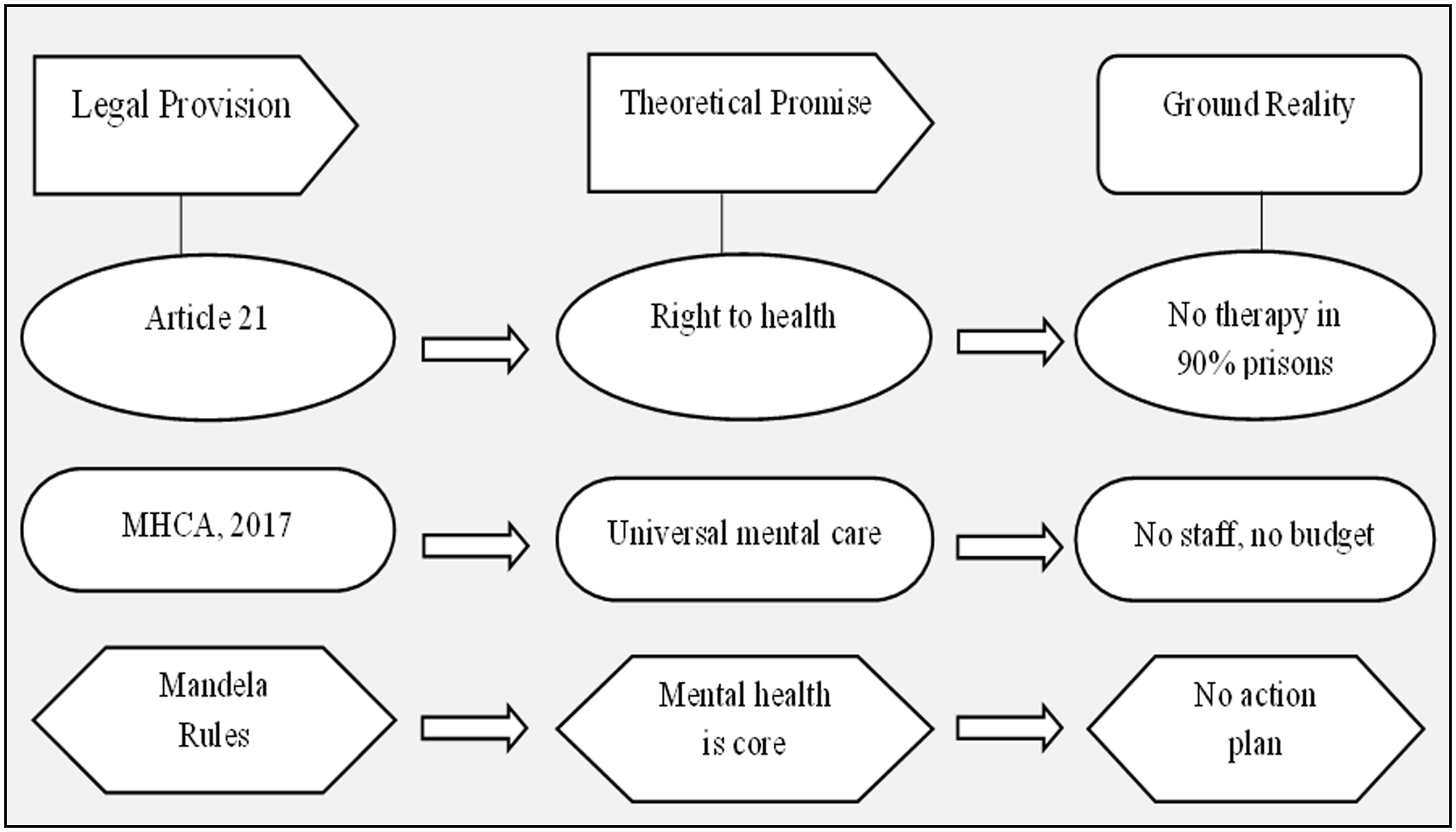
To show how deep this gap is, we can look at a framework (Figure 1) comparing what the law promises and what is happening:
-
Article 21 of the Constitution promises dignity and health, but most prisons still do not offer mental healthcare.
-
The Mental Healthcare Act, 2017 promises mental health services to everyone, but most jails do not have the staff, the budget or any structured therapy programmes.
-
State prison manuals mention health duties but do not define or include psychotherapy.
-
The Nelson Mandela Rules call for equal mental healthcare, but India has no plan to make this a reality.
-
NHRC reports highlight these problems, but no penalties exist for ignoring them.
Conceptual representation of legal–health disconnection. MHCA, Mental Healthcare Act.

This situation can be described through a powerful metaphor: “The Indian prison system is like a courtroom where the law reads poetry, but reality replies with silence. The Constitution may promise dignity, but the cells deliver despair.” It shows how hopeful words are met with total silence inside prison walls. Moreover, the problem is even more serious when we remember that over 75% of prisoners in India are undertrials, people who have not yet been found guilty by any court. Still, they are denied mental health support and kept in conditions that worsen their psychological state.
We can understand this disconnection in three layers. First, there is a paper disconnect, where laws like the Mental Healthcare Act, 2017 do not directly discuss prisons, even though they apply to all. Second, there is a policy disconnect, where state-level policies do not allocate money or staff for mental healthcare in prisons. Moreover, there is a practical disconnect, where prison staff lack the training, time or tools to provide or refer inmates for mental health support. In the end, while India has strong laws and global commitments on paper, prisoners continue to live in psychological darkness. Until these promises are backed by action, budget and accountability, mental health rights will remain only words, unheard and unanswered behind bars. Prisons are detrimental to mental health, and the beginning of reforms is an immediate need (Kumar and Daria Reference Kumar and Daria2013).
Global Promises, Local Silence: India’s Underplayed Duty in Prisoner Mental Care
India is a signatory to the United Nations Standard Minimum Rules for the Treatment of Prisoners, which was revised in 2015 and renamed the Nelson Mandela Rules (Ahmad et al. Reference Ahmad, Muktar, Yar’Adua and Ibrahim2019; Hailing Reference Hailing2019). These rules are not just international guidelines but represent a global standard for treating prisoners. They clearly state that prisoners should receive the same level of healthcare as people in the outside world, including mental health services. For example, Rules 24 to 27 stress the importance of giving prisoners proper medical and mental healthcare, Rule 31 says that solitary confinement should not be used on people with mental or physical disabilities, and Rule 32 adds that prisoners with mental illnesses should be moved to specialized treatment centres when needed (United Nations Office on Drugs and Crime 2016). These rules clarify that psychotherapy is not an optional service but an essential part of modern prison systems (United Nations Office on Drugs and Crime n.d.).
The United Nations Office on Drugs and Crime (UNODC) supports this idea. It works with many South Asian countries, including India, to improve prison health. According to the UNODC, mental health support is not just a small part of rehabilitation; it is central to it. In 2023, India participated in a regional consultation organized by the UNODC on prison health rights. During this event, there was a strong recommendation to include therapy for trauma, addiction treatment and group counselling inside prisons. The UNODC encourages prison systems to use a trauma-informed approach, introduce group therapy sessions and train prison staff to understand the mental health needs of inmates better.
Despite attending these meetings and agreeing to the Nelson Mandela Rules, India has made very little progress in practice. There is still no national policy that ensures mental healthcare or psychotherapy in jails. Most prisons do not have any mental health professionals, and there is no regular funding for mental health services in the prison system. Although India passed the Mental Healthcare Act in 2017, this law is barely followed inside prisons. India’s support for international rules is only on paper. There is a clear gap between what has been promised and what is being done.
To give a clearer picture, we can compare India’s situation with another developing country, South Africa. Both countries have faced challenges like overcrowded prisons and psychological trauma among prisoners. However, South Africa has made more visible efforts to address these problems. Its correctional facilities have psychology departments, and they offer group therapy sessions, anger management programmes and mental health screening for new inmates. For example, Pollsmoor Prison in Cape Town has a special mental health wing.
In contrast, Indian prisons mostly rely on general jail doctors who are already overworked. Psychological screening is not mandatory, and only a few states, like Kerala and Maharashtra, offer basic therapy programmes, mostly through non-governmental organizations. These efforts are not part of a wider government system; they depend heavily on outside help.
If we were to visualize this comparison, we could say that South Africa has a State-run system with a medium level of implementation and some innovative efforts. Conversely, India has no such policy, very low implementation and only small-scale efforts in a few regions. One could describe India’s signature on the Nelson Mandela Rules as ink on ice, visible at first but quickly fading away under the weight of systemic neglect. The main message is that providing therapy and mental health support to prisoners is not a luxury meant only for rich countries. It is a basic human need. For a democratic country like India, which often speaks of human rights and justice, ignoring mental health in prisons is a serious failure. Rehabilitation is not a foreign concept; it is a universal principle.
Case Snapshots – Forgotten Patients
In May 2023, a tragic incident took place in Delhi’s Tihar Jail, where a 26-year-old convict named Javed died by suicide. He was found hanging in the common toilet area meant for mulahiza inmates, a section for those needing medical attention or observation. His death points to the severe psychological stress faced by prisoners and the lack of proper mental healthcare inside Indian jails (Singh 2023). Another painful case occurred in June 2020 in Sathankulam, Tamil Nadu. A father and son, P. Jayaraj and J. Benicks were taken into custody for allegedly breaking COVID-19 lockdown rules. While in custody, they were brutally tortured and later died due to their injuries. This heartbreaking case caused national outrage and brought attention to India’s deep flaws in custodial practices. It showed how urgent it is to change how police handle people in custody (The Quint Reference Quint2020).
Alongside these individual cases, there are ongoing concerns about undertrial prisoners who suffer from mental illnesses. Many of these individuals remain in jail for long periods, not because they have been proven guilty, but because their trials are delayed. The National Crime Records Bureau (NCRB) reported a 22% increase in the number of mentally ill prisoners in recent years. Most are undertrials, people still waiting for their cases to be heard. With no proper mental health services available in many prisons, these inmates are often left untreated and forgotten (Raghavan and Rabiya Reference Raghavan and Rabiya2018). In 2023, the NHRC issued an advisory to address this serious issue. The advisory focused on preventing suicide and self-harm in prisons. Many jails still lack basic mental health support, and prisoners continue to suffer in silence. These cases and observations make it clear that prisoners struggling with mental health issues are often treated as invisible. They are forgotten patients in a system that rarely sees mental healthcare as a priority.
Policy Innovation – Making Therapy a Legal Standard
Indian prisons are more than just overcrowded spaces; they are silent rooms of pain where inmates often carry deep emotional wounds. Therapy in this context is not a luxury. It is a basic need and a constitutional right. If we cannot make prisons bigger, we must at least make them places of healing. In resource-poor settings, there is a need for practical, long-term mental healthcare models, and innovative peer-support programmes could be an effective way to support prisoners with mental health issues (Thekkumkara et al. Reference Thekkumkara, Jagannathan, Muliyala and Murthy2022). Few studies have highlighted the beneficial impact of interventions like yoga, exercise, music therapy, cognitive–behavioural therapy and third-wave psychotherapy on inmates (Maity et al. Reference Maity, Majumdar, Lal, Patra, Avti, Kumar and Anand2024).
One important step in this direction is to make psychological screening a routine part of the admission process, just like regular medical checks for diseases like tuberculosis or human immunodeficiency virus (HIV). Every new prisoner should be given a short and simple mental health check when they enter jail, and policymakers and society need to prioritize the mental health of inmates in India (Roy and Kumar Reference Roy and Kumar2023). This can help catch early signs of trauma, depression or suicidal thoughts (India Today Reference Today2023). The screening tool should be available in local languages, and it does not have to be done by doctors alone; trained nurses or social workers can manage it. To make this work across different states, the government can use help from District Mental Health Programs and use tablets or printed forms.
Another important idea is to introduce tele-psychotherapy inside jails. Since a few counsellors work in prisons, we can use video calls to connect inmates with mental health professionals from institutions like the National Institute of Mental Health and Neurosciences (NIMHANS), the All India Institute of Medical Sciences, New Delhi (AIIMS) or non-governmental organizations such as Sangath and The MINDS Foundation (Agarwal et al. Reference Agarwal, Manjunatha, Gowda, Kumar, Shanthaveeranna, Kumar and Math2018). This can be done using the existing video systems for court hearings. Depending on their needs, prisons can set up small digital rooms or booths where inmates can attend individual or group therapy sessions. Group sessions can focus on managing general stress, while personal therapy can be offered to inmates who are struggling more deeply (Math et al. Reference Math, Manjunatha, Kumar, Basavarajappa and Gangadhar2020). While some organizations work to rehabilitate prisoners and ex-convicts, there is a strong need for effective reformatory programmes to help them lead normal lives (Nanduri and Ram Reference Nanduri and Ram2021). Jail wardens, guards and even kitchen staff interact with inmates daily and are often the first to notice signs of mental distress. A short training course, just a few hours long, can help them identify signs like aggression, sleeplessness or isolation.
Instead of only focusing on jail time, judges should also recommend therapy, helping the person understand and change their behaviour. To make this a reality, we can update our sentencing rules or add mental health education for judges. Other countries already do this, using therapy orders like anger management or addiction counselling. India can learn from these examples. The referral process needs to be simplified, and authorities should be made aware of the Mental Healthcare Act, mental illnesses, and the need to include investigation and behaviour reports (Kumar et al. Reference Kumar, Viswanath, Sebestian, Holla, Konduru, Chandrashekar and Math2012). Undertrial prisoners still waiting for a verdict also need special attention. Many of them are first-time offenders or involved in minor crimes. They face high levels of stress, anxiety and fear, especially in the early days of imprisonment. These individuals should automatically be offered counselling sessions.
Individual interventions must be provided by systemic and structural reforms to address the specific challenges within the prison system (Ghosh et al. Reference Ghosh, Pillai, Vij, Maulik, George and Basu2025). There is a growing need to reform the mental health approach in prisons, with cognitive–behavioural therapy showing particular effectiveness for inmates (Gómez-Figueroa and Camino-Proaño Reference Gómez-Figueroa and Camino-Proaño A.2022). At the heart of all these changes is the idea of therapeutic prisoning. This approach treats a prison not as a place to store people but as a space to heal them. The model includes regular therapy circles, meditation or mindfulness sessions, and scheduled mental health check-ins using digital tools. It should be included in policy frameworks like the Model Prison Manual, 2016 (Ministry of Home Affairs 2016) and future prison reform plans to make it work.
Conclusion – Time to Break the Silence
Indian prisons are not just overcrowded buildings; they are places filled with silent pain, untreated emotional wounds and deep psychological suffering. Mental healthcare remains invisible, not practised, not prioritized and barely discussed. This is not just a missing piece in policy; it is a serious failure. Denying prisoners access to mental healthcare is not only unfair but also a violation of their basic human rights. It goes against the promises made in both our laws and international guidelines like the Nelson Mandela Rules. When we ignore the mental health of inmates, we take away their chance to recover and change. This is not about giving extra comforts, but about doing what is right.
At this point, we must ask ourselves some hard questions. Do we want our prisons to become places where people learn to heal or places where they fall deeper into damage and despair? Are we trying to reform people or punish them for longer periods without any support? These questions are not just about changing policies; they reflect who we are as a democratic country. As the saying goes, “When a country forgets its prisoners, it forgets its humanity.” India must now decide whether it wants a justice system that helps people rebuild or continues to break them. Therapy should not be treated as an optional extra. It must become a basic part of reforming our prisons, a tool for justice, a chance for healing and a true test of how seriously we value human dignity.
Acknowledgements
A heartfelt mention goes to Mr M. Vishnu, Mrs R. Renjitha and Mr G. Arjun for being the quiet constants behind every step.
Competing interests
No potential competing interests were reported by the authors.
R. Renjini has a strong background in criminology and is a doctoral student in forensic psychology at Kalasalingam Academy of Research and Education. She has secured three gold medals for her valuable contribution to the fields of criminology, victimology and forensic science. The author focuses more on criminological and psychological research, behavioural issues and mental health. In addition to recent advancements in psychology, she specializes in the application of psychotherapies and modern technologies to improve the mental health of individuals.
M. C. Janaki is currently an Associate Professor of Forensic Science at Kalasalingam Academy of Research and Education and holds a PhD from Mysore University. As a forensic practitioner, she is interested in a wide range of topics including psychological analysis, criminological thoughts, social studies, police administration, criminal law, analytical instrumentation and dactyloscopy. In addition to being awarded a junior research fellowship, she has published numerous scholarly works in reputed journals.
G. Arun Kumar is a research scholar from the Department of Criminology and Criminal Justice at Manonmaniam Sundaranar University, with primary research interests in cyber pornography, police and policing, cyber sexual crimes, criminal justice and cyber victimology. He emphasizes comprehensive sex education to prevent sexual crimes. Arun previously worked as a research assistant on an Indian Council of Social Science Research (ICSSR)-funded project. He has participated in and presented papers at several international conferences.