1. INTRODUCTION
In 1722, a state official summoned three women to the local court of Östra härad in southern Sweden. They were all said to be ‘young, able and in good health’ and as such, they were obliged to enter a contract of annual service. However, all three had been out of service of late, and the official consequently asked the court to investigate whether there had been any lawful reasons for this lack of compliance with the statute of servants. (The most recent statute had been promulgated in 1686 but this type of legislation had roots much further back in time.)Footnote 1
The first woman proved that she had been with the same master for twenty years, but claimed that she had needed to leave him the previous September to take care of her old and handicapped mother. (Late September, or Michaelmas, was the start and the end of the hiring year.) The court noted that she had paid her tax during this time and that she could support herself with spinning. While being temporarily out of service, she had not harmed the interests of anyone else, the court concluded, and the woman promised to go back into service the following September. The second woman had also been in service until the previous September at which point she had been asked to marry a soldier. At the time of the query the couple had entered into matrimony and the court concluded that she was no longer obliged to go into service. The third woman had for some time farmed a small plot of land owned by a local official, who certified that she had paid her share of the land tax. When the court convened, she had already entered a new service contract and consequently could not be fined.Footnote 2
Work is often discussed in terms of market forces like supply and demand, and women's work has not been an exception.Footnote 3 This case suggests, however, that what women did for a living in early modern Swedish society cannot be explained solely in these terms. For many people, there was no free market where they could offer their labour to the one who paid best; instead, various forms of labour legislation forced ‘young, able and healthy’ women to offer their time and bodies to local masters regardless of how attractive the position seemed. The same was true for ‘young, able and healthy’ men. The regulated nature of early modern economies needs, therefore, to be taken into account and its consequences investigated. It is, for instance, noteworthy that the rules could be used to harass women who were not so young anymore; the first woman had been with her master for twenty years. On the other hand, the case also suggests that there was room for negotiation and manoeuvre. Taking care of one's mother, supporting oneself without encroaching on the economic interests of others, and paying one's taxes were all activities that made at least this local court look more kindly on what was, strictly speaking, a breach of statutory law. There seems to have been a certain discrepancy between what the written rules would have us believe about ‘young, able and healthy’ people's work and what their daily practices actually looked like. And yet, two of the three women either promised to return to service or had already done so. Only one of them had escaped from the obligation to find a master: the woman who had entered into matrimony. This suggests that marriage probably had a profound impact on women's working lives.
This article looks at women's work, defined more broadly here as sustenance activities, in Sweden in the period 1550 to 1800 with a view to establishing and explaining major patterns. What did women do to support themselves, did they perform other sustenance activities than men, and what factors other than gender structured women's ways of making a living – these are the three empirical questions in focus. The broader purpose of the study is to make an intervention into the ongoing discussion about the factors that affected and structured the work of women and possibly men in early modern societies. We use Swedish evidence – a dataset of a little more than 12,000 observations of men's and women's sustenance activities from the Swedish realm in the period 1550 to 1800 – but the explanatory framework is not restricted by national boundaries. Just as in the example from Östra härad, all observations have been culled from court records. And, just as in the case from Östra härad, a major conclusion is that whether a woman was married or not was of fundamental importance to what her daily work consisted of. The distinction between the mistress (the married woman) and the maid (the unmarried woman), mattered at least as much as the gender distinction.
2. NEW PERSPECTIVES ON WOMEN'S WORK
The last decade has witnessed a surge of new research on women's (and men's) work in the pre-industrial period. Especially noteworthy are contributions by Dutch and English scholars.Footnote 4 These new studies have shown that practically all early modern women – unmarried, married and widowed – were engaged in various sustenance activities to support themselves and their families. Thus, assumptions in previous scholarship that women's labour-force participation was limited by bearing children, domestic duties, insufficient schooling, lack of bodily strength, and ideals of respectability have been refuted.Footnote 5 Even more noteworthy is the way in which these results seem to clash with early modern legal norms and official legal doctrine, particularly the ones related to marriage, such as coverture (in England) and guardianship (in Europe in general). Married women's formal legal capacity was more restricted than that of their husbands, and one would expect this to have prevented many married women from supporting themselves in ways that required legal capacity (such as trade). Yet, this now appears to be too rash a conclusion: married women's actual legal capacity varied and was often more extensive than previously assumed.Footnote 6 While the existence of gender-specific legal norms was a Sword of Damocles hovering over the heads of most women, the fact that the sword was not always used in the ways we might expect now makes for a more complex analysis.
The new studies have also stressed certain aspects and introduced novel questions. First, much early modern work was unpaid,Footnote 7 and it is therefore important to use methods that capture all forms of sustenance activity, not only participation in the paid labour-force. This is particularly pertinent for agrarian societies like the Scandinavian ones. Second, early modern economies were often regulated, for instance through guilds and other corporate structures, but it is far from self-evident that these regulations were enforced in the same way everywhere. Sheilagh Ogilvie's study of south-western Germany suggests that corporate restrictions were stark realities for many people in the seventeenth and eighteenth centuries, not least for unmarried women. In a similar way, Kekke Stadin shows that single women without burgher rights found it difficult to support themselves in Swedish small towns around 1700. Many of these women were servants. By contrast, Kirsi Vainio-Korhonen's analysis of Finnish Turku around 1800 suggests slack enforcement of guild restrictions.Footnote 8 Clearly, whether it was easy or difficult to support oneself in a lawful manner depended on gender, civil status, time and place. Third, the prevalence of more or less compulsory work must be taken into account, as the introductory case made clear. Even if young women were paid for their work as servants, they were not acting and negotiating in a free labour market, and their actual work behaviour cannot be explained in terms of free choice only.Footnote 9 One could argue, of course, that like coverture and guardianship, the statutes of service were Damoclean swords of little practical importance, but this needs to be studied empirically.
Fourth, it is important not to talk about women (or men) as a uniform group. Marital status, household position, age, social position, health and wealth were all aspects that may have affected what people could do for a living. Marital status has been shown to have had a particularly beneficial impact on the ways women supported themselves. Alexandra Shepard has argued that ‘marriage enabled women's productive work’, adding that this does not mean that marriage came without constraints for women.Footnote 10 Many women in trade were married, for instance, and the burgeoning urban luxury trade provides a particularly salient example.Footnote 11 Married women had a higher social status than the unmarried, making civil status into a distinction that cut through the gender axis.Footnote 12 In Laura Gowing's words, there was a ‘gulf’ between the married and the single woman.Footnote 13 These results do not sit well together with official legal doctrine – were not married women subject to coverture and marital guardianship? – but they support previous impressions that courts attended to women's marital status in erratic and not always transparent ways.Footnote 14
To sum up, it has been convincingly shown that everyone worked, men and women, married and unmarried. Not everyone performed paid work, however, and even among those who were paid, it is not always relevant to think of them as operating in a free market situation. We need to know more about how institutions – marital law, guild legislation, labour legislation – affected people's ways of supporting themselves since, clearly, variation was large. Married women's capacity to act on their own, for instance in trade, seems to have been more pronounced than once assumed. To achieve these research objectives, we need to find out more about what people actually did to support themselves and about the factors that explain patterns and regularities.
3. SWEDEN IN COMPARATIVE LIGHT
The evidence presented in this article concerns early modern Sweden, a country with a much more rural character than England and the Netherlands at the same time. Contrary to the German-speaking area studied by Ogilvie, Sweden's rural economy was largely unaffected by guild structures. Sweden constitutes, therefore, a case somewhat different from those described above.
In a discussion of people's sustenance activities in early modern Sweden, two circumstances are particularly pertinent: population density and the prevalence of war. In the period 1600 to 1800, no more than c. 7–10 per cent of the Swedish population lived in cities or towns.Footnote 15 Towns were generally small and urban growth was slow; in 1800 most towns still had less than 2,000 inhabitants.Footnote 16 Population density remained low throughout the early modern period. According to Lennart Palm's calculations, 85 per cent of the rural parishes had fewer than 10 inhabitants per square kilometre in 1571, and despite population increase, there were, on average, only 4 persons per square kilometre in 1751.Footnote 17
The Swedish agrarian economy was characterised by mixed farming – crop production alongside the rearing of livestock – in combination with other sources of income such as fishing, mining, handicraft or peddling. Life in towns was characterised by pluri-activity too. Many artisans and merchants combined burgher occupations with agriculture, accentuating the rural character of Swedish society. Combined with the scattered settlement structure indicated by the above figures on population density, with small hamlets and/or farms with no close neighbours, this diversified economy probably necessitated a flexible division of work.Footnote 18 Even if some tasks were female-gendered, this would have carried little weight in a situation where, for instance, the women of the house were ill and the neighbouring farms too far away to make it possible to call for female help. A flexible gender division of work is likely to have been even more imperative due to the many wars fought during this period; between 1560 and 1721, Sweden had only 50 years of peace and this had far-reaching repercussions on the demographic situation. According to calculations made by Jan Lindegren, about 30 per cent of all adult Swedish men died in wars during the period 1620–1719. In such situations there had to be ‘mechanisms for different sorts of catastrophes', Lindegren argues, and a flexible division of work was such a mechanism.Footnote 19
Guilds were not negligible but of less importance than in other European regions. More pertinent than corporate regulations were codified laws and other rules laid down by the state. Of special interest, for our purpose, are the statutes of servants that were promulgated in 1664, 1686, 1723 and 1739, but with roots stretching back to the Middle Ages.Footnote 20 Men and women who lacked burgher rights (in towns), land (in the countryside) or were otherwise without sufficient means to ‘support themselves year-round without harming the interests of others', as the statute phrased it – an idea in affinity with the ideology of the guilds – were threatened with military service, hard labour or fines if they failed to enter a service contract. It was incumbent on the provincial governors to check that no one from the eligible group evaded the duty to go into service – we saw the effect of this in the state official who kept a list of all young, able and healthy people in Östra härad – and the statute of 1739 mentioned the use of informers to spot any young people liable for service either hiding in their parents' homes or living clandestinely as inmates in other people's houses. Employment as a servant was to be for a full year. Although the statutes did not stipulate nationwide wage levels for servants, they ordered that wages be regulated within each province. Eighteenth-century statutes also restricted the numbers of servants who could be employed at farms and introduced restrictions on the mobility of servants from some provinces.
Servants were generally young – in their teens or twenties – and unmarried. In this sense, Sweden fits the European marriage pattern described by John Hajnal: service was typically a life cycle phenomenon, marriage happened late in life and was linked to becoming head of household, and a high proportion of the adult population was unmarried.Footnote 21 Available data support this picture. In 1750, when national population statistics begin, 35 per cent of all women over the age of 15, and 36 per cent of all men, were unmarried, and 10 per cent of the women and 5 per cent of the men in the age group of 45–9 were still not married.Footnote 22 No national data on age at first marriage exist until the second part of the nineteenth century – when it was 26–7 for women and 28–9 for men – but most findings indicate a similar pattern in earlier periods of time.Footnote 23
This marriage pattern allowed labour legislation to affect young people from all social groups, except the few percentages that made up the uppermost echelon of Swedish society. Very importantly, the legislation also affected older people with no means. They too could be forced into service. It is reasonable, therefore, to assume that marriage and labour legislation were institutional factors with a strong impact on what women, and men, did to make a living.
4. THE VERB-ORIENTED METHOD
The ways people make a living can be expressed with the help of occupational descriptors, ‘titles’ or, put even more simply, nouns: farmer, carpenter, bailiff, etc. Such descriptors can be found in many historical sources, and are useful for many purposes, but for the purpose of studying a country like Sweden, they are problematic. First, occupational descriptors were unevenly distributed in the population: men appear with occupational descriptors more often and with greater variety than women. The occupational terminology also seems to have been more varied in urban than in rural areas. Second, occupational descriptors can fool us into believing that people did one thing only. As was pointed out above, Swedish society was characterised by multiple employments. People did different things for a living, and if they had an occupational title – which many people did not – we cannot be sure that it captured the full range of activities that were necessary to support a household.Footnote 24
Third, words change meanings, and this is true for occupational descriptors too. For example, a skinner could be an occupational descriptor in eighteenth-century London, but a skinner could also support himself as a butcher or a clockmaker while at the same time belonging to the guild of skinners.Footnote 25 In a similar way, spinster used to be an occupational descriptor (a woman who spun) but it then turned into a marital status descriptor (an unmarried woman). There are several Swedish examples of such fluidity. The word bonde today means farmer and it is without any doubt an occupational descriptor. Bonde may also appear as an occupational descriptor in early modern sources, but usually, it was a social group descriptor (cf. yeoman), signalling to which of the four social estates a person belonged. Piga was an ambiguous descriptor in early modern society. Today, it is an (uncommon) occupational descriptor designating a female servant, but in the early modern period piga designated a woman who was young and/or unmarried and/or worked as a servant (cf. maid).
Consequently, occupational descriptors work less well as indicators of people's work in early modern Sweden. As an alternative, we have collected data on what people were actually doing. Instead of nouns, we look at verbs; a method we have developed and refer to as ‘the verb-oriented method’. This approach captures both work in the narrow sense of the word and other sustenance activities.Footnote 26
English research has used the possibilities offered by church court records where the person appearing at court was asked how and by what means they got their living and were maintained. This question yielded information on how people identified themselves and the answers could take the form of both descriptions of activities (verb phrases) and descriptors (nouns).Footnote 27 There is no parallel to this source type in Sweden, but there are many court records from different levels of the judiciary.
Sheilagh Ogilvie has designed a method that looks at early modern time-allocation. Focusing on a relatively small region in south-western Germany for a period of approximately 150 years, she collected a large dataset of men's and women's work activities (more than 2,800 observations) described in court records. The data were qualitative, but the large number allowed Ogilvie to turn ‘quality into quantity’ and discern major patterns. This dataset was also combined with and checked against other types of data on, for instance, the demographics of the area under study.Footnote 28
For this study, we have used an even larger amount of qualitative data with a view to establishing quantitative patterns. As in Ogilvie's study, the core data consists of verb phrases: thousands of expressions like ‘fish herring’, ‘milk’ and ‘carry a sack of flour’.Footnote 29 Each observation consists of one verb phrase, at least one person who performed the activity, plus additional contextual data. The data have been collected, analysed and stored in a freely accessible online database.Footnote 30 While the database contains observations from several types of sources, this study uses only court documents as these exist in consistent form over time and space. Of all sources that we tested, the court material was also the one that included the widest variety of activities and captured the broadest range of people. It is true that Swedish court records have a bias in so far as they include many cases of thefts, land transactions and administrative work. On the other hand, they include information about unpaid work, which, for instance, accounts do not. It is also important to know that Swedish courts were all state-controlled and not as specialised as (for example) English courts were.
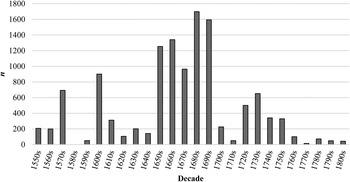
Verb phrases have been collected from courts in several local communities. The advantage of this sampling strategy is variation. The sample consists of 12,231 observations collected from town and countryside, different regions, different points in time and different levels of the judiciary.Footnote 31 2,433 of these, or 20 per cent, were performed by women. Figure 1 shows how the observations are spread across time.
Number of observed sustenance activities in Swedish court records, 1550–1800, per decade. Source: GaW 2014.

Needless to say, this sampling procedure does not fulfil the demands for testing for statistical significance since the observations do not constitute a random sample of people drawn from the same population. The different source materials used in this study have survived in ways that are far from random. Further, it is impossible to give in advance every person ending up in the database the same chance of being drawn into the sample. We will, as a consequence, not be able to generalise estimated differences of proportions based on our data to any larger population based on statistical significance. We may, however, assess the reasonableness of the results in relation to what else is known about work, household structure and gender relations, among other things, of the time period in question, as historians usually do when the information is incomplete with unknown biases.
Among the contextual data, information on gender and marital status of the persons who performed the activities was deemed particularly important. Information on gender was present in most cases, but when the performers of the activity were described as a group (‘the local people, ‘people of the village’, ‘they’, ‘we’) gender was registered as unknown. As in the case of occupational descriptors, marital status descriptors were unevenly distributed in the population: men typically appeared less often with marital status descriptors than women.Footnote 32 For this reason, men will be left out of the latter part of the analysis. Some marital status descriptors have also been shown to change meaning over time, just as occupational descriptors have. Thus, Swedish hustru (wife) has been shown to mean not only married woman but also ‘a woman who is in a governing position’.Footnote 33
The study presented here is not a time-budget analysis in the narrow sense of the word. Thus, the method does not allow us to say anything about the extent to which a person devoted his/her time to the activity in question. We cannot pinpoint whether a woman who sold vegetables did so part-time, full-time, seasonally or merely occasionally. What our analysis of verb phrases shows is not time-use, as modern economists use the term, but repertoires of work practices and how these repertoires varied according to factors such as gender and marital status.Footnote 34
5. CATEGORISING ACTIVITIES
The 12,231 observations have been categorised according to what type of activity the verb phrase describes.Footnote 35 The categorisation was inspired by a discussion by Sheilagh Ogilvie and A.W. Carus on the relationship between the empirical language of the historical sources and the meta-language used by historians. Ogilvie and Carus advocate that historians create some kind of in-between level that takes into account both the source-level language and the meta-language.Footnote 36 This idea was implemented when we reformulated each excerpt from an original source, in early modern Swedish, as a verb phrase in modern Swedish, all of which were then put into one of 16 categories. None of this was done mechanically but manually and with due attention to the specificities of the case in which each activity was mentioned. While, for instance, ‘grow cabbage’ was easily categorised as agriculture, ‘demand payment’ was more difficult to categorise. This latter verb phrase does not in itself talk about work or ways of supporting oneself, but from the context, it was often clear that the phrase reflected an activity that would definitely qualify for inclusion in the dataset: people demanded payment for food and accommodation they had sold, or an object (tobacco), or a service (carpentry). They also asked to have loans repaid and, in one case, a person asked for indemnity. Depending on the context, ‘demand payment’ had to be categorised as food and accommodation, trade, credit, or administration and justice.
As these examples illustrate, verb phrases are in themselves extremely heterogeneous. Some phrases are similar to occupational descriptors: ‘work as shoemaker’, ‘serve as soldier’ or simply ‘serve’. Other phrases might be said to express property relations: ‘possess a farm’, ‘have a cow’, ‘lease a meadow’. Still others describe momentary actions, like ‘feed a horse’, ‘sweep the floor’, ‘write a letter’. Many times, these distinctions are not as simple as they may first appear. ‘Selling beer’, for example, is that an ongoing activity – an occupation – or something that only happened then and there? ‘She was spinning’ is another example: does it suggest that this was how she generally spent her days or does it capture an unusual activity?
While most of our 16 categories are relatively straightforward, two require special comment. First, some verb phrases were difficult to categorise because they contained too little information in themselves and the court record did not supply sufficient complementary data. ‘To serve’ and ‘to work’ are examples of such phrases, and they have all been put into the category unspecified work. Second, some verb phrases were difficult to categorise because they contained too detailed information and the court records did not clarify what the larger context was; they have all been put into the category other specified work. ‘Use horse’ is an example of such a phrase. It could theoretically be classified as agricultural work or transport work or, if the user of the horse was a bailiff, as administrative work. When the context is scarce, we simply do not know. Together, unspecified work and other specified work made up 955 observations, or approximately 8 per cent of the whole dataset.
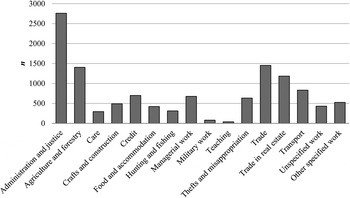
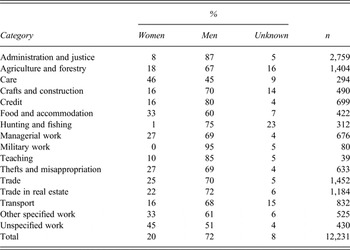
Table 1 presents the whole dataset, grouped according to the 16 categories. In the following analysis, each category will be looked into in greater detail. Figure 2 shows how well court records capture various forms of sustenance activities. There is variation, but no type of sustenance activity is completely left out and it is reasonable to argue that any type of activity could in principle be reported.Footnote 37
Number of observed sustenance activities in Swedish court records, 1550–1800, grouped by category. Source: GaW 2014.

Sustenance activities in Swedish court records 1550–1800, grouped by category and gender

Source: Gender at Work (GaW) 2014 dataset, available at http://gaw.hist.uu.se
6. WOMEN AND MEN IN ALMOST ALL TYPES OF ACTIVITIES
Table 1 shows all observations (verb phrases) grouped according to gender (woman, man, unknown) and according to the 16 categories of work. On average, 8 per cent of the observed activities could not be grouped according to gender, often because the historical documents describe the performer as a group of people and do not make clear if that group is gender-mixed or, if not, if it consists of men or women. Four categories are particularly conspicuous in that they show much higher shares of unknowns, namely craft and construction, agriculture and forestry, transport and fishing and hunting. This does not come as a surprise: these were activities where one would expect teamwork to be common. On the other hand, credit is a type of activity where the share of unknowns was visibly lower than average. This was also expected: in credit transactions, it is important to know exactly who has extended credit to whom, and the likelihood that the creditor would be described as a nebulous group is small.
Table 1 shows that we find both women and men in 15 out of 16 categories. Only in one category – military work – were there no tasks performed by women,Footnote 38 and there was no category where men were completely absent.
In some categories, women appear often and that was also what could be expected. This is true for food and accommodation, care, other specified work and ‘unspecified work’, which often meant service. In other categories, however, the large number of female-performed activities is more surprising in view of the fact that women had less legal authority than men and that, in learned discourse, women were often described as unfit to govern.Footnote 39 Contrary to these assumptions, women were conspicuous in trade, trade in real estate and, not least, managerial work. This latter category includes women who, for instance, employed servants, were responsible for butter production, scolded boys, asked others to have pigs put into a pen, paid wages, ordered male servants to transport grain and female servants to run errands.
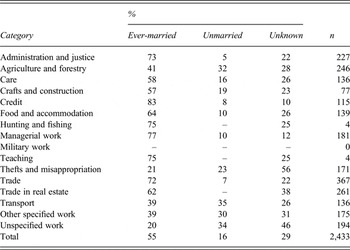
Women were conspicuously less visible as performers of administrative work and more visible among those who engaged in criminal activities. On the other hand, it is noteworthy that women did indeed perform tasks that had an administrative character. There are 227 observations of such activities in the dataset, 75 of which were definitely carried out by a married woman with a living husband and 11 of which were carried out by an unmarried woman. Thirty-five activities were carried out by definitely widowed women and in 56 cases the female performer of the activity was described simply as ‘hustru’, without any further detail on her husband.Footnote 40 These observations speak to the point, made in previous research, that married women's legal capacity and scope to manoeuvre was probably larger than expected. According to the Swedish legal code, only widows would have had full legal capacity, but the court records do not convey the impression that this distinction was heeded. Women of differing marital status accused others of theft and illegal fishing, swore oaths, demanded compensation, inspected victims of crime, paid excise, asked for payment and for inheritance, and asked for cases to be reconsidered.
Figure 3 presents these patterns graphically. It compares the distribution of activities performed by women and by men respectively among the 16 categories (activities that could not be grouped according to gender have been excluded). It shows that men and women had similar profiles in terms of sustenance activities.
Distribution (in percentage) of sustenance activities performed by women and men respectively, by category. Source: GaW 2014.

This gives additional support to the argument about flexibility, made in previous Swedish historiography. With the exception of military work, no category was one-sex only and, therefore, the notions of gender specialisation and separate spheres are clearly inadequate. Both women and men were involved in many types of sustenance activities. This, in turn, is an indication of flexibility. The result adds a new dimension to Judith Bennett's claim that lack of specialisation was typical for women's work in the past.Footnote 41 Looking at the spread of men's and women's sustenance activities, the gender difference appears less striking. Both men's and women's work was unspecialised and characterised by multiple employments.
Like Bennett, Sheilagh Ogilvie has described women's work as highly flexible and while she regards this flexibility as something that lubricated early modern economic life, she adds that the ‘obverse of women's flexibility was their exploitability’.Footnote 42 In Ogilvie's analysis, the exploiting party was male-dominated social networks. In the Swedish countryside guilds did not play the same role as in the German-speaking area. More fundamentally, men too were affected by the need to be flexible. Moreover, as will be shown in subsequent sections, some women were in a position where they could benefit from, or even exploit, the work of others.
7. INSIDE THE BOXES: WOMEN AND MEN ON THE LEVEL OF VERB PHRASES
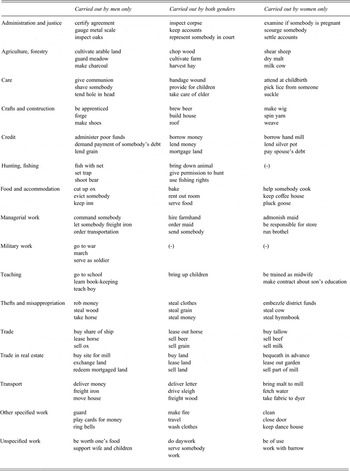
Women and men were thus similar in terms of what they did if we look at how they appear in the 16 categories. This does not mean, however, that gender was not at all a factor that structured working life. To appreciate this, we have to look closer at the verb phrases found in each category. Table 2 shows that while each category included some activities that were common to both women and men, each category also included activities that were carried out only by women or only by men. The somewhat heterogeneous content of each category illustrates that women and men were both similar and at the same time different in terms of what they did for a living.
Examples of sustenance activities/verb phrases in each category

Source: GaW 2014.
Agriculture provides an example of clear gender difference but also gender confluence. Milking of cows was an activity that was never mentioned as being carried out by men in the dataset, and this is also consistent with what we know from literature.Footnote 43 On the other hand, tasks such as ‘chop wood’ and ‘harvest hay’, as well as the buying and selling of land, were carried out by both women and men.
8. THE DIFFERENCE BETWEEN EVER-MARRIED AND UNMARRIED WOMEN
We will now look at the effect of marital status upon sustenance activities. Marital status was given much more often for women than for men in the Swedish court records. In this dataset, only 15 per cent of the men were given marital status descriptors. By contrast, 71 per cent of female performers of activities had some form of marital status descriptor. Consequently, the analysis will concentrate on the effect of women's marital status.
To the discussion of women's marital status and its importance, the word ‘hustru’ is crucial. As was pointed out above, ‘hustru’ was an ambiguous word in early modern Swedish. It could be used for women whose husbands were alive, but it could also be used for women whose husbands were dead, that is, for widows. There are no indications that ‘hustru’ could be used for a woman who was not or had never been married.Footnote 44 In the following analysis, we will treat ‘hustru’ as meaning ever-married woman, in contrast to unmarried woman. It is important to bear in mind however, that ‘hustru’ could also function as an occupational descriptor of sorts. It seems to have referred to an adult woman who was capable of assuming responsibility and of governing others. This meaning came to the fore in cases where work was the central issue.Footnote 45 This is in line with recent results for England where some of women's sustenance activities clearly ‘lent occupational connotations to the term “wife”’.Footnote 46
In general, Swedish court records describe women and men as individuals belonging to kin groups rather than as holders of occupations. This is probably the effect of the importance ascribed to land ownership by the judiciary. In other cases, whether a woman was married and to whom she was married seems to have mattered less. Swedish women did not change their patronymics upon marriage but retained their maiden names throughout their lives. It could be very important to know who her spouse was, but it depended on the type of legal case she was involved in, as Gabriela Bjarne Larsson has shown in her analysis of medieval land transactions. As purchasers of land, women rarely appeared with any sort of descriptor, only with their names. As sellers of land, the pattern was more complex. Many female sellers of land were only described with their names, but sometimes they had an epithet like widow or ‘hustru’. Bjarne Larsson concludes that it mattered from which kin group the land had descended. Thus, when a woman sold land on behalf of her children, who had inherited it from their father, the mother would be described as a widow.Footnote 47
Against this backdrop, it should come as no surprise that a dataset, compiled with a view to mapping sustenance activities, does not have complete coverage for marital status. Therefore, the fact that marital status was given for women in approximately 70 per cent of all observations must be described as quite satisfactory. For as many as 1,738 observations, the woman was described as either ever-married or unmarried. Among the ever-married, it was explicitly stated in 840 cases if the woman was married or widowed, but in the remaining 498 cases the descriptor was simply ‘hustru’. Whether the scribe primarily wanted to say something about these women's marital status or about their capacity to take responsibility is unclear and would have to be investigated for each individual case.
We often know the marital status of the women who did managerial work or were engaged in credit transactions: they were usually ever-married. On the other hand, trade and trade in real estate had higher shares of unknown marital status, and so had thefts and misappropriation. Once again, what the case is about seems to have had an impact on whether marital status was mentioned or not. For trade in real estate, the figures confirm Bjarne Larsson's results that, for reasons sometimes obscure, marital status was not always noted for women involved in land transactions. For thefts and misappropriation, a possible reason for the lack of information could be that women who were thus apprehended wanted to conceal their identity as much as possible.
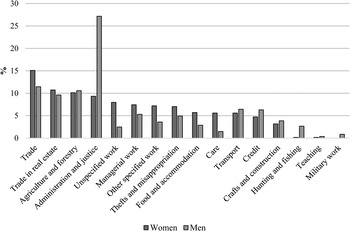
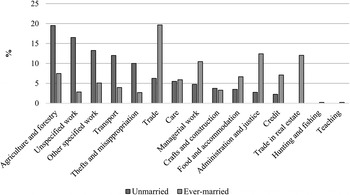
We find both unmarried and ever-married women in almost all categories, the only significant exception being trade in real estate. More striking, however, are the differences between ever-married and unmarried women's activities that Table 3 and Figure 4 display. Put simply, unmarried women seldom carried out activities that ever-married women often did, and ever-married women more seldom performed activities that unmarried women commonly did. Ever-married women were much more visible in administrative work, managerial work, trade in real estate, general trade and credit transactions. Few unmarried women were observed performing tasks in these categories. On the other hand, married women were relatively inconspicuous in categories such as unspecified work, agriculture, transport, other specified work, and theft and misappropriation. In these categories, the unmarried women's presence was more pronounced. Finally, ever-married and unmarried women appeared in crafts and construction and care to approximately the same extent. If Figures 3 and 4 are compared, we see that while the profiles for men and women are very similar, the profiles for ever-married and unmarried women do not coincide at all. Put in a simplified way, the work of the ever-married woman can be described as the opposite, or the mirror image, of the work of the unmarried woman.
Distribution (in percentage) of sustenance activities performed by unmarried and ever-married women respectively, by category. Source: GaW 2014.

Women's sustenance activities in Swedish court records 1550–1800, grouped by categories and marital status

Source: GaW 2014.
At the inception of this article, we pointed out that marital status influenced the ways women supported themselves in early modern society, and that this impact was often beneficial, rather than negative, for married women. The reason for this was that women gained many forms of resources through marriage that they did not have previously. The activity pattern found for married women in early modern Sweden strongly supports this view of early modern marriage. Often, the married woman had resources at her disposal that allowed her to do things unmarried women seldom could do: she could engage in trade activities, sell land (mainly if she was a countrywoman), provide accommodation and food in her home, and make any surplus capital useful by lending it out. The married woman was also co-head of household and in that capacity she would represent the household in public and do various forms of ‘everyday administration’. Finally, she managed the work of others, telling them what to do. In this way, she alleviated her own work.
Marital status also had a profound influence on the ways unmarried women supported themselves, but the impact was more negative in their case. They lacked many of the resources that were essential for survival in early modern society, and the statutes of servants forced them to offer their labour and time to local masters and mistresses. Unlike unmarried women in England,Footnote 48 they seldom seem to have had a surplus that they could make profitable in the credit market; this was probably a reflection of the precarious situation of servants who often had to wait for their pay for long periods of time. Often, this work was poorly described in the sources and, when mentioned at all, was phrased as ‘serving’ or ‘working’. Such nondescript work was paid for, but it was not freely offered and negotiated. The compulsory work of unmarried women was the prerequisite of the, relatively speaking, privileged situation of married women. These interlocking relationships are reflected in Figure 4.
In many ways, our results are in agreement with the ones presented in Ogilvie's study of southern Germany. In Württemberg, there was a clear difference between the work of young women in dependent positions (maidservants and unmarried female offspring) and that of ever-married women. The former group was most visible in agricultural work and ‘marginal work’.Footnote 49 Their work was quite similar to that of young dependent men, with the important exception that men were more visible in guild-regulated activities. Married women's work was somewhat more focused on domestic activities and care work, but these tasks did not characterise their work in general. Instead, the main characteristic of married women's activity pattern was that it was much broader than that of unmarried women. Their work involved mobility and demanded physical strength, knowledge and skills. Widows' work was similar to that of married women and significantly different from that of dependent unmarried women. However, like the unmarried women and unlike the married ones, widows were excluded from work monopolised by guilds.Footnote 50
The main reason for these similarities was obviously the role played by marriage in both early modern Sweden and early modern Württemberg, and probably, in most of early modern Europe. Through marriage, both men and women obtained the role of head of household, and this role in turn conferred a number of resources on them: access to land, access to qualified forms of work, access to social status, access to formal and/or actual legal capacity, and access to direct or indirect political influence. Not least, marriage put both women and men in a position where they could use the labour of other people for their own benefits. In general, these people were young and unmarried. Consequently, the effects of marital status, household position and age would often coalesce: young people were married less often than elder people, and young people would also be heads of household less often than elder people.
9. MISTRESS AND MAID
As we have shown, marriage exerted a profound influence on people's lives in early modern society. The regularities that we do find in women's often flexible work behaviour should be ascribed at least as much (if not more) to marital status, age and household position as to gender. It is likely that marital status also had such an effect on men's work behaviour. We will come back to that in another context, but one obvious reason for assuming that men and women were alike in this respect is the fact that they were all affected by the same statutes of servants. Young people and people of small means were compelled to go into service: they could not choose not to work, and they could not choose which type of work contract they preferred. By forcing young people and people with small means into service, these statutes created and reinforced relations of power between generations and between people of different social status. And they put considerable power into the hands of heads of household, be they men or women. That female heads of household could devote their time to managerial and administrative work, and that they could engage in income-generating trade activities, was to a large extent the effect of their state-sanctioned deployment of other people to do forms of work the mistress did not have the time or inclination to carry out herself, such as look after goats, carry a sack of malt, sweep the floor or heave manure, to name some of the verb phrases in our dataset that describe the tasks done by female servants. As has been stressed by Margaret Hunt and others, the agency of some women was increased at the expense of other women.Footnote 51 When these mostly intergenerational relations did not work as smoothly as they were supposed to, they would end up in court and thus become visible to the historian.
One example of this is when the maid Elisabeth Joensdotter was summoned to court by her mistress. Taking care of children was a form of work that would often be entrusted to female servants, and this may have included care for apprentices. Thus, Elisabeth Joensdotter had given an apprentice boy some butter, and because of this her mistress subsequently refused to give her a full wage. This did not come as a surprise to Elisabeth who had been reluctant to give the boy what he wanted, saying ‘I dare not, mother will scold me if I do’. The use of the word ‘mother’ for her mistress and the domestic character of Elisabeth's work are both evocative of the family context in which many female servants worked, but the case was adjudicated in public and Elisabeth – backed up by a former employer – successfully received her wage.Footnote 52
Other female servants did physically hard work. This was true of Anna Maja Hård who carried a sack of malt from her mistress's home to the mill at a time of the day when customs officials were not on duty. Thus, the mistress used her maid as an instrument for tax evasion, and apart from the ordeal of carrying the heavy burden, this mission also exposed Anna Maja to the risk of being arrested.Footnote 53
The cases illustrate the vulnerability and dependence that characterised a maid's relationship to her mistress. More research is needed on service and on the statutes and their effects, however. The legislation does not seem always to have been applied in a rigid manner. Courts did listen to the grievances of servants, or their relatives, and when state officials tried to enforce the statutes, as we saw in the beginning of this article, they did pay attention to the arguments adduced by the accused: that she had taken care of her mother, that she had spun, that she had paid her taxes, and so on. The statutes themselves included words about the responsibilities of masters and mistresses to treat their servants fairly. On the other hand, state officials and heads of households were able to apply the statutes with discretion, treating people who were in fact no longer young but out of work as a source of cheap labour. Our results indicate that service, the social phenomenon regulated by the statutes, had a strong impact on what types of work tasks men and women carried out: in our sample, those who were liable to go into service generally did other things than those who were not liable to do so.
10. CONCLUSION
What did women do to support themselves in early modern Sweden, did they perform other sustenance activities than men, and what factors other than gender structured the ways women made a living – these were the three questions posed in the beginning of this article. The short answers are, first, that women could be observed carrying out all types of work except military tasks. They were obviously flexible, as previous research has assumed, but the same was true for men. Whether flexibility was a sign of vulnerability or a strategy for coping with complex situations is a matter that requires further discussion, but that discussion must take into account that flexibility itself was not gendered as female. Second, while men and women could be observed in all categories except one, it would be disingenuous to claim that gender did not matter at all. On the level of concrete tasks, or verb phrases, rather than categories, there were both differences and similarities between men and women. This raises an important methodological point: the effects of gender can vary depending on the level of analysis. Third, marital status exerted a strong influence on women's work, creating a clear distinction between the unmarried and the ever-married. Of course, marital status was intimately linked to age and household position, and it was probably the combined effect of these three factors that put its imprint on women's everyday activities.
Our results are highly similar to the ones presented by Sheilagh Ogilvie in her study of an area in German Württemberg. In both cases, marriage was an institution that conferred a number of valuable resources upon spouses. Unmarried women and men, on the other hand, were subject to both compulsion and exclusion. Unless they possessed such means as to make them economically independent, unmarried women and men were at the same time both forced to work and excluded from many forms of work. Clearly, choice was seldom something they could exercise.
The mechanisms behind compulsion and exclusion were similar but not identical. While everyone in the German area seems to have been deeply affected by the presence of guilds and local community institutions, their influence in Sweden was, broadly speaking, more limited. Only a minority of the population lived in cities and towns, where guilds operated, but a large share of the population was affected by compulsory labour legislation. At the root of both guild legislation and statutes of servants was, however, the outlook associated with corporatist societies: people were regarded less as individuals and more as members of different corporations and they enjoyed, or were barred from, resources depending on their membership in these corporations. Members of one corporation were not allowed to encroach upon the resources of another corporation. An idea of this kind was expressed in the statute of servants in that they only allowed women to support themselves in ways that ‘did not harm the interest of others’.
In most parts of early modern Europe, life was highly regulated, not least economic life. Institutions such as marital law, labour law and guild law put their imprint on people's everyday lives. The patterns of women's sustenance activities were shaped more by such institutions than by unchanging, universal phenomena like childbearing and childcare duties. Institutions were neither uniform nor consistent, however. Many different rules affected various but interlinked aspects of life and it is often difficult for the historian to assess their combined effect. Our focus on how practices were structured clearly suggests that in Sweden some rules had more impact than others. While stipulations in family law impinged less on married women's capacity to act in economic life than might be expected, labour legislation seems to have had a massive impact on the life of unmarried women and, very likely, unmarried men.
Filled with work, early modern women's daily lives were significantly affected by whether they were unmarried or ever-married; this distinction was more important than the legal distinction between widows and all other women. To get married was a way of escaping the forms of compulsion and exclusion that affected young people. This does not mean that marriage was heaven to early modern women. Indeed, the lack of attractive options other than marriage is an important theme in the gendered history of work. Yet, in a society where access to land and other resources were relatively widespread, marriage brought the hope of something better. Marriage could transform maid into mistress. Having become a wife, the second woman mentioned at the beginning of this article at least did not have to go back to working as a maidservant. Instead, she may have been able to transfer the heaviest and most boring tasks to her own maid.
ACKNOWLEDGEMENTS
The authors extend their warm thanks to Amy L. Erickson, Erik Lindberg and the anonymous reviewers for valuable comments.