In the decades after the Revolutions of 1848, the Viennese medical community discussed the enactment of a prostitution regulation program that would bring public women under medico-police supervision to prevent the spread of venereal disease.Footnote 1 These measures formed a part of a broader sanitation campaign against the spread of infectious diseases among the swelling urban population in Vienna. The physicians of the Second Vienna Medical School were at the forefront of this urban sanitation campaign.Footnote 2 MaidservantsFootnote 3 featured prominently in discussions about prostitution regulation as they seemed to form a large contingent of arrestees in police prostitution records.Footnote 4 Physicians and police officials in Vienna branded female servants as threats to the health and morality of bourgeois families. They repeatedly prescribed regulation for this swelling class of migrant women, numbering 86,500 in 1890 and 91,000 in 1900.Footnote 5
I argue that the high incidence of female servants in vice police records reflected the ease of collecting data on maidservants due to a preexisting police surveillance system that monitored these women. The Vienna Servant Code of 1810 created a legal system that associated servants with “immorality,” “debauchery,” and “fornication.” The 1810 Code established a system of police surveillance of female servants more so than of any other occupational group. Consequently, medical experts could conveniently refer to existing surveillance data about these women to justify extending prostitution regulation to them. Police officials drew upon the existing rhetoric in the judicial language of the Servant Code that branded maidservants as prone to “promiscuity,” “immorality,” and “fornication” and produced statistical data suggesting that a significant portion of women engaged in selling sex were maidservants. There were some discrepancies in the data they produced. Until 1885, police officials classified most working-class women in Vienna, except for some female factory workers, under the nonspecific category of servants. Therefore, the vice police recorded the concomitant or former occupations of most women as domestic service irrespective of what their actual job descriptions entailed. Notwithstanding the problems in data collection, maidservants continued to be convenient targets for medico-police surveillance through the turn of the century.
The Maidservant as a Vagrant
In the eighteenth century, on account of some imperial policies that suggested as much, aristocrats and the emerging bourgeoisie began to characterize servants as a group of people particularly prone to vagrancy. For instance, in 1712, as part of measures to curb the spread of the plague epidemic to Vienna, Emperor Charles VI (1685‒1740) punished homeless vagrants who failed to find suitable accommodations, and Vienna's homeless population at the time constituted many servants of both sexes.Footnote 6 By the start of the nineteenth century, the terms “vagrant” and “servant” often appeared together in official reports, typified by the morally censorious phrase vazirende or vacirende Dienstboten. This phrase bore the connotation not merely of homelessness or unemployment but of wantonness and laziness. For instance, in 1804, the Imperial Work and Reform Institution, a forced labor facility in Vienna's Laimgrube district, expressed the intention to “put idlers, beggars, work-shy people, wanton vagrant servants, and people who cannot prove to have honorable work, to work and become useful members of society.”Footnote 7
In its various provisions, the 1810 Code mandated strict police supervision of both employed and unemployed servants, and punished servants engaging in or instigating sexual activities outside the context of marriage, especially the sale of sex, procurement, and pandering. Every woman wishing to enter domestic service or to continue as a servant had to register with the police and had as little as eight days to find a service position, after which they would have to renew their registration. Because the servant had to personally submit the registration forms at a police station, unemployed servants met the police every eight days. Servants who were unemployed for extended periods and those who changed employers frequently attracted police investigation. If the police found servants guilty of “debauchery” or earning “in a dishonorable fashion,” they were arrested, subjected to punishment, and deported if their home district was outside Vienna.Footnote 8 Therefore, by 1850, the rhetoric that deemed servants as prone to vagrancy, “debauchery,” and “fornication” existed in the empire's judicial language, and police-mediated implementation of the Code propelled these stereotypes.
Increasing apparent vagrancy was an issue of concern for several European countries in the second half of the nineteenth century. In the pre-1850 Habsburg context, vagrancy was a multifaceted, often ambiguous, somewhat abstract moral concept about a person's willingness to work and, until the last decades of the nineteenth century, it often had nothing to do with governmental and legal parameters of unemployment, poverty, movement, and homelessness. In the second half of the nineteenth century, however, police officials and physicians linked this concept of vagrancy increasingly with unemployment and migration. The 1885 law that replaced the Vagrancy Act of 1873 especially hardened the link between unemployment and movement and the morally censorious concept of vagrancy. The law defined a vagrant as a person who wandered without business or employment and who could not prove that he or she was earning a livelihood through honest means.Footnote 9
In 1850, Eduard Nusser suggested that public women in the city be subjected to regular health exams. By this time, the police already had “experience” of servants allegedly providing a significant number of recruits to the city's sexual commerce.Footnote 10 A police report in 1861 indicated that the police categorized “women who surrendered to extramarital satisfaction of sexual drive” in pre-regulation Vienna into four categories: regular Dirnen, opportunists, mistresses, and concubines. The police clubbed servants under the category of opportunists. These women were apparently easily misled by excessive spending, frequenting dance halls, and expensive presents. They did not make a trade out of fornication initially, but many of them allegedly entered the first category of regular “wage whores” eventually.Footnote 11
Medical experts involved in the prostitution regulation debates of the 1860s expressed concern about the alleged susceptibility of servants to prostitution especially during periods of unemployment. For example, in 1863, Franz Seraph Hügel, the director of Children's Hospital at Wieden, argued that foreign maidservants who stayed in Vienna without service positions as well as those servants who lost their positions and remained unemployed for a long time were susceptible to prostitution. Hügel did not propose a program of regulation for maidservants. Instead, he suggested measures that would address the problem of unemployment and ensure financial security to reduce these women's alleged propensity to enter prostitution.Footnote 12
However, other medical professionals, journalists, and administrators justified medical supervision not only of public women but of maidservants as well. These justifications were based upon the assumption that unemployed servants engaged in prostitution and contracted venereal diseases in the process. In August 1863, an article in the Viennese newspaper Glocke claimed that government authorities did not classify prostitution as a distinct profession. Therefore, public women were referred to as workers, maidservants, laundresses, and so on in police registers. The implication of this report was that it was difficult to distinguish between public women and other working-class women.Footnote 13 In the same year, the city's public body responsible for sanitation, the Stadtphysikat, proposed compulsory medical examinations for servants as well as artisans.Footnote 14 The recommendations of the Collegium of Professors to the Vienna City Council in February 1864 included, aside from public women, medical supervision of other categories of women who “from experience” contributed to the spread of syphilis. Erection of special hostels for homeless female servants to bring them under medical supervision was specifically mentioned in these recommendations.Footnote 15 In 1868, the Vienna city councilor Dr. Klucky submitted a report to the sanitation section of the municipal office. This report recommended compulsory medical examinations not only for “vagrant” but also traveling maidservants.Footnote 16
In the same year, an article in the Constitutionellen Vorstadt-Zeitung claimed that most prostitutes in Vienna were recruited from among female servants. Hospital identity cards, the article continued, showed that servants constituted the highest percentage of patients in hospitals. The susceptibility of servants to prostitution, the author argued, was related to the high number of vagrant servants. The article claimed that there were fifteen thousand vagrant servants in Vienna, and that this number had remained relatively constant in the nineteenth century. The 1810 Code and its defective provisions had allegedly created a vanguard of prostitutes among servants.Footnote 17 Further, the author connected the idea of the vagrant servant with the institution of Bettfrauen—that is, women who rented out beds to unemployed servants. A large majority of Bettfrauen, the author asserted, were either thieves or procurers who enticed servants into prostitution.Footnote 18 The article therefore declared that “The first and most successful step towards the regulation of prostitution will be the regulation of servant conditions.”Footnote 19 The author recommended increased and direct official supervision of unemployed servants. He also recommended official help in finding these women jobs without the mediation of placement agencies to circumvent servant prostitution.Footnote 20
However, opinions on regulating servants were far less unanimous than those about regulating public women. An 1863 article in the prominent medical journal Wiener Medicinische Wochenschrift asserted that prostitutes were the chief source of syphilis. Therefore, the best method to combat syphilis was the regulation of prostitutes, not servants:
Should the Stadtphysikat, as announced, offer the visitations to the servants and artisans? It is true that syphilis arises among the servants, but do you seriously believe that the main source of this disease is to be found here? Some syphilitic infection comes from the serving class, but the sources from which the majority is derived do not reside here, but belong to clandestine prostitution, which has nothing in common with servants. Further, because there are prostitutes among the servants, is it alright to shame this entire, numerous class of the population to such an extent that they are compulsorily subject to visitations?Footnote 21
Similarly, in his 1867 work, Ueber die Quästionirung und Lösung der Prostitutionsfrage (On the Questions and Solutions of the Prostitution Question), Hügel emphasized that servants were not the most important contingent spreading syphilis in society. He argued that the introduction of medical regulation of female servants was a gross infringement of personal freedoms and “female innocence.” He further declared that the idea that syphilis existed mostly among female servants was a grave misconception. While granting that servants were in high numbers among the contingent of patients at syphilis departments in hospitals, he argued that when one considered the total numbers of all syphilitic patients treated by all syphilis physicians in the city—not just in hospitals—servants constituted a very small number. Furthermore, he contended, irrespective of whether they had syphilis or not, vagrant or unemployed foreign servants, who were blamed so much for spreading syphilis, would be deported if they did not find jobs within fourteen days and therefore could not possibly continue to spread syphilis in the city.Footnote 22
Wilhelm Schlesinger opposed police regulation of all public women, female workers, and maidservants. He argued that such practices were discriminatory to the lower classes.Footnote 23 He emphasized that Viennese police officials could not claim authority to subject vagrant and traveling maidservants to medical examinations: “A poor but good girl, who no longer wants to be a burden to her decent parents at home, comes to Vienna to find a position as a maidservant. The first welcome in the residence is a ‘medical examination,’ without the remotest suspicion, without any further justification! Is that not too absurd, too insolent, and worse, too stupid?”Footnote 24
Schlesinger's argument about servants may have received some support from the medical community had he not opposed prostitution regulation altogether. However, physicians vehemently censured Schlesinger's stance against regulation. At the height of this debate, in 1869 the Lower Austrian Institute for Illegitimate Children in Vienna published a report. The report identified most women having illegitimate children to be servants. The report stated that, in some cases, the same servant had multiple illegitimate children whom she could easily give away to the institute. In such cases, the report argued, the institute aided these women in pursuing illicit sexual enjoyment and increasing the number of illegitimate children.Footnote 25 In the 1860s, at a time when the illegitimacy rate in Cisleithenian Austria was highest of all the European countries, this was a point of great concern.Footnote 26
The report certainly did not help Schlesinger's argument. In 1870, another article in the Vorstadt-Zeitung pointed out that daughters of the female underclasses often registered as servants and were subjected to a life of depravity and slavery. Such a life of slavery, the article argued, required immediate reform.Footnote 27 However, there was some lukewarm agreement that measures to regulate maidservants were extreme. For instance, in 1872, a Dr. Bittmann from Brünn argued that even though some members of the sanitation commission had proposed ideas to regulate maidservants, subjecting young girls coming from the countryside to medical examinations was not acceptable in big cities. However, he also suggested that the alternative of first visiting a service placement bureau, as newcomers to the city often did, was in no way a better option. Such places, according to Bittmann, encouraged unemployment, procurers, and prostitution.Footnote 28
Prostitution/Maidservant Regulation
The Viennese prostitution regulation that came into effect in 1873 excluded maidservants. The Vienna police headquarters, however, issued a series of edicts in the 1870s that increased police surveillance of unemployed servants whom they explicitly categorized as “vagrant.” For example, a police decree in November 1875 mandated that the registration form of an unemployed servant should be marked with the rubric “vaz” to distinguish it from the form of an employed servant, which should contain the rubric “D.B.”Footnote 29 Mandates issued in January 1876 underscored the necessity to follow strict registration and deregistration protocols for unemployed servants and to keep them under careful surveillance. An edict in July 1876 required that the service and ID document issued to a servant upon registration, the Dienstbotenbuch, should contain information regarding the number of times a servant had changed her service position and how often she had received police warning for it.Footnote 30
Moreover, while this edict directed commissariats to observe extreme rigor in issuing health books to female persons, for female unemployed servants alone, this rule was relaxed:Footnote 31
From the side of the commissariats, it is necessary to proceed with the utmost rigor in the delivery of health books in the future. This applies to those female persons who are still minors or barely stepped out of the age of immaturity. However, certain persons are not included in this decree, chiefly vagrant servants, who are to be subjected to the most urgent processing on the occasion of their application for health-books, and required cases are to be relentlessly removed from local places. By the way, there is evidence, that they work as non-native prostitutes, who, as a result of their activities, repeatedly give rise to police intervention.Footnote 32
Additionally, the vice police produced several reports that suggested that maidservants formed the largest contingent of women entering the commercial sex industry. For example, an 1880 vice police data set on the former professions of 410 registered prostitutes revealed that a majority of 229 women—that is, more than 50 percent of prostitutes—were formerly maidservants.Footnote 33 Similarly, an 1895 report in the Jahrbericht des Chefarztes der k.k. Polizeidirektion (Yearly Periodical of the Head Physician of the Imperial Police Headquarters) showed that 240 of 393 new recruits to prostitution in Vienna, most of whom were unregistered, were formerly maidservants.Footnote 34
The vice police in other European cities also produced data that suggested maidservants to be a major source of supply to urban prostitution. For instance, data on the previous occupations of registered prostitutes in 1902 Var and Seine et Oise, France, suggested that 53 out of 108 were maidservants.Footnote 35 Similarly, the Parisian vice police reported that maidservants represented the largest contingent of the 6,342 unregistered prostitutes arrested between the years 1877 and 1887.Footnote 36 Studies on prostitution in fin-de-siècle Germany estimated that one-third of prostitutes were formerly servants.Footnote 37 One such report from 1905 suggested that 80 to 90 percent of brothel prostitutes in Berlin were former maidservants.Footnote 38
Reports indicating that maidservants formed the largest contingent of registered prostitutes—women who came under medico-police supervision anyway—did not concern proponents of prostitution regulation. Proponents of regulation had argued that routine medical examination of prostitutes and tolerated brothels were the best measures to protect the Viennese public from venereal diseases.Footnote 39 However, many weekly, monthly, and annual reports from physicians who examined and treated prostitutes indicated that the program of regulation was ineffective.Footnote 40 Moreover, there was no significant increase in the number of public women who came under police surveillance after 1873. For example, in 1862 the Vienna police had 1,988 prostitutes on record; in 1873, registered prostitutes numbered 1,546. Between 1876 and 1885, the number of prostitutes remained roughly stable, with an average of 1,463.Footnote 41 Officials were eager, therefore, to find reasons why the medical examination of prostitutes—an effort that cost the government 100,000 crowns per year in Vienna alone—had not yielded better results.Footnote 42
Police officials argued that only 10 percent of urban prostitutes were registered, and that the remaining 90 percent—clandestine prostitutes who escaped vice police surveillance—were the most significant vectors of venereal diseases.Footnote 43 Police crackdown on clandestine prostitution increased following the reform of the Vagabond Law in 1885.Footnote 44 Because maidservants showed up as a significant contingent in police records on clandestine prostitutes, the crackdown further increased the surveillance of servants.
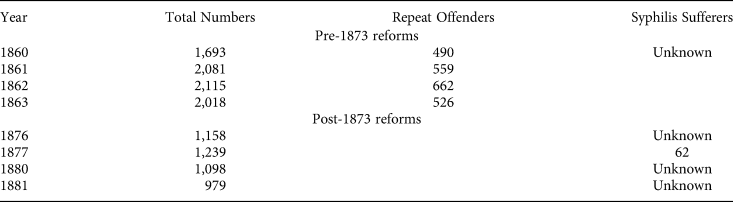
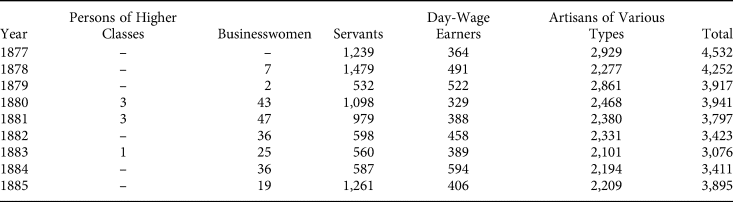
The reasons servants appeared as such a large contingent in police prostitution records were twofold. Data on clandestine prostitutes depended on police officials apprehending a woman on suspicion of prostitution and subjecting her to forced medical examination followed by treatment if necessary. Official data on this subgroup of prostitutes, therefore, reflected women whom officials could easily arrest.Footnote 45 In the decade before the institution of prostitution reform, police officials arrested many maidservants on suspicion of prostitution. The basis of these arrests is uncertain, and the possibilities include servants engaging in sex for money to supplement their meager income, employer complaints about the behavior of their servants, extramarital affairs, and the inopportune presence of a servant at the wrong place.Footnote 46 According to the 1810 Code, a servant had to visit the police station often during her period of unemployment, failing which she was arrested. The Code encouraged police officials to assume that an unemployed servant engaged in commercial sex irrespective of whether she did. As a result, police officials detained servants, oftentimes even employed servants, on suspicions of clandestine prostitution and subjected them to medical examinations—even though they had no clear proof that they were in fact selling sex.Footnote 47 Many servant arrests, therefore, were not necessarily on account of engagement in commercial sex. Such arrests continued after 1873 (see Tables 1 and 2).
Working and unemployed servants in Vienna who allegedly engaged in selling sex before and after prostitution regulation. Josef Schrank, Die Prostitution in Wien, II. Band: Der Administration (Vienna, 1886), 240.

The occupations of those arrested on suspicion of clandestine prostitution between 1877 and 1885 in Vienna. Schrank, Die Prostitution in Wien, II. Band: Der Administration, 244.

Moreover, this data on the profession or former profession of clandestine and registered prostitutes incorporated an ambiguity inherent in the classification of female work in Vienna. Until 1885, the Vienna police classified most women who worked for income in Vienna as servants irrespective of what their job description entailed. This included waitresses, female guesthouse workers, some female shop or business assistants, and even some female factory workers.Footnote 48 Thus, the category of “servant” in such data was comprised of a much broader group of women than simply those who worked in domestic households.
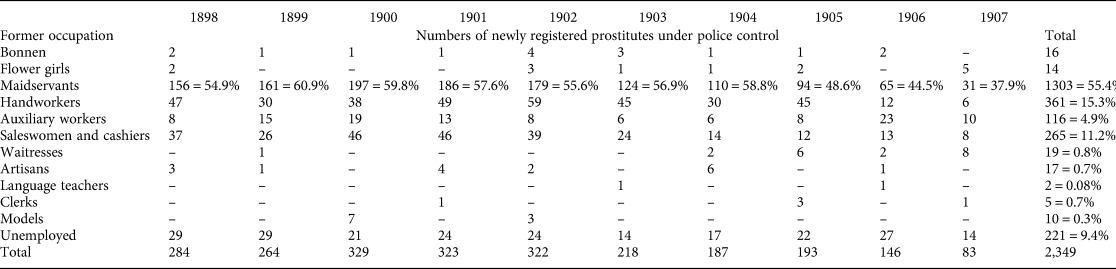
The disparities in classification improved somewhat in data produced after 1885. For instance, police head physician Dr. Anton Merta's data, presented at the 1908 conference of the Austrian Society for the Fight against Venereal Diseases (ÖGBG), indicated that 55 percent of registered prostitutes were formerly servants. The category of servants in Merta's data did not include waitresses, language teachers, female cashiers, or clerks. The data went a step further in its specificity. It subdivided the category of servants into two categories: Bonnen, who were housemaids employed in upper-class or aristocratic households, and maidservants, which was a vaguer category. The latter category encompassed most domestics in middle-class households; chambermaids; some types of cooks working in hotels, guesthouses, and restaurants; and some other servant groups, such as charwomen, wet nurses, and washerwomen (see Table 3).Footnote 49
Former professions of newly registered prostitutes in Vienna between 1898 and 1907. Schrank, Die Prostitution in Wien, II. Band: Der Administration, 190.

Further, compared with other occupations, physicians found it convenient to collect medical data on servants. Data on venereal diseases was available from medical facilities and hospitals, and such data was based upon the insurance system in Vienna that represented the working population.Footnote 50 Authorities in these facilities classified patients according to their occupations and not according to the disease they had contracted. Further, every time a patient switched insurance companies he was classified differently, and patients in outpatient care were not included in the data at all. Moreover, a large percentage of women, children, unemployed persons, and those people who had a private means of livelihood, such as self-owned businesses, were missing from the data. Therefore, this data could not provide any useful information on venereal diseases in the population, but only about a subsection who visited medical facilities for treatment.Footnote 51
However, clear, unambiguous data on the health status of most of the servant population was available to officials. This was on account of the Viennese Servants’ Insurance Program that the Viennese government introduced in 1865 to reduce the expenses incurred by the employers for the treatment of an ill servant in their employ.Footnote 52 The program allowed employers to admit an ill servant free of cost at a local hospital. Due to the low cost,Footnote 53 the number of servants insured grew exponentially from 10,484 in 1870 to 12,003 in 1871, 16,662 in 1872, and 19,148 in 1873.Footnote 54 By 1903, of the approximately 100,000 servants in Vienna, 74,770 were insured.Footnote 55
The Imperial General Hospital handled most servant patients in Vienna, and physician case history records at the Josephinum reveal the strict administrative protocols followed for servant patients. These protocols were based upon the stipulations of the 1810 Code.Footnote 56 The employer was responsible for providing suitable medical care to an ill servant without delay.Footnote 57 Even if the employer could not afford cost of care, he was obliged to take her to the Imperial General Hospital for free treatment and the employer was absolved from paying for treatment in cases of venereal diseases. The Imperial General Hospital sent written information about a servant patient to the regional police office for processing. The police then determined the following: whether the ill servant could remain in service, whether she should be dismissed, whether the employer was truly unable to pay for hospital services, and whether the servant's character certificate for her subsequent employment after discharge would be provided by the employer or the hospital administrators.Footnote 58
Unemployed servants had to produce their police registration papers that authorized their absence from service, and upon release from the hospital, authorities provided them with a written confirmation of their stay. Servants who could not provide the requisite documents were admitted for treatment but subjected to police investigation (§21)Footnote 59 usually involving the regional criminal court.Footnote 60 Other public healthcare facilities and some private institutions in Vienna that treated servants also followed the same painstaking procedures.Footnote 61 Therefore, because hospital authorities had to notify the police in every instance of illness concerning servants, officials had comprehensive knowledge about the medical status of the servant population in Vienna.
In 1893, the report of the Viennese Dermatological Society recommended that all unemployed persons should be brought under surveillance and obliged to register with the sanitary police.Footnote 62 Such recommendations were adopted as official police practice. For example, in March 1896, a police decree to deter “wild prostitution” required unemployed servants to be brought under medical intervention irrespective of existing laws: “The commissariats should pay more attention to the activities of vagrant female servants than before. Particular caution must be taken to ensure these persons are not unduly vagrant and dissolute for a long time and are not earning their livelihood either wholly or in part through prostitution, failing which they should be brought under sanitary police control. In such cases, they must undergo medical examination and should be handled against the existing laws and ordinances.”Footnote 63 Furthermore, in 1900, the servant class was included under §41 of the measures against clandestine prostitution. This paragraph reiterated that police officials should specify the “vagrant” status of a servant on all registration documents and should monitor “vagrant” servants carefully. Additionally, it permitted police officials to arrest and subject female “vagrant” servants to medical supervision if they did not perceive a change in lifestyle.Footnote 64
The assumption that servants were an important source of sexual illnesses had increased medical surveillance of women in other parts of the Habsburg Empire as well. Between 1901 and 1903, authorities in the Galician capital of Lemberg issued several regulations that allowed police physicians to administer regulatory medical examinations on almost all working-class women, including maidservants (both employed and unemployed), seamstresses, waitresses, and factory workers.Footnote 65 In a meeting of the Imperial Association of Physicians at Budapest in March 1895, the deputy chief regional physician at Budapest, Wilhelm Friedrich, argued that many vectors of venereal disease existed outside brothels in the form of vagrant servants and waitresses. He recommended strict police regulation of vagrant servants and waitresses and the eventual revision of servant laws to combat venereal diseases. Similarly, Dr. Marschalko stressed the importance of intensive regulation of servant conditions to prevent the spread of syphilis.Footnote 66 In another meeting in March 1895, head physician of police in Budapest, Alois Rózsaffy, underscored that at least three thousand of the five to six thousand clandestine prostitutes were vagrant servants and a significant source of venereal disease.Footnote 67
Impacts of the 1908 Conference
The condition of maidservants was discussed at the 1908 ÖGBG conference. Conference participants framed the condition of maidservants in Vienna straightforwardly as a health threat to the bourgeois members of Viennese society. For example, the general secretary of the ÖGBG and the imperial head physician, Dr. S. Ehrmann, argued that servants were the second-largest group afflicted by venereal diseases next only to prostitutes. According to Ehrmann, most servant patients showed signs that they had been vagrant for a long time. This time of unemployment and wandering, he argued, made servants vulnerable to “temptations” and this was an important point of entry for infections.Footnote 68 Social Democratic representatives believed the harsh living and working conditions in Vienna to be the primary cause of servants “falling into” prostitution. Adelheid Popp, for instance, argued that poor wages, employer mistreatment, and sudden dismissals led many maidservants to make “male acquaintances” to supplement their meager wages and tide over periods of financial difficulty.Footnote 69 Similarly, the city councilor von Philippovich and the newspaper editor Max Winter implicated poor living conditions of lower-class women that “tempted” many of them to take up prostitution to supplement their income.Footnote 70
Most physicians, police officials, and educators, however, did not accept the economic argument. For instance, the high commissioner of police Anton Baumgarten refuted the suggestion that maidservants in urban centers turned to prostitution because of low wages and poor economic opportunities. He argued that most prostitutes were not women recruited under dire economic circumstances. To substantiate his argument, he pointed to the situation in Stockholm, where one data set showed that 60 percent of prostitutes were formerly maidservants. He claimed that these Swedish women had entered prostitution even though they were economically better off and could have continued to provide a decent living for themselves as servants. Baumgarten claimed that the economic argument did not hold ground because there were many instances when women did not turn to prostitution despite severe economic conditions. He suggested that turning to prostitution depended on whether an individual had received a sound moral education.Footnote 71
Baumgarten asserted that the Vienna police took special measures to “protect” maidservants from prostitution. He pointed out that a large proportion of prostitutes were recruited from the servant population, especially from those who initially only engaged in it occasionally during periods of unemployment. He claimed that placement agencies were often culpable for recruiting prostitutes from the ranks of servants. Many such agencies, he argued, were a cover-up for the white slave trade and frequently targeted job seekers.Footnote 72 The special precautions that the police took to “protect” servants entailed thwarting alleged procurers who recruited women from this occupational group and restricting the amount of time servants could stay unemployed. Such measures included setting strict deadlines for servants to find employment. Upon arrival of the set deadline, he argued, servants had to give proof of their lifestyle and earnings.Footnote 73
Venerologist Dr. Josef Kyrle suggested that most women entered prostitution suddenly and not gradually as Baumgarten claimed. According to Kyrle, this sudden entry occurred following abandonment after the first sexual encounter. His data set included one hundred prostitutes—forty-five from the countryside and fifty-five from the city—that he had examined over a period of ten months. Most prostitutes in this set, he argued, gave details of normal youth and good progress through school. He admitted that some cases seemed to suggest women were predestined from childhood to enter prostitution due to the socioeconomic circumstances in which they were raised. However, in most cases, he asserted, entry into prostitution was not established in childhood.Footnote 74 He argued that the recourse to prostitution was set when a girl had to enter the urban workforce at an early age, as early as fourteen years, for financial reasons. Most of these girls either became servants or factory workers, and in eighty-five cases, the first sexual relationship happened at this stage between fifteen and nineteen years of age. For girls migrating from rural areas, this encounter coincided with the time of their settlement in the city. The relationship in all such cases resulted in the man ending the affair. For all of the eighty-five girls, the relationship had consequences, and in twenty-five of those cases, it resulted in a child. Following the affair, Kyrle noted, there was a change in attitude. While they had been content with their jobs before the affair, they suddenly became inconsistent once the relationship began “and had aspired to be free to live for the one they loved.”Footnote 75 Following the end of the affair, they could not regain their satisfaction in their jobs and changed posts frequently. As a result, they encountered financial ruin and turned to prostitution, which seemed to provide a comfortable living. In all cases, the girl had turned to prostitution suddenly. None of them, Kyrle argued, resorted to temporary or clandestine prostitution before taking it up full-time.Footnote 76
In a minority of cases, Kyrle claimed, the girl did not wish to remain a prostitute.Footnote 77 For example, one of the prostitutes he had examined was a twenty-four-year-old woman. She had come to Vienna from the countryside to work as a maidservant, worked with a bourgeois family for two and a half years, and was satisfied with her work. At this point, she entered a love affair that lasted for about one and a half years. During this time, she lost her job with her employer family. The affair resulted in a child that she delivered in a maternity hospital. Immediately afterward, she registered as a prostitute. She claimed that she would return to her former position as a servant once she cleared the debts she had incurred during childbirth and had placed her child with strangers. Kyrle thus emphasized that a woman's entry into prostitution in most cases was a direct consequence of desertion following the first sexual relationship. This occurred within the first few years of a girl's migration to the city, her entry into her first job, or both.Footnote 78
Kyrle's argument was not the first of its kind. By the turn of the nineteenth century, the “fallen woman” argument—that is, the notion that a woman abandoned following a seduction fell into prostitution—was accepted in medical circles of late nineteenth-century Europe. For instance, Dr. Martineau's investigations in the 1880s on venereal patients in Lourcine, France, showed that most future prostitutes lost their virginity between seventeen and eighteen years of age. Among these women, maidservants were the ones to lose their virginity with the widest variety of men, including employers, military men, shop assistants, artisans, and others. Because servants met a large range of men, they were allegedly susceptible to many “seducers.” Students and men from liberal professions particularly were cited as those who had sexual encounters with maidservants.Footnote 79
For physicians and educators, the primary concern with servants resorting to prostitution and allegedly contracting diseases pertained principally to the possibility that an infected servant could spread the disease to her bourgeois employers.Footnote 80 Dr. Sachs illustrated this concern with a case of a couple in Vienna with three children who had sent their youngest to a small-town wet nurse in Lower Austria. The child returned with a lesion and infected the rest of the family. The children were admitted to the Francis Joseph Children's Hospital, and the parents to the Wiedner Hospital. The father suffered from syphilis for the first year, then died of a stroke.Footnote 81 Similarly, Ehrmann claimed that many bourgeois women were accidently infected through their servants and then passed the disease onto their husbands and children.Footnote 82
Physicians were concerned that many servants with venereal diseases escaped medical supervision and therefore continued to spread the disease to their employer's families. Dr. Ellmann argued that a large percentage of servants seldom consulted physicians during illness. Allegedly, venereal diseases were particularly visible in the fluctuating population of servants and other female workers. These were women who came to Vienna in the summer months in search of work but stayed elsewhere in the winter months. Such women, he emphasized, lived in cramped quarters with thirty to fifty people of both sexes who allegedly “ran amok” on one another, neither sex observing marital fidelity. As a result, many of these women contracted diseases. Ellman argued that even though these fluctuating populations often displayed visible manifestations of the disease, it did not mean that the more stable population of working-class women in Vienna were disease-free. They were simply better at concealing their disease.Footnote 83 Physicians also claimed that lapses in existing regulations for servants encumbered bringing diseased servants under medical supervision.Footnote 84
Some physicians even argued that they should have legal authority to reveal a servant's medical condition to her employer to prevent the disease from spreading to bourgeois families. For example, Dr. Teleky cited the case of a five-year-old-girl he had examined in his private practice. Because the child was from a wealthy and educated household, he was surprised to find that she had a syphilitic rash. Further, he detected signs of syphilis in her three-year-old sister as well. However, both parents and their three elder daughters in the family were healthy. Upon closer investigation, he discovered that their governess had syphilitic papules around her genitals. Because she was a virgin, Teleky was confused about how she contracted the disease. Later, he discovered that her brother had a venereal ulcer that was transmitted to the governess by communal use of towels and utensils. Teleky claimed that he had found other instances when the servants, especially nannies, had venereal diseases. He remarked that his personal practice was to disregard the Penal Code that prohibited physicians from betraying the confidence of their patients and reveal the source of the disease to the employers so that the concerned parties were admitted to the hospital for treatment.Footnote 85
Jurist and university professor Alexander Löffler argued that a servant who continued to work with a family despite knowing of her illness was committing a criminal attack against the family. Therefore, he claimed, committing a criminal offense to circumvent another criminal attack was legally permissible. His implication was that a physician could violate his obligation to confidentiality by revealing the servant's health condition to her employers.Footnote 86 The engineer Emil Gärtner argued that while experts talked about advertising the health status of an ill maidservant, they never discussed scenarios and suitable procedures to deal with, for instance, a son of an employer who through sexual relations with the maidservant had made her ill. In such a scenario, he argued, the son would walk freely because he was a member of respectable society, while the maidservant bore the brunt of the sexual relation.Footnote 87 Venerologist Ernst Finger countered this claim by arguing that physicians likewise would have the right to reveal the illness of the son who spread a venereal disease to the family. In other words, according to medical experts, reporting a maidservant's illness to her employers and reporting a young bourgeois male's illness to his family was essentially the same treatment.Footnote 88
Other medical experts approached concerns about servants allegedly infecting bourgeois families from the angle of sexual enlightenment. For instance, Dr. Scherber argued that because many bourgeois families entrusted their children to the care of servants, children were always under risk of contracting diseases from servants. However, he pointed out that the idea that servants should be subjected to regulation was impractical. Instead, he recommended enlightenment of mothers as well as the service staff.Footnote 89 Borrowing on the existing stereotypes of servant frivolity, the educator Frau Professor Minor suggested that a high percentage of servants submitted to prostitution because they were in constant intimate contact with bourgeois luxury but not in direct possession of it. This allegedly excited their greed. She urged bourgeois women to give up such luxuries that were detrimental to servants as well as children. She suggested that sexual enlightenment courses should be held for servants to circumvent such problems.Footnote 90
Physicians and educators were concerned about the threat that maidservants posed specifically to bourgeois boys. One statistic suggested that in 1908, 10 percent of middle school students and 20 to 25 percent of high school students had contracted venereal diseases. Sixty-seven percent of all infected people in the empire were under twenty-four years of age.Footnote 91 Jurist Steiner presented a study on the sexual environment of students conducted by Karl Wurmfeld at Vienna University in 1905. According to the study, most boys received their sexual education from their peers between eight and eleven years of age. Parents were involved in the sexual education of their children in very few instances. The first sexual encounter occurred between sixteen and eighteen years of age. Steiner argued that in a surprisingly large number of cases, the first encounter took place with a maidservant; going to a prostitute followed soon after. Steiner contradicted the claim that students did not visit prostitutes due to lack of money and argued that in many cases boys were engaged in sexual intercourse either temporarily or exclusively with prostitutes.Footnote 92
Finger argued that when parents did not speak with their children about sex, the children turned to servants in the house, who introduced them to “lies and hypocrisy.”Footnote 93 He pointed out that he had asked his maidservants about such things when he could not speak with anyone else, and posited that many children from “better families” continued to receive their sex education in that manner.Footnote 94 Sex education in homes as well as schools, educators and physicians claimed, was essential to the prevention of venereal diseases among young boys: “No educator may deny that direct education of a child is necessary, so that he does not seek instruction from their contemporaries and servants.”Footnote 95 The schoolteacher A. Tlučhoř also emphasized the importance of offering official sex education courses to “trainees, apprentices, maidservants, unskilled workers, and young female officials, in addition to middle and high school students, soldiers, brides and grooms, and the teaching staff of both sexes.”Footnote 96
The participants of the 1908 conference thus borrowed on the existing rhetoric that connected servant unemployment with vagrancy and prostitution. They argued that ignorant servants not only contracted diseases themselves but also spread them to members of their employers’ household either due to daily physical contact or sexual intercourse. Servants also allegedly imparted faulty sexual education to young boys in the household, which in turn led the latter to engage in dangerous sexual practices (like visiting prostitutes) and contract sexual diseases. Ignorant servants, thus, were potential threats to the health and well-being of bourgeois families.
Following the 1908 conference, physicians and educators devoted considerable focus on prophylaxis through sexual enlightenment of youngsters. In the same year, at a meeting of the Austrian Association for Child Research, pediatrician Josef K. Friedjung argued that children should be enlightened on sexual matters including venereal diseases.Footnote 97 A debate ensued on this matter and divided educators into two groups. Some educators, such as Professor Dr. Burgerstein, a member of the governing council, argued that sexual enlightenment should be introduced in elementary school by an experienced teacher, in the higher sections of boys’ schools by a teacher or the school physicians, and only in some girls’ schools by a female teacher or a female school physician. Other educators, such as the director of the association, Heller, argued that the task of sexual enlightenment was the domain of the mother. Dr. Frankfurter, aligning with Heller, stated that sexual enlightenment should not be introduced to children at all in schools.Footnote 98
Those who believed that sex education should be introduced in schools produced materials on sex for a young audience. For instance, Tlučhoř's 1908 publication Der Universalerbe (The Universal Inheritance) for adolescent boys featured stories about sexual relationships between adults, gender-roles, and diseases, including an illustrated chapter on sexual reproduction.Footnote 99 Educators of the second group produced manuals on how parents should speak with children on these matters. For instance, in 1909, Friedjung published the work Die sexuelle Aufklärung der Kinder (The Sexual Enlightenment of Children) for parents. In it, he addressed three questions: When should a child be educated on sexual matters? Who should educate him? And how should he be educated?Footnote 100 Friedjung argued parents should take personal responsibility for educating their children on sexual matters.Footnote 101 Similarly, in 1912, the high school teacher Lothar Skalla's article, “Über sexuelle Aufklärung” (On Sexual Enlightenment), that appeared in the magazine Zeitschrift für die Österreichischen Gymnasien emphasized that no teacher could understand a child as well as his parents; therefore the authority should lie with the parents.Footnote 102
Whether the responsibility fell upon schools or upon parents, medical experts enjoyed the privilege of advising both school authorities and parents on providing sex education to their children. Physicians served as consultants and editors of the sex education materials produced for schoolchildren. Finger, for example, had proofread Tlučhoř's work.Footnote 103 However, physicians sought to make the sexual enlightenment of children mandatory. At the Seventh International Medical Congress in London in 1913, Finger underscored the importance of government regulation of school curriculum as an important method of individual prophylaxis: “the education about sexually transmitted diseases is only a part of the general sexual pedagogy that must be included in the curriculum of youngsters and should be carried out in a systematic manner.”Footnote 104
Furthermore, Finger argued that the sanitation officesFootnote 105 should post advertisements that clarified the legal rights of physicians, including the right to break patient confidentiality in certain circumstances—such as in cases of servants who had a sexually transmitted illness and risked the health of her employer family. These ads, he emphasized, should not be circulated publicly and should be available only to medical professionals. The physician then must take requisite steps to reveal delicate information to employers and family members. A physician's rights to advertise should be made available to all facilities that handled ill patients.Footnote 106 In 1914, he recommended eleven prophylactic measures that sanitation offices in Vienna needed to institute. Key among these was instruction for youngsters on health, hygiene, and venereal diseases; medical and official instruction for venereal disease patients; instructions for midwives on venereal diseases; a ban on medical quackery; and stricter regulation of wet nurses.Footnote 107
However, the efforts of the medical community were principally directed toward extending prostitution regulation to larger and larger numbers of women. In 1908, Finger and Baumgarten sent a report to the imperial medical advisory board Oberste Sanitätsrat that stressed the urgency to bring clandestine prostitution under medical supervision to stem the tide of sexually transmitted diseases. In 1909, they submitted the report on the regulation of prostitution in Cisleithenian Austria to the International Conference on the Fight against White Slave Trade. The recommendations in the report included extending police surveillance to as many clandestine prostitutes as possible, increasing the duration of hospital stays for ill prostitutes, and adopting stricter legal provisions to prevent prostitution in minors.Footnote 108 The report was particularly insistent on the point of clandestine prostitution. Clandestine prostitutes, the report argued, were mostly young women. While only 16 percent of regulated prostitutes were under twenty-one years of age, 57 to 58 percent of clandestine prostitutes were under twenty-one years of age.Footnote 109
The new prostitution regulation that came into force in Vienna in 1911Footnote 110 increased medico-police control over prostitution, established stricter protections of minors (§5), and retained the original protections prescribed for minor servants under Paragraph §18 that specifically prohibited the employment of underage servants in brothels.Footnote 111 The new Servant Order (Dienstbotenordnung) that came in effect in 1912 also carried measures to ensure officials could monitor the health of the city's servant population. The new order made all employers responsible for the health of their servants (§18). Police notification in every instance of servant illness was mandatory, and employers were not permitted to put servants out on the street without such a notification.Footnote 112
Reforms were introduced in the servant insurance system that now covered the complete cost of treatment during hospitalization for as long as one month and sometimes longer. Further, the system allowed servants whose employers had registered them into the program to avail medical treatment at any and all private and public medical facilities in Vienna.Footnote 113 These reforms provided servants with more cost-effective medical intervention. However, it also afforded physicians greater opportunity to monitor the health of servants in Vienna.
Conclusions
Many historians have referred to the idea that female servants tend to “succumb” to prostitution to bolster a larger argument about the exploitative nature of domestic service.Footnote 114 Using the case of nineteenth-century Vienna, this article has demonstrated that the claim that female servants are “vulnerable” to prostitution, has at least three underlying pressure points. The first is that of police “experience.” Police experience is governed by legal provisions that allow effortless policing of certain groups of people more than others. For example, the 1810 Vienna Servant Code codified the stereotype that servants were prone to vagrancy and “immorality” into the city's judicial language. At the turn of the century, vagrancy was an ambiguous concept about a person's willingness to work. However, as the century progressed, the concept of vagrancy became attached to unemployment and migration. The connection increasingly problematized the swelling population of working-class women in fin-de-siècle Vienna and brought them under police surveillance.
The second pressure point is that of data availability and classification. The system of policing resulting from the 1810 Code made it easier for police to collect relatively unambiguous data on servants as compared with other groups of people. In the Habsburg realm, the officialization of demographic procedures occurred only in the 1850s.Footnote 115 Most working-class women in the post-1850 period were migrants from the Bohemian and Moravian countryside who undertook menial jobs in bourgeois households, hotels, and guesthouses in Vienna. Police officials clubbed all these women, except perhaps some women who worked in factories, under the vague category of “maidservant” and therefore these women were governed by the stipulations of the 1810 Code. While officials fine-tuned this classification after 1885, much of the vagueness persisted in fin-de-siècle Vienna.
The third pressure point is that of data interpretation. The discrepancies in the collection and classification of data on working-class women enabled physicians to use preexisting stereotypes about maidservants to bolster the link between domestic service and prostitution. Medical experts and police officials portrayed ignorant servants as the principal source of clandestine prostitution and as insidious sources of venereal diseases. Consequently, they argued that maidservants were health threats to bourgeois families. Either by infecting members of the family through direct contact and sexual intercourse or by passing on faulty sexual knowledge to children, ignorant servants, the argument went, aided in spreading the plague of venereal disease. Physicians recommended extending medical regulation of prostitution to maidservants, as well as sex education for bourgeois children to circumvent these threats. Deploying such narratives, physicians claimed their authority to intervene in the sexual lives of not only working-class women but also the bourgeoisie who employed them.