Introduction
Drought is one of the most devastating abiotic stress of rice under rain-fed ecosystem, reducing crop yield up to 50%. Approximately, 34 million hectares (Mha) of rain-fed lowland and 8 Mha of upland rice in Asia suffers from drought stress of varying intensities almost every year with 13.6 Mha area affected in India alone (Wopereis et al., Reference Wopereis, Kropff, Maligaya and Tuong1996; Singh et al., Reference Singh, Neelam, Kaur, Kaur, Singh and Kumar2016a, Reference Singh, Singh, Xalaxo, Verulkar, Yadav, Singh, Singh, Prasad, Kondayya, Ramana Rao, Girija Rani, Anuradha, Suraynarayana, Sharma, Krishnamurthy, Sharma, Dwivedi, Singh, Singh, Nilanjay, Singh, Kumar, Chetia, Ahmad, Rai, Perraju, Pande, Singh, Mandal, Reddy, Singh, Katara, Marandi, Swain, Sarkar, Singh, Mohapatra, Padmawathi, Ram, Kathiresan, Paramsivam, Nadarajan, Thirumeni, Nagarajan, Singh, Vikram, Kumar, Septiningshih, Singh, Ismail, Mackill and Singhb). Developing rice cultivars with an inherent capacity to tolerate drought stress is one of the most promising ways for having sustainable yield under rain-fed environment. Drought tolerance is a complex trait governed by many physiological and biochemical properties of plants. Genotypes that have deep, coarse roots with a high ability of branching and penetration, higher root-to-shoot ratio, elasticity in leaf rolling, early stomatal closure and cuticular resistance are reported as component traits of drought avoidance (Blum, Reference Blum1988; Samson et al., Reference Samson, Hasan and Wade2002; Wang and Yamauchi, Reference Wang, Yamauchi and Huang2006). Leaf rolling is one of the drought avoidance mechanism to prevent water deficits during drought stress. Loresto and Chang (Reference Loresto and Chang1981) have also suggested leaf rolling as a criterion for scoring drought tolerance in tall and semi-dwarf rice cultivars. Severity of leaf rolling as well as leaf drying increased with duration of drought stress. Leaf rolling during stress reduces the leaf surface exposure to sunlight energy and decrease transpiration leading to the closure of stomata, so that gaseous exchange and CO2 entry into cells are reduced and photosynthesis is decreased. Many quantitative trait loci (QTLs) were mapped for secondary traits (Nguyen et al., Reference Nguyen, Klueva, Chamareck, Aarti, Magpantaya, Millena and Pathan2004; Ding et al., Reference Ding, Li and Xiong2011; Uga et al., Reference Uga, Sugimoto, Ogawa, Rane, Ishitani, Hara, Kitomi, Inukai, Ono, Kanno, Inoue, Takehisa, Motoyama, Nagamura, Wu, Matsumoto, Takai, Okuno and Yano2013) from the cultivated gene pool but none from wild species germplasm of rice. Wild species of rice constitute valuable resources for genes/alleles and QTLs for resistance to biotic and abiotic stresses and for enhancing the productivity of modern cultivars (Brar and Khush, Reference Brar and Khush1997; Brar and Singh, Reference Brar, Singh and Kole2011; Singh et al., Reference Singh, Neelam, Kaur, Kaur, Singh and Kumar2016a, Reference Singh, Singh, Xalaxo, Verulkar, Yadav, Singh, Singh, Prasad, Kondayya, Ramana Rao, Girija Rani, Anuradha, Suraynarayana, Sharma, Krishnamurthy, Sharma, Dwivedi, Singh, Singh, Nilanjay, Singh, Kumar, Chetia, Ahmad, Rai, Perraju, Pande, Singh, Mandal, Reddy, Singh, Katara, Marandi, Swain, Sarkar, Singh, Mohapatra, Padmawathi, Ram, Kathiresan, Paramsivam, Nadarajan, Thirumeni, Nagarajan, Singh, Vikram, Kumar, Septiningshih, Singh, Ismail, Mackill and Singhb). Only a few reports on the screening or utilization of wild species of rice in improving drought tolerance are available (Liu et al., Reference Liu, Lafitte and Guan2004; Zhang et al., Reference Zhang, Zhou, Fu, Su, Wang and Sun2006; Feng et al., Reference Feng, Xu, Du, Tong, Luo and Mei2012). Keeping in view the above-said need of exploring new resources, the objectives of the present study is to assess genetic variation in component traits of drought among wild species germplasm of Oryza under water deficit.
Material and methods
Materials
A set of 1630 wild species germplasm of Oryza belonging to O. sativa and O. officinalis complex were screened for their vegetative stage drought tolerance (online Supplementary Table S1). These germplasm accessions were originally procured either from the International Rice Research Institute (IRRI), Philippines, or from the National Rice Research Institute (NRRI), Cuttack, and being actively maintained at the Punjab Agricultural University (PAU), Ludhiana.
Methods
Screening for drought tolerance at vegetative stage
(a) Phenotyping for leaf rolling and leaf drying
The experiment was conducted in the field area of the School of Agricultural Biotechnology, Punjab Agricultural University, Ludhiana (30°54′ and 75°48′E) during the kharif crop season (May to November), 2013–2014 and 2015–16. The soil is clayey loam with soil pH ranging from 7.8 to 8.5.The seeds of all wild genotypes were sown on raised beds. Twenty-five days old seedlings were transplanted in the field along with the susceptible check PR121. The plot size consisted of a single row per accession with six plants each. The plant-to-plant distance was 30 cm with 60 cm row-to-row. After crop season was over, the plants were left in the field as ratoon. In the next year, severe water stress was imposed at vegetative stage by withholding water initially for 25 d and then extended further to 35 d during the month of May to June. The drought condition was also ensured with the climate, temperature profile recorded above 40o continuously from 15 to 35 d during the drought period. At the termination of the experiment, soil moisture content (%) was recorded at four randomly chosen sites in the field. Soil samples were collected with screw augor from different depth and soil moisture content was determined in soil samples taken from consecutive depths of 0.15 cm down to a depth of 60.9 cm (A, B, C and D) in the field. To determine soil moisture content, soil samples were taken into moisture box. Initial weight of moisture box (empty) and with fresh soil was recorded separately. Then, the moisture boxes with fresh soil samples were kept into oven at 60o till the constant weight is attained. The calculations were done as per given formula: % moisture on dry weight basis = [(B–A)–(C–A)]/(C–A) × 100, where, A = weight of empty moisture box (in gm), B = weight of moisture box with fresh soil (gm), C = weight of moisture box with dry soil (gm), B–A = weight of fresh soil, C–A = weight of dry soil, [(B–A)–(C–A) = (B–C)] = weight of water in the soil.
Data on leaf rolling and leaf drying were recorded after 25 and 35 d of water stress (online Supplementary Table S2) between 12 and 2 PM using the modified protocol of Datta et al. (Reference Datta, Malabuyoc and Aragon1988). The genotypes that showed a score range of 2– 3 after 25 d of water stress were considered as susceptible and highly susceptible, respectively.The plants with no leaf rolling and leaf drying were scored as zero.
(b) Root phenotyping
In order to study root morphology, selected drought-tolerant accessions along with drought-susceptible indica cultivar Punjab Rice 121 (PR121) were grown in basket mesh kept above water-filled buckets under glass house. The experiment was set up in two replications. Root phenotyping was done using plastic mesh baskets (width × depth: 18 × 8 cm) method. The baskets were filled with soil in a green house (average air temperature 35°C, average humidity, 50–60% and natural light) and were kept on the top of a bucket (width × depth: 18 × 18 cm) filled with water. Sufficient water level was maintained for creating an anaerobic condition. The observations on root length and number of primary roots were taken after 3 months of experimental setup and were analysed using one-way analysis of variance followed by Dunnett's multiple comparison test using GraphPad Prism version 7.00, GraphPad Software, La Jolla California USA, (www.graphpad.com).
Results
The average moisture content of four randomly chosen sites and at a depth of 0.15, 15.3, 30.6 and 60.9 cm was found 3.52, 5.51, 8.02 and 8.66%, respectively, in the year 2013–2014 and these value corresponds to 2.58, 4.25, 7.62 and 8.36% in the year 2015–16. Soil moisture conditions coupled with high temperature (above 40°C) were sufficient to induce the severe water deficit conditions.
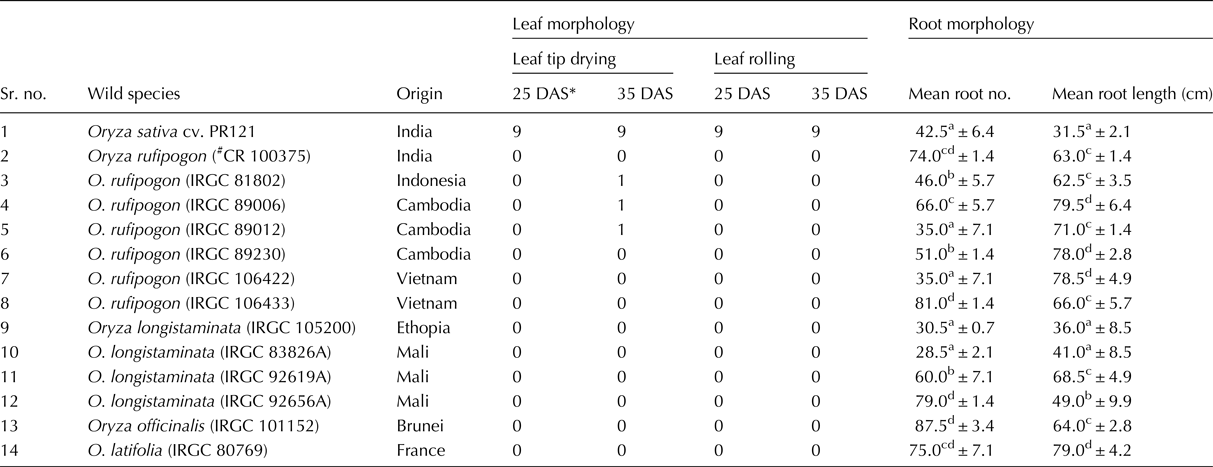
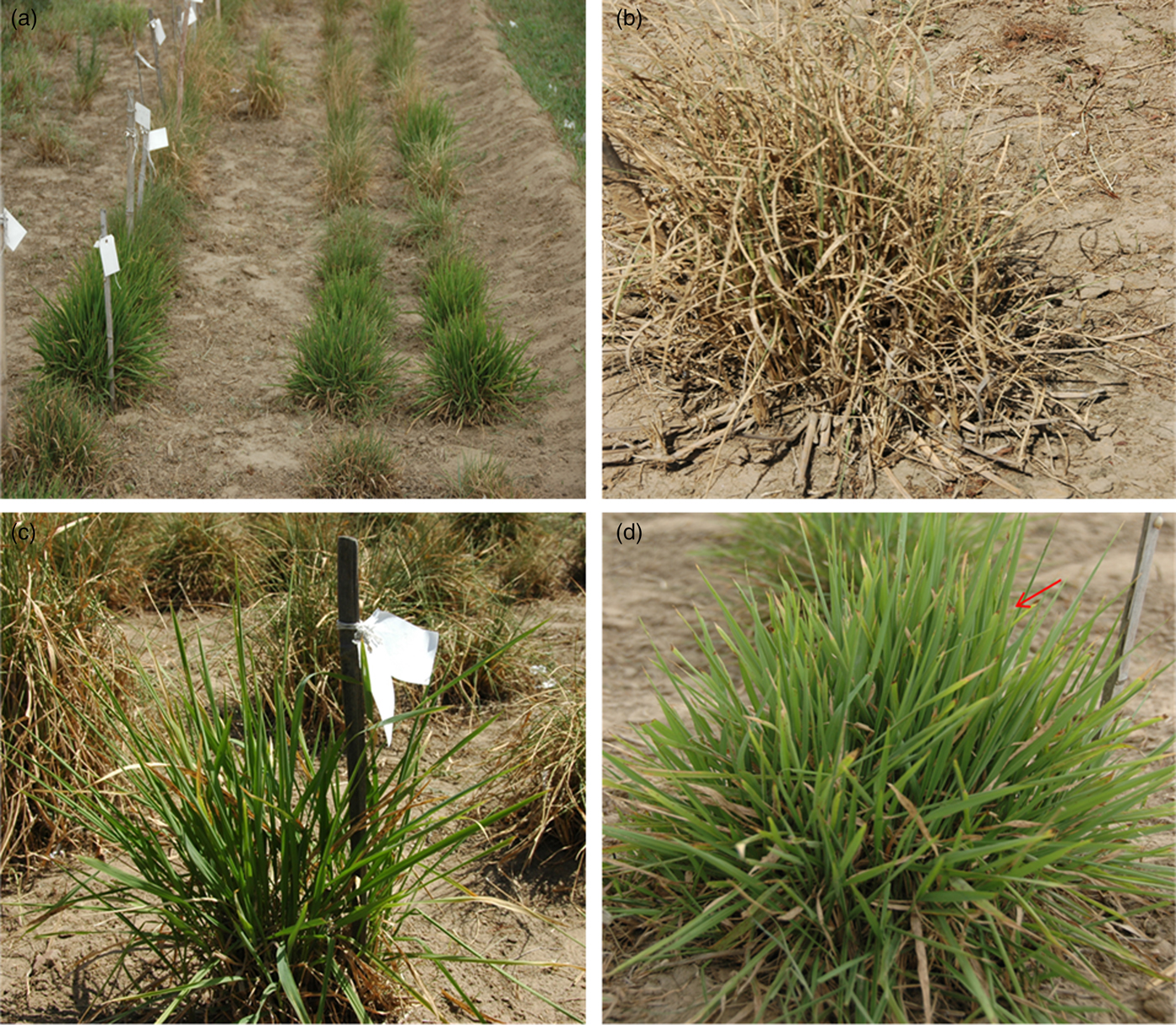
Out of 1630 wild species germplasm screened, only 13 were found tolerant after 35 d of severe water stress (Table 1; online Supplementary Table S3; Fig. 1). Out of 1369 accessions from O. sativa complex under study, only 11 accessions (seven from Oryza rufipogon and four accessions from Oryza longistaminata) were found tolerant to drought with a leaf-rolling score of zero. Among these 11 accessions of O. sativa complex, slight tip drying was observed in three accessions of O. rufipogon namely, IRGC 81802, IRGC 89006 and IRGC 89012. Among 126 accessions of O. longistaminata under study, only four accessions (three accessions from Mali and one accession from Ethopia) showed tolerance to water stress. In case of O. officinalis complex, out of total 261 accessions, two accessions, one each from O. officinalis (accession no. IRGC 101152 from Brunei) and Oryza latifolia (accession no. IRGC 80769 from France) showed the tolerant reaction.
Phenotypic evaluation of wild species germplasm of rice under field condition (a, b); the Oryza rufipogon accession IRGC 106433 with no leaf rolling and tip drying (c); the O. rufipogon accession IRGC 89012 with no leaf rolling, but slight tip burning after 35 d of water stress (d).
Leaf and root morphology of identified drought-tolerant accession along with their countries of origin

*DAS=days after imposing stress. #Code IRGC represents accessions from the International Rice Genetic Consortium, Philippines; CR represents accessions from the National Rice Research Institute, Cuttack, India. Superscripts (a–d) represent significant differences in the means of wild species germplasm accessions for root number and length.
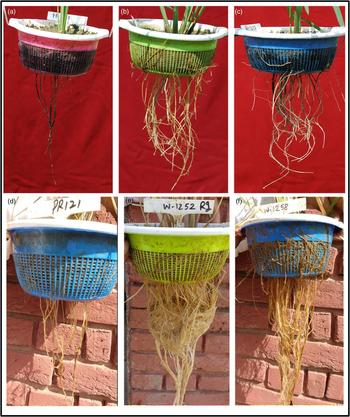
The mean number of roots and root length recorded for drought-susceptible indica rice PR121 was 42.5 and 31.5 cm, respectively (Table 1; Fig. 2, online Supplementary Fig. S1). Among O. rufipogon accessions, IRGC 106433 showed nearly two times higher root number (81.0 ± 1.4) than PR121, followed by CR 100375 (74.0 ± 1.4). Three of the accessions though had a comparable number of mean root number, but had root length almost 2–2.5 times higher than PR121. Sufficient variation was observed for root number (30– 79) and root length (36 cm–68.5 cm) among selected O. longistaminata accessions. The O. officinalis acc. IRGC 101152 has the highest mean number of roots (87.5 ± 3.4) among all the selected drought-tolerant accessions from four different species.
Root phenotyping using plastic mesh baskets (1) After 1 month of vegetative growth: (a) rice cultivar PR121, (b) Oryza rufipogon accession IRGC 106433, (c) Oryza officinalis accession IRGC 101152, (2) after 3 months of vegetative growth, (d) rice cultivar PR121, (e) O. rufipogon accession IRGC 106433, (f) Oryza latifolia accession IR80769.

Discussion
Drought is one of the most serious abiotic stress limiting rice productivity in the world and poses a serious threat to the sustainability of rice yields in rain-fed agriculture. Developing water use efficient and drought-tolerant variety may help to combat this problem in the era of global climate change. Leaf morphology and associated traits have been suggested as one of the parameters for selecting drought-tolerant genotypes (Biswal and Kohli, Reference Biswal and Kohli2013). The presence of genetic variability for leaf rolling and correlation between leaf area index and drought have also been studied by various scientist, indicating the probable role of leaf traits as a measure of drought susceptibility or tolerance (Subashri et al., Reference Subashri, Robin, Vinod, Rajeswari, Mohanasundaram and Raveendran2009; Farooq et al., Reference Farooq, Wahid and Lee2009; Salunkhe et al., Reference Salunkhe, Poornima, Prince, Kanagaraj, Sheeba, Amudha, Suji, Senthil and Babu2011; Cerqueira et al., Reference Cerqueira, Erasmo, Silva, Nunes, Carvalho and Silva2013; Singh et al., Reference Singh, Sengar and Sengar2013; Kumar et al., Reference Kumar, Dwivedi, Singh, Bhatt, Mehta, Elanchezhian, Singh and Singh2014; Sokoto and Muhammad Reference Sokoto and Muhammad2014). Our results revealed, sufficient genetic variation in leaf and root morphology among selected wild species germplasm accessions. Some of the accessions had a higher root number, whereas some of them had a higher root length, suggesting a different underlying mechanism of drought tolerance in them. We noticed the presence of more secondary root mass in the deeper soil zone in these selected accessions suggesting absorption of more water or moisture and thus helping them to withstand under water stress condition. The presence of drought resistance in O. rufipogon and O. officinalis accessions were also reported by Feng et al. (Reference Feng, Xu, Du, Tong, Luo and Mei2012) by assessing morphological and physiological traits related to drought tolerance. He observed stronger drought resistance in O. officinalis accessions as in our case. Greater membrane stability, more stomatal conduction and elongation of the leaves along with higher root mass in deeper soil levels were also observed under water deficit among O. rufipogon and O. longistaminata accessions as compared with O. sativa by Liu et al. (Reference Liu, Lafitte and Guan2004). One of the probable explanations for the occurrence of novel alleles for drought tolerance in O. longistaminata and O. latifolia is their natural habitat, that is, O. longistaminata usually found in seasonally dry areas, whereas O. latifolia used to be found on hill slopes. Therefore, they might have developed some adaptive traits for their survival under adverse environment. In the context of occurrence of drought responsive traits in O. rufipogon accessions, the putative role of differentially expressed tissue-specific miRNA was explained by Zhang et al. (Reference Zhang, Long, Xue, Xiao and Pei2017). He suggested that these differentially expressed miRNA might be involved in the regulation of the auxin pathways, flowering pathways, drought pathways and lateral root development and hence conferring resistance against water deficit. The transfer of drought tolerance from the identified O. rufipogon (IRGC 89006, IRGC 106433) and O. longistaminata (IRGC 92619A) accessions to elite rice cultivars PR121 and PR122 have already been initiated at the Punjab Agricultural University, which would definitely helpful in getting sustainable yield under water stress.
Supplementary material
The supplementary material for this article can be found at https://doi.org/10.1017/S1479262117000284.
Acknowledgement
The authors are thankful to the International Rice Research Institute, Philippines, Manila and National Rice Research Institute, Cuttack, India for providing wild species germplasm of rice. The authors also acknowledge the School of climate change and agricultural meteorology, Punjab Agricultural University, Ludhiana for providing meteorological data.