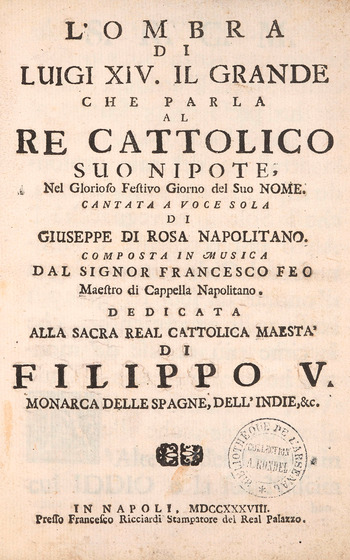
The Bibliothèque nationale de France owns the only extant copy of a libretto printed in Naples in 1738, characterized by a curious contrast between the small number of pages (just eight) and the pompous length of the title: L'ombra di Luigi XIV il Grande che parla al re cattolico suo nipote nel glorioso festivo giorno del suo nome.Footnote 1 It contains the text of a solo cantata consisting of a long recitative followed by an aria. The work, not included in Claudio Sartori's catalogue,Footnote 2 has so far remained almost unknown.Footnote 3 The title-page (Figure 1) clearly indicates the poet and the composer, respectively Giuseppe di Rosa and Francesco Feo, as well as the dedicatee, King Philip V of Spain.Footnote 4 The most interesting elements, however, are the dedicatory letter (dated 15 March 1738) and the signature at the end of it, as the person who offers the musical homage to the sovereign is none other than Carlo Broschi – Farinelli.Footnote 5 The Neapolitan print (the content of which is transcribed and translated in its entirety in the Appendix) therefore constitutes an object of interest for specialists in Farinelli: a close reading helps explain its place within the life and career of the famous singer.
L'ombra di Luigi XIV, title-page. Bibliothèque nationale de France, Paris, 8 RA5 609. Reproduced from gallica.bnf.fr

AT THE COURT OF MADRID
At the time the cantata was published, Farinelli had already been in Spain for a considerable time, having moved there from England in the summer of 1737. It had been known since March of that year that he would take advantage of the closing period of the London theatres to travel to the continent and reach the Iberian Peninsula via France,Footnote 6 where he had been applauded in 1736. In May, while the project was taking a more definite shape, it was rumoured that the trip had been expressly requested and prearranged in secret by the court of Madrid through diplomatic channels.Footnote 7 Broschi stayed in Paris from 7 to 15 July and performed at Versailles, apparently not reaching the same levels of success as he had the previous year. Meanwhile, in London it was taken for granted that he would return for the reopening of the opera season,Footnote 8 and this was almost certainly his intention.
Farinelli arrived in Madrid on 7 August 1737.Footnote 9 A few days later he sang in the presence of Philip V and his second wife, Italian-born Elisabeth Farnese. His first performance, narrated countless times, has taken on almost legendary proportions. I prefer to leave out the myths that have blossomed around the king's psychological disorders, the queen's worries about these and the healing power of the castrato's voice, which have been effectively deconstructed in recent times.Footnote 10 Whatever the truth is, the Spanish sovereigns were deeply impressed by the skill – and perhaps the amiability – of the singer, as can be seen from the letters written by two of their children with whom they shared their appreciation. In Lisbon, Princess Mariana Victoria – wife of the Prince of Brazil Joseph of Braganza (the future King Joseph I of Portugal) – awaited detailed reports from her mother. On 20 August she asked in her uncertain French: ‘J'ai entendu dire que le meilleur musicien qu'il ia est a present la, je vous prie de m'envoier dire coment il vous a pari et s'il est ausi bon qu'on le dit’ (I have heard that the best musician that exists is now there; I beg you to tell me how he seemed to you and if he is really as good as they say).Footnote 11 On 24 August she was pleased with the excellent impression made by Broschi on her parents:
Je suis tres aise que vous vous divertissiez a entendre Farinello et qu'il vous ait parut si bien. Tout le monde dit qu'il nia aucun qui chante ausi bien que lui et on voit bien par les arias (car j'en ai chanté quelques unes et entendu aussi d'autres) la grande agilité qu'il a. La reyne me dit hier que la princesse lui avoit ecrit qu'il n'arrivoit deja pas trop aut, mais je ne sois pas coment cela puisse etre car j'avais entendu dire qu'il arrivoit jusqu'a la fin du clavecin.Footnote 12
I am very glad that you were entertained to hear Farinello and that he seemed so good to you. Everybody says that there is no one who sings as well as he does, and one can see well from the arias (for I have sung some and heard others) the great agility he has. Yesterday the queen told me that the princess had written to her that he was already not reaching too high, but I do not know how this could be, as I have heard that he used to reach to the end of the harpsichord.
On 27 August her brother Charles, King of Naples since 1734, wrote more laconically: ‘Je me rejouyroy que vos M.M. se divertisoint bien, et que Farinello eut este du goust de vos M.M’ (I rejoice that Your Majesties are well entertained, and that Farinello has been to the liking of Your Majesties).Footnote 13
Philip and Elisabeth made their proposal soon after. As early as 15 August the British ambassador to Madrid, Benjamin Keene, had written to the Duke of Newcastle: ‘they divert themselves with their musical entertainments, and have obliged Farinelli to engage himself in their service, and not return to England, as he had promised’.Footnote 14 Broschi later told his Bolognese patron Count Sicinio Pepoli: ‘Nel termine della mia partenza [per] Londra per compire colà i dritti del mio contratto con quella direttione, le maestà loro doppo cantata un'aria mi chiamorono ai loro piedi, con dirmi che volevano ch'io restassi al loro real servizio’ (Before the prescribed time for my departure to London in order to fulfil the terms of my contract under the management there, Their Majesties, after I sang an aria, summoned me to their presence, telling me they wanted me to remain in their royal service).Footnote 15 The singer accepted the very generous conditions offered by the sovereigns, and on 30 August the king appointed him familiar criado (personal servant) and músico de cámara (chamber musician).Footnote 16 The news spread quickly. On 17 September Charles wrote from Naples: ‘Je me rejouy infiniment que vos M.M. se divertisoint bien avoique Farinello, et que le roy l'aiye retenû à son service’ (I am exceedingly glad that Your Majesties have entertained themselves with Farinello, and that the king has kept him in his service).Footnote 17 On 22 September Mariana Victoria also congratulated Elisabeth:
Je vous remercie infiniment de ce que vous avez voulu avor la peine de me donner de nouvelles de Farinello, par ce que vous me dites je crois que ce doit etre une merveille, je sui tres aise que vous et mon cher pere aiez le plaisir de l'entendre . . . je suis tres aise qu'il soit a vostre service pour pouvoir l'entendre toujours.Footnote 18
I thank you very much for taking the trouble to give me news about Farinello, for from what you tell me I think it must be a marvel. I am very happy that you and my dear father have the pleasure to hear him . . . I am very happy that he is at your service so that you can always hear him.
Farinelli, too, was satisfied. In his letter to Pepoli dated 16 February 1738, he gave a very positive account of the first six months spent at the Spanish court:
dal primo giorno che qui arrivai seguito quella medesima vita di cantare tutte le sere ai piedi sovrani, e sono ascoltato come se fosse sempre il primo giorno. Mi conviene pregare Iddio che mi conservi in salute per continuare la vita presente: mi bevo tutte le sante sere 8 in 9 arie in corpo, non v’è mai riposo.Footnote 19
From the first day I arrived here, I have continued that same life of singing every night at the sovereign's feet, and I am listened to as if it were always the first day. I have to pray to God to keep me healthy to continue the present life: every night I drink into my body eight to nine arias, there is never rest.
Broschi also attached a copy of the certificate of familiar criado, pointing out that it ‘ha sorpreso ognuno in questo cielo, perché da che è Spagna non è uscito mai l'eguale’ (has surprised everyone under this sky, because nothing like this has come out of Spain in all its history).Footnote 20 After listing the sumptuous gifts in jewels and money received from various members of the court, he declared: ‘l'ultimo regalo è quello che, lasciando la sovranità da parte, sono guardato come un figlio tanto dai primi quanto dalla real famiglia’ (the last gift is that, leaving matters of status aside, I am looked upon as a son by both the most prominent subjects and the royal family).Footnote 21
On 23 August 1738 he confirmed to Pepoli:
Seguito (grazie al cielo) sul medesimo piede dal primo momento ch'ebbi l'onore d'essere ai sovrani piedi di questi gloriosi monarchi e famiglia reale . . . La mia maggior gloria è quella che tutte le sere mai ho mancato di cantare; e, per Dio, è un gran durare e un gran soffrire in ascoltarmi tutte le sante sere. Sono entrato nel secondo anno colla medesima forza e col medesimo benigno aggradimento. Dunque va bene.Footnote 22
I am continuing (thank heaven) on the same footing since I first had the honour of being at the sovereign feet of these glorious monarchs and royal family . . . My greatest glory is that I have never failed to sing every night; and, by God, listening to myself every single night requires a great deal of endurance and patience. I have entered the second year with the same strength and with the same benevolent appreciation. So everything is all right.
At the end of the letter he did not fail to highlight once again the exceptional level that he had reached: ‘per me non vi è guardia che mi arresta, son patrone d'entrare ed uscire nei appartamenti reali senza render conto a nessuno, e, quel ch’è meglio, a tutte le ore che a me piace, e sono accettato e riguardato come un loro figlio’ (there is no guard who stops me, I am free to go in and out of the royal apartments without being accountable to anyone, and, what is better, at any hour that I like, and I am accepted and looked upon as their son).Footnote 23
Farinelli, in short, could count on lavish remuneration and even greater honours. He was proud and almost incredulous to see what an extraordinary position he was in. The gratitude to Philip and Elisabeth he proclaimed in the letters addressed to Bologna was profound and sincere. This privileged and gratifying position and the resulting sense of self are the background to the birth of L'ombra di Luigi XIV. The dedicatory letter is very clear in this regard: Farinelli presents the cantata as the only means at his disposal to show the king his thankfulness, and he boasts of having been raised to the honour of serving such a great prince, compared – according to an ancient topos – to a splendid sun that radiates its beneficial warmth over all its subjects.
But if Farinelli's desire to pay homage to the sovereign who so graciously welcomed and so munificently rewarded him is understandable, the piece remains a unique object. Giuseppe di Rosa and Francesco Feo were not the promoters of the initiative, but only the poet and the composer chosen by the singer to set up the musical tribute destined to be placed at the foot of the throne. It was Farinelli who conceived the idea of the laudatory cantata, who promoted its realization and who presumably rewarded its authors. Thus he played an unusual role. In ancien-régime Europe, the act of dedicating a musical work was normally performed by two types of subjects. The first was the composer of a work, who – after having requested and obtained the appropriate authorization – placed his creation under the influential protection of the dedicatee. This was the case with innumerable works of instrumental or vocal music. The second was a nobleman – often holding an official and/or public position – who commissioned an encomiastic work and had it performed in honour of a sovereign or another high-ranking figure on a specific occasion. This is the case with many cantatas, serenatas and feste teatrali. Farinelli does not fit into the first category, as he produced neither the text nor the music of L'ombra di Luigi XIV. He acted, rather, according to the norms of the second category, but without occupying the social position usually connected with such behaviour. This case of dedication presents an unusual set of circumstances. Farinelli came from humble origins, and at this stage had no noble title (it was not until 1750 that he was appointed knight of the Order of Calatrava); none the less, he commissioned (and paid for) a poetic text and its musical setting, had the libretto printed at his own expense, signed the dedicatory letter, and in doing so contrived a musical tribute to offer to a king whose domains reached across both the Atlantic and the Pacific Oceans.
In my view, this unusual initiative taken by Farinelli can only be explained in terms of the status he held at the Spanish court. Its exceptional nature stands out more clearly in comparison with a slightly earlier episode. On 11 June 1737, on the occasion of his farewell appearance on the stage, Broschi offered to the London audience music of his own composition, the Ossequioso ringraziamento per le cortesissime grazie ricevute nella britannica gloriosa nazione dall'umilissimo et obbligatissimo servo Carlo Broschi Farinello. This piece consists of a recitative and an aria; in addition to the vocal line and the basso continuo, the printed score includes a high-pitched instrumental accompaniment, presumably for violin.Footnote 24 Although they share the same musical structure, the Ossequioso ringraziamento and L'ombra di Luigi XIV are very different. In the first case Farinelli plays the role of an artist. He shows himself capable of writing music as well as performing it, but he is still a professional musician who handles the tools of his trade. In the second case, instead, he turns into a client who entrusts to others the realization of the musical artefact. Moreover, the Ossequioso ringraziamento is a public and even blatant gesture, and the printed score is a commercial product that can be purchased by anyone who wants to preserve the memory of the famous singer. L'ombra di Luigi XIV, on the other hand, is a private gesture: it is linked to a specific recurrence (the king's name day), as befits the courtly tradition, and the printed libretto is a tangible and lasting trace of deference destined only for the dedicatee and, at most, the royal family.
THE COMPOSER AND THE LIBRETTIST
To prepare his homage, Farinelli sought support in Naples. As I shall explain below, during this period Neapolitan poets and composers often provided Madrid with musical compositions for specific occasions. Meanwhile it is appropriate to focus on the authors of L'ombra di Luigi XIV, beginning with the composer, Francesco Feo (1691–1761). Giuseppe Sigismondo describes him as a good disciple of Alessandro Scarlatti but admits at the same time that he was not particularly well known.Footnote 25 Feo's career as an opera composer is not comparable to that of his most famous contemporaries. He was the first to set Siface, the adapted libretto with which Pietro Metastasio made his debut as a poeta di teatro in 1723, one year before writing his first original dramma per musica, Didone abbandonata. After 1740 Feo stopped composing for the stage and devoted himself mainly to sacred music.Footnote 26 A highly esteemed teacher, he also wrote many secular and spiritual cantatas.Footnote 27 As far as we know, Farinelli never performed in any of Feo's operas, nor are any professional contacts documented between the two; it is conceivable, however, that they had the opportunity to meet personally when Broschi was in Naples. Among the scores that the castrato brought with him from Spain upon his retirement and kept in his residence in Bologna were works by Feo – Andromaca, Arsace and a serenata for six voicesFootnote 28 – though given the origin, size and variety of that collection, the presence of the three items should not be overestimated.
Giuseppe di Rosa is a more elusive figure.Footnote 29 His biographical data are scarce and uncertain. A good starting-point is his literary portrait contained in Nunziante Pagano's Le bbinte rotola de lo valanzone, an explanation in dialect verses of the laws that regulated the Neapolitan Accademia del Portico della Stadera.Footnote 30 In the tenth chapter the author names the most prominent members of the academy and briefly describes the position and activities of each of them. After the eulogy of Giuseppe Aurelio di Gennaro, he introduces di Rosa in twelve lines:

Pagano presents the three faces of di Rosa, who – with a versatility not unusual at the time – was a poet, magistrate and historian. This passage, incidentally, supports the idea that the rather disparate works I am about to list came from the same pen. The Storia cited in the first verse of the second octave is undoubtedly di Rosa's monumental Istoria d'Europa, in twelve volumes.Footnote 32 In the imprimatur of the second volume (1741), the author is defined ‘peritissimus jurisconsultus’ (highly experienced man of law).Footnote 33 From the title-page of the ninth volume (1745), his name is accompanied by the titles of ‘giudice della Gran Corte della Vicaria, ed istoriografo della maestà del re delle due Sicilie’ (judge of the Grand Court of the Vicaria and historian of His Majesty the King of the Two Sicilies), thus confirming Pagano's description of him.
There is no doubt that literature was a minor activity in di Rosa's life. However, he was quite clever in using his poetic skills to promote and consolidate his position. His debut as a man of letters dates back to the period of Austrian rule in Naples (1707–1734). His first work, to my knowledge, is L'Andromeda, a long serenata in two parts, set to music by Domenico Sarro in 1721 for the wedding of Giovanni Battista Filomarino, Eighth Prince of Rocca d'Aspro, to Vittoria Caracciolo.Footnote 34 In the dedicatory letter di Rosa declares himself eternally obliged to the benevolence of the bridegroom, to whom he expresses his deepest gratitude.Footnote 35 While taking into account the typical rhetoric of such writings, in these statements one can catch the reflection of a close relationship between the author and the aristocrat; we will see later how this tie was a determining factor in the genesis of L'ombra di Luigi XIV. The performance of L'Andromeda is recorded by the Gazzetta di Napoli, which on 28 January 1721, after giving notice of the marriage celebrated the day before, announces: ‘questa sera si canterà una famosa serenata allusiva alle dette nozze, posta in note dal celebre Domenico Sarro, maestro di cappella napoletano, e sarà cantata da sei personaggi delli primi virtuosi e virtuose che si ritrovano in questa capitale’ (a famous serenata alluding to the said wedding will be sung this evening, set to music by the renowned Neapolitan chapel master Domenico Sarro, and it will be sung by six people, among the first virtuosi and virtuose who are in this capital).Footnote 36 Sarro's score is lost.Footnote 37 The list of the charactersFootnote 38 includes prestigious singers: Antonio Manna (Feronte), Margherita Zani (Andromeda), Marianna Benti Bulgarelli (Perseo), Santa Marchesini (Amesside) and Francesco Vitale (Fineo). The most interesting name, however, is the one in the last role, the messenger Clisauro: it was Carlo Brosco, a very young Farinelli at the beginning of his career. The Brosco form of the surname is to be found not only in the baptismal record,Footnote 39 but also in the (probably autograph) score of Angelica e Medoro (1720) by Nicola Porpora, preserved at the British Library,Footnote 40 as well as in the libretto of the oratorio Il glorioso San Giuseppe sposo della Beata Vergine, performed with music by Francesco Corradini in a private house of Naples in 1721.Footnote 41 Farinelli played a small part in L'Andromeda; while the other characters have three or four musical numbers each, Clisauro sings only two arias, one in each part of the serenata (‘Nemico cielo al regno’ and ‘Spesso il ciel ci sembra irato’ respectively).Footnote 42
Giuseppe di Rosa's later works tell us about his life and contacts in a period of rapid evolution in the political scene. In 1733 he edited a collection of poems for the wedding of Vinciguerra Rambaldo di Collalto and Antonia de Silva di Montesanto.Footnote 43 The marriage, which was celebrated in Vienna on 26 January of that year,Footnote 44 sanctioned the union between two important families with leading roles at the court of the Habsburgs: Antonio Rambaldo, father of Vinciguerra, was privy councillor of state, while Giuseppe de Silva y Meneses, father of Antonia, was president of the Council of Spain and Italy. The dedication, which is signed by di Rosa, bears the date 20 March 1733.Footnote 45 That means that the collection was published after the wedding. The connection with Naples remains unspecified, as no member of the two families resided or held public positions there. In addition to being the editor, di Rosa contributed to the volume with the poem L'adunanza de’ dei, consisting of seventy-four stanzas, and the sonnet that follows it.Footnote 46 In the same year, he was among the Arcadian shepherds of the Colonia Sebezia who solemnized the arrival in Naples of the Viceroy Giulio Visconti, the last imperial emissary;Footnote 47 under the pastoral name of Tisamarco, he wrote two sonnets.Footnote 48
Southern Italy soon experienced a radical change. On 10 May 1734 Charles of Bourbon, the son of Philip V and Elisabeth Farnese, entered Naples triumphantly and took the crown of the Two Sicilies. Both aristocrats and intellectuals had to face the new political situation, and tried to ingratiate themselves with the young king. Giuseppe di Rosa hastened to pay him homage by publishing the poem Il vaticinio d'Apollo.Footnote 49 In the dedication, dated 12 August 1734, he emphasizes the ‘legame inviolabile di volontà, e di dovere’ (inviolable bond of will and duty) that unites him with the new sovereign and the ‘onore . . . d'essere più particolarmente obligato al suo real servizio’ (honour . . . of being more particularly obliged to his royal service).Footnote 50 The latter statement alludes to an official role played by the author in the Bourbon government, probably already within the administration of justice. In 1738 di Rosa also wrote a sonnet for the collection of poems published on the occasion of Charles's marriage to Maria Amalia of Saxony, celebrated by proxy in Dresden on 9 May.Footnote 51
L'ombra di Luigi XIV, which appeared in that same year, is therefore perfectly consistent with the new (and obligatory) course of the poet's muse and can be viewed as a part of his active commitment to Bourbon propaganda. But before examining the cantata written for Farinelli, another libretto by di Rosa has to be taken into consideration: the serenata in two parts Il Polinice, also printed in 1738.Footnote 52 It was commissioned by Giovanni Battista Filomarino, the same prince for whom di Rosa had written L'Andromeda in 1721. Filomarino, who had meanwhile become Neapolitan ambassador to the court of Spain, requested Il Polinice in order to celebrate in Madrid the wedding of his king. In the long dedicatory letter di Rosa extols Elisabeth Farnese and praises the shrewd strategy with which she had destined her son to marry a princess of very noble lineage.Footnote 53 In the ‘Argomento del drama’ he claims to have modified the mythological plot in order to adapt it to the bridal event.Footnote 54 In fact, he brings the contest between Eteocles and Polynices to a happy end and adopts the usual expedient of pseudo-prophecy to announce the future glories of the King of Naples. The text has six characters: Adrasto (sung by Annibale Pio Fabbri), Polinice (Lorenzo Saletti), Argia (Rosa Mancini), Eteocle (Elisabetta Ottini or Uttini), Tideo (Giacinta Forcellini) and Amfiarao (singer unidentified);Footnote 55 these were the same artists who had recently arrived in Madrid to perform Italian operas.Footnote 56 When Il Polinice was presented is unknown; it is likely, however, that it was sung at the beginning of July, when other official festivities for the Neapolitan royal wedding took place in Madrid.Footnote 57 The libretto also declares the (double) authorship of the score: ‘La musica è per la prima parte del signor Lorenzo Fago, per la seconda del signor Francesco Feo, amendue maestri di cappella napolitani’ (The music for the first part is by signor Lorenzo Fago, for the second by signor Francesco Feo, both Neapolitan chapel masters).Footnote 58 No source of Fago's setting is known, but a copy of Feo's is preserved in the musical archive of the Girolamini in Naples.Footnote 59
MUSIC FROM NAPLES
With Il Polinice, Filomarino repeated the same formula he had previously used on 20 January of the same year, when, for the birthday of the King of Naples, he had offered ‘un sumptuoso festìn con una gran serenata, compuesta de los mejores instrumentos, y de las mejores vozes, concurriendo à ella los musicos italianos, que han venido ultimamente para la opera’ (a sumptuous banquet with a great serenata made up of the best instruments and the best voices, those of the Italian singers who have recently come for the opera).Footnote 60 The work mentioned in this news item has been identified as Feo's L'Oreste.Footnote 61 The indication ‘part one’ that appears in the musical sourceFootnote 62 suggests that this text too was set to music by two different composers. However, in the absence of a printed libretto, I am unable to indicate either the name of the second composer or that of the poet.
L'Oreste and Il Polinice are the first examples of a practice that sees King Charles's ambassadors personally engaged in supplying refined music from Italy. The diplomats in Madrid repeatedly asked librettists and musicians working in Naples to write large dramatic compositions to be performed in the Spanish capital on relevant political and dynastic occasions.Footnote 63 For Il Polinice, Filomarino contacted di Rosa, a poet he had known – and most likely been a patron of – since the early 1720s. Moreover, he had Feo set half of both L'Oreste and Il Polinice to music. It cannot be by chance that Farinelli, in the same year, chose the same two individuals to write L'ombra di Luigi XIV.
Filomarino knew Farinelli too, thanks to L'Andromeda, as the singer participated in the performance of the wedding serenata in 1721. Were the names of Giuseppe di Rosa and Francesco Feo suggested to Filomarino by Farinelli? Or did the castrato take advantage of the diplomat's example and use the contacts already established by him? The latter hypothesis seems to be more persuasive. Broschi had left Naples several years earlier. It is not improbable that, once in Spain, he exploited the support of the ambassador, who certainly maintained close relations with his homeland. In any case, the simultaneous presence of Farinelli and Filomarino in Madrid and the similarity of their artistic initiatives calls for further investigation.
The dedicatory letter of L'ombra di Luigi XIV bears the date 15 March 1738. That means that all the collaborators (client, librettist, composer, typographer) worked well in advance to make sure the composition reached Madrid by the first of May, the day of Saints Philip and James. The Gaceta de Madrid does not mention any musical piece offered to Philip V for his name day in 1738.Footnote 64 The absence of news describing a performance, however, does not prove that it did not take place. Similar recurring events were usually celebrated in semi-private form and left no trace in the accounts of the Gaceta. For the king's name day in 1737, for example, the Infantes of Castile – Felipe, Luis Antonio, María Teresa and María Antonia Ferdinanda, aged between eight and seventeen – performed the ‘dialogo comico y armonico’ entitled Los triunfos que alcanza el zelo solo juzgar puede el cielo in honour of their father.Footnote 65 On 19 December of the same year, the princes celebrated the king's forty-fourth birthday with the serenata Ceder honor por honor nunca delustra el valor; Farinelli himself designed the costumes of the four royal singers by order of the queen.Footnote 66 These works were probably hosted in the inner rooms of the royal palace, and destined for a select audience. The Gaceta described neither of the performances. The newspapers of the ancien régime were not interested in music for its own sake, and mentioned it only for its social, political or symbolic meaning when it was part of a public event. So it is not surprising that the Gaceta did not register the performances of Los triunfos, Ceder honor or (if it took place) L'ombra di Luigi XIV.
As a matter of fact, the only extant source of the cantata commissioned by Farinelli is the printed libretto. There is no evidence that the text was actually set to music, or that the libretto and the score arrived in Madrid, or that the piece was performed before the king. However, assuming that L'ombra di Luigi XIV was offered to Philip V for his name day, I like to think that it was Farinelli himself who sang it. The type of the composition is compatible with his position and duties at the Spanish court, where he was exempted from singing on the stage and was required to perform exclusively in private contexts for the enjoyment of the monarchs. The specification that accompanies his appointment as músico de cámara is explicit in this sense: ‘dejando de cantar en los teatros públicos’ (stopping singing in public theatres).Footnote 67 As a solo cantata, L'ombra di Luigi XIV finds its ideal place in the cámara. Its natural habitat is the protected space of the royal apartments, which Farinelli freely entered on a daily basis as a long-awaited herald of enchanting sounds. In his performances, Farinelli was usually accompanied by the chapel master Francesco Corselli at the keyboard, the cellist Domenico Porretti and two or three violinists.Footnote 68 If Feo composed his score according to the particular purpose hypothesized here, he probably wrote the only aria of the cantata for (soprano) voice, (two) violins and continuo.
The content of di Rosa's text also deserves some comment. In librettos belonging to the encomiastic genre, the subject is usually taken from mythology and classical literature;Footnote 69 di Rosa himself conforms to this tradition in his other occasional works, L'Andromeda and Il Polinice. L'ombra di Luigi XIV, instead, evokes a famous figure from the recent past, which is a more original choice.Footnote 70 In the opening recitative of the cantata, the sound of weapons recalls the ghost of the King of France Louis XIV (1638–1715) – who speaks in the first person – on the banks of the river Tagus (verses 1–3). After noticing public signs of joy, the deceased sovereign observes a host of warriors and recognizes among them his descendant, who makes the lily, symbol of the Bourbon dynasty, bloom on Spanish soil (verses 4–13). This passage clearly alludes to the War of the Spanish Succession (1701–1714), triggered in 1700 by the death of the childless Charles II, the last Habsburg on the Spanish throne. Charles had named Philip, grandson of Louis XIV, as his heir. Philip, who was strongly supported by his grandfather, accepted the crown and was proclaimed the first Bourbon king of Spain (reigning as Felipe V) on 16 November 1700 (verse 14). Great Britain, the Holy Roman Empire and the United Provinces opposed his succession, thus initiating a great European conflict (verse 15). Philip in turn, following the example of Louis (verse 16), extended Bourbon power to southern Italy (verses 23–26) when in 1734 he obtained for his son Charles the sceptre of the Two Sicilies during the War of the Polish Succession (1733–1738). The recitative goes on to state that while he is feared on the battlefields, the King of Spain is a merciful ruler in peacetime (verses 27–36). Louis, therefore, returns happily to his grave, as he considers himself reborn in his grandson (verses 37–40). The concluding aria (verses 41–49) reaffirms that the Spanish monarch is both loved and feared and is equal in greatness to the Roi Soleil.
The notion that Farinelli himself suggested the theme of the cantata, with the idea of doing something to please the dedicatee, cannot be discounted. Philip V was born in 1683 to the Grand Dauphin Louis (son of Louis XIV) and Maria Anna Victoria of Bavaria. He was raised at the court of Versailles with the title of Duc d'Anjou, and remained attached to his French roots. He was also very fond of his paternal grandfather, with whom he had lived in close contact until assuming the crown of Spain at the age of seventeen.Footnote 71
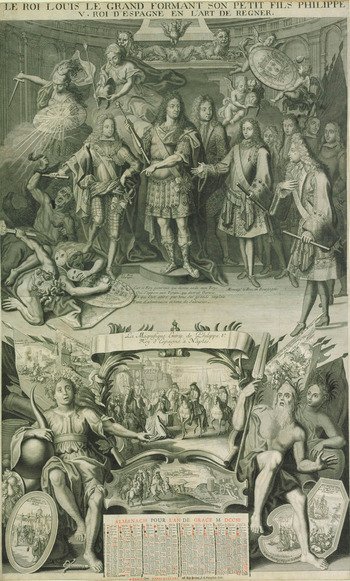
The strong emotional bond between the two and the fundamental role played by Louis in Philip's royal destiny were well known to their contemporaries. A precious document in this regard is a calendar for the year 1703 published in Paris by Pierre Gallays (Figure 2). These large-format prints, which are typical products of the age of Louis XIV, conveyed specific political and ideological messages by means of their textual and, above all, visual content.Footnote 72 The title of the 1703 calendar is very meaningful: Le roi Louis le Grand formant son petit fils Philippe V. Roi d'Espagne en l'art de regner (King Louis the Great Training His Grandson Philip V, King of Spain, in the Art of Ruling). The beautiful engraving is clearly divided into two parts. In the lower one, the Earth (left) and the sea gods Neptune and Amphitrite (right) are surrounded by standards and framed boxes depicting the most important military achievements of the Bourbon armies in the previous year, 1702.Footnote 73 The upper section, on the other hand, is full of historical and allegorical figures. At the top, a rooster, symbol of the French people, poses on a globe with lilies between two lions, which represent royal power. The centre of the scene is occupied by Louis XIV. Four verses appear at his feet: ‘C[’]est ce roy genereux qui donne azile aux roys / qui s'oppose aux tyrans, qui destruis l'heresie / et qui c'est attiré par tous ses grands explois / tant d'admiration et tant de jalousie’ (It is this generous king who gives refuge to kings, / who opposes tyrants, who destroys heresy, / and who has attracted, with all his great exploits, / so much admiration and so much jealousy).
Almanach pour l'an de grace MDCCIII. Bibliothèque nationale de France, Paris, RESERVE QB-201 (171, 15)-FT 5. Reproduced from gallica.bnf.fr

The king, behind whom one can recognize his son Louis, the Grand Dauphin, is accompanied by two of his three grandsons: Louis, Duke of Burgundy (right), who was destined to succeed him on the throne of France (but who died prematurely) and Philip (left), who was already King of Spain. The latter is crowned by a female figure (probably Justice); another female figure (probably Might), holding a sword and a shield with the coats of arms of France and Spain, strikes down an eagle (symbol of Empire) as well as two snake-haired monsters representing Heresy (Anglicanism and Calvinism, professed respectively in Great Britain and the United Provinces) and Fraud (distinguished by the heart in the hand and the double mask),Footnote 74 which partially covers the English emblem. The idea expressed by this representation is clear: Philip's sceptre descends from the authority and power of Louis XIV, who helps him defeat his enemies and teaches him to defend the values of the Catholic faith.Footnote 75
In making the bond between Louis XIV and Philip V the subject of his libretto, Giuseppe di Rosa therefore conformed to a common belief. In addition, it should be noted that he had a personal reverence for the Roi Soleil. In his Vaticinio d'Apollo (1734) he not only dedicated an entire octave to him, but closely linked his commemoration with the enumeration of Philip V's great deeds.Footnote 76 Moreover, in the notice to the reader in the first volume of his Istoria d'Europa, he dwells at length on the figure of Louis XIV,Footnote 77 for whom he declares his boundless admiration: ‘Io non voglio dissimulare’, he wrote, ‘che ho avuto, e che avrò sempre della somma venerazione per la memoria di un principe, ch’è stato il più gran re che abbia riempiuto il trono di Francia almeno da molti secoli in qua’ (I do not want to conceal that I have had and always will have the greatest veneration for the memory of a prince who was the greatest king to fill the throne of France for at least many centuries to the present).Footnote 78 In this light, the choice of the shadow of Louis XIV as the protagonist of the cantata appears even more significant, as di Rosa points to him as an excellent political figure and a model for all European monarchs.
L'ombra di Luigi XIV is therefore a work that reflects complex political values. The subtle allusions to the dedicatee's life and historical role made the text perfectly suited to extol the figure of the Spanish king. Moreover, the cantata had been specially commissioned by Farinelli from Naples, which at the time was considered the European capital of music. With such a refined work of homage, the singer went beyond the usual role (and limits) of a court musician in order to show his gratitude to a monarch who not only had placed him in a privileged position, but treated him almost like a member of the royal family (as seen in the letters to Pepoli of 16 February and 23 August 1738, in which Farinelli states that he was treated as a son by the king and the queen). Further research may establish whether, when and by whom the cantata was sung; in itself, however, the libretto remains a rare and precious piece of evidence that demonstrates Farinelli's special relationship with Philip V.
APPENDIX